*Corresponding Author : Soo-Ho, Choi([email protected])
Received April 9, 2019 Revised May 24, 2019
Accepted June 20, 2019 Published June 28, 2019
The Effect of Logistics Services, Corporate Image, Product Reliability & Customer Services on Customer Satisfaction and
Repurchase Intention in e-Commerce
Soo-Ho Choi
Division of Business, Sogang University, PhD Course
전자상거래에서 물류서비스, 기업이미지, 제품신뢰도, 고객서비스가 소비자만족과 재구매의도에 미치는 영향
최수호
서강대학교 경영학부 박사과정수료
Abstract This study was done to analyze the effect of logistics services, corporate image, product reliability and customer service on consumer satisfaction and repurchase intention that e-commerce users perceive. The survey was divided into "logistics services, corporate image, product reliability, customer services, customer satisfaction, repurchase intention". As a study result, independent variables such as corporate image, product reliability and customer services were found to affect customer satisfaction. Consumer Satisfaction had an effect on repurchase intention in mediated and dependent variable. In conclusion, in order to increase the repurchase intention in companies that introduced SCM, it was necessary to improve the corporate image, product reliability and customer service to satisfy consumers. Logistics services had not been adopted as an impact on customer satisfaction. We should strive to improve customer satisfaction and repurchase intention by creating a higher level logistics services.
Key Words : Logistics Services, Corporate Image, Product Reliability, Customer Services, Customer Satisfaction, Repurchase Intention
요 약 본 연구의 목적은 전자상거래 이용자들이 인식하는 물류서비스, 기업이미지, 제품신뢰도, 고객서비스가 소비자 만족과 재구매의도에 미치는 영향을 분석하는데 있다. 설문 조사는 “물류서비스, 기업이미지, 제품신뢰도, 고객서비스, 소비자만족, 재구매의도”로 구분하여 실시하였다. 연구결과, 독립변수에서는 기업이미지, 제품신뢰도, 고객서비스가 소 비자만족에 영향을 주는 것으로 나타났다. 매개변수와 종속변수에서는 소비자만족이 재구매의도에 영향을 미치는 것으 로 조사되었다. 결론적으로 SCM을 도입한 기업에서 재구매의도를 높이기 위해서는 기업이미지, 제품신뢰도, 고객서비 스를 향상시켜 소비자를 만족시켜야 할 것이다. 물류서비스는 소비자만족에 미치는 영향으로 채택되지 않았다. 우리는 향후 고객 만족과 재구매 의사를 향상시키기 위해 더 높은 수준의 물류 서비스를 개발해야 할 것입니다.
주제어 : 물류서비스, 기업이미지, 제품신뢰도, 고객서비스, 소비자만족, 재구매의도
1. Introduction
Recently, e-commerce market is continuously growing as mobile payment services is developed and social media is affecting online shopping. As smart-phones have improved, mobile shopping has exploded and sales are increasing. Online shopping is more advantageous in time and space than offline, and it is likely that more customers will prefer online in the future.
Domestic electronic commerce market in 2017 exceeded 70 trillion won. Mobile shopping accounts for 60% of total transactions.
Off-line distributors such as large-format stores and department stores are entering the e-commerce market. Recently, mobile shopping transactions have increased by more than 10%
every year[1]. As the e-commerce market grew, Shinsegae Group opened 'Shinsegae Mall' and 'SSG.COM'. The Shinsegae Group plans to build 6 e-commerce logistics centers in the metropolitan area by 2020. Kupang imports logistics specialists of YES24 and Timon imports logistics professionals of Interpark to prepare for e-commerce growth.
The purpose of this study was to analyze the effect of logistics services, corporate image, product reliability and customer services on consumer satisfaction and repurchase intention that e-commerce users perceive. For this purpose, This paper surveyed 200 students and housewives who used Electronic Commerce in the Seoul & metropolitan area from September 1 to September 15, 2018.
The questionnaire factors were classified into the independent variables "logistics services, corporate image, product reliability & customer services" and "customer satisfaction and repurchase intention" as mediated and dependent variables. Using this variables, five research hypotheses were constructed. The questionnaire was conducted with a 5-point Likert scale for each factors, and the reliability, validity and importance were analyzed.
The following conclusions were drawn in this study. In order to increase the repurchase intention in companies that introduced SCM, it is necessary to improve the corporate image, product reliability and customer services for customer satisfaction. In addition, logistics services should be driven to a higher level.
2. Precedent Research
2.1 Logistics Services
Yang & Cho (2017) analyzed the effects on logistics services satisfaction. As a result, information diversity, availability and cost- effectiveness were important factors in logistics services. Logistics companies' human competence, financial soundness, location conditions and network level have a direct correlation with logistics services satisfaction[2]. Chun. (2017) confirmed that location- based logistics status control, driver convenience support, intelligent autonomous driving and real-time predictive delivery have significant effects on logistics services.
In order to meet the expectation of consumers, it is argued that location-based logistics situation control and real-time predictive delivery are necessary for new logistics services innovation[3].
2.2 Corporate Image
In the relationship between corporate image and behavioral intention, Kim (2018) analyzed that the higher the perceived level of competitiveness of firms, the higher the intention to revisit, recommendation intention and positive word-of-mouth intention[4]. Moon & Han (2017) investigated that the authenticity of corporate image advertising was the most influential factor in corporate image formation. In addition, internal communications such as exchange of opinions, cooperation and complaints are important variables[5].
2.3 Product Reliability
Hyung (2015) suggested that brand reliability, brand knowledge and brand involvement are determinants of direct and indirect influence on consumer behavior. He also found that brand trust is an influential predecessor that enhances brand preference. In the influence of rumor types on brand reliability[6], Kim, Yoo & Gan (2015) suggested that corporate rumor refutation positively influences brand trust. In addition, a strong message about rumors positively affects brand reliability rather than a weak rebuttal message[7].
2.4 Customer Services
Bae & Ha (2017) analyzed that customer service positively affects customer performance.
International logistics companies have excellent service and can increase market share, which can increase customer acquisition and profitability[8].
Baek & Lee (2017) showed that the service was improved due to statistically significant difference in service after staff training of air service. In addition, staff service was found to had a positive(+) effect on customer service[9].
2.5 Consumer Satisfaction
Kim & Lee (2017) analyzed that the SNS marketing activities of restaurant companies had a significant effect on consumer satisfaction and purchase intention. Therefore, it is suggested that it is necessary to increase consumer satisfaction and purchase intention through SNS marketing activities[10]. Seo, Lee & Lee (2017) argue that the use environment, brand personality and positive consumption feeling of real estate mobile app have a positive(+) effect on consumer satisfaction[11].
2.6 Repurchase Intention
Choo, Yoon & Jung (2018) suggested that since food styling awareness of eating out consumers affects customer emotions, so knowledge of
design sense, table and service manners and color knowledge are needed. And it is analyzed that these factors have influence on the revisit inquiry[12]. Chun, Lee & Lee (2017) analyzed that value, satisfaction and trust had a significant effect on repurchase intention in joint purchase type social commerce. System quality, service quality and information quality have significant effects on value, satisfaction and trust[13].
3. Data Collection & Research Hypothesis
3.1 Data Collection
The purpose of this study was to analyze the effects of logistics service, corporate image, product reliability and customer service on consumer satisfaction and repurchase intention that e-commerce users perceive. For this purpose, this study conducted questionnaires for approximately 15 days from September 1 to September 15, 2018. The survey was conducted on 200 university students and housewives who experienced electronic commerce in Seoul and the metropolitan area. The questionnaire consists of six variables. Using this variables, five research hypotheses were constructed.
3.2 Research Hypothesis 3.2.1 Research Model
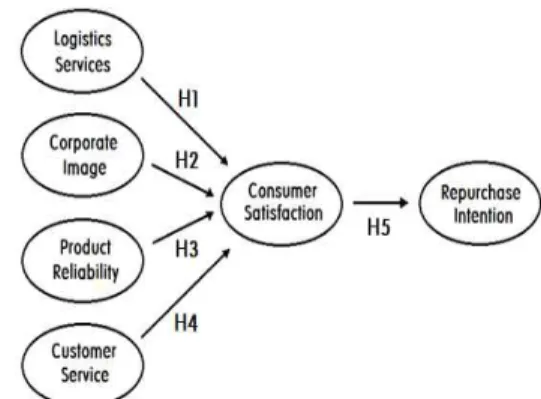
The research model is shown in Fig. 1.
Fig. 1. Research Model
3.2.2 Logistics Services and Consumer Satisfaction Oh, Bang & Kim (2017) studied the effect of port logistics service on customer satisfaction and loyalty. As a result, port logistics service had significant influence on customer satisfaction and loyalty, and technical quality has the biggest influence[14]. Choi & Kim (2016) compared foreign direct purchase and domestic purchase for customer satisfaction according to logistics service quality of online purchase. The analysis results showed that the timeliness of goods and the order process affected the satisfaction of the logistics company and the satisfaction of the logistics company affected the satisfaction of the sales company[15].
Hypothesis 1 : The better the logistics services, the higher the customer satisfaction.
3.2.3 Corporate Image and Consumer Satisfaction Ji & Jung (2015) analyzed that the corporate image has a positive effect on consumer satisfaction in the consumer perception of content service[16]. Park (2009) analyzed the effect of brand image of family restaurant on consumer satisfaction. Through the brand image and consumer satisfaction perceived by the consumer, he investigated the revision inquiry and grasped the difference of perception of the restaurant[17].
Hypothesis 2 : The better the corporate image, the higher the consumer satisfaction.
3.2.4 Product Reliability and Customer Satisfaction Seo & Kim (2011) investigated that culture promotion, cultural support and cultural presentation of cultural marketing in restaurant business had a statistically significant effect on brand trust. Brand trust had a statistically significant positive effect on consumer satisfaction[18]. Lee &
Lee (2015) suggested that brand trust in family
restaurants had a positive effect on brand attitude and customer satisfaction, and that brand attitude affected customer satisfaction positively[19].
Hypothesis 3 : The higher the product reliability, the higher the consumer satisfaction.
3.2.5 Customer Services and Customer Satisfaction Park (2018) analyzed the effect of customer services on customer satisfaction in a limited hotel. For the result of the analysis, fairness and trust of customer service were significant for customer satisfaction[20]. Kim (2018) studied the effect of airline customer service on customer satisfaction.
The results of this study suggested that customer satisfaction had a positive effect on customer loyalty and that various customer service should be provided to maintain customer loyalty[4].
Hypothesis 4 : The better the customer services, the higher the customer satisfaction.
3.2.6 Customer Satisfaction & Repurchase Intention Lim & Jeon (2016) analyzed the effects of TV home shopping on consumer satisfaction and repurchase intention. The analysis results showed that delivery and refund, price, service and convenience had positive effects on consumer satisfaction and repurchase intention[21]. Kim, Choi & Geom (2012) argued that functional value, social value and economic value had a positive effect on consumer satisfaction and that consumer satisfaction had a positive effect on repurchase intention[22].
Hypothesis 5 : The higher the consumer satisfaction, the better the repurchase intention.
3.3 Operational Definition of Variables Operational definition of variables in this study is shown in Table 1 and Table 2.
Variables Measurement Factors References
Logistics Services
Delivery fee are relatively inexpensive.
C. Y. Yang⋅H. S. Cho (2017) H. M. Chun (2017) A/S support after purchase is excellent.
The delivery staff is kind.
Save shopping time and easy to cancel or return.
Corporate Image
Has a good feeling for sales companies.
M. G. Kim (2018) S. Y. Moon⋅M. J. Han (2017)
S. H. Kim⋅E. J. Choi (2017) Provide accurate information about the product.
Sales companies will be interested in the environment and the community.
The sales company will be leading the customer first.
The sales company will have a lot of excellent employees.
The service of the delivery agent will be excellent.
Product Reliability
The price will be right.
Y. H. Hyung (2015) T. H. Kim at el, 2 (2015)
J. M. Kim (2017)[23]
Performance or functionality will be above expectations.
It may be hard to buy on the market.
Sales products will not be much different from advertising products.
Customer Services
Do not advertise false or exaggerated.
H. S. Bae⋅M. S. Ha (2017) J. Y. Baek⋅C. W. Lee (2017) The description of the sale item is kind and sufficient.
Provides accurate information about the product.
Table 1. Operational definition of variables (Independent variables)
Variables Measurement Factors References
Customer Satisfaction
I am generally satisfied with the purchased product. H. J. Kim⋅H. C. Lee (2017), I. J. Seo at. el (2017) Generally consistent with advertising products.
Repurchase Intention
I intend to purchase another product.
S. J. Choo at. el (2018) S. A. Chun at. el (2017) C. M. Choi & H. S. Yang (2016)[24]
Willing to recommend to other consumers.
The more you order, the more mileage you are getting.
I am glad there is a reliable shopping company.
Table 2. Operational definition of variables (Mediated & Dependent variables)
4. Empirical Analysis
The purpose of this study was to examine the effect on the logistics services, corporate image, product reliability and customer services on consumer satisfaction and repurchase intention of e-commerce users. Prior to the hypothesis testing of this study, operational definitions and measurement factors were derived through previous studies. For this study, the reliability and validity of the measurement factors were analyzed. For more information, reliability analysis is the process of determining how well the characteristics of the sample are being made.
In addition, it is an internal consistency check process that verifies whether the respondents clearly understood the questionnaire and responded consistently[25].
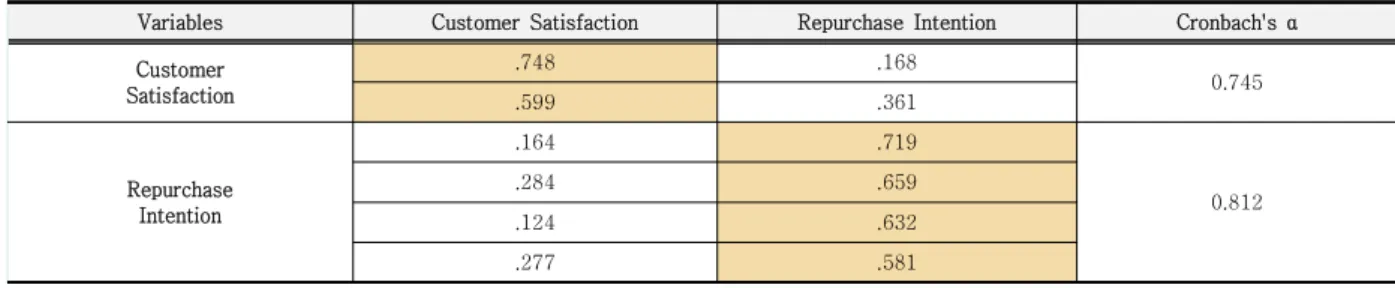
In this study, reliability test method Chronbach's Alpha coefficient was used as a method to confirm the internal consistency. In a preliminary study by
Nunnally (1978), reliability was found to be greater than 0.6. In the actual study, it is said that reliability is secured if it is 0.7 or more[26]. In Table 3 & Table 4, Chronbach's Alpha coefficient was calculated to be 0.7 or more. So, the measurement factors used in this study had internal consistency.
In order to verify the validity of the measurement factors, exploratory factor analysis were performed using Varimax rotation for principal component analysis. In Table 3 & Table 4, the factors loadings of the research were all above the standard value of 0.4. Therefore, it judged that the same factors was closely related to each other. In Table 5, the Average Variance Extracted (AVE) and the Construct Reliability (CR) of the measurement factors were 0.5 and 0.7 or more, respectively. Therefore, it can be said that the intensified validity of the variables used in this study is largely secured. For the discriminant validity analysis, the correlation between the
Variables Logistics Services Corporate Image Product Reliability Customer Services Cronbach's α
Logistics Services
.735 .121 .137 .071
0.701
.689 .167 .131 .254
.623 .234 -.012 .109
.612 .024 .075 -.193
Corporate Image
.062 .792 .238 .114
0.839
.249 .736 .156 .019
.038 .728 -.002 .082
.328 .538 .269 .299
.314 .481 .311 .046
.329 .457 .025 .319
Product Reliability
.108 .122 .711 .190
0.707
-.067 .202 .666 -.066
.138 .120 .637 .160
.179 .110 .608 .276
Customer Services
.240 .044 .112 .799
0.752
.019 .158 .324 .648
.023 .231 .169 .609
Note : KMO=0.906 , Bartlett's =1829.184 (p<0.001)
Table 3. Reliability Analysis and Exploratory Factor Analysis (Independable variable)
Variable AVE CR Logistics
Services
Corporate Image
Product Reliability
Customer Services
Customer Satisfaction
Repurchase Intention
Logistics Services 0.503 0.779 0.709
Corporate Image 0.603 0.861 0.639 0.777
Product Reliability 0.504 0.816 0.473 0.69 0.710
Customer Services 0.502 0.703 0.451 0.674 0.705 0.708
Customer Satisfaction 0.609 0.755 0.386 0.685 0.709 0.702 0.780
Repurchase Intention 0.516 0.788 0.513 0.699 0.694 0.701 0.706 0.719
Note : Bold number of diagonal is AVE square root of variables, Any other value is a correlation coefficient between the variables
Table 5. Discriminatory Feasibility Analysis
Variables Customer Satisfaction Repurchase Intention Cronbach's α
Customer Satisfaction
.748 .168
0.745
.599 .361
Repurchase Intention
.164 .719
0.812
.284 .659
.124 .632
.277 .581
Note : KMO=0.906 , Bartlett's =1829.184 (p<0.001)
Table 4. Reliability Analysis and Exploratory Factor Analysis (Mediated & Dependent Variable)
variables was analyzed. The correlation coefficient and the AVE square root of each variables was compared. In calculation result, Table 5 shows that the AVE square root of the factors had a larger value than other correlation coefficients. Therefore, this study confirmed the
validity of discrimination between each variables.
This study will be confirmed through empirical analysis. In order to verify the proposed research model, the structural equation model using AMOS 18.0 was utilized in this study. Prior to the hypothesis testing, the fitness of the research
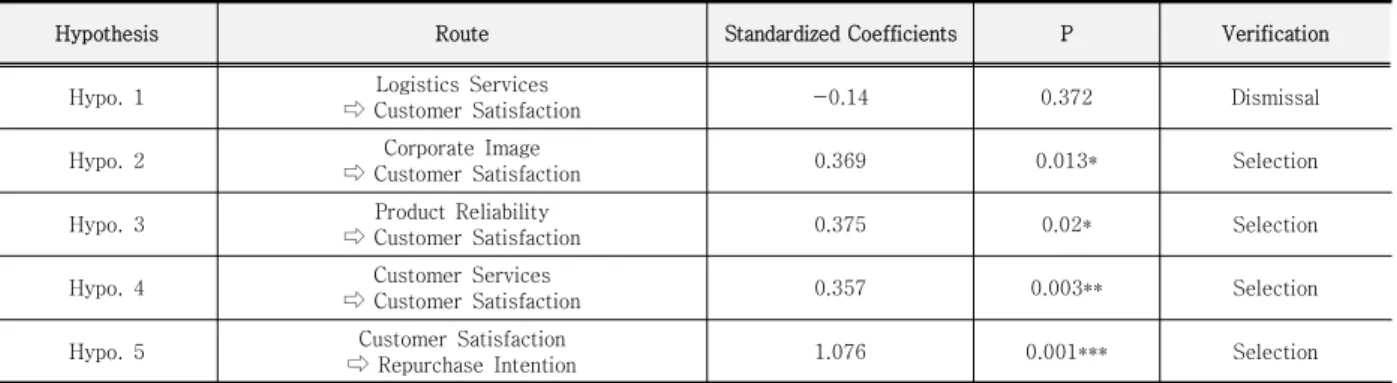
Hypothesis Route Standardized Coefficients P Verification
Hypo. 1 Logistics Services
⇨ Customer Satisfaction -0.14 0.372 Dismissal
Hypo. 2 Corporate Image
⇨ Customer Satisfaction 0.369 0.013* Selection
Hypo. 3 Product Reliability
⇨ Customer Satisfaction 0.375 0.02* Selection
Hypo. 4 Customer Services
⇨ Customer Satisfaction 0.357 0.003** Selection
Hypo. 5 Customer Satisfaction
⇨ Repurchase Intention 1.076 0.001*** Selection
Table 6. Hypothesis Test by Structural Equation model were verified using MAximum Likelihood Estimation. The results of the analysis were as follows : = 342.743 (df = 219, p = 0.000), CMIN/DF = 1.565, CFI = 0.924 (>0.9), TLI = 0.905 (>0.9), IFI = 0.927 (>0.9), RMSEA = 0.054 (Accommodating up to 0.7). Since this was above the recommended standard of fitness, this research model was deemed appropriate and hypothesis testing was conducted. Table 6 shows the causal relationships analyzed through the structural equation. And the analysis results of this hypothesis model are shown in Fig. 2.
In this study, most of the hypothesis tests for each variables were adopted. However, the impact of logistics services on customer satisfaction was not adopted. The reason is because consumers are expecting high logistics services due to the development of logistics services. Therefore, it should be preceded to satisfy high logistics services in the future.
Fig. 2. Research Model Analysis Result
5. Conclusion
This study examined the effects on logistics services, corporate image, product reliability, customer services, customer satisfaction and repurchase intention in previous research. And this study set up five research hypotheses. As a study result, independent variables such as corporate image, product reliability and customer services were found to affect customer satisfaction. Consumer Satisfaction had an effect on repurchase intention in mediated and dependent variables. However, logistics services did not affect customer satisfaction.
To improve Customer Satisfaction, we will need the following factors.
1. We are generally satisfied with the purchased products.
2. Generally consistent with advertising products.
To improve repurchase intention, we need to look at the following factors.
1. We intend to purchase another products.
2. Willing to recommend to other consumers.
3. The more you order, the more mileage you are getting.
4. We are glad there is a reliable shopping companies.
Logistics services had not been adopted as an impact on customer satisfaction. The reason was that consumers were expecting higher logistics services level due to the development of logistics
services. Therefore, we must strive to effort a higher level of logistics services in the future.
In conclusion, in order to increase the repurchase intention in companies that introduced SCM, it is necessary to improve the corporate image, product reliability and customer services for customer satisfaction. Therefore, we should strive to improve customer satisfaction and repurchase intention by creating a higher level logistics services in the future.
REFERENCES
[1] H. S. Yoon. (2017). E-commerce, this year opens 70 trillion won ... New technologies such as AI, VR, chatbot, biometrics spread, Taylor Report, Electronic Newspaper, 2017.04.05.
[2] C. Y. Yang & H. S. Cho. (2017). Determinants of Logistics' Service Satisfaction Considering Service Characteristics and Company Capability, The journal of shipping and logistics, 95, 457-476.
[3] H. M. Chun. (2017). The Usage Factors of Smart Car Influencing on the Logistics Service Value Innovation, Korea logistics review, 27(2), 9-17.
[4] M. G. Kim. (2018). A study on the effect of customer perception on sustainability management of the foodservice industry on corporate image and behavioral intention, International journal of tourism and hospitality research, 32(2), 201-215.
[5] S. Y. Moon & M. J. Han. (2017). An Exploratory Search for Factors that Help form Employees' Psychological Ownership and Corporate Image, Advertising Research, 297-331.
[6] Y. H. Hyung. (2015). The Effect of Brand Trust, Recognition, and Involvement on the Brand Loyalty, Management Education Research, 30(6), 429-447.
[7] T. H. Kim, M. Yoo & H. S. Gan. (2015). Study on brand trust change by rumor types and refutation strategy toward brand rumor, Journal of Product Research, 33(2), 39-48.
[8] H. S. Bae & M. S. Ha. (2017). An Analysis of the Relationships between Customer Service and Firm Performance of International Logistics Firms, The Korean international commerce review, 32(1), 45-61.
[9] J. Y. Baek & C. W. Lee. (2017). A Study of the Effectiveness Education and Training of the Airlines' Ground Staff's and Customer Service Quality, Management Education Research, 32(3), 215-228.
[10] H. J. Kim & H. C. Lee. (2017), Effect of food service
corporate SNS marketing activity on brand awareness, consumer satisfaction, and purchase intention, International journal of tourism and hospitality research, 31(11), 195-209.
[11] I. J. Seo, J. Y. Lee & J. S. Lee. (2017). A Study on Consumer Satisfaction toward Real Estate Mobile App, Consumer policy and education review, 13(4), 125-150.
[12] S. J. Choo, D. I. Yoon & J. H. Jung. (2018). Effect of food styling on the customers' positive recommendation repurchase intention, Korean hospitality and tourism academe, 27(2), 201-214.
[13] S. A. Chun, G. R. Lee & S. J. Lee. (2017). Study on Chinese Repurchase Intention of Group-buying Social Commerce, Journal of the Korea Convergence Society, 8(2), 169-181.
[14] J. Oh, H. S. Bang & H. J. Kim. (2017). An Empirical Study on the Effect of the Port Logistics Service Quality on Customers Satisfaction and Loyalty, The Korean international commerce review, 32(1), 141-162.
[15] S. H. Choi & M. G. Kim. (2016). Logistics Service Quality of Online Purchase on Consumer Satisfaction : Focusing on Comparison between Overseas Purchase and Domestic Purchase, Journal of Korea service management society, 17(3), 109-131.
[16] J. G. Ji & S. J. Jung. (2015). Effect of consumer perception of corporate website's contents service upon change of corporate image, Journal of Korea service management society, 16(5), 149-175.
[17] S. H. Park. (2009). A Study on the Effect of Brand Perception and Image on Consumers' Satisfaction in Family Restaurants, Bulletin brand design association of korea, 7(1), 121-134.
[18] G. Y. Seo & D. S. Kim. (2011). The Effect of Foodservice Companies` Cultural Marketing on Reliability and Loyalty, Korean journal of tourism research, 25(6), 131-154.
[19] J. H. Lee & S. B. Lee. (2015). A Study on the Effects of Family Restaurant`s Cultural Marketing Activities on Brand Personality, Brand Trust, Brand Attitude and Brand Loyalty, Korean journal of hospitality administration, 24(3), 1-22.
[20] J. J. Park. (2018). Effects of Customers' Perceived Service Justice in Membership Discount on Customer's Satisfaction and Relationship Quality in Deluxe Hotel, Journal of convergence for information technology, 8(1), 265-274.
[21] C. I. Lim & H. J. Chun. (2016). The Effects of TV Home Shopping Channels Trait on Consumers' Satisfaction and Intention of Repurchase, Journal of the Korean society of beauty and art, 17(3), 79-92.
[22] E. J. Kim, W. Choi & S. B. Geum. (2012). The Effects of Perceived Value on Consumer Satisfaction and Repurchase Intention in Packaged Kimchi, Journal of hotel & resort, 11(2), 355-375.
[23] J. M. Kim. (2017). The Effect of Posting Source Type Information on Brand Reliability, Product Attitude and Purchase Intention, Journal of Digital Convergence, 15(8), 367-374.
[24] C. M. Choi & H. S. Yang. (2016). The effect of E-commerce's curation characteristics on the customer purchase intention, Journal of Digital Convergence, 14(5), 185-195.
[25] C. Y. Jung & I. G. Choi. (2001). Statistical analysis using SPSS WIN, Trading management company, 2001.
[26] J. I. Nunnally. (1978). Psychometric Theory, New York:
McGraw-Hill.
최 수 호(Soo-Ho, Choi) [정회원]
․ 2011년 2월 : 항공대 항공교통물류학 부(이학사)
․ 2016년 2월 : 서강대학교 대학원 경영 학부(경영학석사)
․ 2016년 3월 : 서강대학교 대학원 경영 학부(경영학박사수료)
․ 2014년 3월 ~ 현재 : 서강대학교 경영 학부 조교
․ 관심분야 : SCM, GVC, 물류, 서비스경영
․ E-Mail : [email protected]