—
ISSN 1229-3350(Print) ISSN 2288-1867(Online)
—
J. fash. bus. Vol. 22, No. 6:14-24, December. 2018 https://doi.org/
10.12940/jfb.2018.22.6.14
Image, Product Preference, and Purchase Intention:
Chinese Consumers’ Perspectives
Jian Zhang · Yu Hua Cui
†Dept. of Fashion Design, Yanbian University, China
Corresponding author
— Yu Hua Cui
Tel : +86-0433-2435808 E-mail: [email protected]
Keywords Abstract
corporate social responsibility (CSR), corporate image, product preference, purchase intention
In this age of information, companies are losing grip of their image. Perhaps this explains the reason why corporate social responsibility (CSR) has become somewhat of a buzzword among established fashion industry leaders companies seem determined to show stakeholders that they have values, are
—
responsible, and they are driven by more by values than the prospects of
financial gain. This study assessed the effect of CSR have in the fashion
industry on the corporate image, product preference, and purchase intention in
China. Three hundred native residents in China participated in an online survey
from 1-12th Jan 2017. The results were as follows: (1) CSR consists of five
components; economic responsibility, ethical responsibility, environmental
protection, consumer protection, and philanthropic responsibility. (2) Both
economic and ethical responsibilities have significant positive effects on
corporate image, while perceived CSR does not have significant effect on
product preference or purchase intention. (3) Consumers’ product preference
and perceptions regarding corporate image influence their intention on making
a purchase. These findings might operationally assist Korean fashion
corporations to identify and address the critical aspects of CSR management
which will improve their image as good corporate citizens and foster favorable
attitudes toward fashion products from China. Further results and direction of
future research were discussed.
. Introduction
Ⅰ
Recent decades have shown changes in fashion customers’ behavior, namely, "green consumption"has become the primary trend of fashion consumption around the world (Jeon, 2011). Consumers not only desire high-quality fashion goods, but also want safe and friendly products that are produced by highly reputable and responsible companies (Thi & Van, 2016).
The concepts of corporate sustainability, social responsibility, social performance, and environmental management have received increasing amounts of attention in recent years from academics and practitioners. Corporate social responsibility (CSR) research has corroborated that a positive relationship exists between corporate social performance and corporate financial performance (Yuen, Thai, & Wong, 2016). Satisfaction with CSR initiatives therefore becomes a key metric of the successful development and implementation of a CSR policy (Rivera, Bigne, &
Curras-Perez,2016). Consequently, managing corporate sustainability is a strategic and profit-driven corporate response to environmental and social issues caused by companies activities (Saltzman, Ionescu-Somers, & Steger, 2005).
The Chinese government has encouraged CSR practices among all state-owned companies (SOCs) since 2008.
Thus, Chinese SOCs have made significant efforts to adopt CSR practices and develop their CSR reports.
However, most CSR studies examine developed countries.
Given the differing economic, political, and geographic contexts, developing countries must develop their own CSR concepts and mechanismsto motivate companies to implement CSR practices while learning from the studies and experiences of developed countries (Zhu & Zhang, 2015).
Past studies have examined the relationship between CSR and consumer purchase intentions (Suki, Suki, &
Azman, 2016). A limiting feature of the past CSR research in this area was the frequent conceptualization and measurement of CSR that involved a single aspect of CSR, such as community fairness, involvement of
employment, or business ethicality (Park, Lee, &
Kim,2014). A more desirable approach would be to take a comprehensive perspective on CSR by incorporating a wide range of social demands in investigating the impact of CSR on consumers’ corporate evaluations. However, previous research affirms that the development of a valid and reliable measure would be challenging. CSR measurement remains an object of study in spite of its clear limitations. Nonetheless, many researchers have ventured into this field of measurement to quantify and evaluate socially responsible actions, and different methods must be considered. Furthermore, to our knowledge, no existing literature in the field of fashion product economics has examined how the different levels of CSR may influence consumer purchasing preferences.
This study aims to fill this gap by exploring fashion product consumers’ reactions to CSR in the fashion productindustry. Specifically, this study explored the Chinese consumers’stated corporate image, product preference, and purchasing intention toward fashion products associated with difference CSR levels.
. Literature Review
Ⅱ
1. Corporate social responsibility
For the corporate world, the notion of CSR is currently ubiquitous (Dahlsrud, 2008). CSR is the overall relationship of the corporation with all its stakeholders.
These include customers, employees, communities, owners/investors, government, suppliers, and competitors (Khoury, Rostami, & Turnbull, 1999). CSR has gained a growing recognition as a new concept to be integrated in companies’ performances. Globally, companies are much more aware of the importance of creating strategies, actions, and a reporting framework for CSR development, mainly related to environmental, economic, and social responsibilities (Gonz lezrodr guez, á í Fern ndez, á
& Simonetti, 2016).
According to stakeholder theory (Ruf, Muralidhar,
Brown, & Janney, 2001), each stakeholder plays a crucial
role in a company while it executes CSR (Chen, Lin,
Cheng, & Tsai, 2012). Lichtenstein, Drumwright, &
Braig, (2004) deduced that, when industries carry out CSR activities, the execution will promote the image of the industry and increase customer purchase behaviors.
CSR is the chief factor for customer purchase intentions, and customers will support a company if it executes CSR activities. As mentioned, given that the fashion industry directly interacts with its customers, those in this industry must take care of all interested parties, such as the public and the stockholders (Chen et al., 2012).
Only producing high-quality products and adequate consumer service is inadequate. Achieving customer satisfaction is also necessary. Furthermore, CSR activities must be pursued to maintain long-term sustainability.
Dahlsrud (2008) divided CSR activities into five dimensions: environment, social, stakeholder, economic, and voluntariness. The environmental dimension refers to recognizing clean and manage environments and also respecting environmental concerns in business operations.
Urandelger, Bae, & Lee (2016) chose CSR that includes the philanthropic, ethical, environmental, and consumer protection dimensions. Using 240 Korean respondents of the case companies (i.e., Samsung Electronics, LG Electronics, and Hyundai Motors), they inferred that CSR activities positively affect corporate image and reputation, outcomes for environmental responsibility on reputation. CSR positively affects customer satisfaction and is mediated by corporate image and reputation.
Chinese respondents’ previous CSR knowledge may be reflected by a high level of awareness about CSR in the wood products industry (Cai & Aguilar, 2013). When asked if they have heard of any companies that are socially responsible in the wood product industry, only 26% of the Chinese respondents indicated such awareness. The Chinese government has always encouraged companies to implement CSR practices, thereby taking the leading role of CSR practices in China. Political connections have been confirmed to have a positive relationship with awareness and adoption of CSR policies among Chinese companies (Gu, Ryan, Li,
& Gao, 2013). A Korean fashion group named Hyungji in China initiated the following major projects to
promote CSR practices: scholarship, disaster prevention center, medical fee support, and staff volunteer activities.
In addition, a Chinese local fashion company named Jeanswest also adopted CSR practices to help increase shareholder and social values by integrating stakeholder and shareholder interests into company decision making.
According to the background above, CSR for the Chinese fashion consumers was developed with multiple stakeholder involvement and included five key CSR dimensions: (1) economic responsibility, (2) ethical responsibility, (3) environmental protection, (4) consumer protection, and (5) philanthropic responsibility.
2. Corporate image
Corporate image refers to consumers’ perceptions, beliefs, impressions, and feelings about a company (Richard &
Zhang, 2012). A company’s stakeholders usually hold a corporate image of the company, which can be an important factor that influences the stakeholder’s attitudes and behavior intentions. If a company’s stakeholders see a positive corporate image for the company, then growth potential is likely to increase through positive interactions between the stakeholder and the company (Kim, Song, Lee, & Jin, 2017). Moreover, corporate image is the general concept of the total company.
A positive relationship exists between corporate image and behavioral intentions,such as those related to repatronage as found in various industry sectors, including the fashion (Jeon, 2011), travel (Richard &
Zhang, 2012), and gaming industries(Kim et al., 2017).
Corporate image will help fashion operators increase their financial gain, and some marketing strategies involve corporate image guidance.
Jeon (2011) validated that a fashion company’s CSR has a significantly positive effect on corporate image, which, in turn, affects consumers’purchase intention.
Chen et al. (2012) provided empirical evidence supporting the conclusionthat when consumers perceived a company to be socially responsible, they are more likely to engage in positive behavior with that company.
This result complements another study on CSR that
suggests that, when companies are socially responsible, consumers would recognize that as good corporate image and engage in customers’revisit intentions that are helpful and supportive of these companies (Kim et al., 2017).
These studies suggest that consumer perceptions of CSR enhance corporate image. When fashion companies engage in CSR initiatives, consumers are likely to assume that these companies have desirable characteristics that resonate with their sense of self which form the basis of corporate image.
3. Product preference
Product preference indicates that the partiality to products can be changed by pairing them with positive or negative stimuli. Conversely, pairing stimuli does not always seem to work. We therefore must examine the variables that modulated evaluate condition (Wanke, 2009). Limited empirical research has been conducted on the impact of CSR on ecological consumer product preference and behavior intention, especially in terms of the cognitive differences between some dimensions of CSR. Thus, exploring whether the different dimensions of CSR impact product preference will aid us in understanding the mechanisms of CSR better.
Luchs, Naylor, Irwin, & Raghunathan (2010) suggested that, if a product is judged to be superior on one observable attribute, it will also be perceived favorably along other attribute dimensions. This result implies that,if ethical superiority is valued, other attributes of sustainable products will be viewed more positively as well. In Gildea(2001)’s study, most respondents listed attributes consistent with the idea that products with positive ethical attributes might be safer, healthier, and gentler than other products (i.e., ethical products are safer for you and for your family, better for you, and more gentle on a person’s body). Richard and Zhang (2012) conducted a mail survey in New Zealand, which indicatesthat corporate image has a positive significant influence on consumer commitment and satisfaction.
Affective commitment is the focal point in the relationship and contributed most in predicting
consumers’ product preference and behavior intention.
Moreover, the government and environmentalists in China have been promoting green transportations as one way to improve air quality, especially new energy passenger vehicles given that over 27% of new cars sold in 2015 all over the globe run on Chinese roads (Shi, Kuang, & Yang, 2017). Therefore, regarding fashion product preference, Chinese consumers should be inclined to support the CSR of fashion enterprises.
. Methods
Ⅲ
1. Research model and hypothesis
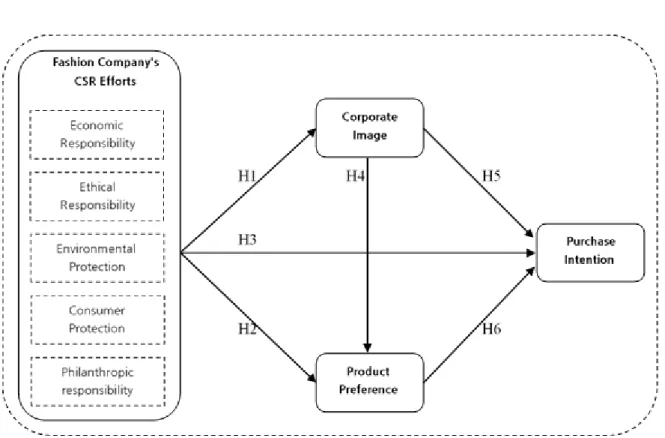
The main objective of the present work was to define a measurement scale of CSR at a fashion area. Creating a fairly complete scale is attempted by defining fashion CSR as a variable that incorporates the five dimensions of the theoretical framework: economic responsibility, ethical responsibility, environmental protection, consumer protection, and philanthropic responsibility. To empirically validate the scale, we addressed the relationship between CSR with three strategic variables deduced to be directly and positively related to the former according to theoretical literature. We refer to the influence of fashion CSR activities in the consuming industry according to Chinese consumers’perception on corporate image, product preference, and purchase intention behavior. Fig. 1 shows the developed conceptual model.
H1. Perceived CSR efforts of a fashion company have positive impacts on corporate image.
H2. Perceived CSR efforts of a fashion company have positive impacts on product preference.
H3. Perceived CSR efforts of a fashion company have positive impacts on purchase intention.
H4. Perceived corporate image of a fashion company has a positive impact on product preference.
H5. Perceived corporate image of a fashion company has a positive impact on purchase intention.
H6. Perceived product preference of a fashion
company has a positive impact on purchase intention.
Figure 1. Research Model
2. Instruments
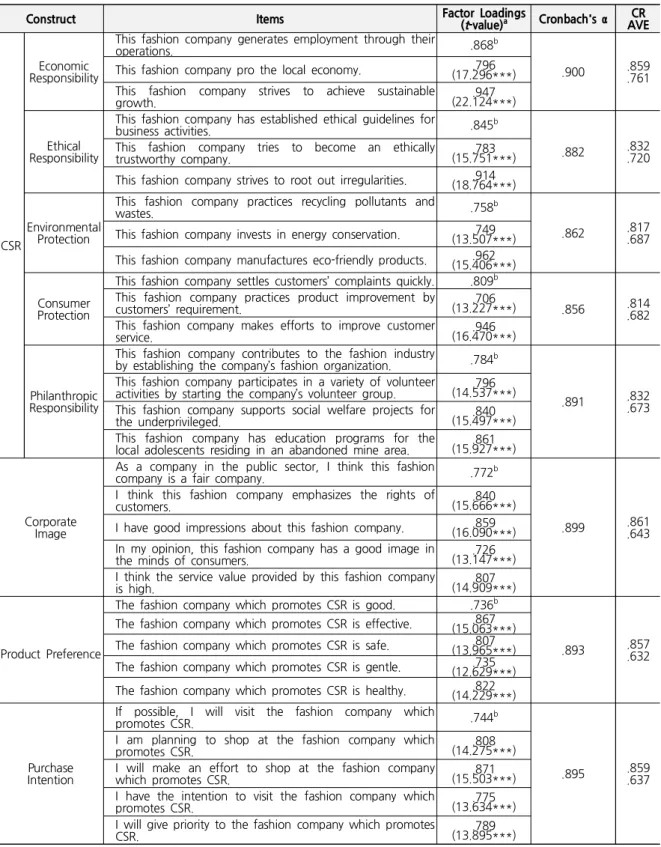
Kim et al. (2017) recommended employing multiple rather than single items to measure a construct. Therefore, multiple items were used to measure the research constructs in this study. The five CSR constructs were adapted from different references, including economic responsibility, ethical responsibility, and philanthropic CSR adapted from related literature (Kim et al., 2017), along with modifications to fit the constructs into the context of a fashion company. Environmental protection and consumer protection constructs were adapted from Urandelger et al. (2016). Corporate image was measured with five items, and purchase intention was also measured with five items adapted from related literature (Kim et al., 2017). Some words were modified to fit the present study. Lastly, product preference was measured with five items (i.e., good, effective, safe,
gentle, and healthy) adapted from related literature (Luchs et al., 2010). All items in this study were measured on a five-point Likert scale (1=strongly disagree, 5=strongly agree). Table 1 presents the survey questions.
3. Data collection and analysis
This study consists of a literature review based on the
theoretical background and an empirical study conducted
through an online survey (www.sojump.com) with
Chinese respondents who currently live in China. The
survey period was January 1 10, 2017. The total –
number of the samples was 300. For statistical processing
of collected data, SPSS 18.0 and AMOS 18.0 were used
to analyze the descriptive statistics, reliability analysis,
CFA, and structural equation modeling (SEM) of
variables.
Table 1. Confirmatory Factor Analysis and Measurement Model Results for Model Constructs
Construct Items Factor Loadings
(
t
-value)a Cronbach's α CR AVECSR
Economic Responsibility
This fashion company generates employment through their
operations. .868
b.900 .859
This fashion company pro the local economy. .796 .761 (17.296***) This fashion company strives to achieve sustainable
growth. .947
(22.124***)
Ethical Responsibility
This fashion company has established ethical guidelines for
business activities. .845
b.882 .832
This fashion company tries to become an ethically .720
trustworthy company. .783
(15.751***) This fashion company strives to root out irregularities. .914
(18.764***)
Environmental Protection
This fashion company practices recycling pollutants and
wastes. .758
b.862 .817
This fashion company invests in energy conservation. .749 .687 (13.507***) This fashion company manufactures eco-friendly products. .962
(15.406***)
Consumer Protection
This fashion company settles customers’ complaints quickly. .809
b.856 .814
.682 This fashion company practices product improvement by
customers’ requirement. .706
(13.227***) This fashion company makes efforts to improve customer
service. .946
(16.470***)
Philanthropic Responsibility
This fashion company contributes to the fashion industry
by establishing the company’s fashion organization. .784
b.891 .832
.673 This fashion company participates in a variety of volunteer
activities by starting the company’s volunteer group. .796 (14.537***) This fashion company supports social welfare projects for
the underprivileged. .840
(15.497***) This fashion company has education programs for the
local adolescents residing in an abandoned mine area. .861 (15.927***)
Corporate Image
As a company in the public sector, I think this fashion
company is a fair company. .772
b.899 .861
.643 I think this fashion company emphasizes the rights of
customers. .840
(15.666***) I have good impressions about this fashion company. .859
(16.090***) In my opinion, this fashion company has a good image in
the minds of consumers. .726
(13.147***) I think the service value provided by this fashion company
is high. .807
(14.909***)
Product Preference
The fashion company which promotes CSR is good. .736
b.893 .857
.632 The fashion company which promotes CSR is effective. .867
(15.063***) The fashion company which promotes CSR is safe. .807
(13.965***) The fashion company which promotes CSR is gentle. .735
(12.629***) The fashion company which promotes CSR is healthy. .822
(14.229***)
Purchase Intention
If possible, I will visit the fashion company which
promotes CSR. .744
b.895 .859
.637 I am planning to shop at the fashion company which
promotes CSR. .808
(14.275***) I will make an effort to shop at the fashion company
which promotes CSR. .871
(15.503***) I have the intention to visit the fashion company which
promotes CSR. .775
(13.634***) I will give priority to the fashion company which promotes
CSR. .789
(13.895***)
CFA model fit X
2=1030.655, df =406, X
2/ df= 2.539, GFI=.821, AGFI=.782, RMR=.067, NFI=.859, and CFI=.909 a: Standard factor loadings from CFA were significant ***p < .001
b: Restricted to 1
. Results and Discussion
Ⅳ
1. Sample characteristics
A total of 300 respondents were included in the sample.
The respondents comprised 52.3% females and 47.7%
males. The respondents’ ages varied, namely, 36.7% were 20 29 years old and 39.0% were 30 39 years old. – – More than three-quarters of the respondents’ had bachelor’s degree. For monthly income in Yuan, almost 53.3% of the respondents were earning 20 30 thousand, – 21.0% were earning 30 40 thousand, and 17.3% were – earning 10 20 thousand. –
2. Measurement model
To validate the measures used in the questionnaire, a confirmatory factor analysis using the maximum likelihood method was performed on all four sets of items (e.g., the five perceived CSR dimensions, respondents’ attitudes toward corporate image, product preference, and their purchase intention).
SEM was employed to test the hypotheses and the measurement model by using Amos 18.0. The general approach recommended by Gefen, Straub, & Boudreau (2000) for evaluating validity and reliability was
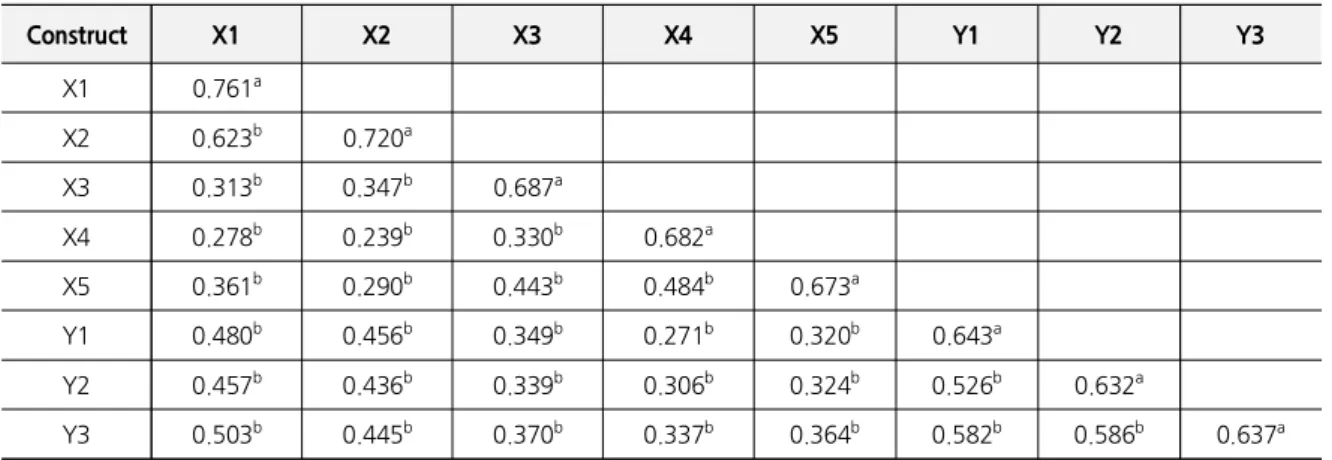
Table 2. Squared Correlations and AVE of Constructs
Construct X1 X2 X3 X4 X5 Y1 Y2 Y3
X1 0.761
aX2 0.623
b0.720
aX3 0.313
b0.347
b0.687
aX4 0.278
b0.239
b0.330
b0.682
aX5 0.361
b0.290
b0.443
b0.484
b0.673
aY1 0.480
b0.456
b0.349
b0.271
b0.320
b0.643
aY2 0.457
b0.436
b0.339
b0.306
b0.324
b0.526
b0.632
aY3 0.503
b0.445
b0.370
b0.337
b0.364
b0.582
b0.586
b0.637
aa: Average Variance Extracted (AVEs) for each construct are displayed on the diagonal.
b: Numbers below the diagonal are the squared correlation estimatesof two variables.
followed. Average variance extracted (AVE) was used as a criterion of convergent validity (Fornell & Larcker, 1981). If AVE is more than .5, then the construct has acceptable convergent validity. Composite reliability (CR) measures internal consistency and its value must be higher than .7. Our result infers that CR and AVE are more than .7 and .5, respectively. Therefore, all constructs have a convergent validity. According to Fornell and Larcker (1981) as a criterion for assessing discriminant validity, the AVE of each latent variable should be higher than the squared correlations with all other latent variables (AVE > ϕ
2). All AVEs in this study exceed the above correlation. Thus, all constructs have discriminant validity. Table 2 shows the AVE, CR and correlations among latent variables. Our model fit indices meet the criteria for acceptable model fit ( X
2=1030.655, df =406, X
2/ df= 2.539, GFI=.821, AGFI=.782, RMR=.067, NFI=.859, and CFI=.909).
3. Structural model
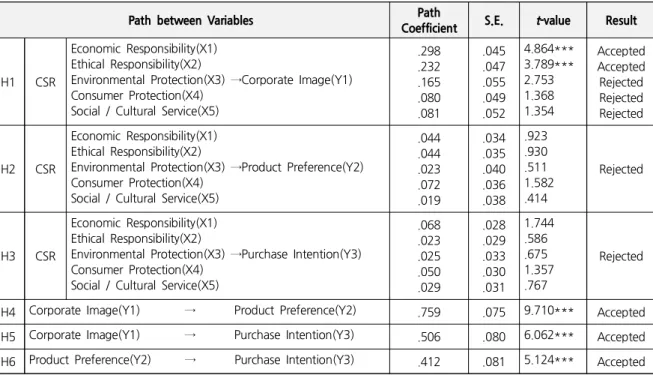
The structural model investigated the relationship between
CSR, corporate image, product preference, and purchase
intention. After identifying a well-fitted measurement
model, the relationships among all observed and latent
variables in the proposed model were tested using SEM.
Table 3. Standardized Parameter Estimates for the Structural Model
Path between Variables Path
Coefficient S.E.