339
서 론
해산 어류 종묘생산에서 중요한 것은 자치어의 효율적 인 사육이라 할 수 있다. 대부분의 해산 자어들은 부화 후 난 황과 유구로부터 성장 및 발육에 필요한 에너지를 공급받는 다. 이들 영양원이 다 소비된 이후에는 먹이생물을 요구하 게 되는데, 이 시기에 가장 많이 이용되고 있는 먹이생물로는 rotifer(
Brachionus
spp.와Artemia
spp.)가 있다(Watanabe et al., 1983; Beck and Turingan, 2007). 그러나 이들 종의 경우, 체내에 HUFA(highly unsaturated fatty acid, i.g., arachidonic acid, ARA, eicosapentaenoic acid, EPA, 및 docosahexaenoic acid, DHA, 등) 함량이 부족하기 때문에 자어의 요구량을 충족 시키지 못해(Lubzens et al., 1985; Rainuzzo et al., 1997) 결국 자치어의 대량폐사와 성장의 지연, 형태 이상 개체의 발현 등 종 묘생산의 생산성을 저하시킨다.자치어의 영양부족과 같은 문제로 먹이생물에 대한 질적 향 상 연구는 해산어류 종묘생산 연구의 초기 단계부터 절실하 게 요구되어 왔으며, 특히 지질에 대한 영양강화를 통한 연구 결과들이 보고되었다(Rainuzzo et al., 1989; Gelabert, 2003).
이중 rotifer와
Artemia
를 대상으로 여러 종류의 식물성먹이생물, 유지효모, 광합성세균(
Schizochytrium
sp.,Ulkemia
sp.,Crypthecodinium cohnii
), 해양 효모(Debarymyces
sp.,Candida
sp.), 해양 박테리아(Shewanella putrefaciens
,Photovacterium profundum
) 등에 대한 영양강화 효과를 시험한 결과(Kissil and Koven, 1990; Whyte and Nagata, 1990;
Watanabe et al., 1992; Nichols et al., 1996; Harel et al., 2002;
Ward and Singh, 2005; Kim et al., 2006; Ganuza et al., 2008;
Estudillo-del Castillo et al., 2009), 수중 현탁 입자를 여과섭식 하는 rotifer와
Artemia
는 여러 형태의 원료 섭취가 가능하여 자 치어가 필요로 하는 지질원의 질적 문제를 해결할 수 있게 되었 다(Figueiredo et al., 2009).그러나 이처럼 다양한 영양강화용 원료에 대한 연구가 이루 어졌지만 원료의 구입 및 배양방법에 대한 문제로 인하여 상업 적으로는 HUFA 함량이 높은 유화오일과 광합성세균을 원료로 하는 영양강화제가 주로 사용되어지고 있다(Harel et al., 2002;
Ganuza et al., 2008). 이들 두 가지 원료를 기본으로 한 영양강 화제로 영양강화를 행할 경우, 많은 어류에서 높은 성장과 생존 율 향상 등의 좋은 결과가 보고되어 있으나(Sargent et al., 1999;
Harel et al., 2002), 각기 다른 어종의 다양한 생리학적 특성과 자어의 영양요구량을 고려하지 못하고 다양하지 못한 영양강화 제로 선택의 여지가 없는 것이 현실이다.
따라서 본 연구의 목적은 오징어 간유와 광합성세균을 주원
*Corresponding author: [email protected]
오징어( Todarodes pacificus) 간유와 광합성세균을 주원료로 한 동물먹이생물 영양강화제의 지질 영양강화 효과
박진철·이배익·권오남1✽
국립수산과학원,
1강릉원주대학교 해양생물연구교육센터
Effect on Enrichment with Schizochytrium sp. and Squid Todarodes pacificus Liver Oil
on Fatty Acid Content of Live Feed
Jin-Chul Park, Bae-Ik Lee and
1O-Nam Kwon*
National Fisheries Research and Development Institute, 619-705 Busan, Korea,
1
Marine Biology Center for Research and Education, Gangneung-Wonju National University, Gangneung 210-853, Korea
We investigated the effects of enrichment with oil or bacteria on the fatty acid composition of rotifers and
Artemia
as live prey. One enrichment(oil source) was mainly composed of squidTodarodes pacificus
liver oil;the other(photosynthetic-bacterial source) was primarily made up of
Schizochytrium
sp. The enrichments were intended to enhance the nutritional value of the live prey, such as their EPA, DHA and n-3 HUFA contents. The lipid content as EPA and DHA of rotifers was higher when enriched with the oil source rather than the photosynthetic- bacterial source. The DHA content ofArtemia
nauplii after enrichment differed significantly, depending on the type of enrichment used(P
<0.05). When theArtemia
nauplii were enriched with the oil source, the DHA content was increased to 16.8%, whereas it increased only to 1.1% when enriched with the photosynthetic-bacterial source. These results indicate that selection of the enrichment is important forArtemia
nauplii but not for rotifers.Key words: Squid liver oil,
Schizochytrium
sp., Enrichment, Rotifer,Artemia
료로 하여 제조한 영양강화제의 지방산 조성 특성과 더불어 영 양강화 후 rotifer와
Artemia
의 지방산 조성 변화를 알고자 하는 것이다.재료 및 방법
영양강화제 제작
실 험 을 위 해 만 든 영 양 강 화 제 는 오 징 어 (
Todarodes pacificus
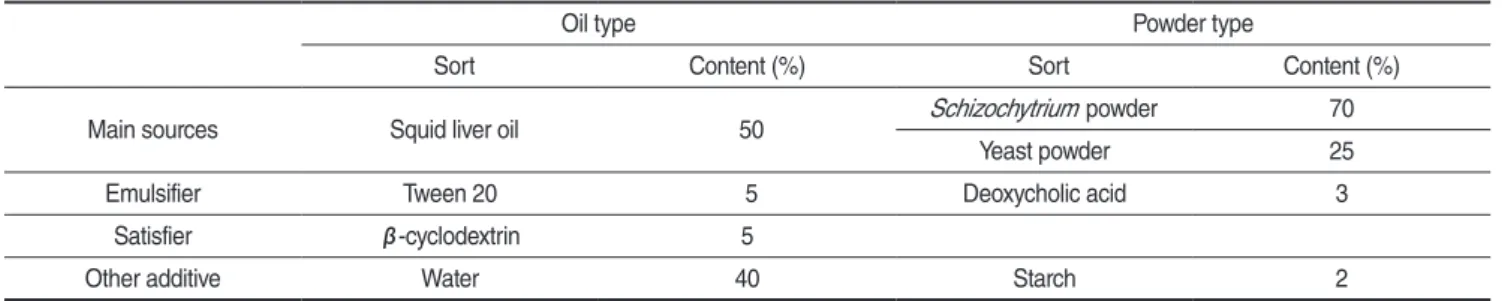
) 간유(oil type)와 광합성세균(powder type)을 주원 료로 하여 Table 1과 같이 배합하였다. Oil type는 오징어 간 유(Hyundai special feed ind. Co. Ltd., Korea) 50%, Tween 20(Ilshin wells, Korea) 5%를 유화제로 사용하였다. 그리고 β -cyclodextrin(Junsei, Japan)을 유화안정제로 사용하였으며, 유 화를 돕기 위해 물 40%를 혼합해 주었다. 그리고 powder type는Schizochytrium
powder(Martek, USA)를 70% 혼합하였고, 부족한 단백질을 보충하기 위해 빵효모 분말(Buma food, Korea) 을 25% 사용하였다. 그리고 deoxycholic acid(Sigma-Aldrich, USA)를 유화제로 3% 혼합하였으며, Kwon and Park (2009)에 따라 soluble starch(Showa Ltd., Japan) 2%를 혼합하였다.
Rotifer 및 Artemia의 배양과 영양강화
우 선 r o t i f e r 의 영 양 강 화 실 험 을 위 해 담 수 산 농 축
Chlorella
(Daesang Ltd., Korea)를 공급하여 28℃에서 배양하던 rotifer(
Brachionus rotundiformis
)(Ul-jin strain)를 20 L 수조 에 mL 당 2,000 개체로 수용하고 1×10⁶ 개체 당 각기 다른 종 류의 영양강화제를 건조중량 0.3 g씩 공급하여 2시간 동안 영양 강화를 행하였다. 영양강화 조건은 수온 26℃, 염분 33 psu였으 며, 수조의 바닥부터 강한 폭기를 시켜주어 배양수가 잘 혼합되 도록 하였다.Artemia
의 영양강화 실험은 부화 후 30시간이 경과한Artemia
(Golden Tower, ROM Ltd., Korea) nauplius를 20 L 수조에 mL 당 200 개체로 수용하여 수온 24℃, 염분 33 psu 및 DO 5 ppm 이상의 조건에서 1×10⁶ 개체 당 두 종류의 영양강 화제를 건조중량으로 환산하여 0.5 g씩 공급하여 3시간 동안 영 양강화 하였다. 영양강화를 마친 rotifer와
Artemia
는 소화 흡수 되지 않고 남아있는 소화기관내 영양강화제를 소모시키기 위 해 깨끗한 배양수로 옮겨서 1-2시간 동안 폭기시켰다. 그리고모든 영양강화 실험은 3회 반복하였다. 영양강화 전후 rotifer와
Artemia
는 지방산 분석을 위해 40 μm sieve로 걸러서 충분히 세척한 후 glass vial에 넣고 분석 시까지 -80℃에 보관하였다. 또 한 두 종류의 영양강화제에 의한 영양강화의 효과를 평가해 보 기 위해 영양강화 되기 전의 rotifer,
Artemia
의 지방산 분석을 3 회 이상 실시하였다.Rotifer 및 Artemia의 지방산 분석
Rotifer와
Artemia
시료는 Parrish (1987) 방법에 의해 지질 을, Morrison and Smith (1964)의 BF3-methanol을 이용한 지 방산 methylation 방법으로 지방산을 추출하였다. 추출한 지방 산은 capillary column(OMEGAWAX 250, SupelcoTM, USA) 이 장착된 gas chromatography(HP6890 plus, Agilent, USA)로 분석하였다. Carrier gas는 nitrogen(30 mL/min)을 사용하였고, oven 온도는 200℃에서 235℃까지 10℃/min 증가시켰으며, injector 온도는 210℃, detector(FID) 온도는 250℃로 설정하였 다. 그리고 gas chromatograph에 의한 각각의 지방산 peak들은 Supelco 37 Component FAME mix.(SupelcoTM, 100 mg Nrat 18919-1AMP, USA)를 표준물질로 하여 동정하였다.통계처리
두 종류의 영양강화제와 영양강화 전후의 rotifer 및
Artemia
의 지방산 조성의 평균을 t-test[SPSS program(Ver. 14.0)]에 의 한 평균간의 유의성을 유의수준 95%로 처리하였다.결 과
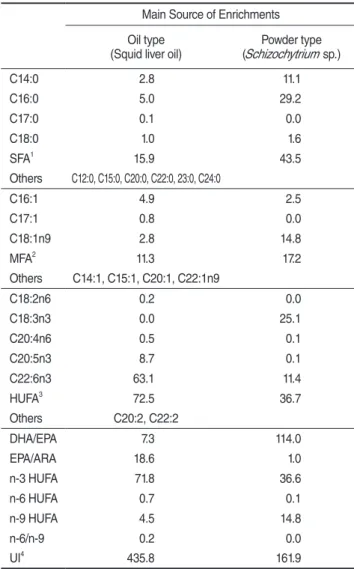
오징어 간유와 광합성세균을 주원료로 하여 제조한 영양강 화제 두 종류의 지방산 조성을 Table 2에 나타내었다. Palmitic acid(C16:0)의 높은 값에 기인하여 포화지방산(saturated fatty acid, SFA)는 광합성세균을 주성분으로 powder type 영양강화 제가 오징어 간유를 주성분으로 하는 oil type 영양강화제에 비 해 높은 것으로 나타났다. 또한 MFA도 powder type에서 oleic acid(C18:1n9)의 값에 의해 oil type 보다 다소 높은 것으로 조 사되었다. 아울러, linolenic acid(C18:3n3)는 powder type이 25.1%로 높은 값을 보인 반면 arachidonic acid(ARA, C20:4n6) 는 oil type에서 다소 높게 나타났다. 또한 eicosapentaenoic acid
Oil type Powder type
Sort Content (%) Sort Content (%)
Main sources Squid liver oil 50 Schizochytrium powder 70
Yeast powder 25
Emulsifier Tween 20 5 Deoxycholic acid 3
Satisfier
β-cyclodextrin 5
Other additive Water 40 Starch 2
Table 1. Component of two enrichments included the different main sources
(EPA, C20:5n3)는 oil type에서 8.7%로 powder type의 0.1% 보 다 높았고, docosahexaenoic acid(DHA, C22:6n3)도 oil type에 서 63.1%로 powder type의 11.4%에 비해 높았다.
한편, 각각의 영양강화제로 영양강화를 행하기 이전과 이 후 rotifer의 지방산 조성을 Table 3에 나타내었다. 영양강화 를 하기 이전 rotifer의 경우, 전체 지방산 함량 중에서 linoleic acid(C18:2n6)가 53.3%로 가장 높은 비율을 차지하였으며, ARA 및 EPA의 비율은 각각 2.2, 0.1%로 낮게 나타났다. 또한 DHA는 검출되지 않았으며, 그로 인해 n-3 HUFA와 DHA/EPA 의 비율도 낮게 나타났다. 그러나 영양강화 이후 EPA는 oil type 및 powder type에서 각각 3.8, 1.0%로 증가했으며, DHA도 0.0%에서 21.7, 14.6%로 매우 높게 향상되었다. 그로 인해 모든 실험구의 n-3 HUFA 함량, DHA/EPA 및 EPA/ARA 비율도 높
게 증가한 것으로 나타났다.
각각의 영양강화제로 영양강화를 행하기 전후
Artemia
의 지 방산 조성을 Table 4에 나타내었다. 영양강화 이전Artemia
의 경 우는 전체 지방산 함량 중에서 C16:0, palmitoleic acid(C16:1) 및 C18:1n9가 각각 16.3, 16.9, 24.1%로 높게 나타났다. EPA 는 15.3%로 높게 나타난 반면 DHA는 분석되지 않았고, 또한 HUFA 함량은 28.2%로 rotifer에 절반 수준으로 낮게 조사되었 다. 영양강화 이후 ARA 및 EPA의 함량은 2개의 실험구간에서 각각 2.5, 2.7%와 14.9, 13.2%로 영양강화 이전의 2.2%, 15.3%와 비교했을 때 변화의 폭이 크지 않는 것으로 나타났다. 한편, DHA는 영양강화 이전 전혀 분석되지 않았지만 영양강화 이후 각각의 실험구간에서 증가한 것으로 나타났다. 다만, oil type의 함량은 각각 16.8%로 높게 나타난 반면 powder type는 1.1%로
Main Source of Enrichments
Oil type
(Squid liver oil) Powder type ( Schizochytrium sp.)
C14:0 2.8 11.1
C16:0 5.0 29.2
C17:0 0.1 0.0
C18:0 1.0 1.6
SFA
115.9 43.5
Others C12:0, C15:0, C20:0, C22:0, 23:0, C24:0
C16:1 4.9 2.5
C17:1 0.8 0.0
C18:1n9 2.8 14.8
MFA
211.3 17.2
Others C14:1, C15:1, C20:1, C22:1n9
C18:2n6 0.2 0.0
C18:3n3 0.0 25.1
C20:4n6 0.5 0.1
C20:5n3 8.7 0.1
C22:6n3 63.1 11.4
HUFA
372.5 36.7
Others C20:2, C22:2
DHA/EPA 7.3 114.0
EPA/ARA 18.6 1.0
n-3 HUFA 71.8 36.6
n-6 HUFA 0.7 0.1
n-9 HUFA 4.5 14.8
n-6/n-9 0.2 0.0
UI
4435.8 161.9
Table 2. Fatty acids contents(area % of total fatty acids) of two enrichments as raw material
1, 2, 3, 4 SFA, MFA, HUFA and UI were indicated the sum of
saturated fatty acids, mono-unsaturated fatty acids, highly unsaturated fatty acids and unsaturated index of fatty acid.
Table 3. Fatty acids contents(area % of total fatty acids) of rotifer
Brachionus rotundiformis
before and after enrichment with different sources1, 2, 3, 4 is same with Table 1.
*was indicate a significant difference between two enrichment (t-test,
P
<0.05).Initial
Main Source of Enrichments Oil type
(Squid liver oil) Powder type ( Schizochytrium sp.)
C14:0 1.3 ± 0.28 2.6 ± 0.41 6.1 ± 1.66*
C16:0 19.1 ± 1.07 14.4 ± 4.92 21.8 ± 0.59*
C17:0 0.1 ± 0.17 0.7 ± 0.85 0.8 ± 1.07
C18:0 4.9 ± 0.83 4.2 ± 1.91 5.1 ± 1.53 SFA
128.8 ± 3.01 29.1 ± 0.24 35.8 ± 3.19*
Others C12:0, C15:0, C20:0, C22:0, C23:0, C24:0
C16:1 0.6 ± 1.08 3.2 ± 1.08 1.9 ± 0.26 C18:1n9 4.0 ± 0.43 2.7 ± 0.43 5.4 ± 1.09*
MFA
210.7 ± 0.83 9.0 ± 0.83 8.5 ± 2.10 Others C14:1. C15:1, C17:1, C20:1, C22:1n9
C18:2n6 53.3 ± 2.34 30.8 ± 4.28 35.8 ± 3.92 C18:3n3 1.6 ± 1.42 0.9 ± 1.07 0.6 ± 0.86 C20:4n6 2.2 ± 0.79 1.7 ± 0.96 3.1 ± 0.07 C20:5n3 0.1 ± 0.15 3.8 ± 1.74* 1.0 ± 0.78 C22:6n3 0.0 ± 0.00 21.7 ± 3.67* 14.6 ± 1.24 HUFA
357.2 ± 3.25 58.9 ± 2.27 55.0 ± 5.04 Others C20:2, C22:2
DHA/EPA 0.0 ± 0.00 5.2 ± 1.82 15.8 ± 1.07*
EPA/ARA 0.1 ± 0.12 3.1 ± 0.96* 0.3 ± 0.24
n-3 HUFA 1.7 ± 1.49 26.4 ± 3.10* 16.1 ± 3.88
n-6 HUFA 55.5 ± 1.78 32.5 ± 7.24 38.9 ± 7.84
n-9 HUFA 4.2 ± 2.44 2.8 ± 0.44 5.4 ± 4.09
n-6/n-9 16.6 ± 8.73 12.0 ± 3.41 10.8 ± 1.63
UI
4131.4 ± 5.61 229.4 ± 6.85* 186.6 ± 6.49
소폭 향상된 것으로 나타났다. 또한 영양강화 후 n-3 HUFA 함 량, DHA/EPA 및 EPA/ARA 비율도 오일제재 실험구가 광합성 세균제재 실험구에 비해 유의적으로 높게 나타났다(
P
<0.05).고 찰
본 실험에 사용된 oil type의 지방산 조성에서 EPA와 DHA 의 함량은 높은 것으로 나타났다. Kolanowski and Laufenberg (2006)에 의하면, 어유에는 omega-3 HUFA(대부분 EPA, DHA) 의 함량이 높다고 하였으며, Sargent et al. (1997)는 질적 향상을 위한 영양강화용 원료로서는 EPA와 DHA가 높은 어유가 최적 이라 보고하였다. 한편, 본 실험에 이용된 powder type의 경우,
DHA는 11.4%를 보였으며 그 외 소량의 ARA 및 EPA(0.1%) 가 존재하는 것으로 나타났다(Table 1). Ganuza et al. (2008)에 의하면, 광합성세균인
Schizochytrium
sp. 및Crypthecodinium cohinii
의 DHA 함량은 어유를 대체할 만큼 높다고 보고하였으 며, Kamlangdee and Fan (2003)도Schizochytrium
sp.는 strain 에 따라 다르지만 전체 지방산 함량 중에서 다량의 palmitic acid(19.7-29.4%)와 DHA(14-47%)가 포함되어 있으며, EPA 는 0.5-1.1% 수준이라 언급하였다. 또 다른 광합성세균인C.
cohinii
는 대부분 흡수가 쉬운 인지질로서 다량의 DHA(30- 50%)가 함유되어 있으며, 비록 소량이지만 EPA(0.2-1.6%)도 함유하고 있어 먹이원으로서 최근 많이 이용되어진다고 보고되 었다(Jiang et al., 1999).이처럼 필수지방산이 풍부한 각기 다른 주원료에 의해 만 들어진 두 가지의 영양강화제들은 확연히 rotifer와
Artemia
의 지방산 조성의 변화를 가져왔다. 우선, 영양강화를 하기 이 전 rotifer의 C18:2n6 함량이 전체 함량 중에서 53.3%로 가 장 높게 나타났고, ARA(2.2%), EPA(0.1%), DHA(0.0%) 및 n-3 HUFA(1.7%)는 낮은 것으로 조사되었다(Table 2). 이는 영 양강화를 하기 이전 rotifer의 전형적인 지방산 조성으로 유독 C18:2n6 함량이 높고, HUFA 함량이 낮았던 것은 먹이인 담수 산C. vulgaris
의 영향(Maruyama et al., 2006) 때문인 것으로 판 단된다. 이러한 특징을 가진 먹이에 기인하여 영양강화 이후 모 든 실험구에서 C18:2n6의 함량은 각각 30.8, 35.8%로 높게 나 타났다. 또한 원료와 상관없이 모든 실험구에서 영양강화 이후 ARA, EPA, DHA 및 n-3 HUFA와 같은 필수지방산의 비율은 증가하는 경향을 보였는데, 이처럼 오징어 간유 및 광합성세균 을 이용한 영양강화의 개선효과는 다른 연구와 동일하게 나타난 것이다(Sargent et al., 1997; Figueiredo et al., 2009). 일반적으 로 영양강화제의 오일제재로는 주로 오징어 간유가 대표적이며 그 외 cod liver oil, tuna orbital oil, menhaden fish oil 및 sardine fish oil 등을 들 수 있는데, 이들의 EPA는 전체 지방산 함량 중에 10-20%이며 DHA는 11-40% 수준으로 매우 높다고 보고되었 다(Southgate and Lou 1995; Sargent et al., 1997; Susan et al., 1997). 또한 Sargent et al. (1997)에 의하면, 어유의 DHA 함량 은 40% 이상으로 풍부한데, 본 연구의 oil type도 이러한 어유가 주원료였기 때문에 영양강화 이후 높은 EPA, DHA, n-3 HUFA 및 EPA/DHA 값을 얻을 수 있었다. 한편, Harel et al. (2002)는 어류 자어가 특히 요구하는 DHA의 함량은Schizochytrium
sp.및
Crypthecodinium
sp.에서 50% 이상 높게 함유하고 있으며, 자가영양형태의 다른 영양강화원인 식물성먹이생물에 비해 효 율적이면서 경제적이라고 강조하였다. 또한 Park et al. (2006) 은Schizochytrium
sp. 및Crypthecodinium
sp.의 원료 각각을 rotifer에게 따로 영양강화를 한 결과, 영양강화 전 DHA 함량 이 1%에서 각각 23.4, 18.3%로 매우 높게 개선되었으며, 이러 한 rotifer를 섭취한 Atlantic cod,Gadus morhua
자어의 성장 및 생존율은 다른 실험구에 비해 높게 향상되었다고 보고하였 다. 실제로 Barclay and Zeller (1996)는 rotifer,B. plicatilis
를 Table 4. Fatty acids contents(area % of total fatty acids) ofArtemia nauplii
before and after enrichment with different sources1, 2, 3, 4 is same with Table 1.
* was indicate a significant difference between two enrichment (t-test,
P
<0.05).Initial
Main Source of Enrichments Oil type
(Squid liver oil) Powder type ( Schizochytrium sp.)
C14:0 1.2 ± 0.07 1.4 ± 0.24 4.6 ± 0.59*
C16:0 16.3 ± 0.42 12.6 ± 0.26 24.9 ± 1.24*
C17:0 1.4 ± 0.35 1.2 ± 0.09 1.4 ± 0.01
C18:0 9.3 ± 0.33 7.9 ± 0.52 7.8 ± 0.21
SFA
128.8 ± 0.67 24.5 ± 0.89 40.2 ± 1.62*
Others C12:0, C15:0, C20:0, C22:0, C23:0, C24:0
C16:1 16.9 ± 1.03 11.7 ± 0.49 12.4 ± 0.43
C17:1 1.8 ± 0.15 1.4 ± 0.13 1.4 ± 0.03
C18:1n9 24.1 ± 1.06 20.0 ± 1.66 20.2 ± 0.44 MFA
242.9 ± 1.53 33.3 ± 1.89 34.2 ± 0.72 Others C14:1. C15:1, C20:1, C22:1n9
C18:2n6 7.2 ± 0.49 5.2 ± 0.42 5.5 ± 0.09 C18:3n3 3.6 ± 0.05 2.6 ± 0.21 2.9 ± 0.03 C20:4n6 2.2 ± 0.09 2.5 ± 0.26 2.7 ± 0.12 C20:5n3 15.3 ± 0.04 14.9 ± 1.27 13.2 ± 0.36 C22:6n3 0.0 ± 0.00 16.8 ± 4.48* 1.1 ± 0.38 HUFA
328.2 ± 0.81 42.1 ± 2.54* 25.7 ± 1.08 Others C20:2, C22:2
DHA/EPA 0.0 ± 0.00 1.2 ± 0.40 0.1 ± 0.03
EPA/ARA 11.0 ± 2.25 6.0 ± 0.58 4.9 ± 0.10
n-3 HUFA 18.9 ± 0.05 34.4 ± 3.13* 17.2 ± 0.73
n-6 HUFA 9.4 ± 0.85 7.7 ± 0.59 8.2 ± 0.16
n-9 HUFA 24.1 ± 1.06 20.0 ± 1.66 20.2 ± 0.44
n-6/n-9 0.4 ± 0.05 0.4 ± 0.00 0.4 ± 0.01
UI
4153.2 ± 2.65 237.4 ± 16.97* 137.7 ± 5.48
Schizochytrium
sp.로 영양강화한 결과, 전체 지방산 함량 중에 DHA는 18.3%까지 증가한다고 하여 본 실험에서 powder type 로 영양강화한 rotifer의 실험결과와 유사성을 보였다.한편,
Artemia
의 영양강화가 되기 이전 큰 특징 중에 하나는 EPA의 함량은 15.3%로 높은 반면 DHA는 전혀 검출되지 않은 것이다(Table 3). Figueiredo et al. (2009)는 cyst에서 갓 부화 한Artemia
의 EPA 함량은 전체 함량 중에서 51.9%로 높은 반 면 DHA는 1.0%로 매우 낮다고 언급하였다. 또한 Navarro et al. (1999)에 의하면,Artemia
는 부화 후 먹이를 섭취하지 못할 시 DHA를 EPA로 재전환하는 독특한 메커니즘을 가지고 있다 고 보고하였으며, Takeuchi (2001)는 부화된 개체는 점차 시간 이 지남에 따라 에너지원인 DHA를 동화시키기 때문에 함량이 점차 감소한다고 발표하였다. 본 실험에서도 이러한 영향이 작 용하여 영양강화를 행하기 이전Artemia
의 EPA는 15.3%로 높 은 반면, DHA는 전혀 검출되지 않았다고 시사된다. 한편, 원료 의 종류가 다른 두 가지의 영양강화제로 영양강화된Artemia
의 지방산 조성의 변화를 살펴보면, rotifer와는 달리 원료의 종류 에 따라 DHA의 함량 차이가 큰 것으로 나타났으며, 그로 인해 광합성세균제재(powder type)의 DHA/EPA, n-3 HUFA 함량은 영양강화 이전과 비교해 봤을 때 큰 차이가 없는 것으로 나타났 다. 특히, DHA의 경우를 보면 oil type으로 영양강화한Artemia
함량이 16.8%로 높게 나타난 반면, powder type는 1.1%로 낮은 수치를 보였다. 이것은 원료의 DHA 함량의 차이와 함께 오징 어 간유와 광합성세균제재에 대한 rotifer와Artemia
의 소화 흡 수력의 차이에서 오는 것으로 판단된다. Rotifer와Artemia
의 장 (intestine) 내 지질원은 지질분해효소에 의해 분해되는데, 이 때 유화제에 감싸여 있는 oil type의 영양강화제는 접촉면에서만 분해가 이루어지는 지질분해효소의 특징을 고려 할 때 powder type이 장 내 분해효소에 의해 소화가 잘 될 것이다. 그렇지만 지 질을 분석하는 과정에서 소화되지 않은 오일은 먹이생물의 지 질분석과정에서 같이 분석되기 때문에 먹이생물 내 DHA 등 의 HUFA 함량은 높게 분석이 된다. 이것은 영양강화 후 경과 시간에 따라 rotifer 내 감소하는 지질 조성을 보고한 Park and Brown (1995)와 일치한다. 이에 반해 powder type은 oil type에 비해 소화시키기에 용이하여 DHA를 에너지원으로서 이용하였 지만(Takeuchi, 2001), 함량이 낮았던 것은 DHA를 EPA로 재전 환하는 것으로 보고한 Navano et al. (1999)와 같은 경향이라고 판단된다. 만약 powder type으로 영양강화된Artemia
개체들이 DHA를 에너지원으로서 이용하였다고 한다면 oil type으로 영 양강화된 개체들에 비해Artemia
의 크기가 컸을 것으로 판단된 다.본 연구를 종합해 볼 때, 원료의 종류가 다른 두 가지 영양강 화제에 의해 동물성먹이생물 체내의 HUFA 함량(ARA, EPA, DHA 및 n-3 HUFA)과 각각의 비(DHA/EPA, EPA/ARA)는 영 양강화 이후 증가 경향을 보였다. 하지만 rotifer는 실험에 사용 한 두 가지의 서로 다른 원료의 지방산조성 차이는 해산어류 자 어의 성장과 생존에 영향을 주지는 못한다고 판단된다. 그러나
Artemia
는 원료 종류에 따라 영양조성이 다른데 사육생물의 소 화능력과 영양요구 간의 상관관계를 고려하여 세심한 선택이 필 요하다. 그렇지만 본 연구에서 자어 적용실험은 이루어지지 않 았기 때문에 추후 자어를 대상으로 하는 먹이효율 실험이 진행 되어야 한다고 판단된다.사 사
본 연구는 지식경제부 지방기술혁신사업(RTI05-01-02) 및 국립수산과학원(어류양식기술개발 RP-2011-AQ-064) 지원으 로 수행되었습니다.
참고문헌
Barclay W and Zeller S. 1996. Nutritional enhancement of n-3 and n-6 fatty acids in rotifers and
Artemia
nauplii by feeding spray-driedSchizochytrium
sp. J World Aquacult Soc 27, 314-322Beck JL and Turinggan R. 2007. The effects of zooplankton swimming behavior on prey capture kinematics of red drum larvae,
Sciaenops ocellatus
. Mar Biol 151, 1463- 1470.Estudillo-del Castillo C, Gapasin RS and Leaño EM. 2009.
Enrichment potential of HUFA-rich thraustochytrid
Schizochytrium mangrovei
for the rotiferBrachionus plicatilis
. Aquaculture 293, 57-61.Figueiredo J, van Woesik R, Lin J and Narciso L. 2009.
Artemia franciscana
enrichment model-How to keep them small, rich and alive? Aquaculture 294, 212-220.Ganuza E, Benítez-Santana T, Atalah E, Vega-Orellana O, Ganga R and Izquierdo MS. 2008.
Crypthecodinium cohnii
andSchizochytrium
sp. as potential substitutes to fisheries-derived oils from seabream(Sparus aurata
) microdiets. Aquaculture 277, 109-116.Gelabert FR. 2003. Bioencapsulation in Artemia: II. Influences of the particle concentration in the enrichment process.
Aquaculture 216, 143-153.
Harel M, Koven W, Lein I, Bar Y, Behrens P, Stubblefield J, Zohar Y and Place AR. 2002. Advanced DHA, EPA and ArA enrichment materials for marine aquaculture using single cell heterotrophs. Aquaculture 213, 347-362.
Jiang Y, Chen F and Liang SZ. 1999. Production potential of docosahexaenoic acid by the heterotrophic marine dinoflagellate
Crypthecodinium cohnii
. Process Biochem 34, 633-637.Kamlangdee N and Fan KW. 2003. Polyunsaturated fatty acids production by
Schizochytrium
sp. isolated from mangrove. Songklanakarin J Sci Technol 25, 643-650.Kim MC, Kang CK, Park HY, Lee DS, Kim YS and Lee WJ.
2006. Isotopic evidence of marine yeast to artificial culture of
Moina macrocopa
. Kor J Microbiol 42, 111-115.Kissil GW and Koven WM. 1990. Preparation of oils, enhanced in highly unsaturated fatty acid(HUFA) content, by low temperature crystallization separation, for rotifer(
Brachionus plicatilis
) enrichment. Aquaculture 88, 69-74.Kolanowski W and Laufenberg G. 2006. Enrichment of food products with polyunsaturated fatty acids by fish oil adadition. Eur Food Res Technol 222, 472-477.
Kwon ON and Park HG. 2009. Comparison of feed efficiency between rotifers enriched lipid-contents to enrichment and enhanced digestive enzymes activity to starch. J Aquaculture 22, 105-111.
Lubzens E, Gibson O, Zmora O and Sukenik A. 1995.
Potential advantages of frozen algae(
Nannochloropsis
sp.) for rotifer(Brachionus plicatilis
) culture. Aquaculture 133, 295-309.Lubzens E, Marko A and Tietz A. 1985. De novo synthesis of fatty acids in the rotifer
Brachionus plicatilis
. Aquaculture 47, 27-37.Maruyama I, Yamamoto S, Hayashi M and Murata O. 2006.
Rotifers fed with n-3 highly unsaturated fatty acid enriched
Chlorella vulgalis
are suitable for the rearing of larval red sea breamPagrus major
. Aquacult Science 54, 229-230.McGuire SO, Alexander DW and Fritsche KL, 1997. Fish oil source differentially affects rat immune cell a-tocopherol concentration. J Nutr 127, 1388-1394.
Morrison WR, Smith LM, 1964. Preparation of fatty acid methyl esters and dimethylacetals from lipids with boron fluoride methanol. J Lipid Res 5, 600-608.
Navarro JC, Henderson RJ, McEvoy LA, Bell MV and Amat F. 1999. Lipid conversion during enrichment of
Artemia
. Aquaculture 174, 155-166.Nichols DS, Hart PR, Nichols PD and McMeekin TA. 1996.
Enrichment of the rotifer
Brachionus plicatilis
fed an Antarctic bacterium containing polyunsaturated fatty acids. Aquaculture 147, 115-125.Park HG, Puvanendran V, Kellett A, Parrish CC and Brown JA.
2006. Effect of enriched rotifers on growth, survival, and composition of larval Atlantic cod(
Gadus morhua
). ICES J Mar Sci 63, 285-295.Parrish CC, 1987. Separation of aquatic lipid classes by Chromarod thin-layer chromatography with measurement by Iatroscan flame ionization detection. Can J Fish Aquatic Sci 44, 722-731.
Rainuzao JR, Olsen Y and Rosenlund G. 1989. The effect of enrichment diets on the fatty acids composition of the rotifer
Brachionus plicatilis
. Aquaculture 79, 157-161.Rainuzzo JR, Reitan KI and Olsen Y. 1997. The significance of lipids at early stages of marine fish: a review. Aquaculture 155, 103-115.
Sargent J, McEvoy LA and Bell JG. 1997. Requirements, presentation and sources of polyunsaturated fatty acids in marine fish larval feeds. Aquaculture 155, 117-127.
Southgate PC and Lou DC. 1995. Improving the n-3 HUFA composition of
Artemia
using microcapsules containing marine oils. Aquaculture 134, 91-99.Takeuchi T. 2001. A review of feed development for early life stages of marine finfish in Japan. Aquaculture 200, 203- 222.
Ward OP and Singh A. 2005. Omega-3/6 fatty acids:
Alternative sources of production. Process Biochem 40, 3627-3652.
Watanabe K, Sezaki K, Yazawa K and Hino A. 1992. Nutritive fortification of the rotifer
Brachionus plicatilis
with eicosapentaenoic acid-producing bacteria. Nippon Suisan Gakk 58, 271-276.Watanabe T, Kitajima C and Fujita S. l983. Nutritional values of live organisms used in Japan for mass propagation of fish: A review. Aquaculture 34, 115-143.
Whyte JNC and Nagata WD. 1990. Carbohydrate and fatty acid composition of the rotifer
Brachionus plicatilis
fed monospecific diets of yeast or phytoplankton. Aquaculture 89, 263-272.