INTRODUCTION
Parkinson’s disease (PD) is the second most common progres- sive neurodegenerative disorder after Alzheimer’s disease.
1It is characterized by the loss of dopaminergic neurons of the substantia nigra and the presence of intraneuronal cytoplas- mic inclusions, known as Lewy bodies, which are aggregates of α-synuclein.
1To detect the loss of dopaminergic neurons in PD, dopamine transporter (DAT) imaging has been employed with single-photon emission computed tomography (SPECT) and positron emission tomography (PET).
2DAT is a sodium chloride-dependent transmembrane protein on the presynap- tic dopaminergic nerve terminal, and controls dopamine levels Received: February 23, 2018 Revised: June 1, 2018
Accepted: June 15, 2018
Co-corresponding authors: Kyoungjune Pak, MD, PhD, Department of Nuclear Medicine and Biomedical Research Institute, Pusan National University Hospital, 179 Gudeok-ro, Seo-gu, Busan 49241, Korea.
Tel: 82-51-240-7389, Fax: 82-51-240-7442, E-mail: [email protected] and Ju Won Seok, MD, PhD, Department of Nuclear Medicine, Chung-Ang University College of Medicine, 84 Heukseok-ro, Dongjak-gu, Seoul 06973, Korea.
Tel: 82-2-860-3015, Fax: 82-2-860-3616, E-mail: [email protected]
•The authors have no financial conflicts of interest.
© Copyright: Yonsei University College of Medicine 2018
This is an Open Access article distributed under the terms of the Creative Com- mons Attribution Non-Commercial License (https://creativecommons.org/licenses/
by-nc/4.0) which permits unrestricted non-commercial use, distribution, and repro- duction in any medium, provided the original work is properly cited.
Effect of rs3910105 in the Synuclein Gene on
Dopamine Transporter Availability in Healthy Subjects
Youngduk Seo
1, Kyoungjune Pak
2, Hyun-Yeol Nam
3, Ju Won Seok
4, Myung Jun Lee
5, Eun-Joo Kim
5, Jae Meen Lee
6, Seong Jang Kim
7, and In Joo Kim
21
Department of Nuclear Medicine, Busan Seongso Hospital, Busan;
Departments of
2Nuclear Medicine,
5Neurology, and
6Neurosurgery, and Biomedical Research Institute, Pusan National University Hospital, Busan;
3
Department of Nuclear Medicine, Samsung Changwon Hospital, Sungkyunkwan University School of Medicine, Changwon;
4
Department of Nuclear Medicine, Chung-Ang University College of Medicine, Seoul;
7
Department of Nuclear Medicine and Research Institute for Convergence of Biomedical Science and Technology, Pusan National University Yangsan Hospital, Yangsan, Korea.
Purpose: The present study investigated associations between dopamine transporter (DAT) availability and α-synuclein levels in cerebrospinal fluid, as well as synuclein gene (SNCA) transcripts, and the effect of single nucleotide polymorphism of SNCA on DAT availability in healthy subjects.
Materials and Methods: The study population comprised healthy controls who underwent
123I-FP-CIT single-photon emission computed tomography screening. Five SNCA probes were used to target the boundaries of exon 3 and exon 4 (SNCA-E3E4), tran- scripts with a long 3’UTR region (SNCA-3UTR-1, SNCA-3UTR-2), transcripts that skip exon 5 (SNCA-E4E6), and the rare short transcript isoforms that comprise exons 1–4 (SNCA-007).
Results: In total, 123 healthy subjects (male 75, female 48) were included in this study. DAT availability in the caudate nucleus (p=0.0661) and putamen (p=0.0739) tended to differ according to rs3910105 genotype. In post-hoc analysis, DAT availability in the putamen was lower in subjects of TT genotype than those of CC/CT (p=0.0317). DAT availability in the caudate nucleus also showed a trend similar to that in the putamen (p=0.0597). Subjects of CT genotype with rs3910105 showed negative correlations with DAT availability in the putamen with SNCA-E3E4 (p=0.037, rho=-0.277), and SNCA-E4E6 (p=0.042, rho=-0.270), but not those of CC/TT genotypes.
Conclusion: This is the first study to investigate the association of rs3910105 in SNCA with DAT availability. rs3910105 had an ef- fect on DAT availability, and the correlation between DAT availability and SNCA transcripts were significant in CT genotypes of rs3910105.
Key Words: Dopamine plasma membrane transport proteins, synucleins, genotype, single-photon emission computed tomography, biomarkers
pISSN: 0513-5796 · eISSN: 1976-2437 Yonsei Med J 2018 Aug;59(6):787-792
https://doi.org/10.3349/ymj.2018.59.6.787
by active reuptake from the synaptic cleft.
3-5DAT imaging al- lows quantifying of the dopaminergic system in the human brain
6and in vivo demonstration of striatal dopamine activity.
5As
123I-FP-CIT shows a higher affinity for striatal DAT density,
3it is one of the most widely used radiotracers in evaluating neu- rodegenerative disease.
7,8α-synuclein, a small, natively unfolded protein in presynaptic axon terminals
9-11plays a role in regulation of dopamine bio- synthesis and terminating dopamine neurotransmission by altering DAT-mediated uptake of synaptic dopamine.
12,13Ag- gregates of α-synuclein protein are a neuropathological hall- mark of PD.
14,15Many previous efforts have attempted to de- termine the usefulness of α-synuclein in cerebrospinal fluid (CSF), synuclein gene (SNCA), and single nucleotide poly- morphisms (SNPs) as biomarkers for PD. Mean CSF α-synuclein levels are significantly lower in patients with typical PD, and may be a biomarker for PD diagnosis.
16SNCA is selectively expressed in blood cells and neurons.
10,17Previous studies have evaluated alternative SNCA transcripts from blood as specific biomarkers for PD development. How- ever, until now, the roles of SNCA transcripts are not well un- derstood. Previous studies have reported a positive correla- tion between DAT imaging and SNCA transcripts in PD.
18,19In the Parkinson’s Progression Markers Initiative (PPMI), five SNCA transcripts, transcript with boundaries of exon 3 and exon 4 (SNCA-E3E4), transcripts with a long 3’UTR region (SNCA-3UTR-1, SNCA-3UTR-2), transcripts that skip exon 5 (SNCA-E4E6), and rare short transcript isoforms that com- prise exons 1−4 (SNCA-007), were counted to evaluate their ability as specific biomarkers for PD. In genome-wide associa- tion study, several SNPs in SNCA were associated with PD.
20However, the effect of SNP in SNCA was not investigated.
In this regard, we hypothesized that α-synuclein levels in CSF, SNCA, and SNP of SNCA might have an effect on DAT availability in healthy subjects. Therefore, we investigated the association between DAT availability measured from
123I-FP- CIT SPECT and α-synuclein levels in CSF, as well as SNCA tran- scripts from venous blood, and the effect of SNP of SNCA on DAT availability in healthy subjects using the PPMI database.
MATERIALS AND METHODS
Subjects
Data used in the preparation of this article were obtained from the PPMI database (www.ppmi-info.org/data). For up-to-date information on the study, visit www.ppmi-info.org.
21The study population consisted of healthy controls who underwent
123I- FP-CIT SPECT screening. According to PPMI criteria of healthy subjects, males or females with an age of 30 years or older at screening were included, and subjects with a neurological dis- order, a first degree relative with idiopathic PD, Montreal Cog- nitive Assessment score of 26 or less, medications that might
interfere with DAT SPECT scans, anticoagulants that might preclude safe completion of the lumbar puncture, or investi- gational drugs, and a condition that precludes the safe perfor- mance of routine lumbar puncture were excluded. Subjects without CSF α-synuclein, RNA synuclein, and genotyping were excluded. Medical history, CSF, RNA synuclein counts, and
123
I-FP-CIT SPECT scans were downloaded. The PPMI study was approved by the local Institutional Review Boards of all participating sites (Institute for Neurodegenerative Disorders, University of Pennsylvania, University of California, Los Ange- les, Coriell Institute for Medical Research, Clinical Trials Co- ordination Center, Laboratory of Neurogenetics; National In- stitute on Aging NIH, Institute for Neurodegenerative Disorders, Clinical Trials Statistical and Data Management Center, Univer- sity of Iowa), and written informed consent was obtained from each subject at the time of enrollment for imaging data and clin- ical questionnaires. All methods were performed in accordance with the relevant guidelines and regulations.
123
I-FP-CIT SPECT and image analysis
123
I-FP-CIT SPECT was performed during the screening visit for all subjects. SPECT scans were acquired 4±0.5 hrs after in- jection of 111−185 MBq of
123I-FP-CIT. Subjects were pretreated with iodine solution or perchlorate prior to injection to block thyroid uptake. Raw data were acquired into a 128×128 matrix stepping every 3 or 4 degrees for the total projections. Raw pro- jection data were reconstructed using iterative ordered subset expectation maximization with HERMES (Hermes Medical Solutions, Stockholm, Sweden). The reconstructed images were transferred to pmod (PMOD Technologies LLC, Zürich, Switzerland) for subsequent processing, including attenua- tion correction.
Downloaded scans were loaded using pmod v3.6 (PMOD Technologies LLC) with a
123I-FP-CIT template.
22Specific bind- ing of
123I-FP-CIT regarding DAT was calculated using a region of interest analysis. A standard set of volumes of interest (VOIs) defining the caudate nucleus and putamen based on the Au- tomated Anatomical Labeling (AAL) atlas
23was defined. The cerebellum was chosen as a reference region. VOI template was applied to measure specific binding ratios (SBRs) of the cau- date nucleus, putamen, and striatum as follows: SBR=(target- cerebellum)/cerebellum. As semi-automatic software (pmod v3.6, PMOD Technologies LLC) with predefined AAL atlas was used to analyze SPECT scans, inter- and intra-observer variation might be negligible.
Synuclein
α-synuclein in CSF was analyzed using an enzyme-linked im-
munosorbent assay (Covance Research Products Inc., Denver,
PA, USA) according to the manufacturer’s instructions. Samples
were run in duplicate, and data used for this study met quality
control measures for technical performance. Venous blood
was collected from each subject in PAXgene tubes (Qiagen,
Valencia, CA, USA), incubated at room temperature for 24 hours, and frozen and shipped on dry ice to Coriell. RNA was extract- ed following the PAXgene procedure. Probes for the target and control RNAs were multiplexed and assayed on the nCounter Digital Analyzer (NanoString Technologies, Inc.). Five SNCA probes were used to target the boundaries of exon 3 and exon 4 (SNCA-E3E4), transcripts with a long 3’UTR region (SNCA- 3UTR-1, SNCA-3UTR-2), transcripts that skip exon 5 (SNCA- E4E6), and the rare short transcript isoforms that comprise ex- ons 1−4 (SNCA-007). Transcript counts were assayed in human blood in a high-precision NanoString gene expression assay that directly measures RNA counts in total RNA without bias from reverse transcription into cDNA. No template controls containing water substituted for template were included. To control for plate-to-plate variation and drift, equal amounts of RNA derived from Human Universal Reference RNA (Agilent Technologies) were spotted at the beginning, end, and through- out the entire experiment.
Genotyping − rs3910105
All samples were genotyped using Illumina NeuroX array fol- lowing the manufacturer’s protocol (Illumina, Inc., San Diego, CA, USA). The Genotyping Analysis Module within Genome Studio version 1.9.4 was used to analyze data. The genotype fre- quencies for SNPs were in Hardy-Weinberg Equilibrium (>0.05), and minor allele frequency was more than 0.05.
Statistical analysis
Normality was examined using D’Agostino-Pearson omnibus test. Kruskal-Wallis test was used to compare three subgroups of SNPs. Post-hoc analysis was done to compare two subgroups of SNPs using Mann-Whitney test. Spearman correlation was used to investigate the relationship between DAT availability and synuclein. Statistical analyses were performed using Graph- Pad Prism 7 for Mac OS X (GraphPad Software Inc., San Diego,
CA, USA), and MedCalc software package (ver. 12.6.0.0, Med- Calc, Mariakerke, Belgium).
RESULTS
Subject characteristics according to rs3910105
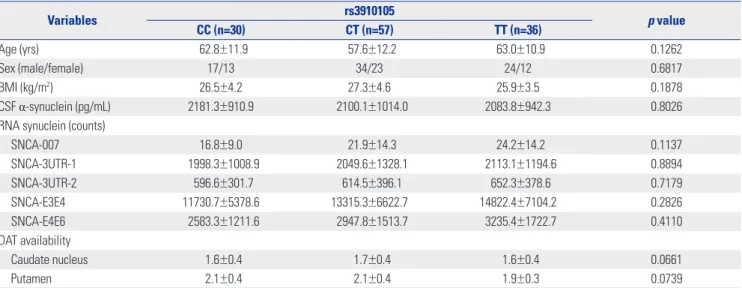
In total, 123 healthy subjects (male 75, female 48) were includ- ed in this study. rs3910105 was in Hardy-Weinberg Equilibrium, and the minor allele frequency was 0.47. According to geno- typing of rs3910105, 30 subjects were of CC genotype, 57 of CT, and 36 of TT. rs3910105 did not show any effect on CSF α-synuclein (p=0.8026), and RNA synuclein (SNCA-007, p=0.1137; SNCA- 3UTR-1, p=0.8894; SNCA-3UTR-2, p=0.7179; SNCA-E3E4, p=
0.2826; SNCA-E4E6, p=0.4110) (Table 1). However, DAT avail- ability in the caudate nucleus (p=0.0661) and putamen (p=
0.0739) tended to differ according to rs3910105 genotype. In post-hoc analysis, DAT availability in the putamen was lower in subjects of TT genotype than those of CC/CT (p=0.0317).
DAT availability in the caudate nucleus tended to be similar with that in the putamen (p=0.0597) (Fig. 1).
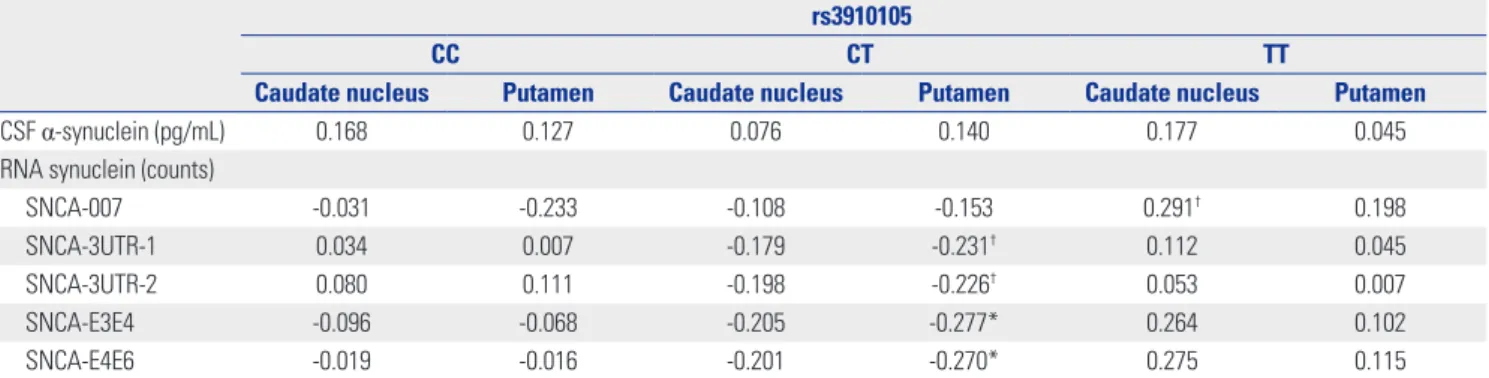
Correlation between DAT availability and synuclein The correlation between DAT availability and synuclein was not significant in 123 subjects. However, after dividing sub- jects into 3 groups according to rs3910105, those with CT gen- otype of rs3910105 showed negative correlations of DAT avail- abilities of putamen with SNCA-E3E4 (p=0.037, rho=-0.277), and SNCA-E4E6 (p=0.042, rho=-0.270) (Fig. 2). In addition, SNCA-3UTR-1 (p=0.084, rho=-0.231), and SNCA-3UTR-2 (p=
0.091, rho=-0.226) also showed the trend toward negative cor- relation with DAT availability of putamen in those with CT gen- otype (Table 2). However, in subjects with CC and TT genotypes did not show the meaningful association between DAT avail- ability and synuclein.
Table 1. Subject Characteristics according to Genotype of rs3910105
Variables rs3910105
p value
CC (n=30) CT (n=57) TT (n=36)
Age (yrs) 62.8±11.9 57.6±12.2 63.0±10.9 0.1262
Sex (male/female) 17/13 34/23 24/12 0.6817
BMI (kg/m
2) 26.5±4.2 27.3±4.6 25.9±3.5 0.1878
CSF α-synuclein (pg/mL) 2181.3±910.9 2100.1±1014.0 2083.8±942.3 0.8026
RNA synuclein (counts)
SNCA-007 16.8±9.0 21.9±14.3 24.2±14.2 0.1137
SNCA-3UTR-1 1998.3±1008.9 2049.6±1328.1 2113.1±1194.6 0.8894
SNCA-3UTR-2 596.6±301.7 614.5±396.1 652.3±378.6 0.7179
SNCA-E3E4 11730.7±5378.6 13315.3±6622.7 14822.4±7104.2 0.2826
SNCA-E4E6 2583.3±1211.6 2947.8±1513.7 3235.4±1722.7 0.4110
DAT availability
Caudate nucleus 1.6±0.4 1.7±0.4 1.6±0.4 0.0661
Putamen 2.1±0.4 2.1±0.4 1.9±0.3 0.0739
BMI, body mass index; CSF, cerebrospinal fluid; SNCA, synuclein gene; DAT, dopamine transporter.
DISCUSSION
In this study, rs3910105 appeared to effect DAT availability in the striatum. In subjects with CT genotype, higher DAT avail- ability in the striatum and significant correlations with SNCA transcripts (SNCA-E3E4, SNCA-E4E6) were noted.
rs3910105, a SNP of SNCA, is a significant predictor of change
Fig. 1. Post-hoc analysis of dopamine transporter availability in the cau- date nucleus (p=0.0597) and putamen (p=0.0317) according to geno- types of rs3910105.
3
2
1
0 –
–
–
–
Specific binding ratio
CC/CT TT
Caudate nucleus Putamen p=0.0597
p=0.0317
4
3
2
1
0
4
3
2
1
0
Specific binding ratio Specific binding ratio
Counts Counts
0 10000 20000 30000 40000 0 2000 4000 6000 8000 10000
–
–
–
–
–
–
–
–
–
–
SNCA-E3E4 SNCA-E4E6
Fig. 2. Correlation between dopamine transporter availability of putamen in subjects with CT genotype of rs3910105 and (A) SNCA-E3E4 (p=0.037, rho=-0.277) and (B) SNCA-E4E6 (p=0.042, rho=-0.270).
A B
Table 2. Correlation Coefficient (rho) between Dopamine Transporter Availability and Synuclein in Subjects according to Genotype of rs3910105 rs3910105
CC CT TT
Caudate nucleus Putamen Caudate nucleus Putamen Caudate nucleus Putamen
CSF α-synuclein (pg/mL) 0.168 0.127 0.076 0.140 0.177 0.045
RNA synuclein (counts)
SNCA-007 -0.031 -0.233 -0.108 -0.153 0.291
†0.198
SNCA-3UTR-1 0.034 0.007 -0.179 -0.231
†0.112 0.045
SNCA-3UTR-2 0.080 0.111 -0.198 -0.226
†0.053 0.007
SNCA-E3E4 -0.096 -0.068 -0.205 -0.277* 0.264 0.102
SNCA-E4E6 -0.019 -0.016 -0.201 -0.270* 0.275 0.115
CSF, cerebrospinal fluid; SNCA, synuclein gene.
*p<0.05,
†p<0.1.
in β-amyloid 1−42 (Aβ42), which has been shown to be rele- vant in PD neurodegeneration.
24However, rs3910105 shows a relatively subtle association with temporal Lewy body counts in the brain, and it seems to play a limited role in the degree to which Lewy body pathology progresses.
25Additionally, rs3910105 was not shown to be associated with cognitive decline in un- treated PD patients.
26Still, the role of rs3910105 in PD, as well as healthy subjects, has remained unclear. In this study, SNCA transcripts showed a significant correlation with DAT availabil- ity in subjects of CT genotype, not in those of CC or TT. Until now, as this is the first study to report the effect of rs3910105 and a correlation between SNCA transcripts and DAT availabili- ty, the underlying mechanism of this association is not clear.
Previous studies have reported the effects of genotypes on DAT availabilities. CC genotypes with rs5443 of the G-protein β3 subunit gene showed higher DAT availability measured by
99m