• 검색 결과가 없습니다.

A Case of Severe Pulmonary Thromboembolism in a Young Male With Klinefelter Syndrome

N/A
N/A
Protected

Academic year: 2022

Share "A Case of Severe Pulmonary Thromboembolism in a Young Male With Klinefelter Syndrome"

Copied!
3
0
0

로드 중.... (전체 텍스트 보기)

전체 글

(1)

562 Copyright © 2012 The Korean Society of Cardiology Korean Circulation Journal

Introduction

Klinefelter syndrome is the most common congenital abnormal- ity causing primary hypogonadism, occurring in approximately one in a thousand (1 : 1000) live male births.

1)2)

This syndrome has a nu- merical chromosome abnormality in males, characterized by the presence of one or more extra X chromosomes.

2)

Affected males carry an additional X chromosome (or more), which results in ab- normal development of the testis, leading to hypogonadism and infertility.

3)

Klinefelter syndrome has a tendency for hypercoagula- bility owing to the propensity for hypogonadism caused by hormo- nal imbalance and genetic inclination. To date, there has been no case report associated with cardiovascular disease in Korea. Here, we encountered and reported on a young male patient with Kline- felter syndrome that also had pulmonary thromboembolism.

Case Report

http://dx.doi.org/10.4070/kcj.2012.42.8.562 Print ISSN 1738-5520 • On-line ISSN 1738-5555
A Case of Severe Pulmonary Thromboembolism in a Young Male With Klinefelter Syndrome

Byung-Soo Kang, MD, Deok-Kyu Cho, MD, Won-Jun Koh, MD, Seung-Hoon Yoo, MD, Ki-Bum Won, MD, Yun-Hyeong Cho, MD, Eui-Seock Hwang, MD, and Jong-Hoon Koh, MD

Division of Cardiology, Cardiovascular Center, Myongji Hospital, Kwandong University College of Medicine, Goyang, Korea

A young male patient diagnosed with Klinefelter syndrome was admitted to our hospital via the emergency room with chief complaints of acute chest pain and dyspnea. Pulmonary thromboembolism was diagnosed from his chest CT images. His symptoms improved after he underwent thrombolysis and anticoagulation treatment. Klinefelter syndrome has a tendency towards hypercoagulability due to hormonal imbalance and one or more inherited thromophilic factors. Thus, Klinefelter syndrome patients with a past medical history of venous throm- boembolism require continuous oral anticoagulation therapy for a period of at least six months. (Korean Circ J 2012;42:562-564) KEY WORDS: Klinefelter syndrome; Pulmonary embolism; Venous thrombosis.

Received: October 31, 2011 Revision Received: January 2, 2012 Accepted: January 12, 2012

Correspondence: Deok-Kyu Cho, MD, Division of Cardiology, Cardiovas- cular Center, Myongji Hospital, Kwandong University College of Medicine, 697-24 Hwajeong-dong, Deogyang-gu, Goyang 412-270, Korea

Tel: 82-31-810-6770, Fax: 82-31-810-6778 E-mail: [email protected]

• The authors have no financial conflicts of interest.

This is an Open Access article distributed under the terms of the Creative Commons Attribution Non-Commercial License (http://creativecommons.

org/licenses/by-nc/3.0) which permits unrestricted non-commercial use, distribution, and reproduction in any medium, provided the original work is properly cited.

Case

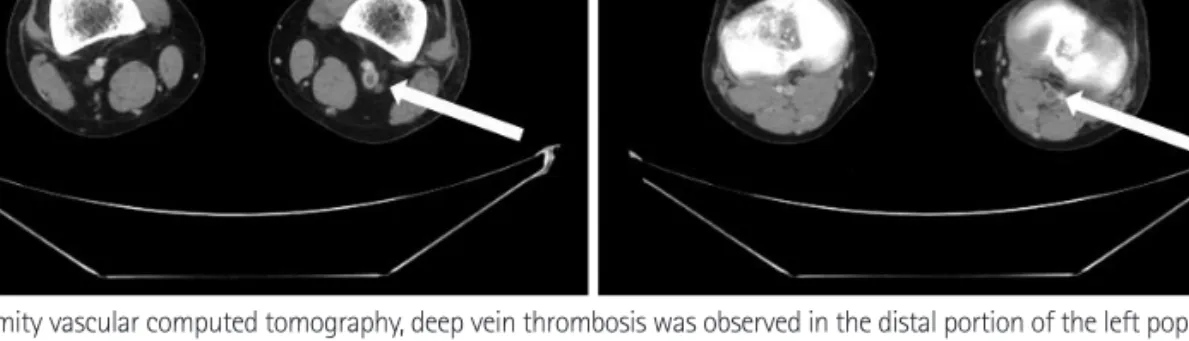
A thirty-eight year-old male patient, diagnosed as having Kline- felter syndrome (47, XXY) during the sterility test, was admitted to our hospital’s emergency room with symptoms of acute chest pain and dyspnea that developed one hour prior to admission (Fig. 1). On arrival at the emergency room, his blood pressure, pulse and respir- ation were 90/60 mm Hg, 130/minute and 24/minute, respectively.

His body temperature was 36.8°C and he was clearly conscious. On auscultation of the chest, crackles were heard in both lower lungs.

Heart sounds showed rapid pulse and no murmur. Interstitial pul- monary edema and cardiomegaly were observed from his chest X- ray, while his electrocardiography revealed findings of ST-depression in the V 3, V 4 and V 5 areas. The peripheral blood test revealed WBC 14100/uL, Hb 14.0 g/dL and platelet 465000/uL. Serobiochemical studies showed blood urea nitrogen 14.6 mg/dL, creatinine 1.2 mg/

dL and hyperlipidemia was shown with total cholesterol of 210 mg/

dL, triglyceride 97 mg/dL, high density lipoprotein 37 mg/dL and low

density lipoprotein 177mg/dL. An immunochemical serologic test

revealed a finding of inflammation with high sensitivity C-reactive

protein 2.56 mg/dL. CK, creatine kinase-MB and troponin-I were all

negative, while the level of D-dimer was measured to be high at

5408 ng/mL. The results of arterial blood gas analysis while the pa-

tient was on O

2

mask 5 L (approximately FiO

2

0.4) showed hypoxe-

mia with pH 7.24, PCO

2

28 mm Hg, PO

2

62 mm Hg, bicarbonate 27

mmol/L and O

2

saturation of 90%. Increased right ventricular size,

decreased right ventricular function and D-shaped left ventricle were

(2)

563 Byung-Soo Kang, et al.

http://dx.doi.org/10.4070/kcj.2012.42.8.562 www.e-kcj.org

observed in the echocardiography. With a suspicion of possible pul- monary thromboembolism, contrast enhanced chest computed to- mography was carried out, which revealed multiple thromboembo- lism in the main, lobar, segmental and subsegmental pulmonary ar- teries of both lungs (Fig. 2). The patient’s O

2

saturation dropped to 90-91% even with an O

2

mask of 7 L (approximately FiO

2

0.6). Owing to observations of persistent hypotension of 80/40 mm Hg despite

hemodynamic support, thrombolytic therapy (Actilyse®-alteplase:

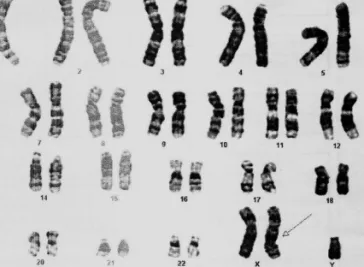
100 mg over 2 hours) was performed. Lower extremity vascular com- puted tomography was carried out to find the origin of venous th- romboembolism. This revealed deep vein thrombosis (DVT) in the dis- tal portion of the left popliteal vein (Fig. 3). The patient underwent anticoagulation therapy with low molecular weight heparin (Cle- xane®-enoxaparin: 60 mg subcutaneously every 12 hours for 7 days) and warfarin. Having observed venous thromboembolism at a young age, a screening test for immunologic diseases was carried out to make the differential diagnosis of antiphospholipid antibody syn- drome. The findings of complement levels (C3, C4), antinuclear an- tibody (ANA), antibody to anti-double-stranded DNA, anti-cardiolip- in antibody of immunoglobulin (Ig) M and IgG, as well as lupus anti- coagulant and venereal disease research laboratory test were all negative.

4)

The follow-up chest computed tomography performed ten (10) days after hospital admission did not show pulmonary th- romboembolism. After the patient was discharged from the hospi- tal, he was put on warfarin for anticoagulation therapy and followed up on an outpatient basis.

Discussion

There are increased incidences of venous thromboembolism in Fig. 1. Chromosomal analysis revealed a karyotype of 47, XXY, which is a

typical finding for Klinefelter syndrome.

Fig. 2. Contrast enhanced chest computed tomography on admission. Multiple thromboembolism (white arrows) in main, lobar, segmental and subseg-

mental pulmonary arteries of both lungs.

(3)

564 Pulmonary Thromboembolism in Klinefelter Syndrome

http://dx.doi.org/10.4070/kcj.2012.42.8.562 www.e-kcj.org

patients affected by Klinefelter syndrome. Campbell and Price

5)

noted increased incidences of DVT and pulmonary embolism in a se- ries of 412 patients with Klinefelter syndrome, observed over peri- ods ranging from 1 to 20 years. A possible explanation was provided by two consecutive studies

6)7)

and subsequently emphasized by Win- kler

8)

in his review about the effects of androgens on hemostasis.

According to these findings, hypogonadism in males is associated with reduced fibrinolytic activity via increased plasminogen activa- tor inhibitor-1 (PAI-1) levels, where plasma levels show an inverse relationship with testosterone concentrations. Hemostasis is achiev- ed by thrombin-stimulated fibrin clot formation and plasmin-in- duced clot lysis. PAI-1 is involved in the process of clot lysis.

9)

With respect to clot lysis, plasminogen, a precursor molecule for plasmin, binds to fibrin and tissue-type plasminogen activator (t-PA) to make ternary complexes. These complexes convert plasminogen into proteolytic plasmin, an active form. Here, PAI-1 suppresses t-PA, inhi- biting plasmin formation, and restricts the process of fibronolysis.

10)

Through such pathogenesis, patients with Klinefelter syndrome would have a higher risk of developing not just DVT but also myo- cardial infarction and venous thromboembolism. However, it would be difficult to explain severe thromboses with hormonal imbalance by way of hypo-androgenism alone, and one or more inherited th- rombophilia {e.g., factor V Leiden and prothrombin (factor II) G20210A mutations} may be associated with it.

11)

Therefore, patients with Klinefelter syndrome with a past medi- cal or family history of venous thromboembolism should undergo an endocrinologic test, as well as additional assessment of innate or acquired thrombophilia. In the future, it seems that more stud- ies on understanding of pathogenesis of venous thromboembolism

in cases of Klinefelter syndrome are necessary. The consideration is that a long-term oral anticoagulation therapy is necessary in the treatment of thrombophilic conditions.

References

1. Schwartz ID, Root AW. The Klinefelter syndrome of testicular dysgen- esis. Endocrinol Metab Clin North Am 1991;20:153-63.

2. Bojesen A, Juul S, Gravholt CH. Prenatal and postnatal prevalence of Klinefelter syndrome: a national registry study. J Clin Endocrinol Metab 2003;88:622-6.

3. Ratcliffe S. Long-term outcome in children of sex chromosome abnor- malities. Arch Dis Child 1999;80:192-5.

4. Moon HJ, Rhim CY, Kim GW, et al. Risk factors of deep vein thrombosis and pulmonary embolism in Korean. Korean Circ J 2005;35:474-9.

5. Campbell WA, Price WH. Venous thromboembolic disease in Klinefel- ter’s syndrome. Clin Genet 1981;19:275-80.

6. Bennet A, Sie P, Caron P, et al. Plasma fibrinolytic activity in a group of hypogonadic men. Scand J Clin Lab Invest 1987;47:23-7.

7. Caron P, Bennet A, Camare R, Louvet JP, Boneu B, Sié P. Plasminogen activator inhibitor in plasma is related to testosterone in men. Metabo- lism 1989;38:1010-5.

8. Winkler UH. Effects of androgens on haemostasis. Maturitas 1996;

24:147-55.

9. Lane DA, Philippou H, Huntington JA. Directing thrombin. Blood 2005;

106:2605-12.

10. Sprengers ED, Kluft C. Plasminogen activator inhibitors. Blood 1987;69:

381-7.

11. Lapecorella M, Marino R, De Pergola G, Scaraggi FA, Speciale V, De Mi- trio V. Severe venous thromboembolism in a young man with Klinefel- ter’s syndrome and heterozygosis for both G20210A prothrombin and factor V Leiden mutations. Blood Coagul Fibrinolysis 2003;14:95-8.

Fig. 3. In the lower extremity vascular computed tomography, deep vein thrombosis was observed in the distal portion of the left popliteal vein (white arrows).

수치

Fig. 2. Contrast enhanced chest computed tomography on admission. Multiple thromboembolism (white arrows) in main, lobar, segmental and subseg- subseg-mental pulmonary arteries of both lungs.
Fig. 3. In the lower extremity vascular computed tomography, deep vein thrombosis was observed in the distal portion of the left popliteal vein (white arrows).

참조

관련 문서