Vol. 19, No. 2, June, 2007
Harris-Galante 무시멘트 비구컵에서 폴리에틸렌 라이너의 해리에 영향을 미치는 인자에 대한 분석
박상원∙박종훈∙조형준∙송동익
고려대학교 의과대학 정형외과학교실
목적: 본 연구는 안정적으로 고정된 무시멘트 Harris-Galante 비구컵에서 폴리에틸렌 라이너의 해리를 일으키는 인자들을 분석 하고자 하였다.
대상 및 방법: 1998년 1월부터 2007년 2월 사이에 비구컵은 안정적으로 고정되어 있으나 비구주위의 골 용해로 수술적 치료 를 시행한 32례를 대상으로 하였다. Harris-Galante 제1형이 5례, 제2형이 27례였다. 폴리에틸렌 라이너의 해리가 발생한 경 우를 제1군, 해리가 없었던 경우를 제2군으로 분류하였으며 제1군은 18례, 제2군은 14례였다. 각 군에서 환자의 연령, 성별, 체중, 비구컵의 종류, 비구컵의 크기, 폴리에틸렌 라이너의 두께, 재치환술까지의 기간, 비구컵의 경사각, 전경, 폴리에틸렌 라 이너의 마모, 비구부 골 용해의 정도, 잠금 장치의 손상들을 분석하였다. 통계적 분석은 Mann-Whitney test (SPSS 12.0)를 이 용하였으며 p<0.05를 유의한 것으로 판정하였다.
결과: 환자의 연령, 성별, 체중, 비구컵의 종류, 비구컵의 크기, 폴리에틸렌 라이너의 두께, 재치환술까지의 기간, 컵의 경사각, 컵의 전경, 골 용해의 정도 등은 두 군간에 유의한 차이를 보이지 않았다. 폴리에틸렌 라이너의 연 평균 선상 마모율은 제1군은 0.40±0.19 mm, 제2군은 0.19±0.08 mm로서 통계적으로 유의한 차이가 있었다(p=0.002). 잠금 장치의 손상은 제1군에서는 16례, 제2군에서는 6례에서 발생하였으며 통계적으로 유의하였다(p=0.006)
결론: Harris-Galante 무시멘트형 비구컵에서 폴리에틸렌 라이너의 해리는 잠금 장치의 손상과 폴리에틸렌 라이너의 심한 마모 와 관련이 있는 것으로 사료되므로 잠금 장치 및 관절면의 개선이 필요할 것으로 사료되었다.
색인단어: Harris-Galante 무시멘트형 비구컵, 폴리에틸렌 라이너의 해리
서 론
시멘트를 사용한 비구컵의 고정 방식에 많은 문제점이 지적되면서, 최근에는 대부분의 인공 고관절 모델이 생물 학적 고정을 이용한 비구컵 방식으로 전환되었으며, 이와 함께 폴리에틸렌 라이너와 금속 비구컵이 분리되는 조절 형(modular type) 디자인을 선택하고 있다.
조절형 디자인의 장기 추시결과 우수한 방사선학적 및 임상적 결과들이 보고되고 있으나 여러 저자들의 보고에 서도 나타나듯이 폴리에틸렌 라이너와 금속 비구컵의 분 리가 문제로 지적되고 있다. 특히 Harris-Galante 비구컵 의 경우 장기 추시 관찰 시 잠금 장치의 파손에 의한 폴리
에틸렌 라이너의 해리가 발생하여 이로 인한 폴리에틸렌 라이너의 마모와 골 용해를 일으켜 비구컵의 재치환술을 시행하는 중요한 원인으로 작용한다고 보고되고 있다
2,7,11,13,1415,19). 본 연구는 안정적으로 고정된 무시멘트
Harris-Galante 비구컵에서 폴리에틸렌 라이너의 해리를 일으키는 인자들을 비교 분석하여 연관된 인자를 알아 보 고자 하였다.
대상 및 방법
1998년 1월부터 2007년 2월까지 본원에 내원하여 비구 컵은 안정적으로 고정되어 있으나 비구주위의 골 용해, 폴 리에틸렌 라이너의 마모 또는 잠금 기전의 실패 등으로 인 해 비구컵 재치환술을 시행한 32례를 대상으로 하였다.
초기 수술은 Harris-Galante 제1형이 5례, 제2형이 27례 였다. 사용된 대퇴 스템은 Harris-Galante스템이 9례, Multilock 스템이 20례, Precoat 스템이 3례였으며 재치 환술은 비구컵만 재치환술을 시행한 경우가 21례, 폴리에 텔렌 라이너만 교체한 경우가 8례, 비구컵과 대퇴 스템의
※ 통신저자 : 박 상 원
서울특별시 성북구 안암동 5가 126-1 고려대학교 의과대학 정형외과학교실 Tel: 82-2-920-5924
Fax: 82-2-924-2471 E-mail: [email protected]
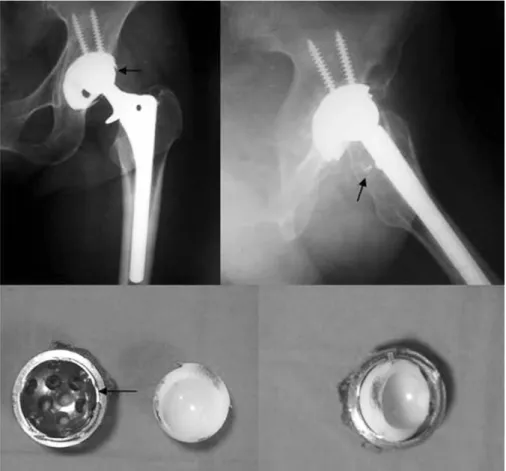
Fig. 1. Plain radiograph at postoperative 10 years shows osteolysis, eccentric position of the prosthetic head and dissociation of polyethylene liner. Retrieved specimens demonstrate the wear and dissociation of the polyethylene liner, and the failure of the locking mechanism (arrow).
Fig. 2. Postoperative radiograph at 9 years shows osteolysis, wear of polyethylene liner and a superolateral migration of the prosthetic head. Retrieved specimens show the wear, dissociation, and rim fracture of the polyethylene liner, but the locking mechanism was intact.
재치환술을 시행한 경우가 3례 였다. 폴리에틸렌 라이너 의 해리가 발생한 경우를 제1군(Fig. 1, 2), 폴리에틸렌 라 이너의 해리가 없었던 경우를 제2군(Fig. 3)으로 정의하 였다. 제1군은 18례, 제2군은 14례였다. Harris-Galante 비구컵을 이용하여 일차적 인공 고관절 전치환술을 시행 하고 5년 이상 추시된 148례 중 해리가 발생한 경우는 18 례(12.1 %)였다. 각 군에서 환자의 연령, 성별, 체중, 비구 컵의 종류, 비구컵의 크기, 폴리에틸렌 라이너의 두께, 재 치환술까지의 기간, 비구컵의 경사각, 전경, 폴리에틸렌 라이너의 마모율, 비구부 골 용해의 정도, 비구컵 잠금 장 치의 손상 들을 분석하였다. 통계적 분석은 Mann- Whitney test (SPSS 12.0)를 이용하였으며, p�0.05를 유 의한 것으로 판정하였다.
결 과
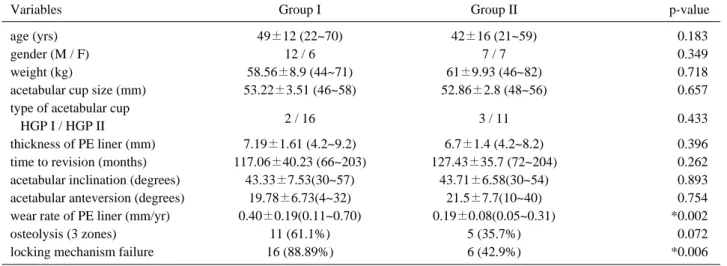
Table 1에서 보는 바와 같이 환자의 연령, 성별, 체중 사 이의 관계는 두 군간의 유의한 차이를 보이지 않았으며 비 구컵의 크기는 제 1 군에서 53.22±3.51 mm (46~58 mm), 제 2 군에서 52.86±2.8 mm (48~56 mm)로 두 군 간의 유의한 차이를 보이지 않았다(p=0.657). 비구컵의 종 류는 제 1군에서 Harris-Galante I형이 2례, Harris-
Galante II형이 16례 였으며, 제 2군에서는 Harris- Galante I형이 3례, Harris-Galante II형이 11례로 두 군간 의 통계적 유의성은 없었다(p=0.433). 폴리에틸렌 라이너 의 두께를 비교하였을 때 제 1군에서는 7.19±1.61 mm (4.2~9.2 mm), 제 2군에서 6.7±1.4 mm (4.2~8.2 mm)로 두 군간의 통계적 유의성은 없었으며(p=0.396), 재치환술 까지의 기간은 제 1군에서 117.06±40.23개월(66~203개 월), 제 2군에서 127.43±35.7개월(72~204개월)로 두 군 간의 통계적 유의성은 보이지 않았다(p=0.262).
비구컵의 경사각은 제 1군에서 43.33±7.53도(30~57 도), 제 2군에서 43.71±6.58도(30~54도)로 두 군간의 통 계적 유의성은 보이지 않았고(p=0.893), 전경도 각각 19.78±6.73도(4~32도), 21.5±7.7도 (10~40도)로 통계 적 유의성은 보이지 않았다(p=0.754).
골 용해와의 관계는 DeLee와 Charnley6)의 3구역 모두 골 용해가 발생한 경우가 제 1군은 11례 (61.1%), 제 2군 은 5례(35.7%)로서 제 1군에서 많았으나 통계적 유의성 은 없었다(p=0.072).
폴리에틸렌 라이너의 연 평균 마모율은 제 1군이 0.40 mm (0.11~0.70 mm), 제 2군이 0.19 mm (0.05~0.31 mm)로서 제 1군이 마모율이 높았고 통계적으로 유의한 차이를 보였으며(p=0.002), 잠금 기전 손상(locking
Fig. 3. Plain radiograph at postoperative 10 years shows the osteolysis. But, dissociation of the liner was not detected. Retrieved specimens demonstrate wear of polyethylene liner, the failure of the locking mechanism (arrow), and partial detachment of porous pad (arrow head)
mechanism failure)이 발생한 경우는 제 1군이 16례 (88.89%), 제 2군이 6례(42.9%)로서 제 1군에서 많이 발 생하였으며 통계적으로 유의하였다(p=0.006) (Table 1).
고 찰
골 시멘트를 사용하지 않는 조절형 반구형 비구컵은 압 박 고정과 추가적인 나사못 고정을 통해 훌륭한 골 내성장 을 얻을 수 있어 장기간의 추시 상 견고한 골성 고정을 얻 을 수 있고, 수술 중에 대퇴골두의 선택이 용이하며, 라이 너의 마모가 발생한 경우에는 라이너의 교환만으로 비구 컵의 수명을 연장할 수 있어 추시관찰에서 좋은 결과들이 보고되고 있다5,10,15,17).
그러나 최근 들어 조절형 반구형 비구컵 전치환술은 기 존의 인공관절이 가진 합병증 외에 기구 구성물간의 분리 현상 즉, 폴리에틸렌 라이너의 분리가 문제시 되고 있다
1,3,7,8,12,14,16). 즉 PCA 조절형 cup (Howmedica), JMP cup,
Anderson screw cup (Joint medical products), APR cup (Intermedics), ACS cup (Acetabular cup system : Depuy), Harris-Galante cup (Zimmer)등에서 폴리에틸 렌 라이너의 분리가 보고되고 있다1,3,7,8,16). Castro 등4)은 조 절형 비구컵에서 비구 구성 성분의 실패는 대퇴 구성 성분 의 실패보다 2배정도 많이 발생하고 있으며, 흔한 실패의 양상은 폴리에틸렌 골절과 폴리에틸렌 라이너의 분리라 고 하였다. Harris-Galante 비구컵의 경우 중, 장기 추시 관찰 시 잠금 장치의 파손에 의한 폴리에틸렌 라이너의 분 리가 발생하고 이로 인한 폴리에틸렌 라이너의 마모와 비 구골 주변의 골 용해를 증가시켜 비구컵의 실패가 야기되 고, 결국 재치환술의 빈도가 증가되는 것이 문제점으로 제 시되고 있다. Harris-Galante II형의 비구컵은 기존의 Harris-Galante I형에 비해 금속 비구컵의 두께가 증가하
고 비구 나사못의 직경도 증가하였으며 잠금 장치의 쐐기 모양의 클립 사이의 보조 지지대가 없어지고, tine의 수는 4~6개로 증가하여 Harris-Galante I형의 단점을 극복하고 자 하였으나, 오히려 폴리에틸렌 라이너의 두께의 감소 및 잠금 장치의 취약성이 발생하여 금속 비구컵과 폴리에틸 렌 사이의 미세 운동 과 두꺼워진 비구컵의 경직성으로 인 한 응력전달의 증가로 오히려 라이너의 마모가 심해지고 라이너의 분리도 증가되었다고 보고되고 있다7,13).
Tradonsky 등18)은 5개의 서로 다른 잠금 기전을 가진 8 개의 조절형 비구컵을 대상으로 실험한 결과 push-out및 lever out 강도가 Harris-Galante 비구컵에서 제일 약하 다고 하였다. Williams 등20)은 Harris-Galante II형 비구 컵이 다른 비구컵에 비해 더 많은 회전 미세운동이 일어난 다고 하였다. 이런 실험 결과들은 Harris-Galante II형의 비구컵이 약한 잠금 장치를 가지고 있음을 의미한다.
폴리에틸렌 라이너의 마모 및 분리와 관련된 인자로는 환자와 관련된 인자와 삽입물과 관련된 인자로 나눌 수 있 다. 환자와 연관 있는 인자로는 연령, 체중, 활동 등과 관 련이 있으며 삽입물과 관련된 인자로는 폴리에틸렌 라이 너의 두께, 비구컵의 경사각 및 대퇴 골두의 직경 등이 관 련 있다고 보고되고 있다.
Brien 등2)은 과 체중 환자에서 라이너의 분리가 발생한 4례를 보고하였고, Repten과 Solgaard16)는 라이너의 마 모가 원인이라고 하였으며 Mihalko와 Papademetriou13) 는 Harris-Galante II 비구컵에서 폴리에틸렌 라이너의 분 리가 비구컵의 경사도, 폴리에틸렌 라이너의 두께 등과 관 련이 있다고 하고 잠금 장치의 중요성을 강조하였으며, Kitzirger 등9)은 비구컵의 경사도가 큰 경우 폴리에틸렌 라이너 상방에 편중된 금속 대퇴 골두의 응력이 분리를 유 발한다고 하였으며, DellaValle 등7)은 약한 잠금 기전이 라이너 분리에 중요한 원인이라고 하였고, Werle 등19)도
Table 1. Comparison data of two groups
Variables Group I Group II p-value
age (yrs) 49±12 (22~70) 42±16 (21~59) *0.183
gender (M / F) 12 / 6 7 / 7 *0.349
weight (kg) 58.56±8.9 (44~71) 61±9.93 (46~82) *0.718
acetabular cup size (mm) 53.22±3.51 (46~58) 52.86±2.8 (48~56) *0.657
type of acetabular cup
2 / 16 3 / 11 *
0.433 HGP I / HGP II
thickness of PE liner (mm) 7.19±1.61 (4.2~9.2) 6.7±1.4 (4.2~8.2) *0.396
time to revision (months) 117.06±40.23 (66~203) 127.43±35.7 (72~204) *0.262 acetabular inclination (degrees) 43.33±7.53(30~57) 43.71±6.58(30~54) *0.893
acetabular anteversion (degrees) 19.78±6.73(4~32) 21.5±7.7(10~40) *0.754
wear rate of PE liner (mm/yr) 0.40±0.19(0.11~0.70) 0.19±0.08(0.05~0.31) *0.002
osteolysis (3 zones) 11 (61.1%) 5 (35.7%) *0.072
locking mechanism failure 16 (88.89%) 6 (42.9%) *0.006
* : statistical significance (p<0.05)
총 7례에서 폴리에틸렌 라이너의 분리를 보고하고 잘 고 정된 비구컵에서 잠금 장치의 실패가 원인이라고 하였다.
이 등11)은 Harris-Galante II형 비구컵에서 라이너의 분리 가 발생한 14례를 분석한 결과 비구컵의 경사도가 큰 경 우 라이너의 분리가 더 많이 발생할 수 있다고 하였다.
본 연구에서는 안정적으로 고정된 Harris-Galante I형 및 II형 비구컵에서 비구컵 주위의 골 용해, 잠금 장치의 손상, 라이너의 마모 등으로 재치환술을 시행한 32례에서 폴리에틸렌 라이너의 분리가 발생한 18례와 라이너의 분 리가 발생하지 않은 14례를 대상으로 라이너의 분리에 영 향을 미치는 인자들을 비교 분석한 결과 환자의 연령, 성 별, 체중, 비구컵의 종류, 비구컵의 크기, 폴리에틸렌 라이 너의 두께, 재치환술까지의 기간, 컵의 경사각, 전경, 골 용해의 정도 등은 연관성이 없었다. 본 연구에서는 다른 연구자들의 보고와 다소 상이한 결과들, 즉 라이너의 두 께, 체중과 같은 요소들이 연관성이 없다는 것을 볼 수 있 는데 이는 비구컵의 재치환술을 시행했던 원인 또는 연구 대 상 의 차 이 에 있 는 것 으 로 판 단 된 다 . Latimer와 Lachiewicz10)는 1례에서 라이너의 분리 없이 잠금 장치의 파열이 발생하였다고 보고하였다. 본 연구에서 제 2 군에 서 잠금 기전이 실패한 6례 에서는 비구컵 내에서 라이너 의 움 직 임 은 있 었 으 나 분 리 는 일 어 나 지 않 았 으 며 DellaValle 등7)이 18례 중 1례에서 잠금 장치의 파열이 관 찰된 후 1 년 후에 폴리에틸렌 라이너의 분리가 발생하였 다는 보고와 마찬가지로 만일 좀더 시간이 경과 하였다면 분리가 발생될 것으로 추정할 수 있다. 또한 잠금 기전의 실패가 없었으나 분리가 발생한 2례는 폴리에틸렌 라이너 의 연간 마모율이 각각 0.38 mm/year, 0.397 mm/year 였던 증례로서 심한 마모로 인해 분리가 발생하였던 것으 로 사료된다. 본 연구에서 폴리에틸렌 라이너의 마모율과 잠금 장치의 손상이 라이너의 분리에 영향을 미치는 것으 로 사료되었으며, 이는 DellaValle 등7) 및 Werle 등19)의 결과와 유사하였다. 조절형 비구컵에서 폴리에틸렌 라이 너의 분리는 발생 시 반드시 관혈적 치료가 필요하므로 주 기적인 X-선 관찰에서 폴리에틸렌 라이너의 마모가 진행 되면 라이너의 분리 및 잠금 장치의 손상등과 같은 재앙적 인 실패를 피하기 위하여 라이너의 교환과 같은 재수술을 고려해야 할 것으로 생각된다.
결 론
Harris-Galante 무시멘트형 비구컵에서 폴리에틸렌 라 이너의 분리를 감소시키기 위해서는 잠금 장치의 개선과 폴리에틸렌 라이너의 마모를 감소시키기 위한 관절면의 개선이 필요하며 잠금 장치의 손상을 조기에 발견하여 안 정적으로 고정된 비구컵의 재치환술을 감소시키는 것이 필요할 것으로 사료되었다.
REFERENCES
01) Barrack RL, Burke DW, Cook SD, Skinner HB and Harris WH:Complication related to modularity of total hip components. J Bone Joint Surg, 75-B: 688-692, 1993.
02) Brien WW, Salvati EA. Wright TM, Nilson CL, Hunger ford DS and Gilliam DL: Dissociation of acetabular components after total hip arthroplasty. Report of four cases. J Bone Joint Surg, 72-A: 1548-1550, 1992.
03) Cameron HU: Dissociation of polyethylene liner from an acetabular cup. Orthop Rev, 22: 1160-1161, 1993.
04) Castro FP Jr, Chimento G, Munn BG, Levy RS, Timmon S and Barrack, RL: An analysis of Food and Drug Administration medical device reports relating to total joint components. J Arthroplasty, 12: 765-771, 1997.
05) Clohisy JC and Harris WH: Primary hybrid total hip replacement, performed with insertion of the acetabular component without cement and a precoat femoral component with cement. An average ten-year follow-up study. J Bone Joint Surg, 81-A: 247-255, 1999.
06) DeLee JG and Chanley J: Radiologic demarcation of cemented sockets in total hip replacement. Clin Orthop Relat Res, 121: 20-32, 1976.
07) DellaValle AG, Ruzo PS, Li S, Pellicci Y, Sculco TP and Salvati EA: Dislodgment of polyethylene liners in first and second-generation Harris-Galante acetabular components. A report of eighteen cases. J Bone Joint Surg, 83-A: 553-559, 2001.
08) Han CD, Choe WS and Yoo JH: Late dissociation of polyethylene liner from a modular acetabular shell of the primary total hip arthroplasty. A report of five cases.
Yonsei Med J, 39: 277-282, 1998.
09) Kitziger KJ, DeLee JC and Evans JA: Disassembly of a modular acetabular component of a total hip-replacement arthroplasty. A case report. J Bone Joint Surg, 72-A: 621- 623, 1990.
10) Latimer HA and Lachiewicz PF : Porous coated acetabular component with screw fixation. Five-to-ten- year results. J Bone Joint Surg, 78-A: 975-981, 1996.
11) Lee JM, Ron JY, Seo IS, Wang WJ and Lee CW:
Factors associated with polyethylene liner dissociation of Harris-Galante II acetabular component. J Korean Hip Soc, 16(3): 332-338, 2004.
12) Louwerse Rt. and Heyligers IC: Late failure of polyethylene liner fixation in uncemented total hip arthroplasty. J Arthroplasty, 14: 391-396, 1999.
13) Mihalko WM and Papademetriou T: Polyethylene liner dissociation with the Harris-Galante II acetabular component. Clin Orthop Relat Res, 386: 166-172, 2001.
14) Min BW, Bae KC, Lee KJ, Sohn SW and Kang CH:
Failure mode of polyethylene liner in total hip arthroplasty with Harris-Galante II Acetabular cup. J Korean Orthop. Assoc, 39: 762-772, 2004.
15) Park SW, Lee SH, Han SB, Lee SJ and Yo WJ: Total hip arthroplasty with Harris-Galante II acetabular
component. J Korean Hip Soc, 13(1): 30-35, 2001.
16) Retpen JB and Solgaard S: Late disassembly of modular acetabular components. A report of two cases. Acta Orthop Scand, 64: 193-195, 1993.
17) Tompkins GS, Jacobs JJ, Kull LR, Rosenberg AG and Galante JO: Primary total hip arthroplasty with a porous-coated acetabular component. Seven-to-ten-year results. J Bone Joint Surg, 79-A: 169-176, 1997.
18) Tradonsky S, Postak PD, Froimson Al and Greenwald AS: A comparison of the disassociation strength of
modular acetabular components. Clin Orthop Relat Res, 296: 154-160, 1993.
19) Werle J, Goodman S, Schurman D and Lannin J:
Polyethylene liner dissociation in Harris-Galante acetabular components: a report of 7 cases. J Arthroplasty, 17(1): 78-81, 2002.
20) William VG 2nd, Whitside LA, White SE and McCarthy DS: Fixation of ultra-high molecular weight polyethylene liners to metal-backed acetabular cups. J Arthroplasty, 12: 25-31, 1997.
The analysis of Affecting Factors for the Dissociation of the
Polyethylene Liner in Cementless Harris-Galante Acetabular Component
Sang-Won Park, M.D., Jong-Hoon Park, M.D., Hyung-Joon Cho, M.D., Dong-Ik Song, M.D.
Department of Orthopedic Surgery, Collage of Medicine, Korea University, Seoul, Korea
Purpose: This study was performed to evaluate the factors associated with dissociation of the polyethylene liner with using a Harris-Galante I or II acetabular component in a stably positioned acetabular cup.
Materials and Methods: Between January 1998 and February 2007, 32 cases underwent revision of the acetabular component due to osteolysis, wear of the polyethylene liner or locking mechanism failure around the acetabulum in spite of stable positioning. 5 cases were primarily operated on using the type I Harris-Galante Hip Prosthesis and 27 cases used the type II. We divided the 32 cases into the two groups: Group I (18 cases) was composed of cases with the existence of polyethylene liner (PE) dissociation and Group II (14 cases) had no dissociation. The analyzed factors were age, gender, body weight, the type and the size of the acetabular cup, the thickness of the polyethylene liner, the duration of the time interval from the primary surgery, the inclination and ante-version of the acetabular cup, the wear rate of the PE liner, the degree of the osteolysis around the acetabulum and the existence of failure of the locking mechanism in the acetabular component. Statistical analysis was performed using the Mann-Whitney test (SPSS 12.0).
Results: Statistical significance was noted only for the wear rate of the PE liner (Group I: 0.40±0.19 mm/year, Group II: 0.19±0.08 mm, p=0.002) and the existence of failure of the locking mechanism (Group I: 16 cases (88.9%), Group II: 6 cases (42.9%), p=0.006).
Conclusion: According to this study, the dissociation of the PE liner was influenced by the wear rate of the PE liner and the existence of failure of the locking mechanism in the acetabular component. In order to prevent PE liner dissociation, improvement of the locking mechanism and the PE liner system are essential.
Key Words: Harris-Galante acetabular component, Polyethylene liner dissociation A
ABBSSTTRRAACCTT