128 서 론
고추장은 콩과 전분질, 고춧가루, 소금을 주원료로 하 며 콩의 분해산물인 아미노산의 감칠맛, 찹쌀, 멥쌀, 보 리 등의 전분질원의 분해로 인한 당질과 단맛, 소금의 짠맛, 고춧가루의 매운맛과 함께 고춧가루의 붉은 색으 로 인한 시각적 효과까지 골고루 갖춘 전통 장류 식품이
다.1) 고추장은 크게 전통식 고추장과 상품용 고추장으로 분류할 수 있는데 전통식 고추장은 메주를 띄우는 과정 에서 많은 종류의 세균이나 곰팡이가 서식하기 때문에 고추장 숙성과정(6∼18개월)에서 이들 미생물이 분비하 는 효소작용에 의하여 원료 성분이 분해되어 생성되는 유기산, 핵산, 알코올 등이 맛이나 향에 관여하여 풍미의 조화를 이룬다. 공장식 고추장은 숙성식, 당화식 고추장 으로 Aspergillus oryzae를 순수배양한 koji를 고추장 메주 대
건조마늘 첨가에 따른 고추장의
in vitro
항암증진 효과부산대학교 식품영양학과, 1(주) 해찬들 식품연구소
공창숙․김수옥․정근옥․길정하․이숙희․한민수1․박건영
Increased Anticancer Effect of Kochujang (Korean Red Pepper Soybean Paste) Prepared with Garlic Powder Dried with Different Methods
Chang-Suk Kong, Su-Ok Kim, Keun-Ok Jung, Jeung-Ha Kil, Sook-Hee Rhee, Min-Soo Han1 and Kun-Young Park
Department of Food Science and Nutrition, Pusan National University, Busan 609-735, Korea
1R&D Center, Haechandle Foods Co. LTD, Chungnam 320-833, Korea
The anticancer effects of methanol extracts from garlic dried differently and the dried garlic added
kochujang (Korean red pepper soybean paste) were evaluated on AGS human gastric and HT-29 human
colon adenocarcinoma cells by MTT assay. Freeze dried garlic was made from a whole bulb garlic and hot-air dried garlic were prepared from a whole bulb, sliced and chopped garlic at 70oC. Methanol extracts of the freeze dried garlic showed higher anticancer effects than those of hot-air dried garlic on AGS human gastric and HT-29 human colon adenocarcinoma cells. Among the hot-air dried garlic, sliced garlic showed the highest inhibition rate. The kochujang prepared with the freeze dried garlic showed higher anticancer effects than the kochujang with hot-air dried garlic on AGS human gastric and HT-29 human colon adenocarcinoma cells. Addition of the freeze dried garlic during kochujang preparation inhibited the growth of the cells in a concentration dependent manner. Addition of the dried garlics during kochujang preparation increased anticancer activities, especially freeze dried one was more effective. (Cancer Prev Res 10, 128-133, 2005)ꠏꠏꠏꠏꠏꠏꠏꠏꠏꠏꠏꠏꠏꠏꠏꠏꠏꠏꠏꠏꠏꠏꠏꠏꠏꠏꠏꠏꠏꠏꠏꠏꠏꠏꠏꠏꠏꠏꠏꠏꠏꠏꠏꠏꠏꠏꠏꠏꠏꠏꠏꠏꠏꠏꠏꠏꠏꠏꠏꠏꠏꠏꠏꠏꠏꠏꠏꠏꠏꠏꠏꠏꠏꠏꠏꠏꠏꠏꠏꠏꠏꠏꠏꠏꠏꠏꠏꠏꠏꠏꠏꠏꠏꠏꠏꠏꠏꠏꠏꠏꠏꠏ Key Words:
Kochujang, Garlic, Anticancer, MTT assay
책임저자 : 박건영, ꂕ 609-735, 부산시 금정구 장전동 30 부산대학교 식품영양학과
Tel: 051-510-2839, Fax: 051-514-3138 E-mail: [email protected]
접수일:2005년 3월 30일, 게재승인일:2005년 5월 4일
Correspondence to:Kun-Young Park
Department of Food Science and Nutrition, Pusan National University, 30 Janjeon-dong, Geumjung-gu, Busan 609-735, Korea
Tel: +82-51-510-2839, Fax: +82-51-514-3138 E-mail: [email protected]
신에 사용한다. Koji 제조에서 단백질 원료로서는 콩이, 전분질 원료로서는 찹쌀이나 밀가루가 사용되는데, 콩 과 쌀에 각각 Aspergillus oryzae를 접종시켜 3∼4일간 발효 한 다음 1:1 비율로 섞어 메주대신 첨가하기 때문에 주 로 Aspergillus oryzae의 효소작용과 효모의 발효작용에 의 해 풍미가 높아지며 숙성기간(15∼60일)이 비교적 짧은 특징을 가진다.2)
예로부터 각종 음식에 이용되고 있는 마늘은 많은 양 의 유기황을 함유하고 있어 독특한 향미를 지니는데, 최 근 이들 황화합물이 항균성, 항암성, 항혈전성, 항산화성 등의 기능성을 가지고 있는 것으로 보고되면서 건강보 조 식품 및 의약품의 소재로도 널리 활용되고 있다.3∼16) 마늘의 자극성 냄새와 맛은 마늘 중의 alliin이 다지거나 썰 때 allinase에 의해 분해되어 생성된 allicin에 의한 것으 로, allliin은 열 등의 자극에 강한 반면 allicin은 외부의 자 극에 불안정하여 20~100oC로 가열시 ajoene과 같은 물질 로 전환된다. Allicin은 항균효과 및 항암효과가 높으며 ajoene은 항암효과 및 혈전용해효과가 높은 것으로 알려 져 최근 주목받고 있는 물질이다. 따라서 고추장의 항암 효과를 증진하기 위해 마늘을 첨가할 경우 통마늘, 슬라 이스, 다진 마늘 등 형태를 달리하거나 동결건조나 열풍 건조 등의 건조방법에 따라 각기 다른 활성물질에 의한 고추장의 항암증진 효과를 기대할 수 있다.
본 연구에서는 본래 고추장은 그 자체가 항암효과를 가지며,2) 제조방법 및 사용되는 부재료에 따라 항암활성 이 달라지므로 고추장의 항암효과를 증진시키기 위하여 건조방법을 달리하여 건조한 마늘을 첨가하여 제조한 고추장의 항암기능성 증진효과를 살펴보았다.
재료 및 방법 1. 시료의 준비
마늘시료는 동결건조법 및 열풍건조법으로 건조하여 사용하였다. 동결건조마늘은 통마늘의 형태로 건조하였 으며, 열풍건조마늘은 통마늘, 슬라이스(2∼3 mm 두께), 다진 마늘의 형태로 준비하여 70oC에서 1~4일간 건조하 여 사용하였다. 건조한 마늘은 1% 및 5%의 비율로 첨가 하여 고추장을 제조하였다. 소금은 한주 소금을 사용하 였으며 밀쌀은 호주산으로 80% 도정된 것을 사용하였 다. 고추장은 상품용 고추장의 제조방법으로 밀쌀과 밀 가루를 증자 냉각하여 Asp. oryzae를 접종한 후 밀가루 곡 자와 덧밥, 식염, 종수를 첨가하였고, 여기에 효모를 접 종하고 혼합(30oC일주일 숙성)하여 이송한 후 30∼40일 간 균질화시킨 사입물에 고춧가루 및 마늘을 첨가하여
제조하였다.
건조된 마늘은 마쇄하여 분말형태로 조제하였으며 고 추장은 동결건조한 후 시료를 마쇄하여 분말로 조제하 였다. 이들 분말시료에 20배(w/v)의 메탄올을 첨가하여 12시간 교반을 2회 반복하여 여과한 후 회전식 진공 농 축기로 농축하여 메탄올 추출물(methanol extract)을 얻었 다. 이들 추출물들은 dimethyl sulfoxide (DMSO)에 희석하여 20% stock을 만들어 여러 농도로 희석하여 사용하였다.
2. 암세포 배양
AGS 인체 위암세포(AGS human gastric adenocarcinoma cell), HT-29 인체 결장암세포(HT-29 human colon adenocar- cinoma cell)는 한국세포주은행(서울의대)으로부터 분양 받아 배양하면서 실험에 사용하였다. AGS 및 HT-29 암 세포는 100 units/ml의 penicilin-streptomycin과 10%의 FBS (fetal bovine serum)가 함유된 RPMI 1640을 사용하였다. 배 양된 각각의 암세포는 일주일에 2∼3회 refeeding하고 6∼7일 만에 PBS로 세척한 후 0.05% trypsin-0.02% EDTA 로 부착된 세포를 분리하여 원심분리한 후 집적된 암세 포에 배지를 넣고 피펫으로 암세포가 골고루 분산되도 록 잘 혼합하여 6~7일 마다 계대배양하면서 실험에 사 용하였다. 계대배양시 각각의 passage number를 기록하였 고 passage number가 10회 이상일 때는 새로운 암세포를 액체질소 탱크로부터 꺼내어 다시 배양하여 실험하였 다.
3. MTT assay
배양된 암세포를 96 well plate에 well당 1×10⁴ cells/ml가 되도록 seeding하고 시료를 농도별로 첨가한 다음, 37oC, 5% CO2 incubator에서 배양하였다. 72시간 후 MTT (Sigma, USA) 20μl를 첨가하고 4시간 동안 더 배양한 후 생성된 formazan 결정을 DMSO에 녹여 540 nm에서 흡광 도를 측정하였다.19)
4. 통계 분석
대조군과 각 시료로부터 얻은 실험 결과들의 유의성 을 검정하기 위하여 분산분석(ANOVA)을 행한 후 α=
0.05 수준에서 Duncan’s multiple range test를 실시하였으 며, 그 결과는 평균(Mean)±표준편차(Standard deviation, SD)로 표시하였다. 모든 통계 분석은 Statistic Analysis Sys- tem (v8.2 SAS Institute Inc., NC, USA) 통계프로그램을 이
대조구의 흡광도-시료처리구의 흡광도 Cytotoxicity (%)=ꠏꠏꠏꠏꠏꠏꠏꠏꠏꠏꠏꠏꠏꠏꠏꠏꠏꠏꠏꠏꠏꠏꠏꠏꠏꠏꠏꠏꠏꠏꠏꠏꠏꠏꠏꠏ×100
대조구의 흡광도
용하여 처리하였다.
결 과
1. 건조방법을 달리한 마늘의 항암효과
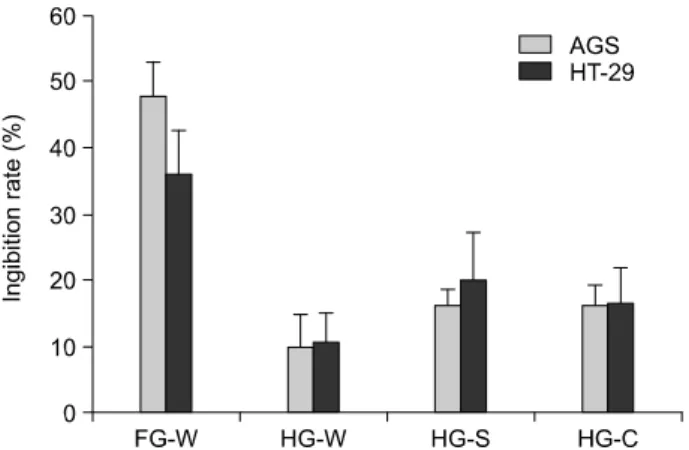
마늘 건조방법에 따른 마늘의 in vitro 항암효과를 살펴 본 결과는 Fig. 1과 같다. 동결건조마늘은 통마늘을 그대 로 건조하여 사용하였으며, 열풍건조마늘은 통마늘, 슬 라이스, 다진 마늘의 형태로 건조하였다. 동결건조법을 이용하여 건조한 마늘은 열풍건조법으로 건조한 마늘에 비해 AGS 위암세포 및 HT-29 결장암세포에 대한 항암효 과가 높게 나타났다. 열풍건조법으로 건조한 마늘은 조 직의 파쇄정도에 따라 그 암세포 증식 억제효과가 다소 다르게 나타났는데, 통마늘로 건조한 것에 비해 슬라이 스 및 다진 상태로 건조한 마늘에서 다소 높은 암세포 증식억제효과를 보였다.
2. 건조방법을 달리한 마늘을 첨가한 고추장의 항암효과
AGS 인체 위암세포에 대하여 건조방법을 달리한 건조 마늘을 첨가한 고추장의 활성을 알아보기 위하여 동결 건조법 및 열풍건조법으로 건조한 마늘을 5% 농도로 첨 가하여 만든 고추장을 메탄올 추출하여 항암효과를 살 펴보았다(Table 1). 건조마늘은 통마늘의 형태로 건조한 것을 분쇄하여 사용하였다. 건조마늘을 첨가한 고추장 은 마늘을 첨가하지 않은 고추장보다 높은 항암효과를
보였다. 동결건조 마늘의 첨가는 고추장의 항암활성을 높여주었으며, 열풍건조마늘의 첨가는 고추장의 항암효 과에는 크게 증진시키지는 않았다.
HT-29 인체 결장암세포에 대한 건조마늘 첨가 고추장 의 항암활성도 AGS 암세포에서와 유사한 결과를 나타내 었다(Table 2). 고추장의 제조에 있어서 동결건조마늘의 첨가는 고추장의 항암활성을 유의적으로 증진시켰으나 열풍건조 마늘의 첨가는 고추장의 항암효과에는 크게 영향을 미치지 않았다.
Fig. 1. Inhibitory effects of methanol extracts from garlic powder prepared with different drying methods on the growth of AGS human gastric and HT-29 human colon adenocarcinoma cells in 3-(4,5-dimethyl-thiazol)-2,5-diphenyltetrazoliumbromide (MTT) assay.
FG-W: the freeze dried garlic powder as a whole bulb of garlic.
HG-W: the hot-air dried garlic powder as a whole bulb of garlic.
HG-S: the hot-air dried garlic powder as a sliced garlic.
HG-C: the hot-air dried garlic powder as a chopped garlic.
Table 1. Inhibitory effects of methanol extracts from kochujang prepared with freeze and hot-air dried garlic powder on the growth of AGS human gastric adenocarcinoma cells in 3-(4,5- dimethyl-thiazol)-2,5-diphenyltetrazoliumbromide (MTT) assay ꠚꠚꠚꠚꠚꠚꠚꠚꠚꠚꠚꠚꠚꠚꠚꠚꠚꠚꠚꠚꠚꠚꠚꠚꠚꠚꠚꠚꠚꠚꠚꠚꠚꠚꠚꠚꠚꠚꠚꠚꠚꠚꠚꠚꠚꠚꠚꠚꠚꠚꠚꠚꠚꠚꠚ
OD540
ꠏꠏꠏꠏꠏꠏꠏꠏꠏꠏꠏꠏꠏꠏꠏꠏꠏꠏꠏꠏꠏꠏꠏꠏꠏꠏꠏꠏꠏꠏꠏꠏꠏ
1 mg/ml 2 mg/ml
ꠏꠏꠏꠏꠏꠏꠏꠏꠏꠏꠏꠏꠏꠏꠏꠏꠏꠏꠏꠏꠏꠏꠏꠏꠏꠏꠏꠏꠏꠏꠏꠏꠏꠏꠏꠏꠏꠏꠏꠏꠏꠏꠏꠏꠏꠏꠏꠏꠏꠏꠏꠏꠏꠏꠏ Control 0.552±0.015a 0.548±0.010a Kochujang1) 0.428±0.015b (23) 0.321±0.022b (41) Kochujang-FG2) 0.364±0.021d (34) 0.255±0.033c (55) Kochujang-HG3) 0.389±0.012c (29) 0.320±0.030b (42) ꠏꠏꠏꠏꠏꠏꠏꠏꠏꠏꠏꠏꠏꠏꠏꠏꠏꠏꠏꠏꠏꠏꠏꠏꠏꠏꠏꠏꠏꠏꠏꠏꠏꠏꠏꠏꠏꠏꠏꠏꠏꠏꠏꠏꠏꠏꠏꠏꠏꠏꠏꠏꠏꠏꠏ
a∼dMeans with the different letters in the same column are significantly different (p<0.05) by Duncan's multiple range test.
1)Kochujang prepared without garlic powder.
2)Kochujang-FG: Kochujang prepared with freeze dried garlic powder (5%) as a whole bulb of garlic.
3)Kochujang-HG: Kochujang prepared with hot-air dried garlic powder (5%) as a sliced garlic.
Table 2. Inhibitory effects of methanol extracts from kochujang prepared with freeze and hot-air dried garlic powder on the growth of HT-29 human colon adenocarcinoma cells in 3-(4,5-dimethyl-thiazol)-2,5-diphenyltetrazoliumbromide (MTT) assay
ꠚꠚꠚꠚꠚꠚꠚꠚꠚꠚꠚꠚꠚꠚꠚꠚꠚꠚꠚꠚꠚꠚꠚꠚꠚꠚꠚꠚꠚꠚꠚꠚꠚꠚꠚꠚꠚꠚꠚꠚꠚꠚꠚꠚꠚꠚꠚꠚꠚꠚꠚꠚꠚꠚꠚ
OD540
ꠏꠏꠏꠏꠏꠏꠏꠏꠏꠏꠏꠏꠏꠏꠏꠏꠏꠏꠏꠏꠏꠏꠏꠏꠏꠏꠏꠏꠏꠏꠏꠏꠏ
1 mg/ml 2 mg/ml
ꠏꠏꠏꠏꠏꠏꠏꠏꠏꠏꠏꠏꠏꠏꠏꠏꠏꠏꠏꠏꠏꠏꠏꠏꠏꠏꠏꠏꠏꠏꠏꠏꠏꠏꠏꠏꠏꠏꠏꠏꠏꠏꠏꠏꠏꠏꠏꠏꠏꠏꠏꠏꠏꠏꠏ
Control 0.327±0.020a 0.311±0.003a
Kochujang1) 0.271±0.018b (17) 0.175±0.013b (44) Kochujang-FG2) 0.212±0.018c (35) 0.140±0.011c (55) Kochujang-HG3) 0.255±0.016b (22) 0.179±0.017b (42) ꠏꠏꠏꠏꠏꠏꠏꠏꠏꠏꠏꠏꠏꠏꠏꠏꠏꠏꠏꠏꠏꠏꠏꠏꠏꠏꠏꠏꠏꠏꠏꠏꠏꠏꠏꠏꠏꠏꠏꠏꠏꠏꠏꠏꠏꠏꠏꠏꠏꠏꠏꠏꠏꠏꠏ
a∼cMeans with the different letters in the same column are significantly different (p<0.05) by Duncan’s multiple range test.
1∼3)The explanations are same as shown in Table 1.
3. 동결건조 마늘 첨가 함량에 따른 고추장의 항암효과
위의 결과에서 열풍건조 마늘에 비하여 동결건조마늘 을 첨가한 고추장의 in vitro 항암효과가 높은 것을 알 수 있었다. 고추장의 항암 기능성을 증진시키기에 적절한 마늘의 농도를 결정하기 위하여 동결건조마늘을 1%, 5%의 농도로 고추장에 첨가하여 in vitro 항암효과를 살 펴보았다. 동결건조마늘 첨가고추장의 AGS 인체 위암세 포에 대한 항암효과를 살펴본 결과는 Table 3과 같다. 동 결건조마늘의 첨가 농도에 비례하여 고추장의 항암효과 도 유의적으로 증가하였다(p<0.05). 시료처리농도 2 mg/
ml에서는 마늘을 첨가하지 않은 고추장, 1% 마늘을 첨 가한 고추장 및 5% 마늘을 첨가한 고추장은 각각 42%, 48%, 55%의 저해율을 보였다.
HT-29 인체 결장암세포에 대한 동결건조마늘 첨가 고 추장의 항암활성을 살펴본 결과에서도(Table 4) AGS 인 체 위암세포에 대하여 살펴본 결과와 비슷한 경향을 나 타내었다. 고추장에 첨가된 동결건조마늘의 농도가 높 을수록 항암활성도 증가하였다.
고 찰
고추장의 항암효과는 제조방법에 따라 차이가 있으며 특히 사용하는 재료가 고추장의 항암효과에 큰 영향을 주는 것으로 알려져 있다. 따라서 본 연구에서는 항암 기능성이 있다고 알려진 부재료 중 고추장의 맛과 색깔 에 영향을 주지 않는 마늘을 첨가하여 고추장의 항암효 과를 증진시키고자 하였다.
마늘에는 유효한 생리활성성분인 휘발성 황화합물이 다량 함유되어 있는데, 이는 마늘을 썰거나 다져서 조직
을 마쇄함으로서 마늘 중의 alliin이 allinase에 의하여 alli- cin과 pyruvic acid로 분해되고 allicin이 다시 diallyl disulfide 로 분해된 후 이들이 pyruvic acid와 서로 작용하여 저급 황화합물 및 carbonyl 화합물을 생성하게 된다.17,18) 또한 마늘의 항암효과는 alliin과 allicin에 의한 것이며 allicin은 열에 약하고 조직을 파괴하였을 때 쉽게 파괴되는 것으 로 알려져 있다. 따라서 마늘을 고추장에 첨가하기 전에 마늘을 어떤 형태로 첨가해야 고추장의 항암효과를 증 진시킬 수 있는지를 알아보기 위해 마늘의 건조방법을 달리하여 in vitro 항암효과를 측정하였다. 열풍건조법보 다는 동결건조법을 이용하여 건조한 마늘에서 AGS 인체 위암세포 및 HT-29 결장암세포에 대하여 높은 in vitro 항 암효과가 높은 것으로 나타났다. 또한 열풍건조법으로 건조한 마늘은 통마늘로 건조한 것보다 슬라이스 나 다 진 상태로 건조한 마늘에서 다소 높은 항암효과를 나타 내었다. 이는 열풍건조법으로 마늘을 건조할 때 다진 마 늘은 건조시간이 1일 소요되었으나 슬라이스한 마늘은 2일, 통마늘은 4일이 소요되었으며, 다진 마늘과 슬라이 스한 마늘은 타지 않고 잘 건조되었으나 통마늘의 경우 속까지 건조되는 동안 표면이 검게 타서 균일하게 건조 되지 못하였다. 따라서 마늘의 경우 그 항암활성성분이 휘발성 황화합물인 allin과 allicin이므로 이들 활성 성분 이 파괴되지 않는 동결건조방법을 사용하는 것이 고추 장의 항암효과를 증진시키는데 도움이 될 것으로 사료 된다.
동결건조법 및 열풍건조법으로 건조한 마늘을 5%의 첨가농도로 하여 만든 고추장을 메탄올 추출하여 항암 활성을 살펴본 결과, 고추장의 제조에 있어서 동결건조 마늘의 첨가는 고추장의 in vitro 항암효과를 유의적으로 증진시켰으나, 열풍건조 마늘의 첨가는 고추장의 항암 Table 3. Inhibitory effects of methanol extracts from kochujang
prepared with freeze dried garlic powder on the growth of AGS human gastric adenocarcinoma cells in 3-(4,5-dimethyl-thiazol) -2,5-diphenyltetrazoliumbromide (MTT) assay
ꠚꠚꠚꠚꠚꠚꠚꠚꠚꠚꠚꠚꠚꠚꠚꠚꠚꠚꠚꠚꠚꠚꠚꠚꠚꠚꠚꠚꠚꠚꠚꠚꠚꠚꠚꠚꠚꠚꠚꠚꠚꠚꠚꠚꠚꠚꠚꠚꠚꠚꠚꠚꠚꠚꠚ
OD540
ꠏꠏꠏꠏꠏꠏꠏꠏꠏꠏꠏꠏꠏꠏꠏꠏꠏꠏꠏꠏꠏꠏꠏꠏꠏꠏꠏꠏꠏꠏꠏ
1 mg/ml 2 mg/ml
ꠏꠏꠏꠏꠏꠏꠏꠏꠏꠏꠏꠏꠏꠏꠏꠏꠏꠏꠏꠏꠏꠏꠏꠏꠏꠏꠏꠏꠏꠏꠏꠏꠏꠏꠏꠏꠏꠏꠏꠏꠏꠏꠏꠏꠏꠏꠏꠏꠏꠏꠏꠏꠏꠏꠏ Control 0.512±0.006a 0.527±0.001a Kochujang-FG 0% 0.400±0.009b (22) 0.319±0.025b (42)
1% 0.358±0.005c (30) 0.285±0.034bc (48) 5% 0.311±0.009d (39) 0.250±0.033c (55) ꠏꠏꠏꠏꠏꠏꠏꠏꠏꠏꠏꠏꠏꠏꠏꠏꠏꠏꠏꠏꠏꠏꠏꠏꠏꠏꠏꠏꠏꠏꠏꠏꠏꠏꠏꠏꠏꠏꠏꠏꠏꠏꠏꠏꠏꠏꠏꠏꠏꠏꠏꠏꠏꠏꠏ
a∼dMeans with the different letters in the same column are significantly different (p<0.05) by Duncan's multiple range test.
Table 4. Inhibitory effects of methanol extracts from kochujang prepared with freeze dried garlic powder on the growth of HT-29 human colon adenocarcinoma cells in 3-(4,5-dimethyl-thiazol) -2,5-diphenyltetrazoliumbromide (MTT) assay
ꠚꠚꠚꠚꠚꠚꠚꠚꠚꠚꠚꠚꠚꠚꠚꠚꠚꠚꠚꠚꠚꠚꠚꠚꠚꠚꠚꠚꠚꠚꠚꠚꠚꠚꠚꠚꠚꠚꠚꠚꠚꠚꠚꠚꠚꠚꠚꠚꠚꠚꠚꠚꠚꠚꠚ OD540
ꠏꠏꠏꠏꠏꠏꠏꠏꠏꠏꠏꠏꠏꠏꠏꠏꠏꠏꠏꠏꠏꠏꠏꠏꠏꠏꠏꠏꠏꠏꠏꠏ
1 mg/ml 2 mg/ml
ꠏꠏꠏꠏꠏꠏꠏꠏꠏꠏꠏꠏꠏꠏꠏꠏꠏꠏꠏꠏꠏꠏꠏꠏꠏꠏꠏꠏꠏꠏꠏꠏꠏꠏꠏꠏꠏꠏꠏꠏꠏꠏꠏꠏꠏꠏꠏꠏꠏꠏꠏꠏꠏꠏꠏ Control 0.332±0.018a 0.313±0.003a Kochujang-FG 0% 0.248±0.021b (25) 0.170±0.011b (46)
1% 0.235±0.010bc (29) 0.148±0.008c (53) 5% 0.218±0.015c (34) 0.137±0.010c (56) ꠏꠏꠏꠏꠏꠏꠏꠏꠏꠏꠏꠏꠏꠏꠏꠏꠏꠏꠏꠏꠏꠏꠏꠏꠏꠏꠏꠏꠏꠏꠏꠏꠏꠏꠏꠏꠏꠏꠏꠏꠏꠏꠏꠏꠏꠏꠏꠏꠏꠏꠏꠏꠏꠏꠏ
a∼cMeans with the different letters in the same column are significantly different (p<0.05) by Duncan's multiple range test.
효과에는 크게 영향을 미치지 않았다. 또한, 동결건조 마 늘을 1%, 5%의 농도로 고추장에 첨가하여 항암효과를 살펴본 결과, AGS 및 HT-29 인체 암세포에 대하여 동결 건조마늘 첨가고추장의 항암활성은 비슷한 경향을 나타 내어, 고추장에 첨가된 동결건조마늘의 농도가 높을수 록 항암효과가 높게 나타났다.
마늘에 함유된 황화합물이 항균성, 항암성, 항혈전성, 항산화성 등의 기능성을 가지고 있는 것으로 보고되고 있는데, 마늘에 대한 항암작용은 위암20∼23)뿐만 아니라, 직장암,24∼26) 폐암,27∼29) 전립선암,30,31) 피부암32∼34) 등 마 늘 또는 마늘의 유황성분에 의한 다양한 효능을 나타내 는 것으로 알려져 있다. 마늘에 함유된 항암성분으로는 Diallyl trisulfide (DATS), S-allylcysteine, allyl methyl disulfide (AMD), allyl methyl trisulfide (AMT), diallyl trisulfide (DAT), dillyl trisulfide (DAS), dillyl disulfide (DADS) 등이 있다.35) 따라서 동결건조마늘은 열풍건조마늘에 비해 AGS 및 HT-29 인체 암세포에 대한 항암활성이 높게 나타내어, 동결건조법은 마늘에 함유된 항암활성성분을 최대한으 로 그대로 유지할 수 있었다. 이러한 높은 항암활성을 가지는 동결건조마늘을 첨가하여 제조함으로써 고추장 의 항암 효과를 더욱 높일 수 있었다.
결 론
고추장의 기능성 증진을 위하여 마늘의 항암활성을 마늘 건조방법에 따라 살펴본 결과, 열풍건조법보다는 동결건조법을 이용하여 건조한 마늘에서 AGS 및 HT-29 인체암세포에 대하여 높은 in vitro 항암효과를 나타내었 다. 고추장의 항암기능성 증진을 위하여 마늘을 첨가하 는 경우, 열풍건조마늘에 비하여 동결건조마늘을 첨가 하였을 때 항암효과가 높게 나타났으며, 고추장에 첨가 된 동결건조마늘의 농도가 높을수록 항암효과가 높게 나타났다. 이는 마늘에 함유된 항암활성 성분에 의한 것 으로 동결건조법은 마늘에 함유된 항암활성성분을 최대 한으로 그대로 유지할 수 있었다. 이러한 높은 항암활성 을 가지는 동결건조마늘을 첨가하여 제조함으로써 고추 장의 항암 효과를 더욱 높일 수 있었다.
감사의 글
본 연구는 2003∼2005년 해찬들 연구비 지원에 의해 수행되었으며, 이에 감사드립니다.
참 고 문 헌
1) 이한창. 한국의 장류(분류, 미생물, 문제점을 중심으로) 한 국 식생활에서의 장류 문화. 한국식생활문화학회지 7, 371-381, 1992.
2) 김소자, 정근옥. AGS 인체 위암세포에서 고추장 및 고추장
재료의 in vitro 항암효과. 대한암예방학회지 9, 42-48, 2004.
3) Sivam GP. Protection against Helicobacter pylori and other bacterial infections by garlic. J Nutr 131, 1106-1108, 2001.
4) Tsao SM, Yin MC. In vitro activity of garlic oil and four diallyl sulfides against antibiotic-resistant Pseudomonas aeruginosa and Klebsiella pneumoniae. J Antimicrob Chemother 47, 665- 670, 2001.
5) Avato P, Tursil E, Vitali C, Miccolis V, Candido V. Allylsulfide constityents of garlic volatile oil as antimicrobial agents.
Phytomedicine 7, 239-243, 2000.
6) Chen GW, Chung JG, Ho HC, Lin JG. Effects of the garlic compounds diallyl sulfide and diallyl disulfide on arylamine N-acetyltransferase activity in Klebsiella pneumoniae. J Appl
Toxicol 19, 75-81,
2004.7) Pinto JT, Rivlin RS. Antiproliferative effects of allium deri- vatives from garlic. J Nutr 131, 1058-1560, 2001.
8) Chung JG. Effects of garlic components diallyl sulfide and diallyl disulfide on arylamine N-acetyltransferase activity in human bladder tumor cells. Drug Chem Toxicol 22, 343-348, 1999.
9) Shenoy NR. Inhibitionary effect of diet related sulfydryl compounds in the formation of carcinogenic nitrosamine.
Cancer Lett 31, 227-232, 1992.
10) Singh SV, Pan SS, Srivastava SK, Xia H, Hu X, Zaren HA, Orchard JL. Differential induction of NAD(P)H: quinone oxidoreductase by anticarcinogenic organosulfides from garlic.
Biochem Biophys Res Commun 27, 917-920, 1998.
11) Ahman K. Historical perspective on garlic and cardiovascular disease. J Nutr 131, 977-979, 2001.
12) Rahman K, Billngton D. Dietary supplementation with aged garlic extract inhibits ADP-induced platelet aggregation in humans. J Nutr 130, 2662-2665, 2000.
13) Chun HJ, Paik JE. Effect of heat treatment of garlic added diet on the blood of spontaneously hypertension rat. J Korean
Soc Food Sci Nutr 26, 103-108, 1997.
14) Borek C. Antioxidant health effects of aged garlic extract. J
Nutr 131, 1010-1015, 2001.
15) Fanelli SL, Castro GD, de Toranzo EG, Castro JA. Mechanisms of the preventive properties of some garlic components in the carbon tetrachloride-promoted oxidative stress. Diallyl sulfide;
diallyl disulfide; allyl mercaptan and allyl methyl sulfide. Res
Commun Mol Pathol Pharmacol 102, 163-174, 1998.
16) Shin DB, Seog HM, Kim JH, Lee YC. Flavor composition of garlic from different area. Korean J Food Sci Technol 31, 293- 300, 1999.
17) Boelens M, de Valois PJ, Wobben HJ, van der Gen A. Volatile
flavor compounds from onions. J Agric Food Chem 19, 984-991, 1971.
18) Carson JF. Chemistry and biological properties of onions and garlic. Food Review International 3, 71-103, 1987.
19) Park JG, Frucht H, LaRocca RV, Bliss DP, Kurita Y, Chen TR, Henslee JG, Trepel JB, Jensen RT, Johnson BE, Bang YJ, Kim JP, Gazdar AF. Characterization of cell lines esta- blished from human gastric carcinoma. Cancer Res 50, 2773- 2780, 1990.
20) Dirsch VM, Vollmar AM. Ajoene, a natural product with non- steroidal anti-inflammatory drug (NSAID)-like properties. Bio-
chem Pharmacol 61, 587-593, 2001.
21) Li Y, Lu YY. Isolation of diallyl trisulfide inducible differen- tially expressed genes in human gastric cancer cells by modified cDNA representational difference analysis. DNA Cell Biol 21, 771-780, 2002.
22) Sparnins VL, Barany G, Wattenberg LW. Effects of organo- sulfur compounds from garlic onions on benzo[α]pyrene- induced neoplasia and glutathione S-transferase activity in the mouse. Carcinogenesis 9, 131-134, 1988.
23) Wattenberg LW, Sparnins VL, Barany G. Inhibition of N- nitroso-diethylamine carcinogenesis in mice by naturally occur- ring organosulfur compounds and monoterpenes. Cancer Res 49, 2689-2692, 1989.
24) Sumiyoshi H, Wargovich MJ. Chemoprevention of 1,2- dimethylhydrazine-induced colon cancer in mice by naturally occurring organosulfur compounds. Cancer Res 50, 5084-5087, 1990.
25) Robert V, Mouille B, Mayeur C, Michaud M, Blachier F.
Effects of the garlic compound diallyl disulfide on the mecha- nism, adherence and cell cycle of HT-29 colon carcinoma cells:
evidence of sensitive and resistant subpopulations. Carcino-
genesis 22, 1155-1161, 2001.
26) Bottone FG Jr, Baek SJ, Nixon JB, Eling TE. Dially disulfide
(DADS) induces the antitumorigenic NSAID-activated gene (NAG-1) by a p53-dependent mechanism in human colorectal HCT 116 cells. J Nutr 132, 773-778, 2002.
27) Hu X, Singh SV. Glutathione S-transferase of female A/J mouse lung and their induction by anticarcinogenic organo- sulfides from garlic. Arch Biochem Biophys 340, 279-286, 1997.
28) Sakamoto K, Lawson LD, Milner JA. Allyl sulfides from garlic suppress the in vivo proliferation of human A549 lung tumor cells. Nutr Cancer 29, 152-156, 1997.
29) Hong YS, Ham YA, Choi JH, Kim J. Effects of allyl sulfur compounds and garlic extract on the expression of Bcl-2, Bax and p53 in non small cell/lung cancer cell lines. Exp Mol Med 32, 127-134, 2000.
30) Pinto JT, Qiao C, Xing J, Suffoletto BP, Schubert KB, Rivlin RS, Huryk RF. Alterations of prostate biomarker expression and testosterone utilization in human LNCaP prostatic car- cinoma cells by garlic-derived S-allylmercaptocysteine. Prostate 45, 304-314, 2000.
31) Hsing AW, Chokkalingam AP, Gao YT, Madigan MP, Deng J, Gridley G, Fraumeni JF. Allium vegetables and risk of prostate cancer: a population-based study. J Natl Cancer Inst 94, 1648-1651, 2002.
32) Sadhana AS, Rao AR, Kucheria K, Bijani V. Inhibitory action of garlic oil on the initiation of benzo[a]pyrene-induced skin carcinogenesis in mice. Cancer Lett 40, 193-197, 1988.
33) Rao AR, Sadhana AS, Goel HC. Inhibition of skin tumors in DMBA-induced complete carcinogenesis system in mice by garlic (Allium sativum). Indian J Exp Biol 28, 405-408, 1990.
34) Singh A, Shukla Y. Antitumor activity of diallyl sulfide on polycyclic aromatic hydrocarbon-induced mouse skin carcino- genesis. Cancer Lett 131, 209-214, 1998.
35) Kwon SK. Organosulfur compounds from Allium sativum and physiological activities. J Applied Pharmacology 11, 8-32, 2003.