J. Korean Soc. of Marine Engineering (JKOSME) ISSN 2234-8352 (Online)
https://doi.org/10.5916/jkosme.2017.41.2.156 Original Paper
This is an Open Access article distributed under the terms of the Creative Commons Attribution Non-Commercial License (http://creativecommons.org/licenses/by-nc/3.0), which permits
†Corresponding Author (ORCID: http://orcid.org/0000-0003-3125-5316): Division of Electrical and Electronics Engineering, Korea Maritime and Ocean University, 727, Taejong-ro, Yeongdo-gu, Busan 49112, Korea, E-mail: [email protected], Tel: 051-410-4419 1 School of Electronics Engineering, Chungbuk National University, E-mail: [email protected], Tel: 043-261-2479
A distributed relay selection algorithm for two-hop wireless body area networks
Seung-Ku Kim1 ․ Yang-Ick Joo†
(Received February 2, 2017; Revised February 8, 2017;Accepted February 14, 2017)
Abstract: This paper investigates two-hop extension communication in wireless body area networks. Many previous studies have demonstrated that two-hop extended topology outperforms single-hop topology. Although many researchers have proposed using two-hop extension communication to improve link reliability, no one has considered using a relay selection algorithm or pro- vided a suitable solution for wireless body area networks. The design goal of the proposed algorithm is selecting a proper re- lay node to retransmit failed packets distributively. The proposed algorithm configures the carrier sensing period to choose one relay node promptly without requiring additional interaction. We analyze the link conditions corresponding to various body pos- tures and investigate which factors are proper to determine the carrier sensing period. The empirical results show that the pro- posed algorithm reduces the expected number of transmissions required to deliver a packet successfully.
Keywords: Relay selection, Two-hop extension, Wireless body area networks
1. Introduction
Wireless Body Area Networks (WBANs) have recently cap- tured public attention in the forms of wearable or implanted de- vices (e.g., smart watches, headsets, wrist bands, glasses, con- tact lenses). These devices usually function in, on, or around the body and are connected with each other or with other elec- tronic devices via wireless communication. WBAN technology can be applied to various fields, including healthcare, sports, en- tertainment, games, military, and security applications [1].
WBAN should guarantee that communication is short range (< 3 m), low power, and reliable to meet various application requirements. Hence, it provides diverse data rate, energy con- sumption, topology control, and Quality of Service (QoS) models according to specific applications [2][3]. WBAN gen- erally consists of one coordinator and several sensor nodes.
The typical role of the coordinator is to collect bio-signals or bio-information from the wearable or implanted sensor nodes that can range from a few to hundreds in number [4].
Candidate WBAN standard technologies are Bluetooth Low Energy (BLE) [5], ZigBee [6], and the IEEE 802.15.6 PHY/MAC specification [7]. BLE, first implemented in 2010, is a typical short-range and low-power wireless communication technology that aims to serve a variety of tiny, cheap devices.
It has already been applied to various wearable devices offer- ing various services. ZigBee is also a short-range and
low-power wireless communication technology, and it is based on the IEEE 802.15.4 PHY/MAC standard [8]. It was designed to serve wireless sensor networks (WSNs), home networks, in- dustrial networks, and the healthcare industry [6]. Initially, nei- ther BLE nor ZigBee aimed to provide wearable and im- planted applications, so these standards cannot satisfy all of the requirements for those types of applications. The IEEE 802.15.6 standard, issued in 2012, was designed to be used in WBANs. Because the IEEE 802.15.6 standard provides flexi- ble PHY and MAC protocols, various WBAN application re- quirements can be satisfied. Beyond these standard activity, a lot of challenging works are in progress for WBAN. Typical issues are summarized well in [3][4].
Star topology has generally been regarded as the default top- ology for WBANs due to its architectural simplicity and short communication range. WBANs contend with both internal move- ment (e.g., postural change) and external mobility (e.g., location change), which cause shadowing effects and channel fading, de- grading the link quality. Increasing the transmission power or adapting the data rate are possible solutions to these problems in star topology, but these modifications deplete battery power fast- er and result in tissue overheating. For these reasons, the IEEE 802.15.6 standard, in accordance with the Specific Absorption Rate (SAR) of the Federal Communications Commission, limits the transmission power of all WBAN devices to between -10
dBm (0.1 mW) and 0 dBm (1 mW) [4]. In star topology, this limited transmission power leads to high outage probabilities be- tween the coordinator and the sensor nodes.
IEEE 802.15.6 requires at least a 95% packet success ratio to provide various WBAN services. Many researches have al- ready shown that multi-hop WBANs outperform single-hop WBANs in terms of link reliability and energy efficiency [9]-[12]. The IEEE 802.15.6 standard also presents a two-hop extension mechanism based on star topology. However, the standard does not consider the relay selection mechanism. In this paper, we propose an algorithm to select an appropriate relay node in a WBAN. The nodes contend to be selected as the relay node by means of their independent carrier-sensing periods. A node with a short carrier-sensing period can obtain an opportunity to retransmit failed packets. This algorithm does not require any additional control packet overhead to se- lect the relay node. We investigate the performance through empirical experiments. The proposed relay selection algorithm reduces the number of packet transmissions, resulting in less energy consumption and higher link reliability.
The rest of this paper is organized as follows: section 2 in- troduces related works and discusses their shortcomings, sec- tion 3 describes the proposed algorithm, and Section 4 presents its performance evaluation. We draw conclusions in Section 5.
2. Related Works and Problem Statement
The most significant factors in determining WBAN perfor- mance are energy efficiency and link reliability. In consi- deration of these factors, a variety of algorithms have been pr- oposed for WBANs, such as MAC, power control, rate adapt- ation, interference avoidance, and others. We propose a r- elay-selection algorithm for a two-hop based WBAN enviro- nment to reduce packet transmissions that are related to energy efficiency and link reliability. In this section, we briefly i- ntroduce several relay-selection algorithms and discuss their shortcomings.
L. Liang et al. [13] verified that multi-hop communication outperforms single-hop communication in WBANs through empirical experiment. Based on these results, they proposed a tree-based energy-efficient routing algorithm that chooses both a transmission power level and a relay node adaptively to find the optimal forwarding path. This algorithm employs an en- ergy-aware expected transmission (eat) metric to select the next hop. The eETX value is calculated from the successful delivery ratios of beacons and data packets.
S. Yousaf et al. [14][15] and K. S. Deepak et al. [16] pro- posed a reliable and energy-efficient coopera- tive-communication scheme for WBANs. In this scheme, when
a sender node transmits packets to the destination node, every neighbor node overhears the packets transmitted. These neigh- bor nodes become candidate relay nodes. For cases in which the destination node fails to receive the packet, it sends a neg- ative acknowledgement (NACK) to all relay nodes. The relay nodes receiving the NACK, rather than the sender node, re- transmit their data to the destination node until all of the data are successfully delivered. However, the researchers did not consider which relay node should retransmit first. This means that they did not consider selecting the relay node.
J. Dong et al. [17] presented a two-hop relay-assisted coop- erative communication system that employs both a joint re- lay-selection algorithm and a simple prediction-based trans- mission-power control algorithm. Their scheme determines the link quality by using previously received packets and then se- lects a relay node and a transmit power level, resulting in both reduced power consumption and reduced interference.
A common problem with conventional relay selection algo- rithms in WSNs and WBANs is that they do not consider link quality variations according to frequent body posture changes.
If body posture changes quickly, the measured link quality shows a wide gap between the relay-node selection time and the data relay time. Hence, H. A. Sabti et al. [18][19] proposed algorithms to solve the link quality fluctuation problem caused by frequent body posture change. Their algorithms use accel- erometer sensors to study patterns of body posture changes and to find a range of accelerometer values that provides high link reliability. Based on this empirical result, the sender node transmits data only in this range. The algorithms were applied to running applications, and the experimental results showed that reliability was enhanced. However, these algorithms are limited to a predefined body-posture change scenario.
R. Pan et al. [20] proposed a non-prediction-based relay protocol employing predefined relay nodes. This protocol was designed based on the IEEE 802.15.6 standard. The predefined relay nodes are always in the active state to relay packets if the hub instructs during the dedicated relaying period. If the sender node fails to transmit packets directly to the destina- tion, a predefined or opportunistic relay node delivers the failed packets. This protocol does not include a relay-selection mechanism, which is the most important mechanism for two-hop communication.
3. Proposed Algorithm
Most conventional research studies regarding WBAN two-hop communication have not considered a relay selection mechanism or used link quality, such as the packet reception ratio, link quality indication (LQI), or RSSI, to determine a
proper relay node. However, measured link quality varies fre- quently along with body posture. When this occurs, the meas- ured values may become too outdated to be used as accurate relay selection metrics [18][19]. In other words, an outdated link quality value is useless for choosing an adequate relay node in a WBAN. Therefore, the time difference between se- lecting a relay and relaying packets should be minimized.
3.1 Experimental Setup
To measure the link quality, we conducted an experiment e- xamining the RSSI values according to various sensor node positions. We analyzed two static body postures and one dyna- mic body posture. The sensor nodes were attached to the right wrist, left ankle, right thigh, left chest, and left waist, and the hub was attached near the solar plexus, as shown in Figure 1.
Each sensor node used an ATmega128 microcontroller [22]
and a CC2420 radio [23]. The ATmega128 is a low-power 8-bit AVR RISC-based microcontroller with 128 KB of program- mable flash memory, 4 KB of SRAM, and 4 KB of EEPROM.
The CC2420 is a 2.4 GHz IEEE 802.15.4 compliant RF trans- ceiver designed for low-power wireless communications. It can transmit up to 250 Kbps with 31 different transmission power levels. In this experiment, we used transmission power level 7, emitting -15 dBm of output power. The sensor node sent a 46 B data packet every 100 ms. The hub collected the received packets and measured the RSSI value.
Figure 1: Position of hub and nodes on body
3.2 Body Posture-based Link Quality Analysis
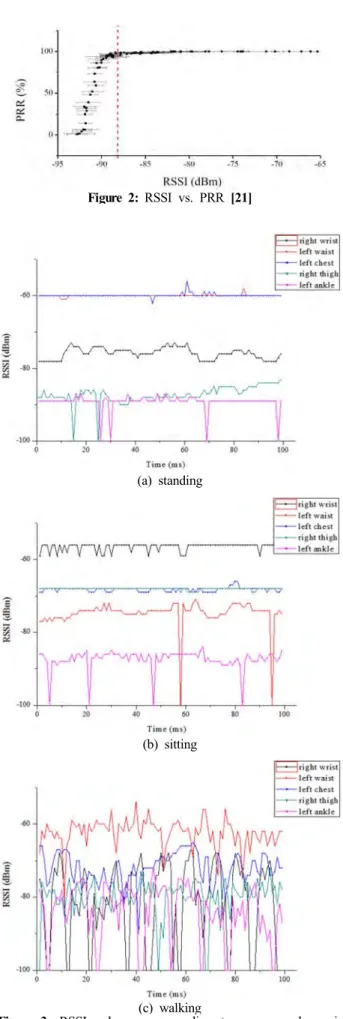
RSSI is one of the most widely used metrics for judging link quality. The RSSI value of a network is highly related to the packet reception ratio (PRR). In our previous study [21], we obtained a relationship between RSSI and PRR, as shown in Figure 2. The average RSSI value over –88 dBm showed a link reliability of more than 95%. In this study, we use the RSSI value to determine the link quality.
Figure 2: RSSI vs. PRR [21]
(a) standing
(b) sitting
(c) walking
Figure 3: RSSI values corresponding to sensor node posi- tions
Figure 3 indicates the transitions of RSSI values corre- sponding to different body postures. When the subject sat or stood, the link quality between the hub and the node was gen- erally stable, with the exception of the left ankle node for the subject in the sitting position. The RSSI values of the sensor nodes on the left ankle, right thigh, and left waist inter- mittently reached –100 dBm. This meant that the hub had not received the packet. In the case where the subject was walk- ing, link quality fluctuated frequently because of frequent changes in body posture. For walking subjects, sensor nodes on the right wrist, left ankle, and right thigh showed low link quality. In contrast, the sensor nodes on the left chest and left waist still indicated stable link quality, because their move- ment is limited.
In the above test scenarios, we analyzed various posture change scenarios and found that link quality varied based on body posture changes. However, WBANs cannot compose com- pletely free topologies, because the human body has a limited range of activity. This means that a WBAN has a network top- ology that is limited by body posture. We can therefore obtain stable link lists in advance based on various body postures.
It is clear from the experimental results that some sensor nodes maintained stable links with the hub regardless of body posture. The sensor nodes attached to body parts that moved less, such as the chest, waist, or head, could be candidates for relay nodes. On the other hand, sensor nodes attached to arms or legs cannot always transmit data directly to the hub because of their frequent movement. Thus, we should categorize each sensor node according to its link stability with the hub. In or- der to distinguish sensor node types, we call the sensor node delivering packets to the hub instead of to other sensor nodes the relaying node. The sensor nodes that are assisted in packet delivery by this relaying node are named relayed nodes.
3.3 A Distributed Relay Selection Algorithm
In the proposed algorithm, when a sender node transmits a packet, the candidate relaying nodes and the hub try to receive the packet. If the hub receives the packet transferred by the sen- der node successfully, it transmits an acknowledgement (ACK) packet to the sender node. The hub does not transmit an ACK packet for every packet reception, but it does send an ACK pac- ket for every bunch of packet receptions to improve throughput.
The ACK packet includes the received packet sequences.
As soon as a sender node and the candidate relaying nodes receive the ACK packet, they investigate the received packet sequences for whether or not packet loss exists. If packet loss is found, one of them retransmits the lost packets to the hub.
We should consider which nodes are selected as relaying no-
des to retransmit the lost packets.
We propose a distributed-relay selection algorithm. The can- didate relaying nodes and the sender node contend to be se- lected as the relaying node after the ACK packet is received.
The proposed algorithm uses a carrier-sensing period distrib- utively to choose a proper relaying node among contending candidate relay nodes. The carrier-sensing period is determined by the number of received packets, the RSSI value obtained by the ACK packet, and recent accelerometer variations. A particular number of packets received successfully can guaran- tee retransmission efficiency, so this quantity is considered in selecting the relaying node. The RSSI value of the ACK pack- et indicates the most recent value for the link quality between the relaying node and the hub. This metric is of use in finding a stable link. The recent accelerometer variations represent the movement of the candidate relaying nodes, which is related to link stability as well. By utilizing of these values, we can de- rive an independent carrier-sensing period. The carrier-sensing period is given by the equation:
(1)
where indicates the carrier-sensing period and and
represent the entire number of transmitted packets and the number of lost packets, respectively. is the packet r- eception ratio at the RSSI value obtained from the results shown in Figure 1. We assume that the relationship between PRR and RSSI is a linear, proportional relation with an RSSI value of less than –88 dBm. is the average value of the 3-axis a- ccelerometer, and is the clear channel assessment time. We use the values α and β to give weight to both the expected transmission number and the probability of link variation.
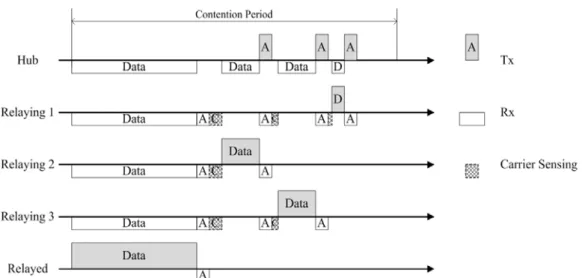
With this metric, it is possible to select the relaying node promptly without any additional packet exchange. Figure 4 il- lustrates an example of selecting a relaying node to retransmit lost packets. At first, the sender node that is the relayed node transmits a number of packets, and the candidate relaying no- des and the hub receive the packets. In this example, the hub cannot receive the packets completely because of link instability. The hub replies with the ACK packet, including the received packet sequences. The candidate relaying nodes and the relayed node receive this packet and perform carrier sens- ing independently during a period determined by Equation (1).
In this example, candidate relaying node 2 wins the contention and retransmits the missed packets. If the hub still cannot receive the missed packets after this retransmission proce- dure, it replies with the ACK packet and waits for another
Figure 4: Example of selected relaying node retransmission
retransmission. The previous retransmission procedure is re- peated until all of the packets are delivered successfully.
3.4 A Region Grouping Scheme
In the proposed algorithm, the candidate relaying nodes should always be in wakeup states to receive packets trans- mitted by the sender node. If the radio is in the wakeup state for a long time, the energy efficiency of the sensor node is se- verely degraded. We propose a region-grouping scheme to re- duce overhearing time. As mentioned in section 3.1, the WBAN has a limited network topology due to its restrictions in body movement, so we can group candidate relaying nodes and relayed nodes according to the restricted topology information. Figure 5 illustrates a sample superframe structure for the region grouping. For instance, candidate relaying nodes belonging to group 2 should always be in wakeup states dur- ing the group’s contention period despite having no packets to transfer. On the other hand, sensor nodes that are not the re- laying node do not need to wake up to overhear packets. They only need to wake up when they have packets to send. The candidate relay nodes can reduce wakeup duration by separat- ing relaying packet delivery periods according to group.
Figure 5: Superframe structure for a region grouping
4. Performance Evaluation
In this section, we present the evaluation of the perfor- mance of the proposed algorithm based on the results of e- mpirical experiment. We considered two experimental scena- rios: static and dynamic. For the static case, the subject was
sitting on a chair. In the dynamic case, the subject changed their body posture frequently. The positions of the hub and the sensor nodes are shown in Figure 1. We used the sensor nodes on left wrist and left chest as the candidate relaying nodes.
We compared the proposed relay-selection algorithm with both single-hop and two-hop communication, each with a randomly chosen relay node. We did not measure the energy efficiency, throughput, or packet reception ratio of the network because the expected number of packet transmissions already covered these quantities.
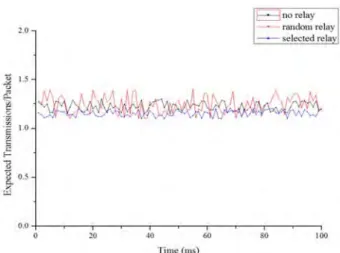
The sensor node on the left ankle transmitted 100 packets to hub every second. If any packets were missed at the hub, the candidate relay nodes contended with one another to be the selected relaying node. Figure 6 and Figure 7 show the ex- pected numbers of transmissions needed to deliver a packet to the hub successfully for the static case and dynamic case, respectively. The expected numbers of transmissions every sec- ond are shown.
Figure 6: The expected numbers of transmissions per Packet for the static case
In Figure 6, the no relay line indicates single-hop communication. The sender node directly transmitted packets to the hub. In this case, the link quality between the sender node and the hub was poor because of the propagation enviro- nment, so the link suffered significant packet loss. These lost packets were retransmitted through the direct link between the sender node and the hub. Thus, the expected number of tran- smissions per packet was higher than that of the two-hop co- mmunication network.
Two-hop communication also experienced a similar pack- et-loss ratio during the first packet transmission, but its re- transmitted-packet reception ratio exceeded that of single-hop communication. The randomly selected relay node also chose a relaying node randomly for the retransmission, but the selected relaying node did not always guarantee a better link quality than the sender node had. Therefore, the use of the correct re- lay selection method is very important for improving the link reliability.
Figure 7: The expected number of transmissions per packet for the dynamic case
Dynamic body posture frequently varied the link quality, e- specially for the sensor nodes attached to body parts that moved a lot. Figure 7 illustrates the expected transmissions per packet for the dynamic case. As in the static case, the first transmission attempt at the sender node caused the same pac- ket loss regardless of the mechanism. In single-hop commun- ication, the sender node retransmits the lost packets via the same link in spite of poor link quality. Hence, the expected number of transmissions per packet is generally high.
In two-hop communication, selecting a relaying node with a stable link is important for enhancing the retransmission re- ception ratio. The proposed algorithm thus outperformed the no relay and random relay mechanisms, as shown in Figure 7.
From these results, we can understand the necessity of
two-hop communication as well as the importance of selecting appropriate relaying nodes in WBANs.
5. Conclusions
In this paper, we proposed a relay selection algorithm for WBAN two-hop communication. This relay selection algorithm can choose a proper relaying node distributively, without re- quiring any additional control packets. It utilizes a carrier-sens- ing period that is sufficiently short to minimize the time dif- ference between the relaying-node selection time and the pack- et-relaying time. The performance evaluation demonstrated the need for two-hop communication in WBANs as well as the significance of proper relaying node selection. We could not find a suitable conventional relay-selection algorithm for WBANs; hence, the efficacy of the proposed algorithm was not completely verified. In the future, we will try to compare our relay selection algorithm against other adequate WBAN re- lay-selection algorithms and to improve it based on the results.
Acknowledgment
This work was supported by the National Research Foundation of Korea(NRF) grant funded by the Korea govern- ment(MSIP) (No. 2016R1C1B1015863).
References
[1] M. Patel and J. Wang, “Applications, challenges, and prospective in emerging body area networking tech- nologies,” IEEE Wireless Communications, vol. 17, no. 1, pp. 80-88, 2010.
[2] M. Chen, S. Gonzalez, A. Vasilakos, H. Cao, and V.
Leung, “Body area networks: a survey,” Mobile Networks and Applications, vol. 16, no. 2, pp. 171–
193, 2011.
[3] R. Cavallari, F. Martelli, R. Rosini, C. Buratti, and R.
Verdone, “A survey on wireless body area networks:
technologies and design challenges”, IEEE Communications Surveys & Tutorials, vol. 16, no. 3, pp. 1635-1657, 2014.
[4] S. Movassaghi, M. Abolhasan, J. Lipman, D. Smith, and A. Jamalipour, “Wireless body area networks: A survey”, IEEE Communicaions Surveys & Tutorials, vol. 16, no. 3, pp. 1658-1686, 2014.
[5] Bluetooth SIG, Bluetooth Core Specification, Core Version 4.0, 2010.
[6] ZigBee Alliance, ZigBee Specifications, Version 1.0, 2005.
[7] Part 15.6: Wireless Body Area Networks, IEEE
Standard 802.15.6, Feb. 2012.
[8] Part 15.4: Wireless Medium Access Control (MAC) and Physical Layer (PHY) Specifications for Low-Rate Wireless Personal Area Networks (LRWPANs), IEEE Standard 802.15.4, 2006.
[9] H. Chebbo, S. Abedi, T. A. Lamahewa, D. B. Smith, D. Miniutti, and L. Hanlen, “Reliable body area net- works using relays: Restricted tree topology,”
Proceedings of International Conference on Computer Netwwork Communication (ICNC), pp. 82-88, 2012.
[10] A. Ehyaie, M. Hashemi, and P. Khadivi, “Using re- lay network to increase lifetime in wireless body area sensor networks,” Proceedings of IEEE International Symposium on a World of Wireless, Mobile Multimedia Network Workshops, pp. 1-6, 2009.
[11] A. Natarajan, M. Motani, B. Silva, K. Yap, and K.
Chua, “Investigating network architectures for body sensor networks,” Proceedings of 1st ACM SIGMOBILE International Workshop on Systems and networking support for healthcare and assisted living environments, pp. 19-24, 2007.
[12] M. Quwaider and S. Biswas, “DTN routing in body sensor networks with dynamic postural partitioning,”
Ad Hoc Networks, vol. 8, no. 8, pp. 824-841, 2010.
[13] L. Liang, Y. Ge, G. Feng, W. Ni, and A. A. P.
Wai, “A low overhead tree-based energy-efficient routing scheme for multi-hop wireless body area net- works,” Computer Networks, vol. 70, no. 8, pp. 45–
58, 2014.
[14] S. Yousaf, N. Javaid, Z. A. Khan, U. Qasim, M.
Imran, and M. Iftikhar, “Incremental relay based co- operative communication in wireless body area networks,” Proceedings of Computer Science, vol. 52, pp. 552-559, 2015.
[15] S. Yousaf, N. Javaid, U. Qasim, N. Alrajeh, Z. A.
Khan, and M. Ahmed, "Towards reliable and en- ergy-efficient incremental cooperative communication for wireless body area networks," Sensors, vol. 16, pp. 284, 2016.
[16] K. S. Deepak and A. V. Babu, “Improving energy efficiency of incremental relay based cooperative communications in wireless body area networks,”
International Journal of Communication Systems, vol.
28, no. 1, pp. 91-111, 2015.
[17] J. Dong and D. Smith, “Joint relay selection and transmit power control for wireless body area net- works coexistence,” Proceedings in IEEE International
Conference on Commununications (ICC), pp. 5676–
5681, 2014.
[18] H. A. Sabti and D. V. Thiel, “Node position effect on link reliability for body centric wireless network running applications,” IEEE Sensors Journal, vol. 14, no. 8, pp. 2687–2691, 2014.
[19] H. A. Sabti and D. V. Thiel, “Time multiplexing-star shape body sensor network for sports applications,”
Proceedings of IEEE Antennas and Propagation Society International Symposium (APSURSI), pp. 969 –970, 2014.
[20] R. Pan, D. Chua, J. S. Pathmasuntharam, and Y. P.
Xu, “An opportunistic relay protocol with dynamic scheduling in wireless body area sensor network,”
IEEE Sensors journal, vol. 15, no. 7, pp. 3743–
3750, 2015.
[21] S. Kim and D. S. Eom, “Link-state-estimation-based transmission power control in wireless body area net- works,” IEEE Journal of Biomedical and Health Informatics, vol. 17, no. 4, pp. 561-571, 2013.
[22] Atmel Corporation. Datasheet: ATmega128(L). avail- able at http://www.atmel.com/products/avr/, Accessed February 1, 2017.
[23] Texas Instruments. CC2420 Datasheet. Available:
http://www.ti.com, Accessed February 1, 2017.