http://dx.doi.org/10.18325/jkmr.2016.26.3.67 Review Article
임상에서 흔히 접하는 외상성 손상에 대한 봉독약침요법의 체계적 문헌고찰
이재은⋅이치호⋅이은정⋅이정민*⋅오민석
대전대학교 한의과대학 한방재활의학과교실, 동의대학교 한방병원 한방재활의학과*
Systematic Review of Bee Venom Therapy for Traumatic Injury
Jae-Eun Lee, K.M.D., Chi-Ho Lee, K.M.D., Eun-Jung Lee, K.M.D., Jung-Min Lee, K.M.D.*, Min-Seok Oh, K.M.D.
Department of Korean Medicine Rehabilitation, College of Korean Medicine, Dae-Jeon University, Department of Korean Medicine Rehabilitation, Dong-Eui University Korean Medicine Hospital*
RECEIVED June 16, 2016 ACCEPTED July 8, 2016
CORRESPONDING TO
Min-Seok Oh, Department of Korean Medicine Rehabilitation, College of Korean Medicine, Dae-Jeon University, 1136, Dunsan-dong, Seo-gu, Daejeon 35235, Korea
TEL (042) 470-9424 FAX (042) 470-9005 E-mail [email protected]
Copyright © 2016 The Society of Korean Medicine Rehabilitation
Objectives To evaluate the evidence supporting the effectiveness of Bee Venom therapy for traumatic injury.
Methods We conducted search across 3 electronic databases (Pubmed, CAJ and Oasis) to find clinical trials that used Bee Venom therapy as treatment for traumatic injury.
The methodological quality of RCTs (Randomized controlled clinical trials) were assessed using the Cochrane Risk of Bias (RoB) tool, while NRCTs (Non-Randomized controlled clin- ical trials) were assessed using the Cochrane Risk of Bias Assessment tool for Non-randomized Study (RoBANS) tool.
Results Among 87 articles that were searched, 10 RCTs and 19 NRCTs were finally selected. Among 19 selected studies, all studies showed that Bee Venom therapy has sig- nificant effect on traumatic injury.
Conclusions Our systematic review found encouraging but limited evidence of Bee Venom therapy for traumatic injury. We recommend clinical trials which compare the effec- tiveness of Bee Venom therapy with other pharmacopuncture therapies to clarify the effec- tiveness of Bee Venom therapy from other pharmacopuncture therapies. (J Korean Med Rehabil 2016;26(3):67-77)
Key words Bee Venom therapy, traumatic injury, systematic review
서론»»»
봉독요법이란 살아있는 꿀벌 독낭에 들어있는 독을 인 위적으로 추출, 정제하여 질병과 유관한 부위 및 경혈에 주입함으로써 자침 효과와 벌의 독이 지니고 있는 생리화 학적 약리작용을 질병의 치료에 이용하는 신침요법이다1). 봉독약침요법의 효과는 실험연구에서는 생리화학적 약리 작용으로 연구되었으며, 임상연구에서는 주로 특정 질환
에 대한 효과로 국한되어 연구되어왔다. 특히 대부분의 임상연구들은 그 주제가 주로 척추질환을 위시로 한 근골 격계 질환을 대상으로 하고 Visual Analogue Scale (VAS) 를 주요 평가기준으로 삼아 봉독약침요법의 진통효과에 집중되어 있다2).
현대사회에서 사람들은 스포츠손상에서부터 교통사고 및 산업재해 등으로 인한 외상성 손상에 지속적으로 노출 되고 있으며, 이에 따라 외상성 손상 환자에 대한 한방치
68
료의 수요도 높아지고 있어 외상성 손상 환자에 대한 체 계적인 한의치료 접근의 필요성은 날로 증가하고 있다.
대한한방볍원협회가 발표한 자동차보험 요양기관종별 심 사실적에 따르면 2014년도 대비 2015년도 한방병원은 물 론 한의원의 자보환자 청구건수 및 자동차보험 진료비가 크게 증가한 것으로 나타났으며3), 근로복지공단 진료비심 사팀에서 집계한 2003년부터 2010년까지의 연도별 산업 재해 보상보험의 한의의료기관 급여지급건수에 따르면 2003년 623,332건에서 2010년에는 676,707건으로 증가하 였다4).
외상성 손상에는 타박(contusion), 염좌(sprain), 좌상 (strain)과 같은 경미한 손상부터 골절(fracture)과 같은 중 증의 손상까지 포함되며, 손상정도에 따른 통증과 운동범 위의 제한을 나타낸다. 외상의 주된 한의학적 병리는 어 혈5)이므로 외상성 손상에 대한 한의학적 인식 또한 주로 외상성 어혈로 인식하여 접근하는 것으로 볼 수 있다.
이에 저자는 이러한 봉독약침요법이 임상에서 근골격 계 질환의 통증에 다용된다는 점을 참고하여, 한의학에서 어혈로 변증되는 외상성 손상에 대한 봉독약침요법을 시행 한 임상 연구를 체계적으로 고찰하여 그 결과를 알아보고 임상적 근거 자료를 마련하고자 본 연구를 시행하였으며 그 결과 유의한 결과를 얻었기에 이에 보고하는 바이다.
대상 및 방법»»»
1. 데이터베이스 선택 및 검색
2016년 6월까지 국내외에 발표된 모든 논문을 대상으 로, Pubmed (www.pubmed.com), Chinese Academic Journals (CAJ; www.cnki.net), 오아시스 (oasis.kiom.re.
kr)의 3가지 온라인 데이터베이스를 활용하여 봉독약침을 외상성 손상에 활용한 연구를 검색하였다.
검색어는 Pubmed와 CAJ에서는 제목/초록 필드에서 중재 방법에 해당하는 ‘Bee venom’과 대상군에 해당하는
‘trauma’, ‘injury’, ‘accident’, ‘contusion’, ‘sprain’, ‘strain’,
‘fracture’를 조합하여 사용했고, 오아시스에서는 중재방법 에 해당하는 ‘봉독약침', ‘봉약침’, ‘봉독’, ‘bee venom’과 대상군에 해당하는 ‘외상’, ‘손상’, ‘사고’, ‘타박’, 염좌’,
‘좌상’, ‘골절’을 조합하여 사용하였다.
2. 선정기준
1차 배제 시에는 검색된 논문들의 제목과 초록을 통해 검토하였으며, 2차 배제 시에는 원문을 모두 검토하여 연 구방법이 사람을 대상으로 하는 임상논문이면서, 외상성 손상이 있는 환자를 대상으로 하고, 봉독약침요법을 중재 로 사용한 연구를 선정하였다.
검색된 논문들 중에서 대상군의 나이나 성별, 기간, 손 상 부위 등에 제한을 두지 않고 외상성 손상이 있는 환자 를 대상으로 봉독약침요법을 중재로 사용한 비무작위배 정 비교임상시험, 무작위배정 비교임상시험을 포함한 모 든 임상시험을 분석하고자 하였다.
한편 중재로 사용한 봉독약침요법의 경우, 한국어(‘봉 독약침’, ‘봉약침’, ‘봉독’), 영어(‘bee venom’)로 명명된 모든 봉독 성분을 이용한 치료방법을 포함하여 구체적인 용량이나 시술부위, 시술방법에 제한을 두지 않았다.
3. 포함 연구자료 분석
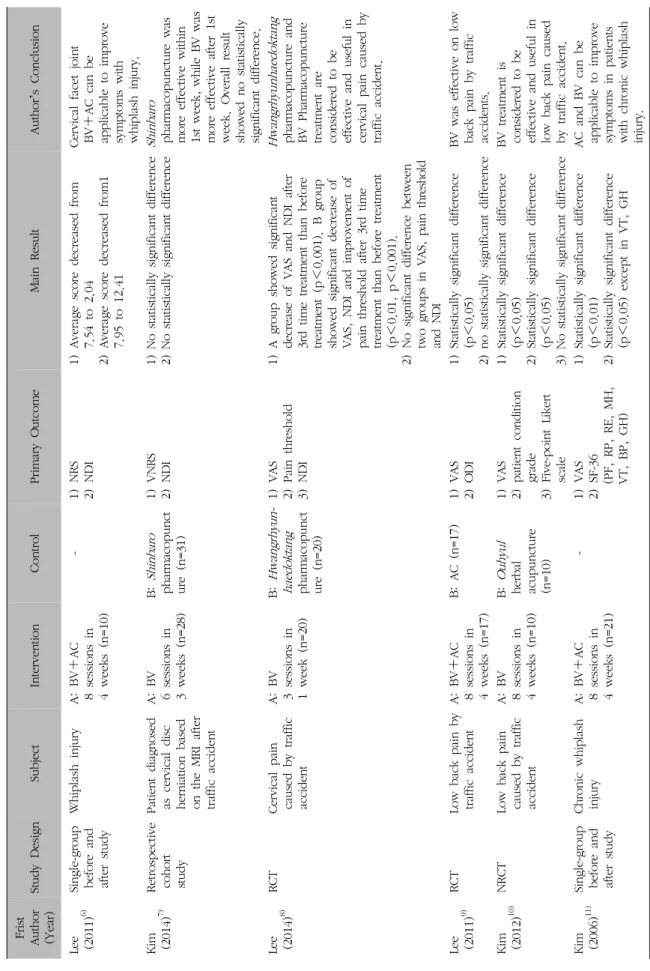
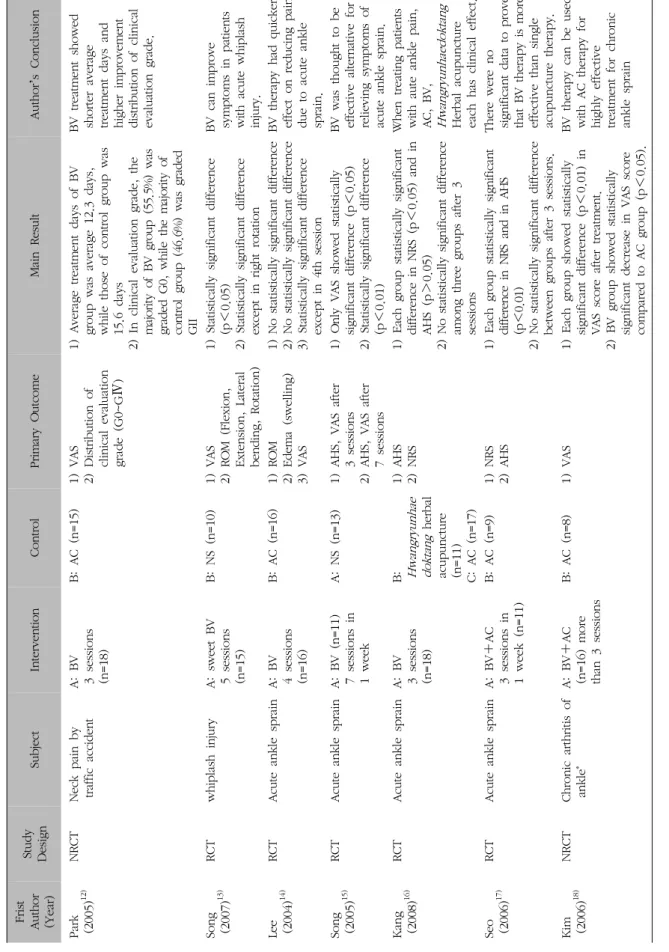
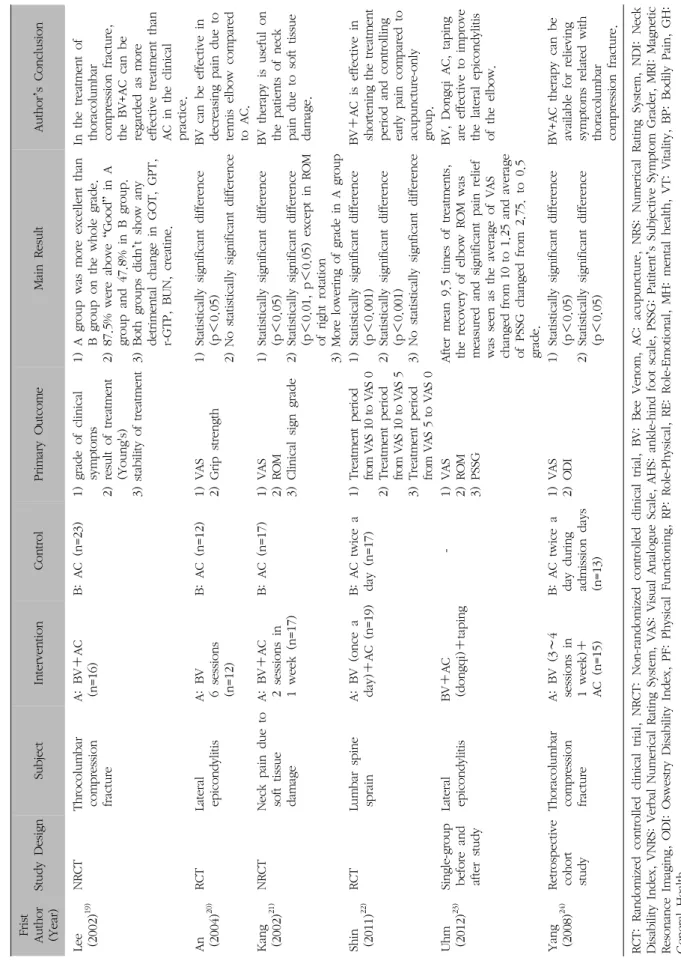
본 연구는 외상성 손상에 대한 봉독약침요법의 연구현 황에 대한 체계적 고찰로서, 두 명의 독립된 연구자(JEL, CHL)에 의한 분석 대상 선정 과정을 거친 후 최종 선정 된 각 논문들의 원문을 검토한 뒤 핵심 정보를 추출하였 다. 선정된 논문들의 연구 디자인, 대상 질환, 적용된 중 재, 대조군, 평가지표, 주요 결과, 저자의 결론 등 각 논 문별로 정리하여 서술적인 분석을 하고, 이를 표로 정리 하였다(Table I).
1) 내용분석
두 명의 독립된 연구자가 선택된 임상연구를 대상으로 하여 중재방법과 대조군, 평가지표 등에 대한 자료를 조 사하였고, 내용에 대한 의견의 불일치는 재논의와 함께 제3의 다른 연구자의 의견도 구하였다.
2) 비뚤림 위험 평가
본 연구에서는 질 평가는 무작위배정 비교임상시험 (Randomized clinical trial; RCT)의 경우 Cochrane Risk of Bias (ROB) criteria에 따른 6개의 세부항목에 대하여 평가하였다. 코호트연구(Cohort study), 단일군 전후 비 교연구(Single-group before and after study), 비무작위배
Fr is t A ut hor (Y ear) St udy D es ig n Subj ect In te rv en tio n Cont ro l Pr im ar y O ut com e Ma in R es ul t Aut hor ’s Concl us ion Lee (2011)
6)Si ngl e- gr oup bef or e and af te r st udy W hip la sh in ju ry A : B V + AC 8 se ssio ns in 4 w eek s (n=10) -1 ) N R S 2) N D I 1) A ver ag e sc or e decr eas ed fr om 7.54 to 2.04 2) A ver ag e sc or e decr eas ed fr om 1 7.95 to 12.41
C erv ic al fac et j oi nt BV + A C c an b e ap p lic ab le t o im p ro ve sy m p to m s w ith w hip las h in ju ry . Ki m (2014)
7)Re tr os p ec tiv e cohor t st udy
Pa tient di agnos ed as c er vi ca l di sc her ni at ion bas ed on th e M R I af te r tr af fic acci dent A: BV 6 se ssio ns in 3 w eek s (n=28) B: Sh inbar o phar m acopunct ur e (n=31)
1) V N R S 2) N D I 1) N o sta tis tic all y si gn ific an t di ffe re nc e 2) N o sta tis tic all y si gn ific an t di ffe re nc e Shi nbar o phar m acopunct ur e w as m ore e ffe ct iv e w ith in 1s t w eek, w hi le B V w as m or e ef fe ct ive af te r 1s t w eek. O ver al l re sul t show ed no st at is tica lly sig nific an t di ffe re nc e. Lee (2014)
8)R C T C er vi cal pai n ca used by tr af fic acci dent
A: BV 3 se ssio ns in 1 w eek ( n=20) B: H w angr hyun - ha edok ta ng phar m acopunct ur e (n=20) 1) VAS 2) P ai n th re shol d 3) N D I
1) A g roup show ed si gni ficant decr eas e of V A S and N D I af te r 3r d tim e tr eat m ent t han bef or e tre atm en t (p < 0.001) . B g roup show ed si gni fica nt d ecr ea se of V A S, N D I and im pr ovem ent of p ai n thr es hol d af te r 3r d tim e tre atm en t th an b ef or e tre atm en t (p < 0.01, p < 0.001). 2) N o si gn ifi ca nt di ff er ence bet w een tw o gr ou ps i n V A S, p ai n th re shol d and N D I H w angr hyunha edok ta ng phar m acopunct ur e and BV Phar m acopunct ur e tre atm en t ar e cons id er ed to be ef fect ive and us ef ul i n ce rv ic al p ain c au se d by tr af fic acci dent . Lee (2011)
9)R C T Lo w b ac k p ai n b y tr af fic acci dent A: BV + AC 8 se ssio ns in 4 w eek s (n=17)
B : A C (n=17) 1) V A S 2) O D I 1) S ta tis tical ly s ig ni ficant d iff er ence (p < 0.05) 2) no st at is tica lly s ig ni fica nt d iff er ence B V w as e ff ect ive on lo w back p ai n by tr af fic acci dent s. Ki m (2012)
10)NR C T Lo w ba ck p ai n ca used by tr af fic acci dent
A: BV 8 se ssio ns in 4 w eek s (n=10) B: O uhyul her ba l ac up unct ur e (n=10) 1) VAS 2) pat ie nt c ondi tion gr ad e 3) F ive-poi nt Li ker t sc al e 1) S ta tis tical ly s ig ni ficant d iff er ence (p < 0.05) 2) S ta tis tical ly s ig ni ficant d iff er ence (p < 0.05) 3) N o sta tis tic all y si gn ific an t di ffe re nc e B V t re at m en t i s cons id er ed to be ef fect ive and us ef ul i n lo w back p ai n caus ed by tr af fic acci dent . Ki m (2006)
11)Si ngl e- gr oup bef or e and af te r st udy
C hr on ic w hip la sh in ju ry A: BV + AC 8 se ssio ns in 4 w eek s (n=21) - 1) VAS 2) S F- 36 (P F, R P, R E, M H , V T , B P, G H ) 1) S ta tis tical ly s ig ni ficant d iff er ence (p < 0.01) 2) S ta tis tical ly s ig ni ficant d iff er ence (p < 0.05) ex cep t in V T , G H AC and BV ca n be ap p lic ab le t o im p ro ve sy m p to m s in p atie nts w ith c hr oni c w hi pl as h in ju ry .
Ta b le I . A S um m ar y of St udi es o f Bee V enom T her ap y for Tr aum at ic Inj ur y
70 Fr is t A ut hor (Y ear)
St udy De si gn Subj ect In te rv en tio n Cont ro l Pr im ar y O ut com e Ma in R es ul t Aut hor ’s Concl us ion Par k (2005)
12)NR CT Ne ck p ai n by tr af fic acci dent A: BV 3 se ssio ns (n=18) B : A C (n=15) 1) V A S 2) D is tr ibut ion of cl in ic al ev alu atio n gr ad e (G 0~G Ⅳ )
1) A ver ag e tr ea tm ent days o f B V gr oup w as aver ag e 12.3 days , w hi le thos e of c ont ro l gr oup w as 15.6 da ys 2) In cl in ical eval uat ion gr ade, t he m ajo ri ty o f B V g ro up (5 5. 5% ) w as gr ad ed G 0, w hi le t he m aj or ity o f co nt ro l gr ou p (4 6. 6% ) w as gr ad ed GI I BV t re at m ent s how ed shor te r aver age tre atm en t da ys an d hi gh er i m p ro vem ent di st ri but ion of c lini cal eval uat ion gr ade. Song (2007)
13)RCT w hi pl as h inj ur y A: s w eet B V 5 se ssio ns (n=15)
B : N S (n=10) 1) V A S 2) R O M ( Fl ex ion, Ext ens ion, Lat er al bendi ng, Rot at ion) 1) S ta tis tical ly s ig ni ficant d iff er ence (p < 0.05) 2) S ta tis tical ly s ig ni ficant d iff er ence ex ce p t in ri gh t ro tatio n B V c an i m p ro ve sy m p to m s in p atie nts w ith a cu te w hip las h in ju ry . Lee (2004)
14)R C T A cu te a nk le s p ra in A : B V 4 se ssio ns (n=16)
B : A C (n=16) 1) R O M 2) Edem a (s w el ling) 3) VAS 1) N o sta tis tic all y si gn ific an t di ffe re nc e 2) N o sta tis tic all y si gn ific an t di ffe re nc e 3) S ta tis tical ly s ig ni ficant d iff er ence ex cept i n 4t h se ss io n B V t he ra p y h ad q ui ck er ef fe ct on re duci ng p ai n due to acut e an kl e sp rain . Song (2005)
15)R C T A cu te a nk le s p ra in A : B V ( n= 11 ) 7 se ssio ns in 1 w eek
A : N S (n=13) 1) A H S, V A S af te r 3 se ss ions 2) A H S, V A S af te r 7 se ss ions 1) O nl y V A S show ed st at ist ic al ly sig nific an t di ffe re nc e (p < 0.05) 2) S ta tis tical ly s ig ni ficant d iff er ence (p < 0.01) BV w as t hought t o be ef fect ive al ter nat ive fo r re lievi ng sym pt om s of acut e ankl e sp ra in . Ka ng (2008)
16)R C T A cu te a nk le s p ra in A : B V 3 se ssio ns (n=18)
B: H w angr yunhae dokt ang h er ba l ac up unct ur e (n=11) C: A C (n=1 7) 1) A H S 2) N RS 1) E ach gr oup s ta tis tic al ly s ig ni fica nt di ff er ence in N RS (p < 0.05) and in AH S (p > 0.05) 2) N o sta tis tic all y si gn ific an t di ffe re nc e am ong thr ee gr oups a ft er 3 se ss ions W hen tr eat in g pat ient s w ith a ut e ankl e pai n, AC, BV , H w angr yunha edok ta ng H erb al a cu p un ctu re ea ch h as c lin ic al e ff ec t. Seo (2006)
17)R C T A cu te a nk le s p ra in A : B V + AC 3 se ssio ns in 1 w eek ( n=11)
B: A C (n=9) 1) N R S 2) A H S 1) E ac h gr ou p s ta tistic ally s ig nifi ca nt di ffe re nc e in N RS a nd in A H S (p < 0. 01) 2) N o sta tis tic all y si gn ific an t di ffe re nc e bet w een gr oup s af te r 3 se ss ions .
Ther e w er e no si gni fic ant da ta t o pr ove th at B V th er ap y is m or e ef fect ive th an s in gl e acupunct ur e ther apy. Ki m (2006)
18)N R CT Chr oni c ar thr iti s of ankl e
*A: BV + AC (n=16) m or e th an 3 s es si on s
B: A C (n=8) 1) VAS 1) Each gr oup s how ed st at is tic al ly sig nific an t di ffe re nc e (p < 0.01) in V A S sc or e af te r tre atm en t. 2) B V gr oup s how ed st at is tic al ly si gni fic an t decr ea se i n VA S sc or e com p ar ed to AC gr oup (p < 0.05).
B V t he ra p y ca n b e u se d w ith A C th er ap y fo r hi gh ly e ffe ct iv e tre atm en t fo r ch ro ni c ankl e sp ra in
Ta b le I . C ont inued
* 원저자가 한국인이므로 한글 제목 '염좌‘에 준하여 본 연구에 포함시켰다.Fr is t Aut hor (Y ea r) St udy D es ig n Subj ect In te rv en tio n Cont ro l Pr im ar y O ut com e Ma in R es ul t Aut hor ’s Concl us ion Le e (2002)
19)NRCT Th ro co lu m ba r com pr es si on frac tu re A: BV + AC (n=16) B : A C ( n= 23 ) 1) g ra de o f c lin ic al sym p to m s 2) r es ul t of t re at m ent (Y oung' s) 3) sta bi lity o f tre atm en t 1) A g roup w as m or e ex cel lent t ha n B gr oup on the w hol e gr ade. 2) 87.5% w er e above “G ood ” i n A gr oup and 47.8% i n B gr oup. 3) B ot h gr oup s di dn ’t s how a ny det ri m ent al change in G O T , G PT , r- G T P, B U N , c re at in e.
In t he tr eat m ent o f thor ac ol um bar co m p re ssio n fra ctu re , the BV +AC can be re ga rd ed a s m ore ef fe ct ive tr eat m ent t ha n A C in th e cl in ic al pr act ice. An (2004)
20)RC T Lat er al ep icondyl iti s A: BV 6 se ss io ns (n=12)
B : A C (n=12) 1) V A S 2) G rip stre ng th 1) S ta tistic ally sig nific an t di ffe re nc e (p < 0.05) 2) N o sta tistic ally s ig nific an t diffe re nc e
B V ca n be ef fect ive in decr ea si ng pai n due to te nni s el bow c om p ar ed to A C . Kang (2002)
21)N R CT N eck p ai n due to so ft t is su e dam age
A: BV + AC 2 se ss io ns in 1 w eek (n=17) B : A C (n=17) 1) V A S 2) R O M 3) C lin ic al sig n gr ad e 1) S ta tistic ally sig nific an t di ffe re nc e (p < 0.05) 2) S ta tistic ally sig nific an t di ffe re nc e (p < 0.01, p < 0.05) ex cep t in R O M of r ig ht r ot at io n 3) M or e lo w er ing of gr ade in A g roup
B V t her ap y is u sef ul on th e p atie nts of n ec k pai n due to so ft t is su e da m age. Sh in (2011)
22)RCT Lum bar s p ine sprai n A : B V (once a day) + A C ( n=19) B: AC t wi ce a day (n=17) 1) Tr ea tm en t p er io d fro m VAS 1 0 to VAS 0 2) T re at m en t p er io d fr om V AS 1 0 to V AS 5 3) T re at m en t p er io d fr om V A S 5 t o V A S 0
1) S ta tistic ally sig nific an t di ffe re nc e (p < 0.001) 2) S ta tistic ally sig nific an t di ffe re nc e (p < 0.001) 3) N o st at is tical ly si gnf icant d iff er ence
BV + A C i s ef fe ct ive in shor te ni ng the tr ea tm ent per iod and cont ro lli ng ea rl y p ai n com par ed to ac up unct ur e- onl y gr oup. Uh m (2012)
23)Si ngl e- gr oup bef or e and af te r st udy
Lat er al ep icondyl iti s BV + AC (dongqi )+ ta p in g -1 ) V A S 2) R O M 3) PSSG
A fte r m ea n 9.5 t im es o f tre atm en ts, th e re cover y of el bow R O M w as m ea su re d an d si gn ific an t p ain r el ie f w as seen as th e aver ag e of V A S cha ng ed fr om 10 to 1 .25 and aver ag e of P SSG chang ed fr om 2.75. to 0.5 gr ad e.
B V , D on gq i A C , t ap in g ar e eff ect ive to i m p ro ve th e la te ra l epi condyl iti s of t he el bow . Yang (2008)
24)Ret rospect iv e cohor t st udy
T hor ac ol um bar com pr es si on frac tu re A: BV ( 3 ∼ 4 se ssio ns in 1 w eek) + A C ( n=15) B: AC t wi ce a day dur in g adm is si on da ys (n=13) 1) V A S 2) O D I 1) S ta tistic ally sig nific an t di ffe re nc e (p < 0.05) 2) S ta tistic ally sig nific an t di ffe re nc e (p < 0.05)
B V +A C t he ra p y c an b e av ai labl e fo r re lievi ng sy mp to ms r el at ed w ith thor ac ol um bar co m p re ssio n fra ctu re . R C T: Random iz ed cont ro lled cl ini ca l tr ia l, N RCT : N on- ra ndom iz ed cont ro lled cl ini cal tr ia l, B V : B ee Venom , A C : ac up unct ur e, N RS : N um eri ca l R atin g Sy ste m , N D I: N ec k D is abi lit y Index, V N R S: V er ba l N um er ical R at ing Sys te m , V AS: Vi su al A na lo gue Sca le, A H S: ankl e- hi nd foot s ca le , PSS G : Pa tit ent ’s S ubj ect ive Sym p to m G rader , M R I: M ag net ic R es onance Im agi ng, O D I: O sw es tr y D is abi lit y Index, P F: Phys ica l Funct ioni ng, R P: Rol e- Phys ica l, RE: Rol e- Em ot ional , M H : m ent al h ea lth , V T : V itality , B P: B od ily P ai n, G H : Ge ne ra l He al th .
Ta bl e I. C ont inued
72
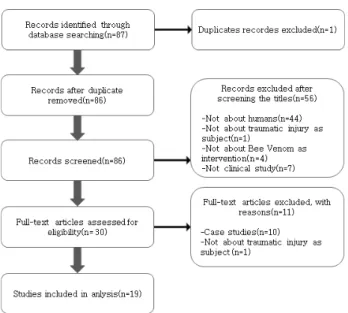
Fig. 1. A flow chart describing the trial selection process.
정 비교임상시험(Non-randomized clinical trial; NRCT)을 포함한 비무작위 연구의 경우 Cochrane Risk of Bias Assessment tool for Non-randomized Study (RoBANS) 에 따른 6개의 세부항목에 대하여 평가하였다. 모든 항목 의 평가는 본문 중 내용이 명시된 경우만을 인정하는 것 으로 하였다. 평가자 두 명의 의견이 일치하지 않는 경우 에는 충분한 논의를 통하여 결론을 도출하였다.
결과»»»
1. 자료 선별
2016년 6월까지 발표된 논문들 중에서 Pubmed, CAJ, 오아시스 등 3가지 데이터베이스를 이용한 검색을 통해 총 87개의 논문을 발견하였다. 이 논문들의 제목과 초록, 원문을 검토하여 사람을 대상으로 하는 임상시험이 아닌 관찰연구 또는 동물실험연구이거나, 외상성 손상을 대상 으로 한 연구가 아니거나, 봉독 요법을 중재로 사용한 연 구가 아닌 것 등을 배제하여 최종적으로 19편의 논문이 분석대상으로 선정되었다. 선정된 19편의 논문은 모두 오 아시스 검색을 통해 발견된 논문이었으며, Pubmed와 CAJ에서는 본 연구의 선정기준에 맞는 논문을 찾을 수 없었다(Fig. 1).
2. 결과
1) 연구개요
최종 선정된 19편의 연구들 중 9편8,9,13-17,20,22)
은 무작위 배정 비교임상시험연구였으며, 나머지 10편6,7,10-12,18,19,21,23,24)
은 비무작위 연구였다. 비무작위 연구에 해당하는 10편의 논문 중 3편6,11,23)은 단일군 전후 비교연구, 2편7,24)은 후 향적 코호트 연구에 속했으며, 나머지 5편10,12,18,19,21)
은 비 무작위배정 비교임상시험에 속했다.
분석한 19편의 논문들은 비교 방식에 따라 5가지로 나 누어 볼 수 있었다. 봉독약침요법과 침치료를 비교한 것
이 3편12,14,20), 침치료를 병행한 봉독약침요법과 단독 침치
료를 비교한 것이 7편9,17-19,21,22,24)
, 봉독약침요법과 생리식 염수를 비교한 것이 2편13,15), 봉독약침요법과 기타 약침 치료를 비교한 것이 4편7,8,10,16), 봉독약침요법을 포함한 다른 한방치료를 병행한 단일 그룹의 전후를 비교한 것이 3편6,11,23)이었다.
2) 대상 질환 및 평가 지표
대상 질환으로는 교통사고로 인한 경추부 및 요추부 손 상, 족관절 염좌, 흉요추 압박골절, 상완골 외상과염 등이 었다. 주요 평가 지표로는 Visual Analogue Scale (VAS), Numeric Rating Scale (NRS) 또는 Verbal Numerical Rating Scale (VNRS)가 대상 질환에 상관없이 모든 연구 에서 사용되었으며, 그 외에 Range of Movement (ROM), Patient’s Subjective Symptom Grader (PSSG), SF-36, Five-point Likert scale 등이 사용되었다. 손상부위에 따 라 경추부에는 Oswestry Disability Index (ODI), Neck Disability Index (NDI), 족관절에는 Ankle-hindfoot scale (AHS) 등이 사용되었다(Table I).
3) 중재 방법
포함된 연구 중 4편의 연구7-10)가 자생한방병원 원외탕 전의 봉약침을 사용하였으며, 7편의 연구12,13,16,17,21-23)
가 대한약침학회를 통해 제조된 봉약침을 사용하였으며, 1편 의 연구11)이 경희의료원의 봉독약침액을 사용하였으며, 6 편의 연구14,15,18-20,24)
가 건조봉독을 생리식염수로 희석하 여 사용하였으며, 1편의 연구6)만 어떤 종류의 봉독약침을 사용했는지 밝히지 않았다.
연구에 포함된 모든 논문들은 사용된 중재로 사용된 봉
Fig. 2. Risk of bias graph.
독약침의 농도, 용량, 시술방법, 시술부위에 대해서 상세 하게 설명하였으며, 포함된 연구 중 10편6,8,9,11,12,14,16-18,23)
만 allergy에 대한 anti-skin test를 시행했음을 밝혔다.
4) 치료효과
(1) 봉독약침 VS 침12,14,20)
모두 3편12,14,20)의 연구가 봉독약침요법을 단독으로 시 행하여 침치료를 시행한 대조군과 그 효과를 비교하였는 데, 그 중 2편14,20)의 RCT에서 봉독약침요법군이 침치료군 에서보다 초기 VAS가 유의하게 감소하여 침치료에 비해 봉독약침요법이 외상성 손상으로 인한 통증 감소에 통계 적으로 유의한 결과를 나타내었다. 그리고 나머지 1편12) 의 논문에서는 봉독약침요법군이 침치료군보다 평균적으 로 짧은 치료기간 및 치료 후 높은 임상등급을 보여 봉독 약침요법군이 침치료군보다 유의한 치료 결과를 나타내 었으나 통계적 유의성은 다루어지지 않았다.
(2) 봉독약침+침 vs 침9,17-19,21,22,24)
모두 7편9,17-19,21,22,24)
의 연구가 봉독약침요법과 침치료 를 병행해서 시행하여 침치료 단독 시행한 대조군과 그 효과를 비교하였는데, 그 중 5편9,18,21,22,24)
의 연구에서 봉 독약침요법과 침치료를 병행한 군이 침치료 단독 시행군 에 비해 외상성 손상으로 인한 통증 및 ROM제한에 통계 적으로 유의한 결과를 나타내었다. 1편19)에서는 두 군간 유의한 차이가 있었으나 통계적 유의성이 다루어지지 않 았고, 1편17)에서는 두 군간 통계적으로 유의성 있는 차이 를 보이지 않았다.
(3) 봉독약침 vs 생리식염수13,15)
모두 2편13,15)의 연구가 봉독약침요법을 단독 시행하여 생리식염수를 사용한 대조군과 그 효과를 비교하였는데,
봉독약침요법이 생리식염수를 사용한 대조군에 비해 외 상성 손상으로 인한 통증에 통계적으로 유의한 결과를 나 타내었다. 하지만 Song15)의 연구에서 AHS 평가는 통계적 으로 유의성이 없었다.
(4) 봉독약침 vs 기타 약침7,8,10,16)
모두 4편7,8,10,16)의 연구가 봉독약침요법을 시행하여 다 른 약침을 사용한 대조군과 그 효과를 비교하였다. 황련 해독탕약침을 대조군으로 하는 연구가 2편8,16), 신바로약 침7)과 중성어혈약침10)을 대조군으로 하는 연구가 각 1편 이었다. 중성어혈약침을 대조군으로 하는 연구에서는 봉 독약침요법군이 외상성 손상으로 인한 통증과 임상증상 에 있어서 통계적으로 유의한 결과(p<0.05)를 나타내었으 나, 황련해독탕약침 및 신바로약침을 대조군으로 한 3편7,8,16) 의 연구에서는 중재군과 대조군간의 유의한 차이가 없었다.
(5) 단일군 전후 비교 연구6,11,23)
모두 3편6,11,23)의 연구가 단일군에 봉독약침요법을 포 함한 한방치료를 적용한 후 그 효과를 전후로 비교하였 다. 3편6,11,23) 모두 외상성 손상으로 인한 통증 및 평가지 수에서 치료 전보다 치료 후에 호전을 보였으나, 1편6)만 통계적 유의성을 다루었다.
3. 선정논문의 질 평가
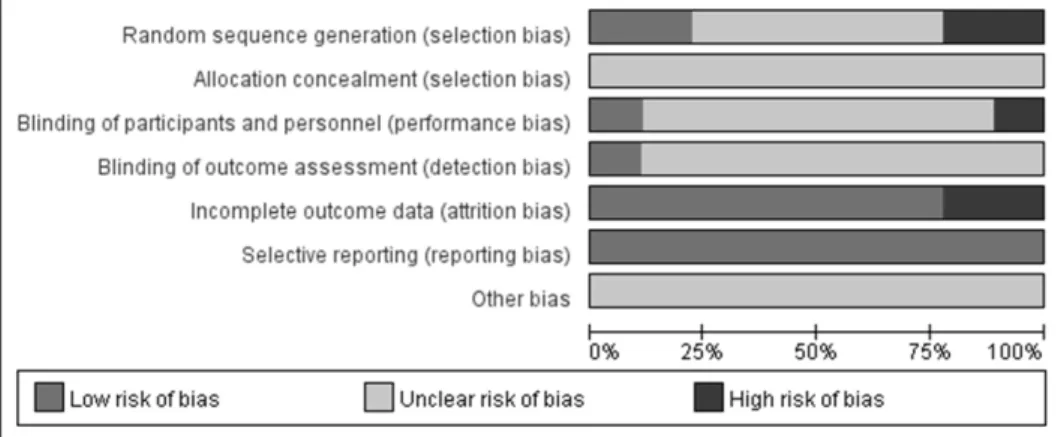
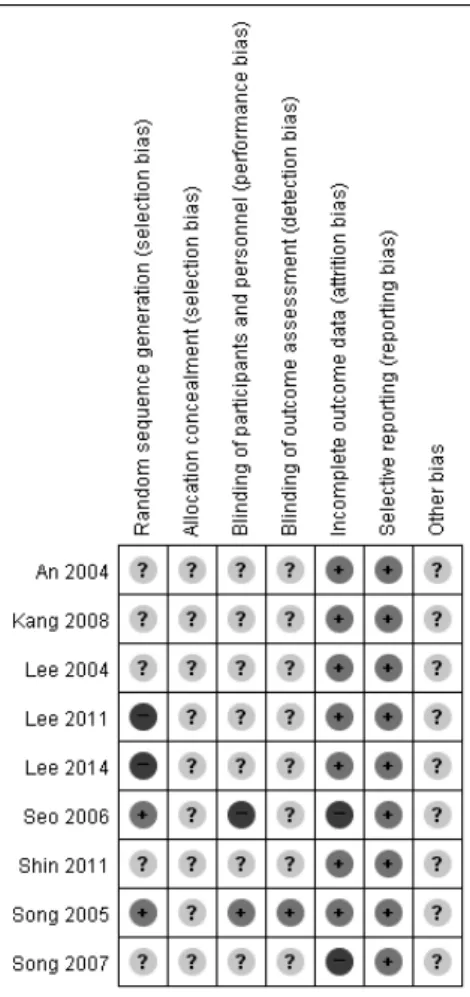
본 연구에서는 9편의 RCTs에 대하여 RoB를 사용하고, 10편의 NRCTs에 대하여 RoBANS를 사용하여 질평가를 시행하였다. 포함된 연구들의 질은 대체적으로 낮거나 불 확실하였다(Fig. 2, 3).
선정된 9편의 RCTs 논문을 무작위배정 비교임상시험 으로서의 비뚤림 위험평가를 위해 RoB criteria를 적용하
74
Fig. 3. Risk of bias summary.
Frist Author (Year)
Rsik of Bias Adeuquate
Sequence Generation
Allocation
Concealment Blinding
Incomplete Outcome Data
Addressed
Free of Selective Reporting
Free of OtherBias
Lee (2014)
8)H U U L L U
Lee (2011)
9)H U U L L U
Song (2007)
13)U U U H L U
Lee (2004)
14)U U U L L U
Song (2005)
15)L U L L L U
Kang (2008)
16)U U U L L U
Seo (2006)
17)L U H H L U
An (2004)
20)U U U L L U
Shin (2011)
22)U U U L L U
Risk of bias: low risk of bias (L), high risk of bias (H), unclear (U).
Table II. Quality Assessment of Each Included Randomized Controlled Clinical Trials
였다. 무작위배정순서 항목에서는 2편15,17)이 동전던지기와 같은 적절한 무작위 배정방법을 사용하여 비뚤림 위험
‘낮음’으로 평가되었고, 2편8,9)이 배정자에 의한 배정으로
비뚤림 위험 ‘높음’으로 평가되었다. 배정순서 은폐 항목 에서는 9편 모두 언급이 없었다. 눈가림 항목에서는 1편15) 만이 제 3자(blinder)를 통한 연구참여자 및 연구자에 대 한 적절한 이중 눈가림을 사용하여 비뚤림 위험 ‘낮음’으 로 평가되었다. 불충분한 결과자료 항목에서는 1편13)이 중도탈락이나 약침시술이 제대로 이루어지지 않은 경우 에 대한 보고가 불충분하여 비뚤림 위험 ‘높음’으로 평가 되었고, 1편17)은 상당수의 결측치가 존재하여 비뚤림 위 험 ‘높음’으로 평가되었다(Table II).
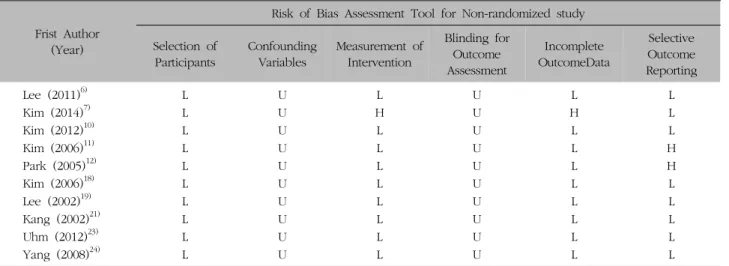
비무작위배정 비교임상연구들은 10편 모두 교란변수, 결과평가에 대한 눈가림항목에 대한 기술이 없어 비뚤림 위험 ‘불확실’로 평가되었다. 중재측정에 대한 항목에서 는 중재가 있는 임상연구 특성상 대부분 비뚤림 위험 ‘낮 음’으로 평가되었으나, 1편7)에서 대조군의 일부 중재 시 점이 연구방법에서 계획한 시점보다 늦어져 비뚤림 위험
‘높음’으로 평가되었다. 불완전한 자료 항목에서는 1편7) 에서 일부 결과 평가 측정 누락으로 향후 전화로 설문을 진행하여 회상 비뚤림으로 인한 비뚤림 ‘위험’으로 평가 되었다. 선택적 결과보고 항목에서는 2편11,12)이 사전에 정해진 평가방법대로 보고하지 않아 비뚤림 위험 ‘높음’
으로 평가되었다(Table III).
Frist Author (Year)
Risk of Bias Assessment Tool for Non-randomized study Selection of
Participants
Confounding Variables
Measurement of Intervention
Blinding for Outcome Assessment
Incomplete OutcomeData
Selective Outcome Reporting
Lee (2011)
6)L U L U L L
Kim (2014)
7)L U H U H L
Kim (2012)
10)L U L U L L
Kim (2006)
11)L U L U L H
Park (2005)
12)L U L U L H
Kim (2006)
18)L U L U L L
Lee (2002)
19)L U L U L L
Kang (2002)
21)L U L U L L
Uhm (2012)
23)L U L U L L
Yang (2008)
24)L U L U L L
Risk of bias: low risk of bias (L), high risk of bias (H), unclear (U).
Table III. Quality Assessment of Each Included Non-Randomized controlled Clinical Trials
고찰»»»
본 연구는 국내외 온라인 데이터베이스 검색을 통해 외상성 손상에 봉독약침요법을 활용한 임상연구를 조사 하여 그 연구현황을 분석하고, 외상성 손상에 대해 좀 더 효과적인 치료방법을 모색하고 차후 이와 관련된 임상연 구에 필요한 기초 자료를 마련하는 것을 목적으로 시행되 었다.
최근 외상성 손상 환자들의 한방치료에 대한 수요가 지속적으로 증가하고 있으며, 외상의 주된 한의학적 병리 는 어혈5)로 인식하여 접근할 수 있다. 외상성 손상에는 타박(contusion), 염좌(sprain), 좌상(strain)과 같은 경미 한 손상부터 골절(fracture)과 같은 중증의 손상까지 포함 되며, 손상정도에 따른 통증과 운동범위의 제한을 나타낸 다. 외상성 어혈의 치료법으로 주로 어혈변증에 따른 한 약처방들은 잘 알려져 있지만, 침치료나 약침치료를 통한 접근법은 사암침의 어혈방25)을 제외하고는 특별히 임상적 으로 활발히 연구된 부분이 없는 실정이다. 봉독약침요법 은 실험연구에서는 진통작용에 관해서 가장 많이 연구되 었고, 임상연구에서는 근골격계 질환을 대상으로 한 연구 가 가장 많았다26). 이에 근골격계 질환을 대상으로 임상 연구가 활발히 진행되고 있는 봉독약침요법을 이용한 외 상성 손상의 치료에 관해 기존에 발표된 임상연구를 체계 적으로 고찰하여 그 효과를 알아보고 임상적 근거 자료를 마련하고자 본 연구를 시행하였다.
봉독약침요법의 임상연구에 대한 문헌고찰연구가 기존 에 Kim 등27)과 Lee 등28)에 의해 발표되었다. 그러나 두 연구방법 모두 특정 환자군에 대한 연구가 아닌 봉독약침 요법이 중재로 사용된 모든 임상연구를 대상으로 하여 연 구대상이 광범위 하였으며, Cochrane에서 제시하는 RoB, RoBANs를 사용하지 않아 본 연구와는 연구방법적인 차 이가 있었다.
본 연구는 국내외 온라인 데이터베이스 검색을 통해 외상성 손상에 봉독약침요법을 활용한 임상연구들을 조 사하여 그 연구현황을 체계적 문헌 고찰의 방법론에 따라 분석하였다. 본 연구의 결과를 살펴보면, 외상성 손상에 대한 봉독약침요법과 침치료를 비교한 3편2,14,20)의 연구와 생리식염수와 비교한 2편13,15)의 연구에서 봉독약침요법을 적용한 군이 침치료 또는 생리식염수를 적용한 군보다 통 증 감소 면에서 더 유의하게 효과가 있었다. 봉독약침와 침 병행 치료와 침 단독치료를 비교한 7편9,17-19,21,22,24)
의 연구 중 6편9,18,19,21,22,24)
의 연구에서 통증 및 ROM제한 개 선에 통계적으로 유의한 결과를 나타내었다. 하지만 봉독 약침과 기타 약침을 비교한 4편7,8,10,16)의 연구에서는 중성 어혈약침을 대조군으로 하는 1편10)만이 통계적으로 유의 한 결과를 나타내었고 나머지 3편7,8,16)에서는 유의한 차이 가 없는 것으로 나타났다.
그러나 선정된 19편의 비교임상연구들에 대한 비뚤림 위험 평가를 실시한 결과, 10편의 비무작위배정 비교임상 연구들 모두 교란변수와 결과평가에 대한 눈가림항목에
76
대한 기술이 없었으며, 9편의 무작위배정 비교임상연구들 모두 배정순서 은폐에 대한 기술이 없었고 대부분의 연구 가 적절한 무작위 방법 및 눈가림을 사용하였는지가 확인 이 어려워 비뚤림 위험이 높은 것을 알 수 있었다.
비록 본 연구가 3개의 제한된 데이터베이스를 대상으 로 기존 연구를 검색했다는 한계를 가지고 있지만, 전체 적으로 보건의료원에서 제시하는 체계적 문헌고찰 매뉴 얼29)에 따라 체계적 고찰의 방법론적 과정을 준수하여 논 문을 분석하였기 때문에 봉독약침요법이 외상성 손상 환 자의 통증 및 ROM 제한 개선의 치료법으로 단독 침치료 에 우선하여 고려될 수 있다고 생각된다. 하지만 한국이 라는 특정국가에서만 편향되게 연구결과가 발표되었고, 연구 방법론적으로 비뚤림 위험이 높은 연구들이 대부분 이었기 때문에 향후 추가적인 연구가 더 필요할 것으로 사료된다. 특히, 외상성 손상에 있어 봉독약침요법과 기 타 약침요법의 비교 연구에서 4편중 3편이 통계적으로 유 의한 차이를 보이지 않았다는 점에서 향후 봉독약침요법 과 기타 약침요법들 간의 치료 효능 특징의 차이를 밝히 기 위한 더 많은 임상연구가 필요할 것으로 사료된다.