Received: January 8, 2018 Revised: February 23, 2018 Accepted: March 8, 2018
Address for Correspondence: Tae-Hee Kim, Department of Obstetrics and Gynecology, Soonchunhyang University Bucheon Hospital, 170 Jomaru-ro, Bucheon14584, Korea
Tel: +82-32-621-5380, Fax: +82-2-6008-6874, E-mail: [email protected]
Original Article
pISSN: 2288-6478, eISSN: 2288-6761 https://doi.org/10.6118/jmm.2018.24.1.1 Journal of Menopausal Medicine 2018;24:1-10
J MM
Introduction
Atrophic vaginitis (AV) appears in approximately 45% of postmenopausal women. Symptoms of AV are dyspareu- nia, dryness, changed vaginal pH, and urinary and genital changes.1 The decrease in serum estrogen level after meno- pause causes these symptoms. AV has potentially negative effects on quality of life and can be related to secondary diseases such as urinary tract infection.2~4
AV is treated with hormone replacement therapy (HRT), typically estrogen.5,6 Estrogen therapy is sufficient to restore normal vaginal acidity and microorganisms, assists epithe- lial thickening, causing an increase in vaginal discharge, and helps to improve the symptoms of AV.5 One approach to low-dose estrogen therapy is to insert estrogen or estradiol as a cream, tablet, or ring into the vagina. Systemic side effects of this therapy are possible, but the risk is insig- nificant.7 Potential risks of low-dose estrogen therapy have
Therapeutic Approaches to Atrophic Vaginitis in
Postmenopausal Women: A Systematic Review with a Network Meta-analysis of Randomized Controlled Trials
Arum Lee1, Tae-Hee Kim2, Hae-Hyeog Lee2, Yeon-Suk Kim1, Temuulee Enkhbold3, Bora Lee4, Yoo Jin Park1, Kisung Song1
1Department of Interdisciplinary Program in Biomedical Science, Soonchunhyang University, Asan, Korea, 2Department of Obstetrics and Gynecology, Soonchunhyang University College of Medicine, Bucheon, Korea, 3Department of Obstetrics and Gynecology, Etemo Clininc, Ulaanbaatar, Mongolia, 4Department of Biostatistics, Graduate School of Chung-Ang University, Seoul, Korea
Objectives: Atrophic vaginitis (AV), which is common in postmenopausal women, is characterized by vaginal dryness, dyspareunia, and discomfort. There are a variety of therapeutic agents for the treatment of AV, besides hormone replacement therapy. We performed this systematic review to compare the effectiveness of various therapies for symptom improvement in AV patients.
Methods: We searched the Cochrane Library, EMBASE, MEDLINE, and other literature (Google Scholar, Web of Science, and hand search) for studies published between January 2010 and March 2015. AV was evaluated by the following outcomes: vaginal pH, dyspareunia, vaginal dryness, or cytological change (endometrial thickness, percentages of superficial cells and parabasal cells).
They measured treatment efficacy with various outcomes pertaining to AV symptoms.
Results: Meta-analysis suggested that ospemifene was effective against dyspareunia, vaginal dryness, endometrial thickness, and percentage changes in superficial and parabasal cells. Vaginal pH was most affected by soy isoflavone vaginal gel. Ospemifene was effective for AV symptoms.
Conclusions: This systematic review compared the effects of several therapeutic agents on symptoms of AV through a network meta-analysis. This study provides objective evidence for clinical treatment and efficacy management in AV. (J Menopausal Med 2018;24:1-10)
Key Words: Atrophic vaginitis · Network meta-analysis · Postmenopause · Therapeutics · Vagina
Journal of Menopausal Medicine 2018;24:1-10
J MM
not been reported in a well-designed study. However, using this therapy for patients who form estrogen-dependent tu- mors, such as breast cancer survivors or patients with latent breast cancer, is controversial.8
Recently, in addition to estrogen, there has been interest in other treatments for AV, such as selective estrogen recep- tor modulators (SERM) (e.g., ospemifene), tissue-selective estrogen complexes (TSEC) (e.g., bazedoxifene), estriol, and natural products (e.g., soy isoflavone, sea buckthorn oil).
SERM and TSEC, when combined with estrogen treatments, improve clinical benefits because they provide a specific es- trogen receptor. Recently, some clinical trials have shown that TSEC containing bazedoxifene with estrogen treatment had effects on endometrial changes, decreased menopausal symptoms, and decelerated postmenopausal loss of bone mass.9,10 Estriol is a type of estrogen; tablets containing a low dose of estriol have been promoted for maturation and proliferation of the vaginal epithelial layer. A beneficial pro- file of the tablet has been indicated in diverse small clinical studies.11 Natural product treatments for AV that have been studied include soy isoflavone and sea buckthorn oil. Soy isoflavone has effects like those of estrogen, and it occurs naturally in soy.12 Sea buckthorn oil has also been studied because of associated improvement in the vaginal epithe- lium.13 In other study of AV, lipofilling with platelet-rich plasma (PRP) relieved symptoms. These are show that lipo- filling with PRP can be effective for vaginal atrophy.14
A variety of therapies for AV are available, but it is hard to determine which therapies are most effective. In addition, it is need to think about the effects on AV symptoms.
This review was conducted to perform a network meta- analysis of randomized controlled trials (RCTs) to identify effective drugs for relief of AV and to identify drug efficacy on vaginal symptoms (vaginal pH, dyspareunia, vaginal dryness, and cytological change) in postmenopausal women.
Materials and Methods
1. Study eligibility criteria
This review was done with recommended methods ac- cording to PRISMA and MOOSE guideline. The databases were searched for publications that described RCTs of AV
for the relief of menopausal vaginal symptoms. The primary outcome was the efficacy of drugs for treatment of AV; the secondary outcome was drug treatment efficacy for vaginal symptoms. To be eligible for inclusion, studies had to focus on AV and assess of the following outcomes: vaginal pH, dyspareunia, vaginal dryness, endometrial thickness, and change in the percentages of superficial and parabasal cells.
Studies of bazedoxifene, bazedoxifene with conjugated es- trogens, ospemifene, estriol, sea buckthorn oil, and soy iso- flavone were included. Furthermore, reports had to provide adequate information to compare outcomes between treated groups and baseline in RCT. Articles satisfying these criteria were separated into RCTs and uncontrolled clinical trial se- ries. An RCT had to include a control group or groups with random distribution to intervention study and had to use either a crossover or parallel design.
2. Information sources and search strategy The review included a search of Medline, OVID Medline, Web of Science, Scopus, National Guideline Clearinghouse, Cochrane Library, Google Scholar, Medical Treatment Guidelines, CMA Infobase, UK Clinical Guidelines, Guideline International Network, KoreaMed, KISS, NDSL, and KM- base databases, as well as a hand search of the pertinent journals published between January 2010 and March 2015 using the key words vagina atrophy, vaginal epithelium, epithelium, atrophy, vagina, vaginitis, atrophic vaginitides,
“vaginitides, atrophic,” “vaginitis, atrophic,” drug therapy, therapeutics, HRT, estrogen replacement therapy, gonadal hormones, gonadal steroid hormones, menopause, post- menopause, postmenopausal period, and climacteric. In all searches, limits were set for MeSH (human) and language (English or Korean).
3. Data extraction and appraisal
Selection of study and extraction of date were indepen- dently performed by two investigators (ARL and BRL).
Through consensus and discussion, discrepancies between the investigators were resolved. The final results were re- viewed by the senior investigator (THK). Data extraction forms were used when necessary with appeal for provide missing data and the alternative to make corrections. Miss- ing standard deviations were estimated from the range or
Journal of Menopausal Medicine 2018;24:1-10 Arum Lee, et al. Therapy on Atrophic Vaginitis
the standard error of the mean.
4. Statistical analysis
Descriptive statistics were summarized for trial and study population characteristics across all the eligible trials, de- scribing the types of comparisons and some important variables, either clinical or methodological (such as year of publication, age, and body mass index [BMI]).
We did a random-effects multiple-treatments meta- analysis within a Bayesian framework; the results are sum- marized using effect sizes and their credible intervals (CrI).
The Bayesian network meta-analysis was carried out to make indirect comparisons among treatments when direct comparisons were not possible. Markov chain Monte Carlo simulation was used for the posterior distributions. Three parallel Markov chain Monte Carlo simulations were runned for a period of 10,000 iterations after the first 10,000 were deleted as the burn-in period. All the evidence was analyzed using two approaches: a consistency model and an incon- sistency model. The fit of the two models was assessed us- ing the deviance information criterion, and the model that showed lower residual deviance was selected.
We calculated the probability that each drug was the most effective (first best) drug, the second drug, the third drug, and so on; these results are presented graphically. The probability was the surface under the cumulative ranking (SUCRA) probabilities, which was expressed as percentages comparing each intervention to an imaginary intervention that is always the best without uncertainty. A SUCRA value of x percent means that the drug accomplishes x percent of the effectiveness of this imaginary drug; thus, larger SU- CRA values denote more effective interventions.
All analyses were performed using R of version 3.1.3 (The R Foundation for Statistical Computing, Vienna, Austria) and WinBUGS version 1.4 (MRCBiostatistics Unit 2007, Cambridge, UK). If the difference between the variance of random-effects an inconsistency was large (P < 0.05), then significant heterogeneity was considered present.
Results
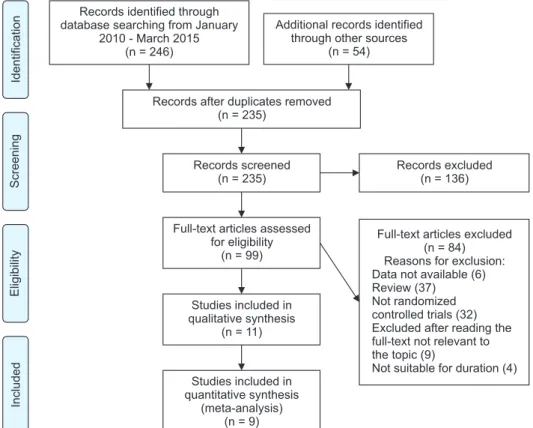
For the study analysis, Fig. 1 displays the flow diagram.
Of 99 potentially relevant articles initially screened, 9 tri-
Records excluded (n = 136)
Full-text articles excluded (n = 84) Reasons for exclusion:
Data not available (6) Review (37) Not randomized controlled trials (32) Excluded after reading the full-text not relevant to the topic (9)
Not suitable for duration (4) IdentificationScreeningEligibilityIncluded
Records identified through database searching from January
2010 - March 2015 (n = 246)
Additional records identified through other sources
(n = 54)
Records after duplicates removed (n = 235)
Records screened (n = 235)
Full-text articles assessed for eligibility
(n = 99)
Studies included in qualitative synthesis
(n = 11)
Studies included in quantitative synthesis
(meta-analysis) (n = 9)
Fig. 1. Flowchart diagram of the search procedure and inclusion of studies into the review.
Journal of Menopausal Medicine 2018;24:1-10
J MM
als was included by inclusion criteria in the final analysis.
Six articles did not contain available data, 37 were review papers, 32 were not RCTs, 9 were not relevant to the topic, 4 were not suitable because of their study period, and 2 were not suitable for quantitative synthesis in the meta- analysis. Fig. 2 shows the evidence network. The available direct comparisons (i.e., intervention and placebo compared against each other in a RCT setting) are graphically depicted in the network graph. A node width is corresponding to the number of trials of drugs. Each node represents 1 drug. The data represented 13 pairwise comparisons (12 active drugs and the placebo treatment). Of the 12 direct comparisons, ospemifene vs. placebo was evaluated in 6 (50%) reports based on 2, 3, 8, and 9 trials, respectively and 7 for two tri- als. Bazedoxifene plus conjugated estrogen vs. placebo was evaluated in 2 (16.7%) reports, each based on 1 trial. Other drugs (bazedoxifene, estriol vaginal gel, sea buckthorn oil, soy isoflavone vaginal gel) vs. placebo were each evaluated in 1 (8.3%) trial. The clinical characteristics of patients en- rolled in the randomized trials are reported in Table 1 and 2.
These studies included 4,034 patients with mean age of 58.3 years and mean BMI of 26.1 kg/m2. The duration of follow-
up was 12 weeks for all studies. Study quality was accept- able in all cases.
1. Superficial cells
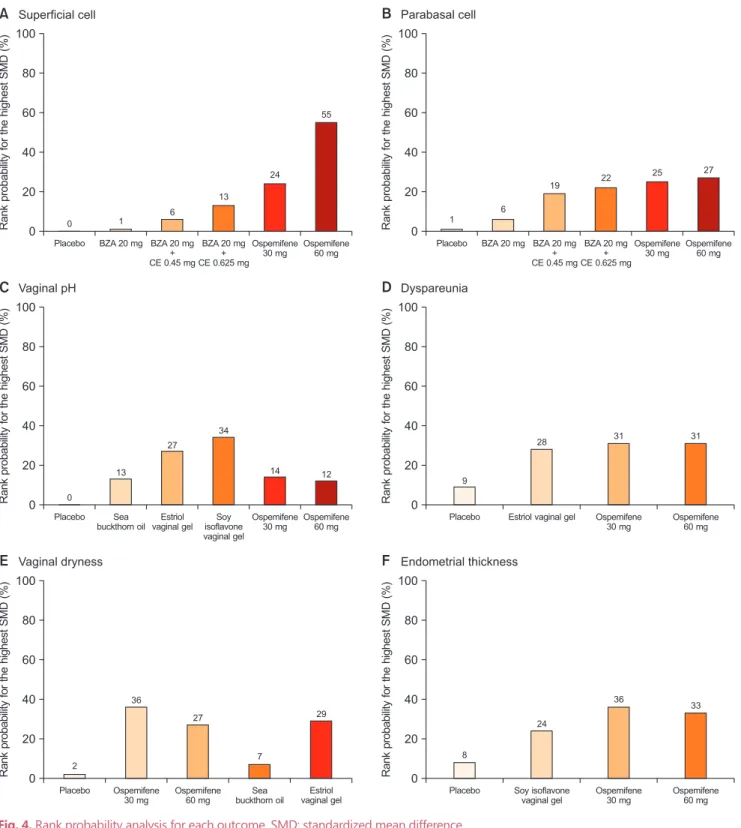
Network meta-analysis combining direct and indirect es- timates demonstrated that ospemifene 60 mg/day had the highest probability (55%) of being ranked as most effective and resulted in the greatest increase in the percentage of superficial cells (mean [95% CrI], 11.07 [-16.08, 37.83]). Re- sults are summarized in Fig. 3A and 4A. Compared with the placebo, mean increases in the percentage of superficial cells were seen with bazedoxifene, bazedoxifene plus conjugated estrogen, and ospemifene, although these differences were not statistically significant. The intervention with bazedoxi- fene alone showed no results when compared with placebo.
2. Parabasal cells
Network meta-analysis combining direct and indirect estimates demonstrated that ospemifene 60 mg/day had the highest probability (27%) of being ranked as most ef- fective and was associated with the greatest decrease in the percentage of parabasal cells (mean [95% CrI], -34.62 [-91.01, 20.90]). Ospemifene 30 mg/day and bazedoxifene 20 mg plus conjugated estrogen 0.625 mg also had com- parable ranked probability (25% and 22%, respectively) and comparable mean decreases in the percentages of parabasal cells (mean [95% CrI], -21.28 [-128.50, 85.17] for osepemi- fene 30 mg; and mean [95% CrI], -22.13 [-141.70, 95.86]
for bazedoxifene 20 mg plus conjugated estrogen 0.625 mg).
Results are summarized in Fig. 3B and 4B. There appeared to be a decrease in the percentage of parabasal cells with bazedoxifene plus conjugated estrogen and ospemifene at all doses compared to placebo (not statistically significant). Ba- zedoxifene alone had no effect.
3. Vaginal pH
Network meta-analysis combining direct and indirect es- timates demonstrated that soy isoflavone vaginal gel had the highest probability (34%) of being ranked as most effective drug and it produced the greatest change in vaginal pH (mean [95% CrI], -1.61 [6.26, 3.08]). Results are summarized in Fig. 3C and 4C. Ospemifene 60 mg/day and estriol vaginal gel showed the second highest effectiveness for vaginal pH
BZA (n = 100)
SIF (n = 29) BZA/CE
(n = 419)
EST (n = 114)
SBO (n = 46)
OSP (n = 1,702)
PBO (n = 1,624) Fig. 2. The size of the nodes corresponds to the number of trials that study the treatments. Directly comparable treatments are linked with a line, the thickness of which corresponds to the number of trials that assess the comparison. PBO: placebo, BZA:
bazedoxifene, CE: conjugated estrogens, EST: estriol vaginal gel, OSP: ospemifene, SBO: sea buckthorn oil, SIF: soy isoflavone vaginal gel.
Journal of Menopausal Medicine 2018;24:1-10 Arum Lee, et al. Therapy on Atrophic Vaginitis
(mean [95% CrI], -1.04 [-4.24, 2.20] for ospemifene 60 mg;
mean [95% CrI], -1.04 [-6.50, 4.34] for estriol vaginal gel).
Compared to placebo, sea buckthorn oil showed no signifi- cant effect on vaginal pH.
4. Dyspareunia
Network meta-analysis combining direct and indirect estimates demonstrated that ospemifene 60 mg/day had the highest probability (31%) of being ranked as most ef- fective and was associated with the greatest increase in the improvement of dyspareunia (mean [95% CrI], 1.25 [-3.37, 5.88]). Ospemifene 30 mg/day also showed the identical ranked probability (31%) compared with ospemifene 60 mg/
day, but had a smaller effect size with a wider 95% CrI (mean [95% CrI], 1.09 [-4.82, 7.07]). However, the interventions included in the meta-analysis exhibited almost no difference in effectiveness compared to placebo in improvement of dys- pareunia. Results are summarized in Fig. 3D and 4D.
5. Vaginal dryness
Network meta-analysis combining direct and indirect estimates demonstrated that ospemifene 30 mg/day had the highest probability (36%) of being ranked as most ef- fective and was associated with the greatest improvement of vaginal dryness (mean [95% CrI], 0.89 [-3.10, 4.80]). Os- pemifene 60 mg/day showed about the same effectiveness as Table 1. Study and patient characteristics
No. Author Year Treatment Participants
Drug + dosage Route Duration (weeks) n Age (years) BMI
1 Kagan et al.9 2010 Placebo Oral 12 98 56.1 ± 4.2 25.7 ± 4.1
BZA 20 mg Oral 12 100 56.4 ± 4.5 25.3 ± 3.9
BZA 20 mg + CE 0.45 mg Oral 12 209 56.4 ± 4.7 25.4 ± 3.8
BZA 20 mg + CE 0.625 mg Oral 12 210 56.3 ± 4.4 25.2 ± 3.8
2 DeGregorio
et al.15 2014 Placebo Cream 12 268 58.9 ± 6.1 26.1 ± 4.4
Ospemifene 60 mg Oral 12 276 58.6 ± 6.3 26.0 ± 4.4
3 Constantine
et al.16 2015 Placebo Cream 12 456 58.5 ± 6.4 26.2 ± 4.3
Ospemifene 60 mg Oral 12 463 58.7 ± 6.6 26.2 ± 4.3
4 Larmo et al.13 2014 Placebo Oral 12 52 62.0 ± 5.0 27.0 ± 5.0
Sea buckthorn oil 3 g Oral 12 46 64.0 ± 5.0 27.0 ± 4.0
5 Cano et al.17 2012 Placebo Gel 12 53 57.2 ± 6.7 26.1 ± 4.5
Estriol vaginal gel 50 μg Gel 12 114 56.5 ± 5.7 26.0 ± 4.1
6 Lima et al.12 2014 Placebo Gel 12 26 59.9 ± 2.9 27.8 ± 4.3
Soy isoflavone vaginal gel 1 g Gel 12 29 59.2 ± 4.8 26.7 ± 5.2 7 Bachmann and
Komi18 2010 Placebo Oral 12 268 58.9 ± 6.1 26.1 ± 4.4
Ospemifene 30 mg Oral 12 282 58.4 ± 6.3 26.4 ± 4.5
Ospemifene 60 mg Oral 12 276 58.6 ± 6.3 26.0 ± 4.4
8 Portman et al.19 2014 Placebo Oral 12 137 59.3 ± 7.0 26.5 ± 4.6
Ospemifene 60 mg Oral 12 127 59.9 ± 6.7 27.2 ± 4.6
9 Portman et al.20 2013 Placebo Oral 12 266 58.1 ± 6.0 26.1 ± 4.2
Ospemifene 60 mg Oral 12 278 58.0 ± 6.4 25.6 ± 4.0
BZA: bazedoxifene, CE: conjugated estrogens, BMI: body mass index
Journal of Menopausal Medicine 2018;24:1-10
J MM
ospemifene 30 mg/day (mean [95% CrI], 0.86 [-3.02, 4.72]), but the probability of its being ranked highest was less (27%).
Results are summarized in Fig. 3E and 4E. The intervention with sea buckthorn oil was a failure compared with placebo in terms of the improvement of vaginal dryness.
6. Endometrial thickness
Network meta-analysis combining direct and indirect es- timates demonstrated that ospemifene 30 mg/day had the highest probability (36%) of being ranked first, and ospemi- fene 60 mg/day was associated with the greatest increase in endometrial thickness (mean [95% CrI], 0.64 [-3.12, 4.39]).
Results are summarized in Fig. 3F and 4F. The two doses of ospemifene showed different results in effectiveness and
ranked probability. This pattern seemed to result from the small effect size combined with wide CrIs. Although the dif- ferences were not significant, soy isoflavone vaginal gel and ospemifene 30 mg/day and 60 mg/day had greater effec- tiveness on endometrial thickness than did the placebo.
Discussion
This systematic review has clearly described the results of nine 12-week clinical RCTs of AV treatment drugs. It is the first study to survey the comparative treatment effects of AV therapeutic agents for six vaginal symptoms using a net- work meta-analysis. Several drugs were indirectly compared Table 2. Primary and secondary outcomes
No. Author Year Superficial cells
(%) Parabasal cells
(%) Vaginal pH
(pH) Dyspareunia
(p) Vaginal dryness
(p) Endometrial thickness (mm)
1 Kagan et al.9 2010 2.2 ± 1.8 -3.0 ± 42.6 - - - -
1.3 ± 1.8 11.0 ± 40.3 - - - -
4.2 ± 2.8 -20.0 ± 41.7 - - - -
6.0 ± 3.0 -23.0 ± 42.8 - - - -
2 DeGregorio
et al.15 2014 - - - - 0.15 ± 0.0281 -
- - - - 0.41 ± 0.0337 -
3 Constantine
et al.16 2015 - - - - 0.14 ± 0.0225 -
- - - - 0.36 ± 0.0274 -
4 Larmo et al.13 2014 - - -0.2 ± 1.1 - 0.76 ± 0.061 -
- - -0.2 ± 1.0 - 0.52 ± 0.075 -
5 Cano et al.17 2012 - - -0.4 ± 1.2 0.75 ± 0.0625 0.67 ± 0.0680 -
- - -1.2 ± 1.4 0.87 ± 0.0333 0.88 ± 0.0314 -
6 Lima et al.12 2014 - - -0.3 ± 0.8 - - 0.05 ± 0.83
- - -1.7 ± 0.8 - - 0.11 ± 0.569
7 Bachmann and
Komi18 2010 2.2 ± 2.6 -3.98 ± 37.6 -0.1 ± 0.7 0.89 ± 0.6 0.84 ± 0.5 -0.02 ± 1.03 7.8 ± 2.9 -21.9 ± 38.3 -0.67 ± 0.7 1.02 ± 0.7 1.22 ± 0.6 0.42 ± 1.35 10.8 ± 3.4 -30.1 ± 39.0 -1.01 ± 0.8 1.19 ± 0.7 1.26 ± 0.6 0.72 ± 1.59 8 Portman et al.19 2014 0.0 ± 17.0 -3.9 ± 25.52 -0.25 ± 0.8 - 1.1 ± 1.02 -0.11 ± 1.2
7.0 ± 17.3 -31.7 ± 23.77 -0.95 ± 0.76 - 1.3 ± 1.08 0.82 ± 1.68
9 Portman et al.20 2013 1.7 ± 6.9 0.0 ± 30.0 -0.07 ± 0.8 1.2 ± 1.1 - 0.10 ± 1.29
12.3 ± 14.8 -40.2 ± 38.8 -0.94 ± 1.0 1.5 ± 1.1 - 0.40 ± 1.25
Journal of Menopausal Medicine 2018;24:1-10 Arum Lee, et al. Therapy on Atrophic Vaginitis
with the placebo: estrogen, which is the typical AV thera- peutic agent, bazedoxifene, estriol vaginal gel, ospemifene, sea buckthorn oil, and soy isoflavone vaginal gel. This indi- rect comparison identified reliable homogeneity of the clini- cal studies included in the analysis. All of the trials included in the analysis used an RCT design, and the patients were generally similar.
Using an estimated probability distribution and comparing a common control, placebo, and the effects of other drugs, ospemifene 60 mg/day was shown to have the best outcomes in terms of superficial cells, parabasal cells, dyspareunia, and endometrial thickness. The effectiveness of ospemifene 30 mg/day was highest for vaginal dryness, but the effect size was not significantly different from that of ospemifene 60 mg/day. The effective probability and effective value of soy isoflavone vaginal gel were highest for vaginal pH. Gen- erally, considering the improvement of AV symptoms, os- pemifene was found to have the greatest therapeutic value.
The high therapeutic effect of ospemifene with regard to the percentage of superficial cells and parabasal cells, dyspa- reunia, endometrial thickness, and vaginal dryness symp- toms was correspond with the previous studies results, but the effect on vaginal pH was not consistent with previous findings.1,15
This systematic review with network meta-analysis has several strengths, including a narrowly focused litera- ture search, attempts to maximize data outcomes through matching the units of variables, triplicate review procedures of the literature by specialists in obstetrics and gynecol- ogy and statistics, revision of effect estimates for inaccurate data through CrIs and SUCRA probabilities, and concurrent consideration of all variables by network meta-analysis.
However, this review did not include many studies, and the duration of the included studies was only 12 weeks, which is short-term treatment. There is a need to evaluate long- term treatment studies to compare the efficacy of various
A B
Change of parabasal cell
Posthoc
mean 95% CrI
Placebo BZA 20 mg
BZA 20 mg + CE 0.45 mg BZA 20 mg + CE 0.625 mg Ospemifene 30 mg Ospemifene 60 mg
2.72 11.9
17.77 22.13 21.28 34.62
( 3.06, 2.38) 103.70 137.30 141.70 128.50 91.01 ( , 128.40) ( , 97.01) ( , 95.86) ( , 85.17) ( , 20.90)
150 150 100 50 0 50 100 Change of
superficial cells (%)
Posthoc
mean 95% CrI
Placebo BZA 20 mg
BZA 20 mg + CE 0.45 mg BZA 20 mg + CE 0.625 mg Ospemifene 30 mg Ospemifene 60 mg
1.53 0.59 3.51 5.34 7.12 11.07
(0.80, 2.27) ( 7.30, 8.35)
5.29 3.70 2.41 16.08 ( , 12.22) ( , 14.44) ( , 16.64) ( , 37.83)
40 20 10 0 10 20 30
Superficial cell Parabasal cell
C D
Change of vaginal pH
Posthoc
mean 95% CrI
Placebo Sea buckthorn oil Estriol vaginal gel Soy isoflavone vaginal gel Ospemifene 30 mg Ospemifene 60 mg
0.22 0.24 1.04 1.61 0.77 1.04
( 2.31, 1.86) 5.26 6.50 6.26 5.31 4.24 ( , 4.72) ( , 4.34) ( , 3.08) ( , 3.71) ( , 2.20)
10
10 5 0 5
Change of dyspareunia
Posthoc
mean 95% CrI
Placebo Estriol vaginal gel Ospemifene 30 mg Ospemifene 60 mg
0.94 1.07 1.09 1.25
( 1.64, 3.49) 4.55 4.82 3.37 ( , 6.85) ( , 7.07) ( , 5.88)
10
10 5 0 5
Vaginal pH Dyspareunia
E F
Change of vaginal dryness
Posthoc
mean 95% CrI
Placebo Ospemifene 30 mg Ospemifene 60 mg Sea buckthorn oil Estriol vaginal gel
0.61 0.89 0.86 0.38 0.82
( 3.07, 4.27) 3.10 3.02 3.75 3.31 ( , 4.80) ( , 4.72) ( , 4.50) ( , 4.88)
10
10 5 0 5
Change of endometrial thickness
Posthoc
mean 95% CrI
Placebo
Soy isoflavone vaginal gel Ospemifene 30 mg Ospemifene 60 mg
0.01 0.06 0.44 0.64
( 1.86, 1.88) 5.18 5.31 3.12 ( , 5.17) ( , 6.13) ( , 4.39)
10
10 5 0 5
Vaginal dryness Endometrial thickness
Fig. 3. Forest plots for effect sizes of treatments for the outcomes. BZA: bazedoxifene, CrI: credible intervals.
Journal of Menopausal Medicine 2018;24:1-10
J MM
drugs and to evaluate risk assessment bias.
Conclusion
This study compared the effects of several therapeutic agents on symptoms of AV through a network meta-analy- A Superficial cell
C Vaginal pH
E Vaginal dryness
B Parabasal cell
D Dyspareunia
F Endometrial thickness 100
80
60
40
20
RankprobabilityforthehighestSMD(%)
0
Placebo BZA 20 mg BZA 20 mg + CE 0.45 mg
BZA 20 mg + CE 0.625 mg
Ospemifene 30 mg
Ospemifene 60 mg
100
80
60
40
20
RankprobabilityforthehighestSMD(%)
0
Placebo BZA 20 mg BZA 20 mg + CE 0.45 mg
BZA 20 mg + CE 0.625 mg
Ospemifene 30 mg
Ospemifene 60 mg
100
100 80
80 60
60 40
40 20
20
RankprobabilityforthehighestSMD(%)RankprobabilityforthehighestSMD(%)
0
0 Placebo
Placebo Sea buckthorn oil
Estriol vaginal gel
Soy isoflavone vaginal gel
Ospemifene 30 mg
Ospemifene 30 mg
Ospemifene 60 mg
Ospemifene 60 mg
100
100 80
80 60
60 40
40 20
20
RankprobabilityforthehighestSMD(%)RankprobabilityforthehighestSMD(%)
0
0
Placebo
Placebo
Estriol vaginal gel Ospemifene 30 mg
Ospemifene 30 mg
Ospemifene 60 mg
Ospemifene 60 mg Sea
buckthorn oil Estriol vaginal gel
Soy isoflavone vaginal gel
0 1
6
13
24
55
0
13
27
34
14 12
2
36
27
7
29
1
6
19 22 25 27
9
28 31 31
8
24
36 33
Fig. 4. Rank probability analysis for each outcome. SMD: standardized mean difference.
Journal of Menopausal Medicine 2018;24:1-10 Arum Lee, et al. Therapy on Atrophic Vaginitis
sis based on well-designed randomized controlled interven- tion studies. Ospemifene had greatest therapeutic effect on the percentage of superficial cells and parabasal cells and on symptoms of dyspareunia, vaginal dryness, and endometrial thickness; thus, ospemifene was confirmed to be effective in symptomatic AV therapy. This finding provides objective evidence for treatment and efficacy management of AV.
Acknowledgement
This research was supported by High Value-added Food Technology development program, Ministry of agriculture, Food and Rural Affairs, Republic of Korea (116029-03-3- HD040).
Conflict of Interest
No potential conflict of interest relevant to this article was reported.
References
1. Nappi RE, Panay N, Bruyniks N, Castelo-Branco C, De Villiers TJ, Simon JA. The clinical relevance of the effect of ospemifene on symptoms of vulvar and vaginal atrophy.
Climacteric 2015; 18: 233-40.
2. Cui Y, Zong H, Yan H, Li N, Zhang Y. The efficacy and safety of ospemifene in treating dyspareunia associated with postmenopausal vulvar and vaginal atrophy: a sys- tematic review and meta-analysis. J Sex Med 2014; 11:
487-97.
3. Goldstein I, Dicks B, Kim NN, Hartzell R. Multidisciplinary overview of vaginal atrophy and associated genitourinary symptoms in postmenopausal women. Sex Med 2013; 1:
44-53.
4. Kim HK, Kang SY, Chung YJ, Kim JH, Kim MR. The re- cent review of the genitourinary syndrome of menopause. J Menopausal Med 2015; 21: 65-71.
5. Lethaby A, Ayeleke RO, Roberts H. Local oestrogen for vaginal atrophy in postmenopausal women. Cochrane Da- tabase Syst Rev 2016: Cd001500.
6. Lee HH, Kim TH, Park J, Lee A, Park Y, Byun DW, et al.
Expression of ezrin in vagina cells of postmenopausal rats after dietary administration of omega-3 Fatty Acid for- mula. J Menopausal Med 2014; 20: 97-103.
7. Santen RJ, Pinkerton JV, Conaway M, Ropka M, Wis- niewski L, Demers L, et al. Treatment of urogenital atrophy with low-dose estradiol: preliminary results. Menopause 2002; 9: 179-87.
8. Wills S, Ravipati A, Venuturumilli P, Kresge C, Folkerd E, Dowsett M, et al. Effects of vaginal estrogens on serum estradiol levels in postmenopausal breast cancer survivors and women at risk of breast cancer taking an aromatase inhibitor or a selective estrogen receptor modulator. J Oncol Pract 2012; 8: 144-8.
9. Kagan R, Williams RS, Pan K, Mirkin S, Pickar JH. A randomized, placebo- and active-controlled trial of baze- doxifene/conjugated estrogens for treatment of moderate to severe vulvar/vaginal atrophy in postmenopausal women.
Menopause 2010; 17: 281-9.
10. Shin JJ, Kim SK, Lee JR, Suh CS. Ospemifene: A novel option for the treatment of vulvovaginal atrophy. J Meno- pausal Med 2017; 23: 79-84.
11. Jaisamrarn U, Triratanachat S, Chaikittisilpa S, Grob P, Prasauskas V, Taechakraichana N. Ultra-low-dose estriol and lactobacilli in the local treatment of postmenopausal vaginal atrophy. Climacteric 2013; 16: 347-55.
12. Lima SM, Bernardo BF, Yamada SS, Reis BF, da Silva GM, Galvão MA. Effects of Glycine max (L.) Merr. soy isoflavone vaginal gel on epithelium morphology and estrogen receptor expression in postmenopausal women: a 12-week, ran- domized, double-blind, placebo-controlled trial. Maturitas 2014; 78: 205-11.
13. Larmo PS, Yang B, Hyssala J, Kallio HP, Erkkola R. Effects of sea buckthorn oil intake on vaginal atrophy in post- menopausal women: a randomized, double-blind, placebo- controlled study. Maturitas 2014; 79: 316-21.
14. Kim SH, Park ES, Kim TH. Rejuvenation using platelet- rich plasma and lipofilling for vaginal atrophy and lichen sclerosus. J Menopausal Med 2017; 23: 63-8.
15. DeGregorio MW, Zerbe RL, Wurz GT. Ospemifene: a first- in-class, non-hormonal selective estrogen receptor modu- lator approved for the treatment of dyspareunia associated with vulvar and vaginal atrophy. Steroids 2014; 90: 82-93.
16. Constantine G, Graham S, Portman DJ, Rosen RC, Kings- berg SA. Female sexual function improved with ospemifene in postmenopausal women with vulvar and vaginal atrophy:
results of a randomized, placebo-controlled trial. Climac- teric 2015; 18: 226-32.
17. Cano A, Estévez J, Usandizaga R, Gallo JL, Guinot M, Delgado JL, et al. The therapeutic effect of a new ultra low
Journal of Menopausal Medicine 2018;24:1-10
J MM
concentration estriol gel formulation (0.005% estriol vagi- nal gel) on symptoms and signs of postmenopausal vaginal atrophy: results from a pivotal phase III study. Menopause 2012; 19: 1130-9.
18. Bachmann GA, Komi JO. Ospemifene effectively treats vul- vovaginal atrophy in postmenopausal women: results from a pivotal phase 3 study. Menopause 2010; 17: 480-6.
19. Portman D, Palacios S, Nappi RE, Mueck AO. Ospemifene, a non-oestrogen selective oestrogen receptor modula-
tor for the treatment of vaginal dryness associated with postmenopausal vulvar and vaginal atrophy: a randomised, placebo-controlled, phase III trial. Maturitas 2014; 78: 91- 8.
20. Portman DJ, Bachmann GA, Simon JA. Ospemifene, a novel selective estrogen receptor modulator for treating dyspareunia associated with postmenopausal vulvar and vaginal atrophy. Menopause 2013; 20: 623-30.