Ⅰ. 서 론
손상된 치아를 금관으로 수복하기 위해서 치아를 삭제한 후 임시 보철물을 제작하게 된다. 임시 보철 물은 삭제된 치아의 치수를 보호하고, 치아의 이동, 과민증을 방지하고 기능과 심미를 회복시켜 주기 위 해서 제작된다.1)임시 보철물을 제작하는 방법은 적 합시키는 방법에 따라 직접법(direct technique)과 간 접법(indirect technique)으로 분류될 수 있고 직접법 은 구강 내 실제 삭제된 치아에서 제작되어지고, 간 접법은 구강 외 모형상에서 제작되어진다. 직접법으 로 임시 보철물을 제작하는 방법에는 삭제된 치아 위에 일정량의 자가 중합 임시수복용 레진을 경화시 킨 후 이를 치관의 형태로 삭제하여 제작하는 방법, 치아를 삭제하기 전 인상을 채득하여 matrix를 제작 후 치아를 삭제한 후 자가 중합 임시수복용 레진을 넣어 경화시키는 방법, 치아를 삭제하기 전 인상 채 득 후 모형을 제작하고 vacuum-formed template를 제작하고 여기에 자가 중합 임시수복용 레진을 넣어 삭제된 치아에 올려 놓고 경화시키는 방법이 있다.2) 자가 중합 임시수복용 레진을 사용하여 직접법으로 임시 보철물이 제작될 경우 자가 중합 임시수복용 레진의 경화시 발생되는 열에 의한 자극으로 치수와 주위 조직이 손상될 수 있다고 한다.3)
직접법으로 자가 중합 임시수복용 레진을 사용하 여 임시 보철물을 제작할 경우 치수의 외부환경으로 상아질의 두께, 레진의 두께, matrix의 종류4)및 두
께가 있다. 본 연구에서는 자가 중합 임시수복용 레 진을 사용하여 직접법으로 임시 치관을 제작할 때 외부환경이 온도 상승에 미치는 영향을 실험하였다.
Ⅱ. 연구재료 및 방법 1. 연구재료
실험에 사용된 자가 중합 임시수복용 레진으로 methymethacrylate(MMA)계통의 Jet(Lang Dental, Mfg., Co., Inc., Wheeling, Il., USA)을 사용하였다.
Matrix재료의 종류는 Vinyl Polysiloxane impression material, Irreversible hydrocolloid impression material, Vacuum-formed template를 사용하였고 상품명은 각각 Express(3M ESPE, St. Paul, USA), Aroma fine(GC Corp., Tokyo, Japan), 0.6 mm두께의 Drufolen-(Dreve-dentamid GmbH, Germany)이었다. 온도측정을 위해 사용된 온도계는 Datalogging K/J thermometer(TES electrical electronics Corp.)를 사용하였다(Fig. 1).
2. 연구 방법
실험은 3단계로 진행되었다. 먼저 레진 두께에 따 른 온도 상승량 측정, 다음은 Matrix종류 및 각각의 두께에 따른 레진 온도 상승량 측정, 마지막으로 치 아 절편의 두께에 따른 레진의 온도 상승량을 측정 대한치과보철학회지:Vol. 44, No. 5, 2006
자가 중합 임시수복용 레진의 경화 시 외부환경 변화에 따른 치아의 온도변화
경희대학교 치과대학 치과보철학교실 오우식∙백 진∙김형섭∙우이형
하였다.
온도 측정을 위한 장치는 다음과 같다. 구강 내 치 수의 온도를 37℃라하고 이를 재현하기 위해 Water bath를 이용하여 metal die의 온도를 37℃로 유지하 고 metal die의 중앙에 thermocouple을 위치시킨다.
Thermocouple을 thermometer에 연결하여 온도를 측 정하고 personal computer에 이를 기록하였다. 온도 의 측정은 시작할 때의 온도도 되돌아올 때까지 측 정하였다. Fig. 2는 실험 장치의 모식도와 사진이다.
1) 레진 두께에 따른 온도 상승량 측정
먼저 내부 지름 12 mm의 acrylic pipe를 1, 2, 3, 6, 10 mm로 각각 10개씩 높이로 절단한다(Fig. 3). 이 를 metal die 중앙의 thermocouple이 위치한 부위에 올려 놓고 레진을 10초간 혼합하여 올려 놓는다
(P/L ratio: 2/1 무게 비). 각 높이 마다 10개 씩 측 정한다.
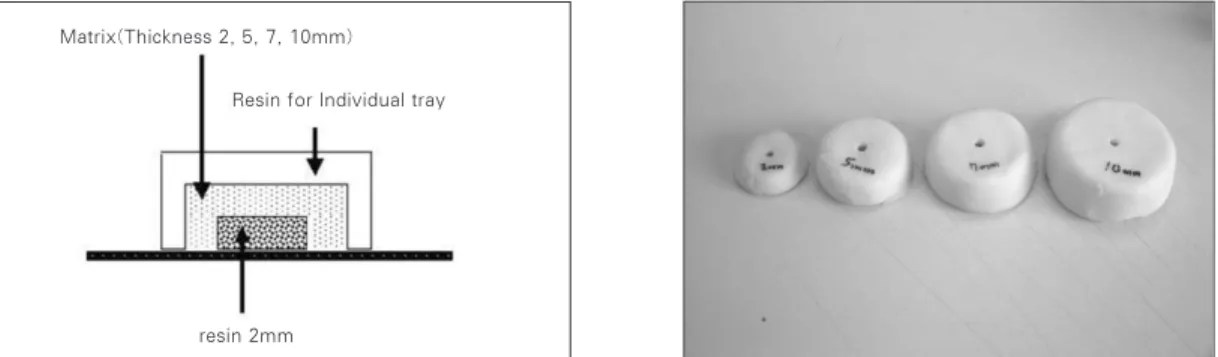
두께 2 mm, 지름 12 mm의 경화된 레진 시편 위 로 두께가 각각 2, 5, 7, 10 mm가 되도록 base plate wax를 사용하여 relief하고 이 위로 tray용 레진을 사용하여 matrix가 2, 5, 7, 10 mm 두께로 들어갈 tray를 제작하고(Fig. 5) vinyl polysiloxane impression material(약칭: putty), irreversible hydrocolloid impression material(약칭: alginate) 을 담은 뒤 각각의 재료마다 두께별로 10개씩 레진 의 온도 상승을 측정한다. 그리고 vacuum-formed template(약칭: vacuum)는 두께 2 mm, 지름 12 mm의 경화된 레진 시편 위로 template를 제작한 뒤 여기에 레진을 혼합하여 10개 온도 측정한다.
2) 치아 절편의 두께에 따른 레진의 온도 상승량 측정
발치 된 대구치를 교합면에서 model trimmer로 상 아질이 노출될 때까지 삭제한 뒤 disc를 사용하여 두 께 0.5, 1.0, 1.5, 2.0 mm가 되도록 치아 절편을 제 작한다. 이를 metal die의 중심에 thermocouple이 위 치한 부위에 올려 놓고 그 위로 지름 12 mm, 높이 2 mm의 acrylic pipe을 올려 놓은 뒤 레진을 혼합하여 올려 놓고 각각의 두께별로 10회씩 측정한다.
실험군의 분류와 coding은 Table I과 같다. 통계처 리는 PC용 프로그램인 SPSS ver 11.0 을 사용하였 고 군간의 비교를 위해 one way ANOVA, t-test를 시행하였다.
Fig. 1. Datalogging K/J thermometer (TES electrical electronics Corp).
Fig. 2. Temperature measuring apparatus (Left: diagram of apparatus, right: apparatus set-up).
Fig. 3. Acrylic pipe with internal diameter 12 mm (height: 1, 2, 3, 6, 10 mm).
Table I. Classification of the experimental groups and coding
Experimental group Code
Resin only: thickness 1mm R01
Temperature rise of Resin only: thickness 2mm R02
the different thickness of Resin only: thickness 3mm R03
resins. Resin only: thickness 6mm R06
Resin only: thickness 10mm R10
Resin 2mm + putty thickness 2mm P02 Resin 2mm + putty thickness 5mm P05 Resin 2mm + putty thickness 7mm P07 Temperature rise of Resin 2mm + putty thickness 10mm P10 the resins using different Resin 2mm+alginate thickness 2mm A02
thickness of matrix. Resin 2mm+alginate thickness 5mm A05
Resin 2mm+alginate thickness 7mm A07 Resin 2mm+alginate thickness 10mm A10 Resin 2mm+vacuum formed template V
Tooth thickness 0.5mm T05
Temperature rise of Tooth thickness 1.0mm T10
the resins using different Tooth thickness 1.5mm T15
thickness of tooth sections. Tooth thickness 2.0mm T20
Tooth thickness 0.5mm T05
Fig. 4. Individual tray relieved by the thickness of the matrix materials (Left: diagram of the individual tray, right: individual trays relieved by thickness of the matrix materials).
resin 2mm
Resin for Individual tray Matrix(Thickness 2, 5, 7, 10mm)
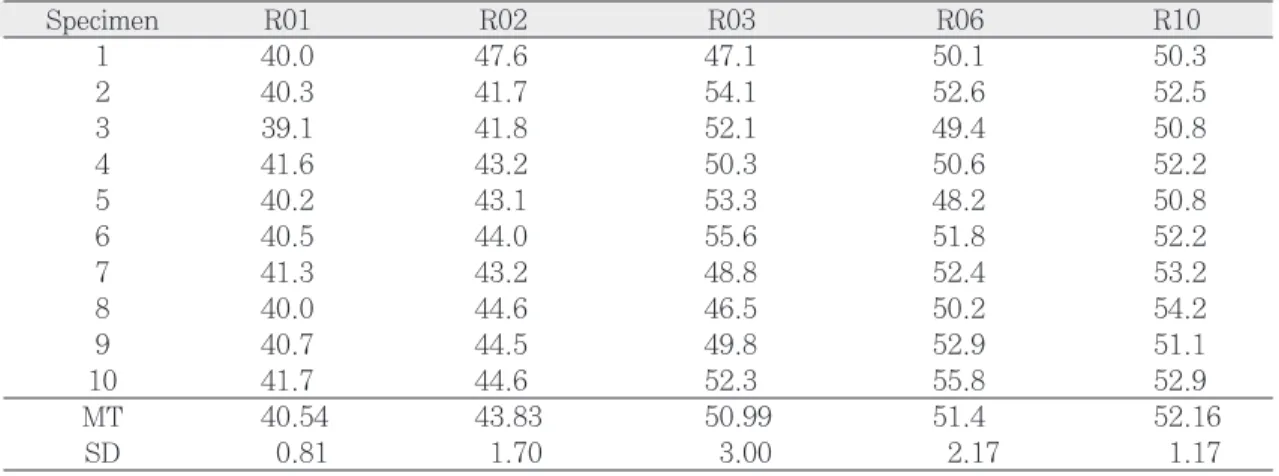
Table II. Mean temperature(℃) and standard deviation of the Resin groups
Specimen R01 R02 R03 R06 R10
1 40.0 47.6 47.1 50.1 50.3
2 40.3 41.7 54.1 52.6 52.5
3 39.1 41.8 52.1 49.4 50.8
4 41.6 43.2 50.3 50.6 52.2
5 40.2 43.1 53.3 48.2 50.8
6 40.5 44.0 55.6 51.8 52.2
7 41.3 43.2 48.8 52.4 53.2
8 40.0 44.6 46.5 50.2 54.2
9 40.7 44.5 49.8 52.9 51.1
10 41.7 44.6 52.3 55.8 52.9
MT 40.54 43.83 50.99 51.4 52.16
SD 0.81 1.70 3.00 2.17 1.17
MT: mean temperature SD: standard deviation
Table III. One-way ANOVA of the temperature rise of the different thickness of resins
Group Duncan’s grouping*
R01 A
R02 B
R03 C
R04 C
R05 C
* : same letters are not significantly different at p=0.05.
Ⅲ. 연구 성적
1) 레진 두께에 따른 온도 상승량 측정
레진의 각 두께에 따른 온도의 평균과 표준 편차는 Table II와 같다. 각각의 군을 ANOVA분석한 결과는 Table III과 같다. R01, R02, R03, R06, R10 군에 서 모두 온도 상승을 보였고 R03, R06, R10사이에 는 유의성 있는 차이가 없었으며 이 세 개의 군과 R01군, R02군 사이에 유의성 있는 차이를 보였다.
2) Matrix 종류 및 각각의 두께에 따른 레진 온도 상승량 측정
가. Vinyl polysiloxane impression material Vinyl polysiloxane impression material의 두께에
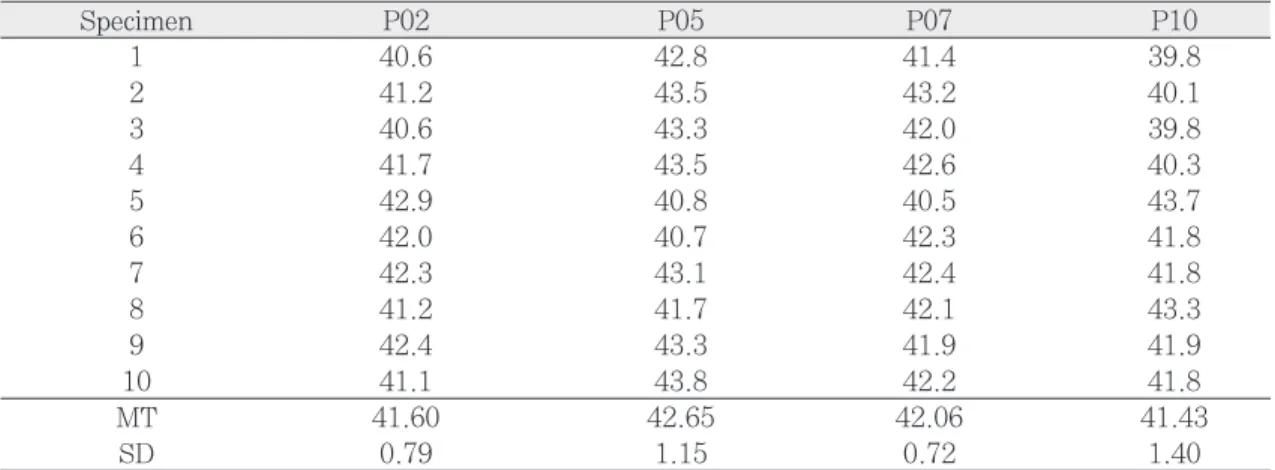
따른 레진의 평균 온도와 표준편차는 Table IV와 같 다. 각각의 군을 ANOVA분석한 결과는 Table V와 같다. 각각의 군 사이에는 유의성 있는 차이가 없었 으며, R02군과 비교시 유의성 있는 차이를 보였다 (p<0.05).
나. Irreversible hydrocolloid impression mate- rial
Irreversible hydrocolloid impression material의 두께에 따른 레진의 평균 온도와 표준편차는 Table VI와 같다. 각각의 군을 ANOVA 분석한 결과는 Table VII과 같다. A02, A05, A07, A10군 사이에 유 의성 있는 차이를 보였다. R02군과의 비교시 유의성 있는 차이를 보였다(p<0.05).
Table IV. Mean temperature(℃) and standard deviation of resins using different thickness of vinyl poly- siloxane impression material
Specimen P02 P05 P07 P10
1 40.6 42.8 41.4 39.8
2 41.2 43.5 43.2 40.1
3 40.6 43.3 42.0 39.8
4 41.7 43.5 42.6 40.3
5 42.9 40.8 40.5 43.7
6 42.0 40.7 42.3 41.8
7 42.3 43.1 42.4 41.8
8 41.2 41.7 42.1 43.3
9 42.4 43.3 41.9 41.9
10 41.1 43.8 42.2 41.8
MT 41.60 42.65 42.06 41.43
SD 0.79 1.15 0.72 1.40
MT: mean temperature SD: standard deviation
Table V. One-way ANOVA of the temperature rise of the resins using different thickness of vinyl poly- siloxane impression material
Group Duncan’s grouping*
P02 A
P05 A
P07 A
P10 A
* : same letters are not significantly different at p=0.05.
Table VI. Mean temperature(℃) and standard deviation of resins using different thickness of Irreversible hydrocolloid impression material
Specimen A02 A05 A07 A10
1 41.90 40.10 39.80 38.00
2 41.90 40.00 38.60 37.80
3 41.80 39.60 39.10 37.80
4 39.10 39.70 38.80 37.80
5 39.00 40.70 39.70 37.70
6 39.20 40.70 39.70 38.30
7 40.10 39.40 39.00 38.30
8 41.20 38.10 38.20 37.80
9 41.10 39.00 39.00 37.60
10 39.60 39.60 38.30 37.30
MT 40.49 39.69 39.02 37.84
SD 1.22 0.78 0.57 0.30
MT: mean temperature SD: standard deviation
Table VIII. Mean temperature(℃) and standard deviation of resins using vacuum-formed template
Specimen M
1 42.3
2 42.3
3 42.9
4 42.7
5 42.6
6 45.0
7 43.2
8 41.7
9 41.7
10 42.7
MT 42.71
SD 0.94
MT: mean temperature SD: standard deviation
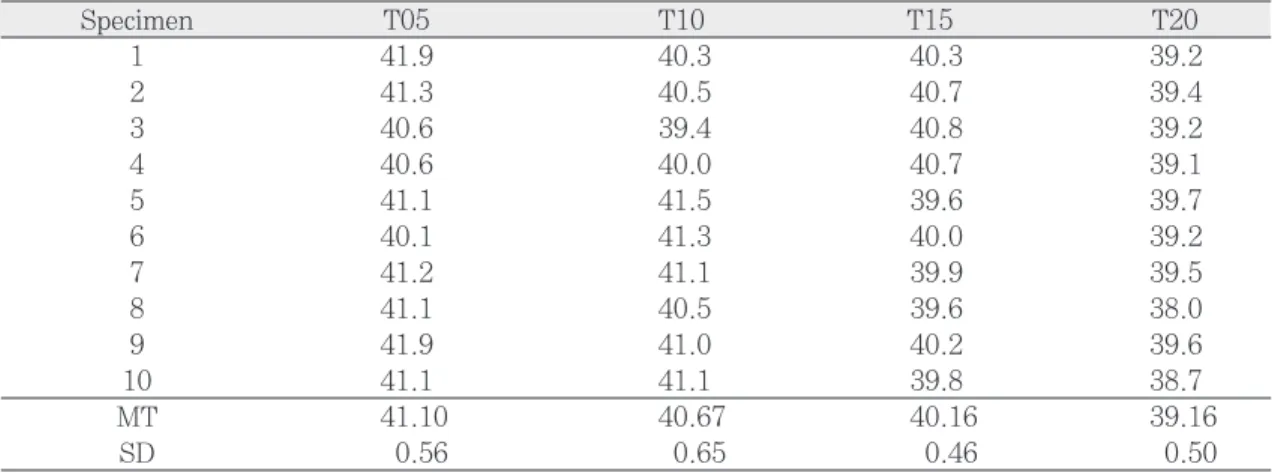
Table IX. Mean temperature(℃) and standard deviation of resins using different thickness of Tooth sections
Specimen T05 T10 T15 T20
1 41.9 40.3 40.3 39.2
2 41.3 40.5 40.7 39.4
3 40.6 39.4 40.8 39.2
4 40.6 40.0 40.7 39.1
5 41.1 41.5 39.6 39.7
6 40.1 41.3 40.0 39.2
7 41.2 41.1 39.9 39.5
8 41.1 40.5 39.6 38.0
9 41.9 41.0 40.2 39.6
10 41.1 41.1 39.8 38.7
MT 41.10 40.67 40.16 39.16
SD 0.56 0.65 0.46 0.50
MT: mean temperature SD: standard deviation
Table VII. One-way ANOVA of the temperature rise of the resins using different thickness of Irreversible hydrocolloid impression material
Group Duncan’s grouping*
A02 A
A05 B
A07 C
A10 D
* : same letters are not significantly different at p=0.05.
Table X. One-way ANOVA of the temperature rise of the resins using different thickness of tooth sec- tions
Group Duncan’s grouping*
T05 A
T10 A
T15 B
T20 C
* : same letters are not significantly different at p=0.05
다. Vacuum-formed template
Vacuum-formed template를 사용했을 때의 레진 의 평균 온도와 표준 편차는 Table VIII과 같다.
R02군과의 비교시 유의성 있는 차이를 보이지 않 았다.
3) 치아 절편의 두께에 따른 레진의 온도 상승량 측정
치아 절편의 두께에 따른 레진의 평균 온도와 표준 편차는 Table IX와 같다. 각각의 군을 ANOVA 분석 한 결과는 Table X과 같다. T10과 T05사이에 유의성 있는 차이를 보이지 않았으며 이 두 군과 T20, T15 군 사이에 유의성 있는 차이를 보였다.
Ⅳ. 총괄 및 고찰
치아 삭제 후 자가 중합 임시 수복용 레진을 사용 하여 임시 보철물을 제작하는 동안 치수는 레진의 monomer에 의한 화학적 자극과 레진의 중합 시 나 타나는 발열 반응에 의한 열 자극으로 치수가 손상 될 수 있다. Zach와 Cohen의 보고에 의하면 치수의 온도가 5.6℃ 높아질 때 15%, 11.2℃높아질 때 60%, 16.8℃ 높아질 때 100%의 비가역성 치수 손상 이 일어난다고 하였다.5)Schubert는 치수에 염증을 일으키기 위한 역치를 41.5℃라 보고하였다.6) 하지 만 일반적으로 커피 등과 같은 뜨거운 음료수, 음식 물 등을 고려해 볼 때 치수 손상은 크게 일어나지 않 는데 이는 치아가 열자극으로부터 보호 작용이 있기 때문이다. 여기에는 치주 인대,7)상아 세관내 세포의 원형질의 확장과 같은 유기 구조물,8) 치수 혈류,9-11) 상아질의 두께 등이 있다. 여기에서는 자가 중합 레
진의 화학적 자극과 치아의 열에 대한 보호 작용은 실험에 포함하지 않았다.
이 실험에서 자가 중합 임시 수복용 레진의 온도 변화를 시간에 따라 나타내면 Fig. 5와 같다. 온도 측 정 시작 후 처음 모든 시편에서 급속히 온도가 떨어 지는 부분이 나타난다. 이 부분은 실온에서 혼합한 레진을 metal die에 올려 놓았을 때 실온에 맞혀진 레진의 온도에 의해서 thermocouple의 온도를 떨어 뜨리기 때문이다. 그 이후 서서히 레진의 중합이 일 어나면서 온도가 상승하다가 최고 온도에 도달한 후 다시 원상태의 온도로 돌아오게 된다. 이는 Tjan의 보고와 일치한다.8)
이 실험의 두번째 단계인 matrix 종류 및 각각의 두께에 따른 레진 온도 상승량 측정 에서 레진의 두 께 2 mm(군: R02)를 사용하였다. 이는 Schubert의 역치를 고려하여 레진의 두께 2 mm에서 충분한 발 열반응이 일어나는 것으로 보고 정하였다. Matrix를 사용한 결과에서 irreversible hydrocolloid impres- sion material이 vinyl polysilloxane impression mate- rial보다 온도를 더 낮추는 효과를 나타냈는데 이는 irreversible hydrocolloid impression material에 포 함되어 있는 물의 비열이 높기 때문에 열 흡수가 많 았을 것으로 보인다. Vinyl polysilloxane impression material의 실험 결과에서 P02, P05, P07, P10사이 에서 유의성 있는 차이를 나타내지 않았는데 이러한 이유는 재료 자체의 열전도율이 낮아 열 흡수가 레 진과 접촉하고 있는 부위에서부터 2 mm이상은 열 이 전도되지 않기 때문일 것으로 보인다.
상아질과 법랑질의 열전도도는 각각 0.0015, 0.0022℃/cm이다.12) 이는 치과용 금합금, 아말감 (열전도도 0.710, 0.055℃/cm)과 비교할 때 적은 수
치이다. 이는 두께가 두꺼울수록 열 차단 효과가 크 다는 것을 나타내고 이는 실험의 결과와 일치한다.
실험에서 치아절편의 두께가 두꺼워 질수록 온도 상 승량이 줄어들었는데 이는 임상에서 잔존 상아질 두 께(remaining dentine thickness)가 두꺼울수록 외 부 열자극으로부터치수의 보호작용이 크다는 것으 로 해석할 수 있다. 이와 같은 결과로 볼 때 구강 내 에서 임시 보철물을 직접 제작할 경우 잔존 상아질 두께와 치아 삭제량에 따른 사용될 자가 중합 임시 수복용 레진의 양을 고려 하여 matrix의 종류를 선택 하여 자가 중합 임시수복용 레진의 발열 반응에 의 한 손상을 줄일 수 있을 것으로 보인다.
임상적으로 직접법으로 구강내에서 임시 보철물을 제작하는 경우 air-water spray로 열을 낮혀주거나 레진의 초기 경화이전에 삭제된 치아에서 임시 보철 물을 제거하는 방법이 보고13)되고 있고 치수 손상을 피하기 위해 임시 보철물을 간접법으로 제작하는 것 을 권장하는 보고14)도 있다.
Ⅴ. 결 론
본 연구에서 임시 수복용 자가 중합 레진의 경화시 나타나는 발열에 의한 치아의 열적인 손상을 구명하 려고 하였다. 이를 위해 water bath를 이용하여 metal die의 온도를 37℃로 유지하고 이 위에 ther- mocouple을 위치 시켜 치아의 환경을 재현할 수 있 는 장치를 제작하였다. 이 장치 위에서 자가 중합 임
시 수복용 레진의 두께에 따른 온도 상승, 각각 다른 matrix와 각 matrix의 두께에 따른 레진의 온도 상 승, 치아 절편의 두께에 따른 레진의 온도 상승을 측 정하였다. 본 실험의 한도 내에서 다음과 같은 결론 을 내릴 수 있다.
1. 레진의 두께가 두꺼워질수록 온도 상승량이 증가 하였으나 3 mm이상에서는 유의차가 없었다 (p<0.05).
2. Irreversible hydrocolloid impression material에 서는 온도 상승량이 가장 적었고, vinyl polysil- loxane impression material, vacuum-formed tem- plate 순이었다(p<0.05).
3. Vinyl polysilloxane impression material을 matrix로 사용한 경우 두께에 관계없이 레진의 온 도상승이 줄어 들었다(p<0.05).
4. Irreversible hydrocolloid impression material을 matrix로 사용할 경우 두꺼울수록 레진의 온도 상 승량이 적었고 두께 10 mm에서는 레진의 온도변 화가 없었다(p<0.05).
5. Polypropylene 계통의 vacuum-formed tem- plate를 사용할 경우에는 레진의 온도상승을 낮추 는 효과가 없었다(p<0.05).
6. 상아질의 두께가 얇아질수록 레진에 의한 온도상 승이 높아지는 경향이 나타났다(p<0.05).
이러한 결론으로부터 임시 수복용 자가 중합 레진 을 사용하여 구강내에서 직접 임시 보철물을 제작할 때 치수에서부터 남아있는 치질의 두께, 제작할 임 시 보철물의 두께 그리고 임시 보철물을 제작하기 위한 matrix의 종류를 고려한다면 치수의 열적 손상 을 방지하는데 도움이 될 것으로 보인다.
참고문헌
1. Lieu C, Nguyen TM, Payant L. In vitro comparison of peak polymerization tem- perature of 5 provisional restoration resins.
J Can Dent Assoc 2001;67:36-41.
2. Shillingburg HT, et al. Fundamentals of Fixed Prosthodontics. 3rd edition.
3. `Baldissara P, Catapano S, Scotti R.
Clinical and histological evaluation of Fig. 5. Time-temperature curve of the provisional
self-curing resin.
time-temperature curve 45
35
25
0 60 120 180 240 300
P02 A02 V02
temperature
thermal injury thresholds in human teeth:
a preliminary study. J Oral Rehabil 1997;
24:791-801.
4. Moulding MB and Teplitsky PE.
International temperature during direct fabrication of provisional restoration. Int J Prosthodont 1990;3:299-304.
5. Zach L, Cohen G. Pulp response to ex- ternally applied heat. Oral Surg Oral Med Oral Pathol 1965;19:515-30.
6. Schubert L. Temperaturemessungen im Zahn wahrend des Schleif-und Bohrvo- rgangs mittels des Lictstrichgalvanometers.
Zahnaerztliche Welt, 58, 768.
7. Nyborg H and Brannstrom M. Pulp reac- tion to heat. J Prosthet Dent 1968;19:
605-12.
8. Tjan AHL, Grant BE, Goddfrey MF.
Temperature rise in the pulp chamber during fabrication of provisional crowns. J Prosthet Dent 1989;62:622-6.
9. White M, Fagan M, Goodies HE.
Intrapulpal temperatures during pulsed
Nd:yag laser treatment of dentin in vitro.
J Periodntol 1994;65:255-9.
10. Meyer M, Weiner D, Grim E. Blood flow in the dental pulp of the dog. Proc Soc Exp Bio Med 1964;116:1038.
11. Grajower R, Shaharbani S, Kaufman E.
Temperature rise in pulp chamber during fabrication of temporary self-curing resin crowns. J Prosthet Dent 1979;41:535-40.
12. Craig R, O’brien W, Powers J. Dental materials. Properties and Manipulation.
5th edition.
13. Moulding MB and Loney RW. The effect of cooling techniques on intrapulpal tem- perature during direct fabrication of pro- visional restorations. Int J Prosthodont 1991;4:332-6.
14. Langeland K and Langeland LK. Pulp reactions to crown preparation, impression, temporary crown fixation and permanent cementation. J Prosthet Dent 1965;15:
129-43.
Reprint request to:
Yi-Hyung Woo, D.M.D., M.S.D., Ph.D.
Department of Prosthodontics, College of Dentistry, Kyung Hee University
#1, Hoigi-Dong, Dongdaemun-Gu, Seoul, 130-701, Korea [email protected]
Statement of the problem: The cold-cured resins used in fabrication of the provisional crown and fixed partial dentures could cause pulpal damage by heat generated during exother- mic polymerization reactions.
Purpose: In this in vitro study investigates the how external conditions such as material of the matrix, thickness of the matrix and thickness of dentin affect the temperature of the tooth during polymerization reaction of the cold-cured resins.
Material and methods: To measure the temperature of the resin, metal die was main- tained to the temperature of 37℃ with water bath to simulate the temperature of thetooth and thermocouple was placed in the center of the metal die. Acrylic pipe was cut in height of 1, 2, 3, 6, 10 mm and placed on the metal die and mixed resin was pored in the acrylic pipe. As the resin polymerized temperature was recorded with the thermome- ter. Temperature of the resin using matrix was recorded by using the individual tray relieved in different thickness 2, 5, 7, 10 mm. The material of the matrix was irreversible hydro- colloid impression material, vinyl polysilloxane impression material and vacuum-formed tem- plate. Temperature rise of the resin using different thickness of tooth section was record- ed by placing tooth section on the metal die and placing resin over the tooth section.
Results:
IN VITRO STUDY OF TOOTH TEMPERATURE CHANGE DURING POLYMERIZATION REACTION OF THE COLD-CURED RESINS USED
IN PROVISIONAL CROWN AND FIXED PARTIAL DENTURES
Wu-Sik Oh, D.M.D., Jin Baik, D.M.D., M.S.D., Ph.D.,
Hyung-Seob Kim, D.M.D., M.S.D., Ph.D., Yi-Hyung Woo, D.M.D., M.S.D., Ph.D.
Department of Prosthodontics, Division of Dentistry, Graduate School, Kyung Hee University ABSTRACT
group Mean group Mean group Mean group Mean group Mean temperature temperature temperature temperature temperature
R01 40.5 P02 41.6 A02 40.5 V 42.7 T05 41.10
R02 43.8 P05 42.7 A05 39.7 T10 40.67
R03 51.0 P07 42.1 A07 39.0 T15 40.16
R06 51.4 P10 41.9 A10 37.8 T20 39.16
R10 52.2
Conclusion:
1. Temperature rise increased as the thickness of the resin increased but there was no sig- nificant differences over 3 mm thickness of the resin.
2. The lowest temperature rise was showed in irreversible hydrocolloid impression material and vinyl polysilloxane impression material, vacuum-formed template as in orders.
3. Temperature rise of the resin decreased regardless of the thickness of the matrix when vinyl polysilloxane impression material was used as the matrix.
4. When irreversible hydrocolloid impressionmaterial was used as matrix, the tempera- ture rise of the resin decreased as the thickness of the matrix increased and there was no temperature rise when thickness of the matrix reached 10 mm.
5. The temperature rise of the resin did not decreased when Polypropylene vacuum-formed template was used as the matrix.
6. The temperature of the resin increased as the thickness of the dentin decreased.
Key words : Provisional restoration, Exothermic polymerization, Methylmethacrylates