Development and Application of Coating Weight Control Technology
Jinhyoung Park
Dongbu Steel, #590-1, Gajwa dong, Seo-Ku, Incheon, Korea (Received August 25, 2009; Revised May 26 2010; Accepted May 28, 2010)
Precise coating weight control is very important issue on quality and minimizing operating costs on continuous galvanizing line. These days, many steel making companies are having a new understanding of cost importance by rise raw material prices and customer's requirement for cost reduction. Dongbu steel also meets these situations and decided to develop the technologies. Dongbu Steel developed Integrated coating weight control system jointly with Objective Control Ltd. and installed 2CGL and 4CGL. Several technological functions were developed and realized to achieve true hands-off operation and maximum cost benefit by combining model-based preset and dynamic prediction models. We also installed it on 1 CGL on April, 2008. This paper will present the interface, functions and application result of the integrated coating weight control system including Zn saving and coating weight uniformity.
Keywords : coating weight control, airknife control, coating process in CGL, ICWCS (Intergrated Coating Weight Control System), air jet system at air knife
†Corresponding author: [email protected]
1. Introduction
No. 1 CGL (Continuous Galvanizing Line) was con- structed in 1980 and has produced galvanizing products.
This line has met in general customer's requirements of qualities and costs. Productivity of the line has been in- creased from 100,000 ton to 250,000 ton by increasing line speed. However, coating weight control was a main difficulty with respect to the speed variation of being com- petitive in galvanizing business.
Coating weight uniformity has one of the most important factors for quality and cost so that coating weight control technology has been improved significantly during last 20 years. The objective of coating weight control is realizing uniform coating on both sides with low standard deviation, minimizing off-target coating and optimizing the target coating amount for minimizing coating material consump- tion. However, these are not easy ones to realize unless the coating weight control models are accurate enough to insure coating uniformity on both side along the strip length and width. Many operating factors influence coating amount and distribution on strip, but only few of these can be manipulated by the control system or operator.
Uniformity of coating depends strongly on the uniformity and stability of gas jet used for wiping, air knife type,
operating conditions, and characteristics of coating medium.
Other influential factors are strip shape, strip passline sta- bility between knives, rig vibration, characteristics of the substrate and molten bath. The on-line controllable operat- ing variables are strip to knife distance and gas pressure under given strip speed. In order to maintain the coating uniformity such transition region as speed and/or coating amount changes especially at weld, accurate predictions of air pressure and distance values are necessary to insure the target coating weight on the given operating conditions.
Dongbu Steel developed an advanced integrated coating weight control system (ICWCS) and installed No.2 CGL, 4CGL and 1CGL. The system was developed jointly with Objective Control (OC) by combining Dongbu's preset model and OC's dynamic control model in 2005.
The objectives of ICWCS were:
∙Hands-free operation by controlling coating weight accurately during preset change and on-going process disturbances like changes of strip passline and/or line speed.
∙Minimize loss due to off-target coating by managing transitions between orders.
∙Uniform coating mass distribution in length and width direction on both sides of strip.
∙Further minimization of zinc consumption by opti- mizing coating mass target based on real-time statistics.
This paper will discuss control functions of the in- tegrated coating weight control system, gas jet system of
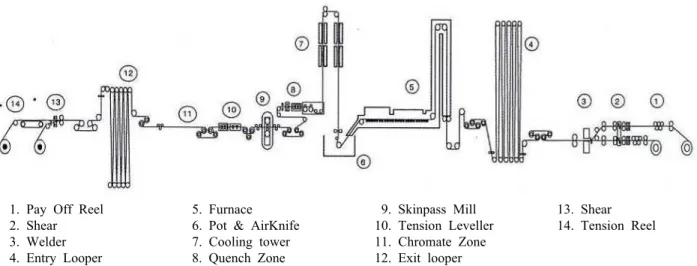
3. Welder 4. Entry Looper
7. Cooling tower 8. Quench Zone
11. Chromate Zone 12. Exit looper Fig. 1. Layout of Dongbu Steel No. 1CGL.
Table 1. Specification of No 1 CGL
Item Main Specification
Product GI CQ, DQ
Product Size Width Thickness
600 ~ 1260m 0.3 ~ 1.6mm
Productivity 250,000 Ton
Coating Weight GI Max 350g/m2
Coil ID Incoming
Recoiling
508/610mm 508/610mm Coil Weight Entry
Exit
Max. 35 ton Max. 20 ton
Line Speed Max. 160m/min
1 CGL and application results of ICWCS.
2. Dynamic control function of icwcs
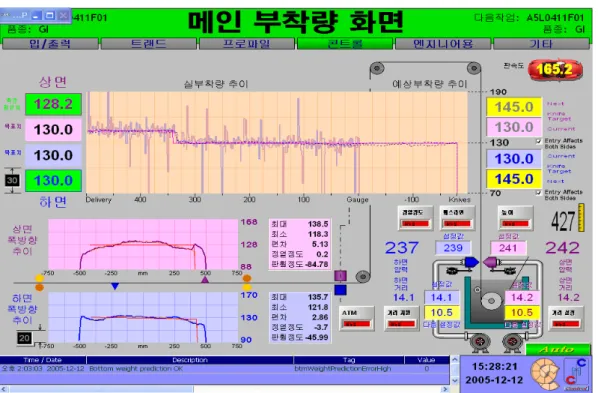
Main control functions of the system are per-side coat- ing weight control, feedback control, predictive feedfor- ward control, passline/skew control, knife height control, scanned measurement processing, automatic target man- agement, and automation of auxiliary functions, Fig. 2.
2.1 Per-side coating weight control
Coating weight is controlled independently for each side of the strip. Differential coating control is possible. Coating weight gauges for the two sides may be either synchronous or independent, and may be mounted at different down- machine locations. Targets from level 2 go to a preliminary target value, which may be adjusted at any time by the operator until they automatically become the active targets when the weld reaches the air knives. Increases in coating
weight can occur before the weld reaches the air knives in order to minimize undercoated material at the head end of the coil.
2.2 Feedback control
Feedback from a scanning weight measurement gauge is used to adjust the coating weight model so that predicted weight equals measured weight on a scan-average basis.
Edge "trim" is adjustable to ignore highly variable coating weight measurements at the extreme edges of the strip.
2.3 Predictive feedforward control
When weight control system adjusts knife pressure with- in specified limits to bring coating weight as close as pos- sible to target. Predictive feedforward adjustments are made for all manual or automatic adjustments to knife po- sition, knife carriage position, and strip speed. If the model compensation for height and/or angle is employed, adjust- ments to these, too, will be compensated by knife pressure.
2.4 Passline/skew control
Passline control system makes coordinated knife posi- tion and pressure adjustments to re-center the strip between the knives without disturbing coating weight. The system uses the measured coating weight variations across the strip to estimate the degree of strip skew relative to one or both air knives and skews the knife carriage to level the apparent skew in the weight profile.
2.5 Knife height control
Knife height control automatically adjusts the knife height above the bath to be proportional to strip speed, subject to minimum and maximum height constraints. The relationship between speed and height can be changed by
Fig. 2. Coating weight control system mimic display.
the operator via an easy-to-use screen.
2.6 Scanned measurement processing
The system monitors the head positions of scanning sen- sors as well as the measurements, and uses algorithms to separate cross direction from machine direction sources of variation. Results include raw scans, raw trends, MD trends, CD profiles, and statistics for each scan (min, max, mean, standard deviation). In addition, the system corre- lates top and bottom side measurements to help detect common sources of variation, such as strip shape and flutter.
2.7 Automatic target management
The system monitors the variability of coating weight within scans and from scan to scan, and modifies the coat- ing weight target as required minimizing total consumption of coating material subject to a minimal risk of under- coating. Top and Bottom side coating variations are first treated as separate loops. Total (Top plus Bottom) coating weight variations are considered by a third loop. The re- sults are then combined to solve a linear programming optimization problem that takes into account all three re- sults plus ratio and difference constraints between top and bottom, and hard maximum and minimum target con- straints
2.8 Coating weight control system interface layout of 1CGL
In order to apply ICWCS, it is needed system interface for communication, fig. 3.
2.9 Improvement of pressure control
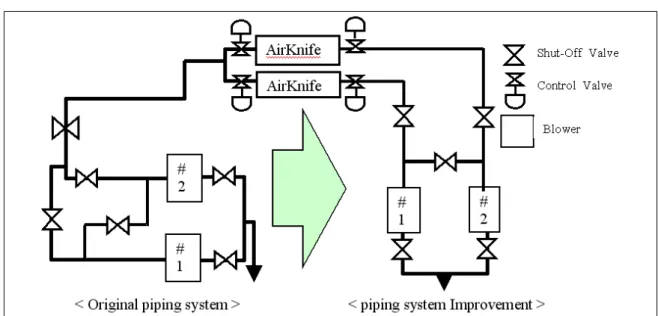
In order to maintain the coating uniformity such tran- sition regions as speed and/or coating amount changes es- pecially at weld, fast and accurate control of air pressure are compulsory to insure the target coating weight. The improvement of the piping system and air control method were made as shown in Fig. 4.
2.10 Pressure control methods of 1CGL
3. System performance
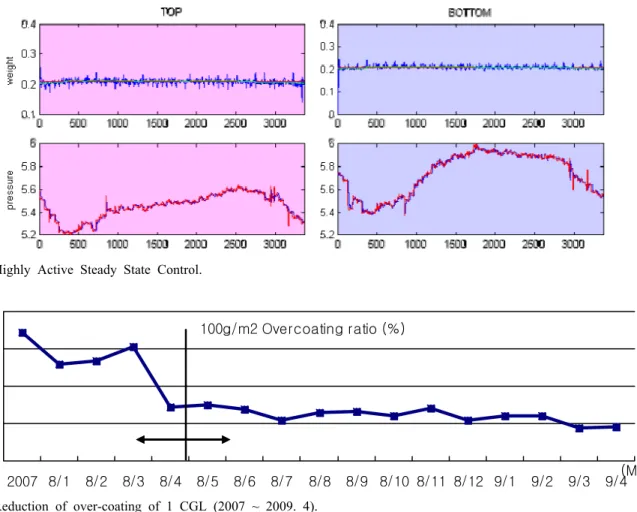
Coating weight was controlled exceptionally well even with operating disturbances such as line speed change, knife distance, passline, and/or knife skew, Fig. 6.
Savings of coating material were more than 6% after application of ICWCS. Although a remarkable improve- ment was made so far, further improvement of auxiliary functions such as target optimization would be realized.
Fig. 3. Interface layout.
Fig. 4. Schematic diagram of new air pressure control of 1CGL.
Fig. 5. Control methods of 1CGL
Fig. 6. Highly Active Steady State Control.
100g/m2 Overcoating ratio (%)
100 104 108 112 116
2007 8/1 8/2 8/3 8/4 8/5 8/6 8/7 8/8 8/9 8/10 8/11 8/12 9/1 9/2 9/3 9/4(M) Fig. 7. Reduction of over-coating of 1 CGL (2007 ~ 2009. 4).
4. Summary and conclusions
An integrated coating weight control technology was developed jointly with Objective Control and Automation Control and Technology.
To provide a capable system that was sufficient for hands-off operation, several automatic functions were re- quired; accurate prediction model and algorithms; pre- dictive feedforward and feedback controls; time delay compensation; passline/skew control; automatic target management; and interaction decoupling of variables.
Auxiliary functions were included to improve the us- ability, operational safety, and post analysis. Those were pressure envelop to minimize problems caused by big pres- sure difference. Savings of coating material were more than 6% for the first quarter.
References
1. Young Ho Lee and R. G. Wilhelm, Development of intergrated coating weight control technology for #4 CGL of Dongbu Steel. (2004).
2. R. C. Corson and R. G. Wilhelm, High Performance Coating Weight Control for Hot Dip Galvanizing Lines.
(1994).
3. R. C. Corson and R. G. Wilhelm, A Statistical Analysis Of Coating Weight Measurements. (2000).
4. G. Voss, S. Hesling, K. Hochstetter, D. Parker, and G.
Wallace, Integration of Coating Mass Control with Bath and Galvanneal Furnace Management. (2001).
5. Y. Anabuki, T. Yoshioka, and A. Shinohara, Coating Weight Control at Kawasaki Steel CGL, Iron and Steel Engineer, Dec. (1997).
6. J. Adam, D. J. Parker, G. Conway, and G. Wallace, Coating Mass Control on No. 2 Galvanizing Line at LTV Steel's Indiana Harbor Works, Iron and Steel Engineer, Jpn.
(1996).