130 PISSN 0304-128X, EISSN 2233-9558
Morphology of Sub-Microscale Atmospheric Aerosols composed of Two Liquid Phases According to the Loading Ratio of Organics/Water
Kee-Youn Yoo†
Department of Chemical and Biomolecular Engineering, Seoul National University of Science and Technology, 232, Gongneung-ro, Nowon-gu, Seoul, 01811, Korea
(Received 12 October 2016; Received in revised form 23 November 2016; accepted 5 December 2016)
Abstract − Organic aerosols dispersed in the atmosphere likely undergo phase separation. Such internally mixed par- ticles are often described as comprising an organic phase and an aqueous phase separately. We studied the morphology of two liquid separated aerosols in the sub-microscale by using a simple thermodynamic model with Russian doll geom- etry. The morphology of particles can be easily predicted from the simple criteria on the surface tension and two alge- braic equations (the volume constraint and Young equation). This result may give the potential explanation about the complex morphology of the organic airborne particles
Key words: Atmospheric organic aerosol, Morphology, Liquid-liquid separation, Russian doll model
1. Introduction
Aqueous aerosol particles, including organic species, are preva- lent in the ambient atmosphere [1,2]. Such atmospheric particles may undergo liquid-liquid phase separation due to the immiscibility [3-6]. This phase separation transforms the morphology of particles, and then they are no longer homogeneous single spheres. The tangi- ble morphology is determined fundamentally by the balance of molecular interactions among the various chemical constituents in the droplet. Experimental and optical studies report the formation of core-shell structure with surface-active organics and asymmetric, overlapped spheres [6,7]. The morphology of sub-microscale parti- cles containing two immiscible liquids is of significant interest, although perplexing to verify experimentally, due to the impact on the physical/optical properties, the rate of gas and water uptake and the kinetics of heterogeneous reactions in ambient atmosphere [8].
By now, most computational researches focus on the calculation of phase equilibria of inorganic/organics [9-12]. However, knowledge of the morphology of phase separated organic aerosols is still largely uncertain. Aerosol particles affect the earth’s energy budget directly by scattering and absorbing solar radiation and indirectly by acting as cloud condensation nuclei [13]. Then the physical state and mor- phology of particles might be critical to estimate the aerosol effects on climate.
We used a simplified thermodynamic model that minimizes the Gibbs free energy of a liquid-liquid segregated particle with a Russian doll droplet representation [14,15] and conducted computational
studies to examine the effect of relative loading ratio of water and organic species with respect to the morphology of sub-microscale liquid-liquid separated atmospheric aerosols. Thus, we can explain the reported experimental morphologies with the surface tension between two liquids and the air and the relative loading ratio of organics/water [4,6,16-18] and suggest that such morphologies might also exist in tropospheric aerosols. And we can construct a pre- dictive atmospheric aerosol module to estimate the effects on the radiative forcing, considering the possible configuration of organic aerosol with phase separation.
2. Russian Doll Representation of two Liquid Phase Separated Aerosol
We first assume that aqueous phase forms a sphere that is partially wetted by organic-rich phase in sub-micro-scale. Called the Russian doll (RD) or lens-on-sphere model [14,15], it is shown in Fig. 1. For all droplets, we also assume that, under the fixed volume of each liq- uid, the Laplace terms are constants irrespective of the degree of insertion between two liquid phases and then can be neglected in the thermodynamic model. Hence the Gibbs free energy of two liquid phase separated aerosol can be formulated from the idealized geom- etry of the RD model:
. (1)
We use the subscripts w, o and v to refer to the aqueous and organic- rich phases and vapor, respectively, and the two liquid phases can be any pair of liquid region identified to have a homogeneous interior. The actual wo interface could have an intermediate curva- ture between the idealized RD and a flat surface, determined by the equilibrium between elastic and capillary forces in aerosol.
But the intermediate curvature gives almost the same configura- ΔG γ= wvAwv+γovAov+γwoAwo
†To whom correspondence should be addressed.
E-mail: [email protected]
This is an Open-Access article distributed under the terms of the Creative Com- mons Attribution Non-Commercial License (http://creativecommons.org/licenses/by- nc/3.0) which permits unrestricted non-commercial use, distribution, and reproduc- tion in any medium, provided the original work is properly cited.
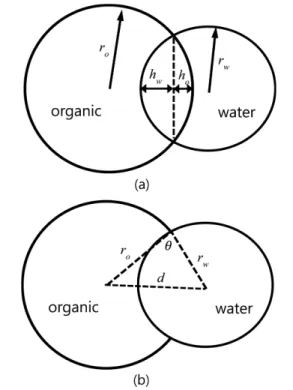
tion as RD model in the sub-microscale. In what follows, we con- sider the minimization problem of the free energy of the idealized RD model, Eq. (1). Using the radius rw and ro of the spherical sec- tion of water and organic phases, and the height hw and ho of the overlapped spherical caps (See Fig. 2(a)), the free energy of the RD model is:
. (2) Here rw is constant but ro is varying according to the degree of insertion of two phases with the fixed volumes, vw and vo, of each phase in aerosol. The organic volume balance assuming the con- stant density is as follows:
(3) where
,
for , for .
Within this volume constraint, the free energy of the RD model, Eq. (2), is the single function of the height of the aqueous spher- ical cap, hw, which characterizes the degree of insertion between two segregated phases. Figs. 3 and 4 show the variation of the free energy according to hw in two representative systems with equal mass loading, respectively, in the typical atmospheric condition.
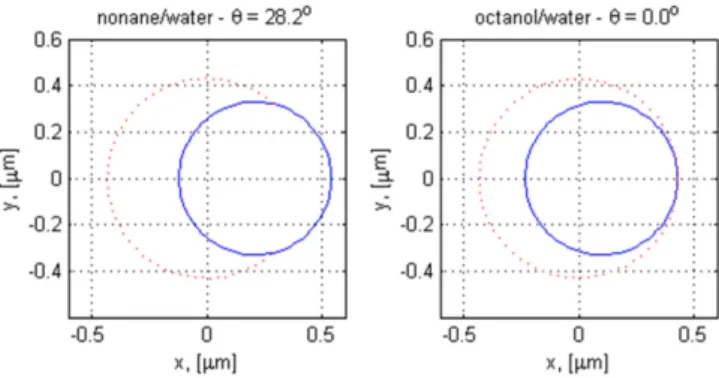
Fig. 5 gives the cross-sectional equilibrium configuration of nonane/
water (partial wetting) and octanol/water (total wetting) correspond- ing to Figs. 3 and 4, in which the contact angle θ between two
ΔG γ= wv(4πrw2–2πrwhw) γ+ ov(4πr2o–2πroho) 2γ+ woπrwhw
4 3---πro3 π
6---hw(3a2+hw2)
– π
6---ho(3a2+ho2)
– =vo
a= 2rwhw–hw2
ho=ro– ro2–a2 ro≥ho ho=ro+ ro2–a2 ro<ho
Fig. 1. Russian doll model of two liquid phase segregated aerosol with partial wetting.
Fig. 2. (a) Idealized geometry for a Russian doll model (RD) of two liquid phase segregated aerosol (0 < hw< 2rw). (b) The contact angle at the RD geometry, in which d (=rw− hw+ ro− ho) is the distance between the spherical centers of each phase.
Fig. 3. The variation of ro and ΔG according to the height of the aque- ous spherical cap, hw, in which circle denotes the equilibrium point (nonane/water system: vo= 0.2089μm3, vw= 0.1504μm3).
Fig. 4. The variation of ro and ΔG according to the height of the aque- ous spherical cap, hw, in which circle denotes the equilibrium point (octanol/water system: vo= 0.1820μm3, vw= 0.1504μm3).
liquid phases is equivalent to the angle between the contact line and the spherical centers of each phase at equilibrium configura- tion (see Fig. 2(b)):
. (4)
3. Criteria of Non-, Partial and Total Wetting
To analyze the impact of surface tensions on the morphology, we rearrange Eq. (2):
. (5)
Here we omit the constant term . The derivative of Eq.
(5) with respect to hw is
, (6) in which
.
When the loading ratio of aqueous/organic phases, k = vo/vw, is fixed, the involved geometric variables are determined at both lim- iting cases as follows:
Non-wetting condition:
Total wetting condition:
Thus Eq. (6) is evaluated at these boundaries as follows:
Non-wetting condition:
(7) Total-wetting condition:
(8)
We can see that, when , the total free energy increases with the progress of the insertion of two liquid phases (dΔG'/
dhw> 0) and the two phases will be separated (non-wetting case).
When , the insertion between two liquid
phases will be advanced and the progress of the wetting will cease between two boundaries (partial wetting case). When , then dΔG'/dhw< 0 at hw= 2rw and the total wetting will occur (aqueous phase will be fully covered by organic phase).
Then the RD model is substituted into the simple core-shell model.
4. Effect on Morphology to the Loading Ratio Of Water and Organics
We first conducted computational studies to examine the effect of the loading ratio of organics and water, k, in case of partial wetting (nonane/water system). Fig. 6 shows that, regardless of k, the equi- librium contact angle is identical to Young equation’s prediction θ = cos-1 ((γwv−γwo)/γov) = 28.2o, in which we may regard the aque- ous phase to the non-deformable solid phase. This result indicates that the force balance at the equilibrium contact line is established as follows:
(9) θ cos–1rw2+ro2–d2
2rwro ---
=
ΔG′ 2πr= w(γwo–γwv)hw+2πγov(2r2o–roho) 4πγwvrw2
dΔG′
dhw
--- 2πrw(γwo–γwv) 2πrodho dhw
---γov 2π 4r( o–ho)dro dhw ---γov +
–
=
dho dhw --- ho
ro–ho ---dro
dhw ---
– rw–hw
ro–ho --- +
=
ho→ r0 o→k1/3rw dro dhw ---→0 dho
dhw
---→k–1/3 at hw→0
, , ,
ho→ r0 o→(1 k+ )1/3rw dro dhw ---→0 dho
dhw
---→–(1 k+ )–1/3 at hw→2rw
, , ,
dΔG′
dhw
---=2πrw(γwo–γwv–γov)
dΔG′
dhw
---=2πrw(γwo–γwv+γov) γwo>γwv+γov
γwv–γov<γwo<γwv+γov
γwo<γwv–γov
γwv–γwo
γov
--- rw2+ro2–d2 2rwro ---
= Fig. 5. The cross-sectional equilibrium configurations of two repre-
sentative liquid-liquid segregated aerosols corresponding to Fig. 3 and 4 (solid line: aqueous phase, dotted line: organic phase): See Table 1 for the physical properties (densities and surface tensions).
Table 1. Surface tensions and densities of nonane/water and octanol/
water system γwv [mJ/m2]
γwo [mJ/m2]
γov [mJ/m2]
ρo [mJ/m2]
θ [deg]
Nonane/water 72.4a 52.4b 22.7b 0.728 28.2
Octanol/waterc 72.8 8.5 27.1 0.824 0
a[19](T = 295 K), b[18](T = 295 K), c[20]
Fig. 6. The contact angle vs. the equilibrium radius of the Russian Doll model according to the loading ratio of nonane/water (The computed contact angle is identical to the Young equa- tion’s prediction).
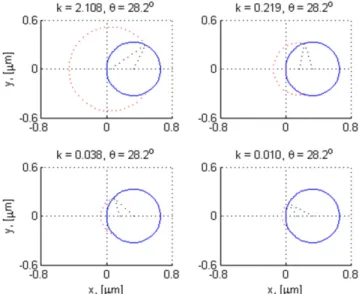
Thus, we can also calculate the equilibrium configuration by simultaneously solving Eqs. (3) and (9) with respect to ro and hw. We present the variation of the geometric variables according to the addition of organics in case of partial wetting in Fig. 7(a). In the lower loading, ho is greater than ro and increases in step with the additional loading of organics. The cross-sectional equilibrium con- figurations in Fig. 8 (k = 0.010, 0.038) are partially engulfed in the form of central aqueous phase with lens of organics protruding from one side. And the free energy is comparable with non-wetting case (see Fig. 7(b)). This situation corresponds to the initial introduction of organics to aqueous particles in case of partial wetting. In the high loading, ho is less than ro and decreases with the more loading of organics. The free energy approaches to the total wetting case (core- shell configuration). Fig. 8 (k = 2.108) shows that the equilibrium configuration is mostly engulfed (similar to core-shell except that core aqueous phase is positioned at the edge region of organics). In case of total wetting (octanol/water system), the equilibrium config- uration is a simple core-shell structure. In the lower loading, the aqueous particles are thinly coated by the organics and the shell side is thicker with the addition of organics (see Fig. 9).
In summary, when liquid-liquid separation in the internally mixed
particle occurs, the relative low loading ratio of organics/water results in the organic-film-coated or fatty-ball-protruded aerosol depending on the surface tensions among the aqueous/organic/vapor phases.
The high loading ratio gives the core-shell structure with centered or edge-positioned aerosol, apparently, depending on the relations between the surface tensions. These discussions have a correspondence to recent experimental studies [4,6,16-18].
5. Conclusions
We studied the morphology of sub-microscale liquid-liquid sepa- rated aerosol by using the simple RD thermodynamic model. The phenomenological morphologies can be easily discriminated by using Fig. 7. (a) The variation of the geometric variables of the RD model
with respect to the loading weight of organics in nonane/
water system. (b) The equilibrium Gibbs free energy of RD model (ΔG), the non-wetting Gibbs free energy (ΔGnon), and the total-wetting Gibbs free energy (ΔGtotal) according to the loading ratio of organics/water in nonane/water system.
Fig. 8. The cross-sectional equilibrium configurations of the RD model with respect to the loading ratio of organics/water in nonane/
water system (solid line: aqueous phase, dotted line: organic phase).
Fig. 9. The cross-sectional equilibrium configurations of the core-shell model with respect to the loading ratio of organics/water in octanol/water system (solid line: aqueous phase, dotted line:
organic phase).
the criteria on the surface tension and the simultaneous solution of the volume constraint Eq. (3) and Young equation, Eq. (9). And the results may explain the experimental studies about the morphologies of the complex atmospheric aerosol by the simple arguments on the surface tensions and the loading ratio of organics/water. However, we consider only the morphological variation of particle. If the mor- phology drives the change of chemical processes within the particle, this would not be accounted for in this work.
References
1. Maria, S. F., Russell, L. M., Gilles, M. K. and Myneni, S. C. B.,
“Organic Aerosol Growth Mechanisms and Their Climate-forc- ing Implications,” Science, 306, 1921-1924(2004).
2. Park, S. S., Cho, S. Y. and Kim, S. J., “Chemical Characteristics of Water Soluble Components in Fine Particulate Matter at a Gwangju Area,” Korean Chem. Eng. Res., 48(1), 20-26(2010).
3. Pye, H. O. T., Murphy, B. N., Xu, L., Ng, N. L., Carlton, A. G., Guo, H., Weber, R., Vasilakos, P., Appel, K. W., Budisulistiorini, S. H., Surratt, J. D., Nenes, A., Hu, W., Jimenez, J. L., Wertz, G.
I., Misztal, P. K. and Goldstein, A. H., “On the Implications of Aerosol Liquid Water and Phase Separation for Organic Aerosol Mass,” Atmos. Chem. Phys. Discuss., doi:10.5194/acp-2016-719 (2016).
4. Song, M., Marcolli, C., Krieger, U. K., Zuend, A. and Peter, T.,
“Liquid-liquid Phase Separation and Morphology of Internally Mixed Dicarboxylic Acids/Ammonium Sulfate/Water Particles,”
Atmos. Chem. Phys., 12, 2691-2712(2012).
5. Zawadowicz, M. A., Proud, S. R., Seppalalinen, S. S. and Cziczo, D. J., “Hygroscopic and Phase Separation Properties of Ammo- nium Sulfate/Organics/Water Ternary Solutions,” Atmos. Chem.
Phys., 15, 8975-8986(2015).
6. Shiraiwa, M., Zuend, A., Bertram, A. K. and Seinfeld, J. H.,
“Gas-particle Partitioning of Atmospheric Aerosols: Interplay of Physical State, Non-ideal Mixing and Morphology,” Phys. Chem.
Chem. Phys., 15, 11441-11453(2013).
7. Zhang, Q. and Thompson, J. E., “Effect of Particle Mixing Morphol- ogy on Aerosol Scattering and Absorption: A Discrete Dipole Mod- eling Study,” GeoResJ, 3-4, 9-18(2014).
8. De Leeuw, G., Andreas, E. L., Anguelova, M. D., Fairall, C. W., Lewis, E. R., O’Dowd, C., Schulz, M. and Schwartz, S. E., “Produc- tion of Flux of Sea Spray Aerosol,” Rev. Geophys., 49(2), doi:
10.1029/2010RG000349 (2011).
9. Zuend, A., Marcolli, C., Peter, T. and Seinfeld, J. H., “Computation of Liquid-liquid Equilibria and Phase Stabilities: Implications for
RH-dependent Gas/particle Partitioning of Organic-inorganic Aero- sols,” Atmos. Chem. Phys., 10, 7795-7820(2010).
10. Zeund, A. and Seinfeld, J. H., “Practical Method for the Calculation of Liquid-liquid Equilibria in Multicomponent Organic-water- electrolyte Systems Using Physicochemical Constraints,” Fluid Phase Equilibria, 337, 201-213(2013).
11. Amundson, N. R., Caboussat, A., He, J. W., Martynenko, A. V., Savarin, V. B., Seinfeld, J. H. and Yoo, K. Y., “A New Inorganic Atmospheric Aerosol Phase Equilibrium Model (UHAERO),”
Atmos. Chem. Phys., 6, 975-992(2006).
12. Amundson, N. R., Caboussat, A., He, J. W., Martynenko, A. V., and Seinfeld, J. H., “A Phase Equilibrium Model for Atmospheric Aerosols Containing Inorganic Electrolytes and Organic Com- pounds (UHAERO), with Application to Dicarboxylic Acids,” J.
Geophys. Res. Atmos., 112, D24S13(2007).
13. Yu, H., Kaufman, Y. J., Chin, M., Feingold, G., Remer, L. A., Anderson, T. L., Balkanski, Y., Bellouin, N., Boucher, O., Chris- topher, S., DeCola, P., Kahn, R., Koch, D., Loeb, N., Reddy, M.
S., Schulz, M., Takemura, T. and Zhou, M., “A Review of Mea- surement-based Assessments of the Aerosol Direct Radiative Effect and Forcing,” Atmos. Chem. Phys., 6, 613-666(2006).
14. Qju, Y. and Molinero, V., “Morphology of Liquid-Liquid Phase Separated Aerosols,” J. Am. Chem. Soc., 137, 10642-10651(2015).
15. Obeidat, A., Hrahsheh, F. and Wilemski, G., “Scattering Form Factors for Russian Doll Aerosol Droplet Models,” J. Phys. Chem.
B, 119, 9304-9311(2015).
16. You, Y., Renbaum-Wolff, L., Carreras-Sospedra, M., Hanna, S.
J., Hiranuma, N., Kamald, S., Smith, M. L., Zhang, X., Weber, R. J., Shilling, J. E., Dabdub, D., Martin, S. T. and Bertram, A.
K., “Images Reveal that Atmospheric Particles can Undergo Liquid-liquid Phase Separations,” Proc. Nat’l Acad. Sci., 109, 13188-13193(2012).
17. Veghte, D. P., Bittner, D. R. and Freedman, M. A., “Cryo-Transmis- sion Electron Microscopy Imaging of the Morphology of Sub- micrometer Aerosol Containing Organic Acids and Ammonium Sulfate,” Anal. Chem., 86, 2436-2442(2014).
18. Kwamena, N. O. A., Buajarern, J. and Reid, J. P., “Equilibrium Morphology of Mixed Organic/Inorganic/Aqueous Aerosol Drop- lets: Investigating the Effect of Relative Humidity and Surfac- tants,” J. Phys. Chem. A, 114, 5787-5795(2010).
19. Vargaftik, N. B., Volkov, B. N. and Voljak, L. D., “International Tables of the Surface Tension of Water,” J. Phys. Chem. Ref. Data, 12(3), 817-820(1983).
20. Goebel, A. and Lunkenheimer, K., “Interfacial Tension of the Water/n-Alkane Interface,” Langmuir, 13, 369-372(1997).