Correlation between Self-esteem, Death Anxiety, and Spiritual Wellbeing in Korean University Students
Chung, Mi Young1 · Cha, Kyeong-Sook1 · Cho, Ok-Hee2
1Department of Nursing Science, Sun Moon University, Asan
2Department of Nursing, College of Nursing and Health, Kongju National University, Gongju, Korea
Purpose: This study aimed at understanding the correlation between self-esteem, death anxiety, and spiritual well- being in university students. Methods: Cross-sectional method was used 671 students in South Korea. This study used the Self-esteem developed by Rosenberg, the Fear of Death Scale revised by Lester and Abdel-Khalek, and Spiritual wellbeing developed by Paloutzian and Ellison. Results: Relationships between self-esteem, death anxiety, and spiritual wellbeing revealed an inverse correlation between self-esteem and death anxiety, and a direct correlation between self-esteem and spiritual wellbeing. Conclusion: In order for students of establishing identity to lead a healthy life, there is a need for studies aiming at developing, implementing, and evaluating the results of consultation and education programs for maintaining spiritual wellbeing such as psychological counsel- ing and logotherapy at the university or regional community level.
Key Words: Self-esteem, Death anxiety, Spiritual wellbeing
Corresponding author: Cho, Ok-Hee
Department of Nursing, College of Nursing and Health, Kongju National University, 56 Gongjudeahak-ro, Gongju 314-701, Korea.
Tel: +82-41-850-0306, Fax: +82-41-850-0315, E-mail: [email protected] - This research was supported by the Sun Moon University Research Grant in 2011.
Received: Mar 30, 2015 / Revised: Jun 9, 2015 / Accepted: Jun 11, 2015
This is an open access article distributed under the terms of the Creative Commons Attribution Non-Commercial License (http://creativecommons.org/licenses/
by-nc/3.0), which permits unrestricted non-commercial use, distribution, and reproduction in any medium, provided the original work is properly cited.
INTRODUCTION
University students exist in the stage between late adolescence and early adulthood during which phys- ical, spiritual, and socio-psychological development is still in progress. This period is an important develop- ment stage during which they establish self-identity and learn to navigate complicated socio-psychological tasks such as the balance between dependence and indepen- dence, responsibility arising from freedom and choice, formation of social relations, ambiguity about the future, and pressure about success[1]. However, the rapidly changing modern society is success oriented and em- phasizes diversity and pluralism, and university students tend to experience frustrations, anxieties, and depres- sions. University students today have a considerably lo- wer capacity to manage frustration, sadness, and pain
than those in the past. They tend toward emotional vul- nerability to even small frustrations, which drives them toward suicidal ideation as an escape from complicated social situations and impulsive suicide attempts[2,3]. The rate of suicide in Korea is the highest among the OECD countries. Suicide is the main cause of death among uni- versity students in their 20s [4]. Therefore, there is an ur- gent need for social attention to reduce the suicide rate.
Self-esteem is important for the establishment of a healthy self-image through a positive view of and atti- tude toward oneself. It is an important factor for the cog- nitive evaluation of and approach to events[5]. People with high self-esteem are stable, sure of their abilities and achievements, and exhibit a healthy mental state and positive attitude toward life. In contrast, people with low self-esteem have unstable relationships with others and negative feelings toward the future and death, which in- creases the likelihood of drug addiction, depression,
and suicidal ideation[6]. Moreover, the widespread con- tempt of life in our society, including abortion, can be conducive to a negative attitude toward death.
No living being can be separated from death. The dif- ference between humans and other living beings is that humans are aware of death, and live a life accompanied by death. Death anxiety is anxiety over the finitude of existence. It is experienced not only at the end of phys- ical life but continuously in everyday life. The issue of death is as important as life during human growth and development. The level of perception and understand- ing of death may influence the understanding of life, and become the key to personal growth and potential devel- opment[7]. Accordingly, in order to live a high-quality, happy life, people need to face their own finitude in an adequate manner and develop a sound perception of their own death. It is important to establish a clear atti- tude toward both life and death. Decreasing the fear of death and encouraging the value of life may become the driving force for finding meaning in one’s current life.
The “spirituality” that exists inside every human being improves and enhances positive thinking and inner de- fense, and promotes inner healing and peace. It is also deeply associated with resolving the anxiety about death.
The spirituality is important factor to cope with death anxiety through perceiving of the death, finding meth- ods for overcoming hardness, and realizing the positive aspects of their own situations. Spiritual wellbeing, the development of spiritual abilities to the fullest, helps in- dividuals find the meaning and goal of life, dreams, and the future, and enhances their self-esteem, dignity, and satisfaction with life in their current circumstances[7-9].
In today’s rapidly changing society, university stu- dents tend to have difficulties establishing their values and feel contempt toward life, or take death too lightly out of a lack of contemplation of life[3]. Regardless, there is a lack of general and research interest in this problem.
Therefore, this study confirmed the levels of self-esteem, death anxiety, and spiritual wellbeing in university stu- dents and their inter-factor correlations, and provides basic data for the development of a program aimed to help this population increase their self-esteem, develop positive attitudes toward death, and maintain their spiri- tual wellbeing.
The detailed objectives of this study are as follows:(1) to determine the levels of self-esteem, death anxiety, and spiritual wellbeing in university students;(2) to de- termine self-esteem, death anxiety, and spiritual well- being according to the students’ general characteristics;
and (3) to determine the correlations among students’
self-esteem, death anxiety, and spiritual wellbeing.
METHODS
1. Study Design
This study utilized a cross-sectional survey design to determine the levels of self-esteem, death anxiety, and spiritual wellbeing in university students as well as their inter-factor correlations.
2. Participants and Data Collection
The content and the method of this study were ap- proved by the Institutional Review Board of the J Uni- versity. Participants were 700 students from S University in Cheonan City, South Korea, who understood the ob- jectives of this study and agreed to participate. Twenty- nine participants were excluded due to incomplete in- formation; thus, the final number of participants was 671. The minimum number of participants required for correlation analysis by G*Power 3.1.2 software was com- puted to be 584 in consideration of an effect size of .30 (medium), significance level of .05, and test power of 95% [10].
Data were collected from March to July 2012 by dis- tributing questionnaires and instructing participants to complete them. The purpose of the study was explained to the participants and then the data was collected from whom agreed with participating the study. The partic- ipants were informed that the answers would be proc- essed confidentially and anonymously. They were ex- plained whenever they did not want to participate in the study, they could stop it without any penalty. The time required to complete the questionnaire was 20 minutes.
3. Measures 1) Self-esteem
Self-esteem was measured with a tool developed by Rosenberg[11] and translated by Lee et al.[12]. It is com- posed of 10 items rated on a 4-point scale. Respondents receive 1 point for answering “strongly disagree” and 4 points for “strongly agree.” Higher scores indicate high- er self-esteem. Cronbach’s ⍺ coefficient for the tool’s reliability in this study was .81.
2) Death anxiety
This study used Seo’s[13] adaptation of the Fear of Death Scale (FODS) revised by Lester and AbdelKhalek
[14], to measure death anxiety. This tool consists of 28 measurement items that evaluate fear and anxiety about the process of dying and death regarding oneself and oth- ers on a 5-point scale; responses of “strongly agree” are assigned 5 points, and “strongly disagree” is assigned 1 point. Higher scores indicate higher levels of death anxiety. Cronbach’s ⍺ coefficient for the tool’s reliability in this study was .90.
3)Spiritual wellbeing
Spiritual wellbeing was measured with the tool devel- oped by Paloutzian and Ellison[15] and adapted by Cheung et al.[16]. This tool consists of 20 items (10 items for the existential and 10 for the religious aspects of spi- ritual wellbeing) rated on a 5-point scale, with 1 point assigned to “strongly disagree” and 5 points to “strongly agree”; higher scores indicate higher levels of spiritual wellbeing. Cronbach’s ⍺ coefficient for the tool’s reli- ability in this study was .82.
4. Data Analysis
Data analyses were conducted with SAS (version 9.2) statistical software. Participants’ general characteristics and their levels of self-esteem, death anxiety, and spiri- tual wellbeing were presented as frequency and per- centage as well as mean and standard deviation. The dif- ferences in self-esteem, death anxiety, and spiritual well- being according to general characteristics were ana- lyzed with t-tests and analyses of variance (ANOVA).
Post-hoc tests were carried out by using Duncan’s multi- ple range test. Correlations between self-esteem, death anxiety, and spiritual wellbeing were estimated with Pearson’s correlation coefficients.
RESULTS
1. Participants' General Characteristics
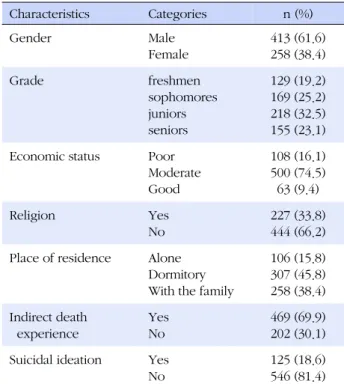
Among the study participants, 413 were male (61.6%) and 258 were female (38.4%). A total of 129 participants were freshmen (19.2%), 169 were sophomores (25.2%), 218 were juniors (32.5%), and 155 were seniors (23.1%).
Perceived economic background was moderate for 500 participants (74.5%), and 444 had no religion (66.2%).
One hundred-six students lived alone (15.8%), 307 lived in the dormitory (45.8%), and 258 lived with their fami- lies (38.4%). Approximately 70%(469 students) had in- directly experienced death through the death of close relatives or pets, and 18.6% had experienced suicidal
ideation within the preceding year (Table 1).
2. Self-Esteem, Death Anxiety, and Spiritual Wellbeing According to General Characteristics
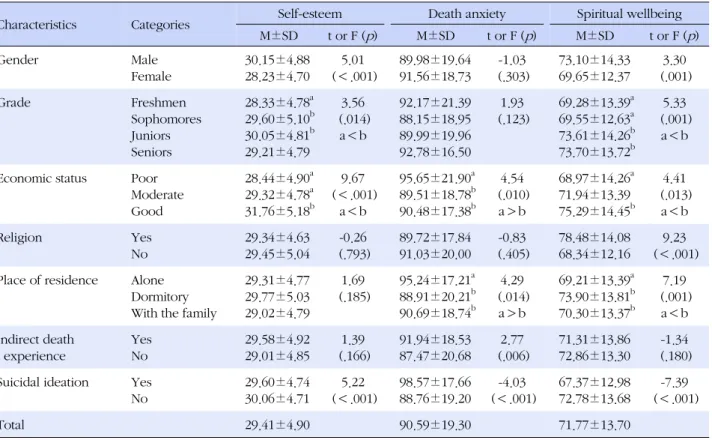
Participants’ average self-esteem score was 29.41 points, but this varied according to sex (p <.001), year of study (p=.014), major (p=.003), economic status (p<
.001), and suicidal ideation (p <.001). In particular, self- esteem was lower in female students than in male stu- dents, in freshmen than in sophomores and juniors, in those with moderate economic status than those with good economic status, and in those who had experi- enced suicidal ideation within the preceding year than those who had not.
The average death anxiety score was 90.59, but this varied according to major (p=.037), economic status (p=
.010), place of residence (p =.014), indirect death expe- rience (p =.006), and suicidal ideation (p <.001). The level of death anxiety was higher in students with poor economic status than in those with moderate economic status or higher, in those who were living alone than in those living in the dormitory or with their families, in those who had indirect experience of death than in those who did not, and in those who had experienced suicidal ideation in the past year than those who had not.
Table 1. General Characteristics of Participants (N=671)
Characteristics Categories n (%)
Gender Male
Female
413 (61.6) 258 (38.4)
Grade freshmen
sophomores juniors seniors
129 (19.2) 169 (25.2) 218 (32.5) 155 (23.1) Economic status Poor
Moderate Good
108 (16.1) 500 (74.5) 63 (9.4)
Religion Yes
No
227 (33.8) 444 (66.2) Place of residence Alone
Dormitory With the family
106 (15.8) 307 (45.8) 258 (38.4) Indirect death
experience
Yes No
469 (69.9) 202 (30.1) Suicidal ideation Yes
No
125 (18.6) 546 (81.4)
Table 2. Self-esteem, Death anxiety and Spiritual Wellbeing according to Characteristics of the Participants (N=671)
Characteristics Categories Self-esteem Death anxiety Spiritual wellbeing
M±SD t or F (p) M±SD t or F (p) M±SD t or F (p)
Gender Male
Female
30.15±4.88 28.23±4.70
5.01 (<.001)
89.98±19.64 91.56±18.73
-1.03 (.303)
73.10±14.33 69.65±12.37
3.30 (.001)
Grade Freshmen
Sophomores Juniors Seniors
28.33±4.78a 29.60±5.10b 30.05±4.81b 29.21±4.79
3.56 (.014) a<b
92.17±21.39 88.15±18.95 89.99±19.96 92.78±16.50
1.93 (.123)
69.28±13.39a 69.55±12.63a 73.61±14.26b 73.70±13.72b
5.33 (.001) a<b
Economic status Poor Moderate Good
28.44±4.90a 29.32±4.78a 31.76±5.18b
9.67 (<.001)
a<b
95.65±21.90a 89.51±18.78b 90.48±17.38b
4.54 (.010) a>b
68.97±14.26a 71.94±13.39 75.29±14.45b
4.41 (.013) a<b
Religion Yes
No
29.34±4.63 29.45±5.04
-0.26 (.793)
89.72±17.84 91.03±20.00
-0.83 (.405)
78.48±14.08 68.34±12.16
9.23 (<.001) Place of residence Alone
Dormitory With the family
29.31±4.77 29.77±5.03 29.02±4.79
1.69 (.185)
95.24±17.21a 88.91±20.21b 90.69±18.74b
4.29 (.014) a>b
69.21±13.39a 73.90±13.81b 70.30±13.37b
7.19 (.001) a<b Indirect death
experience
Yes No
29.58±4.92 29.01±4.85
1.39 (.166)
91.94±18.53 87.47±20.68
2.77 (.006)
71.31±13.86 72.86±13.30
-1.34 (.180) Suicidal ideation Yes
No
29.60±4.74 30.06±4.71
5.22 (<.001)
98.57±17.66 88.76±19.20
-4.03 (<.001)
67.37±12.98 72.78±13.68
-7.39 (<.001)
Total 29.41±4.90 90.59±19.30 71.77±13.70
a, b, c: Bonferroni t-test (means with the same letter are not significantly different).
Table 3. Correlation between Self-esteem, Death Anxiety and
Spiritual Wellbeing (N=671)
Variables Self-esteem Death anxiety
Spiritual wellbeing r (p) r (p) r (p)
Self-esteem -.31 (<.001) .50 (<.001)
Death anxiety -.25 (<.001)
The average spiritual wellbeing score was 71.77 points, but this varied according to sex (p =.001), year of study (p =.001), economic status (p =.013), religion (p <.001), place of residence (p =.001), and suicidal ideation (p <
.001). In particular, the level of spiritual wellbeing was lower in female students than in male students, in 1st and 2nd year students than in 3rd and 4th year students, in those with moderate and poor economic status than in those with good economic status, in those who had no religion than in those with religion, in those living alone than in those living in the dormitory or with their fami- lies, and in those who experienced suicidal ideation than in those who did not (Table 2).
3. Correlations between Self-esteem, Death Anxiety, and Spiritual Wellbeing
Examining the relationships between self-esteem, death anxiety, and spiritual wellbeing revealed an in- verse correlation between self-esteem and death anxiety (r=-.31, p <.001) and a direct correlation between self- esteem and spiritual wellbeing (r=.50, p <.001). Further, death anxiety and spiritual wellbeing were inversely correlated (r=-.25, p <.001, r=-.23, p <.001, r=-.31, p <
.001). This suggests that the lower the self-esteem, the higher the death anxiety and lower the spiritual well- being (Table 3).
DISCUSSION
Student life is important for adults' preparation for so- cial roles. The establishment of self-esteem during this period leads to higher confidence in one's own abilities and achievements[17]. Moreover, helping people under- stand death as a part of life properly establishes the val- ue of and attitude toward death, and makes one's cur- rent life more stable and rewarding. This study was con- ducted to determine the relationships between self-es-
teem, death anxiety, and spiritual wellbeing, and to ex- plore an intervention method for maintaining positive attitudes toward death and spiritual wellbeing.
Students' average self-esteem score in this study was 29.41 out of a possible 40 points, consistent with pre- vious studies that used Rosenberg's instrument: 27.87 points in United States (US) university students[18]. As an evaluation of oneself, self-esteem is the core factor that determines individuals' behavior and adaptation. It is closely related to not only physical but also spiritual health[17]. In this study, self-esteem was lower in female students than male students, in freshmen than sopho- mores and juniors, in those with moderate economic sta- tus than those with good economic status, and in those who had experienced suicidal ideation within the pre- ceding year than those who had not. This is consistent with previous findings that men have higher self-esteem than women[19], and that self-esteem tends to increase with age[5]. This is also consistent with findings that self- esteem decreases as family economic status decreases [5]. Those at a lower economic level have to address fi- nancial problems related to the expenses of higher edu- cation (e.g., university tuition fees), which leads to their lack of self-esteem. It is expected that they also have dif- ficulties developing fellowship with their friends. A pre- vious study found that monthly income and self-esteem were inversely related to stress and suicidal ideation[20].
This indicates that help must be provided to such stu- dents.
Modern students experience various types of stress related to problems with studies and employment, as well as the establishment of personal relationships and values. Self-esteem plays an important role in the overall quality of life and adaptation to everyday life; it is an im- portant factor that influences individuals' behavior in re- lation to personal experience, and informs attitudes and modes of behavior toward others. Moreover, people with high self-esteem perceive themselves as valuable and able beings, think positively about themselves and their surroundings, have higher levels of life satisfaction, and behave positively when interacting with others. In contrast, people with low self-esteem lack confidence, view themselves negatively, and have higher levels of anxiety. They also exhibit negative psychological states such as depression, passivity, maladjustment, or distor- ted viewpoints, project no confidence toward themselves and their environment, and demonstrate unstable be- havior[21] these increase the likelihood of suicidal idea- tion or suicide attempts. Accordingly, the formation of appropriate self-esteem during an important period of
adolescence is essential for overcoming difficult situa- tions and stress later in life, and for living successfully.
Self-esteem could be changed through various experi- ences. The development of systematic programs to im- prove social-interaction ability can help to promote stu- dents' self-esteem for, especially, the freshman who had lower self-esteem and students who were lower eco- nomic status.
Participants' death anxiety score was 90.59 out of a maximum 160 points. This is consistent with the results of previous studies on Americans age 20~29 years who scored 89.90~97.44 points[22] and on Australian nursing students who scored 91~92 points[23]. Death anxiety is an emotional response felt universally by all humans, to greater and lesser degrees, to the event of death, or to negative feelings such as fear, aversion, and denial about the process of dying. Death anxiety can vary depending on values and religion, life experiences, individual char- acteristics, and environmental factors. In this study, death anxiety was higher in students with poor economic sta- tus than those with moderate or higher economic status, in those who were living alone than those living in the dormitory or with their families, in those who had in- direct experience with death than those who did not, and in those who experienced suicidal ideation than those who did not. This is consistent with previous find- ings that the lower the economic level, the higher the level of stress and suicidal ideation[24], and that the ex- perience of suicidal ideation leads to recurring thoughts and various fears about death, which increases death anxiety[20]. Social support systems, such as those pro- vided by family or friends who play a facilitating role, can help students adjust to change during crises. Accor- dingly, those who live alone may develop emotional problems caused by depression, anxiety, and feelings of isolation[25]. This can cause not only death anxiety but also suicidal ideation. Accordingly, it is necessary to rec- ognize the importance of offering social support to uni- versity students and to strengthen the detailed measures to deal with this problem, not only in the process of uni- versity education but also from a public policy stand- point.
Death anxiety was especially high in those who had had indirect experience of death, because such experi- ence has a psychologically adverse effect and increases anxiety[26]. The problem of death is simultaneously the problem of life, and a problem related to human nature.
According to Russac et al.[22], when death anxiety was measured in adults of different ages, those aged 20~29 showed the highest levels. Early adulthood is the period
of making continuous efforts to strengthen one's life and become a recognized member of society; when people realize that their dreams did not come true as they wish- ed, they can fall into crisis[27]. Death severs people from the realization of their dreams, leading to death anxiety.
University students experience the severance of rela- tionships through the death of parents or friends; it is then that they perceive the problem of their own life and death, and when they take control over their lives and obtain savoir-vivre[2]. Death anxiety is increased in stu- dents with little experience of death because their val- ues are not established. This implies the need to go fur- ther than interventions for death anxiety in the elderly and prepare an intervention program for early adult- hood. The meaning of death is mostly negative, and the emotions about death are unpleasant[7]. The attitude of individuals toward death is slightly different from coun- try to country depending on cultures and religions, but the generally perceived objects of anxiety that lead to avoidance, suppression, and fear of death are those cen- tered on the unknown world after death, fear of physical extinction, loneliness, and parting with family and close friends. In the past, Korean society in general avoided discussions of death, understanding it instead through anxiety and fear and maintaining a taboo on the con- nection between death and life. There is nothing more shocking for a human being than death, including not only the fear of one's own death, but also the intense pain and shock caused by the death of a loved one. In the earlier Korean extended-family system, there were many opportunities for individuals to master methods of overcoming anxiety related to death and the psycho- logical pain of the death of family members and friends.
In a modern nuclear family, there are fewer opportuni- ties to deal with death, and therefore fewer opportuni- ties to actively consider its meaning. However, the fear of death may be relieved through education[23]. There is a need to increase individuals' knowledge about death, and to offer a death-preparation educational program that includes a method for resolving emotions about one's own death and that of others. This may help parti- cipants find meaning in death, understand healthy death, prevent the fear of death and accept it as a part of life, and continuously live life to the fullest.
As the basic problems of life and death are difficult to solve, humans need spiritual assistance. The spiritually healthy human state is known as spiritual wellbeing, wherein an individual is full of energy, has a goal in life, and feels fulfilled. The average spiritual wellbeing score of the participants of this study was 71.77 points out of a
maximum 100 points. Spiritual wellbeing levels were lower in female students than male students, in fresh- men and sophomores than juniors and seniors, in those with moderate and poor economic status than those with good economic status, in those who had no religion than those with religion, in those who were living alone than those who lived in the dormitory or with their fami- lies, and in those who had experienced suicidal ideation than those who had not.
In this study, participants who had religion had high- er levels of spiritual wellbeing, because religion contrib- utes to one's integrity and happiness, and gives human life more depth and abundance as well as hope and the desire to discover the true meaning of life[28]. Human spirituality is a philosophy that invokes positive behav- ior, gives meaning and value to life, and, through ques- tions about basic human nature, transcends the in- dividual realm and makes it possible to have meaningful relationships with neighbors and the environment[8].
Further, as an important factor in mental stability, spiri- tual wellbeing reduces suffering and facilitates appro- priate coping behavior in stressful circumstances or in the face of important life situations that influence mental health[17]. From this perspective, spiritual wellbeing is not a state, but an indicator for human spiritual health;
thus, it should certainly be considered one of the as- pects of health.
Spiritual wellbeing is expressed as inner peace, de- sire, longing for interactions with others, respect for life, gratefulness and satisfaction, supportive relations with others, and moral behavior[1]. The scope of social sup- port and the support system is the main factor closely re- lated to spirituality. Through this close relation, personal relationships have a great influence on maintaining spi- ritual health[29]. This study's finding that students who lived alone had lower levels of spiritual wellbeing than those who were living in the dormitory or with their families supports the opinion of Koenig[29]. University life is an important period during which individuals should establish their own life philosophy and identity.
Those who are spiritually well can find meaning and goals in life in their current surroundings as well as fu- ture meaning and their ultimate goals. They show a pos- itive attitude even in negative circumstances or environ- ments, and can accelerate inner healing and peace by improving and revitalizing their inner defense abil- ities[1,2]. Accordingly, implementing a spiritual educa- tion or consultation program aimed at increasing uni- versity students' spiritual wellbeing may help them ach- ieve the tasks they face and live healthy lives.
The higher the students' self-esteem in this study, the lower their death anxiety. This is consistent with pre- vious findings that self-esteem is a psychological buffer for death anxiety, and that the more positive the self-es- teem, the more positive the attitude toward death and the lower the death anxiety[30]. Loss of self-esteem may influence mental, psychological, and spiritual health, and lead to mental anxiety and perceiving oneself as a worthless being. Self-esteem reflects confidence in one- self and nature, and is closely associated with the spiri- tual wellbeing related to inner harmony[29]. It is be- lieved that for these reasons, self-esteem was found to be directly correlated with spiritual wellbeing in this study. Moreover, it was found that the higher the level of spiritual wellbeing, the lower the degree of stress or anxiety about death. This is presumably because when people are spiritually well, they have not only a positive attitude toward their current situation but also better in- ner healing force.
Taken together, these findings suggest that the higher the self-esteem in South Korean students, the lower their death anxiety and the higher their spiritual wellbeing.
People with high self-esteem have a greater sense of their own value, think positively, seek meaning in life, consider their lives meaningful and valuable, and are spiritually healthy. In addition, those who are spiritually healthy can more appropriately manage and overcome circumstances that cause intense stress or bring them in- to contact with death.
LIMITATIONS
This study was carried out with data from the students of only one university, which makes it difficult to gen- eralize the results to all university students. However, students at this university come from different regions of the country, and care was taken in the study design to maintain a balance among majors and regions.
CONCLUSION
This study confirms that self-esteem, death anxiety, and spiritual wellbeing have significant correlations. Ac- cordingly, in order for university students to lead a heal- thy life and build a firm base while in the transitional pe- riod of attaining physical and psychological maturity and establishing their identity, there is a need for studies to develop, implement, and evaluate the results of con- sultation and educational programs at the university or regional/community level.
First, it is necessary to develop and implement pro- grams for identifying the true self and promoting self- development to help students contemplate themselves and facilitate inner growth. Second, it is necessary to de- velop and implement programs for relieving death anxi- ety through training in having respect for life, the mean- ing of death, and preparation for death. Third, it is nec- essary to develop and implement programs for main- taining spiritual wellbeing such as psychological coun- seling and logotherapy.
REFERENCES
1. Lee Y. The relationship of spiritual well-being and involvement with depression and perceived stress in Korean nursing stu- dents. Global Journal of Health Science. 2014;6(4):169-76.
http://dx.doi.org/10.5539/gjhs.v6n4p169
2. Taliaferro LA, Rienzo BA, Pigg RM, Miller MD, Dodd VJ. Spi- ritual well-being and suicidal ideation among college students.
Journal of American College Health. 2009;58(1):83-90.
http://dx.doi.org/10.3200/JACH.58.1.83-90
3. Jo KH, An GJ, Sohn KC. Qualitative content analysis of suici- dal ideation in Korean college students. Collegian. 2011;18 (2):87-92. http://dx.doi.org/10.1016/j.colegn.2010.11.001 4. Statistics Korea. 2013 Annual report on the cause of death
statistics [Internet]. Seoul: Statistics Korea; 2014. [cited 2015 January 20]. Available from:
http://kostat.go.kr/portal/korea/kor_nw/2/6/1/index.board
?bmode=read&bSeq=&aSeq=330181&pageNo=1&rowNum=
10&navCount=10&currPg=&sTarget=title&sTxt=
5. Birndorf S, Ryan S, Auinger P, Aten M. High self-esteem among adolescents: longitudinal trends, sex differences, and protec- tive factors. The Journal of Adolescent Health. 2005;37(3):
194-201. http://dx.doi.org/10.1016/j.jadohealth.2004.08.012 6. Dubois DL, Flay BR. The healthy pursuit of self-esteem: com-
ment on and alternative to the Crocker and Park (2004) for- mulation. Psychological Bulletin. 2004;130(3):415-20.
http://dx.doi.org/10.1037/0033-2909.130.3.415
7. Lyke J. Associations among aspects of meaning in life and death anxiety in young adults. Death Studies. 2013;37(5):471- 82. http://dx.doi.org/ 10.1080/07481187.2011.649939 8. Adams TB, Bezner JR, Drabbs ME, Zambarano RJ, Steinhardt
MA. Conceptualization and measurement of the spiritual and psychological dimensions of wellness in a college population.
Journal of American Colledge Health. 2000;48(4):165-73.
http://dx.doi.org/10.1080/07448480009595692
9. Papazisis G, Nicolaou P, Tsiga E. Christoforou T, Sapountzi- Krepia D. Religious and spiritual beliefs, self-esteem, anxiety, and depression among nursing students. Nursing & Health Sciences. 2014;16(2):232-8.
http://dx.doi.org/10.1111/nhs.12093
10. Faul F, Erdfelder E, Lang AG, Buchner A. G*Power 3: a flexi- ble statistical power analysis program for the social, behavior- al, and biomedical sciences. Behavior Research Methods. 2007;
39:175-91. http://dx.doi.org/10.3758/BF03193146
11. Rosenberg M. Society and the adolescent self-image. Prince- ton, NJ: Princeton University Press; 1965.
12. Lee JY, Nam SK, Lee MK, Lee SM. Rosenberg' self-esteem scale: analysis of item-level validity. The Korean Journal of Counseling and Psychotherapy. 2009;21(Suppl. 1):173-89.
13. Seo HK. An introduction to elderly death. Seoul: Kyungchunsa;
2009.
14. Lester D, Abdel-Khalek A. The Collett-Lester Fear of Death Scale: a correction. Death Study. 2003;27(Suppl. 1): 81-5.
http://dx.doi.org10.1080/07481180302873
15. Paloutzian RF, Ellison CW. Loneliness, spiritual well-being and the quality of life. New York: John Wiley & Sons; 1982.
16. Cheung SD, Lee JB, Park HB, Kim JS, Bai DS, Lee KH, et al. A study on reliability and validity of the Korean version of spiri- tual well being scale. Journal of Korean Neuropsychiatry Asso- ciation. 2001;40(2):230-42.
17. Kim KH, Kim KD, Byun HS, Chung BY. Spiritual well-being, self esteem, and attitude to death among nursing students.
Asian Oncology Nursing. 2010;10(1):1-9.
18. Croghan IT, Bronars C, Patten CA, Schroeder DR, Nirelli LM, Thomas JL, et al. Is smoking related to body image satisfac- tion, stress, and self-esteem in young adults? American Jour- nal of Health Behavior. 2006;30(3):322-33.
http://dx.doi.org/10.5993/AJHB.30.3.10
19. Lawrence J, Ashford K, Dent P. Gender differences in coping strategies of undergraduate students and their impact on self- esteem and attainment. Active Learning in Higher Education.
2006;7(3):273-81.
http://dx.doi.org/10.1177/1469787406069058
20. Lee YJ, Ko JJ. An effect of college students' stress, coping strategies and self-esteem on suicidal ideation. Korean Asso- ciation of Human Ecology Seminar. 2010;1:154-5.
21. Creemers DHM, Scholte RHJ, Engels RCME, Prinsteinc MJ, Wiersd RW. Implicit and explicit self-esteem as concurrent predictors of suicidal ideation, depressive symptoms, and lone- liness. Journal of Behavior Therapy and Experimental Psychi- atry. 2012;43(1):638-46.
http://dx.doi.org/10.1016/j.jbtep.2011.09.006
22. Russac RJ, Gatliff C, Reece M, Spottswood D. Death anxiety across the adult years: an examination of age and gender ef- fects. Death Studies. 2007;31(6):549-61.
http://dx.doi.org/10.1080/07481180701356936
23. Mooney DC. Tactical reframing to reduce death anxiety in un- dergraduate nursing students. The American Journal of Hos- pice & Palliative Care. 2005;22(6):427-32.
http://dx.doi.org/10.1177/104990910502200607
24. Andrés AR, Halicioglu F. Determinants of suicides in Den- mark: evidence from time series data. Health Policy. 2010;98 (issues 2-3):263-9.
http://dx.doi.org/10.1016/j.healthpol.2010.06.023
25. Waite L, Das A. Families, social life, and well-being at older ages. Demography. 2010;47(Suppl.):S87-109.
http://dx.doi.org/10.1353/dem.2010.0009
26. Shear MK, Skritskaya NA. Bereavement and anxiety. Current Psychiatry Reports. 2012;14:169-75.
http://dx.doi.org/10.1007/s11920-012-0270-2
27. Wu YW, Su YJ, Chen CK. Clinical characteristics, precipitating stressors, and correlates of lethality among suicide attempters.
Chang Gung Medical Journal. 2009;32(5):543-52.
28. Wnuk M, Marcinkowski JT. Do existential variables mediate between religious-spiritual facets of functionality and psycho- logical wellbeing. Journal of Religion and Health. 2014;53(1):
56-67. http://dx.doi.org/10.1007/s10943-012-9597-6 29. Koenig H. Faith and mental health: religious resources for
healing. Philadelphia: Templeton Foundation Press; 2005.
30. Routledge C. Failure causes fear: the effect of self-esteem threat on death-anxiety. The Journal of Social Psychology. 2012;152 (6):665-9. http://dx.doi.org/10.1080/00224545.2012.691915