서 론
2019
년12
월31
일 중국에서 원인불명의 폐렴 환자가 발생하였다고 공식적으로 발표하였고 이후2020
년1
월7
일 신종 폐렴 질환의 원인 으로 새로운 코로나바이러스를 보고하였다. 세계보건기구는 이 새 로운 바이러스의 이름을 잠정적으로2019 novel coronavirus
(2019- nCOV
)로 명명하였다. 이후 이 바이러스의 이름은severe acute
respiratory syndrome coronaviruses 2
(SARS-COV-2
)로 재 명명되었고 해당 바이러스로 인한 질환은Coronavirus disease 2019
(COVID-19
) 로 명명되었다. 전 세계적으로COVID-19
확진자가 발생하고 있으며2021
년2
월 기준 질병관리청의 발생동향 발표에 따르면 전 세계200
개 이상 국가에서 확진자 수는1
억명 이상에 이른다.1)대한민국에서도
2020
년1
월20
일 첫 확진자가 보고된2) 이후2021
년2
월 기준 질병관리청의 발생동향 발표에 따르면8
만명 이상의 확Received April 29, 2021 Revised May 11, 2021 Accepted May 18, 2021
Corresponding author Seock-Hwan Lee Tel: +82-53-560-7392, Fax: +82-53-556-4465 E-mail: [email protected]
ORCID: https://orcid.org/0000-0002-0638-643X
Copyright © 2021 The Korean Academy of Family Medicine
This is an open-access article distributed under the terms of the Creative Commons At- tribution Non-Commercial License (http://creativecommons.org/licenses/by-nc/4.0) which permits unrestricted noncommercial use, distribution, and reproduction in any medium, provided the original work is properly cited.
Original Article
https://doi.org/10.21215/kjfp.2021.11.3.164 eISSN 2233-9116
Korean J Fam Pract. 2021;11(3):164-169
Korean Journal of Family Practice
KJFP
코로나바이러스감염증-19 (COVID-19) 진단 목적으로 시행한 Real-Time RT-PCR 검사의 객담과 인두도말 검체의 유용성
윤한솔, 장동성, 이석환*
대구의료원 가정의학과
Usefulness of Sputum and Pharyngeal Swab Specimens for Diagnosis of Coronavirus Disease 2019
Han-Sol Yun, Dong-Sung Jang, Seock-Hwan Lee*
Department of Family Medicine, Daegu Medical Center, Daegu, Korea
Background: Various specimens are possible for the diagnosis of COVID-19, but previous studies comparing samples were small studies with hospitalized patients. The purpose of this study is to help diagnose COVID-19 in the future by comparing the sputum and nasopharyngeal swabs from a COVID-19 screening clinic and accordingly analyzing the clinical characteristics.
Methods: A total of 3,390 people from a COVID-19 screening clinic at a hospital in Daegu were included in the study. McNemar’s test and Cohen’s Kappa statistics were performed to compare sputum and nasopharyngeal swabs and to evaluate the degree of agreement. After classifying participants into groups based on the duration of their symptoms (within one week vs. more than one week), the Mann-Whitney U test was used to compare the Ct values of each gene of the two specimens.
Results: The sensitivity of the sputum specimen was 91.6%, which was lower than that of nasopharyngeal swabs, 94.4%, but there was no significant difference. In addition, Cohen’s Kappa coefficient was 0.917, showing very high agreement. The Ct value of each gene in the two specimens was significantly higher in the group whose symptom duration was longer than 1 week regardless of the type of specimen.
Conclusion: The sensitivity of nasopharyngeal swabs was not significant but higher compared to that of sputum, so they are recommended as the preferred specimens for the diagnosis of COVID-19. In addition, the result of self-collected sputum also showed very high agreement with result of nasopharyngeal swabs, so self-collected sputum can be recommended as a secondary alternative specimen for COVID-19 diagnosis.
Keywords: COVID-19; Sputum; Nasopharyngeal Swab; SARS-CoV-2; Sensitivity; Reverse Transcriptase Polymerase Chain Reaction
윤한솔 외. 코로나바이러스감염증-19 진단을 위한 객담과 인두도말 Korean Journal of Family Practice
KJFP
진자가 발생하였다.1)
COVID-19
진단을 위한real-time reverse tran- scriptase polymerase chain reaction
(RT-PCR
) 검사가 가능한 검체로는 객담, 인두 도말, 혈액, 대변 등이 있으나3) 현재 국내의COVID-19
선 별진료소에서real-time RT-PCR
검사를 위한 검체로는 객담과 인두 도말이 주로 이용되고 있다.증상이 경미한 환자가 많으나4,5) 증상이 경미한 환자에서도 전염 력이 높은 경우가 존재하는6,7)
SARS-COV-2
의 특성으로 인해 집단감 염이 의심되는 상황이 발생하면 검사수요의 폭발적인 증가가 일어 난다. 그러한 상황에서 기존의 의료체계로는 일시적으로 검사수요 를 감당하지 못하는 경우가 발생하여 보다 효율적인COVID-19
선 별검사 방법에 대한 방안들이 제안되고 있다.2021
년2
월 기준 질병 관리청의 발생동향 발표에 따르면 대구광역시의 확진자 수는8
,500
명을 넘었고 시도별 발생동향에서 세 번째로 많은 수를 차지한다.1) 대구의료원의COVID-19
선별진료소에서는COVID-19
진단을 위한 검사 시행 초기 일정기간 동안 기본적으로 객담 검체와 비 및 구 인 두 도말 검체 두 가지를 동시에 채취하여 검사를 시행하였다.COVID-19
진단을 위한real-time RT-PCR
검사 검체로서 객담 검 체와 비 인두 도말 검체 간의 비교를 한 연구8)와 기타 검체 간의 비 교를 한 연구9-11)는 있었으나 이들 연구는 이미COVID-19
진단이 되 어 입원한 환자를 대상으로 한 연구였고 비교적 대상자가 적은 소규 모 연구였다. 현재까지 선별진료소 내원자를 대상으로COVID-19
진단 목적으로 객담 검체와 비 및 구 인두 도말 검체를 비교한 대규 모 연구는 없었다.그래서 본 연구는 선별진료소 내원자를 대상으로 동시에 채취한 두 검체 간의 양성률 및 민감도를 평가하고 그에 따른 임상적 특성 을 분석하여 향후
COVID-19
진단에 도움이 되고자 하였다.방 법
1. 연구대상
본 연구는
2020
년2
월12
일부터2020
년3
월31
일까지 대구의료원 의COVID-19
선별진료소 내원자를 대상으로 하였다. 해당 기간 동 안의 내원자 총4
,640
명 중real-time RT-PCR
검사를 위한 검체 채취 를 하지 않은 경우,real-time RT-PCR
검사를 위한 검체로 객담, 비 및 구 인두 도말 중 한 가지만 채취한 경우, 작성된 의무기록에서 임 상적 특성이 확인되지 않는 경우,18
세 미만의 영아 및 소아인 경우 등을 제외하여 최종적으로 총3
,390
명의 내원자를 연구에 포함시켰 다.2. 연구방법
본 연구는 기존의 전자의무기록을 후향적으로 조사하였다.
COVID-19
선별진료소의 전자의무기록을 통해 확진자 접촉력, 내원당시 체온, 증상(기침, 객담, 근육통, 발열, 인두통, 오한, 호흡곤란, 두통, 흉통, 설사, 어지럼, 콧물 및 코막힘, 구역 및 구토, 복통, 기타 증상 여부), 증상 발생일로부터 내원일까지의 증상 지속기간,
real- time RT-PCR
검사결과 등을 파악하였다.Real-time RT-PCR
검사는GC
녹십자의료재단, 대구시보건환경연구원, 랩지노믹스에 의뢰되어 시행되었다.Real-time RT-PCR
검사는 검사 기관에 따라GC
녹십자 의료재단은Allplex 2019-nCoV Assay
(Seegene
,Seoul
,Korea
), 대구시 보건환경연구원은 질병관리본부kit
, 랩지노믹스는PowerChek 2019- nCoV Real-time PCR Kit
(KogeneBiotech
,Seoul
,Korea
)를 사용하였다.Allplex 2019-nCoV Assay
는envelope
(E
)gene
,RNA dependent RNA polymerase
(RdRP
)gene
,nucleocapsid
(N
)gene
의 세 가지gene
을 목표gene
으로 하였고 질병관리본부kit
및PowerChek 2019-nCoV Real- time PCR Kit
는E gene
,RdRP gene
의 두 가지gene
을 목표gene
으로 하였다.Real-time RT-PCR
검사 결과 기준은 검사 기관에 따라 양성, 음성, 미결정으로 판정되었고 그 기준은 다음과 같았다.GC
녹십자의료재단의 경우 각gene
별 검사 결과에서cut-off cycle threshold
(Ct
)값이40
미만일 경우 양성,40
이상일 경우 음성으로 판정되었다. 세 가지gene
이 모두 양성일 경우 양성으로 판정되었으 며 세 가지gene
이 모두 음성으로 판정된 경우 음성으로 판정되었고 그 외의 경우에는 미결정으로 판정되었다.대구시보건환경연구원의 경우 각
gene
별 검사 결과에서Ct
값이36
미만일 경우 양성,36
이상일 경우 음성으로 판정되었다. 두gene
이 모두 양성일 경우 양성으로 판정되었으며 두gene
모두 음성일 경 우 음성으로 판정되었고 그 외의 경우에는 미결정으로 판정되었다.랩지노믹스의 경우 각
gene
별 검사 결과Ct
값이40
미만일 경우 양성으로 판정되었으며40
이상일 경우 음성으로 판정되었다. 두gene
이 모두 양성일 경우 양성으로 판정되었으며 두gene
이 모두 음 성일 경우 음성으로 판정되었고 그 외의 경우에는 미결정으로 판정 되었다.본 연구에서는 미결정 판정의 경우 음성군에 포함시켜서 연구를 수행하였고 최종 양성군(
COVID-19
환자군)의 기준은 객담 검체와 비 및 구 인두 도말 검체 중 하나의 검체라도real-time RT-PCR
검사 에서 양성으로 판정될 경우로 정하였다.본 연구는 보건복지부 지정 공용기관생명윤리위원회(
electronic institutional review board
)의 승인을 받아 수행되었다(IRB No
:P01- 202101-21-018
).Original Article
Korean Journal of Family Practice
Han-Sol Yun, et al. Sputum and Pharyngeal Swab Specimens for Diagnosis of COVID-19
Korean Journal of Family Practice
KJFP
3. 자료 분석
양성군과 음성군 간의 일반적 특성에 대한 분석은 연속형 변수에 대해서는
t-test
, 명목형 변수에 대해서는chi-square test
또는Fisher
’s exact test
로 검정하였다. 객담 검체와 비 및 구 인두 도말 검체, 두 가 지 검체 간real-time RT-PCR
검사 결과의 비교분석은McNemar
’s test
를 시행하였고 두 검체 간 일치성을 평가하기 위해Cohen
’s Kappa statistics
를 사용하였다. 양성군에서 객담 검체와 비 및 구 인두 도말 검체의 각gene
별로Ct
값을 비교하기 위해paired t-test
를 시행하였다.증상발생일로부터 내원일까지의 증상 지속기간을 기준으로
1
주 이 하(1–7
일)군과1
주 초과(8
일 이후)군으로 분류한 뒤 양성군에서 객 담 검체와 비 및 구 인두 도말 검체의 각gene
별Ct
값을 비교하기 위 해Mann-Whitney U test
를 사용하였다. 통계 분석은R ver
.3
.1
.2 for Windows
(R Foundation for Statistical Computing
,Vienna
,Austria
)를 이용하여 검정하였다. 통계학적 유의수준은P-value
가0
.05
미만인 경우로 설정하였다.결 과
1. 연구대상자의 일반적 특성
총
3
,390
명의 연구 대상자 중 양성군은320
명(9
.4
%), 음성군은3
,070
명(90
.6
%)이었다. 전체 연구 대상자의 평균 연령은43
.7
세이고 양성군의 평균 연령은49
.8
세로 음성군의43
.1
세에 비해 유의하게 높 았다. 유증상자의 비율은 양성군320
명 중257
명(80
.3
%)으로 음성군3
,070
명 중1
,803
명(58
.7
%)에 비해 유의하게 높았다. 유증상자의 증 상 기간은 양성군의 경우 평균5
.0
일로 음성군에서의 평균3
.2
일에 비해 유의하게 길었다. 체온37
.8
°C
이상을 발열의 기준12)으로 정했 을 때 내원 당시 발열 여부의 비율은 양성군320
명 중75
명(23
.4
%)으 로 음성군3
,070
명 중283
명(9
.2
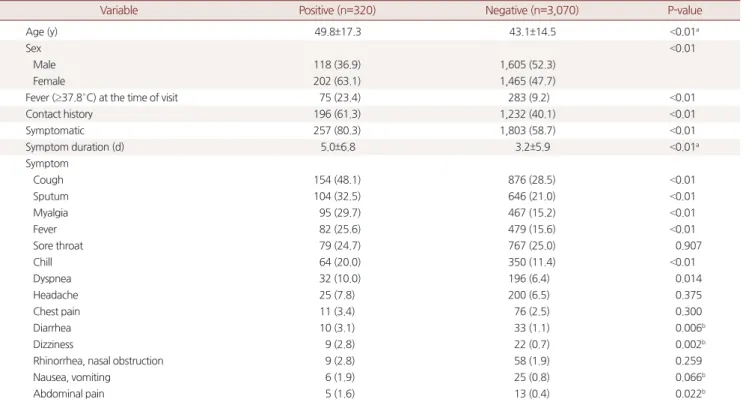
%)보다 유의하게 높았다. 유증상자가 호소하는 증상 중 기침, 객담, 근육통, 발열, 오한, 호흡곤란 등의 증 상은 양성군에서 유의하게 높았으나 인두통, 두통의 증상은 두 군 간의 유의한 차이를 보이지 않았다(Table 1
).2. 객담 검체와 비 및 구 인두 도말 검체, 두 검체 간 real-time RT-PCR 검사의 민감도 및 일치도
최종 양성군(
COVID-19
환자군)의 기준을 객담 검체와 비 및 구Table 1. General characteristics of study subjects
Variable Positive (n=320) Negative (n=3,070) P-value
Age (y) 49.8±17.3 43.1±14.5 <0.01a
Sex <0.01
Male 118 (36.9) 1,605 (52.3)
Female 202 (63.1) 1,465 (47.7)
Fever (≥37.8°C) at the time of visit 75 (23.4) 283 (9.2) <0.01
Contact history 196 (61.3) 1,232 (40.1) <0.01
Symptomatic 257 (80.3) 1,803 (58.7) <0.01
Symptom duration (d) 5.0±6.8 3.2±5.9 <0.01a
Symptom
Cough 154 (48.1) 876 (28.5) <0.01
Sputum 104 (32.5) 646 (21.0) <0.01
Myalgia 95 (29.7) 467 (15.2) <0.01
Fever 82 (25.6) 479 (15.6) <0.01
Sore throat 79 (24.7) 767 (25.0) 0.907
Chill 64 (20.0) 350 (11.4) <0.01
Dyspnea 32 (10.0) 196 (6.4) 0.014
Headache 25 (7.8) 200 (6.5) 0.375
Chest pain 11 (3.4) 76 (2.5) 0.300
Diarrhea 10 (3.1) 33 (1.1) 0.006b
Dizziness 9 (2.8) 22 (0.7) 0.002b
Rhinorrhea, nasal obstruction 9 (2.8) 58 (1.9) 0.259
Nausea, vomiting 6 (1.9) 25 (0.8) 0.066b
Abdominal pain 5 (1.6) 13 (0.4) 0.022b
Values are presented as number (%) or mean±standard deviation.
P-value by chi-square.
aP-value by t-test. bP-value by Fisher’s exact test.
윤한솔 외. 코로나바이러스감염증-19 진단을 위한 객담과 인두도말 Korean Journal of Family Practice
KJFP
인두 도말 검체 중 하나의 검체라도
real-time RT-PCR
검사에서 양성 으로 판정될 경우로 정하였을 때 객담 검체의real-time RT-PCR
검사 의 민감도는91
.6
%로 비 및 구 인두 도말 검체의 민감도,94
.4
%에 비 해 낮았으나 유의한 차이는 없었다(P-value=0
.233
). 또한 일치도 검정 에서는Cohen
’s Kappa
계수가0
.917
로 나타나 아주 높은 일치도를 보 였다(Table 2
).3. 양성군에서 각 gene별 Ct값의 비교
각
gene
별로 객담 검체와 비 및 구 인두 도말 검체 간의Ct
값을 비 교한 결과E gene
,RdRP gene
,N gene
세 가지 모두 객담 검체에서 유 의하게 높았다(Table 3
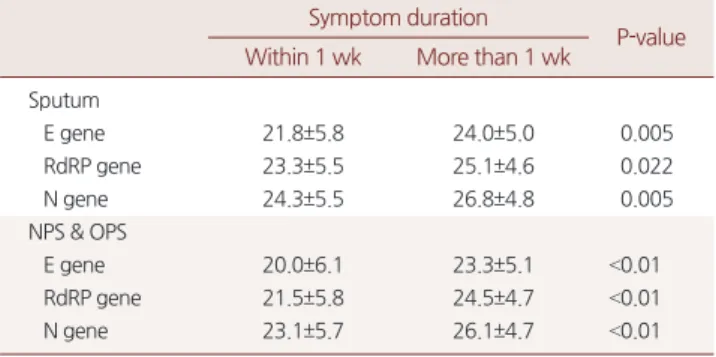
).증상발생일로부터 내원일까지의 기간이
1
주 이하 군과1
주 초과 군의 객담 검체와 비 및 구 인두 도말 검체의 각gene
별Ct
값은 검체 의 종류와 상관없이 증상 기간이1
주 초과 군에서 유의하게 높았다 (Table 4
).고 찰
본 연구는
COVID-19
선별진료소 내원자를 대상으로 객담 검체와 비 및 구 인두 도말 검체의
real-time RT-PCR
검사의 양성률 및 민 감도를 평가하고 그에 따른 임상적 특성을 분석하여COVID-19
진 단을 위한real-time RT-PCR
검사의 검체로서 두 검체의 유용성과 양성군의 특징을 알아보고자 하였다. 본 연구에서 객담 검체의real- time RT-PCR
검사 결과의 민감도(91
.6
%)는 비 및 구 인두 도말 검체 의real-time RT-PCR
검사 결과의 민감도(94
.4
%)에 비해 다소 낮았지 만 유의한 차이는 없었다.B
öger
등13)의 객담 검체의 민감도(97
.2
%) 와 비교하면 다소 낮았으나 비 인두 도말 검체의 민감도(73
.3
%)는 본 연구에서 더 높았다. 그리고Wang
등11)의 비 인두 도말 검체의 민 감도는98
.3
%로 본 연구에 비해 다소 높았다.본 연구에서 객담 검체와 비 및 구 인두 도말 검체 간의 일치도는
Cohen
’s Kappa
계수가0
.917
로 아주 높았다. 이와 대조적으로 객담 검체와 비 인두 도말 검체를 비교한Zhang
등8)의 연구에서는 증상 기간별Cohen
’s Kappa
계수가-0
.09
,0
.12
,0
.13
으로 아주 낮았고 비 인두 도말 검체와 구 인두 도말 검체를 비교한Wang
등11)의 연구에 서도0
.19
로 아주 낮았다. 그리고Altawalah
등10)의 연구에서 비 인두 도말 검체와 타액 검체 간의Cohen
’s Kappa
계수는0
.814
로 본 연구 에 비해 다소 낮았다. 또한SARS-COV-2
가 아닌 다른 호흡기 바이러 스에 대하여 객담 검체와 비 인두 도말 검체의real-time RT-PCR
검 사 결과를 비교한Jeong
등14)의 연구에서도 바이러스별Cohen
’s Kappa
계수는0
.637
에서0
.854
로 본 연구에 비해 다소 낮았다. 상기 여러 연구8,10,11,14)와 비교할 때 본 연구의 두 검체 간 일치도가 아주 높다는 것을 알 수 있다.본 연구에서 검체의 종류와 상관없이 증상 기간이
1
주일을 초과 하는 경우 유의하게Ct
값이 높았으며Ct
값은SARS-COV-2
바이러스 총량과 반비례15)하므로 바이러스 총량이 최고조에 도달한 이후부터 Table 2. Comparison of real-time RT-PCR results between sputum andNPS & OPS specimens
NPS & OPS specimen
Positive Negative
Sputum specimen
Positive 275 (8.1) 18 (0.5)
Negative 27 (0.8) 3,070 (90.6)
Values are presented as number (%).
RT-PCR, reverse transcription polymerase chain reaction; NPS, nasopharyngeal swabs; OPS, oropharyngeal swabs.
P-value=0.233 by McNemar’s test; Cohen’s Kappa=0.917 (95% confidence in- terval, 0.905 –0.929). Cohen’s Kappa: <0, poor; 0–0.2, slight; 0.21–0.4, fair;
0.41–0.6, moderate; 0.61–0.8, substantial; 0.81–1, almost perfect. Sensitivity of sputum specimen is 91.6%; [(275+18)/(275+18+27)]×100(%). Sensitivity of NPS & OPS specimen is 94.4%; [(275+27)/(275+27+18)]×100(%).
Table 3. Ct values of sputum and NPS & OPS specimens in the real- time RT-PCR positive group (N=320)
Sputum NPS & OPS P-value
E gene 22.9±5.7 21.4±6.1 <0.01
RdRP gene 24.3±5.5 22.8±5.9 <0.01
N gene 26.0±5.6 24.3±5.8 <0.01
Values are presented as mean±standard deviation.
Ct, cut-off cycle threshold; NPS, nasopharyngeal swabs; OPS, oropharyngeal swabs; RT-PCR, reverse transcription polymerase chain reaction; E gene, enve- lope gene; RdRP gene, RNA dependent RNA polymerase gene; N gene, nucleo- capsid gene.
P-value by paired t-test.
Table 4. Ct values according to symptom duration in real-time RT-PCR positive group (N=320)
Symptom duration
P-value Within 1 wk More than 1 wk
Sputum
E gene 21.8±5.8 24.0±5.0 0.005
RdRP gene 23.3±5.5 25.1±4.6 0.022
N gene 24.3±5.5 26.8±4.8 0.005
NPS & OPS
E gene 20.0±6.1 23.3±5.1 <0.01
RdRP gene 21.5±5.8 24.5±4.7 <0.01
N gene 23.1±5.7 26.1±4.7 <0.01
Values are presented as mean±standard deviation
Ct, cut-off cycle threshold; RT-PCR, reverse transcription polymerase chain reac- tion; E gene, envelope gene; RdRP gene, RNA dependent RNA polymerase gene; N gene, nucleocapsid gene; NPS, nasopharyngeal swabs; OPS, oropharyn- geal swab.
P-value by Mann-Whitney U test.
Han-Sol Yun, et al. Sputum and Pharyngeal Swab Specimens for Diagnosis of COVID-19
Korean Journal of Family Practice
KJFP
는 감소함을 보였던 기존의 연구16-18)와 일치하였다. 객담 검체의
Ct
값이 비 및 구 인두 도말 검체의Ct
값에 비해 유의하게 높은 결과를 보여Huh
등19)의 연구와 일치하였다. 본 연구와는 다르게 객담의SARS-COV-2
바이러스 총량이 인두 도말에 비해 더 많았던 연구16,20) 도 있었으나 이들 연구16,20)는 입원환자를 대상으로 하였기 때문에COVID-19
의 중증도가 높고 상대적으로 이환 기간이 길었다.COVID-19
환자의 중증도가 높은 군은 낮은 군에 비해SARS-COV-2
바이러스 총량의 양상이 다르므로18) 본 연구와 다른 결과를 보인 것 으로 생각된다.본 연구는 객담 검체 채집에 있어서 부정확함이 있었을 수 있다.
연구의 대상이 되는 대구광역시 소재의 일개 감염병 전담병원의
COVID-19
선별진료소에서는 객담 검체 채집에 있어 내원자가 직접채취하도록 하였다. 객담 증상이 없는 경우에도 채취하여 구강의 세포, 타액 등을 포함한 상기도 환경에 의해 오염 혹은 희석되었을 가능성이 있어 객담 검체로서의 적절성에는 논란의 여지가 있을 수 있다.
그럼에도 본 연구에서 객담 검체는 비 및 구 인두 도말 검체와 비 교하여 유의한 차이 없이 높은 민감도를 보였기에 비 및 구 인두 도 말 검체 채취가 어려운 경우의 대안 검체가 될 수 있음을 보였다. 본 연구는 단일기관연구임에도 불구하고 동시에 채취한 두 가지 검체 를 비교한 연구로서는 전체 연구대상자의 수가
3
,390
명으로 대규모 연구라 할 수 있다. 또한,COVID-19
선별진료소 내원자를 대상으로real-time RT-PCR
검사를 위한 검체로서 객담 검체와 비 및 구 인두 도말 검체의 유용성을 보여준 첫 연구이다.결론적으로, 비 및 구 인두 도말 검체는 객담 검체에 비해 유의하 지 않지만 민감도가 더 높으므로
COVID-19
진단을 위한real-time
RT-PCR
검사의 우선적인 검체로 권장된다. 그리고 자가 채취한 객담 검체도 비 및 구 인두 도말 검체와 아주 높은 일치도를 보였기에
COVID-19
진단을 위한real-time RT-PCR
검사의 이차적인 대안 검체 로 권장될 수 있다.요 약
연구배경:
COVID-19
진단을 위한real-time RT-PCR
검사 검체로서 여러 가지 검체가 가능하나 각 검체를 비교한 이전의 연구들은 입 원 환자를 대상으로 하였고 소규모 연구였다. 이에 본 연구에서는COVID-19
선별진료소 내원자를 대상으로 동시에 채취한 객담 검체와 비 및 구 인두 도말 검체, 두 검체 간의 양성률 및 민감도를 평가 하고 그에 따른 임상적 특성을 분석하여 향후
COVID-19
진단에 도 움이 되고자 하였다.방법:
2020
년2
월12
일부터2020
년3
월31
일까지 대구의료원의COVID-19
선별진료소 내원자 중 총3
,390
명을 연구에 포함시켰다.객담 검체와 비 및 구 인두 도말 검체, 두 가지 검체 간
real-time RT- PCR
검사 결과의 비교분석 및 일치도를 평가하기 위해McNemar
’s test
및Cohen
’s Kappa statistics
를 시행하였다. 증상 발생일로부터 내 원일까지의 증상 지속기간1
주를 기준으로 분류한 뒤 양성군에서 두 검체의 각gene
별Ct
값을 비교하기 위해Mann-Whitney U test
를 시행하였다.결과: 객담 검체의
real-time RT-PCR
검사의 민감도는91
.6
%로 비 및 구 인두 도말 검체의 민감도,94
.4
%에 비해 낮았으나 유의한 차이는 없었다(P-value=0
.233
). 또한 일치도 검정에서는Cohen
’s Kappa
계수 가0
.917
로 나타나 아주 높은 일치도를 보였다. 양성군에서 두 검체 의 각gene
별Ct
값은 검체의 종류와 상관없이 증상 기간이1
주 초과 군에서 유의하게 높았다.결론: 비 및 구 인두 도말 검체는 객담 검체에 비해 유의하지 않지만 민감도가 더 높으므로
COVID-19
진단을 위한real-time RT-PCR
검 사의 우선적인 검체로 권장된다. 그리고 자가 채취한 객담 검체도 비 및 구 인두 도말 검체와 아주 높은 일치도를 보였기에COVID-19
진단을 위한real-time RT-PCR
검사의 이차적인 대안 검체로 권장될 수 있다.중심단어: 코로나바이러스감염증
-19
; 객담; 비 인두 도말;SARS- CoV-2
; 민감도; 역전사 중합효소연쇄반응감사의 글
본 연구는 대구시의사회
COVID19
학술지원단의 지원으로 수행 된 연구입니다.CONFLICT OF INTEREST
No potential conflict of interest relevant to this article was reported
. ORCIDHan-Sol Yun
,https
://orcid
.org
/0000-0003-3404-8726
Dong-Sung Jang
,https
://orcid
.org
/0000-0002-5095-4270
Seock-Hwan Lee
,https
://orcid
.org
/0000-0002-0638-643X
윤한솔 외. 코로나바이러스감염증-19 진단을 위한 객담과 인두도말 Korean Journal of Family Practice
KJFP
REFERENCES
1. Ministry of Health and Welfare. Coronavirus disease-19, Republic of Korea [Internet]. Sejong: Ministry of Health and Welfare; 2021 [cited 2021 Feb 19].
Available from: http://ncov.mohw.go.kr/en/.
2. Korean Society of Infectious Diseases; Korean Society of Pediatric Infec- tious Diseases; Korean Society of Epidemiology; Korean Society for Anti- microbial Therapy; Korean Society for Healthcare-associated Infection Control and Prevention; Korea Centers for Disease Control and Prevention.
Report on the epidemiological features of coronavirus disease 2019 (COV- ID-19) outbreak in the Republic of Korea from January 19 to March 2, 2020. J Korean Med Sci 2020; 35: e112.
3. Wang W, Xu Y, Gao R, Lu R, Han K, Wu G, et al. Detection of SARS-CoV-2 in different types of clinical specimens. JAMA 2020; 323: 1843-4.
4. Zhu J, Ji P, Pang J, Zhong Z, Li H, He C, et al. Clinical characteristics of 3,062 COVID-19 patients: a meta-analysis. J Med Virol 2020; 92: 1902-14.
5. He J, Guo Y, Mao R, Zhang J. Proportion of asymptomatic coronavirus dis- ease 2019: a systematic review and meta-analysis. J Med Virol 2021; 93: 820- 30.
6. Gao Z, Xu Y, Sun C, Wang X, Guo Y, Qiu S, et al. A systematic review of as- ymptomatic infections with COVID-19. J Microbiol Immunol Infect 2021;
54: 12-6.
7. Zhao H, Lu X, Deng Y, Tang Y, Lu J. COVID-19: asymptomatic carrier trans- mission is an underestimated problem. Epidemiol Infect 2020; 148: e116.
8. Zhang H, Chen M, Zhang Y, Wen J, Wang Y, Wang L, et al. The yield and con- sistency of the detection of SARS-CoV-2 in multiple respiratory specimens.
Open Forum Infect Dis 2020; 7: faa379.
9. Lin C, Xiang J, Yan M, Li H, Huang S, Shen C. Comparison of throat swabs and sputum specimens for viral nucleic acid detection in 52 cases of novel coronavirus (SARS-Cov-2)-infected pneumonia (COVID-19). Clin Chem Lab Med 2020; 58: 1089-94.
10. Altawalah H, AlHuraish F, Alkandari WA, Ezzikouri S. Saliva specimens for
detection of severe acute respiratory syndrome coronavirus 2 in Kuwait: a cross-sectional study. J Clin Virol 2020; 132: 104652.
11. Wang H, Liu Q, Hu J, Zhou M, Yu MQ, Li KY, et al. Nasopharyngeal swabs are more sensitive than oropharyngeal swabs for COVID-19 diagnosis and monitoring the SARS-CoV-2 load. Front Med (Lausanne) 2020; 7: 334.
12. Kasper DL, Fauci AS, Hauser SL, Longo DL, Jameson JL, Loscalzo J. Harri- son’s principles of internal medicine. 19th ed. New York (NY): McGraw Hill Education; 2015. p. 123.
13. Böger B, Fachi MM, Vilhena RO, Cobre AF, Tonin FS, Pontarolo R. System- atic review with meta-analysis of the accuracy of diagnostic tests for COV- ID-19. Am J Infect Control 2021; 49: 21-9.
14. Jeong JH, Kim KH, Jeong SH, Park JW, Lee SM, Seo YH. Comparison of sputum and nasopharyngeal swabs for detection of respiratory viruses. J Med Virol 2014; 86: 2122-7.
15. Tom MR, Mina MJ. To interpret the SARS-CoV-2 test, consider the cycle threshold value. Clin Infect Dis 2020; 71: 2252-4.
16. Yu F, Yan L, Wang N, Yang S, Wang L, Tang Y, et al. Quantitative detection and viral load analysis of SARS-CoV-2 in infected patients. Clin Infect Dis 2020;
71: 793-8.
17. Zheng S, Fan J, Yu F, Feng B, Lou B, Zou Q, et al. Viral load dynamics and dis- ease severity in patients infected with SARS-CoV-2 in Zhejiang province, China, January-March 2020: retrospective cohort study. BMJ 2020; 369:
m1443.
18. Wang Y, Zhang L, Sang L, Ye F, Ruan S, Zhong B, et al. Kinetics of viral load and antibody response in relation to COVID-19 severity. J Clin Invest 2020;
130: 5235-44.
19. Huh HJ, Hong KH, Kim TS, Song SH, Roh KH, Lee H, et al. Surveillance of coronavirus disease 2019 (COVID-19) testing in clinical laboratories in Korea. Ann Lab Med 2021; 41: 225-9.
20. Pan Y, Zhang D, Yang P, Poon LLM, Wang Q. Viral load of SARS-CoV-2 in clinical samples. Lancet Infect Dis 2020; 20: 411-2.