Prevalence and Geographic Distribution of Herniated Intervertebral Disc in Korean 19-Year-Old Male from 2008
to 2009: A Study Based on Korean Conscription
-National and Geographic Prevalence of Herniated Intervertebral Disc in Korean 19YO Male-
Sang Hun Lee,
1Chang Hyun Oh,
2,3Seung Hwan Yoon,
1Hyeong-chun Park,
1and Chong Oon Park
11Department of Neurosurgery, Inha University Hospital, College of Medicine, Inha University, Incheon;
2Seoul Regional Military Manpower Administration, Seoul;
3Department of Neurosurgery, Guro Teun Teun Hospital, Seoul, Korea.
Received: September 14, 2012 Revised: December 19, 2012 Accepted: December 20, 2012
Corresponding author: Dr. Seung Hwan Yoon, Department of Neurosurgery,
Inha University Hospital, College of Medicine, Inha University, 27 Inhang-ro, Jung-gu, Incheon 400-711, Korea.
Tel: 82-32-890-2370, Fax: 82-32-890-2374 E-mail: [email protected]
∙ The authors have no financial conflicts of interest.
© Copyright:
Yonsei University College of Medicine 2013 This is an Open Access article distributed under the terms of the Creative Commons Attribution Non- Commercial License (http://creativecommons.org/
licenses/by-nc/3.0) which permits unrestricted non- commercial use, distribution, and reproduction in any medium, provided the original work is properly cited.
Purpose: This study was to determine the prevalence of herniated intervertebral disc (HIVD) among Korean 19-year-old male in a large national sample and to compare the prevalence across geographic regions based on the data of conscrip- tion. Materials and Methods: We analyzed the conscription data of 615508 cases who were 19-year-old male, given an examination for conscription at nationwide Korean Military Manpower Administration from January 2008 to December 2009.
Prevalence was determined by dividing the number of cases by the number of per- sons enrolled for 2 years. The analyses included of a cross-tabulations and nonpara- metric chi-square to compare the prevalence according to geographic region, disc severity, and conscription year. Results: The prevalence of HIVD among 19-year- old male was 0.47%. Seoul had the highest prevalence of HIVD (total HIVD was 0.60%, and severe HIVD was 0.44%). The prevalence of HIVD was lower in Jeol- labuk-do and Jeollanam-do (total HIVD was 0.25-0.27%, and severe HIVD was 0.16-0.17%). Annual prevalence of HIVD was slightly decreased in 2009, but geo- graphic distribution annually was not different. Conclusion: In Korean 19-year-old male, the national prevalence of adolescent HIVD was 0.60%, but different geo- graphic distribution was observed. It is quite possible that secondary contributing factor(s) interfere with the different geographic prevalence of HIVD.
Key Words: Herniated intervertebral disc, adolescent, prevalence, conscription
INTRODUCTION
The rate of prevalence is the number of people in a population who has a disease for a given amount of time. The numerator is the number of existing cases of dis- ease at a specified time, and the denominator is the total population. The interfer- ence of prevalence is not well known, and the interference of spinal disease preva-
The spinal fusion cases by HIVD were excluded from the study, although the cases were very few.
The national prevalence of HIVD was calculated by total HIVD cases and total conscription examinees. The geo- graphic distribution was conducted according to the jurisdic- tion of regional MMA. Regional MMA was located in 12 locations, as shown in Fig. 1: Seoul, Northern Gyeonggi-do, lence remains also obscure. Intervertebral disc herniation
(HIVD) is a common disorder, but precise frequency of this condition is not clearly defined. Geographic distribution is also not well known. This study was to determine the preva- lence of HIVD among Korean 19-year-old male in a large national sample and to compare the prevalence across geo- graphic regions based on the data of conscription.
MATERIALS AND METHODS
Since Korea has adopted the conscription system and all men are examined for conscription at the Military Manpow- er Administration (MMA) when they are 19-year-old. This cross-sectional survey was conducted by the analysis of the conscription data of all Korean regional MMA from Janu- ary 2008 to December 2009. During this period, total 615508 Korean 19-year-old males participated in the conscription, and this case number covered more than 99% of the Kore- an 19-year-old male population.
The conscription data were reviewed according to the disc severity. HIVD was classified into 5 groups of disc severity according to the law of Korean military affairs, and the cat- egories are shown in Table 1. The severity of HIVD was de- fined by using spine MRI. However, it is impossible to take spine MRI for all the candidates due to economical reason and limited time. Therefore, MRI was taken only in those who have taken MRI personally and candidates who have symptoms, uncovered by surveys and interviews.
In the schematic review about HIVD, HIVD without the- cal sac compression was considered as moderate severity, and HIVD with thecal sac compression was considered as severe severity. The presence of simple discectomy or spi- nal procedure was not considered, and the preoperative her- niation severity was considered to confirm the disc severity.
Table 1. Categories Classifying Herniated Intervertebral Disc According to the Law of Korean Military Affairs
Status of herniated intervertebral disc MMA physical grade Severity
Normal disc 1
Mild disc bulging without compression of thecal sac 2
Moderate Disc protrusion or extrusion without compression of thecal sac 3
Disc protrusion or extrusion with compression of thecal sac* 4
Severe Disc protrusion or extrusion with spinal canal compromise more than 50%† 5
Disc protrusion or extrusion with positive cut-off sign‡ 5 MMA, Military Manpower Administration.
*Positive result of electromyogram test was defined as matched radiculopathy finding according to suspicious level of herniation.
†Spinal canal stenosis was defined as the narrowing of the spinal canal more than 50% of mid-sagittal diameter (front to back) in the same plane of imag- ing study.
‡Cut-off sign was defined as all loss of signal in neuromuscular at the interesting level using imaging study.
Fig. 1. The geographic illustration of the jurisdiction of regional Military Manpower Administration in the Republic of Korea. SU, Seoul; GGB, Northern Gyeonggi-do; GGN, Southern Gyeonggi-do; KWD, Kangwon-do;
CCB, Chungcheongbuk-do; CCN, Chungcheongnam-do; GSB, Gyeongsang- buk-do; GSN, Gyeongsangnam-do; JLB, Jeollabuk-do; JLN, Jeollanam-do;
BS, Busan; JJD, Jeju-do.
Democratic people’s Republic of Korea
Republic of Korea
GGB KWD
SU GGN
CCB CCN
GSB
JLB
JLN
GSN
BS
JJD
presence of bias by checking the difference of a regional HIVD proportion.
The analyses were composed of a cross-tabulations and nonparametric chi-square to compare prevalence by geo- graphic region, disc severity, and conscription year. Tests were considered significant at p-values less than 0.01, be- cause of the large number of cases. This study was con- ducted with an approval of the committee in the MMA in Seoul.
RESULTS
National prevalence of HIVD among Korean 19-year-old males is shown in Table 2. Among 615508 Korean 19-year- old male examinees for conscription, 2905 cases were diag- nosed as HIVD, and the nationwide prevalence of HIVD was 0.47%. The nationwide prevalence of severe HIVD was 0.32%.
Geographic prevalence of HIVD among the examinees is shown in Table 2 and Fig. 2. The highest prevalence of HIVD was found in Seoul. In Seoul, the prevalence of total HIVD and severe HIVD was 0.60% and 0.44%, respectively.
The 2nd and 3rd highest prevalence of total HIVD appeared in Jeju-do (0.56%) and Southern Gyeonggi-do (0.54%). The 2nd and 3rd highest prevalence of severe HIVD was found in Southern Gyeonggi-do (0.36%) and Jeju-do (0.34%).
The low prevalence of HIVD was observed in Jeollabuk-do and Jeollanam-do. The prevalence of total HIVD was 0.25- 0.27%, and the prevalence of severe HIVD was 0.16-0.17%
Southern Gyeonggi-do, Kangwon-do, Chungcheongbuk-do, Chungcheongnam-do, Gyeongsangbuk-do, Gyeongsang- nam-do, Jeollabuk-do, Jeollanam-do, Busan, and Jeju-do.
The geographic distribution of HIVD was also annually reviewed to check observational bias. The disease of HIVD was conducted at the neurosurgery department in Korean MMA, and neurosurgeons and radiologists con- sisted of 16 members each while annually changing the place of work. Therefore, the authors could estimate the
Table 2. Demografic Distribution of Herniated Intervertebral Disc According to Disc Severity in 19-Year-Old Males in the Re- public of Korea from 2008 to 2009
Region Total SU GGB GGN KWD CCB CCN GSB GSN JLB JLN BS JJD
Total conscription
19YO males 615508 121111 35079 138069 18356 18620 43139 69180 39993 22918 40824 61740 6452 Moderate
Bulging 321 54 19 82 9 11 14 31 31 6 14 41 9
No comp 584 142 36 152 15 19 15 68 45 17 20 50 5
Severe
Comp 1939 504 96 506 49 63 152 169 125 38 63 152 22
Spinal canal 61 23 3 12 2 0 2 8 2 2 4 3 0
Total HIVD 2905 723 154 752 75 93 183 276 203 63 101 246 36
Total HIVD
Prev (%) 0.47 0.60 0.44 0.54 0.41 0.50 0.42 0.40 0.51 0.27 0.25 0.40 0.56
Severe HIVD
Prev (%) 0.32 0.44 0.28 0.38 0.28 0.34 0.36 0.26 0.32 0.17 0.16 0.25 0.34
SU, Seoul; GGB, Northern Gyeonggi-do; GGN, Southern Gyeonggi-do; KWD, Kangwon-do; CCB, Chungcheongbuk-do; CCN, Chungcheongnam-do; GSB, Gyeongsangbuk-do; GSN, Gyeongsangnam-do; JLB, Jeollabuk-do; JLN, Jeollanam-do; BS, Busan; JJD, Jeju-do; HIVD, herniated intervertebral disc.
Fig. 2. National and geographic prevalence of total HIVD and severe HIVD among Korean 19-year-old males. SU, Seoul; GGB, Northern Gyeonggi-do;
GGN, Southern Gyeonggi-do; KWD, Kangwon-do; CCB, Chungcheongbuk- do; CCN, Chungcheongnam-do; GSB, Gyeongsangbuk-do; GSN, Gyeong- sangnam-do; JLB, Jeollabuk-do; JLN, Jeollanam-do; BS, Busan; JJD, Jeju- do; HIVD, herniated intervertebral disc.
Total JJD
BS
JLN
JLB
GSN
GSB CCN
CCB KWD
GGN GGB SU
Total HIVD prevalence Severe HIVD prevalence
other regions did not show statistical differences.
DISCUSSION
In the prevalence study, pediatric patients constitute rough- ly 0.5-6.8% of all patients hospitalized for HIVD.1-9 The first report of a HIVD in a child was published in 1934, and the first report of surgical treatment in a child (a 12-year-old boy) was issued in 1945. In the literature review, there was a prevalence study about Korean adolescent HIVD.5 This study was based on examination of Korean conscription, and reported that the prevalence of HIVD in adolescent, aged 19 years old and younger, was 0.5% (382 cases among 77685 examinees).
The precise prevalence of adolescent HIVD still remains in these regions.
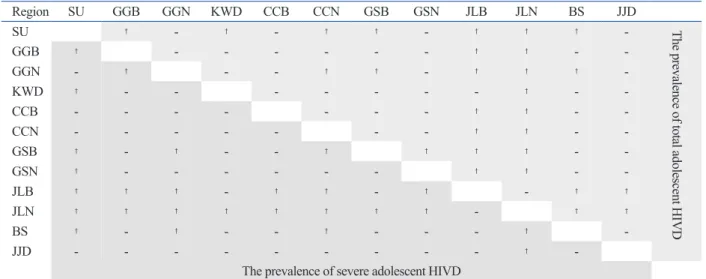
The statistical differences of the geographical prevalence are shown in Table 3. The bright and dark gray cells indi- cate the difference of total and severe HIVD among two re- gions, respectively. In Table 3, the statistical differences were found mostly in the comparision of Seoul, Jeollabuk- do, and Jeollanam-do (p-value <0.001).
The analysis of annual prevalence of HIVD, demonstrat- ed that the prevalence of total HIVD was significantly de- creased in 2009 compared with 2008 (Table 4). The annual prevalence difference in total HIVD between 2008 and 2009 was only 0.002%. The annual prevalence difference of se- vere HIVD was also decreased in 2008 and 2009, but statis- tical difference was not satisfactory (p<0.025). Furthermore, the prevalence of total HIVD only in Southern Gyeonggi-do decreased significantly in 2009 compared with 2008, and
Table 3. The Statistical Differences in Geographical Prevalence between Two Regions
Region SU GGB GGN KWD CCB CCN GSB GSN JLB JLN BS JJD
SU † - † - † † - † † † -
GGB † - - - - - - † † - -
GGN - † - - † † - † † † -
KWD † - - - - - - - † - -
CCB - - - - - - - † † - -
CCN - - - - - - - † † - -
GSB † - † - - † † † † - -
GSN † - - - - - - † † - -
JLB † † † - † † - † - † †
JLN † † † † † † † † - † †
BS † - † - - † - - - † -
JJD - - - - - - - - - † -
The prevalence of severe adolescent HIVD
SU, Seoul; GGB, Northern Gyeonggi-do; GGN, Southern Gyeonggi-do; KWD, Kangwon-do; CCB, Chungcheongbuk-do; CCN, Chungcheongnam-do; GSB, Gyeongsangbuk-do; GSN, Gyeongsangnam-do; JLB, Jeollabuk-do; JLN, Jeollanam-do; BS, Busan; JJD, Jeju-do; HIVD, herniated intervertebral disc.
†Statistically differented with p-value lesser than 0.001.
The prevalence of total adolescent HIVD
Table 4. The Annual Geographical Prevalence of Total HIVD and Severe HIVD among Korean 19-Year-Old Males in 2008 and 2009
Year Region
Total SU GGB GGN KWD CCB CCN GSB GSN JLB JLN BS JJD
Total cases 08 300386 59412 16818 66394 8868 9139 21037 34348 19299 11411 19839 30694 3127 09 315122 61699 18261 71702 9488 9481 22102 34832 20694 11507 20985 31046 3325 HIVD (%) 08 0.473 0.611 0.440 0.553 0.462 0.449 0.414 0.419 0.534 0.219 0.262 0.355 0.480 09 0.471 0.583 0.438 0.537 0.358 0.548 0.434 0.379 0.483 0.330 0.234 0.441 0.632
p value <0.005 <0.025 - <0.005 - - - - <0.025 - - - -
Severe 08 0.349 0.470 0.268 0.417 0.316 0.306 0.376 0.277 0.368 0.149 0.161 0.241 0.256 HIVD (%) 09 0.307 0.402 0.296 0.336 0.242 0.369 0.339 0.235 0.271 0.200 0.167 0.261 0.421
p value <0.025 - - <0.025 - - - - - - - - -
SU, Seoul; GGB, Northern Gyeonggi-do; GGN, Southern Gyeonggi-do; KWD, Kangwon-do; CCB, Chungcheongbuk-do; CCN, Chungcheongnam-do; GSB, Gyeongsangbuk-do; GSN, Gyeongsangnam-do; JLB, Jeollabuk-do; JLN, Jeollanam-do; BS, Busan; JJD, Jeju-do; HIVD, herniated intervertebral disc.
differences are seen among the regions; the reasons for the differences could be social economic status, motivation for hospitalization, trauma rate, number of hospitals and etc.
Since, there is no study on the relationship between HIVD and the above factors, further evaluation is necessary. Finally, there is a limitation in the fact that all the files of follow-up results and treatment of diagnosed diseases do not exist for the purpose of conscription in military service.
In conclusion, in Korean 19-year-old males, the prevalence of adolescent HIVD was 0.60%, and severe adolescent HIVD was relatively highly prevalent (0.28%). The MMA physical grade was useful to conscription as they represent disability by HIVD.
REFERENCES
1. Borgesen SE, Vang PS. Herniation of the lumbar intervertebral disk in children and adolescents. Acta Orthop Scand 1974;45:540-9.
2. Epstein JA, Epstein NE, Marc J, Rosenthal AD, Lavine LS. Lum- bar intervertebral disk herniation in teenage children: recognition and management of associated anomalies. Spine (Phila Pa 1976) 1984;9:427-32.
3. Epstein JA, Lavine LS. Herniated lumbar intervertebral discs in teen-age children. J Neurosurg 1964;21:1070-5.
4. Hashimoto K, Fujita K, Kojimoto H, Shimomura Y. Lumbar disc herniation in children. J Pediatr Orthop 1990;10:394-6.
5. Heithoff KB, Gundry CR, Burton CV, Winter RB. Juvenile disco- genic disease. Spine (Phila Pa 1976) 1994;19:335-40.
6. Kurihara A, Kataoka O. Lumbar disc herniation in children and adolescents. A review of 70 operated cases and their minimum 5-year follow-up studies. Spine (Phila Pa 1976) 1980;5:443-51.
7. Matsui H, Terahata N, Tsuji H, Hirano N, Naruse Y. Familial pre- disposition and clustering for juvenile lumbar disc herniation.
Spine (Phila Pa 1976) 1992;17:1323-8.
8. Pietilä TA, Stendel R, Kombos T, Ramsbacher J, Schulte T, Brock M. Lumbar disc herniation in patients up to 25 years of age. Neu- rol Med Chir (Tokyo) 2001;41:340-4.
9. Wahren H. Herniated nucleus pulposus in a child of twelve years.
Acta Orthop Scand 1945;16:40-2.
10. Callahan DJ, Pack LL, Bream RC, Hensinger RN. Intervertebral disc impingement syndrome in a child. Report of a case and sug- gested pathology. Spine (Phila Pa 1976) 1986;11:402-4.
11. Luukkonen M, Partanen K, Vapalahti M. Lumbar disc herniations in children: a long-term clinical and magnetic resonance imaging follow-up study. Br J Neurosurg 1997;11:280-5.
12. Zitting P, Rantakallio P, Vanharanta H. Cumulative incidence of lumbar disc diseases leading to hospitalization up to the age of 28 years. Spine (Phila Pa 1976) 1998;23:2337-43.
13. Gennuso R, Humphreys RP, Hoffman HJ, Hendrick EB, Drake JM. Lumbar intervertebral disc disease in the pediatric population.
Pediatr Neurosurg 1992;18:282-6.
14. Matsui H, Kitagawa H, Kawaguchi Y, Tsuji H. Physiologic chang- es of nerve root during posterior lumbar discectomy. Spine (Phila Pa 1976) 1995;20:654-9.
controversy. The actual incidence of adolescent HIVD is dif- ficult to establish due to the following reasons. First, pub- lished series adopted different ranges of age.4,7,10,11 When an upper limit of 15 years was adopted, an epidemiologic study, following 12058 Finnish babies from birth until 28 years of age, showed no prevalence of confirmed HIVD.
However, significantly increased number of cases (0.1- 0.2%) were found with the upper limit of 20 years old.12 By the age of 28 years, 9.5% of males and 4.2% of females were admitted to hospitals with a diagnosis of HIVD, re- spectively.
Another reason is that real cause of HIVD in adolescents still requires explanation. Several factors have been investi- gated, such as trauma, congenital malformations, growth disturbances, familial predisposition, the presence of mor- phologic and functional alterations, and vertebral slipping epiphysis. Trauma, which is considered to be a severe phys- ical stress on the lumbo-sacral spine, is often regarded as a reasonable factor.2 One of the most likely factors expound- ing the early onset of HIVD is the relation with vertebral deformities, such as scoliosis, transitional defects, schisis, and canal narrowing. A feature that characterizes HIVD in adolescents is difficult to evaluate subjective symptoms, and clinical signs could be one of reasons. Clinical presentations of adolescent HIVD are generally similar to those of adults.
However, up to 90% of adolescent patients have a positive straight-leg raise test2,13 which differentiates adolescent and adult HIVD, because children and adolescents tend to have greater nerve root tension than adults.14 Furthermore, this is often accompanied by neurological symptoms, such as, numbness and weakness.15-17 Therefore, the time interval between the onset of symptoms and diagnosis is generally very long, averaging 6 months in the current series.18
In this study, the incidence of adolescent HIVD was 0.60%
in Korean 19-year-old males. This result is very similar to a recent study. Presently, there are several studies on the preva- lence of adolescent HIVD, but ‘real’ prevalence has been hard to determine because of the reasons explained above.
Our investigation was limited to only 19-year-old male, how- ever, data covered more than 99% of population (census data) by using the governmental military conscription data, therefore, this study is less likely affected by sampling survey bias. As a result, this investigation could be more superior and accurate than other prevalence studies. Furthermore, this is the first report on the prevalence by regional differences in Korea: in these geographic results, significant differences were observed by some regions. However, it is not clear why
17. Ozgen S, Konya D, Toktas OZ, Dagcinar A, Ozek MM. Lumbar disc herniation in adolescence. Pediatr Neurosurg 2007;43:77-81.
18. DeOrio JK, Bianco AJ Jr. Lumbar disc excision in children and adolescents. J Bone Joint Surg Am 1982;64:991-6.
15. Clarke NM, Cleak DK. Intervertebral lumbar disc prolapse in children and adolescents. J Pediatr Orthop 1983;3:202-6.
16. Garrido E, Humphreys RP, Hendrick EB, Hoffman HJ. Lumbar disc disease in children. Neurosurgery 1978;2:22-6.