255 http://dx.doi.org/10.4196/kjpp.2012.16.4.255
ABBREVIATIONS: n-AS, n-(9-anthroyloxy)stearic acid; BSA, bovine serum albumin; DPH, 1,6-diphenyl-1,3,5-hexatriene; PBS, phosphate- buffered saline; Py-3-Py, 1,3-di(1-pyrenyl)propane; RET, radiationless energy transfer; SPMV, synaptosomal plasma membrane vesicles isolated from bovine cerebral cortex; TNBS, 2,4,6-trinitrobenzenesul- fonic acid.
Received May 10, 2012, Revised July 13, 2012, Accepted July 19, 2012
*Corresponding to: Il Yun, Department of Dental Pharmacology and Biophysics, School of Dentistry and Research Institute for Oral Biotechnology, Yangsan Campus of Pusan National University, Beomeo-ri, Mulgeum-eup, Yangsan 626-870, Korea. (Tel) 82-51-510- 8236, (Fax) 82-51-510-8233, (E-mail) [email protected]
†Co-corresponding to: Hye-Ock Jang, Department of Dental Pharma- cology and Biophysics, School of Dentistry and Research Institute for Oral Biotechnology, Yangsan Campus of Pusan National Univer- sity, Beomeo-ri, Mulgeum-eup, Yangsan 626-870, Korea. (Tel) 82-51- 510-8236, (Fax) 82-51-510-8233, (E-mail) [email protected]
‡These authors contributed equally to this work.
This is an Open Access article distributed under the terms of the Creative Commons Attribution Non-Commercial License (http://
creativecommons.org/licenses/by-nc/3.0) which permits unrestricted non-commercial use, distribution, and reproduction in any medium, provided the original work is properly cited.
The Effect of Methanol on the Structural Parameters of Neuronal Membrane Lipid Bilayers
Hyung-Jin Joo1,‡, Shin-Ho Ahn1,‡, Hang-Rae Lee1, Sung-Woo Jung1, Chang-Won Choi1, Min-Seok Kim1, Moon-Kyoung Bae2, In-Kyo Chung3, Soo-Kyoung Bae1, Hye-Ock Jang1,†, and Il Yun1,*
Departments of 1Dental Pharmacology and Biophysics, 2Oral Physiology and Molecular Biology, 3Oral and Maxillofacial Surgery and Clinical Pharmacology, School of Dentistry and Research Institute for Oral Biotechnology, Yangsan Campus of Pusan National University, Yangsan 626-870, Korea
The structures of the intact synaptosomal plasma membrane vesicles (SPMVs) isolated from bovine cerebral cortexs, and the outer and the inner monolayer separately, were evaluated with 1,6-diphenyl- 1,3,5-hexatriene (DPH) and 1,3-di(1-pyrenyl)propane (Py-3-Py) as fluorescent reporters and trinitro- phenyl groups as quenching agents. The methanol increased bulk rotational and lateral mobilities of SPMVs lipid bilayers. The methanol increased the rotational and lateral mobilities of the outer monolayers more than of the inner monolayers. n-(9-Anthroyloxy)stearic acid (n-AS) were used to evaluate the effect of the methanol on the rotational mobility at the 16, 12, 9, 6, and 2 position of aliphatic chains present in phospholipids of the SPMVs outer monolayers. The methanol decreased the anisotropy of the 16-(9-anthroyloxy)palmitic acid (16-AP), 12-(9-anthroyloxy)stearic acid (12-AS), 9-(9-anthroyloxy)stearic acid (9-AS), and 6-(9-anthroyloxy)stearic acid (6-AS) in the SPMVs outer monolayer but it increased the anisotropy of 2-(9-anthroyloxy)stearic acid (2-AS) in the monolayers.
The magnitude of the increased rotational mobility by the methanol was in the order at the position of 16, 12, 9, and 6 of aliphatic chains in phospholipids of the outer monolayers. Furthermore, the methanol increased annular lipid fluidity and also caused membrane proteins to cluster. The important finding is that was far greater increase by methanol in annular lipid fluidity than increase in lateral and rotational mobilities by the methanol. Methanol alters the stereo or dynamics of the proteins in the lipid bilayers by combining with lipids, especially with the annular lipids. In conclusion, the present data suggest that methanol, in additions to its direct interaction with proteins, concurrently interacts with membrane lipids, fluidizing the membrane, and thus inducing conformational changes of proteins known to be intimately associated with membranes lipids.
Key Words: Annular lipid fluidity, Membrane protein clustering, Methanol, Neuronal membranes, Transbilayer lateral and rotational mobility
INTRODUCTION
A number of theories propose perturbations of bulk phys-
ical properties of the lipids of cell membranes as the pri- mary event leading to inebriation or anesthesia. The molec- ular mechanism of action of ethnaol involved in producing ethanol intoxication, tolerance and general anesthesia are not well understood. An understanding of the behavior of ethanol at the molecular level is complicated by the fact that ethanol has a multi-faceted effect on cells in contrast to a localized site of action on a specific cellular target. The nonspecific effects of ethanol resulted in a large body of work that examined how ethanol affected bulk membrane lipid structure. One hypothesis was that ethanol fluidized the bulk membrane lipid and that the increased in fluidity was involved in general anesthesia and intoxication [1-5].
Most of the accumulated results for the analysis of ethanol’s effect on the cell membrane fluidity used a single molecular
probe for estimations of bulk membrane fluidity, and thus obtained information about one region (or average).
However the membrane fluidity may vary at different positions. In most studies, effects of ethanol on membrane fluidity have examined the bulk bilayer’s rotational mobi- lity, not on the individual monolayer’s rotational mobility (asymmetric mobility). Furthermore with few exceptions work has not focused on the bulk lateral [6-10] and in- dividual monolayers’ mobility [8-10] and annular lipid flu- idity and protein distribution [8-10].
Opinions have been divided as to whether ethanol inter- fered with membrane protein function by directly binding to the proteins [11-13] or whether the main modes of action occurred indirectly through a change in the physicochemi- cal properties of the lipid membranes into which the etha- nol readily diffused [14,15]. Because biological membranes are of highly complex composition, it has not been feasible to monitor changes in the local lipid environment and to determine its effect on the membrane protein function at the same time.
Previous studies have shown that the fluorophores of an- throyloxy derivatives locate at a graded series of levels from the surface to the center of the lipid bilayer structure (or a series of anthroyloxy fatty acids indicates that the depth of the group is almost linearly related to the number of carbon atoms between it and carboxyl group) [16-19]. The fluorophores of anthroyloxy derivatives can also be used to differentiate whether the bilayer has a fluidity gradient across it, as the anthroyloxy group can be positioned at dif- ferent positions of the stearic acid moiety [18-21]. These probes have been suggested to measure primarily the dy- namic component of membrane fluidity [20].
We believe that the study of the structure-activity rela- tionship of n-alkanols becomes a very important material for the research of mechanism of pharmacological action of ethanol. Tempting to further understand the molecular mechanism of action of ethanol, we carried out a compre- hensive study of membrane actions of methanol. We iso- lated synaptosomal plasma membrane vesicles (SPMVs) from fresh bovine cerebral cortex and using intramolecular excimerization of 1,3-di(1-pyrenyl)propane (Py-3-Py) and fluorescence polarization of 1,6-diphenyl-1,3,5-hexatriene (DPH), we examined the effect of methanol on the bulk flu- idity of SPMVs lipid bilayer. In addition, selective quench- ing of both Py-3-Py and DPH fluorescence by trinitrophenyl groups was used to examine the effect of methanol on the individual SPMVs monolayers. We also evaluated the effect of methanol on basic structural parameters of the SPMVs lipid bilayer’s annular lipid fluidity. This study was done through investigation of the effect of methanol on rotational mobility of the hydrocarbon interior and polar region (membrane interface, surface region) in the native mem- branes which differ in fluidity. The study was carried out using 16-(9-anthroyloxy)palmitic acid (16-AP), 12-(9-an- throyloxy)stearic acid (12-AS), 9-(9-anthroyloxy)stearic acid (9-AS), 6-(9-anthroyloxy)stearic acid (6-AS) and 2-(9-an- throyloxy)stearic acid (2-AS) those reflecting rotational mo- bility at the 16, 12, 9, 6 and 2 position of aliphatic chains present in phospholipids of neuronal membrane outer monolayers.
METHODS Materials
The fluorescent probes DPH, Py-3-Py and the fluorescent anthroyloxy palmitate or stearate probes, 16-AP, 12-AS, 9-AS, 6-AS and 2-AS were obtained from Molecular Probes (Eugene, OR). Methanol and 2,4,6-trinitrobenzenesulfonic acid (TNBS) were purchased from Fluka (Buchs, Switzer- land). Other reagents were obtained from Sigma (St. Louis, MO) and were analytical grade.
Preparation of synaptosomes and TNBS labeling reaction
Preparation of synaptosomes was performed according to the earlier procedures [22,23]. To determine fluorescence parameters of probe molecules in each membrane mono- layer, TNBS labeling reactions were performed according to the procedures described earlier [8,9,22,24-26] with a few modifications. Synaptosomal pellet was gently resuspended in 50 ml of 4 mM TNBS in buffer A for 80 min (in the case of asymmetric lateral mobility), or 50 ml of 2 mM TNBS in buffer A for 40 min (in the case of asymmetric rotational mobility) or buffer A alone. Buffer A was com- posed of 30 mM NaCl, 120 mM NaHCO3, 11 mM glucose and 1% bovine serum albumin (BSA). The reagent pH was adjusted to 8.5 with NaOH. To assure complete exposure of all synaptosomal outer monolayers to TNBS, the pellet was passed slowly through an Eberbach tissue grinder (3 up and down strokes). Unless otherwise specified, the treat- ment was carried out at 4oC. The TNBS labeling reaction was terminated by adding an equal volume of 1% BSA in phosphate buffered saline (PBS; 8 g/l NaCl, 0.2 g/l KCl, 0.2 g/l KH2PO4, 1.15 g/l Na2HPO4ㆍ7H2O, 0.48 g/l Hepes, pH 7.4).
Membrane isolation
SPMVs were isolated from synaptosomes by the formerly reported method in our laboratory [22,23]. The specific ac- tivities of Na+, K+-ATPase, acetylcholinesterase and 5’-nu- cleotidase were about 4-, 2.5- and 3-fold, respectively, en- riched in the plasma membrane fraction with respect to crude homogenates. The electron microscopic examination of the SPMVs prepared by us showed very high purity. The vesicles, which were separated according to size, demon- strated homogeneous distribution and no longer showed the presence of intracellular organelles or leakage. The protein concentration was determined by the method of Lowry et al. [27] using BSA as a standard.
Fluorescence measurements
All fluorescence measurements were obtained with a Multi Frequency Cross-Correlation Phase and Modulation Fluorometer (Model; ISS K2-003). Cuvette temperature was maintained at 37.0±0.1oC with a circulating water bath (pH 7.4). Bandpass slits were 10 nm on excitation and 5 nm on emission. Blanks, prepared under identical con- ditions without fluorescent probes, served as controls for the fluorometric measurements.
The incorporation of Py-3-Py was carried out by adding aliquots of a stock solution of 5×10⁻⁵ M in absolute meth- anol to the SPMVs, so that the final probe concentration
was less than 5×10⁻⁷ M [25,26]. The mixtures were initially vigorously vortexed for 10 sec at room temperature and then incubated at 4oC for 18 hr under gentle stirring [24-26].
The fluorescent probe DPH was dissolved in tetrahy- drofuran and a volume of 0.5 μl tetrahydrofuran per ml of PBS was added directly to the membrane suspension at a concentration of 0.01 μg/50 μg membrane protein (fluore- scence probe DPH 2: membrane protein 10,000) as described previously [24-26]. After incorporation of the probes, the membrane suspension was placed in cuvettes. Control lev- els of fluorescence were then determined. Concentrated sol- utions of the methanol were prepared in 10 mM Tris-HCl (pH 7.4) and added to the labeled membrane suspension (or untreated SPMVs suspension) to give the desired con- centration of the methanol (in this case, 30 min for incuba- tion).
Excitation wavelengths were 286 nm for tryptophan and 330 nm for Py-3-Py. Emission wavelengths were 335 nm for tryptophan, 379 nm for Py-3-Py monomer and 480 nm for Py-3-Py excimer. For Py-3-Py excimer emission, a GG- 455 cut-off filter was used. The excimer to monomer fluo- rescence intensity ratio, I’/I, was calculated from the 480 nm to 379 nm signal ratio. The excitation wavelength for DPH was 362 nm and fluorescence emission was read at 424 nm.
The fluorescence measurements of AS probes were taken using a modified method of earlier study [20]. The SPMVs were suspended in PBS to concentration 50 μg of protein/ml.
Stock solutions of the 16-AP, 12-AS, 9-AS, 6-AS and 2-AS in methanol (2×10⁻⁵ M) were prepared and kept in a cold and dark place. Aliquots were added to the solutions of the native membranes so that the final concentrations of the 16-AP, 12-AS, 9-AS, 6-AS and 2-AS became 4×10⁻⁸ M in- corporated the probes. The mixture was stirred for 20 min at room temperature in order to reduce the concentration of methanol that might alter the rotational mobility of the SPMVs. Also, the mixture was bubbled by dry nitrogen for 1 min with 20 min intervals in order to eliminate oxygen that might act as a quencher. To ensure complete removal of methanol residue in the mixture, the prepared mixtures were subjected to exhausted stirring for more than 2 hr which have shown the same results as the mixtures stirred for 20 min. Concentrated solution of methanol was pre- pared in PBS and added to the labeled membrane suspen- sion to give the desired concentration of the methanol. The pH of the buffered sample was not changed significantly by addition of methanol.
The effect of methanol on individual monolayer struc- ture in SPMVs: selective quenching of Py-3-Py This method is based on the assumption that the system is composed of fluorescing compartments of different acces- sibility to TNBS. The excimer to monomer fluorescence in- tensity ratio, I’/I, of Py-3-Py in bulk (inner plus outer), in- ner and outer monolayers were calculated by the following equation:
(I’/I)t=I’t/It ··· equation 1 (I’/I)i=I’i/Ii ··· equation 2 (I’/I)o=(I’t-I’i)/(It-Ii) ··· equation 3
where (I’/I)t, (I’/I)i and (I’/I)o are the excimer to monomer fluorescence intensity ratio of Py-3-Py (I’/I) in bulk, inner
and outer monolayers, respectively. The values of I’t (excimer fluorescence intensity for inner plus outer monolayers) and I’i (excimer fluorescence intensity for inner monolayer) were determined for Py-3-Py in SPMVs obtained from SPMVs incubated with buffer A and buffer A plus TNBS at 4oC (pH 8.5) (nonpenetrating conditions), respectively.
The effect of methanol on annular lipid fluidity in SPMVs
Annular lipid fluidity in SPMVs was evaluated as pre- viously described [6-9]. Incorporated Py-3-Py in the SPMVs was excited through radiationless energy transfer (RET) from tryptophan (excitation at 286 nm) and the excimer to monomer fluorescence intensity ratio (I’/I) of Py-3-Py was calculated from the 480 nm to 379 nm signal ratio.
Taking into account that Förster radius (the RET-limiting distance) for tryptophan-Py-3-Py donor-acceptor pair is 3 nm [28], only Py-3-Py located in annular lipids (close to pro- teins) was excited, and the fluidity of annular lipids was considered proportional to the I’/I [17-19,21,22]. The effi- ciency of RET from tryptophan to Py-3-Py was calculated by the equation:
RET=(Id-Ida)/Id ··· equation 4
where Id and Ida represent the fluorescence intensity of do- nor (in this case, endogenous tryptophan) in the absence and presence of acceptor (Py-3-Py), respectively.
The effect of methanol on protein distribution in SPMV lipid bilayer
This experimental determination of protein distribution in SPMV is based on a method previously established for native membranes [8,9,24,25]. Fluorescence intensity of en- dogenous tryptophan in SPMVs was determined. Following this measurement, the probe Py-3-Py was incorporated at a concentration of 5×10⁻⁷ M (in absolute methanol), and after 10 min, tryptophan emission fluorescence intensity was measured again. The efficiency of RET from trypto- phan to Py-3-Py was calculated by the equation 4. The wavelengths of excitation and emission of tryptophan were 286 and 335 nm, respectively.
The effect of methanol on rotational mobility of bulk lipid bilayer SPMVs
The intensity of the components of the fluorescence that were parallel (I||) and perpendicular (I┴) to the direction of the vertically polarized excitation light was determined by measuring the emitted light through polarizers oriented vertically and horizontally. The polarization (P) was ob- tained from intensity measurements using P=(I||-GI┴)/
(I||+GI┴) where G is a grating correction factor for the monochromator’s transmission efficiency for vertically and horizontally polarized light. This value is given by the ratio of the fluorescence intensities of the vertical to horizontal components when the exciting light is polarized in the hori- zontal direction. The polarization was expressed as the ani- sotropy [r=2P/(3-P)] (equation 5).
Fig. 1. The effect of methanol on excimer to monomer fluorescence intensity ratio (I’/I) of Py-3-Py in SPMVs. The excitation wavelength of Py-3-Py was 330 nm and the I’/I values were calculated from the 480 nm to 379 nm signal ratio. SPMVs was treated ±4 mM TNBS, pH 8.5, at 4oC for 80 min. Py-3-Py was incorporated into SPMVs and fluorescence measurements were performed at 37oC (pH 7.4). Untreated (inner and outer monolayers, ■); TNBS treated (inner monolayer, ●); calculated for outer monolayer (▲) by eq.
3 as described in Materials and Methods. Each point represents the mean±SEM of 5 determinations. An asterisk and double asterisks signify p<0.05 and p<0.01, respectively, compared to control by Student’s t-test.
The effect of methanol on individual monolayer structure in SPMVs: selective quenching of DPH This experimental determination of individual monolayer structure in SPMVs is based on a method previously estab- lished for LM plasma membranes [29], synaptic plasma membranes (SPM) [30,31], plasma membrane vesicles of Chinese hamster ovary cells (CHO-K1-PMV) [24], plasma membranes of Mar 18.5 hybridoma cells (ATCC-PMV) [25], plasma membrane of myeloma cell line Sp2/0-Ag14 (Sp2/0-PMV) [26] and SPMVs [22]. This method does not simply provide a theoretically calculated or average value but is based on the assumption that the system is composed of fluorescing compartments of different accessibility to TNBS. If the fluorescence intensity, F, and anisotropy, r, are measured simultaneously, then
r=∑Fjrj ··· equation 6
where Fj is the fraction of fluorescence intensity in compart- ment j. For a binary system composed of the outer and in- ner monolayers of the SPMVs, this leads to
r= Fi ri+ F-Fi ro ··· equation 7
F F
where F and Fi are DPH fluorescence obtained for SPMVs isolated from synaptosomes incubated with buffer A and buffer A plus 2 mM TNBS (for 40 min) at 4oC (pH 8.5) (nonpenetrating conditions), respectively. The value of fluo- rophore concentration-independent parameter anisotropies, r (anisotropy for both monolayers) and ri (inner monolayer anisotropy), were determined for DPH in SPMVs obtained from synaptosomes incubated with buffer A and buffer A plus TNBS at 4ºC (nonpenetrating conditions), respectively.
The effect of methanol on acyl chain ordering or disor- dering of outer monolayers of SPMVs lipid bilayers The fluorescent probes, 16-AP, 12-AS, 9-AS, 6-AS and 2-AS, were excited at 360 nm (4 nm slit width) and those emissions recorded at 445 nm (8 nm slit width) through a sharp cut-off filter (Schott KV418). Corrections for light scattering (membrane suspensions without fluorescent probes) and for fluorescence in the ambient medium (quantified by pelleting the membranes after each estima- tion) were made routinely, and the combined corrections were less than 9% of the total fluorescence intensity ob- served for anthroyloxy palmitate or stearate-loaded suspen- sions. Determination of polarization (P) and anisotropy (r) values were measured as rotational mobility measurement.
RESULTS
Our data presented herein have shown that methanol sig- nificantly increased the lateral (even at 500 mM) and rota- tional (even at 1,000 mM) mobility in the bulk SPMVs lipid bilayer. Methanol increased the annular lipid fluidity in the SPMVs. Furthermore, the methanol has a clustering effect on proteins in the SPMVs. Furthermore, methanol has dis- ordering or ordering effects of SPMVs hydrocarbon interior and interface.
The effect of methanol on the rate and range of lateral mobility of bulk bilayer SPMVs
In the present study, incubation with methanol increased the range and rate of lateral mobility of the bulk (inner+
outer monolayer) SPMVs at concentration as high as 500 mM (n=5, p<0.05), as demonstrated in Fig. 1. This is in- dicates that methanol has a strong influence on the lateral mobility of neuronal membranes. However, the main point is the different potencies between ethanol and methanol for SPMVs, in terms of the minimal ethanol or methanol con- centration producing a significant increase I’/I. I’/I for Py-3-Py in the bulk SPMVs incubated with 100 mM ethanol was 0.446±0.009** (n=5, p<0.01) and the change in I’/I value after adding 100 mM ethanol was 0.034. The I’/I val- ues for Py-3-Py in the bilayer were 0.412±0.004 (n=5) and 0.356±0.006 (n=5) at 37 and 25oC (pH 7.4), respectively.
Hence the effect of ethanol was equivalent to that produced by a temperature increase of approximately 7.3oC. In this study, I’/I for Py-3-Py in the bulk SPMVs incubated with 1,000 mM methanol was 0.420±0.003** (n=5, p<0.01) and the change in I’/I value after adding 1,000 mM methanol was 0.008. Thus the effect of 1,000 mM methanol was equivalent to that produced by a temperature increase of approximately 1.8oC.
The effect of methanol on the range and rate of trans- bilayer asymmetric lateral mobility of SPMVs mono- layers
The effect of increasing concentrations of methanol on the I’/I values in the individual SPMVs monolayers is shown in Fig. 1. Methanol increased the rate and range of lateral
Fig. 2. The effect of methanol on annular lipid fluidity in SPMVs.
Py-3-Py was excited through RET from tryptophan (excitation wavelength, 286 nm) and the excimer to monomer fluorescence intensity ratio (I’/I) was calculated from the 480 nm to 379 nm signal ratio. Fluorescence measurements were performed at 37oC (pH 7.4). Each point represents the mean±SEM of 5 determinations.
An asterisk and double asterisks signify p<0.05 and p<0.01, respectively, compared to control by Student’s t-test.
Fig. 3. The effect of methanol on protein clustering in SPMVs.
Efficiency of RET from tryptophan to Py-3-Py was taken as a measure of protein clustering and calculated by eq. 4. Fluorescence measurements were performed at 37oC (pH 7.4). Each point repre- sents the mean±SEM of 5 determinations. An asterisk and double asterisks signify p<0.05 and p<0.01, respectively, compared to control by Student’s t-test.
mobility of the outer monolayer (0.464±0.002**, p<0.01, n=5) at 1,000 mM methanol (Fig. 1). The variation in the I’/I values of Py-3-Py in the outer monolayer of SPMVs be- fore and after adding 1,000 mM methanol was 0.019. The I’/I values of Py-3-Py in the monolayer are 0.445±0.003 (n=5), 0.370±0.003 (n=5) at 37 and 25oC, respectively. Based on the aforementioned results at two different temper- atures (25 and 37oC), the observed effect by 1,000 mM methanol (different value 0.019) was the same as produced by the temperature increase of approximate 3.1oC. The dif- ference in the I’/I values of Py-3-Py in the outer monolayer of SPMVs before and after adding 2,500 mM methanol was 0.024. The difference was as large as that produced by an approximate 3.8oC change in temperature on the rate and range of outer monolayer lateral mobility. It had a greater effect on the lateral mobility of the outer monolayer than that of inner monolayer (Fig. 1, filled triangles). Since the change in I’/I values is due primarily from the effect on the outer monolayer, we studied the selective effects of methanol on the rate and range of mobility of the probe.
The effect of methanol on annular lipid fluidity in SPMVs lipid bilayers
Bae et al. [10] have reported that ethanol increased an- nular lipid fluidity in SPMVs. The change in the I’/I value for Py-3-Py in the SPMVs before after adding 25 mM etha- nol was 0.046. This change 0.046 of 50 mM ethanol was the same as that produced by a temperature increase of approximate 12oC. In this study, methanol increased an- nular lipid fluidity in SPMVs (Fig. 2). The change the I’/I value for Py-3-Py in the SPMVs before and after adding 1,000 mM methanol was 0.015. The values for Py-3-Py in the bilayer were 0.156±0.004 (n=5) and 0.110±0.002 (n=5) at 37 and 25oC, respectively. Hence the effect by 1,000 mM methanol was the same as that produced by a temperature increase of approximate 4.0oC.
The effect of methanol on protein distribution in SPMVs We evaluated protein distribution by RET from trypto- phan to Py-3-Py in SPMVs. The RET value of untreated SPMVs was 0.295±0.003 (37oC, pH 7.4) and this was re- duced by concentrations of methanol of 250 mM or more (Fig. 3). The RET differences from tryptophan to Py-3-Py in the SPMVs were 0.295±0.009 (n=5) and 0.334±0.012 (n=5) at 37 and 25oC, respectively. Thus the difference by 1,000 mM methanol was the same as produced by a temperature increase of approximate 4.0oC.
The effect of methanol on the range of rotational mobility of bulk SPMVs lipid bilayers
Our lab researchers reported that the anisotropies (r) of DPH in CHO-K1-PMV [24], ATCC-PMV [25], Sp2/0-PMV [26] and SPMVs [10] were 0.195±0.002, 0.188±0.003, 0.183±
0.002 and 0.202±0.003, respectively. Ethanol increased these rotational mobilities, with a significant decrease in aniso- tropy (r) at 25 mM ethanol or more [12,25-27]. In the pres- ent study, 1,000 mM methanol lowered this anisotropy (r) (Fig. 4). The difference in anisotropy (r) of the bulk SPMVs lipid bilayer before and after adding 1,000 mM methanol was 0.008. The anisotropy (r) of DPH in the bilayer was 0.202±0.003 (n=5), 0.257±0.002 (n=5) at 37 and 25oC (pH 7.4), 1.7oC.
The effect of methanol on the range of transbilayer asymmetric rotational mobility of SPMVs monolayers Fig. 4 shows that the anisotropy (r) of DPH in the TNBS untreated membrane (inner plus outer monolayers) de- creased gradually (fluidization) with increasing methanol concentrations (Fig. 4, filled squares). There was a similar, but more gradual, decrease in the calculated anisotropy of the outer monolayer (Fig. 4, filled triangles). However,
Fig. 4. The effect of methanol on the anisotropy (r) of DPH in SPMVs. SPMVs were treated ±2 mM TNBS, pH 8.5, at 4oC for 40 min. DPH was incorporated and fluorescence measurements were performed at 37oC (pH 7.4). Values from untreated membranes represent inner+outer monolayer; Untreated (inner and outer mono- layers, ■); TNBS treated (inner monolayer, ●); calculated for outer monolayer (▲) by eq. 7 as described in Materials and Methods.
Each point represents the mean±SEM of 5 determinations. An asterisk and double asterisks signify p<0.05 and p<0.01, res- pectively, compared to control by Student’s t-test.
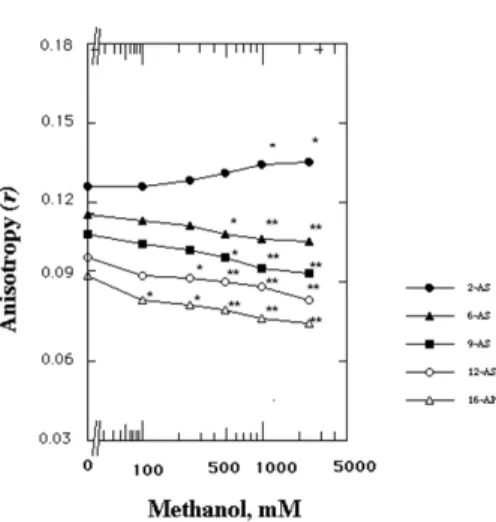
Fig. 5. Effects of methanol on the anisotropy (r) of 16-(9-anthroyloxy) palmitic acid (16-AP), 12-(9-anthroyloxy)stearic acid (12-AS), 9-(9- anthroyloxy)stearic acid (9-AS), 6-(9-anthroyloxy)stearic acid (6-AS) and 2-(9-anthroyloxy)stearic acid (2-AS) in SPMVs. Fluorescence measurements were performed at 37oC (pH 7.4). Each point repre- sents the mean±SEM of 5 sample determinations. The asterisk and double asterisk denote p<0.05 and p<0.01, respectively, compared to the control according to a Student’s t-test.
there was no statistically significant decrease in the aniso- tropy (the rotational mobility range) of the inner monolayer at any of the methanol concentrations used. The aniso- tropies (ro) of DPH in the outer monolayer of the SPMVs were 0.186±0.005 and 0.220±0.002 at 37 and 25oC, respec- tively. Thus, the difference in anisotropy (ro) of DPH in the SPMVs outer monolayer before and after adding 1,000 mM methanol was as large as that produced by a 3.3oC temper- ature change. This suggests that the fluidizing effect (range of rotational mobility) of methanol is selective.
Methanol thus affects the lateral and rotational mobi- lities of SPMVs mainly via an effect on the outer monolayer of the SPMVs. It appears to be the first demonstration that methanol has a differential effect on the transbilayer later- al and rotational mobilities of the inner and outer mono- layers of neuronal membranes.
Ordering effects of methanol on the rotational mobility of the SPMVs outer monolayer membrane interface The effect of the methanol on the anisotropy (r) of the 2-AS in the interface of SPMVs is shown in Fig. 5. The methanol increased the anisotropy (r) of the 2-AS (decrea- sed rotational mobility) in interface of SPMVs in a concen- tration-dependent manner. The significant increases in the anisotropy (r) values by methanol was observed at 1,000 and 2,500 mM (Fig. 5).
The anisotropy (r) value of the 2-AS in interface of SPMVs was higher by 0.009, than those in the same region when 2,500 mm methanol was added. Variation in the anisotropy (r) value was also noticed by the change in temperature.
At 37oC (pH 7.4), the anisotropy (r) of the 2-AS in interface of SPMVs is 0.126±0.002 (n=5). On the other hand, at 25oC (pH 7.4), the anisotropy (r) of the 2-AS in interface of SPMVs is 0.165±0.003 (n=5). Based on the results obtained at the two different temperatures, the observed effects by the ad-
dition of 2,500 mm methanol, different values 0.009 was comparable to the effect of the temperature change by ap- proximately 2.8oC.
Disordering effects of methanol on the rotational mobility of the hydration interior of the SPMVs outer monolayers
The effect of increasing concentrations of the methanol on the anisotropy (r) of the 16-AP, 12-AS, 9-AS and 6-AS in the hydrocarbon interior of SPMVs are shown in Fig.
5. The methanol decreased the anisotropy (r) of the 16-AP, 12-AS, 9-AS and 6-AS (increased rotational mobility) in a concentration-dependent manner. The significant decreases in the anisotropy (r) values of the 16-AP, 12-AS, 9-AS and 6-AS by the methanol in the SPMVs were observed even at such low concentrations as 100, 250, 500 and 500 mM, respectively (Fig. 5). The magnitude of the increased rota- tional mobility by the methanol was in the order at the position of 16, 12, 9 and 6 of aliphatic chains in phospholi- pids of neuronal membrane outer monolayers.
The differences in the anisotropy (r) values of the 16-AP found in hydrocarbon interior of SPMVs before and after adding 1,000 mM methanol were 0.016. These can be illus- trated by comparing effects of temperature on this para- meter. The anisotropy (r) of the 16-AP in hydrocarbon in- terior of SPMVs is 0.092±0.002 (n=5) at 37oC (pH 7.4). The anisotropy (r) of the 16-AP in hydrocarbon interior of SPMVs is 0.121±0.003 (n=5) at 25oC (pH 7.4). Thus, the differences in the anisotropy (r) values at the position of 16 in hydrocarbon interior of SPMVs before and after add- ing 1,000 mM methanol were 0.016, which were as large as those produced by the temperature raises of approximate 6.4oC respectively.
Table 1. Structural parameters of intact SPMVs Membrane I’/I* Anisotropy
(r)**
Annular lipid fluidity
Protein
clustering 16-AP 12-AS 9-AS 6-AS 2-AS
Inner+Outer Inner Outer
0.412±0.005 0.379±0.003 0.445±0.006
0.202±0.003 0.220±0.003 0.186±0.005
0.156±0.006 - -
0.295±0.009 0.092±0.002 - -
0.099±0.002 - -
0.108±0.001 - -
0.115±0.002 - -
0.126±0.002 - - Values from untreated membranes represent inner+outer monolayer; Values from TNBS treated membranes represent the inner monolayer; Values for the outer monolayer were calculated as described in Materials and Methods. Values are represented as the mean±SEM of 5 determinations.
*SPMVs were treated ±4 mM TNBS, pH 8.5, at 4oC for 80 min (I’/I). Py-3-Py was incorporated and fluorescence measurements were performed at 37oC (pH 7.4). **SPMVs were treated ±2 mM TNBS, pH 8.5, at 4oC for 40 min (anisotropy). DPH was incorporated and fluorescence measurements were performed at 37oC (pH 7.4).
DISCUSSION
The effect of methanol on the rate and range of lateral mobility of bulk bilayer SPMVs
Py-3-Py, a pyrene derivative which has successfully been used to quantitate lateral mobility within native membrane [24-26,32,33], was used to determine the rate and range of the lateral mobility in the SPMVs. The excimer fluo- rescence technique of Py-3-Py has an advantage over its counterpart based on intermolecular excimerization since very small probe concentrations can be used (<10-7 M), and the perturbation of the SPMVs by the probe molecule is minimized.
Our lab. researchers have reported that the I’/I values in CHO-K1-PMVs [24], the ATCC-PMVs [25], the Sp2/0- PMVs [26] and SPMVs [10] were 0.529±0.016, 0.586±0.007, 0.608±0.008 and 0.412±0.005, respectively (at 37oC, pH 7.4).
It was not evident why these values differed, as the lipid composition of the different preparations and the fatty acid composition of the individual phospholipids, particularly cholesterol content, were not examined. In the CHO-K1- PMVs, ATCC-PMVs, Sp2/0-PMVs and SPMVs, ethanol in- creased the lateral diffusion of Py-3-Py in a concentration- dependent manner, and significant increases in I’/I values were observed at above 50, 25, 25 and 25 mM ethanol, respectively.
The effect of methanol on the range and rate of trans- bilayer asymmetric lateral mobility of SPMVs mono- layers
The covalently linked trinitrophenyl group has a broad absorbance range with a maximum near 420 nm. This peak has a large overlap with the fluorescence emission of Py-3-Py. This overlap is responsible in part for the high transfer (quenching) efficiency of the probe. Approximately half of the Py-3-Py fluorescence was quenched in the trini- trophenylated SPMVs. When the TNBS labeling was con- ducted under penetrating conditions (37oC), nearly 95% of the fluorescence of the Py-3-Py was quenched. Values of excimer to monomer fluorescence intensity ratio (I’/I) of Py-3-Py in intact SPMVs (both monolayers) and TNBS- treated SPMVs (inner monolayer) are listed in Table 1. The I’/I of Py-3-Py in the outer monolayer were 0.066, greater than calculated for the inner monolayer. This means that the rate and range of lateral mobility of the outer mono- layer is greater than that of the inner monolayer.
The TNBS labeling reaction must be carefully monitored in order to ensure that the reagent does not penetrate into the synaptosomes and label both sides of the plasma membrane. For this purpose, three control procedures are routinely used. First, as an “internal control”, mitochondria and microsomes are isolated from the synaptosomes from which the trinitrophenylated plasma membranes are isola- ted. If any significant degree of penetration of TNBS into the synaptosome occurs, these intracellular organelles also become trinitrophenylated. Only 1.8±0.2% and 2.1±0.4% of microsomal and mitochondrial phosphatidylethanolamine were trinitrophenylated by our treatment. In contrast, when the TNBS treatment is performed under penetrating conditions (37oC), 60∼80% of the phosphatidylethanol- amine in microsomes or mitochondria is trinitrophenylated [22]. Second, approximately half of the Py-3-Py fluorescence was quenched in the trinitrophenylated SPMVs. Third, the trinitrophenylation of the synaptosome may alter mem- brane enzyme activities. Unlike the results obtained under penetrating conditions (37oC), the activity of neither Na+, K+-ATPase nor 5’-nucleotidase was significantly altered by the TNBS reaction under nonpenetrating conditions [22].
It is important to note that the term “membrane fluidity”
is often misused. It arose from a combination of spectro- scopic studies, the realization that membranes can be re- garded as a two dimensional fluids, and the desire to obtain a simple single physical parameter that would describe their properties. The difficulty with the membrane fluidity concept is that any physical parameter chosen will be a function of the spectroscopic method employed, specifically its particular time window, and the properties of the probe (shape, charge, location etc) [34]. The membrane fluidity concept also depends on the assumption that the hydro- phobic region of cell membranes is structurally and dynam- ically homogeneous, an assumption that is now under seri- ous challenge. Thus while it may be true to say that bulk or average spectroscopic properties of cell membranes may not be useful in building a hypothesis for the pharmaco- logical action(s) of drug(s), local properties pertaining to do- mains or the immediate environment of a membrane pro- tein maybe very relevant.
As already pointed out, membrane bilayer mobility is one of the important factors controlling membrane micro- viscosity or fluidity, membrane bilayer mobility includes lateral mobility, rotational mobility and flip-flop and it is well known that the most important of these is lateral mobility. We are pleased to have been able to develop and describe a fluorescence quenching technique that can meas-
ure membrane transbilayer lateral mobility. We therefore believe that this study will make a contribution to the study of drug-membrane interactions.
The effect of methanol on annular lipid fluidity in SPMVs lipid bilayers
The important finding is that there was a greater in- crease in annular lipid fluidity than lateral and rotational mobilities.
The mechanism of action of the methanol on the annular lipid fluidity may be as follows. Annular lipids are known to surround proteins with or without being physically in contact with them. Methanol may alter the stereo structure or dynamics of annular lipids including proteins by combin- ing with lipids, especially with the annular lipids, increas- ing their mobility and indirectly affecting the dynamic be- havior of the proteins. Nevertheless is likely that the ob- served effects are due not only to the lipids, but are magni- fied by interaction between lipids and proteins.
The effect of methanol on protein distribution in SPMVs
The protein clustering is probably caused by interaction between phospholipids, especially annular lipid fluidity, whose movement is increased by methanol, and the pro- teins around them.
The effect of methanol on the range of transbilayer asymmetric rotational mobility of SPMVs monolayers The structures of the intact SPMVs (inner plus outer monolayers), and the outer (extracellular) and the inner (intracellular) monolayers were evaluated with DPH as a fluorescent reporter and trinitrophenyl groups as a quench- ing agents. Trinitrophenylation of the intact synaptosomes at 4oC (nonpenetrating conditions) results in covalent at- tachment of trinitrophenyl quenching agents to the outer monolayers. Approximately half of the DPH fluorescence was quenched in the trinitrophenylated SPMVs outer monolayer. When TNBS labeling was conducted in pene- trating conditions (37oC), greater than 90% of the fluo- rescence of the DPH was quenched. Values of fluorescence parameters in intact SPMVs (both monolayers) and in TNBS-treated SPMVs (inner monolayer) are listed in Table 1. The anisotropy (r) of DPH in the inner monolayer was 0.034, significantly greater than that calculated for the out- er monolayer, as demonstrated in Table 1.
This is in agreement with the results of previous studies [24,30,31,35-38] but inconsistent with two studies [39,40].
Plasma membranes consist of two monolayers that are asymmetric in lipid distribution, electrical charge, fluidity, protein distribution and function, and does not appear to be coupled [41]. It had been widely known that different lipids could affect the physical properties of the membrane.
Membrane cholesterol is one of the major lipids of plasma membranes and is asymmetrically distributed in the outer and inner monolayers of membranes [35,38,42,43]. Interest in rigidifying effect on membrane above the phase tran- sition temperature of the membrane lipid [38]. In eryth- rocytes, differences in fluidity between the two monolayes have not been consistently observed. Some studies have re- ported that the outer monolayers was less fluid [39,40], whereas other studies have found that the outer monolayer
was more fluid compared with the inner monolayer [36,37].
The finding that the SPMVs inner monolayer was less fluid than the outer monolayer was consistent with data showing that the SPM inner monolayer contains approximately 7-times as much cholesterol compared with the outer mono- layer [38]. Thus, a possible explanation for the asymmetric lateral and rotational mobility in the outer and inner mono- layers of SPMVs is that their cholesterol content differs.
Ordering effects of methanol on the rotational mobility of the SPMVs outer monolayer membrane interface Ethanol in vitro had a greater fluidizing effect in the out- er monolayer as compared to the inner monolayer. Thus, ethanol exhibits a specific rather than nonspecific fluidizing action within transbilayer of synaptic plasma membranes [30], cultured mouse myeloma cell line Sp2/0-Ag14 [26], cul- tured Mar 18.5 hybridoma cells [25] and synaptosomal plas- ma membrane vesicles [10,24]. In this study, methanol in vitro had a greater fluidizing effect in the outer monolayer as compared to the inner monolayer of SPMVs. However, the membrane outer monolayer’s fluidity may vary at dif- ferent positions [44]. Thus, this study was carried out using 16-AP, 12-AS, 9-AS, 6-AS and 2-AS those reflecting mobi- lity at the 16, 12, 9, 6 and 2 position of aliphatic chains present in phospholipids of SPMVs.
Possible mechanisms of action of ethanol
Ethanol’s effects on membranes, whether bulk or indivi- dual domains, have been studied under the assumption that the membrane is in bilayer form. In fact, increasing evidence indicated that membrane lipids can adopt a non- bilayer form [45]. In addition, investigations of the effects of higher alkanols and the corresponding alkane on mem- brane luciferase indicate that the anesthetic targets could be hydrophobic pockets on membrane proteins rather than lipids [13,46-53]. For example, ethanol specifically and se- lectively affects the function of the GABA-coupled chloride channel [54,55]. Still, a large, diverse collection of physio- logical agonists produces the alterations in membrane flu- idity as well as specific ligand-receptor interaction [56].
Hence the function of membrane proteins may be modulated secondarily to changes in membrane fluidity. Conversely, ethanol may have a direct effect on certain receptors, re- ceptor-gated ion channels, or membrane-bound enzymes, and, as result, on membrane lipids. As mentioned above, ethanol (at 50 mM) increased both lateral and rotational mobility of SPMVs lipid bilayer, and the increases were mainly due to effects on the outer monolayer of the SPMVs.
However, ethanol (at 50 mM) increased annular lipid fluid- ity in SPMVs by 37.2% and altered the protein distribution by 15.6%. Furthermore, methanol, like ethanol, increased both lateral (at 500 mM) and rotational (at 1,000 mM) mo- bilities of SPMVs lipid bilayer, and the increases were mainly due to effects on the outer monolayer of the SPMVs.
And we confirmed that the increase on annular lipid fluid- ity and the change on protein distribution induced by meth- anol were far greater than the increase on lateral and rota- tional mobilities of the SPMVs lipid bilayer. Direct effects of ethanol on protein appear to have magnified such effects on the lipids. This conclusion can be drawn because Bae et al. [10] confirmed that the increase on annular lipid flu- idity and the change on protein distribution induced by ethanol were far greater than the increase on lateral and
rotational mobility of the SPMVs lipid bilayer.
It is difficult to exclude the possibility that the inter- action of ethanol with neuronal membrane lipids has some influence on the ion channels or receptors that associate tightly with membrane lipids through covalent and non- covalent bonds. That is to say, before, during or even after the interaction of ethanol with the proteins [13,49-51,54,55], the fluidization of membrane lipids may provide an ideal microenvironment for optimum anesthetic effects.
In conclusion, the present data suggest that methanol or ethanol, in addition to its direct interaction with proteins [13,49-51,54,55], concurrently interacts with membrane lip- ids, fluidizing the membrane, and thus inducing conforma- tional changes of proteins known to be intimately asso- ciated with membrane lipids. It may be premature to take sides in the controversy over whether membrane lipids or membrane proteins are the site of ethanol action.
ACKNOWLEDGEMENTS
This work was supported for two years by Pusan National University Research Grant (2011).
REFERENCES
1. Chin JH, Goldstein DB. Effects of low concentrations of ethanol on the fluidity of spin-labeled erythrocyte and brain membranes.
Mol Pharmacol. 1977;13:435-441.
2. Chin JH, Goldstein DB. Drug tolerance in biomembranes: a spin label study of the effects of ethanol. Science. 1977;196:684- 3. Chin JH, Goldstein DB. Membrane-disordering action of 685.
ethanol: variation with membrane cholesterol content and depth of the spin label probe. Mol Pharmacol. 1981;19:425-431.
4. Chin JH, Goldstein DB. Cholesterol blocks the disordering effects of ethanol in biomembranes. Lipids. 1984;19:929-935.
5. Goldstein DB, Chin JH, Lyon RC. Ethanol disordering of spin-labeled mouse brain membranes: correlation with gene- tically determined ethanol sensitivity of mice. Proc Natl Acad Sci USA. 1982;79:4231-4233.
6. Avdulov NA, Wood WG, Harris RA. Effects of ethanol on structural parameters of rat brain membranes: relationship to genetic differences in ethanol sensitivity. Alcohol Clin Exp Res.
1994;18:53-59.
7. Avdulov NA, Chochina SV, Draski LJ, Deitrich RA, Wood WG.
Chronic ethanol consumption alters effects of ethanol in vitro on brain membrane structure of high alcohol sensitivity and low alcohol sensitivity rats. Alcohol Clin Exp Res. 1995;19:886- 8. Jang HO, Jeong DK, Ahn SH, Yoon CD, Jeong SC, Jin SD, 891.
Yun I. Effects of chlorpromazine HCl on the structural parameters of bovine brain membranes. J Biochem Mol Biol.
2004;37:603-611.
9. Jang HO, Shin HG, Yun I. Effects of dimyristoylphosphatidyle- thanol on the structural parameters of neuronal membrane.
Mol Cells. 2004;17;485-491.
10. Bae MK, Jeong DK, Park NS, Lee CH, Cho BH, Jang HO, Yun I. The effect of ethanol on the physical properties of neuronal membranes. Mol Cells. 2005;19:356-364.
11. Franks NP, Lieb WR. Molecular mechanisms of general anaesthesia. Nature. 1982;300:487-493.
12. Franks NP, Lieb WR. Do general anaesthetics act by compe- titive binding to specific receptors? Nature. 1984;310:599-601.
13. Franks NP, Lieb WR. Mapping of general anaesthetic target sites provides a molecular basis for cutoff effects. Nature.
1985;316:349-351.
14. Armbrecht HJ, Wood WG, Wise RW, Walsh JB, Thomas BN,
Strong R. Ethanol-induced disordering of membranes from different age groups of C57BL/6NNIA mice. J Pharmacol Exp Ther. 1983;226:387-391.
15. Goldstein DB. The effects of drugs on membrane fluidity. Annu Rev Pharmacol Toxicol. 1984;24:43-64.
16. Villalaína J, Prietob M. Location and interaction of N-(9-anthroy- loxy)-stearicacid probes in corporated in phosphatidylcholine vesicles. Chem Phys Lipids. 1991;59:9-16.
17. Mason JT. Properties of phosphatidylcholine bilayers as revealed by mixed-acyl phospholipid fluorescent probes containing n-(9- anthroyloxy) fatty acids. Biochim Biophys Acta. 1994;1194:99- 18. Thulborn KR, Sawyer WH. Properties and the locations of a 108.
set of fluorescent probes sensitive to the fluidity gradient of the lipid bilayer. Biochim Biophys Acta. 1978;511:125-140.
19. Tilley L, Thulborn KR, Sawyer WH. An assessment of the fluidity gradient of the lipid bilayer as determined by a set of n-(9-anthroyloxy) fatty acids (n=2, 6, 9, 12, 16). J Biol Chem.
1979;254:2592-2594.
20. Molitoris BA, Hoilien C. Static and dynamic components of renal cortical brush border and basolateral membrane fluidity:
role of cholesterol. J Membr Biol. 1987;99:165-172.
21. Yun I, Cho ES, Jang HO, Kim UK, Choi CH, Chung IK, Kim IS, Wood WG. Amphiphilic effects of local anesthetics on rotational mobility in neuronal and model membranes. Biochim Biophys Acta. 2002;1564:123-132.
22. Yun I, Kang JS. The general lipid composition and aminophos- pholipid asymmetry of synaptosomal plasma membrane vesicles isolated from bovine cerebral cortex. Mol Cells. 1990;1;15-20.
23. Yun I, Kim YS, Yu SH, Chung IK, Kim IS, Baik SW, Cho GJ, Chung YZ, Kim SH, Kang JS. Comparison of several procedures for the preparation of synaptosomal plasma membrane vesicles.
Arch Pharm Res. 1990;13;325-329.
24. Yun I, Yang MS, Kim IS, Kang JS. Bulk vs. transbilayer effects of ethanol on the fluidity of the plasma membrane vesicles of cultured Chinese hamster ovary cells. Asia Pacific J Pharmacol.
1993;8;9-16.
25. Yun I, Lee SH, Kang JS. The effect of ethanol on lateral and rotational mobility of plasma membrane vesicles isolated from cultured Mar 18.5 hybridoma cells. J Membr Biol. 1994;138:
221-227.
26. Kang JS, Choi CM, Yun I. Effects of ethanol on lateral and rotational mobility of plasma membrane vesicles isolated from cultured mouse myeloma cell line Sp2/0-Ag14. Biochim Biophys Acta. 1996;1281:157-163.
27. Lowry OH, Rosebrough NR, Farr AL, Randall RJ. Protein measurement with the Folin phenol reagent. J Biol Chem.
1951;193:265-275.
28. Dobretsov GE, Spirin MM, Chekrygin OV, Karmansky IM, Dmitriev VM, Vladimirov YuA. A fluorescence study of apolipoprotein localization in relation to lipids in serum low density lipoproteins. Biochim Biophys Acta. 1982;710:172-180.
29. Sweet WD, Wood WG, Schroeder F. Charged anesthetics selectively alter plasma membrane order. Biochemistry. 1987;
26:2828-2835.
30. Schroeder F, Morrison WJ, Gorka C, Wood WG. Transbilayer effects of ethanol on fluidity of brain membrane leaflets.
Biochim Biophys Acta. 1988;946:85-94.
31. Wood WG, Gorka C, Schroeder F. Acute and chronic effects of ethanol on transbilayer membrane domains. J Neurochem.
1989;52:1925-1930.
32. Zachariasse KA, Vaz WL, Sotomayor C, Kühnle W. Investiga- tion of human erythrocyte ghost membranes with intramole- cular excimer probes. Biochim Biophys Acta. 1982;688:323-332.
33. Schachter D. Fluidity and function of hepatocyte plasma membranes. Hepatology. 1984;4:140-151.
34. Stubbs CD, Williams BW. Fluorescence in membranes: Fluore- scence Spectroscopy in Biochemistry. Vol 3. New York: Plenum Press; 1992. 231-263 p.
35. Brasaemle DL, Robertson AD, Attie AD. Transbilayer move- ment of cholesterol in the human erythrocyte membrane. J Lipid Res. 1988;29:481-489.
36. Cogan U, Schachter D. Asymmetry of lipid dynamics in human erythrocyte membranes studied with impermeant fluorophores.
Biochemistry. 1981;20:6396-6403.
37. Schachter D, Abbott RE, Cogan U, Flamm M. Lipid fluidity of the individual hemileaflets of human erythrocyte mem- branes. Ann N Y Acad Sci. 1983;414:19-28.
38. Wood WG, Schroeder F, Hogy L, Rao AM, Nemecz G. Asym- metric distribution of a fluorescent sterol in synaptic plasma membranes: effects of chronic ethanol consumption. Biochim Biophys Acta. 1990;1025:243-246.
39. Chabanel A, Abbott RE, Chien S, Schachter D. Effects of benzyl alcohol on erythrocyte shape, membrane hemileaflet fluidity and membrane viscoelasticity. Biochim Biophys Acta. 1985;816:
142-152.
40. Seigneuret M, Zachowski A, Hermann A, Devaux PF.
Asymmetric lipid fluidity in human erythrocyte membrane:
new spin-label evidence. Biochemistry. 1984;23:4271-4275.
41. Curtain CC, Gordon LM, Aloia RC. The role of cholesterol in regulating membrane fluidity: Advances in Membrane Fluidity.
Vol 2. New York: Alan R Liss; 1988. 1-15 p.
42. Kier AB, Sweet WD, Cowlen MS, Schroeder F. Regulation of transbilayer distribution of a fluorescent sterol in tumor cell plasma membranes. Biochim Biophys Acta. 1986;861:287-301.
43. Schroeder F, Nemecz G, Wood WG, Joiner C, Morrot G, Ayraut-Jarrier M, Devaux PF. Transmembrane distribution of sterol in the human erythrocyte. Biochim Biophys Acta. 1991;
1066:183-192.
44. Lee YH, Park NS, Kwon JD, Park JS, Shin GB, Lee CS, Jung TS, Choi NJ, Yoon JH, Ok JS, Yoon UC, Bae MK, Jang HO, Yun I. Amphiphilic effects of dibucaine HCl on rotational mobility of n-(9-anthroyloxy)stearic acid in neuronal and model membranes. Chem Phys Lipids. 2007;146:33-42.
45. Janoff AS, Boni LT, Rauch J. Phase-defined domain in biological membranes: Advances in Membrane Fluidity. Vol 2.
New York: Alan R Liss; 1988. 101-109 p.
46. Curry S, Lieb WR, Franks NP. Effects of general anesthetics
on the bacterial luciferase enzyme from Vibrio harveyi: an anesthetic target site with differential sensitivity. Biochemistry.
1990;29:4641-4652.
47. Dickinson R, Smith EH, Franks NP, Lieb WR. Synthesis and use of the n-bromododecane-1,12-diols as conformational probes for general anesthetic target sites. J Med Chem. 1993;36:
111-118.
48. Dickinson R, Franks NP, Lieb WR. Thermodynamics of anesthetic/protein interactions. Temperature studies on firefly luciferase. Biophys J. 1993;64:1264-1271.
49. Franks NP, Lieb WR. Neuron membranes: anaesthetics on the mind. Nature. 1987;328:113-114.
50. Franks NP, Lieb WR. Do general anaesthetics act by competi- tive binding to specific receptors? Nature. 1984;310:599-601.
51. Franks NP, Lieb WR. Molecular and cellular mechanisms of general anaesthesia. Nature. 1994;367:607-614.
52. Moss GW, Franks NP, Lieb WR. Modulation of the general anesthetic sensitivity of a protein: a transition between two forms of firefly luciferase. Proc Natl Acad Sci USA. 1991;88:
134-138.
53. Moss GW, Lieb WR, Franks NP. Anesthetic inhibition of firefly luciferase, a protein model for general anesthesia, does not exhibit pressure reversal. Biophys J. 1991;60:1309-1314.
54. Gonzales RA, Hoffman PL. Receptor-gated ion channels may be selective CNS targets for ethanol. Trends Pharmacol Sci.
1991;12:1-3.
55. Sanna E, Concas A, Serra M, Santoro G, Biggio G. Ex vivo binding of t-[35S )butylbicyclophosphorothionate: a biochemical tool to study the pharmacology of ethanol at the gamma- aminobutyric acid-coupled chloride channel. J Pharmacol Exp Ther. 1991;256:922-928.
56. Manevich EM, Köiv A, Järv J, Molotkovsky JG, Bergelson LD.
Binding of specific ligands to muscarinic receptors alters the fluidity of membrane fragments from rat brain. A fluorescence polarization study with lipid-specific probes. FEBS Lett. 1988;
236:43-46.