http://e-nrp.org
Antioxidative and antiproliferative activities of ethanol extracts from pigmented giant embryo rice (Oryza sativa L. cv. Keunnunjami) before and after germination
Soo Im Chung
1, Sang Chul Lee
2, Seong Joon Yi
3and Mi Young Kang
1§1Department of Food Science and Nutrition, Brain Korea 21 Plus, Kyungpook National University, 80 Daehakro, Bukgu, Daegu 41566, Korea
2School of Applied Biosciences, Kyungpook National University, Daegu 41566, Korea
3College of Veterinary Medicine, Kyungpook National University, Daegu 41566, Korea
BACKGROUND/OBJECTIVES Oxidative stress is a major cause of cancer. This study investigated the effects of the ethanol extracts from germinated and non-germinated Keunnunjami rice, a blackish-purple pigmented cultivar with giant embryo, on selected human cancer cell lines and on the antioxidant defense system of mice fed with a high-fat diet.
MATERIALS/METHODS: High fat-fed mice were orally administered with either distilled water (HF) or extracts (0.25%, w/w) from brown (B), germinated brown (GB), Keunnunjami (K), and germinated Keunnunjami (GK) rice.
RESULTS: In comparison with the brown rice extract, Keunnunjami extract showed higher anticancer effect against cervical and gastric cell lines but lower anticancer activity on liver and colon cancer cells. Mice from the HF group showed significantly higher lipid peroxidation and lower antioxidant enzyme activities than the control group. However, the oxidative stress induced by high-fat diet markedly decreased in B, GB, K, and GK groups as compared with the HF group.
CONCLUSIONS: Germination may be an effective method for improving the anticancer and antioxidative properties of Keunnunjami rice and extracts from germinated Keunnunjami rice may serve as a therapeutic agent against cervical and gastric cancers and oxidative damage.
Nutrition Research and Practice 2018;12(5):365-370; https://doi.org/10.4162/nrp.2018.12.5.365; pISSN 1976-1457 eISSN 2005-6168
Keywords: Rice, germination, cancer, antioxidant, nutritional and metabolic diseases
INTRODUCTION
1)Keunnunjami rice is a new blackish-purple pigmented cultivar with a giant embryo that was developed in Korea through conventional breeding. This pigmented rice was reported to contains high levels of antioxidant compounds and exhibit strong anti-obesity, hypolipidemic, and antioxidant properties [1-3]. Pigmented rice varieties, particularly those with dark- colored pericarps such as black and purple rice, are known for their health-promoting effects and functional activities, owing to the high contents of flavonoids, phenolic compounds, and anthocyanins [4,5]. Rice varieties with enlarged or giant embryos are similarly rich in bioactive compounds and nutrients such as γ-aminobutyric acid (GABA), γ-oryzanol, and tocopherol, which have various physiological properties, such as anticancer, anti-tumor, and antioxidative activities [6-8].
Germination is an effective and inexpensive process for enhancing the nutrient content and eating quality of brown
rice [9]. Whole rice grains are soaked for a few days until the emerged radicle is approximately 2 to 5 mm [10]. This process induces biochemical changes like enzyme activation and release of free and bound materials, resulting in the softening of texture and increase in bioactive compounds and nutrient bioavailability [11,12]. Several studies have shown that germination signifi- cantly increased the amounts of GABA, γ-oryzanol, and tocols in brown rice [10,13]. Other cereal grains, such as barley, wheat, and oat, also exhibited enhanced levels of nutrients and bioactive compounds after germination [14,15]. The previous study reported that germinated rice could reduce the risk of various chronic diseases such as hyperlipidemia, cardiovascular disease, cancer, and diabetes [16].
Keunnunjami is a unique verity of rice that was bred to possess both a dark purple-colored seed pericarp and a giant embryo. It is expected to have better biofunctional properties than other pigmented varieties or non-pigmented rice with giant embryo. Our recent reports have demonstrated that
This work was carried out with the support of Basic Science Research Program through the National Research Foundation of Korea funded by the Ministry of Education (NRF-2017R1D1A1A09000790) and Cooperative Research Program for Agriculture Science and Technology Development (Project No. PJ013140), Rural Development Administration, Republic of Korea.
§Corresponding Author: Mi Young Kang, Tel. 82-53-950-6235, Fax. 82-53-9506229, Email. [email protected] Received: March 29, 2018, Revised: May 22, 2018, Accepted: July 25, 2018
This is an Open Access article distributed under the terms of the Creative Commons Attribution Non-Commercial License (http://creativecommons.org/licenses/by-nc/3.0/) which permits unrestricted non-commercial use, distribution, and reproduction in any medium, provided the original work is properly cited.
Bioactive compound (mg/100 g extract)
Brown rice Keunnunjami rice
Non-germinated Germinated Non-germinated Germinated
GABA 23.28 ± 2.65a 814.36 ± 9.87c 95.59 ± 3.87b 1,198.26 ± 10.55d
Tocopherol (α, β, γ) 0.02 ± 0.00a 0.07 ± 0.01c 0.06 ± 0.00b 0.16 ± 0.01d
Phytic acid 1.09 ± 0.02a 3.27 ± 0.04c 1.69 ± 0.01b 6.67 ± 0.05d
Polyphenol 2.49 ± 0.02a 6.04 ± 1.29b 11.58 ± 1.01c 18.44 ± 1.29d
Values are means ± SE (n = 3).
a-dMeans in the same row with different letters are significantly different at P< 0.05, as analyzed by Tukey’s range test.
GABA, γ-aminobutyric acid
Table 1. Bioactive compounds in germinated and non-germinated rice extracts
Keunnunjami showed greater antioxidant capacity than non- pigmented giant embryo rice [17]. Furthermore, dietary feeding of germinated Keunnunjami rice powder has been found to ameliorate the lipid metabolism in ovariectomized rats [18]. To further explore the functional properties of Keunnunjami and the influence of germination on its biological activities, the present study carried out the antiproliferative and antioxidative effects of ethanolic extracts from germinated and non-germinated Keunnunjami rice, in comparison to those from non-germinated and germinated ordinary normal embryo brown rice.
MATERIALS AND METHODS
Germination and rice extract preparation
Whole grains of Keunnunjami rice, a dark purple-pigmented cultivar with a giant embryo, and Ilpum rice, an ordinary non-pigmented cultivar, were used. The two rice varieties were of the same species and subspecies and obtained after harvest in October 2016 from the Department of Agricultural Science (Korea National Open University, Seoul, Korea). To rice germinate, The 50 g of gains set a stainless container overlaid with sterilized gauze after washing by distilled water and incubated 3 days at 30°C in an oven. The container was added with 100 mL distilled water and cover surface with plastic wrap with holes prior to incubation. The grains were checked regularly at 12 h interval to make sure there was no unpleasant odor and fungal growth. After 72 h, the germinated grains were dried at 50°C for 2 h, ground using a grinding machine (OCM- D1000PB, OCOO, Chungnam, Korea), passed through a 100 mesh sieve, and extracted with 70% ethanol (1:3 solid/solvent ratio) at 40°C with constant stirring for 2 h. The mixture was then filtered and the rice powder was extracted again with 70%
ethanol (1:1 solid/solvent ratio) at 40°C with constant stirring.
The process was repeated and the combined extracts were concentrated using a rotary evaporator (Eyela N-1000, Tokyo, Japan) to completely remove the ethanol, obtaining an extract yield of 5% (w/w). For the non-germinated rice extract samples, the rice grains (50 g) were washed, dried, ground, and extracted using the same method described above for the germinated grains. The concentrated extracts of the germinated and non-germinated rice samples were freeze-dried. The levels of bioactive components such as GABA, tocopherol, phytic acid, and polyphenol were determined using previously described methods [19-22] and the results are shown in Table 1. All chemicals used in this study were of analytical grade and purchased from Merck KGaA (Darmstadt, Germany) and Sigma- Aldrich, Inc. (Steinheim, Germany).
Cell culture and cell viability
The cancer cell lines AGS, HeLa, HEP3B, and HT-29 were obtained from the Korea Cell Line Bank, Seoul, Korea. The AGS and HT-29 cells were cultured in Roswell Park Memorial Institute (RPMI)-1640 (Hyclone Laboratories, Utah, USA) supplemented with 10% fetal bovine serum. HeLa cells were cultured in MEM (Hyclone Laboratories, Inc., Utah, USA) supplemented with 10%
fetal bovine serum, while HEP3B cells were cultured in DMEM (Hyclone Laboratories, Utah, USA) supplemented with 10% fetal bovine serum in a 5% CO
2atmosphere at 37°C. Cell viability was analyzed using an MTT assay kit (Roche Molecular Bioche- micals, Mannheim, Germany) according to the manufacturer’s instruction. Briefly, the treated cells were incubated with the MTT reagent for 4h and lysed with a lysis buffer. The absorbance was measured from 550 nm to 650 nm after an overnight incubation. The 50% inhibitory concentrations (IC50s) were calculated from four concentrations of the extracts (100, 250, 500, 750 μg/mL).
Animals and diets
Four-week-old male C57BL/6N mice (n = 48, 20 g each) were purchased from Central Laboratory Animal Inc. (Seoul, Korea) and housed individually in hanging stainless steel cages in a room maintained at 25 ± 2°C with 50% relative humidity and 12/12 h light-dark cycle. They were initially fed with a commercial pelletized diet and distilled water ad libitum for 1 wk. Following a 1 wk period, 40 animals were fed with a high-fat diet (45% calories from fat), purchased from Feed Lab (Guri, Gyeonggido, Korea) for 3 wks to induce obesity, while the remaining eight animals were given an AIN93G diet [23]. After 3 wks, the high-fat diet fed mice were divided into 5 dietary groups (n = 8) and orally administered 1 mL of distilled water (HF group) or ethanol extracts in distilled water (0.25%) of the non-germinated normal brown rice (B group), germinated brown rice (GB group), non-germinated Keunnunjami (K group), or germinated Keunnunjami (GK group). The control mice fed with AIN93G diet were orally administered distilled water (C group). For 4 weeks, daily oral gavage was carried out with either the sample rice extracts or distilled water. All mice had free access to water and food during this period. The blood samples gathered from the inferior vena cava (IVC) of anaesthe- tized mice through CO
2inhalation. After samples transferred into ethylenediaminetetraacetic acid (EDTA)-coated tubes and centrifuged at 1,000 x g for 15 min at 4°C to get the plasma.
The heart, liver, kidney, and white adipose tissues (perirenal,
epididymal, and inguinal) were excised, washed with saline
solution, and weighed. The collected samples were stored at
Parameter Animal group
C1) HF HF-B HF-GB HF-K HF-GK
Initial body weight (g) 20.65 ± 0.12ns 20.69 ± 0.16 20.75 ± 0.17 20.63 ± 0.31 20.58 ± 0.10 20.63 ± 0.07
Final body weight (g) 27.73 ± 0.32a 40.58 ± 1.87d 35.11 ± 0.76c 33.00 ± 0.59c 31.28 ± 0.33c 29.21 ± 0.43b Body weight gain (g) 8.12 ± 0.43a 19.57 ± 0.35d 15.43 ± 0.41c 13.81 ± 0.06bc 11.74 ± 0.38bc 9.43 ± 0.51b
Feed intake (g/day) 2.82 ± 0.01a 3.27 ± 0.01b 2.94 ± 0.10a 2.97 ± 0.06a 2.86 ± 0.05a 2.91 ± 0.10a
Feed efficiency ratio 0.09 ± 0.002a 0.18 ± 0.001d 0.17 ± 0.001cd 0.17 ± 0.001bc 0.16 ± 0.001bc 0.12 ± 0.001ab White adipose tissue (g) 1.98 ± 0.07a 4.99 ± 0.10e 3.79 ± 0.10d 3.46 ± 0.05c 3.22 ± 0.07c 2.99 ± 0.04b
Epididymal 0.92 ± 0.02a 2.49 ± 0.16e 2.01 ± 0.21d 1.62 ± 0.15c 1.58 ± 0.14c 1.26 ± 0.09b
Perirenal 0.53 ± 0.03a 1.28 ± 0.09d 1.01 ± 0.08c 0.89 ± 0.03b 0.84 ± 0.02b 0.57 ± 0.02a
Inguinal 0.49 ± 0.01a 1.15 ± 0.04c 0.99 ± 0.02b 0.94 ± 0.03b 0.92 ± 0.02b 0.72 ± 0.02a
Liver (g) 1.24 ± 0.01a 1.50 ± 0.01d 1.42 ± 0.01c 1.36 ± 0.01bc 1.35 ± 0.01bc 1.32 ± 0.03b
Heart (g) 0.15 ± 0.01a 0.17 ± 0.01a 0.16 ± 0.01a 0.15 ± 0.02a 0.15 ± 0.02a 0.14 ± 0.01a
Kidney (g) 0.35 ± 0.01a 0.42 ± 0.02c 0.38 ± 0.01b 0.38 ± 0.01b 0.38 ± 0.01b 0.36 ± 0.01a
Values are means ± SE (n = 8); NS, not significantly different
a-dMeans in the same row with different letters are significantly different at P< 0.05, as analyzed by Tukey’s range test.
1)C, AIN93G diet; HF, high-fat diet; B, HF + normal brown rice extract; GB, HF + germinated normal brown rice extract; K, HF + Keunnunjami rice extract; GK, HF + germinated Keunnunjami rice extract
Table 3. Body weight gain and weights of adipose tissue and organs in high fat-fed mice orally administered with germinated and non-germinated rice extracts
Cancer cell Brown rice extract (μg/mL) Keunnunjami rice extract (μg/mL)
Non-germinated Germinated Non-germinated Germinated
HeLa1) 486.59 ± 2.68d 387.36 ± 4.68c 343.93 ± 2.87b 275.70 ± 8.25a
Hep3B 297.74 ± 5.87a 310.09 ± 7.91a 435.26 ± 4.25c 365.57 ± 6.98b
HT-29 532.31 ± 5.34c 391.92 ± 5.68a 561.39 ± 6.88d 495.43 ± 8.25b
AGS 463.16 ± 1.68d 386.59 ± 2.57c 372.83 ± 6.87b 106.42 ± 5.77a
Values are represented as means ± SE (n = 3).
a-dMeans in the same row with different letters are significantly different at P< 0.05, as analyzed by Tukey’s range test.
1)HeLa, cervical cancer cell; Hep3B, liver cancer cell; HT-29, colon cancer cell; AGS, gastric cancer cell Table 2. IC50 values of the germinated and non-germinated rice extracts in different human cancer cell lines
-70°C before analysis. The study was approved by the Kyungpook National University of the Animal Care Committee.
(Approval No. KNU-2016-0025).
Determination of lipid peroxidation and antioxidant enzyme activity
The amount of thiobarbituric reactive substances (TBARS) in the plasma and erythrocytes was determined following the method of Ohkawa et al. [24]. The activities of hepatic and kidney antioxidant enzymes superoxide dismutase (SOD), glutathione peroxidase (GSH-Px), catalase (CAT), glutathione reductase (GR), and paraoxonase (PON) were determined based on the previous methods described by Chung et al. [17].
Statistical analysis
All data are presented as the mean ± standard error (SE). The data were performed by one-way analysis of variance (ANOVA) using IBM SPSS Statistics 23.0 software. (IBM Corporation, Armonk, NY, USA). Differences between the means were assessed using Tukey’s test. Statistical significance was considered at P
< 0.05.
RESULTS
Antiproliferative activitie
The half maximal inhibitory concentration (IC50) values were the lowest for the Extracts of from the germinated Keunnunjami
rice and highest for the extract from the non-germinated brown rice in HeLa and AGS cancer cells (Table 2). On the other hand, the brown rice extract exhibited significantly lower IC
50value in Hep3B cancer cells than the Keunnunjami extract in both non-germinated and germinated group. The IC
50value for HT29 cancer cell was lowest after treatment with germinated brown rice extract and highest after treatment with non-germinated Keunnunjami extract. In general, germination substantially decreased the IC
50values of both brown rice and Keunnunjami extracts in all the cancer cells analyzed.
Body weight gain
The body weight gain and white adipose tissue weight significantly increased in HF mice compare to that of the control group (Table 3). However, oral administration of the rice extracts markedly decreased the gain in body weight and body fat in the high fat-fed mice, particularly the GK group. The feed intake and feed efficiency ratio were significantly higher in HF mice than the other animal groups. The HF mice also showed higher weights of liver and kidney than the control group. In comparison with HF mice, those fed with rice extracts, especially those from the GK group, showed a considerable decrease in liver and kidney weights.
Lipid peroxidation
The lipid peroxidation significantly increased in HF mice,
manifested by the elevated levels of plasma and erythrocyte
Parameter Animal group
C1) HF HF-B HF-GB HF-K HF-GK
Plasma TBARS (nmol/mL) 5.81 ± 0.32a 9.89 ± 0.19e 8.82 ± 0.06d 7.96 ± 0.05c 8.14 ± 0.02d 7.29 ± 0.09b
Erythrocyte TBARS (nmol/g Hb) 8.27 ± 0.08a 12.54 ± 0.08e 11.42 ± 0.03d 10.93 ± 0.03c 10.84 ± 0.10c 9.32 ± 0.08b Values are means ± SE (n = 8).
a-eMeans in the same row with different letters are significantly different at P< 0.05, as analyzed by Tukey’s Range Test.
1)C, AIN93G diet; HF, high-fat diet; B, HF + normal brown rice extract; GB, HF + germinated normal brown rice extract; K, HF + Keunnunjami rice extract; GK, HF + germinated Keunnunjami rice extract; TBARS, thiobarbituric acid reactive substance
Table 4. Plasma and erythrocyte lipid peroxidation in high fat-fed mice orally administered germinated and non-germinated rice extracts
Enzyme Animal group
C1) HF HF-B HF-GB HF-K HF-GK
Hepatic enzyme activity (nmol/min/mg protein)
SOD2) 2.34 ± 0.05e 0.76 ± 0.02a 1.24 ± 0.02b 1.64 ± 0.02c 1.63 ± 0.01c 1.91 ± 0.04d
GSH-Px 5.30 ± 0.03f 3.52 ± 0.01a 3.93 ± 0.10b 4.22 ± 0.01c 4.34 ± 0.01d 4.89 ± 0.12e
CAT 1.49 ± 0.03e 0.81 ± 0.01a 0.94 ± 0.01b 1.13 ± 0.02c 1.08 ± 0.03c 1.26 ± 0.01d
PON 5.46 ± 0.04f 3.22 ± 0.01a 3.68 ± 0.04b 4.76 ± 0.02c 5.02 ± 0.12d 7.18 ± 0.06e
Nephritic enzyme activity (nmol/min/mg protein)
SOD 1.81 ± 0.01e 1.05 ± 0.02a 1.34 ± 0.05b 1.28 ± 0.03b 1.40 ± 0.05c 1.69 ± 0.06d
GSH-Px 2.46 ± 0.02e 1.06 ± 0.03a 1.33 ± 0.02b 1.74 ± 0.04c 1.68 ± 0.03c 2.07 ± 0.01d
CAT 0.75 ± 0.02e 0.42 ± 0.01a 0.48 ± 0.01b 0.57 ± 0.01c 0.55 ± 0.01c 0.65 ± 0.02d
PON 0.63 ± 0.02d 0.41 ± 0.01a 0.47 ± 0.01b 0.53 ± 0.02c 0.56 ± 0.02c 0.61 ± 0.01d
Values are means ± SE (n = 8).
a-eMeans in the same row with different letters are significantly different at P< 0.05 by Tukey’s Range Test.
1)C, AIN93G diet; HF, high-fat diet; B, HF + normal brown rice extract; GB, HF + germinated normal brown rice extract; K, HF + Keunnunjami rice extract; GK, HF + germinated Keunnunjami rice extract
2)SOD, superoxide dismutase; GSH-Px, glutathione peroxidase; CAT, catalase; PON, paraoxonase
Table 5. Antioxidant enzyme activity in high fat-fed mice orally administered with germinated and non-germinated rice extracts
TBARS, relative to the control group (Table 4). However, addition of the rice extracts in the high-fat diet markedly decreased the TBARS content. Animals that were orally administered with germinated rice extracts showed considerably lower lipid peroxidation than those administered with non-germinated rice group. Between the two germinated rice extract-administered groups, the GK mice exhibited significantly lower TBARS level than the GB group.
Antioxidant enzyme activity
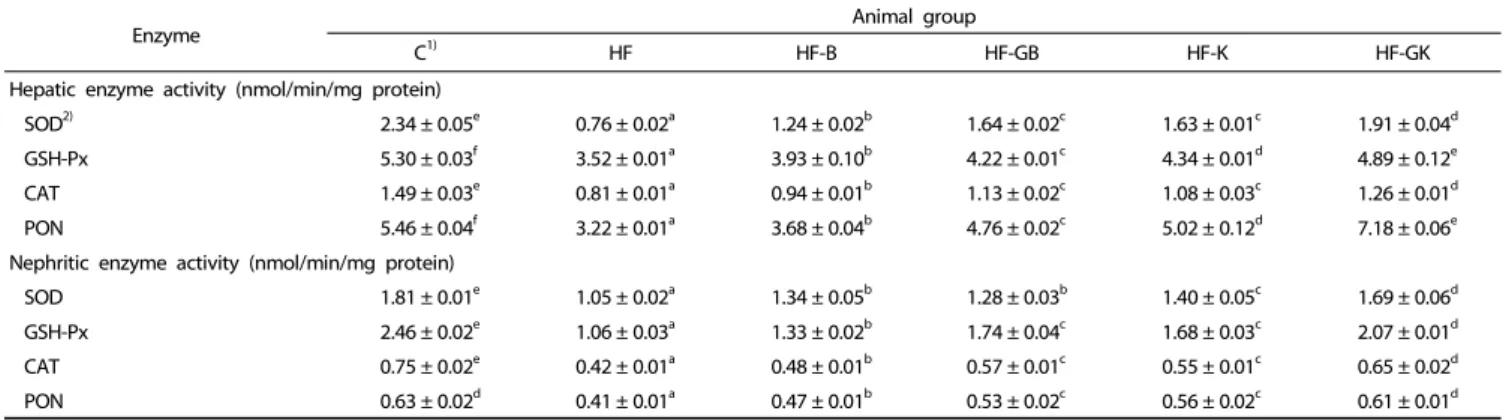
The activities of the hepatic and nephritic enzymes SOD, GSH-Px, CAT, and PON were lowest in HF mice and highest in the control group (Table 5). Compared with the HF group, all rice extract-administered groups showed significantly higher activities of the antioxidant enzymes. Among the groups administered with the rice extracts, the GK mice demonstrated the highest antioxidant enzyme activities, followed by the K and GB groups.
DISCUSSION
Here, we investigated the cytotoxic effects of the ethanolic extracts from germinated and non- germinated Keunnunjami, a pigmented giant embryo rice, and Ilpum, a non-pigmented normal embryo rice, against various cancer cell lines. Mice under high-fat diet regimen were orally administered the ethanolic extracts of these rice varieties to analyze the effects of the extract on the antioxidative defense system of animals. Results showed that germination significantly increased the antiprolife-
rative activities of both the brown rice and Keunnunjami rice extracts. The germinated Keunnunjami extract exhibited greater antiproliferative effect against HeLa cervical cancer and AGS gastric cancer cell lines, as evident from its lower IC
50value, than the germinated brown rice extract. On the other hand, the germinated brown rice extract showed markedly higher anticancer activity against Hep3B liver cancer and HT29 colon cancer cell lines compared to germinated Keunnunjami extract.
Oral administration of the rice extracts considerably decreased the high fat diet-induced body weight gain and TBARS level, an indicator of lipid peroxidation and oxidative stress in laboratory animals. Furthermore, the rice extracts substantially increased the activities of hepatic and nephritic antioxidant enzymes such as SOD, GSH-Px, CAT, and PON in obese mice.
Among the groups fed with rice extracts, the GK group, exhibited the lowest TBARS content and highest antioxidant enzyme activities.
Keunnunjami rice extract contained higher amounts of GABA,
tocopherol, phytic acid, and polyphenol than the ordinary
brown rice extract. Germination further enhanced the levels of
these bioactive compounds, especially GABA, in both rice
samples. This elevation in the bioactive components is probably
due to the breaking down of cell walls that surround various
substances and activation of dormant enzymes during germi-
nation, which then leads to an increase in nutrients and
generation of bioactive compounds in rice grains [11,12,25]. The
GABA, tocopherol, phytic acid, and polyphenol have previously
shown to have antiproliferative effects against different cancer
cell lines such as liver, breast, ovarian, colon, lung, and gastric
cancer cells [26-29]. These bioactive compounds may have been partly responsible for the anticancer activities of the sample rice extracts. Moreover, Keunnunjami rice contains high levels of cyanidin-3-glucoside [1], an anthocyanin compound that have strong anticancer, anti-tumor, and antioxidant properties [30,31]. Past studies have also revealed that extracts from black and red rice have anticancer activities against breast and liver cancer cells due to high amounts of phytochemicals; in particular, an anthocyanin rich extract from black rice suppressed breast tumor (MDA-MB-453) growth [32,33]. Similarly, germinated brown rice extract with enhanced levels of bioactive compounds has reported to inhibit the development and proliferation of cancer cells [7,16]. Kim et al. [34] also accounted that germi- nation for 4 days significantly increased the total polyphenol content and antiproliferative effect of rough rice on stomach and colon cancer cell lines.
Chronic consumption of a high fat diet promotes the formation of free radicals and reactive oxygen species, which then results in lipid peroxidation and oxidative stress [35]. The rice extracts were able to inhibit the high fat diet-induced lipid peroxidation, as evidenced by the lower levels of TBARS in B, GB, K, and GK groups relative to that of the HF mice. Moreover, the activities of the antioxidant enzymes were significantly higher in rice extract-administered groups compared to that of the HF mice. The antioxidant enzymes protect the cells from oxidative damage by catalyzing free radical-quenching reactions.
For instance, superoxide radicals are converted by SOD enzyme into hydrogen peroxides, which are then degraded into non-toxic substances by GSH-Px and CAT enzymes [36]. The enzyme PON, on the other hand, hydrolyzes oxidized phosp- holipids and destroys lipid hydroperoxides [37]. This increase in the antioxidant enzyme activities and reduction in TBARS content suggest a significant improvement in the antioxidant defense system in mice orally administered with the rice extracts, making them less susceptible to oxidative damage caused by the high fat diet. The Keunnunjami rice extract showed greater antioxidative effect in mice than the ordinary brown rice. A previous study on Keunnunjami rice also showed that it has greater antioxidant capacity and higher phenolic and flavonoid contents than non-pigmented giant embryo brown rice [3]. Germination further enhanced the antioxidative property of both brown rice and Keunnunjami extracts which could be attributed to the increased amount of antioxidant compounds in the germinated grains. Dietary feeding of germinated non-pigmented giant embryo rice powder has also been shown to significantly lower lipid peroxidation and increase antioxidant enzyme activities in hypercholesterolemic rats, relative to those fed with non-germinated giant embryo rice and ordinary brown rice powders [38]. Also, increased phenolic compounds and anthocyanin contents from germinated rice were involved in the biosynthesis of proteins related to antioxidant activities [39]. Interestingly, the GB and K groups exhibited generally similar TBARS levels and antioxidant enzyme activities, suggesting that the non-germinated Keunnunjami extract has comparable antioxidant potential to germinated brown rice. This is probably due to the relatively high levels of polyphenol in Keunnunjami rice even in non-germinated form. Polyphenols are powerful antioxidant compounds that
modulate oxidative stress through control of antioxidant enzymes [40,41]. In conclusion, ethanol extracts from Keunnunjami, a pigmented rice with giant embryo, have greater anticancer effect on cervical and gastric cancer cell lines compared to those from ordinary brown rice. On the other hand, the brown rice extract showed higher antiproliferative activity against liver and colon cancer cell lines than the Keunnunjami extract. Oral administration of the rice extracts in high fat-fed mice markedly decreased the lipid peroxidation and increased the activities of antioxidant enzymes. Germination for 72 h further enhanced these antiproliferative and antioxidative effects of both rice samples that may have been probably because of increased bioactive compounds. The germinated Keunnunjami extract exhibited greater antioxidative potential than the germinated brown rice extract. The results demonstrate that germination could be an effective method in enhancing the antiproliferative and antioxidant properties of Keunnunjami rice and that extracts from germinated Keunnunjami may potentially be useful as a natural therapeutic agent against cervical and gastric cancers and high fat diet-induced oxidative damage.
CONFLICT OF INTEREST
The authors declare no potential conflicts of interest.
ORCID
Soo Im Chung: https://orcid.org/0000-0002-1452-7191 Sang Chul Lee: https://orcid.org/0000-0003-2465-6533 Seong Joon Yi: https://orcid.org/0000-0003-1238-2168 Mi Young Kang: https://orcid.org/0000-0002-9053-8650
REFERENCES
1. Han SJ, Kwon SW, Chu SH, Ryu SN. A new rice variety ‘Keunnunjami’, with high concentrations of cyanidin 3-glucoside and giant embryo.
Korean J Breed Sci 2012;44:185-9.
2. Chung SI, Rico CW, Lee SC, Kang MY. Hypolipidemic and body fat-lowering effects of giant embryo brown rice (Seonong 17 and Keunnunjami) in high-fat-fed mice. Cereal Chem 2014;91:18-22.
3. Chung SI, Lo LM, Nam SJ, Jin X, Kang MY. Antioxidant capacity of giant embryo rice Seonong 17 and Keunnunjami. J Adv Agric Technol 2016;3:94-8.
4. Laokuldilok T, Shoemaker CF, Jongkaewwattana S, Tulyathan V.
Antioxidants and antioxidant activity of several pigmented rice brans. J Agric Food Chem 2011;59:193-9.
5. Min B, McClung AM, Chen MH. Phytochemicals and antioxidant capacities in rice brans of different color. J Food Sci 2011;76:
C117-26.
6. Goufo P, Trindade H. Rice antioxidants: phenolic acids, flavonoids, anthocyanins, proanthocyanidins, tocopherols, tocotrienols, γ -oryzanol, and phytic acid. Food Sci Nutr 2014;2:75-104.
7. Oh CH, Oh SH. Effects of germinated brown rice extracts with enhanced levels of GABA on cancer cell proliferation and apoptosis.
J Med Food 2004;7:19-23.
8. Zhang L, Hu P, Tang S, Zhao H, Wu D. Comparative studies on major nutritional components of rice with a giant embryo and a normal embryo. J Food Biochem 2005;29:653-61.
9. Wu F, Yang N, Touré A, Jin Z, Xu X. Germinated brown rice and its role in human health. Crit Rev Food Sci Nutr 2013;53:451-63.
10. Cho DH, Lim ST. Germinated brown rice and its bio-functional compounds. Food Chem 2016;196:259-71.
11. Moongngarm A, Saetung N. Comparison of chemical compositions and bioactive compounds of germinated rough rice and brown rice.
Food Chem 2010;122:782-8.
12. Patil SB, Khan MK. Germinated brown rice as a value added rice product: a review. J Food Sci Technol 2011;48:661-7.
13. Ng LT, Huang SH, Chen YT, Su CH. Changes of tocopherols, tocotrienols, γ-oryzanol, and γ-aminobutyric acid levels in the germinated brown rice of pigmented and nonpigmented cultivars.
J Agric Food Chem 2013;61:12604-11.
14. Hübner F, Arendt EK. Germination of cereal grains as a way to improve the nutritional value: a review. Crit Rev Food Sci Nutr 2013;53:853-61.
15. Nelson K, Stojanovska L, Vasiljevic T, Mathai M. Germinated grains:
a superior whole grain functional food? Can J Physiol Pharmacol 2013;91:429-41.
16. Wu F, Chen H, Yang N, Wang J, Duan X, Jin Z, Xu X. Effect on germination time on physicochemical properties of brown rice flour and starch from different rice cultivars. J Cereal Sci 2013;58:263-71.
17. Chung SI, Rico CW, Kang MY. Comparative study on the hypoglycemic and antioxidative effects of fermented paste (doenjang) prepared from soybean and brown rice mixed with rice bran or red ginseng marc in mice fed with high fat diet. Nutrients 2014;6:4610-24.
18. Lo LM, Kang MY, Yi SJ, Chung SI. Dietary supplementation of germinated pigmented rice (Oryza sativa L.) lowers dyslipidemia risk in ovariectomized Sprague-Dawley rats. Food Nutr Res 2016;60:
30092.
19. Chakuton K, Puangpronpitag D, Nakornriab M. Phytochemical content and antioxidant activity of colored and non-colored Thai rice cultivars. Asian J Plant Sci 2012;11:285-93.
20. Jeng TL, Shih YJ, Ho PT, Lai CC, Lin YW, Wang CS, Sung JM. γ -Oryzanol, tocol and mineral compositions in different grain fractions of giant embryo rice mutants. J Sci Food Agric 2012;92:
1468-74.
21. Konwachara T, Ahromrit A. Effect of cooking on functional properties of germinated black glutinous rice (KKU-URL012).
Songklanakarin J Sci Technol 2014;36:283-90.
22. Velioglu YS, Mazza G, Gao L, Oomah BD. Antioxidant activity and total phenolics in selected fruits, vegetables, and grain products.
J Agric Food Chem 1998;46:4113-7.
23. Reeves PG, Nielsen FH, Fahey GC Jr. AIN-93 purified diets for laboratory rodents: final report of the American Institute of Nutrition ad hoc writing committee on the reformulation of the AIN-76A rodent diet. J Nutr 1993;123:1939-51.
24. Ohkawa H, Ohishi N, Yagi K. Assay for lipid peroxides in animal tissues by thiobarbituric acid reaction. Anal Biochem 1979;95:351-8.
25. Islam MA, Becerra JX. Analysis of chemical components involved in germination process of rice variety Jhapra. J Sci Res 2012;4:
251-62.
26. Norhaizan ME, Ng SK, Norashareena MS, Abdah MA. Antioxidant
and cytotoxicity effect of rice bran phytic acid as an anticancer agent on ovarian, breast and liver cancer cell lines. Malays J Nutr 2011;17:367-75.
27. Watanabe M, Maemura K, Oki K, Shiraishi N, Shibayama Y, Katsu K. Gamma-aminobutyric acid (GABA) and cell proliferation: focus on cancer cells. Histol Histopathol 2006;21:1135-41.
28. Yang CS, Suh N. Cancer prevention by different forms of tocopherols. Top Curr Chem 2013;329:21-33.
29. Zhou Y, Zheng J, Li Y, Xu DP, Li S, Chen YM, Li HB. Natural polyphenols for prevention and treatment of cancer. Nutrients 2016;8:E515.
30. Chen PN, Chu SC, Chiou HL, Chiang CL, Yang SF, Hsieh YS. Cyanidin 3-glucoside and peonidin 3-glucoside inhibit tumor cell growth and induce apoptosis in vitro and suppress tumor growth in vivo. Nutr Cancer 2005;53:232-43.
31. Cho E, Chung EY, Jang HY, Hong OY, Chae HS, Jeong YJ, Kim SY, Kim BS, Yoo DJ, Kim JS, Park KH. Anti-cancer effect of cyanidin-3-glucoside from mulberry via caspase-3 cleavage and DNA fragmentation in vitro and in vivo. Anticancer Agents Med Chem 2017;17:1519-25.
32. Hui C, Bin Y, Xiaoping Y, Long Y, Chunye C, Mantian M, Wenhua L. Anticancer activities of an anthocyanin-rich extract from black rice against breast cancer cells in vitro and in vivo. Nutr Cancer 2010;62:1128-36.
33. Pintha K, Yodkeeree S, Pitchakarn P, Limtrakul P. Anti-invasive activity against cancer cells of phytochemicals in red jasmine rice (Oryza sativa L.). Asian Pac J Cancer Prev 2014;15:4601-7.
34. Kim HY, Lee SH, Hwang IG, Kim TM, Park DS, Kim JH, Kim DJ, Lee J, Jeong HS. Antioxidant activity and anticancer effects of rough rice (Oryza sativa L.) by germination periods. J Korean Soc Food Sci Nutr 2012;41:14-9.
35. Ibrahim W, Lee US, Yeh CC, Szabo J, Bruckner G, Chow CK. Oxidative stress and antioxidant status in mouse liver: effects of dietary lipid, vitamin E and iron. J Nutr 1997;127:1401-6.
36. Reiter RJ, Tan DX, Burkhardt S. Reactive oxygen and nitrogen species and cellular and organismal decline: amelioration with melatonin. Mech Ageing Dev 2002;123:1007-19.
37. Ng CJ, Shih DM, Hama SY, Villa N, Navab M, Reddy ST. The paraoxonase gene family and atherosclerosis. Free Radic Biol Med 2005;38:153-63.
38. Lee YR, Kim CE, Kang MY, Nam SH. Cholesterol-lowering and antioxidant status-improving efficacy of germinated giant embryonic rice (Oryza sativa L.) in high cholesterol-fed rats. Ann Nutr Metab 2007;51:519-26.
39. Maksup S, Pongpakpian S, Roytrakul S, Cha-Um S, Supaibulwatana K. Comparative proteomics and protein profile related to phenolic compounds and antioxidant activity in germinated Oryza sativa
‘KDML105’ and Thai brown rice ‘Mali Daeng’ for better nutritional value. J Sci Food Agric 2018;98:566-73.
40. Scalbert A, Johnson IT, Saltmarsh M. Polyphenols: antioxidants and beyond. Am J Clin Nutr 2005;81:215S-217S.
41. Serafini M, Morabito G. The role of polyphenols in the modulation of plasma Non-Enzymatic Antioxidant Capacity (NEAC). Int J Vitam Nutr Res 2012;82:228-32.