• 검색 결과가 없습니다.

Investigation of amorphous material with ice for cold thermal storage

N/A
N/A
Protected

Academic year: 2021

Share "Investigation of amorphous material with ice for cold thermal storage"

Copied!
5
0
0

로드 중.... (전체 텍스트 보기)

전체 글

(1)

Vol.20, No.4, (2019), pp.40~44 https://doi.org/10.9714/psac.2019.21.1.040

```

1. INTRODUCTION

The energy storage systems (ESS) have been researched actively as contribution of the renewable energy sources to worldwide electricity generation becomes higher. Liquid air has been emerged to store excess electricity from renewable energy, which is called as the liquid air energy storage (LAES) system. Fig. 1 shows a typical configuration of the LAES system [1]. The LAES system operates in three stages. First, air is compressed and liquefied by the excess to charge the electricity. Second, liquid air is stored in an insulated container. Third, liquid air is pressurized, vaporized, and expanded to generate electricity.

Fig. 1. Configuration of liquid air energy storage (LAES) system. [1]

High-grade cold energy is released by vaporizing the liquid air at third stage. It can be stored in a cold thermal storage (CTS) and utilized during liquefaction of the compressed air in the first stage. Therefore the CTS is important part of the LAES system since the recycling of the high-grade cold energy highly affects the round-trip efficiency (the ratio of energy put in to energy retrieved from storage, also called AC/AC efficiency) of the LAES system. In addition, The CTS should be safe since the LAES system is a large-scale system. For example, a 350 kW LAES pilot plant was operated in UK. The round-trip efficiency of the pilot plant was as low as about 8% [2].

One of the main reasons for the low round-trip efficiency was poor recycling level of the high-grade cold energy. In the pilot plant, a packed bed type CTS using quartzite rock was adopted due to its economics and safety. However, the recycling level was significantly low, about 50%. They reported that the recycling level should be more than 90%

in order to achieve a high round-trip efficiency in the commercial grade LAES system [3]. Another CTS using methanol and propane as a material was studied by Kim J et al [4]. Since they have low freezing points and large heat capacities, the CTS can achieve high round-trip efficiency and be compact by using methanol and propane. The LAES system achieved the round-trip efficiency more than 70%.

However, the use of methanol and propane has a safety risk due to their toxicity and flammability [5]. Water, on the other hand, can be a material to store the high-grade cold energy. Since water is inexpensive and safe, the CTS can be constructed economically without safety risk. In addition, the CTS can be designed in a compact structure

Investigation of amorphous material with ice for cold thermal storage

Jhongkwon Kim * , Hyunjun Park, Junhyuk Bae, Sangkwon Jeong, and Daejun Chang Korea Advanced Institute of Science and Technology, Daejeon, Korea

(Received 28 December 2018; revised or reviewed 25 March 2019; accepted 26 March 2019) Abstract

This study investigates mixtures of water and cryoprotectant agents (CPAs) to store high-grade cold energy. Although water is an ideal material for a cold thermal storage (CTS) due to its high specific heat, undesirable volume expansion may cause structural stresses during freezing. The volume expansion can be alleviated by adding the CPAs to water. However, the CPA aqueous solutions not only have different thermal properties but also transit to amorphous state different from pure water. Therefore, these characteristics should be considered when using them as material of the CTS. In experiments, glycerol and dimethyl sulfoxide (DMSO) are selected as the candidate CPA. The volume expansion of the solution is measured by an in-situ strain gauge in low temperature region. The specific heat capacity of the solution is also measured by differential scanning calorimetry (DSC). Both the amount of volume expansion and the specific heat capacity of the CPA aqueous solution decrease in the case of higher concentration of CPA. These characteristics should be contemplated to select optimal aqueous solution for CTS for liquid air energy storage system (LAES). The CPA solutions have advantages of having wide temperature range to utilize the latent heat of water and higher sensible heat of the CPA. The CPA solutions which can satisfy the allowable stress of the structure are determined.

Consequently, among the CPA solutions investigated, DMSO 20% w/w solution is the most suitable for the CTS.

Keywords: cryoprotectant agent (CPA), amorphous ice, strain, specific heat capacity, cold thermal storage (CTS), liquid air energy storage (LAES)

* Corresponding author: [email protected]

(2)

because water has relatively large specific heat. However, the volume expansion of the water during freezing can cause fracture of the structure [6]. The volume expansion problem can be alleviated by adding a cryoprotectant agent (CPA) to water. The CPA can not only decrease the freezing point of water but also suppress the volume expansion. However, thermodynamic properties, such as specific heat and thermal conductivity, are also changed when the CPA is added to water. In addition, the CPA aqueous solution shows a different phase transition phenomena unlike pure water. In the case of the CPA solution, liquid is in an amorphous state instead of a crystalline solid at low-temperature region. This is so called vitrification phenomenon, and the amorphous state is called glass. As the glass has different thermodynamic properties from the crystalline solid, these characteristics must be considered to use the CPA solution in CTS. The requirements of the CPA solution for the CTS are small thermal expansion and large specific heat capacity.

However, both the volume expansion and specific heat capacity can be diminished by adding CPA into water.

Therefore, the concentration of the CPA in solution is required to determine properly. Currently, glycerol and dimethyl sulfoxide (DMSO) are widely used as the CPAs.

However, there is insufficient data of the CPA aqueous solutions with various concentration although thermodynamic properties of pure CPAs have been studied.

This paper investigates the thermal expansion and the specific heat of the CPA solutions with various concentrations in low temperature range. In addition, the CPA aqueous solution suitable for the CTS is determined according to thermodynamic properties and experimental results.

2. EXPERIMENTAL APPARATUS AND METHOD 2.1. CPA selection

In this study, the CPA aqueous solutions of glycerol and DMSO with various concentrations are prepared for the experiment. The strain and specific heat of the CPA solutions are measured in low temperature range. The concentrations of the glycerol solutions are range from 25% w/w to 40% w/w at 5% interval. In the case of the DMSO solutions, the concentrations are 20% w/w, 25%

w/w, and 30% w/w.

2.2. Experimental apparatus

2.2.1. Volume expansion measurement

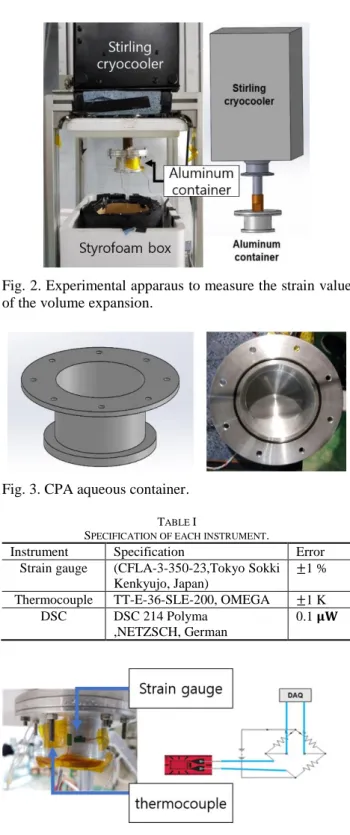
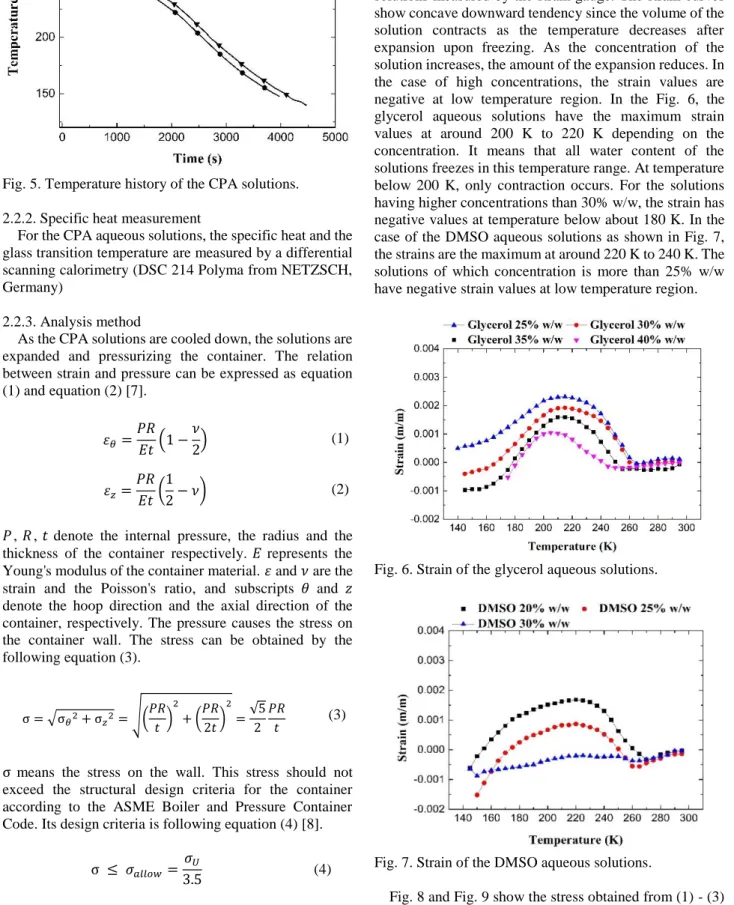
Experimental setup are shown in Fig. 2 for measuring the strain, which is caused by the volume expansion of the solutions. Fig. 3 shows the CPA aqueous container, which is made of aluminum 6061 - T6. Its inner diameter and height are 60 mm and 30 mm, respectively. The wall thickness is 0.5 mm. A Stirling cryocooler is connected to a CPA aqueous container to cool down the solutions. The container is cooled down from 300 K to 140 K by the stirling cryocooler. An E-type thermocouple (TT-E-36- SLE-200, OMEGA) and a strain gauge (CFLA-3-350-23, Tokyo Sokki Kenkyujo, Japan) are attached at 15 mm height on the wall from the bottom of the container to

Fig. 2. Experimental apparaus to measure the strain value of the volume expansion.

Fig. 3. CPA aqueous container.

T ABLE I

S PECIFICATION OF EACH INSTRUMENT .

Instrument Specification Error

Strain gauge (CFLA-3-350-23,Tokyo Sokki Kenkyujo, Japan)

±1 %

Thermocouple TT-E-36-SLE-200, OMEGA ±1 K

DSC DSC 214 Polyma

,NETZSCH, German

0.1 𝛍𝐖

Fig. 4. CFLA-3-350-23 Strain gauge, Tokyo Sokki Kenkyujo Co., Ltd.

measure the temperature and the strain of the container simultaneously. The container is insulated by a styrofoam box to prevent external heat ingress from the environment.

The strain gauge is attached to the container as shown in

Fig. 4. Wheat stone bridge circuit is utilized to receive the

signal from strain gauge. As this strain gauge sends a signal

excluding thermal expansion of the container itself, the

output value is the strain by volume expansion of the CPA

solution only. The cooling rates of the container are -2.0

K/min and -2.2 K/min for the case of glycerol and DMSO

solutions, respectively as shown in Fig. 5

(3)

Fig. 5. Temperature history of the CPA solutions.

2.2.2. Specific heat measurement

For the CPA aqueous solutions, the specific heat and the glass transition temperature are measured by a differential scanning calorimetry (DSC 214 Polyma from NETZSCH, Germany)

2.2.3. Analysis method

As the CPA solutions are cooled down, the solutions are expanded and pressurizing the container. The relation between strain and pressure can be expressed as equation (1) and equation (2) [7].

𝜀 𝜃 = 𝑃𝑅 𝐸𝑡 (1 − 𝜈

2 ) (1)

𝜀 𝑧 = 𝑃𝑅 𝐸𝑡 ( 1

2 − 𝜈) (2)

𝑃 , 𝑅 , 𝑡 denote the internal pressure, the radius and the thickness of the container respectively. 𝐸 represents the Young's modulus of the container material. 𝜀 and 𝜈 are the strain and the Poisson's ratio, and subscripts 𝜃 and 𝑧 denote the hoop direction and the axial direction of the container, respectively. The pressure causes the stress on the container wall. The stress can be obtained by the following equation (3).

σ = √σ 𝜃 2 + σ 𝑧 2 = √( 𝑃𝑅 𝑡 )

2

+ ( 𝑃𝑅 2𝑡 )

2

= √5 2

𝑃𝑅

𝑡 (3)

σ means the stress on the wall. This stress should not exceed the structural design criteria for the container according to the ASME Boiler and Pressure Container Code. Its design criteria is following equation (4) [8].

σ ≤ 𝜎 𝑎𝑙𝑙𝑜𝑤 = 𝜎 𝑈

3.5 (4)

𝜎 𝑎𝑙𝑙𝑜𝑤 and 𝜎 𝑈 are the allowable stress and the ultimate strength of the container material. This criteria should be satisfied to use proper CPA aqueous solutions for the CTS.

3. RESULTS AND DISCUSSIONS 3.1. Volume expansion

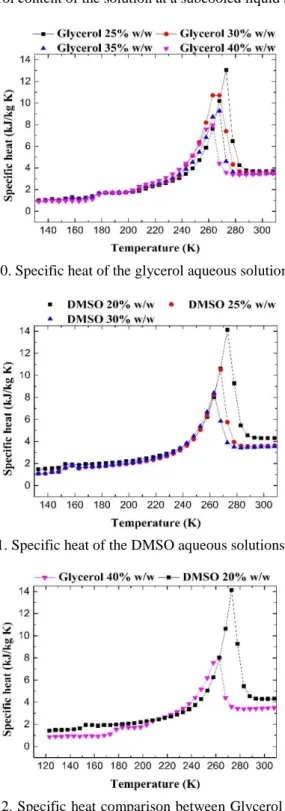
Fig. 6 and Fig. 7 show the strain of the CPA aqueous solutions measured by the strain gauge. The strain curves show concave downward tendency since the volume of the solution contracts as the temperature decreases after expansion upon freezing. As the concentration of the solution increases, the amount of the expansion reduces. In the case of high concentrations, the strain values are negative at low temperature region. In the Fig. 6, the glycerol aqueous solutions have the maximum strain values at around 200 K to 220 K depending on the concentration. It means that all water content of the solutions freezes in this temperature range. At temperature below 200 K, only contraction occurs. For the solutions having higher concentrations than 30% w/w, the strain has negative values at temperature below about 180 K. In the case of the DMSO aqueous solutions as shown in Fig. 7, the strains are the maximum at around 220 K to 240 K. The solutions of which concentration is more than 25% w/w have negative strain values at low temperature region.

Fig. 6. Strain of the glycerol aqueous solutions.

Fig. 7. Strain of the DMSO aqueous solutions.

Fig. 8 and Fig. 9 show the stress obtained from (1) - (3) and the allowable stress of aluminum 6061-T6 from (4).

The stress induced by the volume expansion must be lower

than the allowable stress.

(4)

Fig. 8. Stress of the glycerol aqueous solutions.

Fig 9. Stress of the DMSO aqueous solutions.

In the case of the glycerol aqueous solutions, only glycerol 40% w/w solution is applicable for the CTS since only 40% w/w solution can satisfy the requirement. In the case of the DMSO solution, samples of which concentration is more than 20% w/w satisfy the design criteria from equation (4). Therefore, it can be utilized for the CTS.

3.2. Specific heat measurement

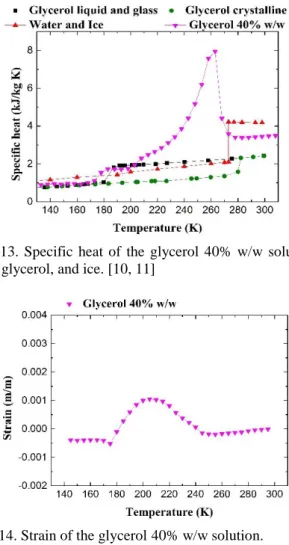
The specific heat changes drastically in the range of 250 K - 280 K as shown in Fig. 10 and Fig. 11. The water releases the latent heat since the phase of water content of the solutions changes. Therefore, the amount of the specific heat peaks decreases as the concentration increases.

According to the experimental results, glycerol 40% w/w aqueous solution and the DMSO solutions can be used for the CTS. In addition, the glycerol 40% w/w solution has lower specific heat than the DMSO 20% w/w solution as shown in Fig. 12. Therefore, the DMSO 20% w/w solution is considered as the most suitable for the CTS. From both Fig. 13 and Fig. 14, the glycerol solution starts the volume expansion at 263 K. The specific heat increases sharply at the same temperature because the water content of the solution coagulates and releases latent heat.

At 210 K, the volume expansion becomes the maximum and specific heat increase due to the latent heat release.

Therefore, the water content of the solution freezes in temperature range from 273 K to 210 K.

It is known that crystallization of impure glycerol is harder than pure material [9]. Comparing the specific heat

of the glycerol 40% w/w solution with that of the pure materials, the specific heat of the solution is the weighted average of the specific heat of the pure materials at each temperature condition, except in the water freezing region.

Fig. 13 shows the specific heat of each phase of glycerol and the specific heat of ice. The liquid state of glycerol is the subcooled liquid phase before glass transition and glass state of glycerol is the vitrified phase after glass transition during cooling. Crystalline of glycerol is the state after solidification with crystal structure. From 175 K to 210 K, the specific heat of the solution is located between that of the liquid glycerol and the ice as shown in Fig. 13. The glycerol content of the solution at a subcooled liquid state

Fig. 10. Specific heat of the glycerol aqueous solutions.

Fig 11. Specific heat of the DMSO aqueous solutions.

Fig. 12. Specific heat comparison between Glycerol 40%

w/w and DMSO 20% w/w.

(5)

Fig. 13. Specific heat of the glycerol 40% w/w solution, pure glycerol, and ice. [10, 11]

Fig. 14. Strain of the glycerol 40% w/w solution.

is not a crystalline solid, which has lower specific heat than subcooled liquid state. It is known that crystallization of impure glycerol is harder than pure material. Therefore, the CPA solutions have advantages of utilizing the latent heat of the water content in wider range and higher sensible heat of the CPA content in low temperature range.

4. CONCLUSION

Water can be utilized to apply to CTS (Cold thermal

storage) for LAES system. The undesirable volume expansion of water can be alleviated by adding cryoprotectant agents, such as glycerol or DMSO, to water.

The volume expansion is measured as strain by a strain gauge, and DSC is conducted for specific heat capacity.

Both volume expansion and the specific heat capacity of the mixture decrease in the case of higher concentration of CPA. Trade-off between volume expansion and the specific heat capacity is considered to select the suitable CPA solution. DMSO 20% aqueous solution is shown as the most suitable as thermal storage material since it has the highest specific heat and does not exceed the allowable stress.

REFERENCES

[1] Y. Ding, L. Tong, P. Zhang, Y. Li, J. Radcliffe and L. Wang, Liquid Air Energy Storage, 2016

[2] R. Morgan, S. Nelmes, E. Gibson and G. Brett, "Liquid air energy storage–analysis and first results from a pilot scale demonstration plant," Applied energy, vol. 137, pp. 845-853, 2015

[3] A. Sciacovelli, A. Vecchi and Y. Ding, "Liquid air energy storage (LAES) with packed bed cold thermal storage–From component to system level performance through dynamic modelling," Applied Energy, vol. 190, pp. 84-98, 2017

[4] J. Kim, Y. Noh and D. Chang, "Storage system for distributed- energy generation using liquid air combined with liquefied natural gas," Applied Energy, vol. 212, pp. 1417-1432, 2018

[5] W. P. Schmidt, K. S. Winegardner, M. Dennehy and H. Castle‐

Smith, "Safe design and operation of a cryogenic air separation unit," Process Safety Progress, vol. 20, pp. 269-279, 2001 [6] J. A. Noël, S. Kahwaji, L. Desgrosseilliers, D. Groulx and M. A.

White, Phase Change Materials, 2016

[7] W. C. Young and R. G. Budnyas, Roark’s formulas for stress and strain, 2017

[8] W. Sperko, Reduction of Design Margin in the ASME Boiler and Pressure Vessel Code in the 1999 Addenda, 2011

[9] O. Andersson and G. P. Johari, "Thermal conductivity of Glycerol’s liquid, glass, and crystal states, glass-liquid-glass transition, and crystallization at high pressures," The Journal of chemical physics, vol. 144, p. 064504, 2016

[10] R. J. Corruccini and J. J. Gniewek, "Specific heats and enthalpies of technical soilds at low temperatures," S. A Compilation from the Literature, National Bureau of Standards, Washington, DC, 1960 [11] G. Gibson and W. Giauque, "The third law of thermodynamics.

Evidence from the specific heats of glycerol that the entropy of a

glass exceeds that of a crystal at the absolute zero," Journal of the

American Chemical Society, vol. 45, pp. 93-104, 1923

수치

Fig. 1. Configuration of liquid air energy storage (LAES)  system. [1]
Fig. 2. Experimental apparaus to measure the strain value  of the volume expansion.
Fig.  6  and  Fig.  7  show  the  strain  of  the  CPA  aqueous  solutions measured by the strain gauge
Fig. 8. Stress of the glycerol aqueous solutions.
+2

참조

관련 문서

In this study, a finned-tube-in-tank heat exchanger was applied to a PCM thermal energy storage system to increase heat transfer efficiency.. The effects of geometric

Preparation and Thermal Properties of Octadecane/xGnP Shape-Stabilized Phase Change Materials to Improve the Heat Storage Performance of Buildings.. 김석환(Sughwan

10 Greenhouse heating effect and cold water injection by using greenhouse heating and cooling system with seasonal thermal storage in alluvial aquifer.. 물의온도는 30.0

The thermal performance including insolation energy, heat loss from collector system, useful energy, collector efficiency, and temperature of storage tank were

Abstract: A raw-water source heat pump equipped with a thermal storage tank was dynamically simulated by TRNSYS, and the results were verified by using the data from a