Korean Circulation Journal
Introduction
Atrial fibrillation (AF) is a common arrhythmia and an important cause of cardiovascular morbidity and mortality.
1)AF is also
associated with a 4 to 5-fold increased risk of stroke and is responsible for approximately 15% of all strokes.
2)3)The incidence and prevalence of AF increase with older age
4)5)and are higher in men than in women.
6)7)The prevalence of AF in the United States is estimated at 2.3 million and is expected to increase to 5.6 million by 2050.
4)In the Rotterdam Study, the prevalence of AF was 5.5% in subjects aged≥55 years, and the incidence rate in subjects aged 80- 84 years was 21 per 1000 person-years.
8)Assessment of Medicare beneficiaries in the United States showed that the incidence of AF over a 14-year period ranged from 27.3 to 28.3 per 1000 person- years; moreover, AF was associated with various co-morbidities and mortality, and its incidence rates were consistently higher in men than in women and in whites than non-whites.
9)In Asia, the prevalence of AF is approximately 1%, lower than in Caucasians (1-
2%).
4)10)Moreover, it is estimated that by 2050,72 million individuals
in Asia will be diagnosed with AF, which is more than double the combined numbers of patients in Europe and the United States, due to proportionally larger number of aged individuals in Asian
Print ISSN 1738-5520 • On-line ISSN 1738-5555
Incidence and Risk Factors for Atrial Fibrillation in Korea: the National Health Insurance Service Database (2002–2010)
Mi Kyoung Son, MS
1, Nam-Kyoo Lim, PhD
1, Myeong-Chan Cho, MD
2, and Hyun-Young Park, MD
11Division of Cardiovascular and Rare Diseases, Center for Biomedical Science, Korea National Institute of Health, 2Department of Internal Medicine, College of Medicine, Chungbuk National University, Cheongju, Korea
Background and Objectives: Atrial fibrillation (AF) is a common arrhythmia that is known as an important independent risk factor for stroke. However, limited information is available on AF in Korea. This study evaluated the incidence of AF, its associated co-morbidities and risk factors for AF in Korea.
Subjects and Methods: The National Health Insurance Service database between 2002 and 2010 was used in the study. Individuals<30 years old and those diagnosed with AF between 2002 and 2004 were excluded. Hazard ratios (HRs) according to co-morbidities and risk factors for AF were determined using a Cox proportional hazard model. Population attributable fractions (PAFs) of AF risk factors were determined.
Results: During a 6-year follow-up period, 3517 (1.7%) developed AF. The incidence rates in men and women aged 30-39 years were 0.82 and 0.55 per 1000 person-years, respectively; the incidence rates further increased with age to 13.09 and 11.54 per 1000 person-years in men and women aged≥80 years, respectively. The risk factors for incident AF were age, sex, body mass index (BMI), hypertension, ischemic heart disease (IHD) and heart failure. After adjusting for variables related to AF, the risk of AF was significantly associated with hypertension (HR 1.667), IHD (HR 1.639), heart failure (HR 1.521), and the PAFs for age, sex, BMI, hypertension, IHD, heart failure and diabetes mellitus were 30.6%, 10.1%, 3.4%, 16.6%, 8.2%, 5.3% and 0.8%, respectively.
Conclusion: Incidence of AF increased with age and was higher in men than in women. A larger proportion of AF events was attributable to hypertension than to other co-morbidities. (Korean Circ J 2016;46(4):515-521)
KEY WORDS: Atrial fibrillation; Incidence; Comorbidity.
Received: August 28, 2015
Revision Received: December 5, 2015 Accepted: December 8, 2015
Correspondence: Hyun-Young Park, MD, Division of Cardiovascular and Rare Disease, Center for Biomedical Science, Korea National Institute of Health, 187 Osongsaengmyeong 2-ro, Osong-eup, Heungdeok-gu, Cheongju 28159, Korea
Tel: 82-43-719-8650, Fax: 82-43-719-8689 E-mail: [email protected]
• The authors have no financial conflicts of interest.
This is an Open Access article distributed under the terms of the Creative Commons Attribution Non-Commercial License (http://creativecommons.
org/licenses/ by-nc/3.0) which permits unrestricted non-commercial use, distribution, and reproduction in any medium, provided the original work is properly cited.
countries.
11-13)To date, few epidemiologic studies have assessed the prevalence of AF in Korea, and none have examined its incidence.
14)15)The Korean Genome and Epidemiology Study reported that the prevalence of AF was 0.4% in adults aged 40-69 years, increasing to 1.0%
in individuals aged 60-69 years.
14)Another study found that the prevalence of AF was 0.7% in subjects aged≥40 years and 2.1%
in those aged≥65 years.
15)These studies may have underestimated the prevalence of AF because they enrolled study population aged 40-69 years
14)or healthy individuals.
15)Many studies have reported that risk factors for AF include increased age, male sex, hypertension, diabetes mellitus, obesity, heart failure, valve disease, myocardial infarction and alcohol consumption.
7)16-18)The Copenhagen City Heart Study reported that AF was a much more pronounced risk factor for stroke and cardiovascular death in women than in men.
19)The prevalence of AF is expected to increase in proportion to the aging of the Korean population and thus likely to become a greater public health problem. Effective prevention of AF and care of patients with this condition require reliable determination of its prevalence and incidence.
20)Therefore, the purpose of this study was to determine the incidence of AF, its associated co-morbidities and risk factors and the contribution of co-morbidities to AF incidence using data from the Korean National Health Insurance Service (NHIS).
Subjects and Methods
Data source
The NHIS is a mandatory universal health insurance system that covers about 97% of the Korea population; it includesa centralized healthcare claims database that provides a nationwide source of information on healthcare resource utilization. The remaining 3%
of the population is covered by the Medical Aid program, a public assistance program providing healthcare for the poor. Data in the NHIS database includedemographic information, anthropometric measurements, biochemical test results, medical treatment, and disease diagnoses according to the Korean Classification of Diseases-6 (KCD-6), which is a similar system to the International Classification of Diseases-10(ICD-10). Data made publicly available from the NHIS database from 2002 through 2010 were reviewed.
The study protocol was approved by the Institutional Review Board of the Health Insurance Review and Assessment Service.
Study population and materials
Patients were defined as having AF if they had the KCD-10 disease
codes I48 (atrial fibrillation and atrial flutter), I48.0 (atrial fibrillation), and I48.1 (atrial flutter). To avoid classifying those with pre-existing AF as incident cases, subjects with AF between 2002 and 2004 were excluded. The NHIS database included 207896 subjects aged≥30 years who underwent at least one health-screening between 2002 and 2004. After excluding the 1883 subjects who had been diagnosed with AF between 2002-2004, 206013 subjects (121226 men and 84787 women) remained eligible for analysis.
Covariates included demographic characteristics (age and sex), anthropometric measurements (body mass index [BMI], systolic blood pressure [SBP] and diastolic blood pressure [DBP]), biochemical test results (glucose, total-cholesterol and hemoglobin concentrations) and co-morbidities (hypertension, ischemic heart disease [IHD], heart failure and diabetes mellitus). Subjects were divided into 10-year age groups; i.e., 30-40, 40-50, 50-60, 60-70, 70-80, and ≥80 years. BMI was calculated as weight in kilograms divided by height in meters squared. Co-morbidities present during the period between 2002-2004 were retrospectively assessed in subjects subsequently diagnosed with incident AF by searching for the KCD-10 disease codes for 4 co-morbidities, hypertension (KCD-10 I10-I15), ischemic heart disease (KCD-10 I20-I25), heart failure (KCD-10 I11.0, I13.0, I13.2, I50) and diabetes mellitus (KCD-10 E10-E14) (Supplementary Table in the online-only Data Supplement).
Statistical analysis
Characteristics of the study population during the window period were determined. Continuous variables were expressed as mean±standard deviation and compared using t-tests, and categorical variables were expressed as frequency (percentage) and compared using chi-square tests. Incidence of AF was determined overall and by sex and age group, with incidence calculated as the number of patients with incident AF during each year of the 6-year follow-up period divided by the total person-years at risk among all subjects that year who did not have AF at the beginning of the year.
To assess risk factors for AF incidence, hazard ratios (HRs)
and 95% confidence intervals (CIs) were estimatedusing Cox’s
proportional hazard regression analyses. We evaluated unadjusted
and multivariable-adjusted HRs of incident AF according to the
co-morbidities. Unadjusted and multivariable-adjusted population
attributable fractions (PAFs) of AF co-morbidities were ascertained,
with multivariable-adjusted PAFs adjusted for age, sex, BMI and
the other co-morbidities. All statistical tests were two-tailed,
and p<0.05 were considered statistically significant. All statistical
analyses were performed using SAS software (version 9.4; SAS
Institute, Cary, NC, USA).
Results
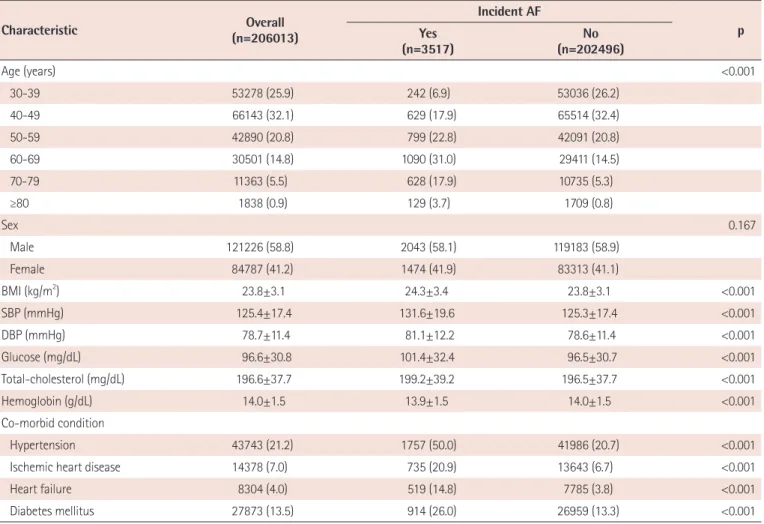
During the 6-year follow-up period, 3517(1.7%) individuals aged≥30 years in South Korea were newly diagnosed with AF, including 2043(58.1%) males and 1474(41.9%) females. Table 1 showed the characteristics of the study population according to the incidence of AF during the window period. The incidence of AF differed significantly among groups assorted by age; BMI; SBP;
DBP; concentrations of glucose, total-cholesterol, and hemoglobin;
and by the presence of hypertension, IHD, heart failure and diabetes mellitus. Among subjects with incident AF during 2005- 2010, 50.0% had hypertension, 20.9% had IHD, 14.8% had heart failure and 26.0% had diabetes mellitus.
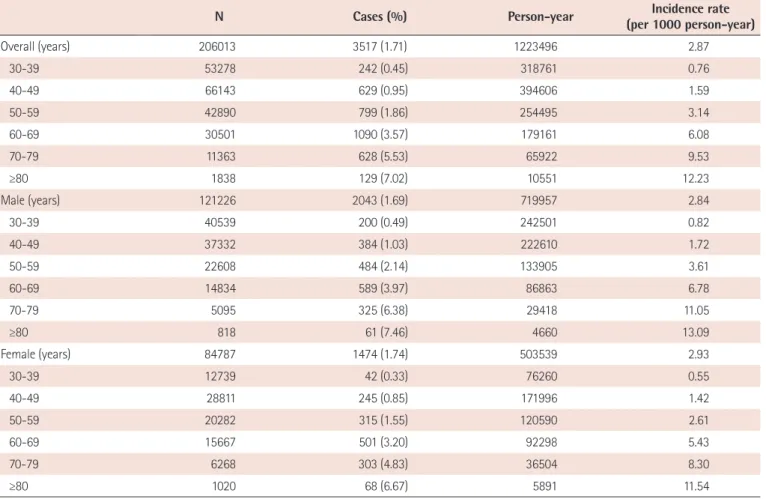
The incidences of AF during the follow-up period according to sex and age groups were shown in Table 2. The overall incidence rate was 2.87/1000 person-years. The incidence was consistently higher among men than women and increased substantially with age. The incidence rates in men and women aged 30-39 years were
0.82 and 0.55 per 1000 person-years, respectively, increasing with age to 13.09 and 11.54 per 1000 person-years in men and women aged ≥80 years, respectively.
Table 3 showed the risk factors for incident AF after adjusting for variables related to incident AF. The risk factors for incident AF were age, sex, BMI, hypertension, IHD and heart failure (p<0.05 each). The association between total-cholesterol concentration and incident AF showed borderline significance, but the HR was approximately 1 (HR=0.999, 95% CI=0.998-1.000). Hypertension was the strongest risk factor for incident AF.
The HRs of co-morbidities for incident AF were presented in Table 4. Unadjusted and age- and sex-adjusted risks for AF were significantly increased by hypertension, IHD, heart failure and diabetes mellitus. After adjustments for age, sex, BMI and co- morbidities, all except diabetes mellitus remained significant.
Consistent with the risk factors for incident AF, the HR of hypertension was the strongest (HR=1.667, 95% CI=1.537-1.807).
Table 5 presented unadjusted and multivariable-adjusted PAFs
Table 1. Demographic and clinical characteristics of subjects with and without AF during the window period (2002–2004)
Characteristic Overall
(n=206013)
Incident AF Yes p
(n=3517) No
(n=202496)
Age (years) <0.001
30-39 53278 (25.9) 242 (6.9) 53036 (26.2)
40-49 66143 (32.1) 629 (17.9) 65514 (32.4)
50-59 42890 (20.8) 799 (22.8) 42091 (20.8)
60-69 30501 (14.8) 1090 (31.0) 29411 (14.5)
70-79 11363 (5.5) 628 (17.9) 10735 (5.3)
≥80 1838 (0.9) 129 (3.7) 1709 (0.8)
Sex 0.167
Male 121226 (58.8) 2043 (58.1) 119183 (58.9)
Female 84787 (41.2) 1474 (41.9) 83313 (41.1)
BMI (kg/m2) 23.8±3.1 24.3±3.4 23.8±3.1 <0.001
SBP (mmHg) 125.4±17.4 131.6±19.6 125.3±17.4 <0.001
DBP (mmHg) 78.7±11.4 81.1±12.2 78.6±11.4 <0.001
Glucose (mg/dL) 96.6±30.8 101.4±32.4 96.5±30.7 <0.001
Total-cholesterol (mg/dL) 196.6±37.7 199.2±39.2 196.5±37.7 <0.001
Hemoglobin (g/dL) 14.0±1.5 13.9±1.5 14.0±1.5 <0.001
Co-morbid condition
Hypertension 43743 (21.2) 1757 (50.0) 41986 (20.7) <0.001
Ischemic heart disease 14378 (7.0) 735 (20.9) 13643 (6.7) <0.001
Heart failure 8304 (4.0) 519 (14.8) 7785 (3.8) <0.001
Diabetes mellitus 27873 (13.5) 914 (26.0) 26959 (13.3) <0.001
Data presented as mean±standard deviation or n (%). AF: atrial fibrillation, BMI: body mass index, SBP: systolic blood pressure, DBP: diastolic blood pressure
and 95% CIs for AF. The sex-adjusted PAF for age was 40.2%. After adjusting for all covariates, the PAF for age (≥60 years), sex (male) and BMI (≥25 kg/m
2) were 30.6%, 10.1% and 3.4%, respectively. The unadjusted PAFs for hypertension, IHD, heart failure and diabetes mellitus were 36.9%, 15.2%, 11.3% and 14.6%, respectively. After adjustments for age, sex, BMI and co-morbidities, the PAFs for hypertension, IHD, heart failure and diabetes mellitus were 16.6%, 8.2%, 5.3% and 0.8%, respectively. The PAF for age of established AF was highest. The PAF for hypertension was greater than other co-morbidities, and the PAF for diabetes mellitus was not significant in the full model.
Discussion
To our knowledge, this is the first study to investigate the incidence of AF in Korea using the nationwide NHIS database. The study population consisted of subjects aged≥30 years without AF during the window period. In our study,the incidence of AF
increased with older age and was higher in men than in women, consistent with previous reports.
5)9)21)The risk factors for incident AF were age, sex, BMI, hypertension, IHD and heart failure. A larger proportion of AF events was attributable to hypertension than to other co-morbidities.
Several reports
14)15)described the prevalence of AF in Korea. The Korean Genome and Epidemiology Study showed that the overall prevalence of AF was 0.4% and was 1.0% in subjects aged 60-69 years.
14)To compare these findings andthe results of our study, we conducted additional analysis for the incidence of AF using 9986 Korean adults (4726 men and 5260 women) who enrolled in the Korean Genome and Epidemiology Study. During an 8-year follow- up period, the incidence rates in men and women aged 60-69 years were 3.01 and 1.80 per 1000 person-years, respectively. However, the high follow-up loss rate (approximately 35%) suggested that these results may have been underestimated. Our assessment of the NHIS database showed that the incidence rates of AF in men and women aged 30-39 years were 0.83 and 0.55 per 1000 person- years, respectively; the incidence rate further increased to 13.09
Table 2. Incidence of AF during the 6-year follow-up period according to age and sex
N Cases (%) Person-year Incidence rate
(per 1000 person-year)
Overall (years) 206013 3517 (1.71) 1223496 2.87
30-39 53278 242 (0.45) 318761 0.76
40-49 66143 629 (0.95) 394606 1.59
50-59 42890 799 (1.86) 254495 3.14
60-69 30501 1090 (3.57) 179161 6.08
70-79 11363 628 (5.53) 65922 9.53
≥80 1838 129 (7.02) 10551 12.23
Male (years) 121226 2043 (1.69) 719957 2.84
30-39 40539 200 (0.49) 242501 0.82
40-49 37332 384 (1.03) 222610 1.72
50-59 22608 484 (2.14) 133905 3.61
60-69 14834 589 (3.97) 86863 6.78
70-79 5095 325 (6.38) 29418 11.05
≥80 818 61 (7.46) 4660 13.09
Female (years) 84787 1474 (1.74) 503539 2.93
30-39 12739 42 (0.33) 76260 0.55
40-49 28811 245 (0.85) 171996 1.42
50-59 20282 315 (1.55) 120590 2.61
60-69 15667 501 (3.20) 92298 5.43
70-79 6268 303 (4.83) 36504 8.30
≥80 1020 68 (6.67) 5891 11.54
AF: atrial fibrillation
Table 4. HR of incident AF according to co-morbidity
Co-morbidity HR (95% CI)
Unadjusted Model 1 Model 2
Hypertension 3.762 (3.521-4.019) 2.102 (1.955-2.260) 1.667 (1.537-1.807)
IHD 3.595 (3.314-3.899) 2.187 (2.012-2.378) 1.639 (1.498-1.792)
Heart failure 4.234 (3.857-4.647) 2.300 (2.089-2.534) 1.521 (1.372-1.687)
Diabetes mellitus 2.267 (2.102-2.444) 1.364 (1.262-1.474) 1.048 (0.966-1.136)
Model 1: adjusted for age and sex. Model 2: adjusted for age sex, body mass index and other co-morbidities. HR: hazard ratio, AF: atrial fibrillation, CI: confidence interval, IHD: ischemic heart disease
Table 5. PAFs(%) and 95% CIs of established AF
PAF (95% CI)
Unadjusted Multivariate adjusted†
Age (≥60 years) 40.1 (38.0-42.0) 30.6 (28.4-32.7)
Sex (Male) -1.9 (-)* 10.1 (7.6-12.5)
BMI (≥25 kg/m2) 8.5 (6.5-10.5) 3.4 (1.3-5.4)
Hypertension 36.9 (34.8-38.8) 16.6 (14.3-18.9)
IHD 15.2 (13.8-16.6) 8.2 (6.8-9.7)
Heart failure 11.3 (10.1-12.6) 5.3 (4.0-6.5)
Diabetes mellitus 14.6 (13.0-16.2) 0.8 (-0.9-2.4)
*The CI for the PAF estimate is not shown because the SMR estimate was less than 1. †Adjusted for age sex BMI and co-morbidities. PAF: population attributable fraction, CI: confidence interval, AF: atrial fibrillation, BMI: body mass index, IHD: ischemic heart disease
Table 3. Multivariate analysis of risk factors for incident AF
Variables HR(95% CI) p*
Age (years)
30-39 vs. ≥80 0.090 (0.072-0.112) <0.001
40-49 vs. ≥80 0.183 (0.150-0.223) <0.001
50-59 vs. ≥80 0.310 (0.256-0.375) <0.001
60-69 vs. ≥80 0.520 (0.432-0.626) <0.001
70-79 vs. ≥80 0.755 (0.624-0.914) 0.004
Sex
Male vs. female 1.302 (1.195-1.418) <0.001
BMI 1.024 (1.015-1.034) <0.001
SBP 1.001 (0.998-1.003) 0.682
DBP 1.001 (0.996-1.005) 0.812
Glucose 1.000 (0.999-1.001) 0.572
Total-cholesterol 0.999 (0.998-1.000) 0.044
Hemoglobin 1.013 (0.984-1.042) 0.390
Co-morbidity
Hypertension 1.651 (1.517-1.796) <0.001
Ischemic heart disease 1.638 (1.497-1.792) <0.001
Heart failure 1.521 (1.371-1.687) <0.001
Diabetes mellitus 1.059 (0.973-1.153) 0.183
*by Cox proportional hazard regression analysis. AF: atrial fibrillation, HR: hazard ratio, CI: confidence interval, BMI: body mass index, SBP: systolic blood pressure, DBP: diastolic blood pressure
and 11.54 per 1000 person-years, in men and women aged≥80 years, respectively. These rates were lower than in previous studies.
For example, in the Rotterdam Study, the incidence rates of AF were 21 per 1000 person-years in subjects aged 80-84 years and 33-39 per 1000 person-years in the Medicare cohort.
8)9)Similar to other studies, we found that incidence rates were higher among men than women in all age groups.
5)9)21)After multivariable adjustment, older age, male sex, BMI, hypertension, IHD and heart failure were significantly associated with the incidence of AF in this study. Moreover, after adjusting for age, sex, BMI and co-morbidities, the risk of AF was significantly associated with hypertension, IHD and heart failure. The Framingham Heart Study showed that the risks of AF in men and women were increased by hypertension 1.5- and 1.4-fold, respectively, and by heart failure 4.5- and 5.9-fold, respectively.
7)The lifetime risk for development of AF in adults aged≥40 years was increased 7-10% by antecedent congestive heart failure or myocardial infarction.
21)In addition, obesity, sleep apnea, and metabolic syndrome have been linked to the development of AF.
22)23)Hypertension, IHD, heart failure and diabetes showed adjusted HRs for incident AF of 1.667, 1.639, 1.521 and 1.048, respectively.
The HR was greater for hypertension than for these other co- morbidities, and the HR for diabetes was no longer significant after adjustment for variables related to AF. Moreover, after adjusting for age, sex, BMI and other co-morbidities, hypertension (36.9%) had a higher PAF for established AF than other co-morbidities, whereas the PAF for diabetes mellitus was not significant. The Multi-Ethnic Study of Atherosclerosis calculated age- and sex-adjusted PAFs to determine the relative contribution of major risk factors for AF (diabetes mellitus, hypertension, BMI and current smoking) among different race-ethnic groups,
24)showing that hypertension was the most important contributor to AF events, affecting 22.2% of non- Hispanic whites, 33.1% of non-Hispanic blacks, 46.3% of Chinese, and 43.9% of Hispanics. In addition, similar to our results, that study showed that the PAFs for diabetes were quite small.
Our study had several limitations. First, patients with atrial flutter were included among those with AF, and participants with paroxysmal AF were not distinguished from those with persistent AF. Therefore, some participants may only have had a single episode of paroxysmal AF. However, individuals with an index AF event have high rates of recurrence and conversion to persistent AF.
25)In addition, paroxysmal and persistent AF are similarly associated with risk for stroke.
26)Second, patients with AF were identified according to KCD-10 codes and not confirmed by electrocardiography. Thus, the AF group may have included some patients without the disease.
Conversely, the frequency of AF and co-morbidities may have been underestimated if the event did not result in a claim. However, a
recent validation study of KCD-10 diagnostic codes in the Korean NHIS database has shown that about 70% of primary, secondary, and tertiary diagnosis codes in NHIS records coincide with those from medical records. Moreover, the accuracy of diagnosis codes tended to be higher for claims from hospital admissions than from office visits, and for claims for severe than for mild conditions.
27)Nevertheless, our study had several strengths, including the sample size, which was larger than in previous studies. Furthermore, our study investigated the incidence of and risk factors for AF and its HR and PAF for co-morbidities in Korea.
In conclusion, this nationwide survey on the incidence of AF using medical claim data from the NHIS showed that the incidence of AF increased with age and was higher in men than in women. The risk of AF was significantly associated with hypertension, IHD and heart failure. A higher proportion of AF events was attributable to hypertension than to other co-morbidities. These findings suggest the importance of managing hypertension to prevent AF and the establishment of appropriate prevention strategies to reduce AF morbidity and mortality.
Acknowledgments
This work was supported by the Korea National Institute of Health intramural research grant, 4800-4845-302 (2011-NG63002-00).
This study used NHIS data (No. NHIS-2014-2-010) and made clear that all results were notrelated to NHIS.
Supplementary Materials
The online-only Data Supplement is available with this article at http://dx.doi.org/10.4070/kcj.2016.46.4.515.
References
1. Kannel WB, Abbott RD, Savage DD, McNamara PM. Coronary heart disease and atrial fibrillation: the Framingham Study. Am Heart J 1983;106:389-96.
2. Wolf PA, Mitchell JB, Baker CS, Kannel WB, D’Agostino RB. Impact of atrial fibrillation on mortality, stroke, and medical costs. Arch Intern Med 1998;158:229-34.
3. Wolf PA, Abbott RD, Kannel WB. Atrial fibrillation as an independent risk factor for stroke: the Framingham Study. Stroke 1991;22:983-8.
4. Go AS, Hylek EM, Phillips KA, et al. Prevalence of diagnosed atrial fibrillation in adults: national implications for rhythm management
and stroke prevention: the AnTicoagulation and Risk Factors in Atrial Fibrillation (ATRIA) Study. JAMA 2001;285:2370-5.
5. Psaty BM, Manolio TA, Kuller LH, et al. Incidence of and risk factors for atrial fibrillation in older adults. Circulation 1997;96:2455-61.
6. Aronow WS, Ahn C, Gutstein H. Prevalence and incidence of cardiovascular disease in 1160 older men and 2464 older women in a long-term health care facility. J Gerontol A BiolSci Med Sci 2002;57:M45-6.
7. Benjamin EJ, Levy D, Vaziri SM, D’Agostino RB, Belanger AJ, Wolf PA.
Independent risk factors for atrial fibrillation in a population-based cohort. The Framingham Heart Study. JAMA 1994;271:840-4.
8. Heeringa J, van der Kuip DA, Hofman A, et al. Prevalence, incidence and lifetime risk of atrial fibrillation: the Rotterdam study. Eur Heart J 2006;27:949-53.
9. Piccini JP, Hammill BG, Sinner MF, et al. Incidence and prevalence of atrial fibrillation and associated mortality among Medicare beneficiaries, 1993-2007. Circ Cardiovasc Qual Outcomes 2012;5:85-93.
10. Lip GY, Brechin CM, Lane DA. The global burden of atrial fibrillation and stroke: a systematic review of the epidemiology of atrial fibrillation in regions outside North America and Europe. Chest 2012;142:1489-98.
11. Tse HF, Wang YJ, Ahmed Ai-Abdullah M, et al. Stroke prevention in atrial fibrillation--an Asian stroke perspective. Heart Rhythm 2013;10:1082-8.
12. Miyasaka Y, Barnes ME, Gersh BJ, et al. Secular trends in incidence of atrial fibrillation in Olmsted County, Minnesota, 1980 to 2000, and implications on the projections for future prevalence. Circulation 2006;114:119-25.
13. Krijthe BP, Kunst A, Benjamin EJ, et al. Projections on the number of individuals with atrial fibrillation in the European Union, from 2000 to 2060. Eur Heart J 2013;34:2746-51.
14. Lee KS, Choi SJ, Park SH, Kim HL, Min H, Park HY. Prevalence of atrial fibrillation in middle-aged people in Korea: The Korean Genome and Epidemiology Study. Korean Circ J 2008;38:601-5.
15. Jeong JH. Prevalence of and risk factors for atrial fibrillation in Korean adults older than 40 years. J Korean Med Sci 2005;20:26-30.
16. Wang TJ, Parise H, Levy D, D’Agostino RB Sr, Wolf PA, Vasan RS, Benjamin EJ. Obesity and the risk of new-onset atrial fibrillation.
JAMA 2004;292:2471-7.
17. Schnabel RB, Sullivan LM, Levy D, et al. Development of a risk score for atrial fibrillation (Framingham Heart Study): a community-based cohort study. Lancet 2009;373:739-45.
18. Djoussé L, Levy D, Benjamin EJ, et al. Long-term alcohol consumption and the risk of atrial fibrillation in the Framingham Study. Am J Cardiol 2004;93:710-3.
19. Friberg J, Scharling H, Gadsbøll N, Truelsen T, Jensen GB; Copenhagen City Heart Study. Comparison of the impact of atrial fibrillation on the risk of stroke and cardiovascular death in women versus men (The Copenhagen City Heart Study). Am J Cardiol 2004;94:889-94.
20. Kannel WB, Wolf PA, Benjamin EJ, Levy D. Prevalence, incidence, prognosis, and predisposing conditions for atrial fibrillation:
population-based estimates. Am J Cardiol 1998;82:2N-9.
21. Lloyd-Jones DM, Wang TJ, Leip EP, et al. Lifetime risk for development of atrial fibrillation: the Framingham Heart Study. Circulation 2004;110:1042-6.
22. Frost L, Hune LJ, Vestergaard P. Overweight and obesity as risk factors for atrial fibrillation or flutter: the Danish Diet, Cancer, and Health Study. Am J Med 2005;118:489-95.
23. Wang TJ, Parise J, Levy D, et al. Obesity and the risk of new-onset atrial fibrillation. JAMA 2004;292:2471-7.
24. Rodriguez CJ, Soliman EZ, Alonso A,et al. Atrial fibrillation incidence and risk factors in relation to race-ethnicity and the population attributable fraction of atrial fibrillation risk factors: the Multi-Ethnic Study of Atherosclerosis. Ann Epidemiol 2015;25:71-6.e1.
25. Allessie MA, Boyden PA, Camm AJ, et al. Pathophysiology and prevention of atrial fibrillation. Circulation 2001;103:769-77.
26. Atrial Fibrillation Investigators. Risk factors for stroke and efficacy of antithrombotic therapy in atrial fibrillation: analysis of pooled data from five randomized controlled trials. Arch Intern Med 1994;154:1449-57.
27. Suh HS, Kang HY, Kim J, Shin E. Effect of health insurance type on health care utilization in patients with hypertension: a national health insurance database study in Korea. BMC Health Serv Res 2014;14:570.
Supplementary Table. Definitions of co-morbidities of AF
Co-morbidity KCD-6 Name of disease
Hypertension I10 Essential (primary) hypertension
I11 Hypertensive heart disease
I12 Hypertensive renal disease
I13 Hypertensive heart and renal disease
I15 Secondary hypertension
Ischemia I20 Angina pectoris
I21 Acute myocardial infarction
I22 Subsequent myocardial infarction
I23 Certain current complications following acute myocardial infarction
I24 Other acute ischemic heart diseases
I25 Chronic ischemic heart disease
Heart failure I11.0 Hypertensive heart disease with (congestive) heart failure
I13.0 Hypertensive heart and renal disease with (congestive) heart failure I13.2 Hypertensive heart and renal disease with both (congestive) heart
failure and renal failure
I50 Heart failure
Diabetes mellitus E10 Insulin-dependent diabetes mellitus
E11 Non-insulin-dependent diabetes mellitus
E12 Malnutrition-related diabetes mellitus
E13 Other specified diabetes mellitus
E14 Unspecified diabetes mellitus
AF: atrial fibrillation, KCD-6: Korean classification diseases-6