Streptococcus gordonii is a Gram-positive, facultative anaerobic and non-motile cocci. S. gordonii is a member of oral flora and a pioneer species that initiate the dental biofilm formation. S.
gordonii has also been implicated in the pulpitis of primary teeth as well as systemic diseases such as infective endocarditis and septic arthritis. S. gordonii is associated with oral, respiratory, and gastrointestinal tract infections. S. gordonii KCOM 1506 (= ChDC B679) was isolated from a human acute pulpitis lesion. Here, we present the complete genome sequence of S.
gordonii KCOM 1506.
Keywords: Streptococcus gordonii, acute pulpitis, human
Streptococcus gordonii is one of the pioneer species that initiate the dental biofilm formation on tooth surfaces (Loo et al., 2000). S. gordonii has also been implicated in the pulpitis of primary teeth (Ruviére et al., 2007) as well as systemic diseases such as infective endocarditis (Douglas et al., 1993) and septic arthritis (Yombi et al., 2012). S. gordonii KCOM 1506 (=
ChDC B679) was isolated from a human acute pulpitis lesion.
In this report, we present the complete genome sequence of S.
gordonii KCOM 1506.
The S. gordonii KCOM 1506 was grown on brain heart infusion (BHI, Difco Laboratories) medium in 37°C incubator for 24 h. The bacterial genomic DNA was prepared as described previously (Cho et al., 2015). DNA concentration was deter- mined by the Epoch
TMMicroplate Spectrophotometer (BioTek Instruments Inc.) at wavelengths of 260 and 280 nm (Cho et al., 2015).
The genomic DNA of S. gordonii KCOM 1506 was sequenced using the Illumina Hiseq 2000 platform by Macrogen Inc. The library of 5 kb mate-pair was sequenced which reached coverage of 1,336 folds. The de novo assembly was performed by ALLPATHS- LG (Gnerre et al., 2011) which produced one circular large scaffold and 3 tiny scaffolds. All 15 gaps among the scaffolds were filled by GapCloser (Luo et al., 2012; http://sourceforge.net/
projects/soapdenovo2/files/GapCloser). And we confirmed the 3 tiny scaffolds were placed at gaps on the largest scaffold by dot plot analysis. Finally, the assembly was polished by iCORN2 (Otto et al., 2010). Genome annotation was conducted by the
Korean Journal of Microbiology (2017) Vol. 53, No. 2, pp. 129-130 pISSN 0440-2413
DOI https://doi.org/10.7845/kjm.2017.7020 eISSN 2383-9902
Copyright ⓒ 2017, The Microbiological Society of Korea
Note (Genome Announcement)
Complete genome sequence of Streptococcus gordonii KCOM 1506 isolated from a human acute pulpitis lesion
Soon-Nang Park
1†, Hanseong Roh
2†, Yun Kyong Lim
1, and Joong-Ki Kook
1,3*
1
Korean Collection for Oral Microbiology and Department of Oral Biochemistry, School of Dentistry, Chosun University, Gwangju 61452, Republic of Korea
2
Macrogen Inc., Seoul 08511, Republic of Korea
3
Oral Biology Research Institute, Chosun University, Gwangju 61452, Republic of Korea
사람 급성치수염에서 분리된 Streptococcus gordonii KCOM 1506의 유전체 염기서열 해독
박순낭
1†・ 노한성
2†・ 임윤경
1・ 국중기
1,3*
1
조선대학교 치과대학 구강생화학교실 및 한국구강미생물자원은행,
2마크로젠,
3조선대학교 구강생물학연구소
(Received April 11, 2017; Revised April 17, 2017; Accepted April 17, 2017)
†
These authors contributed equally to this work.
*For correspondence. E-mail: [email protected]
Tel.: +82-62-230-6877; Fax: +82-62-224-3706
130 ∙ Park et al.
미생물학회지 제53권 제2호
NCBI Prokaryotic Genome Annotation Pipeline (PGAP) (https://
www.ncbi.nlm.nih.gov/genome/annotation_prok/).
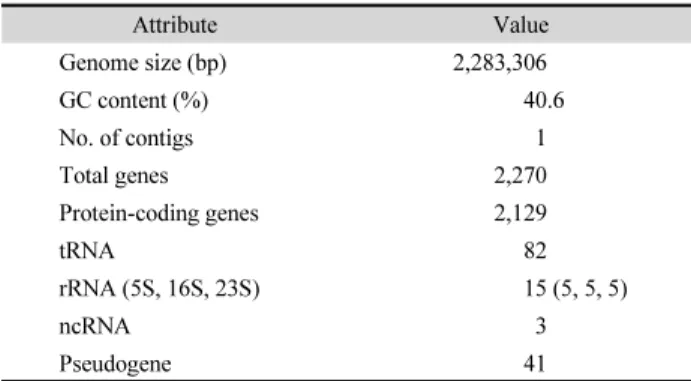
The complete genome of S. gordonii KCOM 1506 is 2,283,306 bp in length and has a G+C content of 40.6% (Table 1). A total of 2,129 protein-coding sequences (CDSs), 15 rRNAs, and 82 tRNAs were annotated (Table 1). The genome sequence contained virulence factors such as hemolysin, toxin A, antitoxin HipB, antiseptic resistance protein, T surface-antigen of pili, staphylococcal secretory antigen SsaA precursor, antirestriction protein (ArdA), zinc metalloproteases, penicillinase repressor, and macrolide export ATP-binding/permease protein MacB. The genome contained oxidative stress-response genes, superoxide dismutase and glutaredoxin-like protein NrdH, bacteriocin class IIc cyclic gassericin A-like protein, and antilisterial bacteriocin subtilosin biosynthesis protein AlbE. The complete genome included genes responsible for biofilm formation, glycosyl- transferase EpsE, glycosyltransferase-stabilizing protein Gtf2, glycosyltransferase Gtf1, and AI-2 transport protein TqsA. The genome also contained Type II secretion system protein E/F, the nine two-component systems (VicK/VicR, SaeS/SaeR, CiaH/CiaR, LiaS/LiaR, Ihk/Irr, NisK/NisR, AgrC/AgrA, ComD/
ComE, and YesM/YesN), one unmatched sensor histidine kinase (DskK). ESX-1 secretion system protein EccCa1.
Nucleotide sequence accession number
This whole genome sequence was deposited in GenBank under accession number NZ_CP012648.
적 요
Streptococcus gordonii는 그람 양성이면서, 통성 혐기성,
및 비운동성 구균이다. S. gordonii는 사람의 구강 내 정상세균 총의 하나이고, 치면 생체막 형성의 선구적 세균 종이다. S.
gordonii는 감염성 심내막염과 패혈성관절염 뿐만 아니라 유 치의 치수염에 연관이 있다. S. gordonii KCOM 1506 (= ChDC
B679) 균주가 사람 급성치수염 병소에서 분리되었으며 그 유전체
염기서열을 해독하여 보고한다.
Acknowledgements
This research was supported by the Bio and Medical Technology Development Program of the National Research Foundation (NRF) funded by the Ministry of Science, ICT and Future Planning (NRF-2013M3A9B8013860). The Streptococcus gordonii KCOM 1506 strain was deposited in the Korean Collection for Oral Microbiology (Gwangju, Korea).
References