Comparison of Organic Carbon Composition in Profile by Using Solid
13C CPNMR Spectroscopy in Volcanic Ash Soil
Yeon Kyu Sonn, Seong Soo Kang, Sang Keun Ha, Yoo Hak Kim, and Chang Hoon Lee*
1Soil and Fertilizer Management Division, NAAS, RDA, Suwon, 441-707, South Korea
(Received: October 7 2013, Accepted: October 17 2013)
Soil organic carbon (SOC) has the potential to promote the soil quality for sustainability and mitigation of global warming. There is little information on organic carbon composition despite of having resistance of carbon degradation in soil. In this study, to understand the effect of volcanic ash on organic carbon composition and quantity in soil, we investigated characteristics of volcanic soil and compared organic carbon composition of soil and humic extract by using 13C-CPMAS-NMR spectra under soil profiles of Namweon series in Jeju. SOC contents of inner soil profiles were 134.8, 101.3, and 27.4 g C kg-1 at the layer of depth 10-20, 70-80 and 90-100 cm, respectively. These layers were significantly different to soil pH, oxalate Al contents, and soil moisture contents. Alkyl C/O-alkyl C ratio in soil was higher than that of humic extracts, which was decreased below soil depth. Aromaticity of soil and humic extract was ranged from 29-38 and 24-32%, which was highest at the humic extract of 70-80 cm in soil depth. These results indicate that the changes of SOC in volcanic ash soil resulted from alteration of organic composition by pyrolysis and stability of organic carbon by allophane in volcanic ash soil.
Key words: Soil organic carbon (SOC), Andisols, Carbon composition, 13C NMR, Alkyl C/O-alky C ratio, Aromaticity
Relative distribution of signal area over chemical shift regions (ppm) in 13C-CPMAS-NMR spectra of soil and humic extracts from a different depth in profile of volcanic ash soil.
Contents Soil depth Organic carbon composition A/OA
Ratio† Aromaticity
Alkyl O-Alkyl Aromatic Carboxyl
cm --- % --- % Soil
10-20 25.3a 29.3a 33.0a 12.3a 0.864a 37.7a
70-80 22.2b 32.7b 30.8b 14.2b 0.678b 35.9ab
90-100 22.6b 38.3c 25.2c 13.9c 0.590c 29.3c
Humic extracts
10-20 24.1a 39.6a 20.3a 15.7a 0.605a 24.1a
70-80 20.8b 35.4b 26.4b 17.3b 0.587ab 32.0b
90-100 19.8bc 41.8c 22.2c 16.2c 0.474c 26.4a
† A/OA ratio denotes alkyl C and O-alkyl C ration. Means with the same letter in column are not significantly different at p<0.05 level by Duncan´s test.
1)
*Corresponding author : Phone: +82312900355, Fax: +85312900208, E-mail: [email protected]
§Acknowledgement: This study was carried out with the support of “Cooperative Research Program for Agricultural Science &
Technology Development (Project No. PJ0086202013)”, Rural Development Administration, Republic of Korea and was supported by 2013 Postdoctoral Fellowship of National Academy Agricultural Science (Project No. PJ008598032013), Rural Development Administration, Republic of Korea.
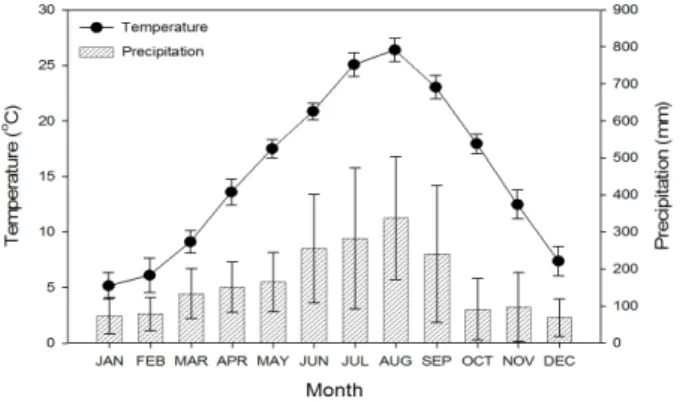
Fig. 1. Average temperature and precipitation during 30 years around the selected site in Jeju islands (Bar means standard errors).
Introduction
집약적인 농경지에서 토양 유기물 함량은 감소되는 경향 을 보이고 있는데 (Lal, 2004), 이는 경운에 의한 입단 교란 및 입단에 포함된 유기물이 노출되어 분해가 촉진된 결과로 나타날 수 있다 (Baldock and Nelson, 2000; Chen, 1986;
Devevre and Horwathm, 2000). 토양유기물의 감소는 토양 질과 작물의 지속성, 그리고 탄소탈취 및 침식저항성을 감 소 (Lee et al., 2009, 2013a, 2013b)시키기 때문에 농경지 토 양유기물을 보전하기 위한 합리적인 방안모색이 필요하다.
토양유기물은 목탄, 3차원의 구조적 특성, 그리고 다양한 aromatic 화합물에 의해 생물학적 분해 저항성을 나타낸다 (Baldock and Skjemstad, 2000; Marschner et al., 2008;
Oades, 1988). 유기물의 분해는 토양에서 humus와 물리적 결합, 점토의 표면특성, amorphous oxide 함량에 영향을 받는다 (Baldock and Skjemstad, 2000). 최근 몇몇 연구는 allophane과 복합체를 형성하는 유기물은 미생물과 효소작 용에 의한 무기화율이 낮아진다고 보고하고 있다 (Chevallier et al., 2010; Woignier et al., 2007). 그러나 화산활동 및 기후, 그리고 식생 등과 같은 자연적 인자는 토양유기물과 밀접한 관계를 가지기 때문에 자연환경은 토양유기물을 변 화시키는 주요한 원인이 될 수 있다. 토양유기물은 식물체 와 미생물로 유래되는 이질성의 혼합체로 이루어져 있으나, 토양 유기물의 구조 및 화합물의 분류는 비파괴 분광기술로 분석이 가능하다 (Simpson et al., 2008). NMR spectroscopy 는 화합물의 탄소 결합형태 및 작용기 특성을 분류할 수 있 고, 토양유기물을 구성하는 fulvic 및 humic acid, lipid, carbohydrate, 그리고 lignin과 더불어 유기물을 구성하는 lipid 및 phenol 화합물을 NMR spectra의 chemical shift에 의해 분류와 더불어 각 peak 면적 비율을 통해 정량이 가능 하다 (Diel et al., 1990; Kögel-Knabner, 2000).
일반적으로 Andisols는 Soil organic carbon (SOC)을 안 정화시키기 때문에 잠재적인 탄소 고정원 (C sink)으로 높 은 가치가 있다 (Dahlgren et al., 1993; Eswaran et al., 1993). Andisols에서 SOC 함량은 black carbon과 같이 aromatic 화합물의 특성 (Golchin et al., 1997; Shindo et al., 1986a, 1986b, 2004), 화재 및 화산재, 그리고 미세입자 의 과습상태가 aromaticity에 영향을 미친다 (Buurman et al., 2007; Gonzölez-Pörez et al., 2007; Naafs, 2004;
Nierop and Buurman, 2007). 또한 allophane과 imogolite 와 같은 비결정형 광물 (Torn et al., 1997) 및 Al-humus 복 합체 (Inoue and Higashi, 1988) 함유가 높기 때문에 미생 물 분해로부터 토양유기물의 안정성을 도모할 수 있다 (Kögel, 1986; Takahashi et al., 1995). 이와 같이 Andisols 는 광물구조 및 특성, 열분해 및 기후에 따라 유기물의 특성 에 영향을 미칠 수 있다 (Almendros, 2008). 이와 같이
Andisols 특성은 농경지 유기물의 보전 및 증진할 수 있는 관리방안을 제공하는 토양 자원으로 활용이 가능하다. 그럼 에도 불구하고 토양단면에 따른 토양유기물의 조성 및 분포 특성에 대한 연구는 거의 없는 실정이다. 본 연구는 농경지 토 양유기물 관리를 위한 방안을 모색하고자 화산재를 모암으 로 생성된 Andisols의 토양 특성과 13C NMR spectroscopy 를 이용하여 토양 깊이에 따른 유기탄소 화합물의 조성 변 화를 비교하였다.
Materials and Methods
토양시료 채취 토양 시료는 제주도 서귀포시 표선면 성읍리 (33°25'11.40'' N; 126°46'39.73'' E)에서 채취하였다.
이 지역의 30년간 연평균 기온은 15.4 ± 0.5℃, 연평균 강 수량은 1970 ± 413 mm이었고, Fig. 1과 같이 월 평균 기온 과 강수량은 8월이 26.4 ± 0.5℃와 337 ± 167 mm으로 가 장 높았고, 특히 강우량은 6-9월 사이에 집중되는 경향을 보였다. Soil Taxonomy의 표준 방법인 Soil Survey Laboratory Methods Manual에 의해서 토양 단면의 층위를 구분하였다.
A 층 (0-5cm)과 BA 층 (5-40 cm)은 black (10YR 2/1)색, Bw 층 (40-80 cm)은 very dark brown (10YR 2/2), BC1 층 (80-95 cm)은 dark grayish brown (10YR 2/3), BC2 층 (95-120 cm)은 dark yellowish brown (10YR 4/4)으로 토양 층위에 따라 뚜렷한 토양색을 나타내었다. 이 토양단면을 기술한 결과, 조사지역은 화산재의 영향을 받았고, 토양수 분상 및 온도상은 각각 udic과 thermic 특성을 가진 남원통 이었다. 이때 배수등급은 “양호”이었고, 2-7%의 경사 지역 에서 사료작물을 재배하고 있었다. 토양시료는 10 cm 간격 으로 130 cm까지 코어 (200 cm3)와 토양 bulk 시료를 3반복 으로 채취하였다.
토양 분석 코어시료는 건조기에서 105℃로 48 시간 동 안 건조한 후에 용적밀도와 중량수분을 산정하는데 이용하
였다. 토양 bulk 시료는 풍건 및 분쇄한 후 2 mm 체를 이용 하여 분석을 위한 토양시료로 조제하였다. 토양 pH는 토양 과 증류수를 1:5 (wt wt-1)로 30분 침탕하여 pH meter (Orion 720A, USA)로 측정하였다 (NAAS, 2010). 유효인산 은 Lancaster 방법으로 침출하여 660 nm에서 UV-visiable spectrometer로 측정하였다 (NAAS, 2010). 전탄소 (TC)와 전질소 (TN)는 토양시료를 ball-mill로 곱게 갈은 후 원소 분석기 (CHN elemental analyzer)로 측정하였다. 또한 입자 탄소 (particular carbon)는 5% sodium pyrophosphate로 16 시간 진탕하여 53 ㎛ 체에 걸려진 부산물을 105℃로 24 시 간 건조하여 원소분석기를 이용하여 TC와 TN 함량을 측정 하였다 (Lee et al., 2009). 간접적인 Allophane과 ferrihydrite 함량을 위해서 0.5 M sodium oxalate로 침출하여 Al, Fe, Si 를 ICP (Inductively coupled plasma)로 측정하였다 (Childs, 1985; Parfitt and Wilson, 1985).
Humic substance 추출 및 13C NMR spectra 토양시 료는 NMR 분석 동안에 자기에 영향을 미치는 광물을 제거 하기 위해서 0.1M HF를 처리하였고, 증류수를 이용하여 반 복적으로 씻어낸 후, 동결 건조하여 NMR 분석에 이용하였 다 (Schmidt et al., 1997; Gelinas et al., 2001). Humic substance의 추출은 2 단계 과정으로 하였다. 먼저 토양 20 g 을 0.25M NaOH-HF 혼합용액 200 mL와 함께 250 mL 원 심분리용기에 넣은 후, 200 rpm 에서 16 시간 동안 교반하 였다 (Olk et al., 1996). 이후 4000 rpm에서 20 분간 원심 분리를 하였고, 상등액을 No. 2 여과지를 이용하여 여과하 였다. 두 번째 과정에서 여과된 humic 상등액을 –20℃에서 급속 냉동한 후에 동결 건조하여 13C NMR spectra을 얻는 시료로 이용하였다.
토양 및 동결 건조된 humic 추출물 약 100 mg을 4-mm probe에 넣은 후 13C Cross Polarization with Magic Angle Spinning (CP/MAS) Nuclear Magnetic Resonance (NMR)로
13C NMR spectra을 얻었다. 각 spectra는 4 mm H-X MAS probe가 장착된 Bruker BioSpin Avance 400 MHz NMR spectrometer에서 ramp CP pulse 를 사용하여 얻었고, 다 음과 같이 각 peak를 동정하였다: 10 kHz의 spine rate, 2 ms ramp-CP, 1s delay time (Simpson and Hatcher, 2004). Spectra는 Bruker XWINNMR (version 3.5) 프로그 램을 이용하여 10 MHz로 각 peak를 동정하였고, Chemical shift에 의해 다음과 같이 적분하여 상대적인 비율을 산정 하였다: alkyl C (0-50 rpm), alcohols, amines, carbohydrate, ethers, methoxy and acetal carbon을 포함하는 O-alkyl C (50-110 rpm), aromatic C (110-160 rpm), 그리고 carboxyl 과 carbonyl C (160-200 rpm) (Hatcher et al., 1983;
Malcolm, 1989; Preston et al., 1997). Alkyl C/O-alkyl C 비는 alkyl C intensity에 O-alkyl C intensity를 나누어 구
하였다 (Baldock and Preston, 1995). Aromaticity의 비율 은 [Aromatic/(alkyl C + O-alkyl C + aromatic C)] × 100 로 구하였다 (Hatcher et al., 1983). 13C NMR의 조성비는 SAS 프로그램 (version 9.1)에서 ANOVA 분석하였고, 5%
유의수준으로 Duncan의 다중검정으로 평균을 비교하였다.
Results and Discussion
깊이에 따른 토양 특성 변화 Andisols의 중심 개념은 화산회, 부석, 분석, 용암과 같은 화산분출물이나 화산쇄설 물 위에서 발달되고, 교질 부분이 allophane, imogolite, ferrihydrite 등 과 같은 short-order-range 광물이거나 Al-유기복합체가 주가 되는 토양이다 (USDA, 1999). Andisols 의 대표적인 특성은 풍화작용으로 인한 무기적인 변환과 Al 과 복합체 형태로의 유기물 집적이다 (Song et al. 1997).
Figure 1과 같이, SOC 함량은 10-20 cm에서 134.8 g kg-1 이었고, 이후 80 cm 까지 SOC 함량은 감소되는 경향을 보 였으며 70-80 cm의 SOC 함량은 101.3 g kg-1을 나타내었 다. 그러나 토양 깊이 80 cm 이후에 SOC 함량은 27.4 g kg-1 이하로 표층에 비해 급격한 감소를 나타내었다.
Particular organic carbon (POC) 함량은 0-10 cm 에서 125.3 g kg-1, 30-80 cm에서 약 50 g kg-1, 80 cm 이후에는 7.1-26.7 g kg-1을 나타내었다. C/N 율은 13.1 (0-10 cm)에 서 토양하층으로 갈수록 14.5 (80 cm 까지)로 서서히 증가 되는 경향을 보였고, 80-130 cm에서는 약 15.5-22.4를 나 타내었다. Hernandez and Almendros (2012)는 화산재 토양 입단에 형성된 피막 또는 수용성 화합물의 분해는 일부가 무기화된다고 보고하였는데, Andisols과 같이 산성 조건은 광물 조성 및 비결정형 산화물 (Al과 Fe), 식생 조성에 의해 유기물 함량이 달라질 수 있다고 하였다 (Boudot et al., 1988, 1989; Zunino et al., 1982). 따라서 표층에서 SOC 함 량의 증가는 토양에 유입된 유기물이 Al-humus 복합체 형 성 (Inoue and Higashi, 1988), 그리고 점토광물에 유기화 합물이 피막 형성하여 유기물의 분해저항성이 높아진 결과 로 해석된다.
화산재는 allophane과 imogolite와 같은 비결정형 광물의 조성이 높고 (Torn et al., 1997), 특히allophane의 구조적 특성이 유기물의 분해에 영향을 미칠 수 있다. Figure 2에 서 토양 깊이에 따른 oxalate Al, Fe, Si 함량 변화를 나타내 었다. 간접적으로 allophane 함량을 나타내는 oxalate Al은 토양 깊이 0-80 cm 사이에서 약 19-22 g kg-1을 나타내었 고, 대부분의 작물의 뿌리가 존재하는 토양 깊이 0-30 cm 에서 19 g kg-1으로 70-80 cm 깊이에 비해 낮은 결과를 보 였다. 이는 Fig. 2와 같이 표토의 pH 개선이 Al의 용해에 영 향을 미치거나 유기물 함량의 증가로 Al-humus의 복합체 형성이 높아진 결과로 해석된다. 또한 유효인산 함량은 토
Fig. 2. Properties of soil profiles on Namweon series in Jeju islands (A; soil organic carbon; B, particular carbon; C, carbon to nitrogen ratio; D, oxalate Al, E; oxalate Fe; F, oxalate Si; G, soil pH; H, bulk density; I, water content).
양 깊이 0-10, 10-20, 20-30 cm에서 각각 96.1, 61.1, 19.1 mg kg-1을 나타내었고, 30 cm 이후에는 유효인산함량은 거 의 없었다. 산성토양 조건에서 침전과 특이적 흡착으로 무 기태 인이 Al 및 Fe 과 결합하여 인 유효도가 영향을 받는 데, Fig. 2와 같이 Al과 Fe의 결합이 표토의 oxalate Al과 Fe 함량을 감소시킬 수 있다. 토양 깊이 0-80 cm의 용적밀 도는 평균 0.62 g cm-3으로, 90 cm 이후 깊이의 용적밀도
0.89 g cm-3에 비해 낮았다. 호기적 조건에서 생물학적 분 해는 촉진됨에도 불구하고 (Chevallier et al., 2010; Woignier et al., 2007), 표토의 SOC 함량은 증가되는 결과를 나타내 었다 (Fig. 2). 화산재의 포함된 allophane의 구조적 특징은 다공성으로 인해 수분보유력이 높은 것으로 알려져 있다 (Nierop and Buurman, 2007). 따라서 조사지점의 평균 강 수량은 1970 mm로 기후적 특성이 토양 깊이에 따라 SOC
Table 1. Relative distribution of signal area over chemical shift regions (ppm) in 13C-CPMAS-NMR spectra of soil and humic extracts from a different depth in profile of volcanic ash soil.
Contents Soil depth Organic carbon composition A/OA
Ratio† Aromaticity
Alkyl O-Alkyl Aromatic Carboxyl
cm --- % --- %
Soil 10-20 25.3a 29.3a 33.0a 12.3a 0.864a 37.7a
70-80 22.2b 32.7b 30.8b 14.2b 0.678b 35.9ab
90-100 22.6b 38.3c 25.2c 13.9c 0.590c 29.3c
Humic extracts
10-20 24.1a 39.6a 20.3a 15.7a 0.605a 24.1a
70-80 20.8b 35.4b 26.4b 17.3b 0.587ab 32.0b
90-100 19.8bc 41.8c 22.2c 16.2c 0.474c 26.4a
† A/OA ratio denotes alkyl C and O-alkyl C ration. Means with the same letter in column are not significantly different at p<0.05 level by Duncan´s test.
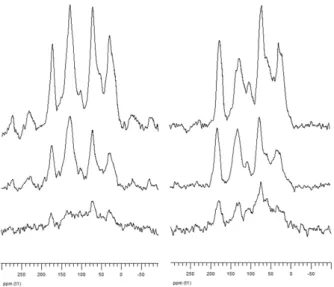
Fig. 3. 13C NMR spectra of soil and humic extract at different soil depth in volcanic ash soil.
함량에 영향을 미친 것으로 사료된다. 이상의 결과를 통해 토양유기물은 화산재의 광물 구조 및 화학적 특성, 기후에 영향을 받는 것을 알 수 있었다.
13C NMR spectra 분포 특성 Andisols에서 SOC 변화 는 유기물에 포함된 aromatic 화합물의 특성에 의존한다고 알려져 있다(Golchin et al., 1997; Shindo et al., 1986a, 1986b, 2004). 이러한 결과는 열에 의해 발생되며 매우 안 정한 형태로 생물학적 분해 저항성을 가진다. 토양 생성 및 발달 과정 중 유기물의 형태가 화산재에 의해 영향을 받는 다는 가설을 기초로 하여 토양 깊이 10-20 cm, 70-80 cm, 90-100cm를 선발하였고, 그리고 13C NMR spectra로 SOC 의 조성을 비교하였다 (Fig. 3). 이때 각 peak는 시료에 따 라 약간의 chemical shift가 있었고, 토양과 humic 추출물 의 SOC 조성은 13C NMR spectra의 면적비율로 Table 1에 나타내었다. 예를 들어 alkyl C는 chemical shift 0-50 ppm 사이로 alkyl chain (24-26 ppm) methylene C (28-34 ppm), aliphatic C (41-42 ppm), 그리고 amine C (45-46 ppm)을 포함한다. 또한 amorphous (29-30 ppm)과 crystalline methylene C (32-33 ppm)는 생물학적 분해에 저항성을 나타내는 식물체 구성물로부터 유래되며 Alkyl C 영역에서 축적된다 (Hu et al., 2000; Salloum et al., 2002). O-alkyl C 영역 (50-110 ppm)은 산소를 기반하는 하는 methoxyl C (56 ppm), 탄수화물에 포함된 ring C 과 ether 형태로 결합된 C (65-95 ppm), 그리고 탄수화물에 있는 anomeric C (105 ppm)을 포함한다 (Malcolm, 1989).
Aromatic C 영역 (110-165 ppm) 은 aromatic C (110-145 ppm)과 phenol C (145-160 ppm)을 나타내며, carboxyl C 영 역 (160-210 ppm)은 carboxylic, amide, ester C의 signal을 가진다 (Malcolm, 1989).
토양 중 13C NMR spectra의 alkyl C/O-alkyl C의 비는 각 유기탄소의 조성과 분해력을 평가할 수 있다. alkyl
C/O-alkyl C 비는 유기물의 분해가 증가함에 따라 함께 증 가되기 때문에 13C NMR spectra의 비를 활용함으로써 토양 유기물의 분해저항성을 해석하는 지표로 이용된다 (Baldock and Preston, 1995). Table 1에서와 같이, 세 지점의 토양 깊이에서 alkyl C/O-alkyl C 비는 0.590-0.864 범위로 humic 추출물의 0.474-0.605 보다 높았다. 토양과 humic 추출물의 alkyl C/O-alkyl C 비는 토양 깊이가 깊을수록 감 소는 결과를 나타내었다. 이는 토양에 유입된 유기물 자체 의 화학적 특성에 따른 이유도 있으나, Fig. 2와 같이 andisol 에서 나타나는 oxalate Al 함량 및 allophane 같은 비결정형 광물의 구조가 유기물의 안정성 및 생물학적 분해저항성이 증가된 결과로 해석된다.
유기물의 안정성의 정도를 나타내는 Aromaticity는 토양 에서 29.3-37.7%로 두 지점 (10-20와 70-80 cm)에서 뚜렷 한 통계적 차이를 나타내지 않았다. 그러나 humic 추출물의 aromaticity는 24.1-32.0%로 토양에 비해 낮았고, 세 지점
중에서 70-80 cm 깊이의 aoromacity는 32.0%로 가장 높았 다. 화산재 유입에 의한 열작용이 토양유기물의 구조를 변 화시킬 수 있다. Aromaticity는 숯이 된 식물의 조각과 어울 려 있는 것으로 화산활동의 영향을 받아 “Black C”가 생성 된다고 일본 화산재 토양에서 규정하고 있고 있다 (Golchin et al., 1997; Shindo et al., 2004). 이러한 화합물은 다량 의 aromatic를 함유하여 구조적으로 매우 안정한 aromatic 화합물로 변화되고, 생물학적인 분해에 저항성이 매우 높다 (Baldock and Skjemstad, 2000; Marschner et al., 2008;
Oades, 1988). Figure 3에서 13C NMR spectra는 aromatic 영 역은 검은 탄소 (pyrogenic C)의 조성비율을 간접적으로 잘 나타내고 있다. Allophane과 같은 단편구조는 비부식 탄소 의 보전, 공극에 포화된 수분, 열분해로 인한 carbohydrate 와 토양질소의 생성 양에 의해 영향을 미치는데 (Almendros et al., 1996), 이러한 이유로 토양 깊이에 따라 토양유기물 함량의 차이가 나타난 것으로 해석된다. 이상의 결과는 화 산재로 생성 및 발달된 토양은 유기물의 화학적 특성 및 조 성의 변화로 유기물의 안정성에 기여함을 나타내고 있다.
Conclusion
본 연구는 토양유기물에 대한 화산재의 영향을 조사하고 자 화산재를 모암으로 생성 및 발달된 남원통에서 토양 깊 이별 토양특성과 13C NMR spectra를 이용하여 유기물의 조 성비율을 비교하였다. 화산재는 토양단면에서 Al과 allophone 같은 비결정형 광물에 의해 SOC 함량을 증가시켰고, 특히 경작층의 유기물을 축적시켰다. 또한 화산재는 alkyl C와 O-alkyl C의 변화로 유기물의 생물학적 분해저항성이 향상 되며, 열분해에 의해 다량의 aromatic 구조를 함유하는 pyrogenic C가 유기물의 안정성에 기여하였다. 본 결과는 농경지 토양유기물을 보전 및 증진하기 위한 합리적인 방안 을 모색하는 기초 자료로 활용가치가 있는 것으로 판단된다.
References
Almendros, G., 2008. Humic substances. In: Cheswort,W.
(Ed.), Encyclopedia of Soil Science. Springer, Dordretch, pp. 97-99.
Almendros, G., M.E. Guadalix, F.J. González-Vila, and F.
Martin. 1996. Preservation of aliphatic macromolecules in soil humins. Org. Geochem. 24:651-659.
Baldock, J.A., and C.M. Preston. 1995. Chemistry of carbon decomposition processes in forests as revealed by solid-state carbon-13 nuclear magnetic resonance. p. 89–117. In W.W.
McFee and J.M. Kelly (ed.) Carbon forms and functions in forest soils. SSSA, Madison, WI.
Baldock, J.A., and J.O. Skjemstad. 2000. Role of the soil
matrix and minerals in protecting natural organic materials against biological attack. Org Geochem. 31:697-710.
Boudot, J.P., A. Bel Hadi Brahim, and T. Chone. 1988.
Dependence of carbon and nitrogen mineralization rates upon amorphous metallic constituents and allophones in highland soils. Geoderma. 42:245-260.
Boudot, J.P., A. Bel Hadi Brahim, R. Steiman, and F. Seigle- Murandi. 1989. Biodegradation of synthetic organo-metallic complexes of iron and aluminum with selected metal to carbon ratios. Soil Biol Biochem. 21:961-966.
Buurman, P., F. Peterse, and G. Almendros. 2007. Soil organic matter chemistry in allophanic soils: a pyrolysis-GC/MS study of a Costa Rican Andosol catena. Eur J Soil Sci.
58:1330-1347.
Chen, Y. 1986. The Role of Organic Matter in Modern Agriculture. Martinus Nijhoff, Dordrecht. Chevallier, T.,Woignier, T., Toucet, J., Blanchart, E., 2010. Organic carbon stabilization in the fractal pore structure of Andosols.
Geoderma. 159:182-188.
Chevallier, T., T. Woignier, J. Toucet, and E. Blanchart.
2010. Organic carbon stabilization in the fractal pore structure of Andosols. Geoderma. 159:182-188.
Childs, C. S. 1985. Towards understanding soil mineralogy.
II. Notes on ferrihydrite. Laboratory Report CM 7. Soil Bureau, Lower Hutt, New Zealand
Dahlgren, R.A., S. Shoji, and M. Nanzyo. 1993. Volcanic ash soils: genesis, properties and utilization. In: Shoji, S., Nanzyo, M., Dahlgren, R.A. (Eds.). Elsevier, Amsterdam, The Netherlands, pp. 73-100.
Devevre, O.C., and W.R. Horwathm. 2000. Carbon sequestration into soil organic matter under organic-based management.
In: Proc. 10th International Meeting of the International Humic Substances Society, Tolouse, France, pp. 707-711.
Dinel, H., M. Schnitzer, and G.R. Mehuys. 1990. Soil lipids:
Origin, nature, content, decomposition, and effect on soil physical properties. p. 397-427. In Bollag, J.M. and G.
Stotzky (ed.) Soil biochemistry. Vol. 6. Marcel Dekker, New York.
Eswaran, H., E. Van Den Berg, and P. Reich. 1993. Organic carbon in soils of the world. Soil Sci. Soc. Am J. 57:192- 194.
Gelinas, Y., J.A. Baldock, and J.I. Hedges. 2001. Demineralization of marine and freshwater sediments for CP/MAS 13C NMR analysis. Org. Geochem. 32:677-693.
Golchin, A., J.A. Baldock, P. Clarke, T. Higashi, and J.M.
Oades. 1997. The effects of vegetation and burning on the chemical composition of organic matter of a volcanic ash soil as shown by 13C NMR spectroscopy. Geoderma.
76:175-192.
González-Pérez, J.A., C.D. Arbelo, F.J. GónzalezeVila, A.
Rodríguez Rodríguez, G. Almendros, C.M. Armas, and O.
Polvillo. 2007. Molecular features of organic matter in
diagnostic horizons from andosols as seen by analytical pyrolysis. J Anal Applied Pyrolysis. 80:369-382.
Hatcher, P.G., I.A. Breger, L.W. Dennis, and G.E. Maciel.
1983. Solid-state carbon-13-NMR of sedimentary humic substances: new revelations on their chemical composition.
In: Christman, R.F., and E.T. Gjessing (Eds.), Aquatic and Terrestrial Humic Materials. Ann Arbor Science, Michigan, pp. 37-81.
Hernández, Z., and G. Almendros. 2012. Biogeochemical factors related with organic matter degradation and C storage in agricultural volcanic ash soils. Soil Biol Biochem.
44:130-142.
Hu, W. G., J. Mao, B. Xing, and K. Schmidt-Rohr. 2000.
Poly(methylene) crystallites in humic substances detected by nuclear magnetic resonance. Environ. Sci. Technol.
34:530–534.
Inoue, K., and T. Higashi. 1988. Al- and Fe-humus complexes in Andisols. In: Kinloch, D.I., Shoji, S., Beinroth, F.M., Eswaran, H. (Eds.), Proc. 9th International Soil Classification Workshop, Japanese Committee for 9th International Soil Classification Workshop and Soil Management Support Services, Washington, pp. 535-546.
Kögel, I. 1986. Estimation and decomposition pattern of the lignin component in forest humus layers. Soil Biol Biochem. 18:589-594.
Kögel-Knabner, I. 2000. Analytical approaches for characterizing soil organic matter. Org. Geochem. 31:609–625.
Lee, C.H., K.Y. Jung, S.S. Kang, M.S. Kim, Y.H. Kim, and P.J. Kim. 2013a. Effect of long term fertilization on soil carbon and nitrogen pools in paddy soil. Korean J. Soil Sci.
Fert. 46(3):216-222.
Lee, C.H., C.Y. Park, K.Y. Jung, and S.S. Kang. 2013b.
Long-term effects of inorganic fertilizer and compost application on rice sustainability in paddy soil. Korean J.
Soil Sci. Fert. 46(3):223-229.
Lee, S.B., C.H. Lee, K.Y. Jung, K.D. Park, D.K. Lee, and P.J. Kim. 2009. Changes of soil organic carbon and its fractions in relation to soil physical properties in a long-term fertilized paddy. Soil Tillage Res. 104:227-232.
Marschner, B., S. Brodowski, A. Dreves, G. Gleixner, A.
Gude, P.M. Grootes, U. Hamer, A. Heim, G. Jandl, R. Ji, K. Kaiser, K. Kalbitz, C. Kramer, P. Leinweber, J.
Rethemeyer, A. Schäffer, M.W.I. Schmidt, L. Schwark, G.L.B. Wiesenberg. 2008. How relevant is recalcitrance for the stabilization of organic matter in soils? J Plant Nutr Soil Sci. 171:91-110.
Malcolm, R.L. 1989. Applications of solid-state 13C NMR spectroscopy to geochemical studies of humic substances.
In: Hayes, M.H.B., MacCarthy, P., Malcolm, R.L., Swift, R.S. (Eds.), Humic Substances II. In Search of Structure.
Wiley, New York, pp. 340-372.
Naafs, D.F.W. 2004. What are humic substances? A molecular
approach to the study of organic matter in acid soils. PhD Thesis, University of Utrecht, Utrecht, The Netherlands, pp. 162.
NAAS. 2010. Fertilizer application recommendations for crop plants, National Academy of Agricultural Science, RDA, Suwon, Korea.
Nierop, K.G.J., and P. Buurman. 2007. Thermally assisted hydrolysis and methylation of organic matter in two allophanic volcanic ash soils from the Azores Islands. In:
Arnalds, O., F. Bartoli, P. Buurman, H. Oskarsson, G.
Stoops, and E. García-Rodeja (Eds.), Soils of Volcanic Regions in Europe. Springer, Berlin, pp. 411-422.
Oades, J.M., 1988. The retention of organic matter in soils.
Biogeochemistry. 5:35-70.
Piccolo, A., 1996. Humic Substances in Terrestrial Ecosystems.
Elsevier, New York, pp. 675.
Parfitt, R. L. and A. D. Wilson. 1985. Estimation of allophane and halloysite in three sequences of volcanic soils, New Zealand. In E. F. Caldas and D. H. Yaalon(ed.). Volcanic Soils. Catena Suppl. 7:1-8.
Preston, C., J. Trofymow, B. Sayer, and J. Niu. 1997. 13C nuclear magnetic resonance spectroscopy with cross-polarization and magic-angle spinning investigation of the proximate- analysis fractions used to assess litter quality in decomposition studies. Canadian J Botany. 75:1601–1613.
Salloum, M.J., B. Chefetz, and P.G. Hatcher. 2002.
Phenanthrene sorption to aliphatic-rich natural organic matter. Environ. Sci. Technol. 36:1953–1958.
Schmidt, M., H. Knicker, P.G. Hatcher, and I. Kogel-Knabner.
1997. Improvement of 13C and 15N CPMAS NMR spectra of bulk soils, particle size fractions and organic material by treatment with 10% hydrofl uoric acid. Eur. J. Soil Sci.
48:319-328.
Shindo, H., Y. Matsui, and T. Higashi. 1986a. A possible source of humic acids in volcanic ash soils in JapaneCharred residue of Miscanthus sinensis. Soil Sci. 141:84-87.
Shindo, H., Y. Matsui, and T. Higashi. 1986b. Humus composition of charred plant residues. J Soil Sci Plant Nutr.
32:475-478.
Shindo, H., T. Honna, S. Yamamoto, and H. Honma. 2004.
Contribution of charred plant fragments to soil organic carbon in Japanese volcanic ash soils containing black humic acids. Org Geochem. 35:235-241.
Simpson, M.J., and P.G. Hatcher. 2004. Determination of black carbon in natural organic matter by chemical oxidation and solid-state13C nuclear magnetic resonance spectroscopy.
Org Geochem. 35:923–935.
Simpson, M.J., A. Otto, and X. Feng. 2008. Comparison of Solid-State Carbon-13 Nuclear Magnetic Resonance and Organic Matter Biomarkers for Assessing Soil Organic Matter Degradation. Soil Sci. Soc. Am. J. 72:268-276.
Song, K.C., B.G. Hyun, Y.K. Sonn, H.C. Lim, and S.C. Lee.
2009. Taxonomical Classification of Namweon Series,
Black Volcanic Ash Soils. Korean J. Soil Sci. Fert.
42(5):385-392
USDA, Soil Survey Staff. 1999. Soil Taxonomy. A basic system of soil classification for making and interpreting soil surveys. 2nd ed. Agric. Handbook 436. USDA-NRCS. CRC Press, Boca Paton, Fla., USA.
Takahashi, T., T. Fukuoka, and R.A. Dahlgren. 1995.
Aluminum solubility and release rates from soil horizons dominated by aluminumehumus complexes. Soil Sci Plant Nutr. 41:119-131.
Torn, M.S., S.E. Trumbore, O.A. Chadwick, P.M. Vitousek,
and D.M. Hendricks. 1997. Mineral control of soil organic carbon storage and turnover. Nature. 389:170-173.
Woignier, T., G. Pochet, H. Doumenc, P. Dieudonné, and L.
Duffours. 2007. Allophane: a natural gel in volcanic soils with interesting environmental properties. J Sol-Gel Sci Technol. 41:25-30.
Zunino, H., F. Borie, S. Aguilera, J.P. Martin, and K. Haider.
1982. Decomposition of 14C-labeled glucose, plant and microbial products and phenols in volcanic ashderived soils of Chile. Soil Biol Biochem. 14:37-43.