Synthesis, Curing and Properties of Silicone-Epoxies
Wei Huang†, Youxue Yuan, and Yunzhao Yu
Lab of High-Tech Materials, Institute of Chemistry, Chinese Academy of Science, Beijing, 100080, China (Received November 9, 2006, Accepted November 22, 2006)
Abstract:A new kind of silicone-epoxy composite is reported in this research. The silicone-epoxy resin was synthesized by the hydrosilylation of tetramethycyclotetrasiloxane and 4-vinyl-1-cyclohexene 1,2- epoxy with a high reaction yield. It was found that the obtained silicone-epoxy resin shows a high reactive activity to the aluminum complex-silanol catalyst. The resin could be cured under the catalysis of (Al(acac)3/Ph2Si(OH)2 at a concentration below 0.1 wt% to give a hard cured resin showing excellent optical clarity, UV resistance and thermal stability. It was also found that the Si-H groups facilitated the curing reaction and the silicone-epoxy resin bearing Si-H group could be cured effectively even if Ph2Si(OH)2h was absent. Moreover, the UV resistance and thermal stability were improved significantly by the introduction of Si-H groups. This is possibly due to the reductive property of Si-H groups which can annihilate radical and peroxide effectively. This kind of silicone-containing epoxy composite might have very promising applications as optical resin, optical adhesive and encapsulation materials for electronic devices.
Keywords: silicone-epoxy, cure, UV and thermal aging, encapsulation materials
1. Introduction
1)
As a promising lighting source for the next gen- eration, white LEDs (light emitting diodes) possess many advantages over the traditional lighting sources such as incandescent and fluorescent lamps. They have enjoyed a tremendous growth and a significant technical progress over the past several years. However, there are still a lot of problems to resolve to improve the performance and lifetime, which is highly required in order for white LEDs to enter lighting market substantially. One of them is to develop high-performance encapsulation materials.
Although the use of epoxy resins for the encapsulation of LEDs has been the standard choice for many years [1], new problems have emerged as ever-increasing lev- els of brightness. The toughest one is UV and heat-in- duced yellowing of epoxy resin during actual use espe- cially for short-wavelength LEDs such as green, blue, UV and white LEDs [2]. The yellowing reduces light transmittancy considerably, mainly in the band range from green to near-UV, and consequently results in a serious decrease in the lifetime of LEDs as well as a
†Corresponding author: e-mail: [email protected]
deteriorated spectrum of output light.
To improve the UV stability and thermal stability of epoxy resin for LED encapsulation, attempts including optimization of the ingredients of the epoxy composition [3,4] and the addition of UV stabilizer and antioxidant have been made [2]. Although these methods were rela- tively simple and low-cost, the effects achieved by them were also limited. One the other hand, the modification of epoxy mostly by silicone attracts much attention in recent years [5-9]. Silicone-modified epoxy have the ad- vantages of both epoxy and silicone, for instance, a much improved UV and thermal aging stability com- pared with epoxy and much improved mechanical and adhesive properties compared with silicone. Silicone and epoxy are physically immiscible due to the noticeable discrepancy in their solubility parameters. The mod- ification of epoxy by silicone is generally in a chemical way, i.e, to synthesis silicone-epoxy.
According to the literatures so far, silicone-epoxies for LED encapsulation were always cured using general methods as for unmodified epoxy resins. For example, a large amount of saturated acid anhydride was used as curing agent together with a certain amount of accelerant for anhydride-epoxy reaction. The use of anhydride re-
duced the relative contents of silicone in the cured ma- terials and consequently degraded their UV and thermal stability. Accelerants also have negative effects on their UV and thermal stability. In this paper, we synthesized a kind of silicone-epoxy resins by the hydrosilylation of tetramethycyclotetrasiloxane with 4-vinyl-1-cyclohexene1, 2-epoxy. It was found that these resins were very active to the aluminum complex-silanol catalysts [10]. They could be cured under the catalysis of aluminum acetyla- cetonate (Al(acac)3)/Ph2Si(OH)2 at very low concentra- tions. In addition, the silicone-epoxy resins containing Si-H groups could be cured even if without silanol com- pound [11]. The cured silicone-epoxy resins have ex- cellent optical clarity, UV resistance and thermal aging stability. They are very promising materials for LED encapsulation.
2. Experimental
2.1. Materials
Tetramethycyclotetrasiloxane, 4-vinyl-1-cyclohexene 1,2- epoxy, Al(acac)3 and 2-mercaptobenzothiazole were ch- emical reagents purchased from Adrich Chemical Co.
and used as received. Lamoreaux platinum catalyst and Ph2Si(OH)2 were obtained from Dow Corning Company.
Cyclo-aliphatic epoxy resin (ERL-4221) and diglycidyl ether of bisphenol (DGEBA, epoxy value 0.529) were industrial products supplied by Dow Co. and Shell Chemical Co., respectively. The acid anhydride harder, methyl-hexahyro-phthalic anhydride (MeHPPA), was a commercially available product of Lonza Co. (Italy).
Catalyst used to promote the epoxy-anhydride reactions was tetra-n-butylphosphonium o,o'-diethylphosphotodith- ioate purchased from Nippon Chemical Co. (Japan).
2.2. Synthesis of Silicone-Epoxies
To a 250 mL three-necked round bottom flask equip- ped with a reflux condenser and a nitrogen inlet were added a mixture of 24 g (0.1 mol) tetramethycyclote- trasiloxane and 4-vinyl-1-cyclohexene 1,2-epoxy 52.1 g (0.42 mol) and 80 mL toluene. The reaction mixture was heated to reflux for 1 h to dry the reagents. After cooling to room temperature, there was added 1 drop of the platinum catalyst (0.75 wt% Pt). Then the temper- ature of the reaction mixture was increased to 70oC and held for 2 h. There was no absorption due to the Si-H bond which could be detected by IR at the band of
2100 cm-1 and by 1H-NMR at the band centered at δ=
4.67 ppm. The reaction mixture was cooled to room temperature and 0.005 g 2-mercaptobenzothiazole was added. The toluene and excess reactant were removed under 80oC/5 mmHg. To synthesize the silicone-epoxies containing Si-H bonds, 0.2 mol and 0.3 mol 4-vinyl-1- cyclohexene 1,2-epoxy were used, respectively. The re- maining Si-H bonds were confirmed by IR and 1H- NMR.
2.3. Curing of Silicone-Epoxies
0.1 g Ph2Si(OH)2 and 0.1 g Al(acac)3 were dissolved in 5 g DGEBA epoxy at 120oC, respectively, to obtain catalyst component A and catalyst component B. 5 g sil- icone-epoxy was mixed with a certain amount of compo- nent A and component B, the mixture was degassed un- der vacuum and then poured into a polycarbonate mould.
The cure reactions were carried out at 80oC for 30 min and then 120oC for 30 min. The gelation time of the silicone-epoxy composition was estimated using an elec- trical hot plate. Anhydride-ERL-4221 and anhydride- DGEBA cure reactions were performed at 120oC for 1 h. The composition consisted of 100 parts by weight of ERL-4221 or DGEBA, 80 parts by weight of MeHPPA and 1.2 parts by weight of tetra-n-butylphosphonium o,o'-diethylphosphotodithioate.
2.4. Test of the UV and Thermal Stability of Cured Silicone-Epoxies
Light transmission properties were determined on 10 mm thick sample. The percent light transmittance over a range of 360 nm to 800 nm was measured by a UV- Vis spectrophotometer. Thermal aging studies were con- ducted in a circulating air oven. Test temperature was 150oC and aging time was 24 h. A UV mercury-vapor lamp with a wavelength band range 250-320 nm and a power of 500 watts was used for UV aging test. The distance between the cured epoxy resins and the UV lamp was 40 cm.
3. Results and Discussion
3.1. Synthesis and Cure of Silicone-Epoxy
The platinum catalyzed hydrosilylation reaction is by far the most important method for the synthesis of sili- con containing epoxy compound and polymer. Many sili- cone-epoxies have been synthesized via hydrosilylation as
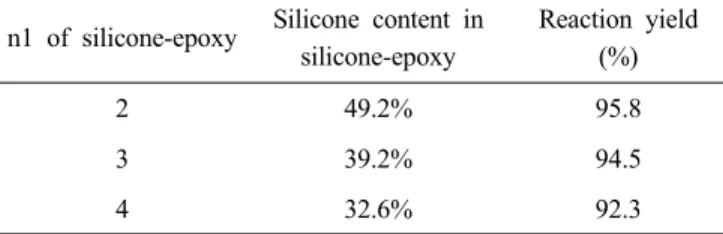
Table 1. Silicone-epoxies synthesized in this study n1 of silicone-epoxy Silicone content in
silicone-epoxy
Reaction yield (%)
2 49.2% 95.8
3 39.2% 94.5
4 32.6% 92.3
described by Crivello and Lee [12]. The reaction used in this paper is shown in eq. (1). Typically, the re- actions were carried out at between 60∼90oC using tol- uene as a solvent.
(1) In eq. (1), if n2 = 0, that means all the Si-H bonds were consumed, the silicone content of the product is about 32.6%. In the case of using a cure agent such as acid anhydride or amine to cure the silicone-epoxy, re- maining of Si-H bonds must be avoided. Otherwise H2
will be released through the reaction of Si-H bonds with the cure agents, which leads to the formation of voids in the cured materials. To ensure the complete dis- appearance of Si-H, 4-vinyl-1-cyclohexene 1,2-epoxy was always used beyond the stoichiometric amount by several percent in the reaction.
It has been reported for a long time that cyclo-ali- phatic epoxy resins can be cured by aluminum com- plex-silanol compound catalyst through a cationic poly- merization mechanism [13-15]. However, this catalyst has found almost no practical application at least till to now.
We have noted that cure reaction involving this catalyst was very sensitive to humidity and atmosphere and the cyclo-aliphatic epoxy resin cured by this catalyst showed a seriously crinkly surface. This might be the main hin- drance to the actual use of this catalyst. Moreover, the catalyst was not so active to cyclo-aliphatic epoxy res- ins, several percent of catalyst is required to obtain well-cured materials. However, it was found that this catalyst was very active to the above silicone-epoxy
[15]. The silicone- epoxy could be well cured with a catalyst concentration less than 0.1 wt%. The cured resin had a smooth surface and the cure reaction was not af- fected obviously by humidity and atmosphere.
Another big advantage of complex-silanol-catalyst-cured silicone-epoxies is that the cure reaction is not interfered by Si-H bonds. Therefore, Si-H can be remained in sili- cone-epoxy and the resins with different silicone contents can be synthesized. Table 1 lists the silicone-epoxies with different n1 values synthesized in this study. The silicone-epoxies were colorless liquids with slight viscosities. The synthesis reactions always had high yields, especially for the silicone-epoxies containing Si-H bonds.
A competing side reaction involving platinum-catalyzed ring-opening polymerization of the cyclohexeneoxy gr- oups of the silicone-epoxies also occurred [16]. The side reaction was enhanced in the synthesis of silicone-epoxy containing Si-H bonds asit was reported that platinum complexes together with compounds containing Si-H bonds were effective initiators for the ring-opening poly- merization of heterocyclic epoxides [17]. The side re- action caused the risk of gel formation because the sili- cone-epoxies were di-, tri- or tetra-functional. To avoid the gel problem, reaction temperature and time must be well controlled and 2-mercaptobenzothiazole must be added to deactivate the platinum catalyst before remov- ing the solvent.
When no catalyst was used, the silicone-epoxies didn’t gelate even at 100oC for 10 h. This suggested that these resins had good storage stability. To cure the silicone- epoxies using a aluminum complex-silanol compound catalyst, Al(acac)3 was selected as aluminum complex and Ph2Si(OH)2 was employed as silanol compound in this study. Other aluminum complexes and silanol com- pounds as reported in the literature [13] were also tuned out effective.
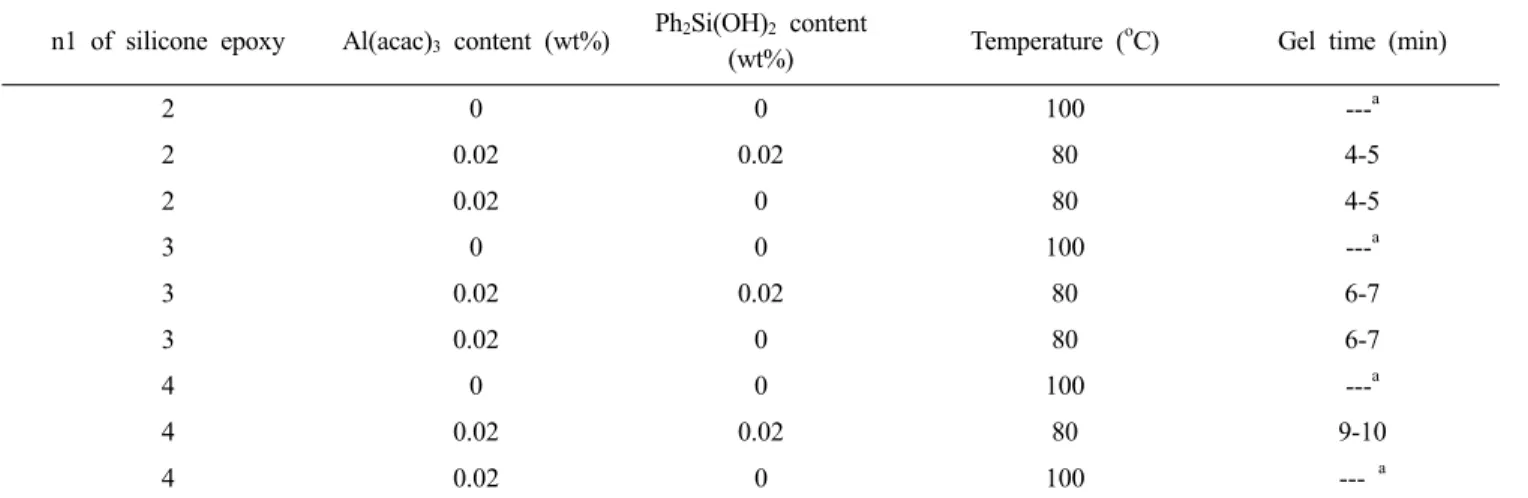
Table 2 shows the gelation time of silicone-epoxies cured with Al(acac)3/Ph2Si(OH)2 catalyst at a concen- tration of 0.02 wt%/0.02 wt%. All the silicone epoxy resins showed a high activity to the catalyst. The resin without Si-H bond had the longest gelation time of about 10 min at 80oC. The gelation time decreased to about 7 min for the silicone-epoxy of n1 = 3 and about 5 min for the silicone-epoxy of n1 = 2, which indicated that the reactive activity of the silicone-epoxies in- creased, with increasing Si-H bonds in the resins.
Table 2. Gelation time of silicone-epoxy compositions
n1 of silicone epoxy Al(acac)3 content (wt%) Ph2Si(OH)2 content
(wt%) Temperature (oC) Gel time (min)
2 0 0 100 ---a
2 0.02 0.02 80 4-5
2 0.02 0 80 4-5
3 0 0 100 ---a
3 0.02 0.02 80 6-7
3 0.02 0 80 6-7
4 0 0 100 ---a
4 0.02 0.02 80 9-10
4 0.02 0 100 --- a
aNot gelate after 10 h.
Furthermore, the silicone-epoxies containing Si-H bonds could be cured even if Ph2Si(OH)2 was not used. The rate of the cure reaction for these resins seemed not to be influenced by Ph2Si(OH)2 since their gelation time didn't change with its addition as shown in Table 2. On the other hand, Ph2Si(OH)2 was indispensable to the cure reaction of the silicone-epoxy without Si-H bonds. When Ph2Si(OH)2 was not presented, gelation was not detected at 100oC for 10 h.
After heated at 80oC for 30 min and then 120oC for 30 min, the silicone-epoxies were cured to transparent materials whose hardness varied with the value of n2.
The cured materials became softer with increasing sili- cone content, and thus cured silicone-epoxies with differ- ent hardness could be obtained.
The mechanism of the polymerization reaction of sili- cone-epoxies was believed to be cationic. Ongoing stud- ies are currently under way to investigate the kinetics of the polymerization and illustrate the role of Si-H bonds in the cure reactions. It was likely that the Si-H bonds played the same role as they did in the ring-open poly- merization of epoxides by organometallic rhodium com- plexes together with Si-H bonds-containing compounds [18].
3.2. UV and Thermal Aging Stability of Cured Silicone- Epoxies
The silicone-epoxies cured by Al(acac)3/Ph2Si(OH)2
have excellent UV and thermal-stabilities [10,11]. Figure 2 shows the relationship between the transmittance and wavelength for the silicone-epoxy with n1 = 2 before and after UV aging. For comparison, the UV aging
property of anhydride-cured cyclo-aliphatic epoxy resin ERL-4221 is also shown. Figure 3 shows the thermal aging properties of the silicone epoxy and anhy- dride-cured DGEBA epoxy resin. Cyclo-aliphatic epoxies have been reported to have excellent UV resistance while DGEBA epoxy have excellent thermal stability among the commercial epoxy resins [2]. And the cata- lyst used to promote the epoxy-anhydride reactions in this study has been found very useful to improve the UV and thermal stability of epoxy resins [19].
The transmittance of the cured silicone-epoxy was evi- dently higher than that of anhydride-cured ERL-4221 in the band range 360∼500 nm before UV aging as shown in Figure 2. After UV aging, the transmittance of anhy- dride-cured ERL-4221 decreased remarkably in this band range and yellowing was detected easily by the naked eyes. Compared with ERL-4221, reduction in trans- mittance of silicone-epoxy was much alleviated and ob- vious yellowing was not observed. This result indicated that the UV stability of silicone-epoxy was greatly supe- rior to that of anhydride-cured ERL-4221. The decrease trend of transmittance of silicone-epoxy in the band range 360∼500 nm after thermal aging was similar to that of anhydride-cured DGEBA epoxy resin. It was concluded that they have similar thermal stability.
However, the transmittance of silicone-epoxy in this band range was higher than that of anhydride-cured ep- oxy before and after thermal aging.
The excellent thermal and UV stability might be mainly ascribed to the high silicone content of the cured silicone-epoxy. On the other hand, it was also found that the UV resistance and thermal stabilities could be
Figure 1. Transmittance of silicone-epoxy and anhydride- cured ERL-4221 vs. wavelength before and after UV aging.
Figure 2. Transmittance of silicone-epoxy and anhydride- cured DGEBA vs. wavelength before and after thermal aging.
improved efficiently by the introduction of Si-H groups [11]. This was possibly due to the reductive property of Si-H groups which can annihilate radical and peroxide effectively. In addition, the absence of any accelerant was also in favor of improving the thermal and UV stability of silicone-epoxies.
4. Conclusions
The silicone-epoxy resins with different silicone con- tent were synthesized. The silicone-epoxies showed high reactive activities to the aluminum complex-silanol com- pound catalyst. They were cured under the catalysis of Al(acac)3/Ph2Si(OH)2 at very low concentrations to hard
materials showing high optical clarity. Furthermore, the silicone-epoxy resin containing Si-H bonds could be cured effectively even if silanol compound was absent.
The cured silicone-epoxy resins have much better UV resistance than that of anhydride-cured ERL-4221 and thermal stability similar to that of anhydride-cured DGEBA. UV LEDs packaged by silicone-epoxies have a lifetime evidently longer than that of LEDs packaged by anhydride-cured ERL-4221 and DGEBA. It should be pointed out that this kind of silicone-epoxy compositions might also have very good electrical properties as the cyclo-aliphatic epoxy resins cured by the aluminum com- plex-silanol catalysts. Therefore, they are very promising encapsulation materials for electronic devices as well as short-wavelength LEDs.
References
1. S. Muth, F. J. P. Schuurmans, and M. D. Pashley, IEEE Journal on selected topics in Quantum Electronics, 8(2), 333 (2002).
2. J. C. Huang, Y. P. Chu, M. Wei, and R. D.
Deanin, Adv. Polym. Technol., 23:298 (2004).
3. N. Narendran, Y. Gu, J. P. Freyssinier, H. Yu, and L. Deng, Journal of Crystal Growth; 268(3-4): 449 (2004).
4. G. W. Yeager and M. Rubinsztajn, United States Patent 6507049 (2003).
5. O. Yoshinobu, Japanese Patent 2004339319 (2004).
6. T. H. Ho and C. S. Wang, European Polymer Journal, 37(2): 267 (2001).
7. T. B. Gorczyca, United States Patent 6800373 (2004).
8. M. I. Rubinsztajn and S. Rubinsztajn, United States Patent 6916889 (2005).
9. S. Kaji and T. Usui, United States Patent Applica- tion 20050272896 (2005).
10. W. Huang, Y. Z. Yu, and Y. X. Yuan, Chinese Patent Application 200510130312.5 (2005).
11. W. Huang, Y. Z. Yu, and Y. X. Yuan, Chinese Patent Application 200610083846.1 (2006).
12. J. V. Crivello and J. L. Lee, Journal of Polymer Science: Part A: Polymer Chemistry, 28: 479 (1990).
13. S. Hayase, T. Ito, S. Suzuki, and M. Wada, Journal of Polymer Science: Polymer Chemistry Edition, 19:2185 (1981).
14. S. Hayase, T. Ito, S. Suzuki, and M. Wada, Journal
of Polymer Science: Polymer Chemistry Edition;
19:2997 (1981).
15. S. Hayase, Y. Onishi, K. Yoshikiyo, and S. Suzuki, M. Wada, Journal of Polymer Science: Polymer Chemistry Edition, 20:3155 (1982).
16. J. V. Crivello and D. S. Bi, Journal of Polymer
Science: Part A: Polymer Chemistry, 31:2563 (1993).
17. J. V. Crivello and M. X. Fan, Makromolekulare Chemie-Macromolecular Symposia, 54(5):179 (1992).
18. J. V. Crivello and M. X. Fan, Journal of Polymer Science: Part A: Polymer Chemistry, 30(1):1 (1992).
19. Y. Morita, Japanese Patent 2003012896 (2003).