DOI: http://dx.doi.org/10.7316/KHNES.2014.25.1.019 eISSN 2288-7407
기계적 합금화법으로 제조한 Mg2NiHx-Graphene 복합재료의 수소화 특성 평가
이영상1ㆍ이수선2ㆍ이병하3ㆍ정 석3ㆍ홍태환1,2†
1한국교통대학교 신소재공학과/친환경에너지 부품 소재센터
2한국교통대학교 친환경에너지 부품소재센터
3명지대학교 신소재공학과
Evaluation of Hydrogen Properties on Mg
2NiH
x-Graphene Composites by Mechanical Alloying
YOUNG-SANG LEE1, SOO-SUN LEE2, BYUNG-HA LEE3, SEOK JUNG3, TAE-WHAN HONG1,2†
1Depatrment of Materials Science and Engineering/Research Center for Sustainable Eco-Devices and Materials(RIC-ReSEM), Korea National University of Transportation, Daehak-ro 50,
Chungju, Chungbuk, 380-702, Republic of Korea
2Research Center for sustainable Eco-Devices and materials(RIC-ReSEM)
3Department of Material Science & Engineering, Myongji University
Abstract >> Mg hydride has a high hydrogen capacity (7.6%), at high temperature, and is a lightweight and low cost material, thus it a promising hydrogen storage material. However, its high operation temperature and very slow reaction kinetics are obstacles to practical application. In order to overcome these disadvantages of Mg hydride, graphene powder was added to it. The addition of graphene has been shown to reduce the operating temperature of dehydrogenation.
Moreover, in this report the environmental aspects of MgHx-Graphene composites are investigated by means of the environmental life cycle assessment (LCA) method. MgHx-Graphene mixture was prepared by hydrogen induced mechanical alloy (HIMA). The synthesized powder was characterized by XRD(X-ray Diffraction). The hydro- genation behaviors were evaluated by using a Sievert’s type automatic PCT apparatus. Such evaluation of Materials also conducted in the LCA.
From the result of P-C-T(Pressure-Composition-Temperature) curves, the MgHx-3wt.% graphene composite was evaluated as having a 5.86wt.% maximum hydrogen storage capacity, at 523K. From absorption kinetic testing, the MgHx-7wt.%graphene composite was evaluated as having a maximum 6.94wt.%/ms hydrogen absorption rate, at 573K. Environment evaluation results for the MgHx-graphene composites and other materials indicated environmental impact from the electric power used and from the materials themselves.
Key words : Hydrogen storage materials(수소저장자료), Hydrogenation properties(수소화 특성), Reactive mechanical alloying(기계적 합금화법), Mg2NiHx-graphene, Life Cycle Assessment(환경전과정평가)
†Corresponding author : [email protected]
[ 접수일 : 2013.12.17 수정일 : 2014.2.6 게재확정일 : 2014.2.28 ] Copyright ⓒ 2014 KHNES
1. Introduction
In recent years, serious environmental concerns regarding pollution have emerged, while competition for energy resources has intensified1,2). To solve these problems, the introduction of a fuel cell system to promote the hydrogen economy is important3). Hydrogen has attracted attention as an ideal energy resource and is expected to be applied in fuel cells. Thus, there is a need for high efficiency catalysts and for a safe technology for room temperature hydrogen storage.
Many metal hydrogen systems, such as those made from Mg-based hydrides, are promising as solutions for hydrogen storage. However, the hydrogen absorption/
desorption kinetics of such materials are too low for practical application.
The main reasons for the slow hydrogen sorption kinetics are an oxide layer on the magnesium surface and blocked hydrogen diffusion4). In order to improve hydrogen sorption/desorption kinetics, ball milling is most widely used. Even though it usually takes a longer time to prepare the alloy by this method, ball milling prevent magnesium hydride from creating a solid layer on the surface.
Carbon nano-materials such as graphene, fullerrens, and carbon nanotubes have been widely studied and applied not only in the electronics and chemical fields but also in hydrogen storage. This is because carbon materials offer many advantages, such as a low mass density and large surface area5).
In a previous paper6), it was determined that graphene is an efficient destabilizing agent for MgH2, resulting in a decrease of the absorption temperature of this phase while still maintaining a temperature high enough for practical applications. Catalysis on the hydriding
reaction indicated that the absorption kinetics and hydrogen storage capacity increase in proportion to the concentration of the substitutional graphene. We seek fundamental knowledge of this system and understanding of the effect of graphene content on the structure and hydro- genation properties of the synthesized materials. In addition, we seek to identify the most environmentally important activities within the life cycle of MgHx- graphene composites, for which purpose an environmental life cycle assessment (LCA) was conducted.
2. Experimental Precedure
MgHx was prepared by ball milling Mg powder (99.9%) under a H2 atmosphere at a pressure of 2MPa for 48hrs. The ball to chips weight ratio was 40:1, and the mill’s rotation speed was 200rpm. The composites of 3, 7wt.% graphene (12nm flake, grade:
AO-3, Graphene-Supermarket) and the MgHx. Previously obtained were than mechanically milled for 72hrs using a planetary ball mill(Pulverisette-5, FRITSCH Co.).
X-ray diffraction analysis(XRD, D8 Advance, Bruker) was performed using a Cu Kα radiation of 1.5405Å (scanning speed: 3deg/min, scanning angle: 20~80°).
The hydrogen sorption properties of the composites were determined using an automated Sievert’s apparatus.
The composites were activated under an activation treatment condition. After activation, the Pressure- Composition-Isothermal(PCI) curves were measured at 473K, 523K, 573K and 623K with an H2 pressure of 5MPa. Absorption and desorption kinetics of the MgHx-graphene composites were evaluated under the same temperature for 1hours, under 5MPa hydrogen pressure.
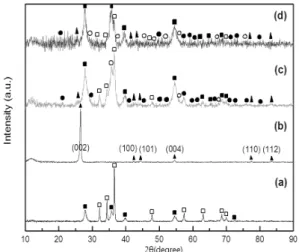
Fig. 1 X-Ray Diffraction (XRD) of MgHx-graphene composites:
(a) MgHx, (b) graphene, (c) MgHx-3wt.% graphene, and (d) MgHx-7wt.% graphene (□:Mg, ■:MgH2, ▲:graphene, △:
graphite oxide, ○:MgC2, ●:Mg2C3)
The present LCA is especially worthy of attention as a preliminary indication of the future environmental impact of the production and evaluation processes for MgHx-graphene composites. The material requirements and environmental emissions are inventoried and the energy requirements are discussed, based on actual production data. The analysis is performed according to the recommendations of ISO norms 140407), and updates thereof. The performance of the analyzed MgHx-graphene composite is also compared to other examples of Mg2Ni based on different materials.
3. Results and Discussion
3.1 X-ray diffraction(XRD) analysis
Fig. 1 presents XRD analysis results of the as- prepared samples (Graphene, MgHx, MgHx-graphene composites). The graphene flakes exhibit a very sharp characteristic peak at 2θ=26.55°5), whereas the MgHx-
graphene composites showed a broader peak than that of the graphene. MgC2 phase and, Mg2C3 phase are
present in the MgHx-grapnene composites. All diffraction peaks of MgHx-graphene composites correspond to the JCPDS. This indicates that a composite MgHx-
graphene material suitable for use as a target sample was produced successfully. In previous study6), two phases were also significantly observed in MgHx-5wt.%
graphene and MgHx-10wt.% graphene.
3.2 Hydrogen sorption
3.2.1 Hydrogen absorption kinetics
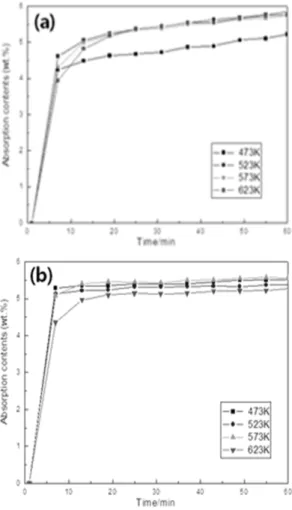
Fig. 2 shows the absorption curves which illustrate the rate increases as the graphene composites at 473K, 523K, 573K and 623K under 50bar H2. The absorption rate increases as the graphene content rises.
In particular, hydriding at 523K and 573K occurs at a higher rate than it does at 623K. This effect can be ascribed to the fact that at 523K hydriding is accompanied by formation of MgH2, In addition, the magnesium hydride is formed more easily, which means that a large number of nuclei appear on the particle surfaces.
This fact determines the higher rate of hydriding at the above temperature.
Comparison with MgHx-graphene composites shows that both composites have a similar kinetic behavior when hydride at 523K, 573K, and 623K. However, the presence of Mg2C3 or MgC2 phases behavior when hydriding at 473K. In the case of MgHx-7wt.%
graphene, the MgC2 phase is more dominant than Mg2C3.
A preceding study shows that MgHx-10wt.% graphene was 2.1 and 1.6wt.% at 573 and 673K. MgHx-7wt.%
graphene and MgHx-10wt.% graphene shows a similar trend. In the same previous experiment, it was shown that have a positive effect on both its absorption kinetics and hydrogen capacity. Additionally, shortening
Fig. 2 Hydrogenation kinetic on (a) MgHx-3wt.% graphene and (b) MgHx-7wt.% graphene composites under 5MPa of H2
Fig. 3 The absorption P-C-I curves of (a) MgHx-3wt.% grap hene and (b) MgHx-7wt.% graphene composites from 0.3M Pa to 5MPa H2
of the hydrogenation time is due to formation of a carbon coating layer between particles during ball milling. The carbon coating layer prevents particle agglomeration and restoration of the oxide layer on the fresh cracked surface4).
Fro 1h absorption times, it can be clearly seen that the hydriding rate of MgHx-graphene at all temperatures increased with the rise in graphene content. However for longer absorption times, MgHx-7wt.% graphene shows a larger final hydrogen storage capacity.
Hydrogen absorption pressure-composition isotherms
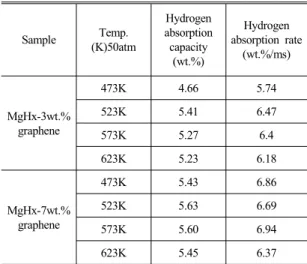
(PCI) at 473K, 523K, 573K and 623K are shown in Fig. 3. As absorption temperature increased from 473K to 523K to 573K to 623k, the amounts of absorbed hydrogen for MgHx-3wt.% graphene were 4.66wt.%, 5.41wt.% 5.27wt.% and 5.35wt.%, respectively.
3.2.2 P-C-I curves
The amounts for MgHx-7wt.% graphene were 5.43 wt.%, 5.63tw.%.%, 5.6wt.%, and 5.45wt.%. It is also notable that the equilibrium pressure for hydrogen absorption of these composites decreases as the amount
Table 1 Hydorghen absorption capacity and Hydrogen absorption rate of MgHx-graphene composites
Sample Temp.
(K)50atm
Hydrogen absorption capacity
(wt.%)
Hydrogen absorption rate
(wt.%/ms)
MgHx-3wt.%
graphene
473K 4.66 5.74
523K 5.41 6.47
573K 5.27 6.4
623K 5.23 6.18
MgHx-7wt.%
graphene
473K 5.43 6.86
523K 5.63 6.69
573K 5.60 6.94
623K 5.45 6.37
Table 2 Environmental impact categories (CML 2001 and Eco-indicator 99)
CML 2001 category Unit Eco-indicator 99 category Unit
Abiotic resource depletion(ARD) Kg Sb eq Fossil fuels MJ
Minerals MJ
Aciedification potential (ACP) Kg SO2eq Acidification/Eutrophication PDF*m2*yr Eutrophication potential (EUP) Kg PO4eq
Global warming potential (GWP) Kg CO2eq Climate change DALY
Ozone layer depletion potential (ODP) Kg CFC-11eq Ozone depletion DALY Photochemical oxidation potential (POCP) Kg C2H4eq Respiratory(organic) DALY
Fresh-water aquatic ecotoxicity potential
(FAETP) Kg 1,4 DCBeq
Ecotoxicity PDF*m2*yr Marine aquatic ecotoxicity potential (MAETP) Kg 1,4 DCBeq
Terrestrial ecotoxicity potential(TETP) Kg 1,4 DCBeq
Human toxicity potential (HTP) Kg 1,4 DCBeq Carcinogenic effect DALY Respiratory(inorganic) DALY Ionizing radiation DALY
Land-use PDF*m2*yr
of graphene increases, which indicates that graphene tends to support more stable hydrides.
Except at 473K, absorption plateaus increased with increasing temperature and this feature along with the hysteresis result conforms to the classic behavior of metal-hydride systems8).
3.3 Environmental life cycle assessment (LCA) of MgHx-graphene composites
Conducting experiments is basic to science, and experiments are necessary for the scientific investigation.
However, there is also a need to increase our knowledge of the environmental consequences of experiments in order to be able to make improvements that promote sustainability in experimental processes. And during the recent years, No information was available about the environmental consequences of experiments involving materials based on Mg hydride. And research on hydrogen has been focused on life cycle stages about production, storage, transport and use9).
The scope of our environmental impact assessment was the identification of the most environmentally important activities within the life cycle of MgHx- graphene composites. The method chosen for the study was an environmental life cycle assessment (LCA).
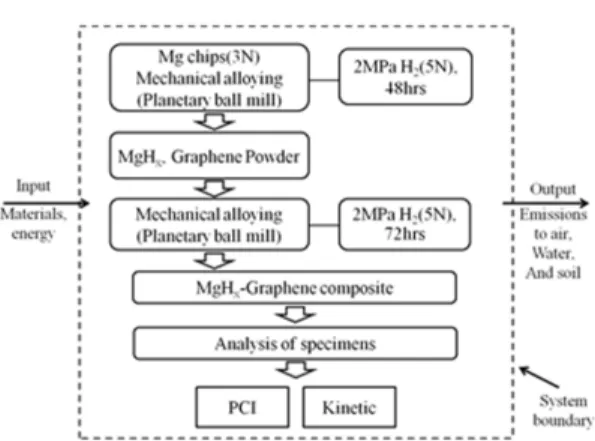
Fig. 4 Discription of MgHx-graphene composites system
3.3.1 Environmental impact categories Impact categories quantitatively present
resource and energy consumption. As shown in Table 2, the categories specified include the key parameters for environmental impact10,11). The key parameters are carbon dioxide (CO2), ethylene (C2H4), chloro fluoro carbon (CFC), sulphur dioxide (SO2), and phosphate (PO4)12,13).
3.3.2 Goal and scope definition
The first component of the goal and scope definition phase is the depiction of the goal of the LCA. This includes the description of the analysed system and boundaries.
In this study the goal of the analysis is to quantify and to evaluate the impact of the MgHx-graphene composites production system.
3.3.3 System Boundaries and Characteristics The system can be defined as everything involved in the production of MgHx-graphene composites, including the analysis for the composites. Fig. 4 shows a description of the system and each phase.
3.3.4 Inventory Data and Information Collection For inventory data, the European ecoinvent inventory database (v 2.2) was used for this paper Cycle Impact Assessment (LCIA) method developed at the University of Leiden, the so called CML (Centrum voor Milieu- wetenschappen (Institute of Environmental Sciences)) method, and key performance indicators were used.
The CML method defines several impact categories for emissions and for resource consumption. This method groups by-products, emissions and resource consumption caused by these processes, into specific environmental impacts14).
3.3.5 Study Limitations
Due to the lack of available information about graphene, we used alternate data (on graphite) in the GaBi databases. In order to obtain the environmental performance of the studied processes, a combination of a Life
3.3.6 Life Cycle Inventory results
For the Life Cycle Inventory, the data collected were used in “Gabi” software. Energy input through the production of MgHx-graphene, Mg2NiHx and Mg9Ti1-Ni are as follows. Three samples of the PCI and kinetic experiments were used at an equal power value. Electricity use is increased when the duration of planetary ball milling is long. For MgHx-graphene composites, the ball milling time is 120hours, for Mg2NiHx it is 48hours, and for Mg9Ti1-Ni it is 96 hours.
3.3.7 Life Cycle Impact assessment results In this section, the environmental performance of the investigated MgHx-graphene, Mg2NiHx, and Mg9Ti1-Ni composites is presented. All results presented represent
Table 3 Scope Definition
System Production and analysis of MgHx-5wt.%
graphene
Function Storage of hydrogen Function unit Hydrogen content (wt.%) Reference flow Powder of MgHx-graphene (9.5g)
Fig. 5 Comparison of the environmental impacts assessed by applied Ei’99 methods for three composites.
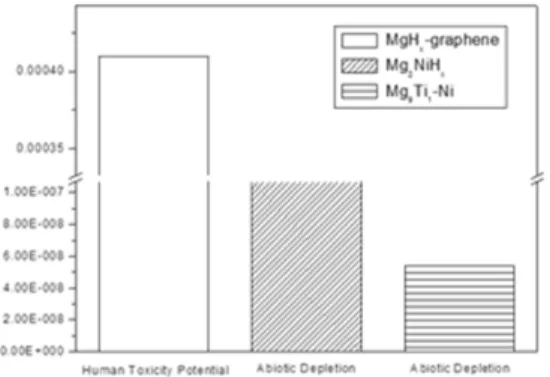
Fig. 6 Compariosn of the environmental impacts assessed by applied CML 2001 mthods for three composites
relative environmental impacts per functional unit.
3.3.7.1 EI’99 methods
Fig. 5 shows the results of the environmental impacts for all three samples. MgHx-graphene has the highest impacts, followed by Mg9Ti1-Ni, and Mg2NiHx. Energy consumed during the life cycle stage constituted a majority of the impacts for many of the impact
categories evaluated. Due to the large influence of electricity, the fossil fuels category is the highest impact category. Also the climate change and Respiratory (inorganic) categories are high because of energy consumption. Other factor is materials like to graphite, nickel and titanium. These materials have been concerned resource depletion. In addition as shown in Table 2, Fossil fuels, Minerals categories in Ecoindicator 99 same to the Abiotic resource depletion (ARD) at CML 2002. But In this method, Impact of Energy consumption is more than higher materials.
3.3.7.2 CML 2002 methods
In this method, Energy consumption is excepted so the total environmental impacts of the three samples are dominated by the materials. MgHx-graphene shows higher values for the Human Toxicity Potential (HTP) due to graphite powder in the production process.
Because graphite powder is very small size, it is bad influenced by human15). However, the other two samples show abiotic resource depletion (ADP) due to the materials involved, namely nickel and titanium16,17). In particular, the environmental load value of nickel is higher than that of titanium. Mg9Ti1-Ni has the lowest relative impacts of all evaluated composites because the amount of nickel and titanium in that composite is smaller than in the other two. In addition, the amount of magnesium in Mg9Ti1-Ni is relatively high, and magnesium does not have an influence on the environment in the measured categories. Likewise, hydrogen has little impact on the environment.
4. Conclusion
In this paper, the hydrogen storage properties of
MgHx-graphene composites have been studied system- atically. And Life cycle assessments are reported for MgHx-graphene composites from production, evaluation experiment until disposed.
1) The results of X-ray powder diffraction show that MgHx-3wt.% graphene consists mainly of the MgH2
and Mg2C3 phases, while MgHx-7wt.% graphene consist of MgH2 and MgC2 phases.
2) The kinetic experimental results show that both composites have a similar kinetic behavior when hydride at 523K, 573K, and 623K. However, the presence of the Mg2C3 and MgC2 phases affects the kinetic behavior when hydriding at 473K.
3) P-C-T curves indicate that the equilibrium pressure for hydrogen absorption/desorption of these com- posites decreases with increasing amounts of graphene, which indicates that graphene tends to support more stable hydrides.
4) Analysis of the MgHx-graphene composites produ- ction system indicates that, in the case of EI’99 methods, MgHx-graphene has the highest environ- mental impacts, followed by Mg9Ti1-Ni, and then Mg2NiHx. Due to the large influence of electricity consumed in the process, the fossil fuels category is the highest impact category. For CML 2002 methods, MgHx-graphene shows higher values of HTP (Human toxicity potential) due to graphite powder in the production process. However, the other two samples show ADP (a biotic resource depletion) due to the materials used, namely nickel and titanium. The Fossil fuels categories in Eco-indicator 99 can be considered similar to the Abiotic resource depletion (ARD) at CML 2002.
So the two methods show similar result. The main
factor is energy consumption and minor factor is materials. But this study didn’t account for life cycle of samples. Experiment for hydrogen storage of powder limited to number of times. Although electricity consumption for production is big, if the experiment can be possible to longer, this can be an economical and environment-friendly. Because of this, future studies should be considered to life cycle of samples.
Acknowledgement
The research was supported by a grant from the Academic Research Program of Korea National University of Transportation in 2013.
References
1. Dinar, Shlomi, “Beyond Resource Wars Scarcity:
Environmental Degradation, and International Cooperation”, MIT Press (MA), 2011.
2. Klare, Michael T. “Resource Wars The New Landscape of Global Conflict”, Holt McDougal, 2002.
3. Hephaestus, “Hydrogen Economy, Including Fuel Cell, Utsira, Hydrogen Vehicle, Hope Curriculum, Hydrogen Fuel, Roger E. Billings, Fuel Cell Vehicle, the Hype ab”, Hephaestus Books 2011.
4. A. D. Rud, A. M. Larhnir, “Effect of carbon allotropes on the structure and hydrogen sorption during reactive ball-milling of Mg-C powder mixtures” Int. J. Hydrogen Energy 2012, Vol. 37, pp. 4179-4187.
5. B. J. kim, S. J. P, “Optimization of the pore structure of nickel/graphite hybrid materials for hydrogen storage”, Int. J. Hydrogen Energy 2011, Vol. 36, pp. 648-653.
6. S.S.Lee, N.R.Lee, K.I.Kim, T.W.Hong. “Hydrogen- ation Properties of MgHx-Graphene Composites
by Hydrogen Induced Mechanical Alloying (HIMA)”, Int. J. Hydrogen Energy, 2012, In press.
7. “environmental management e life cycle assessment e principles and framework”, International Organization for Standardization, ISO 14040, 2007 and ISO 14044, 2007.
8. Y. Moriwaki, T. Gamo, T. lwaki, “Control of hydrogen equilibrium pressure for C14-type laves phase alloys”, Journal of The Less-Common Metals 1991, Vol. 172-174, pp. 1028-1035.
9. J. Dufour, D. P. Serrano, J. L. Galvez, A.
Gonzalez, E. Soria, J.L.G. Fierro, “Life cycle assessment of alternatives for hydrogen production from renewable and fossil sources”, Int. J. Hydrogen Energy 2012, Vol. 37, pp. 1173-1183.
10. F. Brentrup, J. Kusters, H. Kuhlmann, J. Lammel,
“Environmental impact assessment of agricultural production systems using the life cycle assessment methodology Ⅰ. Theoretical concept of a LCA method tailored to crop production”, Europ. J.
Agronomy 2004, Vol. 20, pp. 247-264.
11. H. Monteiro, F. Freire, “Life-Cycle assessment of a house with alternative exterior walls: Comparison of three impact assessment methods”, Energy and Buildings, 2012, Vol. 47, pp. 572-583.
12. J. Berlin, “Environmental life cycle assessment
(LCA) of swedish semi-hard cheese”, International Dairy Journal, 2002, Vol. 12, pp. 939-953.
13. A. Moberg, G. Finnveden, J. Johansson, P. Lind,
“Life cycle assessment of energy from solid waste- part 2: landfilling compared to other treatment methods”, J. Cleaner Production, 2005. Vol. 13, pp. 231-240.
14. F. Brentrup, J. Kusters, H. Kuhlmann, J.Lammel,
“Application of the Life Cycle Assessment methodology to agricultural production : an example of sugar beet production with different forms of nitrogen fertilizers”, European journal of Agronomy, 2001, Vol. 14, pp. 221-233.
15. V. K. K. Upadhyayula, D.E. Meyer, M. A.
Curran, M. A. Gonzalez, “Life cycle assessment as a tool to enhance the environmental performance of carbon nanotube products: a review”, Journal of Cleaner Production, 2012, Vol. 26, pp. 37-47.
16. C. J. Rydh, M. Karlstrom, “Life cycle inventory of recycling portable nickel–cadmium batteries”, Resources, Conservation and Recycling 2002, Vol. 34, pp. 289-309.
17. M. Yellishetty, G. M. Mudd, P. G. Ranjith, “The steel industry, abiotic resource depletion and life cycle assessment: a real or perceived issue?”, Journal of Cleaner Production, 2011, Vol. 19, pp.
78-90.