Introduction
Kenaf (Hibiscus cannabinus L.), which belongs to the family of Malvaceae, is an annual C3 and a common warm season fiber plant native to India and Africa (Yazan et al. 2011).
It is one of the most important fibre crops in the world. It has been cultivated and used twine, rope, gunny bag, sackcloth, pulping and paper making, oil absorption, potting media, board making, filtration media and animal feed (Dempsey 1975, Sellers & Reichert 1999, Cheng 2001, Charles 2002). Also, the seeds are good source of low cholesterol vegetable oil and for biodiesel production (Webber & Bledsoe 1993).
Although kenaf is a tropical plant, its cultivars are now well adapted to a wide geographical and climatic range (Danalatos
& Archontoulis 2010). Its height reaches 4-6 m in about 4-5 months and a yield is 6-10 tonnes of dry mass per acre each year, which is 3-5 times greater than the yield for the southern pine tree taking 7-40 years to be used (LeMahieu et al. 2003).
The ‘green tag’ is further associated with kenaf because of its promising growth, and scavenges extensive amounts of Carbon dioxide (CO
2) from the atmosphere. It is the most abundant gas which could give severe effects to the global warming. So, kenaf is the best suitable resource to go green.
The Renewable Energy Portfolio Standard (RPS) has been operated in 44 countries including USA, Japan, and so forth.
Since 2012, it has been implemented in Korea. The policy’s aim is to increase expansion of a new renewable energy to decrease the CO
2of an atmosphere. So, a lot of wood pellet
Korean J. Breed. Sci. 53(3):191-199(2021. 9) https://doi.org/10.9787/KJBS.2021.53.3.191
여교잡을 통한 케나프 바이오매스 우수 계통 선발
이인석*⋅강찬호⋅이진재⋅김희준
전라북도농업기술원
Development of Kenaf (Hibiscus Cannabinus L.) Pedigrees with Superior Characteristics through Backcross
In-Sok Lee
*, Chan-Ho Kang, Jin-Jae Lee, and Hee-Jun Kim
Jeollabuk-do Agricultural Research & Extension Services, Iksan City 54591, Republic of Korea
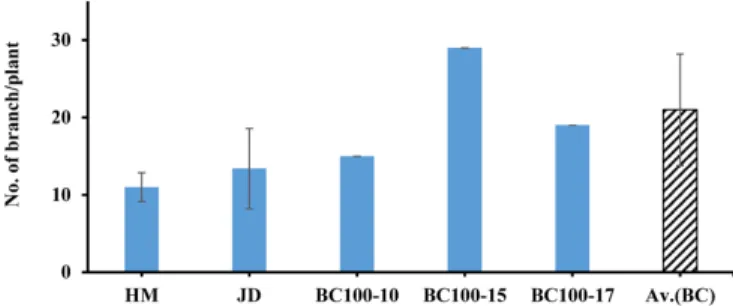
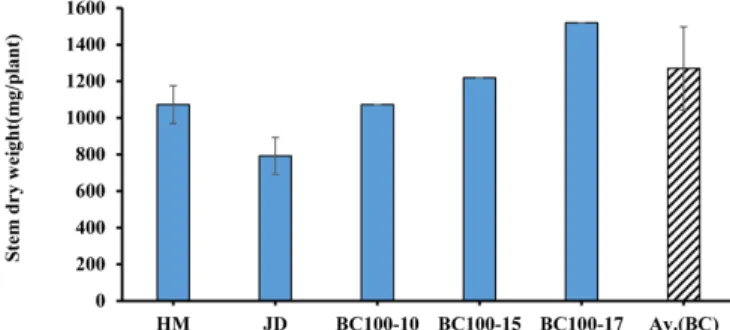
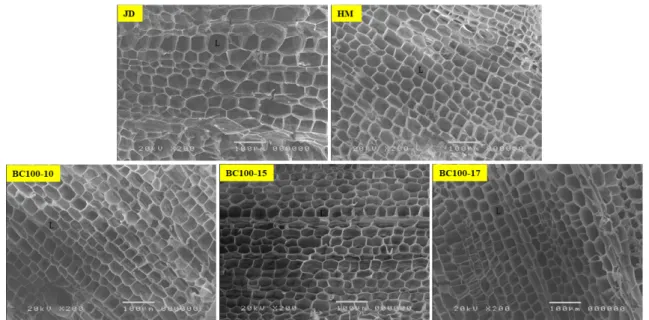
Abstract Multipurpose utilization, including as rope, pulp, and filtration media, is what makes kenaf (Hibiscus cannabinus L.) special. This experiment was conducted to select elite pedigrees with high biomass production through backcrosses. The agronomic performance, fuel characteristics, and histological analysis of the elite lines were investigated at the BC
1F
2generation in comparison with the Control. Significant differences were observed in 12 evaluations of variety and pedigrees. Five plants, including the two Controls (Jangdae and Hongma300) and three pedigrees, showed a large difference in the number of flowering days from July 5 to September 30. The plant height of BC100-10 (447 cm) was the highest among the genotypes. Regarding branch number, BC100-15 showed the best performance with 29 branches. Stem dry weight was found to be the lowest in Jangdea at 792 g, whereas BC100-17 showed the highest dry weight. Hongma did not set seeds owing to late flowering. However, with 34 g/plant on average, three elite lines had more seeds than Jangdae (16 g/plant), which are vulnerable to decay owing to viviparous germination. In the fuel characteristics analysis, the heating value of the three elite lines ranged from 4,510 to 4,930 kcal/kg, which was much higher than that of the two Controls (4,320 kcal/kg). The ash content analysis indicated the lowest value at 3.2% for the line BC100-10, which was similar to Korea’s 3
rd-grade. Based on the histological analysis of the stem, the pedigrees were close to Hongma. Taken together, these three elite lines would be useful as genetic resources for high biomass production.
Keywords kenaf, pedigree, fuel characteristics, histological analysis
Received on March 8, 2021. Revised on May 16, 2021. Accepted on May 24, 2021.
* Corresponding Author (E-mail: [email protected], Tel: +82-63-290-6038, Fax: +82-63-290-6049)
ⓒ 2021 by the Korean Society of Breeding Science
have been imported in Korea to be used in a thermoelectric power plant from 2013 year. To my surprise, its amount of income was 540 billion Won in 2018 (Kim et al. 2020). More seriously, the harmful insects such as red imported fire ant (Solenopsis invicta) and Fire Blight (Erwinia amylovora) have been coming in with the imported pellets, causing a severe social problem.
Kenaf is commercially cultivated in more than 20 countries, particularly in India, China, Thailand and Vietnam (Olasoji et al. 2014). This plant was introduced in Korea in the 60’s.
However, it has limited use in the country. In recent years, its value in Korea has been increasing as it has been used as forage, and for biomass and fuel production. Researches on kenaf have been done by the different research institutions in Korea since 2003 which focus on the development of new varieties, agronomic practices, and downstream application development studies such as animal feed (Kang et al. 2018, Lee et al. 2018). To successfully cultivate kenaf in Korea, the development of its new varieties producing high biomass is essential. Unfortunately, the yield of an early maturing kenaf variety in Korea is still very low. The highest yield achieved for early maturing varieties were 14.8 and 16.1 ton per hectare only in Jeokbong and Jangdae, respectively, thus becoming a major limitation for commercial use (Ryu et al. 2018). Of all the available early maturing kenaf varieties, only a few were suitable to be planted in Korean climate. The late flowering kenaf plant variety has been identified as the most essential trait required for growing in Korea to increase biomass production. However, this variety was not able to bear seeds in Korean climate. Thus, in order to overcome the problem
on the lack of varieties, the development of a new kenaf variety with selected target traits is imperative.
Thus, the main objective of this study was to generate new kenaf varieties with high biomass through backcross breeding.
Also, it aimed to describe pedigrees in regards to their morpho- logical, genetic and histological traits in comparison to the Control varieties, Jangdae and Hongma, in BC
1F
2generation.
Materials and Methods
Location, experimental design, treatments, and agronomic practices
A field study was conducted for 4 years, from 2017 to 2020, at Iksan, Korea (35.9 N, 127 W) on a fine sandy loam, 1~2%
slope. The field was cleaned and treated with 3 kg Pendimethalin herbicide 10a
-1. Before planting, fertilizer was applied at a rate of 15 kg 10a
−1N, 10 kg 10a
−1P and 10 kg a
−1K. A field cultivator was used to incorporate the fertilizer and to prepare the seedbed for planting. Planting was done at 80 ×
40 cm distance on 1
stMay. The p rimary weeds in the field were tumble pigweed (Amaranthus albus L.), purslane (Portulaca oleracea, Purslane), and removed throughout the growing season by herbicide and handweeding.
Climate conditions during the experimental period During the experimental period, from 2017 to 2020, the average minimum temperature in the area was 17.7℃ and average maximum temperature was 26.7℃, with a total of 580~1,525 ㎜ rainfall (Table 1). The optimum temperature for kenaf to grow ranges from 20-27℃ (Koester et al. 2014)
Region Temperature (℃)
Rainfall (㎜)
Av. minimum Av. maximum Av.
2017 17.3 25.3 22.5 580
2018 17.9 27.7 22.3 1,022
2019 17.9 27.3 22.1 696
2020 17.6 26.6 21.4 1,525
Av. 17.7 26.7 22.1 956
*
Av. : Average
Table 1. Climatic conditions of field during the experimental period, from May 2017 to October 2020.
and rainfall of 500-1,200 ㎜ (Banerjee et al. 1988, Bañuelos et al. 2002). Thus, the climatic conditions in Iksan City is very suitable to raise kenaf.
Pedigrees preparation, screening of elite lines and fuel characteristics evaluation
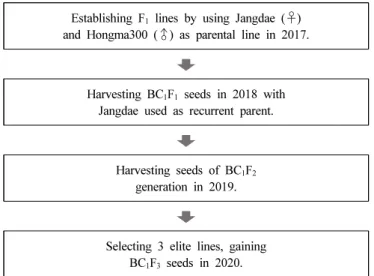
A selection step of the elite lines was done (Fig. 1). Two varieties, Jangdae and Hongma300, were used as parental lines for crossing. F
1lines were established in 2017 using Jangdae as female and Hongma300 as male resource. In 2018, backcross was implemented with Jangdae used as recurrent parent and harvested BC
1F
1seeds. The seeds of previous year were planted, harvested BC
1F
2seeds, and since then assigned numbers for 22 lines in 2019. 20 seedlings per each pedigree of BC
1F
2generation were grown to maturity in an upland field in 2020.
The elite lines showing normal seed fertility were investigated on individual plants. The stem color, leaf shape, 1
stflowering date, capsule shape, plant height, stem diameter of 15 cm above soil surface, branch number, dry weight, and seed weight were recorded for three elite lines and compared to the Control plants (Jangdae and Hongma300) evaluated in 10 replications. All genotypes were evaluated for the anthracnose incidence, using a five-point scale method (0 point = Disease free, 1 point = 1~20% incidence, 2 point = 20.1~30% incidence, 3 point = 30.1~40% incidence, 4 = point over 40.1% incidence). The fuel characteristics was evaluated from KTR (Korea Testing
& Research Institute), which is a national accredited agency, according to Ministry of Environment Notice 2020-219 in 2020 (Seo et al. 2015).
Scanning electron microscope (SEM) image The stems were air-dried for 48 hours at 30℃. Each stem was then fastened using a nipper before cutting vertically to avoid mechanical injury for the vertical section filming. The specimens were air-dried for 20 hours at 80℃ to shoot, then placed on an aluminum stub, and plated with gold using a gold ion sputtering device (Jeol, JFC-1100E, Fine Coat, Tokyo, Japan) at 10 mA for 400 seconds. A mutant stem plated with gold was observed using a scanning electron microscope (Jeol, JSM-5410LV, Tokyo, Japan) at 15 kV condition (Bednorz et al. 2008).
Statistics analysis
Results were analyzed for analysis of variance (ANOVA) using SAS Enterprise Guide 4.2 (Statistical Analysis System, 2009, SAS Institute Inc., Cary, NC, USA). Also, comparison of means was done at 5% level of significance using Duncan’s Multiple Range Test (DMRT).
Results and Discussion
Characteristics of donors
The elite pedigrees were developed from a cross between
‘Jangdae’ × ‘Hongma300’. The female parent released from KAERI (Korea Atomic Energy Research Institite) is of Korean origin.
The cultivar divided into mid-late flowering group has been flowering for three months from early-July to late-September, when planted on May 1. As a result, it can be harvested up to 16.1 ton per hectare at 100 days after seeding that is a relatively low yield (Kang et al. 2016). However, the male parent introduced from China has been designated as late-flowering, since the first flower blossoms in late-September. In the end, it has a high biomass production of 17.9 ton per hectare at the same harvest time with Jangdae (Kang et al. 2016). Accordingly, growers have been preferring Hongma300 to Jangdae for an aerial-part biomass.
Establishing F
1lines by using Jangdae (♀) and Hongma300 (♂) as parental line in 2017.
Harvesting BC
1F
1seeds in 2018 with Jangdae used as recurrent parent.
Harvesting seeds of BC
1F
2generation in 2019.
Selecting 3 elite lines, gaining BC
1F
3seeds in 2020.
Fig. 1. Selection steps of kenaf elite lines.
Selection intensity
To develop new superior genotypes compared to its parent, backcross method has been used in a lot of crops (Ali et al.
2006, Behmaram et al. 2014, Noori et al. 2016). Screening and selection of desired lines were the most critical step in early generation. Assessment of important morphological traits in BC
1F
2progeny is common. 440 BC
1F
2populations were planted and primarily selected for the flowering date, anthracnose and biomass amount of aerial part through at least twenty observations. Finally, the progenies showing transgressive performance of the target traits over the parental lines were obtained. The selection intensity showed 0.68% with three elite lines picked out. This suggests the presence of gene for improved biomass amount in the donors, which in some cases were not expressed in the donor phenotype. Ali et al. (2006) reported a result in agreement with ours.
Plant characteristics: stem color, leaf shape, flowering date, capsule shape, anthracnose
Through single-crossing, it was impossible to select an elite line satisfying a flowering date we want. So, backcross program was implemented. Results on stem color, leaf shape, 1
stflowering date, and capsule shape of the Controls and pedigrees were presented (Table 2). The stem color among the three pedigrees was significantly different from Hongma300, being similar to Jangdae in green. The leaf shape of all the genotypes was palmate. The 3 lines (BC100-10, BC100-15, BC100-17) came into blossom at a period of August 12 and 31, which were a big difference in the number of flowering days of Jangade on July 5 and Hongma300 on September 30. The capsule shape of all genotypes was same as ovoid. The incidence of anthracnose
for the 3 pedigrees was classified as 1 point with Hongma300 compared to Jangdae of 3 point in the range of 30.1~40%.
Anthracnose is perhaps the most serious potential disease problem. So, the anthracnose-resistant varieties were bred in a heavily disease field (Li & Huang 2013). Similarly, the useful lines through the backcross program was obtained by other studies for rice and kenaf (Ali et al. 2006, Behmaram1 2014).
Plant characteristics: plant height, diameter, branch number, dry and seed weight
Fig. 2 shows the varying plant height by the genotypes.
The range of plant height was the highest in the line BC100-10 with 447 cm among the genotypes. However, no statistical difference was noted when comparing the two Controls and the average of the three genotypes be marked with the slashes.
No statistical analysis for the three mutants was carried out because there was only one lines in BC
1F
2generation. The
Genotypes Stem color Leaf shape Flowering period Capsule shape Anthracnose
zHongma300 Light red Palmate After Sep. 30 Ovoid 1
Jangdae Green Palmate Jy. 5~Sep. 30 Ovoid 3
BC100-10 Green Palmate Aug. 12~Sep. 30 Ovoid 1
BC100-15 Green Palmate Aug. 16~Sep. 30 Ovoid 1
BC100-17 Green Palmate Aug. 31~Sep. 30 Ovoid 1
z