Vol. 9, No. 3, p. 269−276, September 2005
Comparing the inverse parameter estimation approach with pedo-transfer function method for estimating soil hydraulic conductivity
ABSTRACT: The soil hydraulic conductivity was evaluated by the inverse parameter estimation method using the cumulative infil- tration data measured by the tension infiltrometer. The inverse parameter estimation approach combines the Levenberg-Marquardt nonlinear optimization method with the variably saturated flow equation. In addition to the inverse parameter estimation method, soil hydraulic conductivity was also determined by various pedo- transfer functions (PTF) which can be used to estimate soil hydraulic conductivity indirectly. The soil texture contents and organic carbon content were measured at experimental sites and used as input vari- ables for PTF. A measure of root mean square error (RMSE) and mean absolute error (MAE) was utilized to compare soil hydraulic conductivity values between numerical inverse solution and PTF.
The comparison of various PTFs indicated that PTF of Wösten et al.
(1999) combined with the PTF of Cosby et al. (1984) was the best predictor for saturated hydraulic conductivity compared to the inverse solution. For unsaturated hydraulic conductivity, the PTF of Schaap (1999, SSC) showed the best prediction. The accuracy of var- ious PTFs is highly variable depending on the saturated water con- tent information. The results and method presented in the paper can be used as a hypothesis for further investigation and formulation of PTF applicable to soil condition in Korea.
Key words: soil hydraulic conductivity, inverse parameter estimation, pedo-transfer function, tension infiltrometer
1. INTRODUCTION
The soil hydraulic conductivity is an important parameter for quantifying soil water and solute movement and for modeling hydrogeologic processes. In the past, a variety of laboratory and field methods have been used for direct mea- surement of soil hydraulic conductivity. Recently, tension disc infiltrometers have been popular devices for in-situ measurement of the near-saturated soil hydraulic properties (Ankeny et al., 1991; Reynolds and Elrick, 1991). Tension disc infiltration data are used to estimate saturated and unsat- urated hydraulic conductivity based on Wooding’s analytical solution (Wooding, 1968). Since only steady-state infiltra- tion rates are used for Wooding’s analytical solution, Šimu
˚nek, and van Genuchten (1996) suggested the inverse param- eter estimation method using the transient cumulative infil- tration data instead of Wooding type analysis to evaluate soil hydraulic conductivity. The inverse parameter estima- tion procedure combines the Levenberg-Marquardt nonlinear optimization method with the variably saturated flow equation.
In a subsequent paper, Šimu
˚nek and van Genuchten (1997) found that the combination of multiple tension cumulative infiltration data with measured initial and final water con- tents yielded unique solutions of the inverse estimation problem for the unknown parameters of van Genuchten’s hydraulic conductivity function.
Since direct measurement of soil hydraulic properties is time consuming and expensive, an alternative approach to the estimation of soil hydraulic properties has been a sub- ject of research efforts and an indirect estimation method which is often regarded as pedo-transfer function (PTF) approach has been developed. In the PTF method, soil hydrau- lic properties can be estimated in terms of easily measurable soil properties such as soil textural content, organic matter content and others. Wagner et al. (2001) evaluated eight well-known PTFs used for estimation of soil hydraulic con- ductivity using detailed measurements of 63 German soil horizons and found that the PTF of Wösten (1997) per- formed the best for predicting the unsaturated hydraulic conductivity. Wösten et al. (2001) reviewed the current sta- tus of PTF development, methods to develop PTFs, and the accuracy and uncertainty of various PTFs.
Because every PTF is developed on the basis of a limited database, there exists a lot of uncertainty in applying PTF to other soil conditions different from the soil conditions under which PTFs are developed. Thus, there is a need to under- stand the accuracy and the limit of the PTFs developed in other countries in order to apply for soil conditions in Korea.
The aim of the present paper is to compare soil hydraulic conductivity estimated from two different methods of the inverse parameter estimation and pedo-transfer function. For the inverse parameter estimation, we will follow a method- ology presented in Šimu nek and van Genuchten (1996,
˚1997) using the in-situ measured cumulative infiltration data. The comparative study attempted in the paper will allow us to identify the appropriate PTFs which are applicable to Korea’s soil conditions and to understand the limits of the PTFs developed elsewhere.
2. METHODS AND MATERIALS 2.1. Tension Disc Infiltration Experiment
The tension disc infiltration experiments were conducted
Do-Hun Lee* Kyung Hee University, Yongin, Gyeonggi-do 449-701, Korea
*Corresponding author: [email protected]
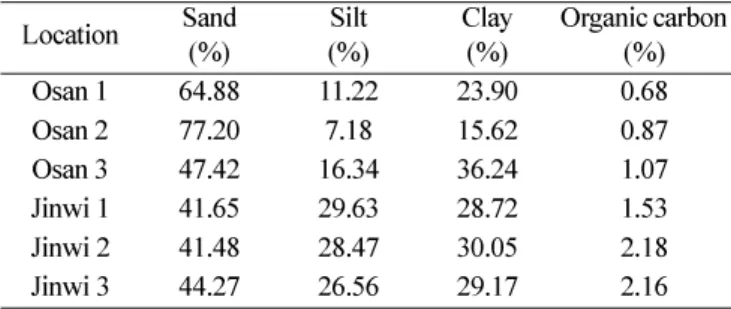
at six field locations to evaluate the saturated and unsatur- ated hydraulic conductivities using a numerical inversion method. Table 1 shows the measured contents of sand, silt, clay and organic carbon at each experimental location.
Among six experimental sites, Osan 1, Osan 2, and Osan 3 are located at Osancheon watershed while Jinwi 1, Jinwi 2, and Jinwi 3 are located at Jinwicheon watershed. The ten- sion infiltrometer developed by Ankeny et al. (1989) was used in the field experiment and had a diameter of 20 cm while the experiment was executed with three consecutive tensions of 10, 7, and 5 cm. With these three supplied ten- sions, cumulative infiltration rates were measured at six experimental locations. The detailed experimental methods regarding tension disc infiltrometer can be found in Ankeny et al. (1989).
2.2. Numerical Inversion Method
The numerical inversion method used a numerical solu- tion of the Richards’ equation coupled with the Levenberg- Marquardt nonlinear minimization method to estimate soil hydraulic properties by fitting the tension disc infiltrometer data. The governing flow equation for radially symmetric isothermal flow in a variably-saturated rigid porous medium is given by the following Richards’ equation:
(1) where
θis the volumetric water content,
his the pressure head,
K(
h) is the unsaturated hydraulic conductivity,
ris a radial coordinate,
zis the vertical coordinate positive down- ward, and
tis time. Equation (1) can be numerically solved with the following initial and boundary conditions:
or for
t=0 (2)
for 0<
r<
ro,
z=0(3)
for
r>
ro,
z=0 (4)
for
r2+
z2→∞(5)
where
θiis the initial water content,
hiis the initial pres- sure head,
h0(
t) is the time variable supply pressure head imposed by the tension infiltrometer, and
rois the disc radius. The equation (2) describes the initial condition in terms of either the water content or the pressure head. The equation (3) prescribes the time-variable pressure head under the tension disc permeameter, while the equation (4) specifies a zero flux at the remainder of the soil surface.
The equation (5) states that the other boundaries are suffi- ciently distant from the infiltration source so that they do not influence the flow process.
Numerical inverse parameter estimation approach requires the selection of a certain parametric model for unsaturated hydraulic conductivity function. In this paper the unsatur- ated hydraulic conductivity function
K(
h) proposed by van Genuchten (1980) was defined as follows:
(6) (7) where
Ksis the saturated hydraulic conductivity,
θsis the sat- urated water content,
θris the residual water content,
ldenotes the pore-connectivity parameter, and
α,
n, and
m(=1
−1/
n) are shape parameters. So the parameters contained in the Equations (6) and (7) are determined during the inverse parameter estimation process.
The inverse parameter estimation method is based on the minimization of the objective function which can be for- mulated in terms of an arbitrary combination of cumulative infiltration data, water contents or pressure head measure- ments. The objective function is defined as
(8) where
mindicates different sets of measurements,
njis the number of measurements in a particular measurement set, is the specific field measurement at time
tifor the
jth measurement set,
βis the vector of optimized parameters,
qj(
ti,
β) indicates the model predition of the
jth measurement set at time
tifor the estimated parameter vector
β. The weighting coefficients (
νj) are given as
νj= 1/
njσj2where
σjis the measurement variances. In this paper the solution for the inverse parameter estimation was obtained using the DISC software (Šimu nek and van Genuchten, 2000)
˚which applies Levenberg-Marquardt nonlinear minimization method.
2.3. Pedo-Transfer Function Approach
In the pedo-transfer function (PTF) approach the soil hydrau- lic properties are indirectly estimated from the readily avail-
∂θ∂t
--- 1 ---
r∂---
∂r rK h( )∂h∂r
---
⎝ ⎠
⎛ ⎞
=
∂---
∂z K h( )∂h∂z
---
⎝ ⎠
⎛ ⎞ ∂K
∂z
--- – +
θ(r z t, , ) θ
=
i( )z h r z t( , , )=
hi( )z h r z t( , , )=
h0( )t∂h r z t( , , )
∂z
--- 1 =
h r z t( , , )=
hiSe( ) θh ( ) θh
–
rθs
–
θr--- 1 1 +
αhn( )m
---
= =
K h( )
=
KSSel[1 1 –
(–
Se1⁄m)m]2Φ β( ,qm) νj [q*j( )ti
–
qj(ti,β)]2i=1
∑nj
⎝ ⎠
⎛ ⎞
j=1
∑m
=
q*j( )ti
Table 1. Soil texture and organic carbon contents at experimental sites.
Location Sand
(%) Silt
(%) Clay
(%) Organic carbon
Osan 1 64.88 11.22 23.90 0.68(%)
Osan 2 77.20 7.18 15.62 0.87
Osan 3 47.42 16.34 36.24 1.07
Jinwi 1 41.65 29.63 28.72 1.53
Jinwi 2 41.48 28.47 30.05 2.18
Jinwi 3 44.27 26.56 29.17 2.16
able soil data such as soil textures, bulk density, organic content and others. Many PTFs have been proposed and developed in the past. Among them we considered eight different PTFs for estimating saturated hydraulic conduc- tivity and five PTFs for the estimation of unsaturated hydraulic conductivity.
2.3.1. PTF for saturated hydraulic conductivity
The PTFs for saturated hydraulic conductivity used in the paper are explained below. The variables contained in the PTF equations are defined as follows:
KS
is saturated hydraulic conductivity (m/s), sa is sand content (%), si indicates silt content (%), cl is clay content (%), oc is organic carbon content (%), bd is bulk density (g/
cm
3), om is organic matter content (%) which can be esti- mated by 1.72 times oc,
θsis saturated water content, and top is a parameter that is set to 1 for topsoils and 0 for sub- soils.
(1) Vereecken et al. (1990)
KS
= 1.1574×10
−7exp(20.62
−0.96 ln(cl)
−0.66 ln(sa)
−
0.46 ln(oc)
−8.43 (bd) (2) Cosby et al. (1984)
KS
= 7.05556×10
−6· 10
(−0.6+0.0126(sa)−0.0064(cl))(3) Wösten et al. (1999)
KS= 1.15741×10
−7exp(
x)
x
=7.755+0.0352(si)+0.93(top)
−0.967(bd)
2−0.000484(cl)
2−
0.000322(si)
2+0.001/(si)
−0.0748/(om)
−0.643ln(si)
−
0.01398(bd)(cl)
−0.1673(bd)(om)+0.02986(top)(cl)
−
0.03305(top)(si) (4) Saxton et al. (1986)
KS
= 2.778×10
−6exp(
x)
x
=12.012
−7.55×10
−2(sa)+{
−3.895+3.671×10
−2(sa)
−
0.1103(cl)+8.7546×10
−4(cl)
2}/
θs(5) Rawls and Brakensiek (1985)
KS
= 2.778×10
−6exp(
x)
x
=19.52348(
θs)-8.96847-0.028212(cl)+1.8107×10
−4(sa)
2−
9.4125×10
−3(cl)
2−8.395215(
θs)
2+0.077718(sa)(
θs)
−
0.00298(sa)
2(
θs)
2−0.019492(cl)
2(
θs)
2+1.73×10
−5(sa)
2(cl) +0.02733(cl)
2(
θs)+0.001434(sa)
2(
θs)
−3.5×10
−6(cl)
2(sa) (6) Campbell and Shiozawa (1994)
KS
= 1.5×10
−6exp(-0.07(sa)-0.167(cl)) (7) Schaap (1999)
Schaap (1999) developed ‘Rosetta program’ which can be used to estimate saturated and unsaturated hydraulic con- ductivities. Rosetta is based on neural network analysis and offers different PTF in terms of input data. In this paper two models were examined to estimate soil hydraulic properties
and differentiated by Schaap (1999, SSC) and Schaap (1999, SSC+BD). The input data for Schaap (1999, SSC) use soil information of sand, silt, and clay percentages while Schaap (1999, SSC+BD) utilizes bulk density as well as sand, silt, and clay percentages.
In eight PTFs explained above, PTFs for Campbell and Shiozawa (1994), Cosby (1984), Saxton (1986), and Schaap (1999, SSC) require input variables of soil texture contents only, while PTFs for Schaap (1999, SSC+BD), Vereecken et al. (1990), Rawls and Brakensiek (1985), and Wösten et al. (1999) need additional variables of bulk density and/or saturated water content in addition to soil texture contents.
Since soil textural contents and organic carbon content are only available at experimental sites of Table 1, PTF input variables of bulk density and saturated water content need to be determined using PTF.
Three PTFs used for the estimation of saturated water content are defined in terms of soil texture contents as fol- lows:
(1) PTF of Cosby et al. (1984):
θs={50.5
−0.142(sa)
−0.037(cl)}/100, (2) PTF of Saxton et al. (1986):
θs=0.332
−7.251×10
−4(sa)+0.1276 log
10(cl), (3) PTF for Schaap (1999) based on neural network analysis requires sand, silt, and clay percentages. After the saturated water content is deter- mined, the bulk density can be estimated as
where
ρsis particle density which is assumed to be 2.65 g/cm
3. In this relation the porosity is assumed to be equal to the sat- urated water content.
2.3.2. PTF for unsaturated hydraulic conductivity As in the PTFs for saturated hydraulic conductivity, the parameters contained in the unsaturated hydraulic conduc- tivity function can be determined in terms of easily mea- sured soil data such as soil texture contents, bulk density, and saturated water content. Five different PTFs considered for the evaluation of unsaturated hydraulic conductivity can be described as below.
(1) Vereecken et al. (1990)
Vereecken et al. (1990) used regression equations for the unsaturated hydraulic conductivity based on the model of Gardner (1958) defined by
Empirical parameters of
band
nwere derived based on data from 182 Belgian soil horizons as
ln(
b) =
−3.01
−0.019(sa)+0.056(cl)+0.579ln(
KS) ln(
n) = 1.186
−0.194 ln(cl)
−0.0489 ln(si)
ρb
=
(1 –
θs)ρsK h( ) Ks b hn
+
b---
=
where
KSis in cm/d.
(2) Wösten et al. (1999)
The PTF developed by Wösten et al. (1999) determines the transformed Van Genuchten parameters as:
α
* =
−14.96+0.03135(cl)+0.0351(si)+0.646(om)+15.29(bd)
−
0.192(top)
−4.671(bd)
2−0.000781(cl)
2−0.00687(om)
2+0.0449/(om)+0.0663 ln(si)+0.1482 ln(om)
−
0.04546(bd)(si)
−0.4852(bd)(om)+0.00673(top)(cl)
n* =
−25.23
−0.02195(cl)+0.0074(si)
−0.194(om)+45.5(bd)
−
7.24(bd)
2+0.0003658(cl)
2+0.002885(om)
2−12.81/(
D)
−
0.1524/(si)
−0.01958/om
−0.2876 ln(si)
−0.0709 ln(om)
−
44.6 ln(bd)
−0.02264(bd)(cl)+0.0896(bd)(om) +0.00718(topsoil)(cl)
l
* = 0.0202+0.0006193(cl)
2−0.001136(om)
2−0.2316ln(om)
−
0.03544(bd)(cl)+0.00283(bd)(si)+0.0488(bd)(om) The parameters for van Genuchten’s unsaturated hydrau- lic conductivity function of equations (6) and (7) are obtained from transformed parameters as follows:
α
= exp(
α*),
n=exp(
n∗)+1,
l=10(exo(
l*)-1)/(exp(
l*)+1) where
αis in cm.
(3) Rawls and Brakensiek (1985)
The PTF of Rawls and Brakensiek (1985) is also based on Van Genuchten’s unsaturated hydraulic conductivity function of equations (6) and (7). However, the parmeter
lis assumed to be 0.5 and
αand
ncan be determined as
α−1
=exp{5.3396738+0.1845038(cl)–2.48394546(
θs)
−
0.00213853(cl)
2−0.04356349(sa)(
θs)
−0.61745089(cl)(
θs) +0.00143598(sa)
2(
θs)
2−0.00855375(cl)
2(
θs)
2−
1.282×10
−5(sa)
2(cl)+0.00895359(cl)
2(
θs)
−
7.2472×10
−4(sa)
2(
θs)+5.4×10
−6(cl)
2(sa)+ 0.5002806(
θs)
2(cl)}
n
= 1+exp{-0.7842831+0.0177544(sa)–1.062498(
θs)
−
5.304×10
−5(sa)
2–0.00273493(cl)
2+1.11134946(
θs)
2−
0.03088295(sa)(
θs)+2.6587×10
−4(sa)
2(
θs)
2−
0.00610522(cl)
2(
θs)
2−2.35×10
−6(sa)
2(cl) +0.00798746(cl)
2(
θs)
−0.00674491(
θs)
2(cl)}
(4) Schaap (1999)
Schaap’s PTF determines the parameters of van Genu- chten’s unsaturated hydraulic conductivity model based on neural network analysis assuming that
l= 0.5. And two dif- ferent PTFs were utilized depending on the input variables.
As explained in the PTF for saturated hydraulic conductiv- ity, Schaap (1999, SSC) uses soil information of sand, silt, and clay percentages, while Schaap (1999, SSC+BD) uti- lizes bulk density as well as sand, silt, and clay percentages
as input variables.
3. RESULTS
3.1. Numerical Inverse Solution
The soil hydraulic conductivity values were evaluated at each experimental location of Table 1 by the application of the inverse parameter estimation method to the measured in-situ tension disc infiltrometer data. The van Genuchten’s soil hydraulic conductivity function was used in the numerical inverse estimation process and parameters con- tained in equations (6) and (7) were determined. The resid- ual water content (
θr) and the pore-connectivity parameter (
l) are not optimized and specified a priori because of a non-uniqueness problem during the optimization process.
Hence, depending on soil texture
θrwas specified as an average value of soil data given in Carsel and Parrish (1988), and the pore-connectivity parameter (
l) was spec- ified as 0.5 which is an average value of many soils (Mualem, 1976). In the optimization process the parameter ranges for the optimized parameters (
θs,
α,
n, and
KS) were specified on the basis of the statistics of parameter values given by Carsel and Parrish (1988) such that the lower bound for each parameter was set to 0 and the upper bound was defined by adding the average of each parameter value to three times larger than the standard deviation of each parameter value.
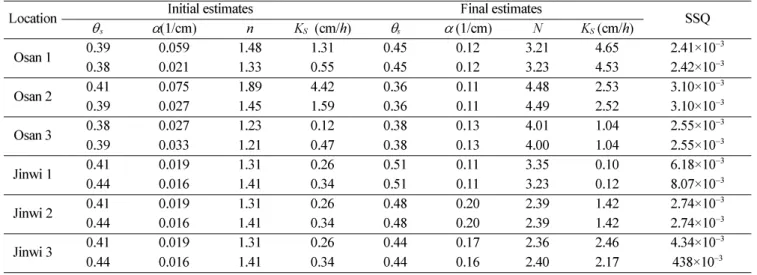
Table 2 shows the results of the inverse parameter esti- mation method. Two different sets of initial estimates for soil hydraulic parameters at each location were used in the numerical inverse solution as shown in Table 2.
The final optimized soil hydraulic parameters are con- verged to almost the same values at each location regardless of initial estimates. Although there exists a slight difference in the final saturated hydraulic conduc- tivity estimates for Osan 1 and Jinwi 3 locations, it seems that the difference is not significant enough to reject the solution. And as shown in the Fig. 1, the inverse solution revealed very good agreement between measured and optimized cumulative infiltration data with correlation of one. Thus, the final optimized soil hydraulic parameters at each location can be determined with the smallest value of objective function (SSQ) in Table 2.
3.2. Comparison of Soil Hydraulic Conductivity Between Inverse Solution and PTF
The soil hydraulic conductivity values obtained from the
inverse parameter estimation approach were compared with
the hydraulic conductivity values estimated from pedo-
transfer function method. For a measure of the comparison,
RMSE (root mean square error) and MAE (mean absolute
Table 2. The optimized parameters of van Genuchten model using inverse parameter estimation method.
Location θ Initial estimates Final estimates SSQ
s α(1/cm) n KS (cm/h) θs α (1/cm) N KS (cm/h)
Osan 1 0.39 0.059 1.48 1.31 0.45 0.12 3.21 4.65 2.41×10⁻³
0.38 0.021 1.33 0.55 0.45 0.12 3.23 4.53 2.42×10⁻³
Osan 2 0.41 0.075 1.89 4.42 0.36 0.11 4.48 2.53 3.10×10⁻³
0.39 0.027 1.45 1.59 0.36 0.11 4.49 2.52 3.10×10⁻³
Osan 3 0.38 0.027 1.23 0.12 0.38 0.13 4.01 1.04 2.55×10⁻³
0.39 0.033 1.21 0.47 0.38 0.13 4.00 1.04 2.55×10⁻³
Jinwi 1 0.41 0.019 1.31 0.26 0.51 0.11 3.35 0.10 6.18×10⁻³
0.44 0.016 1.41 0.34 0.51 0.11 3.23 0.12 8.07×10⁻³
Jinwi 2 0.41 0.019 1.31 0.26 0.48 0.20 2.39 1.42 2.74×10⁻³
0.44 0.016 1.41 0.34 0.48 0.20 2.39 1.42 2.74×10⁻³
Jinwi 3 0.41 0.019 1.31 0.26 0.44 0.17 2.36 2.46 4.34×10⁻³
0.44 0.016 1.41 0.34 0.44 0.16 2.40 2.17 438×10−3
Fig. 1. Comparison between measured and optimized cumulative infiltration data.
error) were used and defined as:
RMSE = , MAE =
in which
yidenotes the soil hydraulic conductivity calculated from the inverse parameter estimation method,
yi*indicates the soil hydraulic conductivity estimated from PTF, and
Nis the total number of data. The performance of different PTFs is defined by the total error which is the sum of RMSE and MAE and the total errors are calculated for saturated hydrau- lic conductivity and relative unsaturated hydraulic conduc- tivity, separately. The relative unsaturated hydraulic conductivity is defined as the unsaturated hydraulic conductivity normal- ized by the saturated hydraulic conductivity such that the rel- ative unsaturated hydraulic conductivity value ranges between
0 and 1.
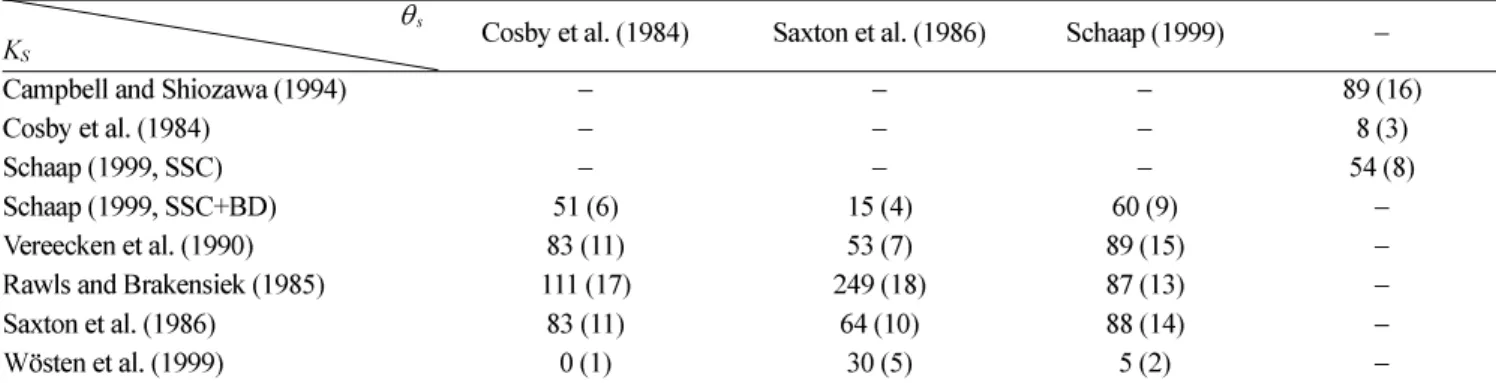
The Tables 3 and 4 show the result of total errors, relative error, and ranking for different PTFs of saturated hydraulic conductivity. The relative error is defined as the error rel- ative to the best predicted PTF. As explained above, the sat- urated water content can be estimated using three different PTFs of Cosby et al. (1984), Saxton et al. (1986) and Schaap (1999) in terms of soil textural information. Thus, as shown in Tables 3 and 4, 18 different PTFs can be com- pared and ranked depending on the PTF applied for the esti- mation of saturated water content. The PTF of Wösten et al.
(1999) combined with the
θsPTF of Cosby et al. (1984) is shown to be the best PTF for predicting saturated hydraulic conductivity. The PTF of Rawls and Brakensiek (1985) combined with the PTF of
θsfor Saxton et al. (1986) are the worst PTF for predicting saturated hydraulic conductivity.
Tables 5 and 6 show the evaluation results for 13 different
yi–
yi*( )2
i=1
∑N
---
N yi yi–
* i=1∑N
---
NTable 3. Comparison of total errors for PTFs of saturated hydraulic conductivity.
θs
KS Cosby et al. (1984) Saxton et al. (1986) Schaap (1999) −
Campbell and Shiozawa (1994) − − − 4.3
Cosby et al. (1984) − − − 2.45
Schaap (1999, SSC) − − − 3.49
Schaap (1999, SSC+BD) 3.42 2.6 3.63 −
Vereecken et al. (1990) 4.16 3.47 4.28 −
Rawls and Brakensiek (1985) 4.79 7.93 4.24 −
Saxton et al. (1986) 4.16 3.72 4.27 −
Wösten et al. (1999) 2.27 2.94 2.39 −
Table 4. The relative errors and ranking for PTFs of saturated hydraulic conductivity.
θs
KS Cosby et al. (1984) Saxton et al. (1986) Schaap (1999) −
Campbell and Shiozawa (1994) − − − 89 (16)
Cosby et al. (1984) − − − 8 (3)
Schaap (1999, SSC) − − − 54 (8)
Schaap (1999, SSC+BD) 51 (6) 15 (4) 60 (9) −
Vereecken et al. (1990) 83 (11) 53 (7) 89 (15) −
Rawls and Brakensiek (1985) 111 (17) 249 (18) 87 (13) −
Saxton et al. (1986) 83 (11) 64 (10) 88 (14) −
Wösten et al. (1999) 0 (1) 30 (5) 5 (2) −
Note: The value in parenthesis indicates the ranking and the relative error is given in percent.
Table 5. Comparison of total errors for PTFs of unsaturated hydraulic conductivity.
θs
K(h) Cosby et al. (1984) Saxton et al. (1986) Schaap (1999) −
Schaap (1999, SSC) − − − 1.50
Schaap (1999, SSC+BD) 1.60 1.79 1.55 −
Vereecken et al. (1990) 1.68 1.51 1.72 −
Rawls and Brakensiek (1985) 1.53 1.57 1.52 −
Wösten et al. (1999) 1.69 1.67 1.70 −
PTFs of unsaturated hydraulic conductivity. The PTF of Schaap (1999, SSC) which utilizes only soil texture infor- mation turned out to be the best PTF for an estimation of unsaturated hydraulic conductivity. The worst PTF in the prediction of unsaturated hydraulic conductivity was the PTF of Schaap (1999, SSC+BD) combined with the
θsPTF of Saxton et al. (1986). It is shown that the accuracy of var- ious PTFs in predicting unsaturated hydraulic conductivity is highly dependent on the PTF used to estimate the satu- rated water content. Although the PTFs tested in this study cover the soil textural classes of the current experimental sites, it is very difficult to identify the source of accuracy of various PTFs because there is no enough information regarding to experimental data and measurement methods used for the determination of PTFs.
4. CONCLUSIONS
The saturated and unsaturated hydraulic conductivity val- ues were evaluated by the inverse parameter estimation method and PTF method. The inverse parameter estimation method combines numerical simulation of Richards equa- tion with Levenberg-Marquardt nonlinear minimization method and is very useful approach for estimating both sat- urated and unsaturated hydraulic conductivity based on the in-situ measured tension infiltration data. The PTF approach estimates soil hydraulic conductivity parameters indirectly based on the input variables such as soil textures, bulk den- sity, and saturated water content and is very efficient way of estimating soil hydraulic conductivity when measured hydraulic conductivity data are absent.
The performance of various PTFs was classified by mea- suring the sum of RMSE and MAE and the comparison of performance measure revealed the following conclusions.
For the estimation of saturated hydraulic conductivity, the PTF of Wösten et al. (1999) combined with the
θsPTF of Cosby et al. (1984) showed the best prediction. The satu- rated hydraulic conductivity PTF of Cosby et al. (1984) is a useful and good predictor since it requires soil texture information only and the error is within 10% relative to the best PTF of Wösten et al. (1999). For unsaturated hydraulic conductivity PTF, the PTF of Schaap (1999, SSC) appears to be the best predictor compared to the numerical inversion
solution. The PTF of Vereecken et al. (1990) combined with the
θsPTF of Saxton et al. (1986) and the PTF of Rawls and Brakensiek (1985) combined with the
θsPTF of Schaap (1999) are also comparable predictors because the relative errors are within 1% relative to the best PTF.
Although the conclusions drawn in the paper might be limited by the lack of number of measurement sites and soil types being investigated, it may be useful for preliminary estimation of soil hydraulic conductivity properties for modeling soil water movement studies and hydrologic anal- ysis. And a methodology presented in the paper can be extended to further investigation and the best PTF identified in this paper needs to be further tested in order to under- stand the uncertainty and accuracy of PTF.
ACKNOWLEDGEMENT: This research has been supported by Kyung Hee University in 2004. The author wishes to thank the review- ers for their helpful and constructive comments.
REFERENCES
Ankeny, M.D., Kaspar, T.C., and Horton, R., 1989, Design for an automated tension infiltrometer. U.S. Patent #4,884,436.
Ankeny, M.D., Ahmed, M., Kaspar, T.C., and Horton, R., 1991, Sim- ple field method for determining unsaturated hydraulic conduc- tivity. Soil Science Society of America Journal, 55, 467−470.
Campbell, G.S., and Shiozawa, S., 1994, Prediction of hydraulic properties of soils using particle-size distribution and bulk den- sity data. In: van Genuchten, M. Th., et al. (ed.), Proceedings of the International Workshop on Indirect Methods for Estimating the Hydraulic Properties of Unsaturated Soils. University of Cal- ifornia, Riverside, CA, p. 317−328.
Carsel, R.F., and Parrish, R.S., 1988, Developing joint probability distributions of soil water retention characteristics. Water Resources Research, 24, 755−769.
Cosby, B.J., Hornberger, G.M., Clapp, R.B., and Ginn, T.R., 1984, A statistical exploration of the relationships of soil moisture char- acteristics to the physical properties of soils. Water Resources Research, 20, 682−690.
Gardner, W.R., 1958, Some steady state solutions of the unsaturated moisture flow equation with application to evaporation from a water table. Soil Science, 85, 228−232.
Mualem, Y., 1976, A new model for predicting the hydraulic conduc- tivity of unsaturated porous media. Water Resources Research, 12, 513−522.
Rawls, W.J. and Brakensiek, D.L., 1985, Prediction of soil water prop-
Table 6. The relative errors and ranking for PTFs of unsaturated hydraulic conductivity.
θs
K(h) Cosby et al. (1984) Saxton et al. (1986) Schaap (1999) −
Schaap (1999, SSC) − − − 0 (1)
Schaap (1999, SSC+BD) 7 (7) 19 (13) 3 (5) −
Vereecken et al. (1990) 12 (9) 1 (2) 15 (12) −
Rawls and Brakensiek (1985) 2 (4) 5 (6) 1 (3) −
Wösten et al. (1999) 13 (10) 11 (8) 13 (11) −
Note: The value in parenthesis indicates the ranking and the relative error is given in percent.
erties for hydrologic modeling. Proceedings of Symposium on Watershed Management, American Society of Civil Engineers, New York, p. 293−299.
Reynolds, W.D., and Elrick, D.E., 1991, Determination of hydraulic conductivity using a tension infiltrometer. Soil Science Society of America Journal, 55, 633−639.
Saxton, K.E., Rawls, W.J., Romberger, J.S., and Papendick, R.I., 1986, Estimating generalized soil-water characteristics from tex- ture. Soil Science Society of America Journal, 50, 1031−1036.
Schaap, M. G., 1999, Rosetta Version 1.0. U.S. Salinity Laboratory, ARS, U.S. Department of Agriculture, Riverside, CA.
Šimu˚nek, J., and van Genuchten, M. Th., 1996, Estimating unsaturated soil hydraulic properties from tension disc infiltrometer data by numerical inversion. Water Resources Research, 32, 2683−2696.
Šimu˚nek, J., and van Genuchten, M. Th., 1997, Estimating unsatur- ated soil hydraulic properties from multiple tension disc infil- trometer data. Soil Science, 162, 383−398.
Šimu˚nek, J., and van Genuchten, M. Th., 2000, The DISC computer software for analyzing tension disc infiltrometer data by param- eter estimation. U.S. Salinity Laboratory, ARS, U.S. Department of Agriculture, Riverside, CA.
van Genuchten, M. Th., 1980, A closed-form equation for predicting the hydraulic conductivity of unsaturated soils. Soil Science Society of America Journal, 44, 892−898.
Vereecken, H., Maes, J., and Feyen, J., 1990, Estimating unsaturated hydraulic conductivity from easily measured soil properties. Soil Science, 149, 1−12.
Wagner, B., Tarnawski, V.R., Hennings, V., Müller, U., Wessolek, G., Plagge, R., 2001, Evaluation of pedo-transfer functions for unsat- urated soil hydraulic conductivity using an independent data set.
Geoderma, 102, 275−297.
Wooding, R.A., 1968, Steady infiltration from large shallow circular pond. Water Resources Research, 4, 1259−1273.
Wösten, J.H.M., 1997, Pedotransfer functions to evaluate soil quality.
In: Gregorich, E.G., Carter, M.R. (Eds.), Soil Quality for Crop Production and Ecosystem Health. Developments in Soils Sci- ence, vol. 25, Elsevier, Amsterdam, pp. 221−245.
Wösten, J.H.M., Lilly, A., Nemes, A., Le Bas, C., 1999, Develop- ment and use of a database of hydraulic properties of European soils. Geoderma, 90, 169−185.
Wösten, J.H.M., Pachepsky, Ya. A., Rawls, W.J., 2001, Pedotransfer functions: bridging the gap between available basic soil data and missing soil hydraulic characteristics. Journal of Hydrology, 251, 123−150.
Manuscript received October 29, 2004 Manuscript accepted August 4, 2005