• 검색 결과가 없습니다.

양이온성 지방산아민 벌키화제를 이용한 저밀도 종이 제조 (4)

N/A
N/A
Protected

Academic year: 2021

Share "양이온성 지방산아민 벌키화제를 이용한 저밀도 종이 제조 (4) "

Copied!
8
0
0

로드 중.... (전체 텍스트 보기)

전체 글

(1)

양이온성 지방산아민 벌키화제를 이용한 저밀도 종이 제조 (4)

- 지력증강제 첨가가 종이 강도에 미치는 영향 -

남윤석·최경화 1 ·김해란 2 ·조준형 3†

접수일(2017년 6월 4일), 수정일(2017년 6월 13일), 채택일(2017년 6월 16일)

Manufacture of Low Density Paper by Cationic Fatty Acid Amine Bulky Promotor Treatment (4)

- Effect of Strength Additives on Paper Strength -

Yun-Seok Nam, Kyoung-Hwa Choi 1 , Hai-Lan Jin 2 and Jun-Hyung Cho 3†

Received June 4, 2017; Received in revised form June 13, 2017; Accepted June 16, 2017

ABSTRACT

The effects of a strength agent on the properties of handsheets have been investigated during the manufacturing of low density paper (high bulk paper) with cationic fatty acid bulky promotor. Paper strength was improved by the addition of strength agents while properties of handsheets including bulk, opacity, and light scattering coefficient were decreased, in the order of cationic starch, high molecular cationic polyacrylamide, and low molecular polyacrylamide. Namely, the change in mechanical and optical properties of paper by the addition of cationic starch was greater than that of cationic polyacryl- amide. Moreover, high molecular cationic polyacrylamide made more effect on the change of paper properties than low molecular cationic polyacrylamide. However it was found that the concentration of strength agents showed almost no relation to the change of paper properties by the addition of strength agent.

Keywords: Cationic fatty acid amine bulky promotor, strength agent, strength, bulk, low density paper

• 국일제지(주) 기술연구소(Institute of Technology, Kuk-Il Paper MFG Co. Ltd., Yongin, Republic of Korea)

1 강원대학교 창강제지기술연구소(Changgang Institute of Paper Science and Technology, Kangwon National University, Chun- cheon, 24341, Republic of Korea)

2 중국 동북 임업대 재료과학공정학원 제지학과(School of Material Science and Technology, Northeast Forestry University, Har- bin, China)

3 강원대학교 산림환경과학대학 산림응용공학부 제지공학전공(Program of Paper Science & Engineering, Division of Forest Mate- rial Science and Engineering, College of Forest and Environmental Sciences, Kangwon National University, Chuncheon, 24341, Republic of Korea)

† 교신저자(Corresponding Author): E-mail: [email protected]

Printed in Korea http://dx.doi.org/10.7584/JKTAPPI.2017.06.49.3.20

(2)

1. 서 론

전 세계적으로 자원 보존 및 환경오염 등 환경적인 규 제가 심화되고 있으며, 국제 원료가격 또한 지속적으로 상승되고 있어 각 산업분야에서 이에 관련된 다양한 연 구들이 이루어지고 있다. 펄프제지산업은 목재자원 및 용수 등 많은 양의 자원을 소비할 뿐만 아니라 다양한 화학 첨가제들을 사용하기 때문에 자원을 절감할 수 있 는 친환경 제조기술개발이 요구된다. 특히 국내의 경우 펄프원료의 대부분을 수입에 의존하고 있으므로 제지순 환자원의 재활용 및 펄프 사용량 절감과 관련된 기술개 발이 더욱 시급하다.

저밀도 종이(하이벌크지)는 동일 두께를 가지는 저평 량의 벌키한 종이로서 펄프 사용량을 절감할 수 있는 대 표적인 방안 중의 하나로 이를 제조하기 위한 다양한 기 술들이 개발, 시도되고 있다. 현재까지 연구된 저밀도 종이를 제조하는 주요 방안으로는 화학열기계펄프 (chemithermomechanical pulp, CTMP)를 혼합하거 나, 펄프 자체의 형상 및 특성을 변화시키거나, 보다 벌 키한 특성을 부여하는 침강성 탄산칼슘(precipitated calcium carbonate, PCC)을 충전제로 사용하거나, 초 지공정에서의 압착을 최소화 하는 등의 방법들이 있 다.

1-7)

그러나 CTMP를 혼합하여 저밀도 종이인 하이벌 크지를 제조하는 경우 CTMP가 함유하고 있는 리그닌에 의해 착색 및 강도손상 등 내구성에 문제가 발생될 수 있으며, 침강성 탄산칼슘의 사용, 압착 최소화, 섬유특 성 제어 등의 방법들은 벌크 개선효과가 제한적이거나 강도가 저하되는 등 다양한 문제점들을 가지고 있다.

8)

이러한 문제를 해결하기 위해 새로운 방안으로 연구되고 있는 것이 벌크향상제이다.

8-13)

일반적으로 벌크향상제는 알킬 에스테르, 알킬 에테 르, 알킬 아미드 등의 유기계와 이산화규소(화이트 카 본) 등의 무기계로 나누어지는데 최근 연구결과에 의하 면 유기계의 벌크 개선효과가 무기계보다 높은 것으로 알려져 있다.

11-13)

이에 양이온성 지방산 아민류의 유기 계 벌크향상제를 적용하여 저밀도 종이를 제조하고자 하 였으며, 이에 대한 이전 연구결과 우수한 벌크 개선 효 과를 확인할 수 있었다.

14-16)

그러나 종이의 벌크 개선에 따른 종이의 강도 저하가 발생되었다. 현재까지 제시된 벌크향상제의 발현 기작을 살펴보면 소수성과 친수성기 를 모두 가지고 있는 벌크향상제를 펄프 슬러리에 첨가

하면 벌크향상제의 친수성기가 펄프의 수산기에 결합되 어 펄프 표면을 소수화시켜 펄프 섬유 간 수소 결합 형 성을 방해함으로써 종이의 두께를 증가시킨다. 반면에 섬유 간 결합 형성을 방해하기 때문에 종이의 강도 저하 가 발생될 수 있다. 그러므로 벌크향상제를 이용한 저밀 도 종이 제조 시 벌크를 어느 정도 유지하면서 강도 저 하를 최소화시킬 수 있는 지력증강제의 종류 및 첨가량 등에 대한 최적화 연구가 필요하다. 따라서 본 연구에서 는 양이온성 지방산 아민류 벌크향상제를 이용한 저밀도 종이 제조 시 지력증강제 첨가가 종이의 벌크 특성, 강 도적 특성, 광학적 특성 등의 변화에 미치는 영향을 평 가하고자 하였다.

2. 재료 및 방법

2.1 공시재료

저밀도 종이 제조를 위해 국내 H사에서 분양받은 활엽 수 표백 크라프트 펄프(hardwood bleached kraft pulp, HwBKP, Eucalyptus, Brazil)와 침엽수 표백 크 라프트 펄프(softwood bleached kraft pulp, SwBKP, Pine, Canada)를 펄프 시료로 사용하였으며, 벌크향상 제로 국내 K사에서 분양받은 양이온성 지방산아민류 계 면활성제(cationic fatty acid amine type surfactant) 를 사용하였다. 또한 지력증강제로서 국내 S사에서 분양 받은 양이온성 감자전분(cationic potato starch, C-Starch)과 국내 A사에서 분양받은 양이온성 폴리아 크릴아미드(cationic polyacrylamide, C-PAM)를 사용 하였으며, 각 지력증강제들의 기본 물성은 Table 1에 나 타냈다.

2.2 실험방법

2.2.1 벌키화제와 지력증강제 처리 및 수초지 제조

HwBKP와 SwBKP를 고속 해리기(Lorentzen &

Wetter disintergrator, Sweden)로 해섬하였으며, 실

험실용 고해기(Valley beater)를 사용하여 HwBKP와

SwBKP를 각각 여수도 450 mL CSF가 되도록 고해하

였다. 고해한 HwBKP와 SwBKP를 각각 70:30으로 배

합한 후(지료농도 1.5%), 펄프 전건무게 대비 1%의 양이

온성 지방산 아민류 벌크향상제를 첨가하고 자력 교반기

(electronic overhead stirrer)를 사용하여 600 rpm으

(3)

로 10분 교반 후 30분간 정치하였다. 이후 지력증강제의 첨가량을 0%-1.5%로 달리하여 첨가한 후 보류탈수 분 석기(retention & drainage analyzer, RDA)를 사용하 여 평량 60 g/m

2

의 수초지를 제조하였다(Table 2).

2.2.2 수초지 특성 분석

양이온성 지방산 아민류 벌크향상제 적용한 저밀도 종 이 제조 시 지력증강제 첨가가 수초지 특성에 미치는 영 향을 평가하기 위해 지력증강제 종류 및 첨가량을 달리하 여 제조한 수초지의 벌크, 강도적 특성, 광학적 특성을 분 석하였다. 각 수초지 시료들은 물성 측정에 앞서 ISO 187 에 의거하여 상대습도 50±2%, 온도 23±1°C로 조절한 항온항습실에서 24시간 이상 조습처리하였다. 벌크특성 은 ISO 534에 의거하여 평량(A&D Phoenix GH-200, German) 및 두께(Lorentzen & Wettre Micrometer, Sweden)등을 측정하여 수초지의 밀도를 분석한 후 역수 를 취하여 계산하였다. 또한 강도적 특성으로 ISO 1924- 2, ISO 1974, ISO 2758에 의거하여 인장강도(Lorent- zen & Wettre Tensile tester, Sweden), 인열강도(El- mendorf tearing tester, USA), 파열강도(Lorentzen

& Wettre bursting strength tester, Sweden)를 측정 하였으며, 광학적 특성으로 ISO 7810과 ISO 9416에 의 거하여 불투명도 및 광산란계수(Lorentzen & Wettre Elrepho, Swe den)를 측정하였다.

3. 결과 및 고찰

3.1 지력증강제 첨가에 따른 저밀도 수초지의 강도적 특성 변화

양이온성 지방산아민류 벌크향상제를 적용한 저밀도 수초지 제조 시 지력증강제 첨가가 수초지의 강도적 특 성에 미치는 영향을 평가하기 위해 지력증강제 종류 및 처리농도에 따른 수초지의 인장강도, 인열강도, 파열강 도 등을 측정한 결과는 Figs. 1-9에서 보는 바와 같다.

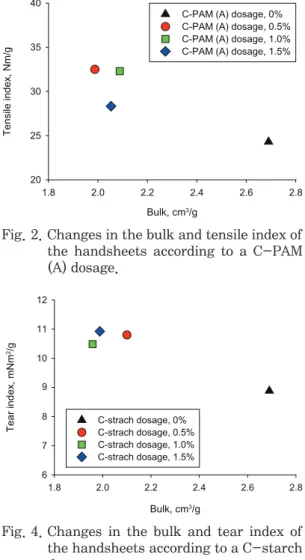
먼저 지력증강제 종류 및 처리농도에 따른 수초지의 인 장지수 변화를 분석한 결과, Figs. 1-3에서 보는 바와 같이 벌크향상제 처리와 함께 지력증강제를 첨가한 경우 수초지의 인장강도가 증가되었으며, C-starch, C- PAM(A), C-PAM(B) 순으로 양이온성 전분을 첨가한 경우의 인장지수가 보다 높게 나타났다. 또한 C-PAM의 경우 분자량이 높을수록 인장지수가 소폭 더 증가되는 것으로 나타났다. 첨가량 변화에 따른 변화는 지력증강 제 종류에 따라 다르게 나타났는데, C-starch의 경우 첨가량 변화에 따라 거의 영향을 받지 않았으며, C- PAM의 경우 분자량이 높은 C-PAM(A)는 첨가량이 높 은 경우의 인장지수가 가장 낮았던 반면 분자량이 낮은 C-PAM(B)는 첨가량이 높은 경우의 인장지수가 가장 높아 분자량에 따라 상이한 결과를 나타냈다. 지력증강 제 처리에 따른 수초지의 벌크는 감소되었는데 이는 지 Table 1. Characteristics of different strength agents

Type Solid content (%) Salt viscosity

1)

(cPs) pH Charge density (meq/g)

C-starch 95 - - -

C-PAM A 10.5 9,168 3.71 1.15

B 26.1 220 4.55 1.07

1)

0.3% salt content in 1 M NaCl (25°C).

Table 2. Manufacturing conditions of low density handsheets

Conditions Contents

Mixing ratio of HwBKP and SwBKP HwBKP 70% + SwBKP 30%

Degree of beating (mL CSF) 450

Concentration of bulk promoter (%) 1.0

Concentration of pulp slurry (%) 1.5

Concentration of strength agent

1)

(%) 0, 0.5, 1.0, 1.5

Basis weight of handsheets (g/m

2

) 60

1)

C-starch, C-PAM A type, C-PAM B type.

(4)

Fig. 1. Changes in the bulk and tensile index of the handsheets according to a C-starch dosage.

Bulk, cm

3

/g

1.8 2.0 2.2 2.4 2.6 2.8

Te ns ile in de x, N m /g

20 25 30 35

40 C-strach dosage, 0%

C-starch dosage, 0.5%

C-starch dosage, 1.0%

C-starch dosage, 1.5%

Fig. 2. Changes in the bulk and tensile index of the handsheets according to a C-PAM (A) dosage.

1.8 2.0 2.2 2.4 2.6 2.8

20 25 30 35

40 C-PAM (A) dosage, 0%

C-PAM (A) dosage, 0.5%

C-PAM (A) dosage, 1.0%

C-PAM (A) dosage, 1.5%

Bulk, cm

3

/g

Te ns ile in de x, N m /g

Fig. 3. Changes in the bulk and tensile index of the handsheets according to a C-PAM (B) dosage.

1.8 2.0 2.2 2.4 2.6 2.8

20 25 30 35

40 C-PAM (B) dosage, 0%

C-PAM (B) dosage, 0.5%

C-PAM (B) dosage, 1.0%

C-PAM (B) dosage, 1.5%

Bulk, cm

3

/g

Te ns ile in de x, N m /g

Fig. 4. Changes in the bulk and tear index of the handsheets according to a C-starch dosage.

1.8 2.0 2.2 2.4 2.6 2.8

6 7 8 9 10 11 12

C-strach dosage, 0%

C-strach dosage, 0.5%

C-strach dosage, 1.0%

C-strach dosage, 1.5%

Bulk, cm

3

/g Te ar in de x, m N m

2

/g

Fig. 5. Changes in the bulk and tear index of the handsheets according to a C-PAM (A) dosage.

1.8 2.0 2.2 2.4 2.6 2.8

6 7 8 9 10 11

12 C-PAM (A) dosage, 0%

C-PAM (A) dosage, 0.5%

C-PAM (A) dosage, 1.0%

C-PAM (A) dosage, 1.5%

Bulk, cm

3

/g Te ar in de x, m N m

2

/g

Fig. 6. Changes in the bulk and tear index of the handsheets according to a C-PAM (B) dosage.

1.8 2.0 2.2 2.4 2.6 2.8

6 7 8 9 10 11

12 C-PAM (B) dosage, 0%

C-PAM (B) dosage, 0.5%

C-PAM (B) dosage, 1.0%

C-PAM (B) dosage, 1.5%

Bulk, cm

3

/g

Te ar in de x, m N m

2

/g

(5)

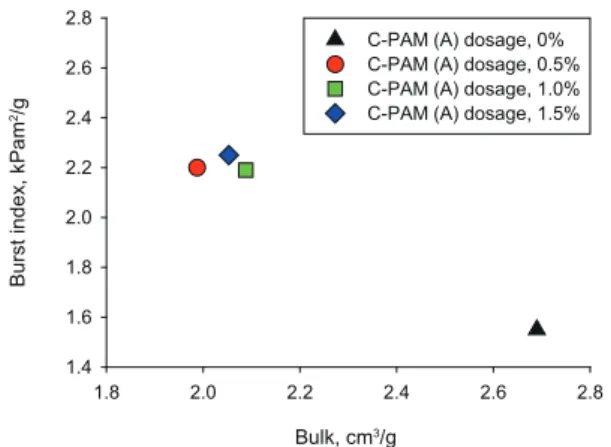
력증강제 첨가에 따른 섬유간 결합력의 증가에 기인된 결과로 판단됐다. 인장지수 개선율 대비 벌크의 감소율 이 낮은 최적 조건은 C-starch는 0.5%, C-PAM(A)는 1.0, C-PAM(B)는 1.5%인 것으로 나타나 지력증강제 종류 및 분자량에 따라 상이한 결과를 나타냈다. 벌키향 상제 처리 시 지력증강제 첨가에 따른 수초지의 인열지 수(Figs. 4-6) 및 파열지수(Figs. 7-9)는 인장지수의 경 우와 마찬가지로 증가되었으며, 반면에 벌크는 감소되었 다. 지력증강제 종류 및 처리농도에 따른 변화는 인장지 수의 변화와 유사한 경향을 나타냈다. 즉, C-starch를 첨가한 수초지의 강도가 가장 높았으며, 분자량이 보다 높은 C-PAM을 첨가한 경우의 수초지 강도가 높게 나타 났다. 또한 수초지의 강도 개선율 대비 벌크의 감소율이 Fig. 7. Changes in the bulk and burst index of the handsheets according to a C-starch dosage.

1.8 2.0 2.2 2.4 2.6 2.8

B ur st in de x, k P am

2

/g

1.4 1.6 1.8 2.0 2.2 2.4 2.6

2.8 C-strach dosage, 0%

C-strach dosage, 0.5%

C-strach dosage, 1.0%

C-strach dosage, 1.5%

Bulk, cm

3

/g

Fig. 8. Changes in the bulk and burst index of the handsheets according to a C-PAM (A) dosage.

1.8 2.0 2.2 2.4 2.6 2.8

1.4 1.6 1.8 2.0 2.2 2.4 2.6

2.8 C-PAM (A) dosage, 0%

C-PAM (A) dosage, 0.5%

C-PAM (A) dosage, 1.0%

C-PAM (A) dosage, 1.5%

B ur st in de x, k P am

2

/g

Bulk, cm

3

/g

Fig. 9. Changes in the bulk and burst index of the handsheets according to a C-PAM (B) dosage.

1.8 2.0 2.2 2.4 2.6 2.8

1.4 1.6 1.8 2.0 2.2 2.4 2.6

2.8 C-PAM (B) dosage, 0%

C-PAM (B) dosage, 0.5%

C-PAM (B) dosage, 1.0%

C-PAM (B) dosage, 1.5%

B ur st in de x, k P am

2

/g

Bulk, cm

3

/g

낮은 최적 조건 역시 인장지수의 그것과 동일한 경향을 나타냈다. 즉 C-starch는 0.5%, C-PAM(A)는 1.0, C-PAM(B)는 1.5%를 첨가할 경우, 수초지의 강도가 개 선율 대비 벌크 감소율이 가장 적은 것으로 나타났다.

3.2 지력증강제 첨가에 따른 저밀도 수초지의 광학적 특성 변화

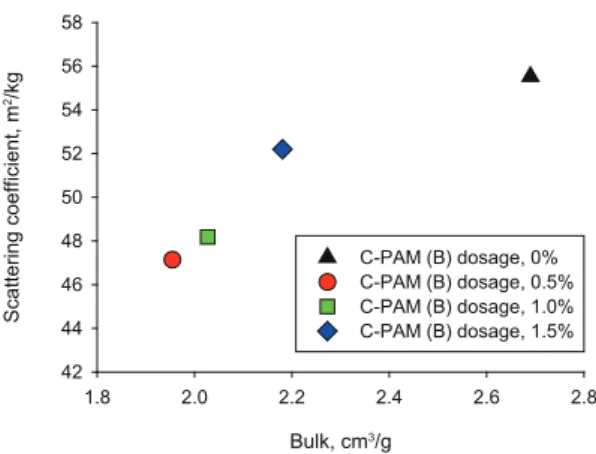
양이온성 지방산아민류 벌크향상제를 적용한 저밀도 수초지 제조 시 지력증강제 첨가가 수초지의 광학적 특 성에 미치는 영향을 평가하기 위해 지력증강제 종류 및 처리농도에 따른 수초지의 불투명도와 광산란계수를 측 정한 결과는 Figs. 10-15에서 보는 바와 같다. 그림에서 보는 바와 같이 지력증강제 첨가에 따라 수초지의 불투 명도는 감소되었다. 특히 C-starch, C-PAM(A), C- PAM(B) 순으로 양이온성 전분을 첨가한 경우의 불투명 도 보다 감소되었으며, C-PAM의 경우 분자량이 높을 수록 불투명도가 소폭 더 감소되는 것으로 나타났다. 반 면 첨가량에 따른 변화는 지력증강제 종류에 따라 다르 게 나타났으며 수초지의 벌크 감소 경향에 비례하는 결 과를 나타냈다. 지력증강제 처리에 따른 수초지의 광산 란계수 또한 불투명도와 유사한 경향을 나타냈다.

4. 결 론

양이온성 지방산아민류 벌키화제 적용 시 지력증강제

첨가가 수초지의 벌크 특성, 강도적 특성, 광학적 특성

(6)

Fig. 11. Changes in the bulk and opacity of the handsheets according to a C-PAM (A) dosage.

1.8 2.0 2.2 2.4 2.6 2.8

76 78 80 82 84 86 88

C-PAM (A) dosage, 0%

C-PAM (A) dosage, 0.5%

C-PAM (A) dosage, 1.0%

C-PAM (A) dosage, 1.5%

O pa ci ty , %

Bulk, cm

3

/g

Fig. 12. Changes in the bulk and opacity of the handsheets according to a C-PAM (B) dosage.

1.8 2.0 2.2 2.4 2.6 2.8

76 78 80 82 84 86 88

C-PAM (B) dosage, 0%

C-PAM (B) dosage, 0.5%

C-PAM (B) dosage, 1.0%

C-PAM (B) dosage, 1.5%

O pa ci ty , %

Bulk, cm

3

/g

Fig. 13. Changes in the bulk and scattering coefficient of the handsheets according to a C-starch dosage.

1.8 2.0 2.2 2.4 2.6 2.8

Sc at te rin g co ef fic ie nt , m

2

/kg 42 44 46 48 50 52 54 56

58 C-strach dosage, 0%

C-starch dosage, 0.5%

C-starch dosage, 1.0%

C-strarch dosage, 1.5%

Bulk, cm

3

/g

Fig. 14. Changes in the bulk and scattering coefficient of the handsheets according to a C-PAM (A) dosage.

1.8 2.0 2.2 2.4 2.6 2.8

42 44 46 48 50 52 54 56 58

C-PAM (A) dosage, 0%

C-PAM (A) dosage, 0.5%

C-PAM (A) dosage, 1.0%

C-PAM (A) dosage, 1.5%

Sc at te rin g co ef fic ie nt , m

2

/kg

Bulk, cm

3

/g

Fig. 15. Changes in the bulk and scattering coefficient of the handsheets according to a C-PAM (B) dosage.

1.8 2.0 2.2 2.4 2.6 2.8

42 44 46 48 50 52 54 56 58

C-PAM (B) dosage, 0%

C-PAM (B) dosage, 0.5%

C-PAM (B) dosage, 1.0%

C-PAM (B) dosage, 1.5%

Sc at te rin g co ef fic ie nt , m

2

/kg

Bulk, cm

3

/g

Fig. 10. Changes in the bulk and opacity of the handsheets according to a C-starch dosage.

1.9 2.0 2.1 2.2 2.3 2.4 2.5 2.6 2.7 2.8

O pa ci ty , %

76 78 80 82 84 86

88 C-strach dosage, 0%

C-starch dosage, 0.5%

C-starch dosage, 1.0%

C-strarch dosage, 1.5%

Bulk, cm

3

/g

(7)

등에 미치는 영향을 분석한 결과 다음과 같은 결론을 얻 을 수 있었다.

양이온성 지방산아민류 벌키화제 처리 시 지력증강제 첨가에 의해 인장강도, 인열강도, 파열강도 등의 종이 강도가 개선된 반면 벌크, 불투명도, 광산란계수는 감소 되었다. 즉 지력증강제 처리에 의해 종이의 강도는 개선 되지만 벌크향상제 처리에 따른 벌크 개선율을 감쇠시키 는 것으로 나타났다. 이와 같은 결과들로 볼 때 지력증 강제에 의해 섬유간 결합면적이 높아져 강도가 개선되나 이에 따른 벌크가 감소되는 것으로 생각된다. 특히 이와 같은 경향은 C-starch를 첨가한 경우가 C-PAM을 첨 가한 경우보다 큰 것으로 나타났으며, 분자량이 큰 C- PAM 첨가한 경우가 분자량이 보다 낮은 C-PAM을 첨 가한 경우 보다 크게 나타났다. 향후 벌크향상제와 지력 증강제를 사용하여 강도가 개선된 저밀도 종이 제조 시 벌크 감쇠 및 강도 개선 두 측면을 모두 만족할 수 있는 지력증강제 처리 조건에 대한 최적화 연구가 선행되야 할 것으로 판단된다.

사 사

2016년도 강원대학교 대학회계 학술연구조성비로 연 구하였음(관리번호-520160132).

Literature Cited

1. Ono, H., Watanabe, M., Nonomura, F., and Nanri, Y., High-bulk, wood containing print- ing paper, US patent, US007404876B2 (2008).

2. Gwak, H. J., Lee, J. Y., Kim, C. H., Back, K.

K., Shin, J. H., Lee, H. J., Kim, S. H., Shim, S. Y., and Kang, H. Y., Improvement of paper bulk and properties using modified precipitat- ed calcium carbonate (PCC), Proceedings of 2009 Fall Conference of the Korea TAPPI, p.

313 (2009).

3. Nam, K. Y., Chung, S. K,. and Won, J. M., Effects of raw materials for papermaking and physical treatment on the pore structure and

paper properties, Journal of Korea TAPPI 39 (4):7-13 (2007).

4. Nam, K., Chung, S., and Won, J. M., Effect of raw materials of the papermaking and physical treatment on the pore structure and properties of the paper, Proceedings of 2003 Fall Conference of the Korea TAPPI, pp. 127- 134 (2013).

5. Sousa, G. D. A., Abreu, C. T., Amaral, J. L., and Bras, C., Office paper bulk optimization in a paper machine using multivariate tech- niques, O PAPEL 72(8):50-55 (2011).

6. Sung, Y. J. and Keller, D. S., Evaluation of the changes in local paper structure and paper properties depending on the forming elements types, Journal of KTAPPI 41(1):17-23 (2009).

7. Eber, R. J. and Janda, B. W., Multiple layer fibrous web products of enhanced bulk and method of manufacturing same, US patent, US005102501A (1992).

8. Takashi, O., Challenge to the development of bulky paper in NPI (Nippon Paper Industries Co. Ltd), Japan TAPPI J. 61(1):50-53 (2007).

9. Kubota, K., Hiraisi, A., Hamada, Y., Nishi- mori, T., and Takahashi, H., Lighter weight and improved paper production by using noble

“bulking promoter”, Japan TAPPI J. 55(4):

451-455 (2001).

10. Hailan, J. and Okayama, T., Effects of inter- nal addition of bulking promoter on low-den- sity and porous structure of handsheet, Seni’i Gakkaishi 65(5):139-145 (2009).

11. Ikeda, Y., Ishibashi, Y., Tadokoro, T., and Takahashi, H., Paper bulking promoter, US patent, US 006576085B2 (2003).

12. Sone, N., Matsushima, T., and Kawamura, M., Paper caliper increaser “PT production line”, Japan TAPPI J. 59(9):1328-1336 (2005).

13. Tomoda, Y., Tanaka, T., and Mukougawa, Y., Density decreaser for paper, Japan TAPPI J.

60(8):1161-1166 (2006).

(8)

14. Nam, Y. S., Choi, K. H., Jin, H. L., and Cho, J.

H., Manufacture of low density paper by cat- ionic fatty acid bulky promotor treatment (1) - Effect of its concentration and pulp type -, Journal of Korea TAPPI 46(4):21-27 (2014).

15. Nam, Y. S., Choi, K. H., and Cho, J. H., Manufacture of low density paper by cationic fatty acid bulky promotor treatment (2) - Ef-

fect of CTMP handsheets properties -, Jour- nal of Korea TAPPI 47(3):18-23 (2015).

16. Nam, Y. S., Choi, K. H., Jin, H. L., and Cho, J.

H., Manufacture of low density paper by cat-

ionic fatty acid bulky promotor treatment (3)

- Effect of pulp beating degree and bulky

promotor concentration -, Journal of Korea

TAPPI 48(1):111-118 (2016).

수치

Table 2. Manufacturing conditions of low density handsheets
Fig. 3.  Changes in the bulk and tensile index of  the handsheets according to a C-PAM  (B) dosage.1.82.0 2.2 2.4 2.6 2.82025303540C-PAM (B) dosage, 0%C-PAM (B) dosage, 0.5%C-PAM (B) dosage, 1.0%C-PAM (B) dosage, 1.5%Bulk, cm3/gTensile index, Nm/g
Fig. 8.  Changes in the bulk and burst index of  the handsheets according to a C-PAM  (A) dosage.1.82.0 2.2 2.4 2.6 2.81.41.61.82.02.22.42.6
Fig. 14.  Changes  in  the  bulk  and  scattering  coefficient of the handsheets according  to a C-PAM (A) dosage.

참조

관련 문서

In the change of physical strength, The exercise group showed statistically significant differences in muscle strength(right), muscle strength(left),

12 weeks of combined exercise (body strength exercise and aerobic exercise) was applied to measure health fitness (muscle strength, muscular endurance,

The average tensile strength value before heat treatment of PLA output was 9.67 N/㎟, and the average tensile strength value after heat treatment was 24.17 N/㎟, which

CMP characteristics such as the removal rate and WIWNU% were improved by the increase of CMP pressure; however, the electrical properties

Based on the above results, the characteristics of the wrestling Greco-Roman style of athletes were statistically significant in terms of basic physical

 Euler buckling strength of long column cannot be improved by higher- strength material since it is due to the instability of the column as a whole.  For a column

The purpose of this study was to investigate how the 8-week aerobic exercise program affects the physical strength and stress of obese women in the

In the health fitness category of the adult women who underwent instrument pilates exercise, they were statistically significant in muscle strength,