
http://dx.doi.org/10.7840/kics.2014.39C.12.1338
※ This research was supported by the MSIP (Ministry of Science, ICT and Future Planning) Korea, under the Global IT Talent support program (NIPA-2014-H0904-14-1005).
First Author : Dept. of IT Convergence Engineering, Kumoh National Institute of Technology, [email protected], 학생회원
° Corresponding Author : Lecturer at School of Electronic Engineering, Kumoh National Institute of Technology, [email protected], 정회원
논문번호:KICS2014-09-366, Received September 29, 2014; Revised November 13, 2014; Accepted December 2, 2014
마감 단조 스케줄링을 사용한 ISA100.11a 슈퍼프레임 성능평가
Oka Danil Saputra, 신 수 용°
Performance Evaluation of ISA100.11a Superframe Using Deadline Monotonic Scheduling
Oka Danil Saputra, Soo Young Shin°
요 약
최근 무선 기술은 저가, 유연성, 쉬운 설치, 그리고 무엇보다 중요하게도 라우팅 문제를 해결할 수 있다는 측면 에서 산업용 네트워크 분야에서 주목을 받고 있다. 그 중 ISA100.11a는 산업용 무선 환경에서 촉망 받는 표준들 중의 하나이다. 산업 환경에서의 데이터 트래픽은 일반적으로 주기성을 가지며, 데드라인이라는 실시간성을 만족해 야 하는 요구사항을 갖는다. 본 논문은 ISA100.11a의 주기적 태스크들의 처리를 위해 deadline monotonic scheduling 을 적용하는 것을 제안하고 이러한 제안된 알고리즘을 기반으로 ISA 100.11의 성능을 schedulability 및 beacon 오버헤드 관점에서 평가한다. 모의실험 결과 제안된 알고리즘은 기존 결과 대비 schedulability를 유지 하면서도 스케줄링 오버헤드를 감소시킬 수 있다는 것을 보인다. 추가로, 이러한 네트워크 오버헤드의 감소를 통 해, 제안된 알고리즘은 무선 산업용 네트워크의 성능 저하 없이 더 많은 데이터 전송이 가능할 것으로 기대된다.
Key Words : ISA100.11a, Superframe, Deadline Monotonic, Scheduling
ABSTRACT
Recently, wireless technology gains attention for industrial networks due to low cost, flexibility, relatively easy installation and most importantly, solving the rouring issue. ISA100.11a is one of promising standard for wireless industrial networks (WINs). Data traffic in industrial networks are known to be periodic and must satisfy the real-time property namely deadline. Therefore, in this paper, we proposed to apply deadline monotonic scheduling to periodic tasks in ISA100.11a networks and to evaluate the performance of ISA100.11a by checking the schedulability and beacon frame overhead. Simulation results showns, that our proposed scheme can reduces the network overhead while maintaining schedulability as compared to the previous algorithm. In addition, by reducing the network overhead, our proposed scheme can send more data without degrading the overall performance of WINs.
Ⅰ. Introduction
The complexity of process monitoring in industry are getting higher due to more data exchange in the networks. To overcome transfer data problem, all the effort are done especially to utilize the technology. On the other hand, the technology has grown exponentially by bringing new opportunities and perspective. In fact, more than three decades, wired technology has been used in factories for communication. Taking the advantage on robust and relatively faster to send data made wired technology widely adopted in industrial environments. All the standards such as DeviceNet, Controller Area Network (CAN), fiedlbus has been proposed to solve the exchange data problem[1-3]. In general, the data transfer is related to the physical field condition, e.g., pressure, humidity, temperature, distance, etc. In this case, the previous standard mentioned, are used to provide only the data system monitoring. Furthermore, these technologies succeed to takle routing problem caused by cable. However, the space and inflexibility in installation are another problem should be considered.
The wireless technology can accommodate the problem by offering low cost, flexibility, relative easily for installation. The emergence of wireless technology has more positive aspect after combine with the wired technology. Currently, there are two organizations working on development of WINs namely WirelessHART and International Society of Automation (ISA). The comparison between HART 7.2 and ISA100.11a protocols is studied in [4]. Both of standard uses IEEE 802.15.4 as the physical layer and are supported bt direct-sequence spread spectrum (DSSS), time division multiple access (TDMA), channel blacklisting, and channel hopping.
In the network layer, WirelessHART is developed to extend HART address while ISA100.11a is used IPv6. From the viewpoint of the technical specification, ISA100.11a support wide application and it has interoperability with other networks.
ISA100.11a is one of promising standard for WINs and are attracted the reseacher to enhance the performance. In [6], the author studied the
parameters and impact on ISA100.11a performance.
There are three variable including time slot superframe, superframe period and maximum backoff exponent. They showed the effect on length of the superframe to throughput and average delay of nodes are examined in system. Adjusting of length of superframe is proposed in [7]. The method is called message scheduling algorithm by modifying the length of superframe. The objective of message scheduling is to accommodate periodic and aperiodic data in networks. Although their scheme generates lower end to end delay as compared to conventional method but it produce more overhead.
To overcome the overhead problem, the scheduling algorithm is applied in ISA100.11a[8]. In their discussion, deadline monotonic scheduling is used to test the schedulability of superframe.
However, the detail scenario of their proposed scheme is neglected. The author extended their scheme by including the scheduling technique and analysis in [9]. However the throughput analysis is neglected. Although many researcher proposed the performance evaluation study in ISA100.11a, based on our knowledge, this is first discussion about ISA100.11a superframe with throughput analysis. In this paper, we study the superframe impact on performance of wireless industrial networks. Paper [10] clarifies that the data characteristics in industrial networks are exchanged periodically. The main contribution of our paper is of two fold: firstly we discuss about superframe scheduling inspired by deadline monotonic, secondly our scheme is developed based on real scenario and our scheme do not require any special hardware. The rest of paper is organized as follows. The brief discussion related the ISA100.11a standard is described in Section II.
Furthermore, our proposed scheme and simulation results are explained in Section III and Section IV, respectively. Last, section V concludes our paper along with future works.
Ⅱ. ISA100.11a Standard
In April 2009, ISA100.11a-the standardization of wireless industry was approved. The purpose of the
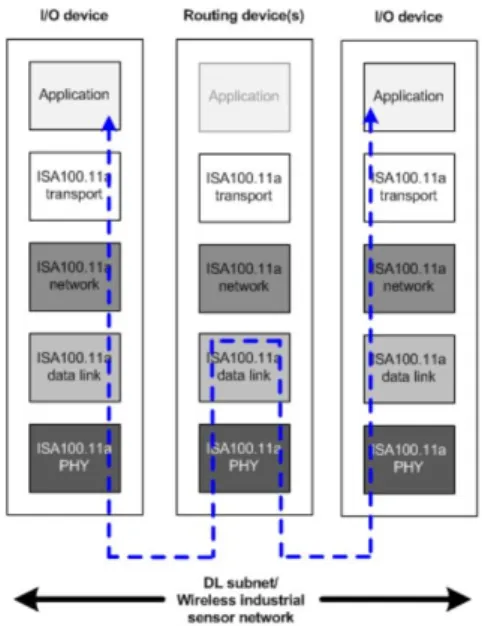
Fig. 1. Data flow between I/O devices.
establishment of protocols is to meet the challenges that exists within the industry whose requirement was not only to secure but also to sustain the communication system[4]. As seen in Fig. 1, ISA100.11a is composed of 5 layers to support the operation. Firstly, at the bottom, the layer is filled by ISA100.11a physical layer based on IEEE 802.15.4 and uses the frequency band of 2.4 GHz.
Secondly, the next layer is occupied by data link which is composed of IEEE 802.15.4 MAC and Upper Data link – ISA100.11a. In MAC layer, ISA100.11a uses carrier sense multiple access with collision avoidance (CSMA /CA) to detect the interference from other frequencies and is equipped with time division multiple access (TDMA), and channel hopping. The network layer is assigned for IPv6. Last, the transport and application layer are presented in fourth and fifth layer, respectively.
Furthermore, hop-to-hop authentication and encryption is related with the link layer security, while the end-to-end authentication and encryption of data message is included in the transport layer security[11]. The illustration of data flow is depicted in Fig. 1. The main purpose of this process is to give the understanding about the data exchange among nodes. The communication starts from node application layer to other node application layer
while node in the middle acts as routing for bridge system in network. In our scheme, we assign the gateway to perform the bridge task. Consequently, the aim of gateway is to collect the data into time slots and distribute it to neighborhood node.
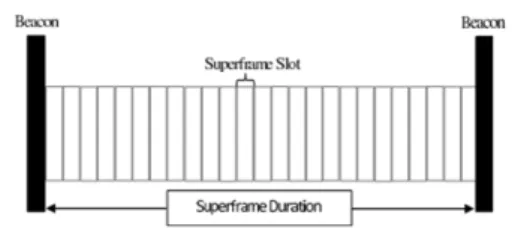
Moreover, the standard defines about length of each time slot with value varying from 10-12 ms. Next, the collection of repeating time slots in time is called as superframe. After a superframe is produced, it is connected with a superframe ID for recognition. Last, every new superframe is called as superframe cycle. For example Fig. 2 shows more specifically that how nodes may communicate in three time slot.
First slot is dedicated for information exchange between node A and B, further communication from node B to node C is placed in the second slot and the last slot is in idle mode. In summary, three time slots are repeated periodically. Additionally, the ISA100.11a superframe and links are shown in Fig.
3, where the group of time slots is referred by superframe. In case of assignment of superframe time slot for data communication, a certain device is used known as links. As described by standard[5], each node has feasibility to own different lengths of superframe.
Fig. 2. Example of communication a three-timeslot ISA100.11a superframe.
Fig. 3. ISA100.11a Superframe and Links.
Ⅲ. Proposed Scheme 3.1 System Model
The enhancement in number of nodes deployed
Fig. 4. Network model consists of gateway and n-number of node.
Fig. 5. The configuration of superframe.
Fig. 6. ISA100.11a superframe message characteristics.
affect the distribution of data in network.
Consequently, the probability of overlap among data also gets higher. So, the problem regarding the overlap among data should be solved. Hence, considering utilization of superframe can impact on effectiveness and efficiency of data exchange. As explained in previous section, superframe is one of the important keys for communication among nodes in ISA100.11a wireless industrial networks. In this paper, we propose a scheme to evaluate the performance of superframe using deadline monotonic scheduling. Furthermore, the network model is presented in Fig. 4. In our model, there are several fixed distributed node, while the gateway is located in center of a circle. We assume node N=
{N1,N2,...,Nn} have the task of data exchange through the gateway. Finally, the star topology is chosen in network of proposed scheme. In this paper, the superframe is categorized into beacon enabled mode as determined in ISA100.11a MAC layer. In particular, the function of beacon is for synchronization, scalability and self-organization.
Thus, the beacon is assigned in beginning of superframe and followed by data from nodes[9]. The Eq. (1) defines the accumulation of time slot where the configuration of superframe is illustrated in Fig.
5.
(1)
where S and B are the superframe and beacon,
respectively. Each of the time slots is occupied only for one device, where shared data from different nodes is non negotiable. We assume the length of each time slot is 10 ms, and we propose 25 time slots for one superframe and duration of superframe is the interval time of two consecutive beacons[8].
3.2 Deadline Monotonic Scheduling
In this subsection, we briefly describe deadline monotonic scheduling (DMS) for scheduling analysis of superframe. The main rule for DMS is data with lowest deadline is executed first until the computation time is done. Further, the Fig. 6 describe the characterization of data (message) in system as follows[12]:
≤ ≤ (2)
where c is computation time, d is the deadline time, r is release time and t is the period of process m and I is the iteration number. Since our system is for industrial monitoring network, we know all the values of the parameters. Theorem 1 is used to determine whether superframe S is schedulable or unschedulable. In outline, the algorithm 1. is presented for the scheduling analysis.
Theorem 1: Superframe is schedulable if and only if, it is sufficient for all the data to follow in Eq. 2.
Message rm (ms) tm (ms) dm (ms) cm (ms)
Beacon 0 250 10 10
Node 1 10 150 20 20
Node 2 20 80 80 20
Node 3 30 100 100 30
Node 4 40 50 50 10
Table 1. Simulation parameters of message for each node.
Fig. 7. The performance evaluation of message scheduling scheme [7] using deadline monotonic scheduling.
Proof: Suppose that the condition is not satisfied, i.e., the condition Cm>Dm, then the data transmission would continue even after Dm is exceed. Therefore, node misses to deliver the data at that time and superframe is defined unschedulable.
Finally, the scheduling condition reaches while data finishes the Cm before the deadline time.
The algorithm 1 is proposed to check the schedulability of superframe. The objective is to examine schedulability to clarify the data can be sent without overlap from each others.
Algorithm 1. Scheduling Analysis for ISA100.11a superframe by using deadline monotonic.
1: Initialize maximum number of node N.
2: Gateway generated beacon B.
3: Initialize rm ,cm ,dm ,tm.
4: The node transmitted data.
5: Gateway collect the data into superframe.
6: if S is satisfied Theorem 1. then S is
“schedulable”
else S is “unschedulable”
Ⅳ. Simulation Results
In this section, the simulation results and performance evaluation of superframe is given.
MATLAB program[13] is used to simulate the proposed scheme and scenario. The simulation
parameters which are used for simulation are listed in Table. 1.
The simulation result is based on algorithm 1 and presented in Fig. 7 and Fig. 8. The result shown, there are six layers which consist four type of data (messages) from nodes. The beacon is generated by gateways. Finally, the superframe pattern is on top of the layers. The simulation of the message scheduling technique is reproduced[7]. defined the length of each superframe as 70 ms. Even though most of the data finished the task before the deadline, but the data in layer 2 still had execution time 10 ms. Thus, the superframe for message scheduling technique is missed the deadline. The reason for this case is data does not have any time slot to assign the execution time and too small length of supeframe is another reason. Accordingly, based on theorem 1, that superframe which can’t be scheduled can be declared as unschedulable.
Fig. 8. The performance evaluation of proposed scheme using deadline monotonic scheduling.
Fig. 9. The comparison number of beacons needs between message scheduling scheme and the proposed scheme.
Fig. 8 represents the result of simulation of proposed scheme. In this algorithm, the length of superframe is determined 250 ms where the value is maximum length allowed by standard. So as a result, all the data task is completed the task before the deadline time. Based on Theorem 1 the superframe is declared as schedulable. For comparison basis our scheme is better than previous scheme, Fig. 9 is depicted to show comparison which indicate the number of beacon used in the superframe. As clearly shown in Fig. 9, in our scheme the superframe generate less amount of beacons as we have extended the length of the
superframe up to 250 ms which indicate the superiority of our scheme. Eq. 3 is used to compute the percentage of the superframe throughput in one time iteration, Ps, and Tr is the superframe throughput.
(3)
By using equation (3), we calculate and obtain the enhance throughput of the superframe up to 12
% in one iteration as compared to previous scheme.
Ultimately, after we know that the superframe is
“schedulable”, we can guarantee that the exchange of data across the network is successful without interference or overlap among data in one time slot of the superframe.
Ⅴ. Conclusion and Future Works
In this paper, the scheduling of ISA100.11a superframe is examined by using deadline monotonic algorithm. MATLAB program is used to evaluate the ISA100.11a superframe performance.
The simulation result shows, that our scheme reduces the overhead without degrading the overall performance of wireless industrial networks as
compared to the other methods. In our scheme, we have added maximum length of time slot for one superframe to provide more data exchange.
Consequently, the advantage of our algorithm is that, more data can be sent through the networks. For future work, we will consider the multi-superframe scheduling and see the impact on ISA100.11a networks performance.
References
[1] S. Misbahuddin and N. Al-Holou, “Improving inter-processor data transfer rates over industrial networks,” in Proc. Int. Conf.
Comput. Syst. Appl., pp. 547-553, Amman, May 2007.
[2] IEC 61158-5, Digital data communications for measurement and control Fieldbus for use in industrial control systems, International Electrotechnical Commission, Jan. 2000.
[3] European Committee for Electro technical Standardization, Industrial communications subsystem based on ISO 11898 (CAN) for controller device interfaces, Nederlands Normalisation Institute, 09 Jul. 2009.
[4] H. Hayashi, T. Hasegawa, and K. Demachi,
“Wireless technology for process automation,”
in Proc. Int. Joint Conf. ICCAS-SICE 2009, pp. 4591-4594, Fukuoka, Japan, Aug. 2009.
[5] An ISA Standard, Wireless systems for industrial automation Process control and related applications, ISA100.11a Working Group, 2009.
[6] F. P. Rezha and S. Y. Shin, “Performance evaluation of ISA100.11A industrial wireless network,” in Proc. Int. Inf. Commun. Technol.
(IETICT 2013), pp. 587-592, Apr. 2013.
[7] F. Dewanta, F. P. Rezha, and D. S. Kim,
“Message scheduling approach on dedicated time slot of ISA100.11a,” in Proc. Int. ICT Convergence (ICTC 2012), pp. 466–471, Oct.
2012.
[8] O. D. Saputra and S. Y. Shin, “Deadline monotonic scheduling to reduce overhead of superframe in ISA100.11a,” in Proc. KICS
Summer Conf. 2014, Jeju Island, South Korea, Jun. 2014.
[9] O. D. Saputra and S. Y. Shin, “Superframe scheduling with beacon enable mode in wireless industrial networks,” in Proc. Int.
Workshops Electrical Comput. Eng. (IWMSN 2014), pp. 199-203, Istanbul, Turkey, Aug.
2014.
[10] M. H. Klein, J. P. Lehoczky, and R.
Rajkumar, “Ratemonotonic analysis for real- time industrial computing,” Computer, pp.
24-33, Jan. 1994.
[11] ISA100 Wireless Compliant. The Technology Behind the ISA100.11a Standard, An Exploration, Retrieved May, 10, 2014, from http://www.isa100wci.org.
[12] N. C. Jaudsley, A. Burns, M. F. Richardson, and A. J. Wellings, “Hard real-time scheduling:
The deadline monotonic approach,” in Proc.
Workshop on Real-Time Operating Syst. Softw., pp. 133-137, Georgia, USA, 1991.
[13] C. Vincent, Task scheduler beta (2013).
Retrieved Mar., 15, 2014, from http://www.ma thworks.com
Oka Danil Saputra
2012 년 12월:Electrical Engin- eering at Diponegoro Univer- sity, Semarang, Indonesia 2013년~현재:국립금오공과대
학교 IT융복합공학과 석사과정
<관심분야> Wireless networks, localization, and compressive sensing
신 수 용 (Soo Young Shin)
1999년 2월 : 서울대학교 전기 공학부 졸업
2001년 2월 : 서울대학교 전기 공학부 석사
2006년 2월 : 서울대학교 전기 컴퓨터공학부 박사
2010년~현재 : 국립금오공과대 학교 전자공학부 교수
<관심분야> Network/communication protocol, MIMO and OFMD, wireless networks, etc.
![Fig. 7. The performance evaluation of message scheduling scheme [7] using deadline monotonic scheduling.](https://thumb-ap.123doks.com/thumbv2/123dokinfo/5280354.371941/5.799.117.682.686.972/performance-evaluation-message-scheduling-scheme-deadline-monotonic-scheduling.webp)

