Received: September 19, 2011 ; Accepted: December 23, 2011
Corresponding author: Yun Kyung Shin
Tel: +82 (51) 720-2423 e-mail: [email protected] 1225-3480/24404
북방전복,
Haliotis discus hannai
의 염분 변화에 따른 생리적 반응신윤경, 전제천, 임재현, 김동욱, 손맹현, 김응오 국립수산과학원 전략양식연구소 양식관리과
Physiological Responses in Abalone Haliotis discus hannai with Different Salinity
Yun Kyung Shin, Je Cheon Jun, Jae Hyun Im, Dong Wook Kim, Maeng Hyun Son and Eung Oh Kim
Aquaculture Research Institute, NFRDI, Busan, 619-705, Republic of Korea
ABSTRACT
This study investigated survival rate, osmorality, respiration, excretion and histological response with change of salinity in the abalone, Haliotis discus hannai at 24 ± 1℃. Survival rate was 100% at 37.0 psu whereas all died after 6 days at 19.8 psu and within 24 hours at 12.8 psu, respectively. The 7-day median lethal limit (7day-LS50) was 20.1-28.2 psu with confidence limits of 20.1-28.2 psu. Respiration rate in low salinity groups was lower than control group, but ammonia excretion rate was more increased in comparison to control group. Osmorality was acclimated within 1 hour at above of 26.8 psu but others could not acclimated at each experimental salinity.
Histological observation of foot muscle showed hemolymph sinus distension, epidermal destruction and increased infiltration of phagocytes
Key words: Haliotis discus hannai, Physiological response, Salinity, LS50, Histological response
서 론
수온과 염분은 해양생물의 지리적 분포를 결정지으며, 해양 생물의 생리적 과정에 영향을 미치는 주요한 물리적 요소이다 (Kinne, 1963; Widdows, 1985). 연안에서 염분의 변화는 계절에 따라 다르며, 비록 짧은 기간 동안 염분의 변화에 노출 되었다 할지라도 생물의 반응은 생물의 종류에 따라 다양하게 나타난다. 대부분의 패류들은 근본적으로 150-50% 해수의 범 위에서는 등장성 (isomotic) 이며 (Tucker, 1970), 염분감소 에 따라 심장박동수, 산소소비의 유형, 암모니아배설 및 아미 노산 등의 생리적 변화가 수반한다 (Pierce and Greenberg, 1972). 또한 염분의 변화는 세포내 수분과 염류 출입간의 일 정한 균형 상태를 파괴시키며, 염분이 급격하게 변하면 세포용
적과 관련된 대사율의 감소를 줄이기 위하여 즉시 패각을 닫는 행동반응을 보이므로 환경변화와 관련된 연구는 종묘생산, 양 성관리 및 양식생물의 환경재해에 의한 폐사원인을 구명하는 자료로서 활용할 수 있을 것으로 여겨진다.
북방전복, Haliotis discus hannai은 한국의 수출전략 품 종으로 생산량은 2010년에 6,226 톤으로 전체 패류양식 생산 량의 (33 만톤) 의 1.9%를 차지하지만, 생산금액은 47.2%를 차지해 양식수산물 중 최고의 품목으로 성장하고 있다 (농림수 산식품부, 2011). 그러나 여름철 집중호우, 고수온 등 환경변 화로 인하여 집단폐사가 빈번히 발생하고 있어 이에 대한 대책 도 시급한 실정이다.
전복에 관한 연구는 양식 (Jeong et al., 1994; Yoon et al., 2004), 사료 (Cho et al., 2006), 유전 (Park et al., 2003) 등 다양하게 보고되고 있으나 환경변화와 관련된 전복 에 관한 연구는 수온스트레스 (Kim et al., 2005, 2006) 및 염분스트레스 (Yang et al., 2008; Cheng et al., 2002) 으 로 미흡한 실정이며, 기후변화에 따라 불규칙하게 발생하는 환 경재해에 의한 영향을 평가하기 위한 기초 자료로 필요할 것으 로 여겨진다.
0 20 40 60 80 100
0 1 2 3 4 5 6 7
Exposure time(day)
Survival rate(%)
3.2 psu 6.4 psu 12.8 psu 19.8 psu 26.7 psu 32.9 psu 37.0 psu
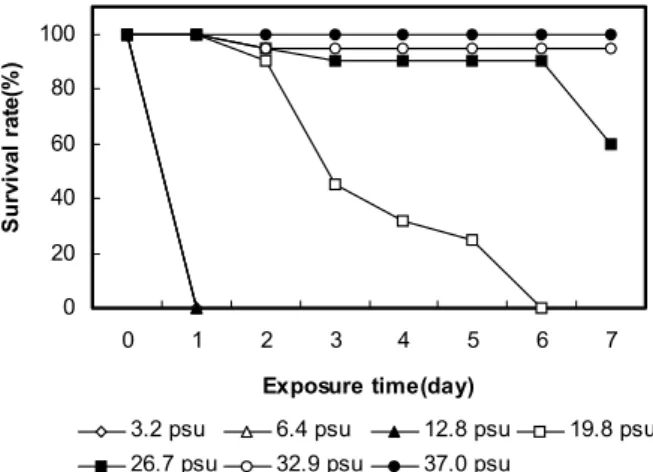
Fig. 1. Survival rate of abalone, Haliotis discus hannai with decreasing salinity from 32.9 psu to 3.2psu at 24 ± 1℃
0 300 600 900 1200
1 2 3 4 5 6 7 8
Exposure time (hr)
Osmorality (mmol/ kg)
3.2 psu 6.4 psu 12.8 psu 19.8 psu 26.7 psu 32.9 psu 37.0 psu
Fig. 2. Osmorality of abalone, Haliotis discus hannai with decreasing salinity from 32.9 psu to 3.2 psu at 24 ± 1℃
본 논문은 염분변화에 따른 북방전복, Haliotis discus hannai의 생존, 삼투질 농도 변화, 대사반응 및 조직학적 반 응 등을 분석하여 여름철 집중호우 시 저염분 발생에 따른 전 복양식의 관리 방안 및 염분에 의한 폐사원인 구명의 기초자료 로 활용하기 위해 수행되었다.
재료 및 방법
실험에 사용된 북방전복은 경남 통영시 가두리어장에서 사 육중인 개체를 구입하여 실험실로 옮긴 후 5t 수조에서 실내 사육하면서 2주 동안 순응시켜 실험에 사용하였다. 순응기간 동안 먹이는 시판용인 다시마를 공급하였다. 실험수온은 24 ± 1℃, 염분은 일반해수 (32.9 psu), 37.0, 26.7, 19.8, 12.8, 6.4 및 3.2 ± 0.5 psu였다. 실험에 사용된 개체의 크기는 평 균 각장 89.8 ± 1.4 mm, 평균 전중 88.9 ± 9.3 g 이었다.
실험방법은 실험해수를 제조하여 지수식으로 7일 동안 수행하 였으며, 실험해수의 오염을 방지하고 실험해수의 염분을 일정 하게 유지하기 위하여 매일 환수하였다. 염분측정은 자동염분 계 (Atago, PR-100SA, Korea) 를 사용하였다. 생존율은 12시 간 간격으로 점검하여 사망개체를 선별하여 구하였으며 모든 실험은 3회 반복하여 평균값을 이용하였다. 호흡률은 Respirometer와 생물호흡측정기 (Orbis 3600 made by Switzerland) 를 이용하여 실험 전후 Respirometer 내 용존 산소의 차로서 구하였으며, 암모니아질소 배설률은 phenolhypochlorite (Solorzano, 1969) 방법을 이용하였다.
혈액 내 삼투질 농도를 측정하기 위하여 1 ml의 주사기를 이 용하여 전복의 심장부위에서 채혈하였으며, 삼투질 농도 분석 은 Osmomat 030 (genotec, Inc, Germany) 를 이용하여 측정하였다. 염분에 의한 북방전복의 조직학적 변화를 관찰하 기 위하여 북방전복의 발 근육조직을 절취하여 Bouin's solution에 24시간 동안 고정하고, 24-36시간 동안 흐르는 물 에서 수세한 다음 70%-100% 에탄올을 이용하여 단계적으로 탈수하였다. 이후 paraplast (McCormick, USA) 을 이용하 여 포매하고, microtome (RM2235, Leica, Germany) 을 이용하여 두께 4-6 μm의 횡단면과 종단면의 연속 절편을 제 작하였다. 이들 조직 절편들은 구조와 세포형태를 관찰하기 위 해 Mayer's hematoxylin-eosin (H-E) 비교염색을 실시하여 광학현미경 (BX50, Olympus, Japan) 으로 관찰하였다. 각 실험에 따른 반수치사 농도는 (50% lethal contentration) 는 probit법에 의해 분석 (Finney, 1971) 하였다.
결 과
북방전복의 염분에 대한 내성을 조사하기 위하여 수온 24
± 1℃에서 각 실험 염분에 7일 동안 노출시키며, 생존율을 측 정한 결과 (Fig. 1) 생존율은 일반해수와 염분 37 psu에서
95% 이상을 나타내었다. 26.7 psu에서 노출 7일째 생존율은 60%, 19.8 psu에서 노출 5일째 25%를 나타내었으며, 노출 6 일째 모두 사망하였다. 반면 염분 12.8 psu이하에서 노출 1일 째 모두 사망하여 노출 7일 동안의 반수치사염분 (7days-LS50) 은 24.9 psu (20.1-28.2 psu) 였다.
염분감소에 따른 북방전복의 삼투질 농도 변화를 노출 시간 의 경과에 따라 나타내었다 (Fig. 2). 염분 37.0 psu에 노출시 킨 경우, 삼투질농도가 1,129 mmol/Kg으로 노출 1시간 이내 에 사육 해수의 삼투질농도와 같이 순치하였으며, 염분 26.7 psu의 경우에도 942 mmol/Kg으로 노출 1시간 이내에 사육 해수의 삼투질농도와 같이 순치하였다. 그러나 19.8 psu이하 에서는 노출 7일째 726-529 mmol/Kg으로 19.8 psu 이하의 사육해수 삼투질농도 694-265 mmol/Kg에 순치하지 못하였 다 (Fig. 2).
염분감소에 따른 북방전복 대사율의 변화를 조사하기 위하
0 0.1 0.2 0.3 0.4 0.5
3.2 6.4 12.8 19.8 26.7 32.9 37 Salinity (psu)
Respiration rate(mg O2/g DW/h.)
0 3 6 9 12 15 18 21 Excretion rate(㎍/g DW/h) Respiration rate
Excretion rate
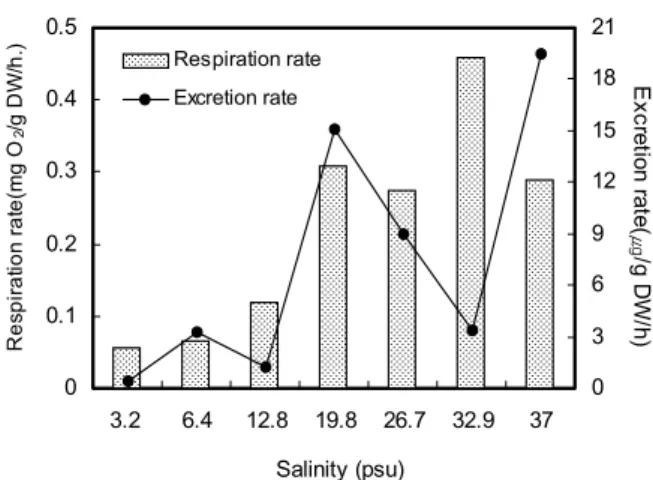
Fig. 3. Changes of the respiration and excretion rate in the abalone, Haliotis discus hanni exposed to decreasing salinity at 24 ± 1℃
Fig. 4. Microphotographs of the muscle of abalone, Haliotis discus hannai. A: Outer region, showing the epidermal layer (El) consisted of simple columnar epithelial cells. B: Muscle layer, note the dense muscle fiber. C: Muscle layer, note the crossed circular muscle bundle (Cmb) and longitudinal muscle bundle (Lmb). D: Hemolymph sinus, note the irregular shapes hemolymph sinus with thin hemolymph sinus membrane (Hsm) and its surrounded by a fine connective tissue (Ct). Hs, hemolymph sinus; Ml, muscle layer.
여, 각 실험 염분에 노출 후 18-24시간째 생존하고 있는 전복 을 대상으로 호흡률과 암모니아질소 배설률의 변화를 측정하 였다.
일반해수 (32.9 psu) 에 노출된 북방전복의 호흡률은 실험 기간동안 평균 0.45 ± 1.58 mg O2/g DW/h이었으며, 고염 분 37 psu에 노출시킨 북방전복의 경우에는 0.28 ± 0.03 mgO2/g DW/h으로 대조구에 비해 37.1% 감소를 나타내었 다. 26.7 psu 및 19.8 psu에 노출시킨 경우에는 0.27 ± 0.16 mgO2/g DW/h와 0.30 ± 0.042 mgO2/g DW/h를 나 타내었으며, 12.8 psu이하에 노출시킨 경우에는 북방전복의 호흡률이 0.11 mgO2/g DW/h이하로 대조구에 비해 호흡률은 75.5% 이상 감소하였다.
북방전복 발근육은 높이 120 μm 내외의 상피층으로 둘러 싸여 있었다. 상피층의 하단에는 근육층이 존재하고 있었는데, 근육층에는 근섬유 다발들과 혈림프동 (hemolymph sinus) 이 관찰되었다 (Fig. 4A). 근육층에 존재하는 근섬유다발들은 조밀하게 분포하고 있었으며 (Fig. 4B), 환상근섬유와 종주근 섬유들이 격자모양으로 엮여있었다 (Fig. 4C). 근섬유 사이에 존재하는 혈림프동은 얇은 막 (hemolymph sinus membrane) 에 의해서 지지되어 있었고, 혈림프동의 주변에 는 결합조직들이 둘러싸여 있었다 (Fig. 4D).
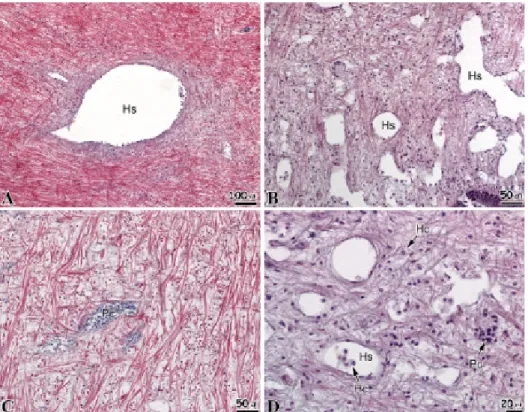
Fig. 5. Histopathological changes of the muscle of abalone, Haliotis discus hannai. exposed diluted sea water. A: Extension of the hemolymph sinus (Hs), 80% sea water. B:
Degeneration of muscle fibers near the hemolymph sinus, 60% sea water. C: The muscle fibers with phagocytes (Pc) filling up their degenerated portions (known as tubular bag), 60% sea water. D: Hemocytes in the hemolymph sinus and muscle fibers, 60% sea water.
80%의 해수에 노출된 북방전복의 발은 근육층 내의 혈림프 동이 확장되어 있었으며, 혈림프동을 둘러싸고 있는 결합조직 의 섬유다발의 파괴가 관찰되었다 (Fig. 5A). 60% 해수에 노 출된 발은 다수의 혈림프동들이 확장되고 혈림프동막에 존재 하는 상피세포들이 파괴되었다 (Fig. 5B). 분절된 근섬유다발 들 사이에는 식세포 덩어리들이 관찰되었는데, 이를 “tubular bad"이라고 부른다 (Fig. 5C). 확장된 혈림프동 사이에는 다 수의 혈구들이 관찰되었으며, 근섬유다발들 사이에서도 혈구 와 식세포가 관찰되었다 (Fig. 5D).
40%의 해수에 노출된 북방전복에서는 혈림프동 주변에서 괴사된 결합조직들이 관찰되었다 (Fig. 6A). 20%의 해수에 노출된 북방전복의 발에서는 근섬유다발들의 원형질막과 미세 섬유가 파괴된 조직상이 관찰되었다 (Fig. 6B). 발의 외부에 존재하는 상피층은 상피세포의 파괴와 함께 붕괴되었으며, 발 근육조직들이 외부로 노출되었다 (Fig. 6C). 근섬유다발의 파 괴로 인하여 퇴화된 부분에서는 혼탁종창 (cloudy swelling) 이 관찰되었으며, 혼탁종창의 결과로 생성된 물질들은 막이 파 괴된 혈림프동으로 유입되었다 (Fig. 6D).
고 찰
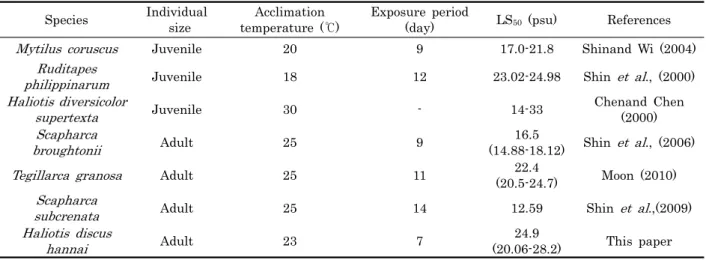
일반적으로 염분은 해양 및 연안생물의 생리적 과정에 영향 을 미치며, 낮은 염분에서 전형적인 패류의 반응은 먹이섭취, 성장률 감소 (Bohle, 1972; Widdows, 1985) 및 패각의 폐 쇄 (Hand and Stickle, 1977; Shumway, 1977) 등을 나타 낸다. 특히 연안에서 이루어지고 있는 양식어업은 대체로 기후 변화에 대한 문제를 안고 있어, 하계 고수온 및 저염분, 동계 저수온 등 계절적 변화에 의해 연안 양식생물의 폐사에 영향을 미치기도 하고 생산량의 변동이 발생하기도 한다. 염분감소에 따른 패류의 생존율에 대하여, 25‰과 30℃에서 순치시킨 Haliotis diversicolar supertexta (Chen and Chen, 2000) 의 경우 14-33‰의 범위에서 생존이 가능하였으나, Haliotis asinina (Singhagraiwan et al., 1992) 의 경우에 는 32.5‰에서 저염분으로 옮겼을 때, 20.5‰의 염분까지 생 존이 가능하였다. 이는 본 연구에서 수온 24 ± 1℃ 및 염분 32.9 psu에서 순치시킨 전복의 생존가능 범위와 유사하였으 나, Haliotis diversicolar supertexta (Table 1) 은 넓은 범 위의 염분에서 (14-33‰) 생존이 가능하고, 꼬막, Tegillarca
Fig. 6. Histopathological changes of the muscle of abalone, Haliotis discus hannai. exposed diluted sea water. A: Necrotic connective tissue (asterisk) near the hemolymph sinus, 40%
sea water. B: Constricted sarcolemma and muscle fibers (arrowhead), 20% sea water. C:
Destruction of epidermal layer, 20% sea water. D: Cloudy swelling and degeneration (white asterisk) of muscle fibers (black asterisk), 20% sea water.
Species Individual
size Acclimation
temperature (℃) Exposure period
(day) LS50 (psu) References Mytilus coruscus Juvenile 20 9 17.0-21.8 Shinand Wi (2004)
Ruditapes
philippinarum Juvenile 18 12 23.02-24.98 Shin et al., (2000) Haliotis diversicolor
supertexta Juvenile 30 - 14-33
Chenand Chen (2000) Scapharca
broughtonii Adult 25 9
16.5
(14.88-18.12) Shin et al., (2006)
Tegillarca granosa Adult 25 11 22.4
(20.5-24.7) Moon (2010) Scapharca
subcrenata Adult 25 14 12.59 Shin et al.,(2009)
Haliotis discus
hannai Adult 23 7 (20.06-28.2)24.9 This paper
Table 1. Critical tolerance ranges of salinity on several cultured bivalves granosa (Table 1) 은 수온 25℃에서 LS50이 22.4 psu
(20.5-24. psu), 바지락, Ruditapes philippinarum (Table 1) 은 23.02-24.98 psu로 연안 서식 생물일지라도 종에 따라 서식지에 따라 생리적 상태 및 염분변화에 대한 내성의 차이가 있는 것으로 나타났다. 생물체의 대사지표로서 이용되는 호흡
률은 생리적으로 스트레스를 겪고 있는 생물에서 여러 가지 형 태로 변화하는데 (Sastry and Varge, 1977), Almada-Villela (1984) 는 다양한 환경변화의 스트레스에 노 출된 생물에서 호흡률이 증가하거나 감소하는 것으로 보고하 였다. 본 연구에서 북방전복의 호흡률은 염분 37.0 psu, 26.7
psu 및 19.8 psu에서 대조구에 비해 32.5-40.1% 감소하였으 나, 염분 12.8 psu 이하에서는 75.5%이상 감소하여 아치사 상태에 이른 것으로 나타났다. 한편 암모니아질소 배설률은 염 분 19.8 psu이상에서 대조구에 비해 62.1-82.5% 증가하였으 나, 12.8 psu 이하 저염분에서 배설률은 현저히 감소하여 대 사활성이 감소하는 것으로 나타났다. 이는 염분내성 범위 내에 서 염분감소에 따라 증가하는 산소소비율과 암모니아질소 배 설률이 변화하는 Chilean scallop, Argopecten purpuratus (Navarro and Gonzalez, 1998)의 양상과 유사하였다. 또한 Mytilus edulis (Widdows, 1985)의 경우, 20-30 psu에서 산소소비율, 여수율 및 에너지수지 등 대사조절이 일정하게 유 지되는 반면, 20.0 psu 이하 저염분에 노출 후 사망하였는데 이는 본 연구에서 북방전복의 경우 19.8 psu에 노출 후 6일째 모두 사망한 결과 유사하였다. 이는 20 psu이하 외부환경의 삼투질농도에 순치하지 못하여 항상성을 유지할 수 있는 생리 적 내성한계 범위를 벗어나게 됨으로써 대사조절 능력을 잃게 되어 사망하는 것으로 추정된다.
갑작스런 염분 변화에 따른 패류의 먹이섭취 및 대사와 관 련된 생리적 반응은 노출초기에는 감소되지만 2-3일 지나면서 점차 세포내 삼투요인을 변화시켜 조절하며, 정상적인 기능을 되찾아 회복한다 (Widdows, 1985). 북방전복의 혈액 내 osmolailty는 일반해수 (32.9 psu)에서 37.0 psu로 옮겼을 경우 1시간이내 외부농도에 순치하였으며, 26.7 psu로 옮겼을 경우에는 3시간 내에 외부농도에 순치하여 생존에 영향을 미 치지 않았으나, 19.8 psu이하에서는 노출 5일째 외부 농도에 순치하였으나 노출 6일째 사망하였으며, 12.8 psu이하 저염분 에서는 노출기간동안 순치하지 못하고 사망하여 단기간의 염 분변화에 대한 에너지 균형을 조절할 수 있는 생리적 보상 조 정에 영향을 미칠 수 있는 능력에는 한계가 있는 것으로 보인 다 (Widdows, 1985). 염분증가에 따른 암모니아질소 배설량 의 증가는 Chilean scallop, Argopecten purpuratus (Navarro and Gonzalez, 1998)과 Mytilus edulis (Sadok et al., 1997) 에서 보고되고 있으며, 이러한 현상은 염분 감소 함에 따라 내부 삼투압을 조절하기위해 protein catabolism 이 증가하였기 때문인 것으로 설명하고 있다. 특히 Livingstone et al., (1979)에 의하면, Mytilus edulis의 암 모니아 배설률의 증가는 염분감소와 관련하여 haemolymph 내 amino acid 농도증가와 관련하여 보고하고 있으며, 전복 의 암모니아 배설률의 증가는 낮은 염분에 노출되어있는 기간 동안 osmotic adjustment에 의한 것으로 여겨진다.
종합하여 보면 북방전복의 23 ± 1℃에서 염분내성범위는 24.9 psu (20.1-28.2 psu)이며, 다양한 생리적 기작을 이용하 여 20.1 psu이상에서 생존할 수 있을 것으로 여겨진다. 특히 여름철에 집중호우가 내리고 이 시기에 연안의 염분은 일정기
간 동안 20 psu 이하로 떨어지기도 한다. 이 기간 동안 여름 철의 고수온과 저염분에 의해 연안에서 양식되고 있는 패류들 의 대량폐사가 빈번히 발생하고 있으나 이러한 연구가 미흡한 실정이므로 이 연구는 여름철 염분감소로 인한 패류의 폐사원 인 규명에 중요한 기초자료가 될 것이다.
요 약
염분변화에 따른 북방전복의 생리적 반응을 조사하기 위하 여 고염분 및 저염분의 농도에 따라 생존율, 삼투질농도, 대사 율 및 조직학적 반응을 분석하였다. 염분변화에 따른 북방전복 의 생존율은 37 psu에서는 100%였다. 반면 19.8 psu에서 노 출 6일째, 12.8 psu 이하에서는 노출 24시간 이내 모두 사망 하여 북방전복의 7-days LS50은 24.9 psu (20.1-28.2 psu) 를 나타내었다. 염분변화에 따른 호흡률은 대조구에 비해 감 소하였으며, 반면 암모니아질소 배설률은 증가하였다. 삼투질 농도는 염분 26.8 psu이상에서는 1시간 이내 순치하였다. 북 방전복 발근육의 조직학적 반응은 염분감소에 따라 혈림프동 의 확장, 상피세포의 괴사 및 식세포 증가 등의 현상이 관찰되 었다.
사 사
본 연구는 국립수산과학원 전략양식연구소 (RP-2011-AQ- 089)의 지원에 의해 수행되었습니다
참고문헌
Almada-villela P.C. (1984) The effects of reduced salinity on the growth of small Mytilus edulis. Journal of Marine Biological Association United Kingdum, 64:
171-182.
Bohle B. (1972) Effects of adaptation to reduced salinity on filtration activity and growth of mussels (Mytilus edulis). Journal of Experimental Marine Biological Ecology, 10: 41-49.
Chen J.C. and W.C. Chen. (2000) Salinity tolerance of Haliotis diversicolor supertexta at different salinity and temperature levels. Aquaculture, 181: 191-203.
Cheng W, Yeh S.P, Wang C.S and Chen J.C. (2002) Osmotic and ionic changes in Taiwan abalone Haliotis diversicolor supertexta at different salinity levels. Aquaculture, 203: 349-357.
Cho S.H., Park J.E., Kim C.I., Yoo J.H., Lee S.M. and Choi C.Y. (2006) Effect of the various sources of dietary additives on growth, body composition and shell color of abalone Haliotis discus hannai.
Journal of Aquaculture, 19(4): 275-280.
Finney D.J. (1971) Probit Analysis, 3rd ed. Cambridge University Press. London, pp. 333.
Hand S.C. and Stickle W.B. (1977) Effects of tidal fluctuations of salinity on pericardial fluid
composition of the American Crassostrea virginica.
Marine Biology, 42: 259-271.
Jeong S.C., Jee Y.J. and Son P.W. (1994) Indoor Tank culture of the abalone Haliotis discus hannai. Ⅰ.
Effects of tank shape and stocking density on the growth of young abalone. Journal of Aquaculture, 7(1): 9-20.
Kim T.H., Yang M.H., Choe M.K., Han S.J. and Yeu I.K. (2005) Physiological studies on acute water-temperature stress of juvenile abalone, Haliotis discus hannai. Journal of Aquaculture, 18(1): 7-12.
Kim T.H., Kim K.J., Choe M.K. and Yeo I.K. (2006) Physiological changes of junvile abalone, Haliotis sieboldii exposed to acute water-temperature stress.
Journal of Aquaculture, 19(2): 77-83.
Kinne O. (1966) Physiological aspects of animal in estuaries with special reference to salinity. Neth. J.
Sea Res., 3: 222-244.
Livingstone D.R., Widdow J. and Feith P. (1979) Aspects of nitrogen metabolism of the common mussel Mytilus edulis: adaptation to abrupt and fluctuating changes in salinity. Marine Biology, 53: 41-45.
Moon T.S. and Shin Y.K. (2010) Efffects of salinity on survival and metabolism of ark shell, Tegillarca granosa. Korean Journal of Malacology, 26(3):
171-177.
Navarro J.M. and Gonzalez C.M. (1998) Physiological responses of the Chilean scallop Argopecten purpuratus to decreasing salinities. Aquaculture, 167: 315-327.
Park I.S., Im J.H., Lee Y.D., Kim B.L., and Han S.J.
(2003) A temperature -dependent index of mitotic interval in Haliotis gigantea and Haliotis discus.
Korean Journal of Genetics, 25(1): 15-19.
Pierce S.K. and Greenberg M.J. (1972) The nature of cellular volume regulation in marine bivalves.
Journal of Experimental Biology, 57: 681-692.
Sadok S., Uglow R.F. and Haswell S.J. (1997) Haemolymph and mantle fluid ammonia and ninhydrin positive substance variation in salinity–
challenged mussels (Mytilus edulis L.). Journal of Experimental Marine Biological Ecology, 212:
195-212.
Sastry A.N. and Vargo S.L. (1977) Variations in the physiological response of crustacean larvae to temperature. In: Vernberg, F.J., Calabrese, A., Thurberg, F.P., Vernberg W.B.(Eds.), Physiological response of marine biota to pollutants. Academic
Press, New York., pp. 410-424.
Shin Y.K., Kim Y., Chung E.Y. and Hur S.B. (2000) Temperature and salinity tolerance of the manila clam, Ruditapes philippinarum, Journal of Korean Fisheries Science, 33(3): 213-218.
Shin Y.K., Kim B.H., Oh B.S., Jung C.G., Sohn S.G.
and Lee J.S. (2006) Physiological responsses of the ark shell Scapharca broughtonii (Bivalvia: Arcidae) to decreases in salinity. Journal of Fisheries Science and Technology, 9(4): 153-159
Shin Y.K., Lee W.C., Jung R.H., Kim S.Y. and Park J.J.
(2009) Survival of the ark shell Scapharca subcrenata and physiological and histological changes at decreasing salinity. Fisheries and Aquatic Science, 12(3): 209-218.
Shin Y.K. and Wi C.H. (2004) Effects of temperature and salinity on survival and metabolism of the hard shelled mussel Mytilus coruscus, Bivalve; Mytilidae.
Journal of Aquaculture, 17: 103-108.
Shumway, S. (1977) The effects of fluctuating salinity on the tissue water content of eight species of bivalve mollusks. Journal of Comperative Physiology, 116: 269-285.
Singhagraiwan T., Doi M. and Sasaki M. (1992) Salinity tolerance of juvenile donkey’s ear abalone, Haliotis asinina Linne. Thailand Marine Fisheries Reserch Bulletin. 3: 71-77.
Solorzano L. (1969) Determination of ammonia in natural waters by the phenol-hypochlorite method.
Limnology Oceanography, 14: 799-801.
Tucker L.E. (1970) Effects of external salinity on Scutus breviculus (Gastropoda, Prosobranchia)-Ⅰ.
Body weight and blood composition. Comperative Biochemistry and Physiology, 36: 301-319.
Yang H.S., Park K.I., Hong C.H. and Choi K.S. (2008) Effects of salinity stress on the composition of the free amino acids of the pacific abalone Haliotis discus discus. Journal of Aquaculture, 2(4): 218-225.
Yoon H.S., Rha S.J., Cha Y.B., Cho J.H., Kim K.Y. and Choi S.D. (2004) Growth and survival rate on density of Haliotis discus hannai in cage culture.
Journal of Korean Fisheries Society, 37(4): 287-294.
Widdows J. (1985) The effects of fluctuating and abrupt changes in salinity on the performance of Mytilus edulis. In: Gray, J. S., Christiansen, M.E. (Eds.), Marine Biology of Polar Regions and Effects of stress on marine organism. Wiley-Interscience, 555-566.