• 검색 결과가 없습니다.

Cognitive Behavioral Therapy for Improving Parenting Efficacy of Married Immigrant Women

N/A
N/A
Protected

Academic year: 2021

Share "Cognitive Behavioral Therapy for Improving Parenting Efficacy of Married Immigrant Women"

Copied!
14
0
0

로드 중.... (전체 텍스트 보기)

전체 글

(1)

결혼이주여성의 양육효능감 향상을 위한 CBT 부모훈련 프로그램의 개발 및 효과

Cognitive Behavioral Therapy for Improving Parenting Efficacy of Married Immigrant Women

김 희 정(Hee Jung Kim), 김 정 민(Jung Min Kim)

*

Department of Child Development and Education, Myongji University

---

<Abstract>

The purpose of this study is to develop cognitive behavioral therapy(CBT) to improve the parenting efficacy of married immigrant women, and verify its effectiveness. In the CBT of this study, behavioral technique was added to cognitive re- construction based on cultural context in order to improve parenting efficacy. The study selected 28 married immigrant women, and randomly divided them into a CBT group(10), a general treatment group(8) and a control group(10). The CBT and the general treatment programs consisted of 10 sessions, approximately 2 hours in duration. The results of the study were as follows. 1) The level of parenting efficacy was improved significantly in the CBT and the general treatment group. 2) The level of negative automatic thoughts and dysfunctional parenting thoughts was significantly decreased only in the CBT group.

3) In the CBT and the general treatment group, the level of parenting stress and acculturative stress was decreased while the level of psychological well-being improved. On the other hand, the level of parent-adolescent communication was improved significantly only in the CBT group. 4) In comparison with the general treatment group, the CBT group showed higher parent- ing efficacy and lower automatic thoughts and dysfunctional parenting thoughts. This study has significance in its attempt to develop a parent training program to improve the parenting efficacy of married immigrant women by integrating behavioral modification and communication skills training focused on cognitive reconstruction of parenting-related negative thoughts and beliefs in application of the CBT paradigm.

---

▲주제어(Key words) : 결혼이주여성(married immigrant women), 양육효능감(parenting efficacy), 인지행동치료(cognitive behavioral therapy, CBT), 부모훈련(parent training)

Ⅰ. 서 론

1990년대 이후 우리 사회의 결혼이주여성의 비약적인 양적 증가는 이들 가정의 자녀 수의 증가로 이어지고 있

다. 2010년 다문화가정의 자녀 수는 121,935명에서 2013 년 191,328명으로 약 57%가 증가했는데(Ministry of Se- curity and Public Administration, 2010, 2013), 이는 결 혼이주여성의 가족생애주기가 가족 관계 및 부부 적응이

• 본 논문은 주저자의 박사학위논문을 일부 수정 보완한 것임.

* Corresponding Author: Jung Min Kim, Department of Child Development and Education, Myongji University, 34,

Geobukgol-ro, Seodaemun-gu, Seoul, Korea, Tel: +82-2-300-0603, E-mail: [email protected]

(2)

주요 과제인 가족 형성기를 벗어나 자녀 양육 및 교육기 에 진입하고 있음을 단적으로 보여주는 것이다. 이에 따 라 결혼이주여성의 초기 정착 과정에서 나타나는 의사소 통, 문화 및 가족 관계 관련 적응의 어려움은 거주 기간 이 길어짐에 따라 감소하는 경향을 보이는 반면, 자녀 양 육에 대한 관심과 책임감, 경제적 부담 등으로 인한 스트 레스는 증가하고 있다(K. Chung et al., 2007; Y. Kim, 2008; B. Kwon, 2009; J. Park & J. Chung, 2007; S.

Park et al., 2009; M. Yoon & H. Lee, 2011). 결혼이주 여성이 자녀 양육의 문제로 어려움을 겪는 것은 새로운 곳에서의 정착으로 인해 양육 관련 도움을 받을 수 있는 사회적 지지 체계가 부족하고, 언어적 어려움과 맞물려 자녀의 양육 및 교육에 관한 정보를 원활히 얻을 수 없다 는 데서 그 원인을 찾을 수 있다(M. Jang & O. Lee, 2008; S. Kim, 2011; C. Park & E. Lee, 2011). 또한 결 혼 후 단기간 내에 자녀를 출산하는 경향이 높아 부모 역 할 수행에 많은 시행착오를 거치게 된다(G. Han, 2006).

더욱이 최근 결혼이주여성은 주로 농촌 지역에 거주하 는 초기의 형태를 벗어나 약 76%에 이르는 대다수가 도 시 지역에 거주하며, 과반수가 넘는 55%가 서울, 경기 등 수도권 지역에 밀집하는 양상을 보이고 있다(H. Kang &

Y. Kwon, 2013; Korean Women’s Development Insti- tute, 2013). 도시 거주 결혼이주여성은 농촌 거주자에 비 해 상대적으로 자녀 교육에 대한 기대 수준과 참여도가 높은 반면, 이와 관련된 실질적인 지원을 하는 데 어려움 을 겪고 있는 것으로 보고되었다(K. Kim, 2009; Y. Kim

& S. Oh, 2013). 특히 학령기 전후의 자녀를 둔 경우, 경 제적 부담으로 인해 자녀에게 다양한 경험을 제공하지 못 하거나 과외 등의 사교육을 시키지 못하는 것에 대해 부 모로서 적절한 지원을 하지 못한다는 좌절감을 느끼기 쉽 다. 또한 이들은 취학 전 자녀가 기본적인 학습 능력을 습득하지 못할 것에 대한 우려, 한국식의 경쟁적 교육에 대한 압박감, 한국의 학교 생활에 대한 정보의 부족, 교과 내용을 이해하지 못하는 데서 오는 학습 지도의 어려움 등 다양한 스트레스를 경험한다(N. Choi et al., 2009; S.

Kim, 2011; E. Lee, 2013; C. Park & E. Lee, 2011). 결 혼이주여성이 겪는 이러한 어려움들은 부모 역할 수행에 관한 낮은 자신감, 즉 양육효능감의 저하(J. Kim, J. Oh, C. Yoon, & J. Lee, 2009; O. Kim, K. Kim, & J. Lee, 2008; M. Song, H. Shin, & E. Lee, 2008)를 초래하며, 이는 다시 좌절, 불안, 부적절한 양육 행동 및 높은 양육 스트레스로 이어지게 된다(H. Jun, S. Pae, & K. Kwak, 2008).

최근 부모 역할에 관한 선행 연구들은 부모의 인지적

변인 중 하나인 양육효능감에 주목하고 있다(M. H. Born- stein et al., 1998; H. Choe & O. Chung, 2001; D.

Kim, 2008). 양육효능감은 자녀 양육과 관련하여 어려움 에 잘 대처할 수 있다는 스스로에 대한 믿음으로(D. B.

Bugental, J. Blue, & M. Cruzcosa, 1989; C. Johnston

& E. J. Mash, 1989; D. M. Teti & D. M. Gelfand, 1991), 특히 유아기와 아동기의 부모 양육 행동을 결정짓 는 중요한 변인으로 알려져 있다(P. K. Coleman & K.

H. Karraker, 1998). 게다가 부모로서 자신에 대한 인식 이나 평가가 부정적일 때 전반적인 부모 역할 수행에 어 려움을 느끼게 되는데, 이는 양육스트레스를 가중시킬 뿐 아니라 실제로 자녀와의 부적절한 상호작용으로 이어지는 경우가 많다(A. Bandura, C. Barbaranelli, G. V. Cap- rara, & C. Pastorelli, 2001). 더욱이 양육효능감은 부모- 자녀 간 의사소통의 영향을 받는 것으로 보고되었는데(H.

Chung, 2013; J. Kim, 2010), 결혼이주여성의 언어적 어 려움은 더욱 양육효능감의 저하를 가져올 가능성이 있다.

결혼이주여성의 경우, 문화적 요인은 이들의 양육효능감 에 영향을 미치는 또 다른 변수이다. 즉, 결혼이주여성의 양육 태도나 양육 행동은 자신의 출신 문화권의 부모-자 녀 관계 등의 경험에서 형성된 가치관에 따라 달라진다는 것이다(M. Huh, 2009; S. Yang, W. Kim, & Y. Kim, 2013). 이러한 문화적 차이는 이들의 자녀 양육 및 부모 역할에 대한 신념에 혼란을 초래하거나, 양육에 대한 자 신의 능력을 과도하게 부정적으로 지각하도록 이끌 수 있 다. 한편, 이들이 새로운 문화에 정착하는 과정에서 경험 하는 문화적응 스트레스 및 그로 인한 외로움, 고립감, 우 울, 불안 등의 심리적 안녕감의 문제들(J. W. Berry, 1997) 또한 양육효능감의 저하를 초래할 가능성도 배제할 수 없다.

지금까지 결혼이주여성의 어려움을 돕기 위해 시행된 프로그램들은 대부분 초기 적응과 정착을 돕기 위한 한국 어와 문화 교육 등 특정 영역에 국한된 것들이다(W.

Choi, 2007; L. Kim, J. Hwang, & J. Lee, 2007; Korean

Women’s Development Institute, 2013; S. Lee, J. Park,

P. Kim, & H. Kim, 2007). 이들 프로그램 외에 자녀 양육

과 관련하여 결혼이주여성의 부모 역할을 돕기 위한 소수

의 부모훈련 프로그램이 시도 되었는데, 거의 대다수가 일

반적인 부모훈련 프로그램을 그대로 활용한 것들이다. 선

행 부모훈련 프로그램들은 공통적으로 양육 및 발달 단계

에 대한 정보 제공과 자녀와의 효과적인 의사소통 등 양육

행동과 관련된 기술 습득에 초점을 맞추고 있다(K. Han,

2012; E. Im, 2013; K. Kang, 2009; E. Lee, 2013). 그러나

이는 부모의 자녀 양육 행동에 영향을 끼치는 사고, 태도

(3)

및 신념 등의 요인을 다루고 있지 못하다는 한계를 갖는 다. 게다가 결혼이주여성이라는 대상의 특성상 문화적 차 이가 부모 역할 및 자녀 양육에 대한 신념에 영향을 미침 을 고려하여 프로그램을 구성해야 함에도 불구하고 이를 반영한 접근이 이루어지지 못하고 있는 실정이다.

이에 본 연구에서는 결혼이주여성을 대상으로 양육효능 감을 향상시킬 수 있는 부모훈련 프로그램을 개발하기 위 해 인지행동치료(Cognitive Behavioral Therapy, 이하 CBT로 표기)적 개입을 그 틀로 선택하였다. CBT는 한 개 인이 경험하는 사건에 대한 이해와 해석이 감정과 행동에 영향을 미친다고 보고 사건의 의미를 평가하는 인지적 과 정을 중요하게 다룬다. 따라서 개인의 궁극적인 변화를 위 해서는 사건 또는 경험에 대한 부적응적인 사고와 신념을 보다 적응적인 대안으로 바꾸는 인지적 재구성(cognitive reconstruction)을 강조한다(A. T. Beck, G. Emery, & R.

L. Greenberg, 1985; D. A. Clark & R. A. Steer, 1996).

양육효능감은 자신이 자녀 양육과 관련된 문제를 잘 해결 하고 효율적으로 관리할 수 있다고 믿는 것으로 자신의 양 육 태도나 양육 행동에 대한 주관적인 평가나 인식을 바탕 으로 형성된다. 더욱이 양육효능감은 문화적인 특성에서 비롯된 부모 역할과 관련된 가치관이나 신념 등에 의해 영 향을 받으므로, 이러한 양육효능감의 인지적 특성을 고려 할 때 인지행동적 접근의 개입이 타당하다고 보았다. 또한 본 연구에서는 인지적 재구성을 중심으로 의사소통훈련과 양육기술훈련 등의 행동적 기법을 추가하였는데, 이는 효 과적인 양육 행동 기술의 습득을 통해 부모 역할 수행에서 의 성공 경험을 갖도록 할 뿐 아니라, 나아가 이러한 성공 경험은 양육효능감의 증진을 촉진시키는 결과로 이어질 수 있기 때문이다(O. Lee, S. Park, & H. Jeong, 2014; S. Spa- ccarelli, S. Cotler, & D. Penman, 1992; J. H. Wright, M. R. Basco, & M. E. Thase, 2009).

종합하면, 본 연구의 목적은 결혼이주여성의 양육효능 감 향상을 위해 문화적 맥락을 바탕으로 인지적 재구성, 의사소통훈련 및 양육기술훈련으로 구성된 CBT 부모훈련 프로그램을 개발하고, CBT 부모훈련 집단과 일반 부모훈 련 집단 및 통제집단을 비교하여 그 효과를 검증하는 데 있다. 이러한 목적을 위해 설정한 구체적인 연구문제들은 다음과 같다.

<연구문제 1> CBT 부모훈련 프로그램은 결혼이주여성의 양육효능감에 효과가 있는가?

<연구문제 2> CBT 부모훈련 프로그램은 결혼이주여성의 양육스트레스, 부모-자녀 간 의사소통, 문화 적응 스트레스 및 심리적 안녕감에 효과가

있는가?

<연구문제 3> CBT 부모훈련 프로그램 과정에서 나타난 결혼이주여성의 양육효능감 관련 사고 및 신념은 어떠한 변화를 나타냈는가?

Ⅱ. 연구방법

1. 연구대상

본 연구의 대상은 한국 남성과 혼인관계에 있는 결혼이 주여성으로 아동기 자녀를 두고 있고, 한국어로 충분한 의사소통이 가능한 자를 대상으로 하였다. 연구 대상자의 모집은 서울시 N 다문화가족지원센터를 통해 이루어졌다.

본 부모훈련 프로그램에 관심을 가지고 참여를 희망하는 신청자 가운데 전화 면접 및 센터 교육 담당자와의 협의 를 통해, 한국어로 의사소통이 원활한 36명을 1차 선정하 여 프로그램의 취지와 내용, 운영 방법, 실시 기간 등에 대한 사전 설명회를 가졌다. 이후 프로그램의 참가 의사 를 밝힌 28명을 2차 선별하고, 이들을 CBT 부모훈련 집 단(10명), 일반 부모훈련 집단(8명), 통제집단(10명)에 무 선 배정하였다. 통제집단에게는 추후 프로그램의 실시를 약속하였으며, 본 프로그램이 끝난 이후 참여를 희망하는 대상자들에 한해 추후 프로그램을 실시하였다. 이들 세 집단을 대상으로 프로그램 사전과 사후에 사전검사와 사 후검사를 각각 실시하였으나, 프로그램 실시 기간 중 다 른 프로그램이나 교육의 중복 참여자, 재일 교포, 그리고 사후검사 미실시 자 등 3명은 분석에서 제외하여, 최종 결과 분석에 포함된 대상은 CBT 부모훈련 집단(8명), 일 반 부모훈련 집단(7명), 통제집단(10명)의 총 25명이다. 연 구 대상의 일반적 특성으로 연령별 구분은 20∼30세가 8 명, 31∼40세가 9명, 41∼50세가 8명이었다. 출신국은 중 국이 5명, 일본이 12명, 베트남이 6명, 필리핀이 2명이었 으며, 교육 수준은 중졸이 3명, 고졸이 9명, 전문대졸이 7 명, 대졸 이상이 6명이었다. 결혼 기간은 5년 미만이 2명, 5∼10년 미만이 13명, 10∼15년 미만이 10명이었다. 자녀 수는 1명이 8명, 2명이 10명, 3명 이상이 7명이었으며, 자 녀의 평균 연령은 7.2세였다.

2. 측정도구

1) 양육효능감 척도(Parenting Sense of Competence

Scale: PSOC)

(4)

J. Gibaud-Wallston and L. P. Wandersman(1978)이 개발하고 S. Shin(1997)이 번안한 척도를 사용하였다. 본 연구에서는 총 16문항 중 부모 역할에서의 유능감과 부모 -자녀 관계에서의 문제해결기술과 능력에 대한 어머니 자 신의 기대를 측정하는 양육효능감 9문항을 사용하였다.

Likert 5점 척도로 평정하게 되어 있으며, 점수가 높을수 록 양육효능감이 높음을 의미한다. 본 연구에서 척도의 Cronbach’s α는 .80이었다.

2) 부정적 자동적 사고 척도(Negatvie Automatic Thoughts Questionnaire: ATQ-N)

S. D. Hollon and P. C. Kendall(1980)이 개발하고 S.

Kwon and H. Yoon(1994)이 번안한 척도를 사용하였다.

총 30문항으로 Likert 5점 척도로 평정하게 되어 있으며, 점수가 높을수록 부정적 자동적 사고의 빈도가 높음을 의 미한다. 본 연구에서 척도의 Cronbach’s α는 .95였다.

3) 양육 역기능적 사고 척도

J. Park(2000)이 개발한 척도로 총 28문항이며, Likert 5점 척도로 평정하게 되어 있다. 자신과 자녀에 대한 역기능적 사고, 배우자와 가족에 대한 역기능적 사고, 양육통제의 상실 및 불안감 등 3개의 하위 척도 중 본 연구에서는 인지적인 영역에 해당하는 자신과 자녀에 대한 역기능적 사고와 배우 자와 가족에 대한 역기능적 사고의 2개 하위 척도만을 사용 하였다. 점수가 높을수록 양육에 대한 부정적인 기대를 나타 낸다. 본 연구에서 척도의 Cronbach’s α는 .94였다.

4) 양육스트레스 척도(Parenting Stress Index/Short Form: PSI/SF)

R. R. Abidin(1990)의 양육스트레스 지표/단축형(Paren- ting Stress Index/Short Form: PSI/SF)을 J. Kim(2005)이 보완한 척도를 사용하였다. 총 36문항으로 점수가 높을수록 자녀 양육으로 인한 부모의 스트레스 수준이 높음을 의미한 다. 본 연구에서 척도의 Cronbach’s α는 .93이었다.

5) 부모-자녀 간 의사소통 척도(Parent-Adolescent Communication Inventory: PACI)

H. Barnes and D. H. Olson(1982)이 개발하고 J.

Kim(1989)이 번안한 척도를 사용하였다. 총 20문항으로 Likert 5점 척도로 평정하게 되어 있다. 문제형 의사소통 문항은 역채점하여 전체 점수가 높을수록 의사소통이 긍 정적이고 개방적임을 의미한다. 본 연구에서 척도의 Cronbach’s α는 .85였다.

6) 문화적응 스트레스 척도(Acculturative Stress Scale for International Student: ASIS)

S. D. Sandhu and R. B. Asrabadi(1994)가 개발하고 M. Hong(2009)이 번안한 척도를 사용하였다. 본 연구에 서는 이사와 관련된 문항(1문항)과 신뢰도가 다른 문항에 비해 매우 낮게 나온 두려움(3문항)을 제외한 총 33문항 만을 사용하였다. Likert 5점 척도로 평정하게 되어 있으 며, 점수가 높을수록 문화적응 스트레스가 높음을 의미한 다. 본 연구에서 척도의 Cronbach’s α는 .97이었다.

7) 심리적 안녕감 척도(Psychological Well-Being Scale:

PWBS)

C. D. Ryff(1989)가 개발하고 M. Kim, H. Kim, and K. Cha(2001)가 번안한 척도를 사용하였다. 총 46문항으 로 Likert 5점 척도로 평정하게 되어 있으며, 점수가 높을 수록 심리적 안녕감이 높음을 의미한다. 본 연구에서 척 도의 Cronbach’s α는 .94였다.

Ⅲ. 프로그램의 구성

1. 프로그램 개발 과정

본 연구의 프로그램 개발 과정은 4단계로 이루어졌다.

1단계는 결혼이주여성을 위한 부모 교육 및 훈련과 관련 된 선행 연구 고찰을 실시하였다. 2단계는 예비 프로그램 구성 단계로 다문화가족지원센터 총괄 팀장과 교육 담당 자를 대상으로 현장에서의 부모훈련 프로그램 요구와 필 요성에 대한 정보를 얻기 위해 비구조화된 면접을 실시하 였다. 3단계에서는 예비 프로그램 실시 후 CBT 전문가와 의 논의를 거쳐 프로그램 구성 요인의 이론적 근거와 논 리적 연결성, 프로그램 운영의 적절성, 구체적인 활동 내 용과 방법 등을 수정 보완하였다. 4단계는 예비 프로그램 을 수정 보완한 결과를 토대로 CBT 부모훈련 본 프로그 램을 구성하였다.

2. 결혼이주여성을 위한 CBT 부모훈련 프로그램

결혼이주여성을 위한 CBT 부모훈련 프로그램의 주요

구성 요인은 인지적 재구성, 의사소통훈련 및 양육기술훈

련이다. 프로그램의 초기 단계는 1∼2회기로 서로 다른

문화적 배경을 가진 집단원들의 친밀감 형성, 프로그램의

목표와 진행 과정 소개, CBT 모델 교육, 자기 점검(self-

(5)

Stage Session Purpose Activity

Beginning

1 Development of intimacy in group

Understanding the purpose and process of CBT Educating a CBT model

․We are from various countries: 'Separate but together'

․Finding happiness in Korea: Let's have a travel of thinking to find happiness

․Thought-Feeling-Behavior, all connected

․Beliefs related to being a parent in Korea 2

Cognitive reconstruction I - Self-monitoring:

Finding & rating feelings Finding automatic thoughts

․Feelings contain expressions and names: Find them using 'feeling cards'

․Finding feelings and rate the degree of feelings

․What does the character in the picture think?: Connect feelings with thoughts

Development 3

Cognitive reconstructionⅡ - Changing automatic thoughts Parenting skills trainingⅠ

- Providing information on parenting

․Finding automatic thoughts: What kind of thoughts flashed across my mind?

․Dividing thoughts into (+) and (-)

․Child growth report: Provide information on parenting by children’s developmental stage

․Happy Time with kids: Playing with mother!

4

Cognitive reconstructionⅢ

- Understanding types of cognitive distortions - Finding intermediate beliefs & core beliefs - Changing thoughts and beliefs

Parenting skills trainingⅡ

- Introducing behavioral modification ABC model

․Obstacles in my life: Learn types of cognitive distortions

․What are the roots of my thoughts?: Find intermediate beliefs &

core beliefs of my life

․Strong trees must have healthy roots: Change to adaptive thoughts

․Modifying a child's behavior: Learn ABC model

․Turning on happiness switch: Expressing positive interests to a child 5

Cognitive reconstruction Ⅳ - Changing thoughts and beliefs Parenting skills trainingⅢ

- Application of behavioral modification

․Storytelling from a wise man: What if I∼?

․Quiz, Quiz: Learn how to modify cognitive distortion

․Giving effective instructions/modifying wrong behaviors of a child 6 Cognitive reconstructionⅤ

- Changing thoughts and beliefs Communication skills trainingⅠ

․I can do a good job: Changing maladaptive, irrational beliefs

․What kinds of thoughts do I choose?

․Mommy from Mars?: Learning communication

․Tree frog-message/You-message/I-message comparing 7 Application of cognitive reconstructionⅠ

Communication skills trainingⅡ

․I am happy in Korea(1): Let's lighten up the ‘thought bag’

․Being a happy parent in Korea

․Practicing I-message 8 Application of cognitive reconstructionⅡ

Communication skills trainingⅢ

․I am happy in Korea(2): Let's lighten up the ‘thought bag’

․Living happily in Korea: Making a coping card

․Let's get closer: Applying I-message

Conclusion

9 Cognitive behavioral rehearsalⅠ

․Checking your ‘thought bag’ to have a happy travel: Applying CBT in real life

․Making a future strategy

․Remedying my shortcomings 10 Cognitive behavioral rehearsalⅡ Completion

․Making a future strategy

․Having a final check

․Presenting cards of praise and encouragement/share feedbacks Table 1. CBT program for married immigrant women

monitoring)으로 구성하였다. 1회기는 PPT를 활용한 심 리교육(psycho-education)을 통해 CBT 모델을 다루었다 (J. H. Wright et al., 2009). 2회기는 인지적 재구성의 첫 단계로 감정 찾기, 감정의 강도 구별하기, 자동적 사고 찾 기 등의 자기 점검을 실시하였다. 프로그램의 전개 단계 는 3∼8회기로 부정적 자동적 사고 찾기/바꾸기, 중간신 념 및 핵심신념 찾기/바꾸기 등의 단계적인 인지적 재구 성을 실시하였다. 부정적 자동적 사고는 스트레스를 받거

나 정서적으로 긴장할 때 마음속에 문득 떠오르는 생각으 로 ‘방금 내 마음에 스쳐간 것이 무엇이지?’라고 자문했을 때 비교적 쉽게 의식할 수 있는 생각이다(M. Neenan &

W. Dryden, 2011). 핵심 신념은 자동적 사고의 기초가

되는 정보 처리 방식에 영향을 미치는 기본적인 생각의

틀로 주로 생애 초기에 형성되며, 중간 신념은 ‘만일 ~라

면(if~ then~)’의 가정으로 자동적 사고와 핵심 신념을 연

결하는 중간 단계이다(J. H. Wright et al., 2009). 본 프

(6)

로그램에서는 단계적인 인지적 재구성을 위해 애니메이션 과 일러스트, 만화 컷, 역할극, 소집단 토론 및 논의, 워크 시트 작성하기, 브레인스토밍, 상황카드 만들기 등을 활용 하였다. 초반부 이러한 활동들은 결혼이주여성의 문화적 맥락에 따라 자녀 양육과 관련된 사고와 신념이 다를 수 있음을 고려하여 출신국에 따라 소집단으로 나누어 진행 되었다.

또한 3회기부터는 양육기술훈련을, 6회기부터는 의사소 통훈련을 추가하여 매 회기 반복 실시하였다. 양육기술훈련 은 발달 단계에 따른 양육 관련 정보를 제공하는 것을 포함 하여 행동수정의 ABC 모델을 통해 자녀의 문제행동을 효과 적으로 다룰 수 있도록 하였다(R. D. Friedberg & J. M.

McClure, 2009). 의사소통훈련은 나-전달법을 활용하여 자 녀의 행동에 대한 생각이나 감정을 비판 없이 솔직하게 표 현하는 것을 연습하도록 구성하였다(T. Gordon & A. E.

Zender, 2012). 종결 단계는 9~10회기로 초기, 전개 단계에 서 습득한 것들을 일상생활에서 적용할 수 있도록 인지행동 예행연습을 실시하였다. 프로그램의 세부적인 회기별 개요 는 <Table 1>에 제시되어 있다.

3. 결혼이주여성을 위한 일반 부모훈련 프로그램 결혼이주여성을 위한 일반 부모훈련 프로그램의 주요 구성 요인은 양육기술훈련과 의사소통훈련이다. 프로그램 의 초기 단계는 1∼2회기로 집단원들 간의 친밀감과 신뢰 감 형성하기(M. Corey, G. Corey, & C. Corey, 2012), 프로그램의 목표와 진행 과정 소개하기, 부모로서의 자기 인식하기 등으로 구성하였다. 1회기에는 게임을 통해 자 기 소개하기, 자신 및 가족을 상징적인 그림으로 표현하 기 등을 통해 가족 구성원 간의 역동을 알 수 있도록 하 였다. 2회기는 부모 역할 및 자녀 양육의 어려움을 공감 할 수 있도록 하여 집단원 간의 상호 신뢰와 집단 응집력 을 높일 수 있도록 하였다. 또한 자신의 양육 태도 유형 을 점검하고, 그에 따른 자녀와의 관계 양상 등을 살펴봄 으로써 부모역할의 중요성에 대해 인식할 수 있게 하였 다. 프로그램의 전개 단계는 3~8회기까지로 자녀의 발달 단계별 과제를 확인하고, 행동 수정 등을 포함한 양육기 술훈련과 의사소통훈련을 실시하였다. 3∼5회기에서는 자 녀의 발달 단계별 특성을 알고 이를 고려한 다양한 양육 기술을 습득할 수 있도록 하였다. 6∼8회기에서는 부모-자 녀 간의 의사소통능력을 향상시키는 것을 목표로 하였다.

의사소통훈련은 나-전달법을 중심으로 자녀의 감정 반영 하기, 반영적 경청하기, 나-전달법으로 이야기하기 등을 연습할 수 있도록 구성하였다(T. Gordon & A. E. Zender,

2012). 프로그램의 종결 단계는 9~10회기로 효과적인 자 기 관리 방법과 양육스트레스에 대처하는 방법을 다루고, 초기 및 전개 단계에서 배운 양육기술과 의사소통기술을 일상생활 속에서 활용할 수 있도록 반복, 연습하였다. 프 로그램의 세부적인 회기별 개요는 <Table 2>에 제시되어 있다.

4. 프로그램의 운영

본 프로그램을 실시하기 전 CBT 부모훈련 프로그램의 예비 실시를 위해 서울시 N 다문화가족지원센터에 프로 그램을 홍보하였다. 신청자 중 아동기 자녀가 있고, 한국 어로 원활한 의사소통이 가능하며, 프로그램에 성실하게 참석할 것을 동의한 5명의 결혼이주여성을 대상으로 실시 하였다. 예비 프로그램은 8월 26일부터 9월 30일까지 매 주 월요일 오전 10시부터 11시 40분까지 총 6회기, 한 회 기 당 100분씩 진행하였다. 예비 프로그램은 N 다문화가 족지원센터 집단 상담실에서 본 연구자가 진행하였고, 다 문화가족지원센터 사회복지사 1인이 연구보조자로 참여하 였다. 예비 프로그램 실시 후 참여자들의 프로그램 평가 내용과 피드백을 적극 수렴하여 회기 수와 시간을 늘렸으 며, 인지적 재구성, 양육 기술의 습득 및 의사소통훈련을 구체적인 상황에서 활용할 수 있도록 돕는 인지행동 예행 연습의 필요성이 제안되어 이를 본 프로그램에 포함시켰 다. 또한 본 프로그램에서는 참여자들의 이해를 돕기 위 해 역할극을 실시하고, 만화, 동영상, 일러스트, 영상 자료 등의 시청각 매체를 적극적으로 활용하였으며, 심리교육 자료 및 워크시트, 매 회기 진행된 교육을 요약한 유인물 등을 제공하여 프로그램이 끝난 뒤에도 사용할 수 있도록 하였다.

본 프로그램의 실시는, CBT 부모훈련 프로그램이 2013 년 10월 28일부터 11월 28일까지 주 2회 120분씩 10회기 로, 일반 부모훈련 프로그램은 2013년 11월 5일부터 12월 4일까지 주 2회 120분씩 10회기로 모두 N 다문화가족지 원센터 집단 상담실에서 실시되었다. 두 프로그램의 전체 진행은 CBT 수련 과정을 이수한 본 연구자가 맡았으며, 2인의 연구보조자가 각 프로그램의 진행을 도왔다. 연구 보조자들은 2주에 걸쳐 연구자로부터 CBT 부모훈련 프로 그램에 대한 오리엔테이션을 받았으며, 프로그램 진행 방 법 및 준비물 등을 사전 점검하는 모임을 가졌다.

5. 자료분석

수집된 자료분석은 SPSS 21.0을 사용하여 분석하였다.

(7)

Stage Session Purpose Activity

Beginning

1 Introducing the program Developing intimacy in group

Understanding parent-children relationship

․Guess who I am

․Expressing family relationship in symbols

․What do I want from my child?

2 Finding my image as a parent Finding my positive role as a parent

․Sharing difficulties as a parent

․Understanding myself as a parent: Check types of child-rearing attitude

․Realizing importance of parent role

․Finding my positive image as a parent

Development 3

Parenting skills training I

- Understanding your child’s developmental stage

- Understanding your child’s behaviors

․Understanding the characteristics of a child’s developmental process

․Child growth report: Providing parenting information by developmental stage

․Understanding a child’s behaviors: Four purposes of a child’s wrong behaviors

4 Parenting skills training II - Effective praise, encouragement - Improving confidence and self-worth

․Praising/encouraging

․Turning on the happiness switch: Expressing positive interests to a child

․Improving your child's confidence and self-worth 5 Parenting skills training III

- Giving effective instructions - Modifying wrong behaviors

․Fundamental behavior principle: Learning ABC models

․Giving effective instructions: Immediate execution of instruction and positive reinforcement

․Time-out

6 Communication skills training I - Practice of expressing feelings - Reflective listening

․Finding feelings: Quiz! Quiz!

․Learning feeling words that express diverse feelings

․Learning reflective listening

․Tree frog-message/You-message/I-message comparing

․Finding factors that disturb communication between you and your child

7 Communication skills training II

- I-message practice ․Learning 3 elements of I-message

․Practicing I-message with details

8 Communication skills training III ․Practicing through a role play(Setting various situations)

Conclusion 9

Application of parenting skills and communic- ation skills

Effective self-care

Dealing with parenting stress

․Practicing for real situations

․Finding effective self-care methods: Increasing interest in oneself

․Finding one's strengths

․Finding copying strategies to deal with stress from child-rearing 10 Application of parenting skills and commu-

nication skills Conclusion

․Practicing for real situations

․Giving high praises & presenting praise cards

․Sharing feedbacks Table 2. General parent treatment program for married immigrant women

먼저 빈도와 백분율을 구하였으며, CBT 부모훈련 집단, 일반 부모훈련 집단 및 통제집단 간 각 척도별 사전검사 점수의 차이를 알아보기 위해 비모수 검정인 Kruskal- Wallis 검정을 실시하였다. 또한 세 집단 내 사전-사후검 사 점수의 차이를 알아보기 위해 비모수 검정인 Wilcoxon 부호 순위 검정을 실시하였다. 마지막으로, 세 집단 간 사 후검사 점수의 차이를 알아보기 위해 비모수 검정인 Kruskal-Wallis 검정과 Bonferroni correction을 통한 사 후 검정을 실시하였다(C. E. Bonferroni, 1936).

Ⅳ. 연구결과

1. CBT 부모훈련 집단, 일반 부모훈련 집단 및 통제 집단 간 사전 동질성 검증

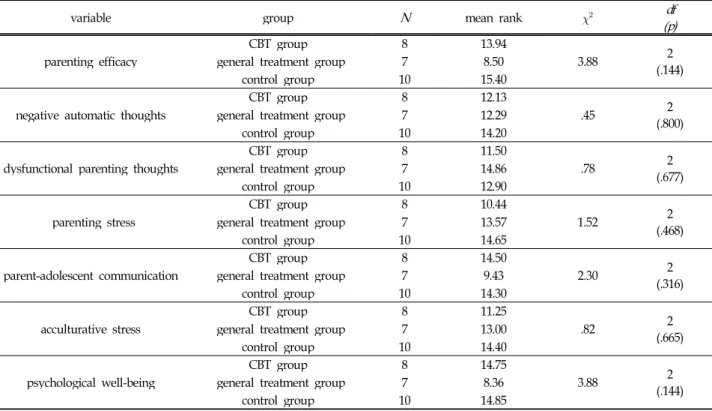
프로그램 사전검사 시 CBT 부모훈련 집단, 일반 부모

훈련 집단 및 통제집단 간 양육효능감(양육효능감, 부정적

자동적 사고, 양육 역기능적 사고)과 양육스트레스, 부모-

자녀 간 의사소통, 문화적응 스트레스, 심리적 안녕감의

차이를 알아보기 위해 각각 Kruskal-Wallis 검정을 실시

하였다. 분석 결과, 각 척도에서 세 집단 간 사전검사 점

(8)

variable group N mean rank 

df (p) parenting efficacy

CBT group 8 13.94

3.88 2

(.144)

general treatment group 7 8.50

control group 10 15.40

negative automatic thoughts

CBT group 8 12.13

.45 2

(.800)

general treatment group 7 12.29

control group 10 14.20

dysfunctional parenting thoughts

CBT group 8 11.50

.78 2

(.677)

general treatment group 7 14.86

control group 10 12.90

parenting stress

CBT group 8 10.44

1.52 2

(.468)

general treatment group 7 13.57

control group 10 14.65

parent-adolescent communication

CBT group 8 14.50

2.30 2

(.316)

general treatment group 7 9.43

control group 10 14.30

acculturative stress

CBT group 8 11.25

.82 2

(.665)

general treatment group 7 13.00

control group 10 14.40

psychological well-being

CBT group 8 14.75

3.88 2

(.144)

general treatment group 7 8.36

control group 10 14.85

Table 3. Pre-test assessments among CBT group, general treatment group and control group

수가 통계적으로 유의한 차이를 보이지 않는 것으로 나타 나 세 집단 간의 동질성이 검증되었다<Table 3>.

2. CBT 부모훈련 집단, 일반 부모훈련 집단 및 통제 집단 내 사전-사후검사 비교

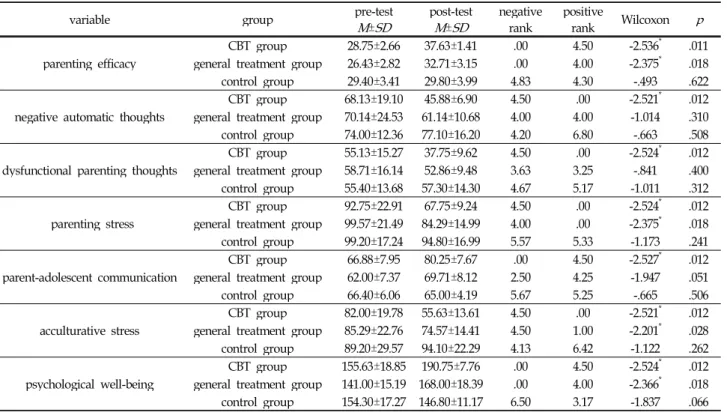
CBT 부모훈련 집단, 일반 부모훈련 집단 및 통제집단 내 양육효능감(양육효능감, 부정적 자동적 사고, 양육 역기능 적 사고)과 양육스트레스, 부모-자녀 간 의사소통, 문화적응 스트레스, 심리적 안녕감의 사전-사후 차이를 비교하기 위 해 Wilcoxon 부호 순위 검정을 실시하였다. 분석 결과, 프 로그램 사전-사후 CBT 부모훈련 집단(Z = -2.536, p< .05) 과 일반 부모훈련 집단(Z = -2.375, p< .05)의 양육효능감은 각각 유의한 차이를 나타냈다. 반면, 프로그램 사전-사후 통 제집단의 양육효능감은 유의한 차이를 나타내지 않았다(Z

= -.493, n.s.). 또한 프로그램 사전-사후 CBT 부모훈련 집 단의 부정적 자동적 사고는 유의하게 낮아진 것으로 나타 났으나(Z = -2.521, p< .05), 일반 부모훈련 집단의 경우 유 의한 차이가 나타나지 않았다(Z = -1.014, n.s.). 통제집단의 부정적 자동적 사고 또한 유의한 차이를 나타내지 않았다 (Z = -.663, n.s.). 양육 역기능적 사고는 CBT 부모훈련 집 단의 경우 프로그램 실시 후 유의하게 낮아졌으나(Z = -2.524, p< .05), 일반 부모훈련 집단의 경우 유의한 차이가

나타나지 않았다(Z = -.841, n.s.). 통제집단의 양육 역기능 적 사고 또한 유의한 차이를 보이지 않았다(Z = -1.011, n.s.). 프로그램 사전-사후 CBT 부모훈련 집단(Z = -2.524, p

< .05)과 일반 부모훈련 집단(Z = -2.375, p< .05)의 양육스 트레스는 각각 유의하게 낮아진 것으로 나타난 반면, 통제 집단의 경우 유의한 차이가 나타나지 않았다(Z = -1.173, n.s.). 프로그램 사전-사후 CBT 부모훈련 집단의 부모-자녀 간 의사소통은 유의하게 향상되었으나(Z = -2.527, p< .05), 일반 부모훈련 집단(Z = -1.947, n.s.)과 통제집단(Z = -.665, n.s.)의 경우 유의한 차이가 없는 것으로 나타났다. 프로그 램 사전-사후 CBT 부모훈련 집단(Z = -2.521, p< .05)과 일 반 부모훈련 집단(Z = -2.201, p< .05)의 문화적응 스트레스 는 각각 유의하게 낮아졌으나, 통제집단의 경우 유의한 차 이가 나타나지 않았다(Z = -1.122, n.s.). 프로그램 사전-사 후 CBT 부모훈련 집단(Z = -2.524, p< .05)과 일반 부모훈 련 집단(Z = -2.366, p< .05)의 심리적 안녕감은 각각 유의 하게 증가한 것으로 나타났으나, 통제집단의 경우 유의한 차이가 나타나지 않았다(Z = -1.837, n.s.) <Table 4>.

3. CBT 부모훈련 집단, 일반 부모훈련 집단 및 통제 집단 간 사후검사 비교

프로그램 사후 검사 시 CBT 부모훈련 집단, 일반 부모훈

(9)

variable group post-test

M ± SD mean rank Kruskal-

Wallis p Bonferroni

parenting efficacy CBT group 37.63±1.41 20.50

13.208

**

.001 a

general treatment group 32.71±3.15 11.50 b

control group 29.80±3.99 8.05 b

negative automatic thoughts CBT group 45.88±6.90 5.56

14.728

**

.001 a

general treatment group 61.14±10.68 13.00 b

control group 77.10±16.20 18.95 b

dysfunctional parenting thoughts CBT group 37.75±9.62 6.75

8.842

*

.012 a

general treatment group 52.86±9.48 14.71 b

control group 57.30±14.30 16.80 b

parenting stress CBT group 67.75±9.24 6.38

11.229

**

.004 a

general treatment group 84.29±14.99 13.36 ab

control group 94.80±16.99 18.05 b

parent-adolescent communication CBT group 80.25±7.67 20.06

12.201

**

.002 a

general treatment group 69.71±8.12 12.07 ab

control group 65.00±4.19 8.00 b

acculturative stress CBT group 55.63±13.61 6.63

11.531

**

.003 a

general treatment group 74.57±14.41 12.50 ab

control group 94.10±22.29 18.45 b

psychological well-being CBT group 190.75±7.76 20.44

16.074

***

.000 a

general treatment group 168.00±18.39 13.79 a

control group 146.80±11.17 6.50 b

* p < .05, ** p < .01, *** p < .001 ※ Bonferroni Correction: 같은 문자가 있는 열은 유의한 차이가 없다.

Table 5. Post-test assessments among CBT group, general treatment group and control group

variable group pre-test

M ± SD post-test M ± SD negative rank positive

rank Wilcoxon p parenting efficacy

CBT group 28.75±2.66 37.63±1.41 .00 4.50 -2.536

*

.011

general treatment group 26.43±2.82 32.71±3.15 .00 4.00 -2.375

*

.018 control group 29.40±3.41 29.80±3.99 4.83 4.30 -.493 .622 negative automatic thoughts

CBT group 68.13±19.10 45.88±6.90 4.50 .00 -2.521

*

.012 general treatment group 70.14±24.53 61.14±10.68 4.00 4.00 -1.014 .310 control group 74.00±12.36 77.10±16.20 4.20 6.80 -.663 .508 dysfunctional parenting thoughts CBT group 55.13±15.27 37.75±9.62 4.50 .00 -2.524

*

.012 general treatment group 58.71±16.14 52.86±9.48 3.63 3.25 -.841 .400 control group 55.40±13.68 57.30±14.30 4.67 5.17 -1.011 .312 parenting stress

CBT group 92.75±22.91 67.75±9.24 4.50 .00 -2.524

*

.012 general treatment group 99.57±21.49 84.29±14.99 4.00 .00 -2.375

*

.018 control group 99.20±17.24 94.80±16.99 5.57 5.33 -1.173 .241 parent-adolescent communication CBT group 66.88±7.95 80.25±7.67 .00 4.50 -2.527

*

.012 general treatment group 62.00±7.37 69.71±8.12 2.50 4.25 -1.947 .051 control group 66.40±6.06 65.00±4.19 5.67 5.25 -.665 .506 acculturative stress

CBT group 82.00±19.78 55.63±13.61 4.50 .00 -2.521

*

.012 general treatment group 85.29±22.76 74.57±14.41 4.50 1.00 -2.201

*

.028 control group 89.20±29.57 94.10±22.29 4.13 6.42 -1.122 .262 psychological well-being CBT group 155.63±18.85 190.75±7.76 .00 4.50 -2.524

*

.012 general treatment group 141.00±15.19 168.00±18.39 .00 4.00 -2.366

*

.018 control group 154.30±17.27 146.80±11.17 6.50 3.17 -1.837 .066

* p < .05

Table 4. Pre-test and post-test assessments among CBT group, general treatment group and control group

련 집단 및 통제집단 간 양육효능감(양육효능감, 부정적 자 동적 사고, 양육 역기능적 사고)과 양육스트레스, 부모-자녀 간 의사소통, 문화적응 스트레스, 심리적 안녕감의 차이를

알아보기 위하여 Kruskal-Wallis 검정 및 Bonferroni cor-

rection을 통한 사후 검정을 실시하였다. 분석 결과, 양육효

능감은 CBT 부모훈련 집단이 일반 부모훈련 집단과 통제

(10)

Partici-

pant Category Maladaptive thoughts and beliefs Adaptive thoughts and beliefs A Personalization I can be a good parent and raise my kid well only

when I speak Korean well. If my kid cannot speak Korean well, it is all my fault.

It is not true that kids from foreign countries cannot speak Korean well. Most children from multi-cultural families around us can speak Korean well enough, and their pronunciation is not bad. I don't have to speak Korean fluently to be a good parent.

B Catastrophizing

My kid is unaccustomed to speaking Korean. If he continues to speak broken Korean, my child will be bullied, and he will not get good scores at school.

As a result, everyone will discriminate my child and hate him.

It’s not that kids get bad scores, or get bullied because of their clumsy Korean. My child gets along with his friends at kindergarten and his Korean is getting better.

C Feeling of inadequacy

I don't know much about Korean school life because I never went to school in Korea. So, I feel sorry for not being able to help my child at all.

It is hard to understand Korean school life because I don't know much about it, but it does not mean I am no help.

I am a good parent in some sense. I heard Korean mothers also have difficulty raising children as children get older.

D Absolutistic thinking

I went to a school meeting, but I had difficulty understanding. I felt I didn't know anything while other mothers were doing so well. I am so upset because I can not be a good mother.

I can always find out what I missed. Having difficulty at a meeting doesn’t make me a bad mother. What’s important is doing my best. No one can be a perfect mother.

Table 6. Contents of change in thoughts and beliefs relating to parenting efficacy of CBT group 집단보다 높게 나타났으며(

= 13.208, p= .001), 부정적

자동적 사고는 CBT 부모훈련 집단이 일반 부모훈련 집단 과 통제집단보다 낮게 나타났다(

= 14.728, p= .001). 양 육 역기능적 사고 또한 CBT 부모훈련 집단이 일반 부모훈 련 집단과 통제집단보다 낮게 나타났다(

= 8.842, p=

.012). 양육스트레스는 CBT 부모훈련 집단이 통제집단보다 낮게 나타났으며(

= 11.229, p= .004), 부모-자녀 간 의사 소통은 CBT 부모훈련 집단이 통제집단보다 높게 나타났다 (

= 12.201, p= .002). 문화적응 스트레스의 경우 CBT 부 모훈련 집단이 통제집단보다 낮게 나타났으며(

= 11.531, p= .003), 심리적 안녕감은 CBT 부모훈련 집단과 일반 부 모훈련 집단이 통제집단보다 높게 나타났다(

= 16.074, p

= .000)<Table 5>.

4. CBT 부모훈련 집단의 양육효능감 관련 사고 및 신념의 변화

프로그램 실시 후 CBT 부모훈련 집단은 양육효능감과 관련된 부적응적 사고 및 신념의 변화를 나타냈다. CBT 부모훈련 집단은 모든 상황이 자신과 관련되어 있다고 생 각하는 개인화, 실제로 일어날 확률이 낮음에도 불구하고 부정적 사건이 극단적으로 일어날 것이라고 속단하는 파 국화, 자신은 무능하고 아무것도 할 수 없다고 생각하는 무능감, 자신에 대한 판단이 완전히 성공하거나 혹은 실 패하거나의 두 개 범주 중 하나에 해당된다고 생각하는 절대주의적 사고와 관련된 사고 및 신념이 감소하였다.

이러한 부정적, 역기능적 사고는 보다 기능적이고 대안적

인 사고로 대체된 것으로 나타났다<Table 6>.

Ⅴ. 논의 및 결론

본 연구의 주요 결과를 토대로 한 논의는 다음과 같다.

첫째, 프로그램 실시 후 CBT 부모훈련 집단과 일반 부 모훈련 집단 각각 양육효능감 점수가 유의하게 증가하여 두 프로그램 모두 결혼이주여성의 양육효능감을 향상시키 는 데 효과적인 것으로 나타났다. 그러나 CBT 부모훈련 집단과 일반 부모훈련 집단을 비교했을 때, CBT 부모훈 련 집단이 일반 부모훈련 집단에 비해 양육효능감 점수가 더 높게 나타나 일반 부모훈련 집단보다 양육효능감 증진 에 더 효과가 있는 것으로 밝혀졌다. 이러한 결과는 양육 효능감이 부모가 자녀 양육과 관련된 문제를 잘 해결할 수 있다는 자신의 수행 능력에 대한 믿음 혹은 자기 지각 을 가리키는 인지적 특성이라는 점(M. H. Bornstein et al., 1998; P. K. Coleman & K. H. Karraker, 1998; C.

Johnston & E. J. Mash, 1989)으로 미루어 볼 때, CBT의 인지적 재구성 훈련을 통한 양육 관련 부적응적 사고와 역기능적 신념의 변화에 따른 것으로 보인다.

일반 부모훈련 프로그램의 실시도 양육효능감의 향상을

가져왔는데, 이는 양육기술 및 의사소통과 같은 행동적

기술의 훈련을 통해 자녀와의 상호작용에 대한 자신감 증

가에 따른 것으로 예상할 수 있다. 그러나 이러한 행동기

술훈련에 인지적 접근을 통합했을 때, 양육효능감의 증진

효과는 더욱 배가되는 것처럼 보인다. 왜냐하면 적절한

(11)

양육 행동의 기술을 습득한다 하더라도 스스로의 능력에 대한 부정적인 지각이 학습한 기술을 실행에 옮기지 못하 도록 방해하거나, 또는 습득한 기술을 활용하여 자녀와의 원만한 상호작용이 이루어졌다 하더라도 왜곡된 사고 양 식이 이를 평가 절하할 가능성이 있기 때문이다. 즉, 행동 기술훈련과 함께 자녀 양육과 관련된 부적응적 사고를 직 접 다루어 주는 것이 다양한 양육의 어려움에 잘 대처할 수 있다는 자신감을 더욱 효과적으로 변화시킬 수 있음을 시사한다.

둘째, 프로그램 실시 후 CBT 부모훈련 집단에서 유일 하게 부정적 자동적 사고와 양육 역기능적 사고의 점수가 유의하게 감소한 것으로 나타났는데, 이는 CBT 부모훈련 프로그램의 주요 구성 요인인 인지적 재구성 훈련이 양육 관련 역기능적 사고 및 신념을 찾아 이를 보다 기능적인 대안으로 수정하는 데 초점을 맞춘 결과이다. 구체적으로, CBT 부모훈련 프로그램 실시 후 결혼이주여성의 부모 역 할을 제대로 수행하고 있지 못하다는 자기 비난, 무기력 과 의욕상실, 부정적 자기상과 부정적 기대 등의 양육 관 련 비합리적 사고가 감소하였다.

셋째, 프로그램 실시 후 CBT 부모훈련 집단과 일반 부 모훈련 집단 각각 양육스트레스와 문화적응 스트레스가 감소한 것으로 나타났다. 이는 인지적 접근과 행동기술훈 련을 통합한 CBT 부모훈련 프로그램과 행동기술훈련 중 심의 일반 부모훈련 프로그램 모두 결혼이주여성의 양육 스트레스와 문화적응 스트레스를 감소시키는 데 효과가 있음을 가리킨다. 그러나 일반 부모훈련 집단의 이러한 사전-사후 변화는 CBT 부모훈련 집단에 비해 상대적으로 미미하여 집단 간 사후검사 비교에서는 통제집단과 별다 른 차이를 나타내지 않았다. 반면, CBT 부모훈련 집단의 경우 통제집단과 뚜렷한 차이를 보여 인지적 개입이 결혼 이주여성의 양육 및 문화적응 스트레스 감소에 영향을 미 치는 것으로 볼 수 있다. 이는 동일한 사건 혹은 상황을 어떻게 지각하느냐에 따라 그에 따른 반응이 달라진다는 CBT 모델의 기본 전제와 일치하는 것이다.

넷째, 프로그램 실시 후 CBT 부모훈련 집단에서만 유 일하게 부모-자녀 간 의사소통이 유의한 변화를 보였는데, 이러한 결과는 의사소통훈련에 추가된 인지적 개입이 상 승효과를 가져온 것으로 추측해 볼 수 있겠다. 즉, 대인 간 효과적인 의사소통은 상대방의 언어적, 비언어적 반응 을 어떻게 이해하고 해석하느냐에 달려 있으므로(F. M.

Dattilio & J. Kwon, 2004), 자신 및 타인에 대한 긍정적 지각은 의사소통기술의 습득과 더불어 원활한 상호작용을 촉진하도록 이끈다는 것이다. 이러한 가정은 양육효능감 이 높을수록 부모-자녀 간의 긍정적인 상호작용이 증진된

다는 연구 결과(S. Dorsey, K. Klein, R. Forehand, &

Family Health Project Research Group, 1999; H. Park

& J. Ma, 2013)로 미루어 볼 때 지지를 얻는다.

다섯째, 프로그램 실시 후 CBT 부모훈련 집단과 일반 부모훈련 집단 각각 심리적 안녕감이 증가한 것으로 나타 났다. 이는 두 집단 모두 양육스트레스와 문화적응 스트 레스가 감소한 것과 연관이 있는 것처럼 보인다. 그러나 자녀 양육의 문제 이외에도 결혼이주여성의 심리적 안녕 감에 영향을 미칠 수 있는 요인들은 매우 다양하며, 본 연구의 결혼이주여성 집단이 특정 심리적 문제를 고려하 여 구성된 것이 아님을 염두에 둘 필요가 있다.

여섯째, 프로그램 실시 후 CBT 부모훈련 집단은 양육 효능감 관련 부적응적 사고 및 신념의 변화를 나타냈다.

사고 및 신념의 구체적인 변화 내용을 살펴보면, 양육과 관련된 개인화, 파국화, 무능감, 절대주의적 사고 등의 역 기능적 사고가 인지적 재구성 과정을 통해 보다 기능적인 대안으로 대체되었다.

종합하여 볼 때, 본 연구는 의의는 다음과 같다. 첫째, 본 연구는 사고-감정-행동의 CBT 패러다임을 적용하여 결혼이주여성 대상 부모훈련 프로그램을 개발하려는 새로 운 시도이다. 이를 위해 양육 관련 부적응적 사고 및 신 념의 변화를 위한 인지적 재구성을 중심으로 양육기술훈 련과 의사소통훈련 등 양육 관련 기술의 실제적 습득을 통합함으로써 양육효능감의 향상을 꾀했다. 둘째, 본 연구 의 CBT 부모훈련 프로그램은 결혼이주여성이라는 대상의 특수성을 고려하여 문화적응의 요소를 포함시켰다. 셋째, 기존의 소수 연구에서는 특정 장애를 가진 자녀의 어머니 를 대상으로 한 부모훈련 프로그램에 CBT를 사용하는 데 그쳤으나, 본 연구에서는 자녀 양육의 어려움이 있는 일 반 부모 집단을 대상으로 확장하여 CBT 부모훈련의 효과 를 검증하였다.

본 연구의 결과를 토대로 후속 연구를 위한 제언은 다 음과 같다. 첫째, 추후 결혼이주여성들의 출신 국가, 연령, 결혼 동기 등의 특성을 고려한 프로그램의 구성이 필요할 것이다. 둘째, 본 연구에서는 CBT 부모훈련 프로그램의 효과가 장기적으로 지속성을 갖는지에 대한 평가가 이루 어지지 않았으므로 이를 위한 추후검사가 시행될 필요가 있다.

REFERENCES

Bandura, A., Barbaranelli, C., Caprara, G. V., & Pastorelli,

C. (2001). Self-efficacy beliefs as shapers of chil-

(12)

dren’s aspirations and career trajectories. Child Development, 72(1), 187-206.

Beck, A. T., Emery, G., & Greenberg, R. L. (1985).

Anxiety disorder and phobias: A cognitive perspective.

New York: Basic Books.

Berry, J. W. (1997). Immigration, acculturation, and adaptation. Applied Psychology: An International Review, 46(1), 5-68.

Bonferroni, C. E. (1936). Teoria statistica delle classi e calcolo delle probabilità. Pubblicazioni del R Istituto Superiore di Scienze Economiche e Commerciali di Firenze, 8, 3-62.

Bornstein, M. H., Haynes, O. M., Azuma, H., Galperín, C., Maital, S., Ogino, M., Painter, K., Pascual, L., Pêchuex, M. G., Rahn, C., Toda, S., Venuti, P., Vyt, A., & Wright, B. (1998). A cross-national study of self-evaluations and attributions in pa- renting: Argentina, Belgium, France, Israel, Italy, Japan, and the United States. Developmental Psychology, 34(4), 662-676.

Bugental, D. B., Blue, J., & Cruzcosa, M. (1989).

Perceived control over caregiving outcomes:

Implications for child abuse. Developmental Psychology, 25, 532-539.

Choe, H. S., & Chung, O. B. (2001). The development of an inventory for measuring the parenting self-efficacy of Korean mothers. The Korean Journal of Child Studies, 22(3), 1-15.

Choi, N. Y., Woo, H. K., Jung, H. S., Park, H. J., & Yi, S. H. (2009). Mothers' parenting stress in mul- ti-cultural families. Journal of Korean Home Management Association, 27(2), 255-268.

Choi, W. S. (2007). A study on the social-cultural adap- tation of foreign wives in Korea. Journal of Asian Women, 46(1), 141-181.

Chung, H. J. (2013). The impact of the mother's parenting attitudes and parenting efficacy in communication skills. Unpublished master's thesis. Kyonggi University, Kyonggido, Korea.

Chung, K. S., Kim, Y. H., Park, K. E., Lee, E. A., Park, J. H., Lee, S. A., & Lee, J. H. (2007). International marriage immigrant family actual condition survey and policy support measures research in Gyeonggido (Government Publication No. 2007-02). Gyeon- ggido, Korea: Gyeonggido Family & Women Development Institute.

Clark, D. A., & Steer, R. A. (1996). Empirical status of the cognitive model of anxiety and depression. In P. M. Salkovskis (Ed.), Frontiers of cognitive therapy. New York: Guilford Press.

Coleman, P. K., & Karraker, K. H. (1998). Self-efficacy and parenting quality: Findings and future applications. Developmental Review, 18(1), 47-85.

Corey, M., Corey, G., & Corey, C. (2012). Groups: Process and practice(8th ed.). Seoul: Cengage Learning Korea.

Dattilio, F. M., & Kwon, J. H. (2004). Cognitive-behavior therapy with couples. Cognitive Behavior Therapy in Korea, 4(2), 1-25.

Dorsey, S., Klein, K., Forehand, R., & Family Health Project Research Group. (1999). Parenting self-effi- cacy of HIV-infected mothers: The role of social support. Journal of Marriage and the Family, 61(2), 295-305.

Friedberg, R. D., & McClure, J. M. (2009). Clinical prac- tice of cognitive therapy with children and adolescents.

Seoul: Sigmapress.

Gordon, T., & Zender, A. E. (2012). Parent effectiveness training. Seoul: Korea Counseling Center.

Han, G. S. (2006). Family life and cultural encounter of foreign wives in rural area. Korean Cultural Anthropology, 39(1), 195-243.

Han, K. N. (2012). A study on the development of a parental education program for child-rearing at multicultural families. Unpublished doctoral dissertation. Chung- Ang University, Seoul, Korea.

Hong, M. K. (2009). A study on acculturative stress and dy- adic adjustment of immigrant women who married to Korean men: Focusing on the mediating effect of social support and couple's communication. Unpublished doctoral dissertation. Ewha Womans University, Seoul, Korea.

Huh, M. W. (2009). A qualitative research on the iden- tity of internationally married mothers and the meaning of nurturing children. Korea Journal of Child Care and Education, 59, 273-303.

Im, E. M. (2013). The effects of activity-centered parent edu- cation program on self-esteem, parenting attitude and social competence of international marriage immigrant women. Unpublished doctoral dissertation. Dong- A University, Busan, Korea

Jang, M. S., & Lee, O. K. (2008). Seoul multicultural fami-

(13)

lies actual condition and support systems establish- ment research (Government Publication No. 08- 016). Seoul, Korea: Seoul Foundation of Women

& Family.

Johnston, C., & Mash, E. J. (1989). A measure of parent- ing satisfaction and efficacy. Journal of Clinical Child Psychology, 18(2), 167-175.

Jun, H. J., Pae, S. Y., & Kwak, K. J. (2008). Practices and meanings of immigrant mothers' support for children's education: Cases of mothers from the Philippines and Japan. Family and Culture, 20(3), 161-186.

Kang, K. J. (2009). A study on parent coaching experi- ences for strengthening parent skills of multi- cultural family women. Korean Journal of Family Welfare, 14(3), 111-125.

Kang, H. Y., & Kwon, Y. H. (2013). A study on policy al- ternatives for supporting multi-cultural families in the process of settlement and social integration seen through the analysis of their life conditions in Seoul 2012 (Government Publication No. 2013-12).

Seoul, Korea: Seoul Foundation of Women &

Family.

Kim, D. H. (2008). A study of effect on parenting efficacy of immigrant women for marriage: Focusing on the mediating effect of acculturation. Unpublished doc- toral dissertation. Ewha Womans University, Seoul, Korea.

Kim, J. H. (1989). Relations between parent-adolescent com- munication and the family cohesion and adaptability.

Unpublished master's thesis. Ewha Womans University, Seoul, Korea.

Kim, J. H. (2010). The effect of parent communication pro- gram on parenting efficacy and parenting stress of mothers. Unpublished master's thesis. Jeju National University, Jeju, Korea.

Kim, J. H., Oh, J. A., Yoon, C. M., & Lee, J. H. (2009).

Married immigrant women's child-rearing experi- ences including parenting stress and parenting efficacy. Korean Parent-Child Health Journal, 12(1), 46-60.

Kim, J. Y. (2005). The effectiveness of the counseling-utilized parent education for mothers(CUPEM). Unpublished doctoral dissertation. Yonsei University, Seoul, Korea.

Kim, K. H. (2009). A study for parents’ desire, expectation,

and supports for their children’s education: An ethno- graphical approach. Unpublished doctoral disserta- tion. Changwon National University, Gyeongnam, Korea.

Kim, L. S., Hwang, J. M., & Lee, J. Y. (2007). Establish policy paradigm for the implementation of a multi-eth- nic & multi-cultural society(I): Acceptance reality and policy challenges in Korea (Government Publication No. 07-19-01). Seoul, Korea: Korean Women's Development Institute.

Kim, M. S., Kim, H. W., & Cha, K. H. (2001). Analyses on the construct of psychological well-being (PWB) of Korean male and female adults. The Korean Journal of Social and Personality Psychology, 14(2), 19-39.

Kim, O. N., Kim, K. S., & Lee, J. H. (2008). A study on improvement of marital relationship program for immigrant women's husbands. Journal of Korean Home Management Association, 26(1), 69-84.

Kim, S. H. (2011). A qualitative study on the problem of educating children in multicultural families.

Journal of Korean Home Management Association, 29(4), 17-33.

Kim, Y. J., & Oh, S. B. (2013). A qualitative study of married immigrant mother’s enthusiasm for their children’s education. Korean Education Inquiry, 31(3), 135-160.

Kim, Y. S. (2008). Study on the effectiveness and adapt- ability of the resilient parenting program to mul- ticultural families. Korean Journal of Family Social Work, 24, 189-222.

Korean Women’s Development Institute. (2013). A study on the national survey of multicultural families 2012 (Government Publication No. 11-1383000-000384- 12). Seoul, Korea: Ministry of Gender Equality &

Family.

Kwon, B. S. (2009). The effects of Korean ability and self-esteem on acculturative stress of mar- riage-based immigrant women: Focused on Vietnamese, Filipino, and Chinese women in Daegu. Korean Journal of Social Welfare, 61(2), 5-32.

Kwon, S. M., & Yoon, H. K. (1994). Development and utilization of the Korean version of negative auto- matic thoughts scale. Student Review, 29(1), 10-25.

Lee, E. A. (2013). Urban marriage migrant women’s role

of a mother and their identities: Focusing on the

(14)

experience of child education. Journal of Korean Women's Studies, 29(3), 115-146.

Lee, E. K. (2013). A study regarding with development and application of a parental competency enhancement pro- gram for mothers of multicultural families. Unpubli- shed doctoral dissertation. Chung-Ang University, Seoul, Korea.

Lee, O. D., Park, S. H., & Jeong, H. D. (2014). The effects of the ecological-based empowerment program for parents of children with disabilities on self-ef- ficacy and parenting-efficacy of mother. Journal of Special Education, 21(1), 20-38.

Lee, S. S., Park, J. S., Kim, P. S., & Kim, H. S. (2007).

Marriage/procreation behavior and policies of interna- tional marriage immigrant women (Government Publication No. 2007-19-1). Seoul, Korea: Korea Institute for Health and Social Affairs.

Ministry of Security and Public Administration. (2010, 2013). Statistics of foreign residents status. Retrieved from www.mospa.go.kr.

Neenan, M., & Dryden, W. (2011). Cognitive therapy: 100 key points and techniques. Seoul: Hakjisa.

Park, C. O., & Lee, E. K. (2011). A study in regard to the parents' acculturation and the view on child- ren's education in multicultural families. Early Childhood Education Research & Review, 15(6), 433-458.

Park, H. Y., & Ma, J. S. (2013). The effect of maternal attachment and parenting efficacy on in- fant-mother’s interactions. Journal of the Korea Academia-Industrial Cooperation Society, 14(6), 2727- 2734.

Park, J. G. (2000). A comparison of cognitive-behavioral and behavioral parent training in the treatment of dis- ruptive behavior disorders in children. Unpublished doctoral dissertation. Yonsei University, Seoul, Korea.

Park, J. H., & Chung, J. K. (2007). Acculturation and identity of immigrant wives of international mar- riages in Korea. The Korean Journal of Woman Psychology, 12(4), 395-432.

Park, S. Y., Ha, S. J., Song, J. Y., Ahn, H. S., Cho, H.

W., & Park, S. Y. (2009). The relations between concepts of children, parent role beliefs, life sat- isfaction and parenting behavior of mothers' in Korean-Japanese multi-cultural families. Journal of

Korean Home Management Association, 27(6), 43-54.

Shin, S. J. (1997). Effects of stress, social support and effi- cacy on mothers' parenting behaviors. Unpublished doctoral dissertation. Yonsei University, Seoul, Korea.

Song, M. K., Shin, H. J., & Lee, E. K. (2008). Development of a group counseling program for parents of multi- cultural families (Government Publication No.

2008-140). Seoul, Korea: Korea Youth Counseling Institute.

Spaccarelli, S., Cotler, S., & Penman, D. (1992). Problem- solving skills training as a supplement to behav- ioral parent training. Cognitive Therapy and Research, 16(1), 1-17.

Teti, D. M., & Gelfand, D. M. (1991). Behavioral com- petence among mothers of infants in the first year: The mediational role of maternal self- efficacy. Child Development, 62, 918-929.

Wright, J. H., Basco, M. R., & Thase, M. E., (2009).

Learning cognitive-behavior therapy. Seoul: Hakjisa.

Yang, S. N., Kim, W. Y., & Kim, Y. Y. (2013). A study on multi-cultural family mothers' experience of child rearing. The Journal of Korea Open Association for Early Childhood Education, 18(1), 71-94.

Yoon, M. S., & Lee, H. K. (2011). A study on the foreign mothers' adaptation through parenthood experi- ences in rural area. Korean Journal of Family Social Work, 32, 103-135.

□ Received:

□ Revised:

□ Accepted:

January 15, 2015

March 20, 2015

March 22, 2015

수치

Table 3. Pre-test assessments among CBT group, general treatment group and control group
Table 5. Post-test assessments among CBT group, general treatment group and control group
Table 6. Contents of change in thoughts and beliefs relating to parenting efficacy of CBT group집단보다 높게 나타났으며(= 13.208,p= .001), 부정적자동적 사고는 CBT 부모훈련 집단이 일반 부모훈련 집단과 통제집단보다 낮게 나타났다(= 14.728,p= .001)

참조

관련 문서

Influencing Factors of Reproductive Health Behavior in Married Immigrant Women : Application of Theory of Planned Behavior *. An, Na won (Part time Lecturer, Department of

The purpose of this study was to help married immigrant women solve the problem of acculturation based on their own educational and cultural experiences and to overcome limitations

Purpose: This study was done to explore the lived experience of pregnancy, childbirth, postpartum and early child rearing in married immigrant women in urban areas. Methods:

Purpose: The purpose of this study was to compare the levels of stress, social support, and marital satisfaction between married immigrant women living in urban areas and

Results: Educational needs of Married Immigrant Women were conjugal and family relationship, child rearing and child health care, health management, sex

The Influence of Self-Esteem and Social Support on Social Adjustment of Married Immigrant Women, master's degree Thesis, Department of Social Welfare Graduate School

First, the types of 'Good Leisure' that married immigrant women think are classified into 4 types; Psychological Stability Pursues Type, Emotional Stability and

“Effects of an Educational Program of Pregnancy and Delivery on Pregnancy related Knowledge, Newborn Care Knowledge, and Postpartum Care Self-efficacy of Marriage Immigrant