Analysis of Types and Meaning of ‘Good Leisure’ Perceived by Married Immigrant Women of Korea
Young-Mee Kim
Professor, Department of Leisure Sports, Seowon University
결혼이주여성이 인지하는 ‘좋은 여가’의 유형과 의미 분석
서원대학교 레저스포츠학과 교수 김영미
Abstract This study is to identify the types and meaning of 'Good Leisure' that married immigrant women perceived. 32 Q samples were extracted from the interviews and questions and 40 immigrant women were selected as P samples. The conclusion are as follows; First, the types of 'Good Leisure' were classified as 4 types. Second, the type 1, 'Psychological Stability Pursue Type’ recognizes ‘Good Leisure’
when they feel comfort and relaxed through activities. The type 2, ‘Emotional Stability and Self-development Type’ recognized ‘Good Leisure’ when they are pleased, or engaged in self-development activities. The type 3, ‘Practical Use Pursue and Information Acquisition Type’, recognizes ‘Good Leisure’ when they learn things necessary for living with less cost, and type 4,
‘Acculturation and Exchange Type’ recognizes ‘Good Leisure’ when they learn Korean culture or interact with Korean people. Third, regardless of each type, married immigrant women perceived in having a good time with people as ‘Good Leisure’.
Key Words : Good Leisure, Married Immigrant Women, Q Methodology, Psychological Stability, Self-Development, Information Acquisition, Cultural Acculturation
요 약 이 연구는 결혼이주여성들이 인지하는 ‘좋은 여가’에 대한 유형과 특성을 규명하고자 심층면담과 개방형 질문을 통해 32문항의 Q 표본을 추출하여, 결혼이주여성 40명을 P표본으로 연구하였다. 그 결과 첫째, 결혼이주여성들이 생 각하는 ‘좋은 여가’의 유형은 4가지로 분류되었다. 둘째, 결혼이주여성들이 생각하는 ‘좋은 여가’의 유형은 여가 활동을 통해 마음이 편안하고 여유로워질 때 좋은 여가로 인식하는 제 1유형인 심리적 안녕 추구형과 여가활동을 통해 즐겁고, 자기 개발이 될 때 좋은 여가라고 인식하는 제 2유형인 정서 안정 및 자기 개발형, 적은 비용으로 생활에 필요한 것을 배울 때 좋은 여가라고 인식하는 제 3유형인 실용 추구 및 정보 습득형, 한국문화를 배우고 한국인과 교류할 때 좋은 여가라고 인식하는 제 4유형인 문화 적응 및 교류형 등으로 분류되었다. 셋째, 각 유형에 관계없이 결혼이주여성들은
‘좋은 사람과 함께 시간을 보내는 것’을 좋은 여가로 인식하는 것으로 나타났다.
주제어 : 좋은 여가, 결혼이주여성, Q 방법, 심리적 안녕, 자기 개발, 정보 습득, 문화 적응
*Corresponding Author : Young-Mee Kim([email protected]) Received January 14, 2020
Accepted February 20, 2020 Revised February 7, 2020 Published February 28, 2020
1. Introduction
Over the past decade, Korean society has been gradually transformed into a multiethnic society, with the increase of foreign workers and residents including international married immigrant women.
In this context, Korean society has been rapidly influenced by various cultures. In particular, considering the rate of increase of international marriage rate, Korea is expected to show the most representative multicultural characteristics in relation to multi-cultural family. International marriage in Korean society has increased in visibility since the 2000s and soared in 2005.
Since then, international marriages have tended to decline, but it still occupies 7.9% of total marriages in end of 2017, of which 71.4%
appeared to be marriages with foreign women[1].
The increase in married immigrant women has positive aspects to suggest a solution to the problem of low birth rate and aging in Korean society, but there are also negative aspects that generate new social problems[2]. Therefore, it is argued that integration of multi-cultural society is strongly demanded as a social task of Korean society, and it should be implemented as a social integration policy[3].
Since the late 2000s, when the number of married immigrant women increased significantly, the government began to promote multi-cultural family policies for married immigrant women and their families in earnest. Since ‘The Support for Multi-cultural Families Act’ has been enacted in 2008, the multi-cultural family policy committee has been formed and operated under the Ministry of Gender Equality and Family. The multi-cultural family policy committee has established the ‘multi-cultural family support basic plan’ every three years since 2010 to support early settlement and independence for marriage immigrants, make healthy society environment for multi-cultural family children[4].
From the beginning of the policy-making
process of the multi-cultural family, the Ministry of Gender Equality and Family has been promoting policies to revitalize the married immigrant women’s self-help organization based on nationwide multi-cultural family support centers. According to one study, self-help organizations for hobbies and leisure activities have the highest percentage of self-help organizations in married immigrant women[5]. As the government support policy for married immigrant women and their families has been promoted since the end of the 2000s, the domestic social science community studying leisure phenomena such as tourism, physical education, and sociology has also started to carry out studies on their leisure activities in the context of acculturation and improvement of life quality of married immigrant women[4].
As the importance of leisure activities to the cultural adaptation of married immigrant women emerged, various studies have been carried out both quantitatively and qualitatively. There have been studies on the leisure patterns of black and white married families through social network theory[6], and concepts such as assimilation and cultural adaptations have been widely applied to explain leisure activities of minority races[6-8].
According to the results of this study, the interracial couples felt socially isolated from various aspects of daily life such as work, family, and leisure. The primary cause of their social isolation was due to racial discrimination, and it appeared that they experienced low levels of comfort when participating in leisure activities within public spaces[9].
In Korea, there are many studies that have examined the effect of leisure activities of married immigrant women. According to the results of quantitative research on leisure sports activities of married immigrant women, leisure activities have a positive effect on psychological wellbeing, life satisfaction, life quality and cultural adaptation by lowering their stress and
depression[10-12]. Also, In-depth interviews with married immigrant women showed that leisure activities helped to share information necessary for child rearing and life, comforting and encouraging each other, and forming various human relationships. Leisure activities have a positive effect on forming cultural cohesion with Koreans, thus showing a great contribution to adaptation to Korean life[13,14].
As such good leisure activities are related to the satisfaction of married immigrant women's life and multicultural families, the perception of good leisure is very important to illuminate the present life satisfaction of married immigrant women. Interest in leisure and recreation, which has emerged in Korean society since the mid-1900s, has been accepted as a social, psychological, and cultural medium of leisure departing from the classical category of rest or free activity to perform a dynamic social mechanism[15]. The concept of daily leisure and that of married immigrant women should be interpreted differently to some extent. In other words, married immigrant women's leisure plays an important role in the adaptation to Korean society, unlike the general people who think that leisure is a way to recover from their main work and life and to recover from mental and physical fatigue. In this sense, this study on the meaning and structure of ‘Good Leisure’ recognized by married immigrant women may be an important task for the successful acculturation and life quality of married immigrant women.
In order to identify the structure and process of ‘Good Leisure’ experienced by individuals of married immigrant women, it is desirable to find the essential factors of ‘Good Leisure’ through the research for a subjective structure according to the self-determining definition[16]. Therefore, through the Q methodological approach considered to be the most appropriate for this study, the author would like to classify the type of ‘Good Leisure’ recognized by the married
immigrant women and identify the characteristics of the structured type.
The research questions of this study are as follows. First, what kind of ‘Good Leisure’ types perceived by married immigrant women?
Second, what are the characteristics of each type of ‘Good Leisure’ classified? Third, what are the similarities and differences between the types of
‘Good Leisure’?
2. Materials and Methods
In this study, it is used Q methodology to find out the characteristics of people who have similarities and common views through the responses of married immigrant women to the Q items, which are subjective statements about
‘Good Leisure’
2.1 Q Sample Selection
2.1.1 Derivation of Q Population
Derivation of Q population was collected statements through previous studies[17] or literatures related to meanings or thoughts for the leisure or life exercise of married immigrant women. It is collected statements through in-depth interviews with 20 married immigrant women who have enjoyed various leisure activities in the multi-cultural family support center for more than 2 years, out of married immigrant women living in Daejeon, Chungnam and Chungbuk areas. The open question contents includes ‘when was the best time during leisure activities and why do you think so?’, ‘ How do you feel about leisure?’, and ‘What does the leisure mean in your life?’
The statements of ‘Good Leisure’ derived from the interviews and questions of married immigrant women were first set as a Q population. And in order to include more diverse and professional opinions about ‘Good Leisure',
additional statements were derived through open questions with total 7 experts including professors of leisure science and social welfare and persons engaged in multi-cultural family support center.
2.1.2 Selection of Q-Samples
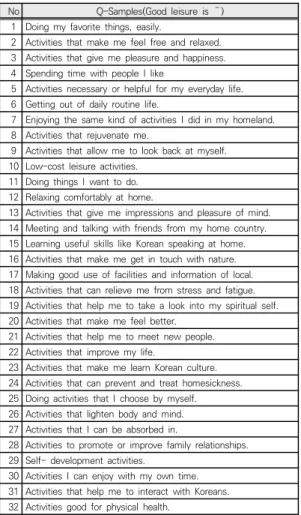
By reading the statements repeatedly, Q-samples were selected by categorizing the statements that have common meanings and values, which are not overlapped in the questions. Q-samples were selected receiving reviews and consultations from 4 professors. Finally total 32 statements were chosed as shown Table 1.
No Q-Samples(Good leisure is ~)
1 Doing my favorite things, easily.
2 Activities that make me feel free and relaxed.
3 Activities that give me pleasure and happiness.
4 Spending time with people I like
5 Activities necessary or helpful for my everyday life.
6 Getting out of daily routine life.
7 Enjoying the same kind of activities I did in my homeland.
8 Activities that rejuvenate me.
9 Activities that allow me to look back at myself.
10 Low-cost leisure activities.
11 Doing things I want to do.
12 Relaxing comfortably at home.
13 Activities that give me impressions and pleasure of mind.
14 Meeting and talking with friends from my home country.
15 Learning useful skills like Korean speaking at home.
16 Activities that make me get in touch with nature.
17 Making good use of facilities and information of local.
18 Activities that can relieve me from stress and fatigue.
19 Activities that help me to take a look into my spiritual self.
20 Activities that make me feel better.
21 Activities that help me to meet new people.
22 Activities that improve my life.
23 Activities that make me learn Korean culture.
24 Activities that can prevent and treat homesickness.
25 Doing activities that I choose by myself.
26 Activities that lighten body and mind.
27 Activities that I can be absorbed in.
28 Activities to promote or improve family relationships.
29 Self- development activities.
30 Activities I can enjoy with my own time.
31 Activities that help me to interact with Koreans.
32 Activities good for physical health.
Table 1. 32 Q-Samples
2.2 Configuration of P-Samples
Q methodology deals with differences in meaning or significance within the individual, so the number of P-samples is generally 40 ± 20, and if it becomes over 100 people, it may be theoretically and statistically problematic[17].
Therefore, in this study, 40 women who are 20 or older married immigrant women living in Gyeonggi, Chungcheong and Daejeon were selected as P-samples considering many local multicultural families. The composition of P-sample was limited to married immigrant women who learned Korean language for more than 2 years at multicultural support centers, can read letters, are currently participated in the leisure activities.
It was tried to recruit subjects with various backgrounds and experiences so that the perception or attitude for 'Good Leisure' can be fully revealed.
2.3 Q Classification Process and Data Processing Q classification was conducted by the researcher and the research assistant who was educated about research method in the house or leisure activity place of the subjects extracted as P-samples. After giving a Q card and a card placement board for Q classification to the subject, the researcher asked the subject to select Q statements on the card from the strongly positive statement to the strongly negative statement and classify them on the 9 point scale (4, -3, -2, -1, 0, +1, +2, +3, +4). Statements selected were distributed in force according to the principle of Q methodology so that the opinions could be normally distributed.
The collected data were scored from 1 point which is strongly negative to 9 points which is strongly positive to be encoded. Q-factor analysis was performed using the QUANL PC program and varimax was used for revolving method.
3. Results and Discussion 3.1 Types of ‘Good Leisure’
3.1.1 Classification of Q Type and Correlation between Types
As a result of analyzing the type of 'Good Leisure' that married immigrant women perceived, it was classified to 4 types as shown in Table 2. The explanatory power of each type was 16.4% for type 1, 10.2% for type 2, 8.3% for type 3, and 5.6% for type 4, and the explanatory power of all types was 41.1%.
Type 1 Type 2 Type 3 Type 4
Eigen value 6.5431 4.0967 3.5330 2.2577
Variance(%) .1636 .1024 .0833 .0564
Cumulative(%) .1636 .2660 .3543 .4108
Table 2. Classification of Q Type
As shown in Table 3, the results of correlation by each type, the negative correlation between type 3 and 4 was high(-.722), and the correlation coefficient between the remaining types was .241
~ -0.016, such that they are independent each other.
Type 1 Type 2 Type 3 Type 4
Type 1 1.000
Type 2 .099 1.000
Type 3 .160 .241 1.000
Type 4 -.016 .071 -.722 1.000
Table 3. Correlation between Types
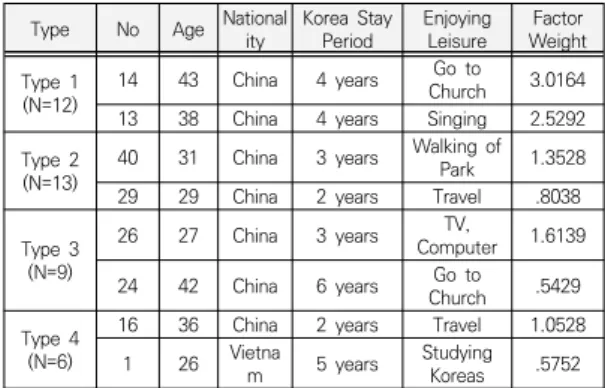
3.1.2 Type and Factor Weight of P-Samples The demographic characteristics and factor weights of the representative subjects of each type are shown in Table 4. 40 selected P-samples were significantly classified with 12 persons in Type 1, 13 persons in Type 2, 9 persons in Type 3, and 6 persons in Type 4. For the nationalities
of Married immigrant women, they included 24 Chinese, 2 Cambodian, 4 in Thai, 2 Nepalese, 5 Vietnamese, 1 Malaysian, 1 Pilipino and 1 Uzbekistan. And 7 of them appeared to have acquired Korean nationality. In terms of age, 15 persons were 20’S, 20 persons were 30’S and 5 persons were 40’S. Within each type, those with the highest factor weight were P14 (3.0164), P40 (1.3528), P26 (1.6139) and P16 (1.0528) and represent each type best.
Type No Age Nationality Korea Stay Period Enjoying
Leisure Factor Weight Type 1
(N=12) 14 43 China 4 years Go to
Church 3.0164
13 38 China 4 years Singing 2.5292
Type 2
(N=13) 40 31 China 3 years Walking of
Park 1.3528
29 29 China 2 years Travel .8038
Type 3 (N=9)
26 27 China 3 years TV,
Computer 1.6139 24 42 China 6 years Go to
Church .5429 Type 4
(N=6)
16 36 China 2 years Travel 1.0528
1 26 Vietna
m 5 years Studying Koreas .5752 Table 4. Representative P-Sample Types
3.2 Characteristics of ‘Good Leisure’ by Type
‘Good Leisure’ perceived by married immigrant women was classified into four types. The type 1 was named ‘Psychological Stability Pursues Type’, type 2 was ‘Emotional Stability and Self-development Type', Type 3 was ’Practical Pursues and Information Acquisition Type’, and type 4 was named ‘Cultural Acculturation and Exchange Type’.
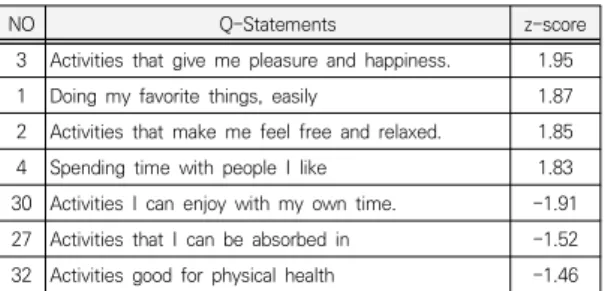
3.2.1 Type 1: Psychological Stability Pursues Type Type 1 has 12 respondents out of 40, accounting for 16.4% of the total variance. As shown in Table 5, subjects in type 1 strongly agree and recognized 'activities that bring me pleasure and happiness' and ‘activities which do my favorite thing conveniently’ as ‘Good Leisure’.
On the other hand, the most disagreeable item in type 1 was 'activities which I enjoy with my own
time'.
Type 1 subjects were perceived as good leisure when they feel pleasure and comfort through leisure activity. On the other hand, activities such as spending time alone and maintaining physical health were recognized as not important leisure activities and named as ‘Psychological Stability Pursues Type’.
NO Q-Statements z-score
3 Activities that give me pleasure and happiness. 1.95
1 Doing my favorite things, easily 1.87
2 Activities that make me feel free and relaxed. 1.85
4 Spending time with people I like 1.83
30 Activities I can enjoy with my own time. -1.91 27 Activities that I can be absorbed in -1.52 32 Activities good for physical health -1.46 Table 5. Z-Score ±1.00 or Higher in Type 1
3.2.2 Type 2: Emotional Stability and Self-development Type
Type 2 was the most common type of married immigrant women with 13 respondents, accounting for 10.2% of the total variance. As shown in Table 6, subjects in type 2 recognized as good leisure when they were enjoyable, moved, or self-developed through leisure activities. On the other hand, the prevention of homesickness in the home country, enjoying activities in the home country, and activities to make friends with surrounding people were regarded as unimportant leisure activities and named as
‘Emotional Stability and Self-development Type’.
NO Q-Statements z-score
26 Activities that lighten body and mind. 1.77 3 Activities that give me pleasure and happiness 1.21 13 Activities that give me impressions of mind 1.05
29 Self-development activities. 1.02
21 Activities that help me to meet new people. -2.19 15 Learning useful skills like computer operation -1.98 17 Making good use of facilities & information of local -1.72 24 Activities that can prevent and treat homesickness. -1.45 Table 6. Z-Score ±1.00 or Higher in Type 2
3.2.3 Type 3: Practical Use Pursues and Information Acquisition Type
Type 3 is composed of 9 respondents, accounting for 8.3% of the total variance. As shown in Table 7, subjects in type 3 recognize as good leisure when they did activity that was pleasant and impressive like type 1. But difference of type 1 and 3 they recognize as good leisure when they learn the things necessary for daily life and require small cost. On the other hand, they recognized as not important leisure learning Korean culture or exchange, so type 3 was names as ‘Practical Use Pursues and Information Acquisition Type’.
NO Q-Statements z-score
11 Doing things I want to do. 2.02
12 Relaxing comfortably at home. 1.99
14 Meeting and talking with friends from home country 1.57 13 Activities that give me impressions of mind. 1.56 31 Activities that help me to interact with Koreans. -1.97 23 Activities that make me learn Korean culture. -1.68 27 Activities that I can be absorbed in -1.60 Table 7. Z-Score ±1.00 or Higher in Type 3
3.2.4 Type 4: Cultural Acculturation and Exchange Type
Type 4 is composed of 6 respondents, accounting for 5.6% of the total variance. As shown in Table 8, subjects in type 4 recognized as good leisure when they could learn Korean culture or interact with Koreans. On the other hand, less cost, less rest, and studying were recognized as unimportant leisure, so type 4 was named as
‘Cultural Acculturation and Exchange Type’.
NO Q-Statements z-score
22 Activities that improve my life 1.70
23 Activities that make me learn Korean culture. 1.54 2 Activities that make me feel free and relaxed. 1.37 31 Activities that help me to interact with Koreans. 1.24
10 Low cost leisure activities. -2.23
12 Relaxing comfortably at home -2.11
11 Doing things I want to do. -1.60
Table 8. Z-Score ±1.00 or Higher in Type 4
3.3 Common Points and Difference among Types
3.3.1 Common points among Types
Table 9 shows the items that perceived by commonly positive or negative in Q category regardless of each type. Statement 4, ‘Spending time with good people’ is affirmative as ‘Good Leisure’ in all types, but the statement 2, ‘An activity from which feel comfort and relaxed' is commonly positive in all types except for type 3.
NO Q-Statements z-score
1 2 3 4
4 To spend time with good people 1.8 .8 0 .9 2 Activity from which I feel comfort 1.8 0.8 -.6 1.4 Table 9. Statements that are affirmed by type.
3.3.2 Difference between types
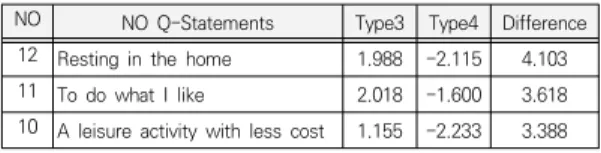
Table 10 shows the results of the analysis of the biggest differences among the types. The items that showed the biggest difference in each type were Q-sample questions 12 and 11 (4.103, 3.618) in type 3 and 4 respectively. In other words, 'Practical Use Pursues and Information Acquisition Type' is positively recognized 'Resting at home' and 'Doing what I want to do', whereas 'Acculturation and Exchange Type' was very negative.
NO NO Q-Statements Type3 Type4 Difference
12 Resting in the home 1.988 -2.115 4.103
11 To do what I like 2.018 -1.600 3.618
10 A leisure activity with less cost 1.155 -2.233 3.388 Table 10. Difference between types
4. Conclusion
The purpose of this study was to identify the types of subjective structure and characteristics of 'Good Leisure', which are recognized by married immigrant women, using the Q
methodology. Q-samples of 32 questions were extracted through interviews and open questionnaires for research purposes, and Q samples were forcedly distributed by selecting 40 married immigrant women as P samples. The data were analyzed by Q-factor analysis using QUANL PC program and the following conclusions were derived.
First, the types of 'Good Leisure' that married immigrant women think are classified into 4 types; Psychological Stability Pursues Type, Emotional Stability and Self-development Type, Practical Use Pursues and Information Acquisition Type, Cultural Acculturation and Exchange Type.
Second, ‘Psychological Stability Pursues Type’
recognizes ‘Good Leisure’ when they feel comfort and relaxed through leisure activities. ‘Emotional Stability and Self-development Type’ recognized
‘Good Leisure’ when they are pleased, or engaged in self-development activities through leisure activities. ‘Practical Use Pursues and Information Acquisition Type’ recognizes ‘Good Leisure’ when they learn things necessary for living with less cost. ‘Culture Acculturation and Exchange Type’
recognizes ‘Good Leisure’ when they learn Korean culture or interact with Korean people.
Third, regardless of each type, married immigrant women perceived ‘spending a good time with good people’ as ‘Good Leisure’. While
‘Enjoying their activities performed in their home country continuously in Korea’ and ‘’An activities to make friends with surrounding people’
appeared to be not important by all types as
‘Good Leisure’.
Based on the results of this study, it is necessary to recognize the importance and value of leisure education of married immigrant women and to provide diverse leisure policies and institutional plans for quick adaptation to Korean culture and stability as well as ‘Good Leisure’.
REFERENCES
[1] Statistics Korea. (2018). 2017 Statistics of marriage &
divorce [Online].https://mdis.kostat.go.kr.
[2] J. H. Song. (2018). Phenomenological Study on the Spousal Bereavement Experience of Married Immigrant Women. Journal of the Korea Contents Association, 18(8), 379-391.
DOI : 10.5392/JKCA.2018.18.08.379
[3] M. A. Sung. (2011). Comparative Study of Social Integration Policies for Multi-cultural Families in Korea and the United States. Journal of Korean Family Resource Management Association, 15(3), 63-81.
[4] J. H. Lee. (2019). A Systematic Review of 10 years of Research on the Leisure of Marriage Migrant Women in Korea: Its Progress and Future Directions. Journal of Tourism Science, 43(1), 205-229.
DOI : 10.17086/JTS.2019.43.1.205.229
[5] K. Y. Park, O. H. Chae & H. S. Jong. (2012). A Study on Activation Plan of Marriage Migrant Women's Self-help Group in Multicultural Family Support Center. Korea: The Ministry of Gender Equality and Family [Online].
http://www.nl.go.kr/app/nl/search/common/downloa d.jsp?file_id=FILE-00008153075
[6] D. K. Hibbler & K. J. Shinew.(2002). Interracial Couples’s Experience of Leisure: A Social Network Approach. J. of Leisure Research, 43(2), 135-156.
[7] S. O. Lyu & Y. J. Ahn. (2015). Examining Factors Affecting Leisure Club Participation. Journal of Tourism Studies, 27(4), 73-93.
[8] B. W. An & S. H. Whang. (2012). Relationship Between Leisure Competence, Flow, Leisure Satisfaction, and Self-Efficacy in Leisure Sports Participants. Leisure Studies, 9(3), 1-19.
[9] M. Stodolska. (2000). Looking beyond the invisible:
Can research on leisure of ethnic and racial minorities contribute to leisure theory. Journal of Leisure Research, 32(1), 156-160.
DOI : 10.1080/00222216.2000.11949907
[10] M. Stodolska & G. J. Walker. (2007). Ethnicity and Leisure: Historical Development, Current Status, and Future Directions. Leisure/Loisi, 31(1), 3-26.
DOI : 10.1080/14927713.2007.9651371
[11] Y. S. Kim & S. Y. Lee. (2015). Relationship among Leisure Experience, Social Support and Cultural Adaptation of Marriage Migrant Women. Journal of Leisure Studies. 13(3), 87-108.
[12] H. R. Lee & Y. H. Kwon. (2014). The Relationship among Leisure Participation, Leisure Satisfaction, and Life Satisfaction of Foreign Wives in Rural Community. Journal of Tourism and Leisure, 26(1), 151-170.
[13] Y. M. Kim, S. S. Park & I. G. Kim. (2014). Meaning and
Practical Application of Leisure as a Cultural Welfare for Adjustment of Marriage Migrant Women in Korea.
Korean Journal of Physical Education, 53(2), 407-421.
[14] Y. H. Shin & S. W. Lim. (2017). Significance of Marriage Immigrant Women’s Participation in Volleyball Club and Effects on their Adapting Process to Korean Culture and Society. Journal of Sport and Leisure Studies, 68, 453-466.
[15] C. W. Lee. (1999). An Analysis of the Character about Korean Leisure Culture under IMF Supervisory Situation. Journal of Leisure and Recreation Studies, 16(1), 213-226.
[16] Y. M. Kim. (2014). A Research Approach of Q-Methodology to the Meanings and Types of Good Leisure Perceived by Korean Olders for their Successful Aging. Journal of Leisure Research, 38(1), 56-73.
[17] H. K. Kim. (2009). Q methodology : Philosophy, Theories, Analysis, and Application. Seoul: Communication Books.
김 영 미(Young-Mee Kim) [정회원]
․ 1987년 2월 : 서울대학교 체육교육과 (체육학사)
․ 1989년 2월 : 서울대학교 체육교육과 (교육학석사)
․ 2000년 2월 : 단국대학교 체육학과(이 학박사)
․ 2006년 3월 ~ 현재 : 서원대학교 레 저스포츠학과 교수
․ 관심분야 : 스포츠 사회학, 무용교육
․ E-Mail : [email protected]