• 검색 결과가 없습니다.

Predictive value of C-reactive protein for the diagnosis of meningitis in febrile infants under 3 months of age in the emergency department

N/A
N/A
Protected

Academic year: 2021

Share "Predictive value of C-reactive protein for the diagnosis of meningitis in febrile infants under 3 months of age in the emergency department"

Copied!
6
0
0

로드 중.... (전체 텍스트 보기)

전체 글

(1)

Predictive value of C-reactive protein for the diagnosis of meningitis in febrile infants under 3 months of age in the emergency department

Tae Gyoung Lee, Seung Taek Yu, Cheol Hwan So

Department of Pediatrics, Wonkwang University School of Medicine, Iksan, Korea

Background: Fever is a common cause of pediatric consultation in the emergency department.

However, identifying the source of infection in many febrile infants is challenging because of in- sufficient presentation of signs and symptoms. Meningitis is a critical cause of fever in infants, and its diagnosis is confirmed invasively by lumbar puncture. This study aimed to evaluate poten- tial laboratory markers for meningitis in febrile infants.

Methods: We retrospectively analyzed infants aged <3 months who visited the emergency de- partment of our hospital between May 2012 and May 2017 because of fever of unknown etiolo- gy. Clinical information and laboratory data were evaluated. Receiver operating characteristic (ROC) curves were constructed.

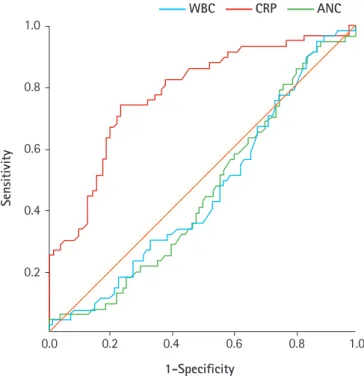
Results: In total, 145 febrile infants aged <3 months who underwent lumbar punctures were evaluated retrospectively. The mean C-reactive protein (CRP) level was significantly higher in the meningitis group than in the non-meningitis group, whereas the mean white blood cell count or absolute neutrophil count (ANC) did not significantly differ between groups. The area under the ROC curve (AUC) for CRP was 0.779 (95% confidence interval [CI], 0.701–0.858). The AUC for the leukocyte count was 0.455 (95% CI, 0.360–0.550) and that for ANC was 0.453 (95% CI, 0.359–

0.547). The CRP cut-off value of 10 mg/L was optimal for identifying possible meningitis.

Conclusion: CRP has an intrinsic predictive value for meningitis in febrile infants aged <3 months.

Despite its invasiveness, a lumbar puncture may be recommended to diagnose meningitis in young, febrile infants with a CRP level >10 mg/L.

Keywords: C-reactive protein; Fever; Infants; Meningitis; Spinal puncture

Introduction

Fever is a common cause of patient visits in pediatric practice [1].

In many patients, the main cause of infection cannot be identified based solely on the clinician’s physical examination, especially in pediatric patients [2]. When infants who visit the emergency de- partment exhibit fever without a clear source of infection, doctors must differentially diagnose various diseases from a simple viral Received: October 30, 2019

Revised: December 9, 2019 Accepted: December 16, 2019 Corresponding author:

Cheol Hwan So Department of Pediatrics, Wonkwang University School of Medicine, 895 Muwang-ro, Iksan 54538, Korea

Tel: +82-63-859-1510 Fax: +82-63-853-3670 E-mail: [email protected]

Yeungnam Univ J Med 2020;37(2):106-111 https://doi.org/10.12701/yujm.2019.00402

infection to a serious bacterial infection [3]. The management of febrile infants aged < 3 months is especially challenging because of the relatively high prevalence of serious bacterial infections such as bacteremia, meningitis, and urinary tract infection, and the lack of specific signs or symptoms to differentiate these infec- tions from a simple viral infection [4,5]. A combination of medi- cal history and physical and laboratory findings has been widely accepted as an approach to identify the source of infection in fe-

Copyright © 2020 Yeungnam University College of Medicine

This is an Open Access article distributed under the terms of the Creative Commons Attribution Non-Commercial License (http://creativecommons.org/licenses/by-nc/4.0/)

which permits unrestricted non-commercial use, distribution, and reproduction in any medium, provided the original work is properly cited.

(2)

brile patients [6].

Meningitis is one of the causes of fever, and lumbar puncture (LP) is required to determine the presence of meningitis by ob- taining a cerebrospinal fluid (CSF) sample. Making a decision of when to perform an LP to differentiate meningitis from other dis- eases can be difficult [7]. In early-onset sepsis in the neonatal pe- riod, the American Academy of Pediatrics (AAP) recommends performing an LP in the case of positive blood culture results, if the “clinical course or laboratory data strongly suspect bacterial sepsis,” or if the infant does not respond to antimicrobial therapy [8]. However, even with meningitis, young infant patients often do not present symptoms such as fever, vomiting, or headache, and blood culture examinations normally take a couple of days.

Therefore, many clinicians rely on laboratory findings, including the level of C-reactive protein (CRP), an acute-phase reactant synthesized by the liver in response to tissue injury or inflamma- tion, which is a sensitive marker for infection [9,10]. The National Institute for Health and Care Excellence (NICE) published clini- cal guideline 149 (CG149) that suggests considering LP if the blood culture result is positive, the patient does not respond to antimicrobial therapy, or if the patient has a CRP level > 10 mg/L [11]. Many studies have analyzed the diagnostic markers for seri- ous bacterial infections in febrile infants, but markers indicating meningitis and the cut-off values for the diagnosis of meningitis have rarely been evaluated.

Therefore, the aim of this study was to retrospectively assess several laboratory markers, such as CRP, white blood cell (WBC) and absolute neutrophil count (ANC), as markers of meningitis in febrile infants in the emergency department and to identify predictive values using receiver operating characteristic (ROC) curves for meningitis.

Materials and methods

1. Ethics statement

Ethical approval for this study was obtained from the Institutional Review Board of Wonkwang University Hospital (IRB No: WKUH 2019-04-045). The requirement to obtain informed consent was waived given the retrospective nature of the study.

2. Data collection, study setting, and definitions

This retrospective study included all infants aged < 3 months who visited the emergency department of our hospital from May 2012 to May 2017 for fever with no clear source of infection. Electronic medical records of 610 infant patients whose history and physical examination could not reveal the source of infection and who un- derwent a blood test were analyzed. The exclusion criteria were

lack of blood test results and antibiotic therapy prior to the visit.

All patients underwent a full physical examination to localize the source of the fever, including the evaluation of their overall physical appearance as well as assessment of the heart, lungs, pharynges, fontanel, and ears. We collected the following clinical data from the electronic medical records: patient’s age, sex, duration of fever be- fore the hospital visit, final diagnosis, CRP level, WBC count, ANC, platelet (PLT) count, and results of the CSF analysis when LP was performed according to the ward’s policy. Meningitis was defined as meningism without altered consciousness, with CSF WBC count ≥5/µL in infants older than 28 days and ≥30/µL in neonates [12]. Bacterial meningitis was confirmed based on the culture results of the CSF, Wellcogen (Remel Europe Ltd., Dart- ford, Kent, UK) bacterial antigen rapid latex agglutination test, or polymerase chain reaction (PCR) using dual priming oligonucle- otide, Seeplex (MT Promedt Consulting GmbH, St. Ingbert, Ger- many). Viral meningitis was confirmed based on positive viral multiplex PCR results in the CSF. Aseptic meningitis was con- firmed by negative bacterial growth in the CSF. For comparative analysis, we distinguished aseptic meningitis from viral meningi- tis. We confirmed that no bacterial pathogens were found in all in- vestigated specimens from the aseptic or the viral meningitis groups. Undetermined fever was defined when the cause of fever was not revealed after 7 days of hospitalization. Urinary tract in- fection was diagnosed with pyuria (WBC > 5/high power field) and the isolation of > 100,000 colony-forming units per milliliter of a single pathogen from the urine collected in a urine bag. Cul- tures with more than one isolate were considered contaminated.

Fever was defined as a tympanic membrane temperature of 38°C or higher.

3. Statistical analysis

Continuous variables were presented as mean± standard devia- tion. Categorical variables were expressed as a number (%) using the cross analysis. The independent t-test was used when compar- ing the meningitis and non-meningitis group. Sensitivity, specific- ity, positive predictive value (PPV), negative predictive value (NPV), and area under the curves (AUCs) for laboratory bio- markers with respect to the diagnosis of meningitis were calculat- ed and compared. Data were analyzed using IBM SPSS version 25.0 (IBM Corp., Armonk, NY, USA). A p-value <0.05 was con- sidered statistically significant.

Results

During the study period, 610 febrile infants aged < 3 months

were evaluated at the emergency department or outpatient pedi-

(3)

atric department of our hospital due to fever with no clear source of infection. Of these, three patients did not undergo laboratory tests, and 36 patients were treated with antibiotic therapy prior to the visit. Thus, a total of 571 infants who met the inclusion criteria were enrolled in the study. Among the 571 patients, LP was per- formed in 145 patients and 57 patients were definitively diagnosed with meningitis. The meningitis group was comprised three pa- tients with bacterial meningitis and 54 patients with aseptic or viral meningitis. Among the viral meningitis group, 50 patients were di- agnosed with enteroviral meningitis, and 4 patients were diagnosed with herpes simplex virus type 2 meningitis. Moreover, 88 patients comprised the non-meningitis group (Fig. 1). Febrile illness with- out a source of infection was the most common final diagnosis in all studied infants, accounting for 54.3% of all diagnoses (Table 1).

Urinary tract infection was the next most common diagnosis, ac- counting for 157 patients (27.5%). Respiratory tract infection ac- counted for 33 patients (5.8%). Human rhinovirus was the most common pathogen accounting for 14 patients (2.5%). Respirato- ry syncytial virus, parainfluenza virus, enterovirus, coronavirus, human bocavirus, and influenza virus were the pathogens detect- ed in the respiratory tract. Gastrointestinal tract infection account- ed for 14 patients (2.5%). Rotavirus was the most commonly identified pathogen and astrovirus was also detected in the stool multiplex PCR.

The demographic characteristics and laboratory findings of in- fants with and without meningitis were evaluated. A total of 61.4%

of the non-meningitis group were male infants (n=54), and 64.9%

of the meningitis group were also male infants (n=37). The mean age was 40.9 ±23.7 days in the non-meningitis group and 40.6±25.3 days in the meningitis group. The mean duration of fe- ver at the time of visit was 1.9 ±1.9 and 1.8 ±1.3 days in the non-meningitis group and meningitis group, respectively. More- over, no significant difference in sex, age, fever duration, and mean time required for improvement of fever was found. A statistically significant difference was found in terms of CRP level between the meningitis and non-meningitis groups (p<0.05). The mean CRP level was 24.32 ±33.66 mg/L in the meningitis group and 7.44±6.50 mg/L in the non-meningitis group. Other laboratory variables showed no statistically significant differences (Table 2).

For predicting meningitis, the AUC was 0.779 for CRP (95%

confidence interval [CI], 0.701–0.858), 0.455 for WBC (95%

CI, 0.360–0.550), and 0.453 for ANC (95% CI, 0.359–0.547) (Fig. 2). The AUC for CRP was significantly higher than that for WBC and ANC. The ROC curve was used to select optimal cut- off values of laboratory factors for predicting whether LP is need- ed to detect meningitis. CRP was the only laboratory parameter found to be associated with meningitis. According to the data in

Table 1. Final diagnosis of febrile infants aged <3 months (n=571)

Final diagnosis No. (%)

Undetermined fever 310 (54.3)

Urinary tract infection 157 (27.5)

Respiratory tract infection 33 (5.8)

Viral meningitis 28 (4.9)

Aseptic meningitis 26 (4.6)

Gastrointestinal tract infection 14 (2.5)

Bacterial meningitis 3 (0.5)

this study, a CRP cut-off of 10 mg/L showed both relatively high sensitivity and specificity. At that threshold, a sensitivity of 73.7%, specificity of 77.3%, and NPV of 81.9% for possible meningitis were noted in febrile infants (Table 3).

Discussion

In this study, we analyzed febrile infants with an unknown source of infection who met the inclusion criteria in the study period and compared the predictive values of commonly used laboratory data to establish effective markers for predicting meningitis.

When febrile infants without a clear source of infection seek treatment in a hospital, deciding the management approach is

Febrile infants <3 months old hospitalized from May 2012 to May 2017 (n=610)

57 Diagnosed with meningitis

426 Lumbar punctures not performed

88 Not diagnosed with meningitis

39 Did not meet the study inclusion criteria 3 Patients: did not undergo laboratory tests 36 Patients: prior antibiotic therapy

Fig. 1. Subject enrollment flow chart shows the number of patients in each classified group.

145 Lumbar punctures performed

571 Suitable for study and enrolled

(4)

quite challenging for clinicians. Particularly, febrile infants aged

< 3 months are frequently evaluated for the risk of invasive bacte- rial infections such as bacteremia or bacterial meningitis in the pe- diatric department [13,14]. The probability of serious bacterial infection without a definitive etiology is reported to be approxi- mately 12% in the neonatal period and up to 9% between 1 and 3 months of age [15]. Diagnostic tests for differentiating severe bac- terial infections from viral infections have long been the focus of

several investigations [16]. Chest radiography has been used for diagnosing pneumonia. Urine and CSF samples have been used for the diagnosis of urinary tract infection and meningitis, respec- tively [17]. However, deciding the timing of LP for CSF sampling has been challenging [7]. For neonates with early-onset sepsis, the AAP recommends performing LP if the blood culture result is positive with clinical or laboratory findings strongly indicating bacterial sepsis or if the patients do not respond to antibiotic ther- apy [8]. Gajdos et al. [18] analyzed predictive factors of bacterial infection in febrile infants aged < 3 months and found that only an elevation in WBC with > 50% of neutrophils and an elevation in CRP levels > 20 mg/L could predict serious bacterial infection, with a negative predictive value of 93%. Pulliam et al. [1] demon- strated that CRP level was a better diagnostic tool than WBC and ANC for predicting serious bacterial infection in a group of febrile children aged between 1 and 36 months.

During infection or inflammation, the plasma pro-calcitonin (PCT) concentration is known to both increase and return to normal concentration more rapidly than the CRP level [19]. The PCT level was also observed to increase faster than the CRP level 6 hours after the onset of severe infection or inflammation [20].

Therefore, the PCT test has been considered a useful tool for early diagnosis of infection [21]. In other studies, PCT was found to be Table 2. Comparison of clinical and laboratory characteristics between the meningitis group and non-meningitis group

Variable Meningitis (n= 57) Non-meningitis (n= 88) p-value

Male sex 37 (64.91) 54 (61.36) 0.699

Age (day) 40.6± 25.3 40.9± 23.7 0.944

Fever duration (day) 1.8± 1.3 1.9± 1.9 0.511

Fever improvement (day) 3.0± 1.4 2.6± 2.0 0.201

Hemoglobin (g/dL) 11.27± 2.43 11.14± 2.18 0.739

White blood cell count× 10

3

(/μL) 9.58± 5.12 10.39± 5.40 0.370

Absolute neutrophil count× 10

3

(/μL) 5.04± 3.74 5.63± 3.69 0.350

Neutrophil (%) 51.76± 15.73 52.58± 15.19 0.757

Lymphocyte (%) 37.80± 15.22 35.39± 13.87 0.329

Platelet count× 10

3

(/μL) 364.47± 126.49 344.89± 114.62 0.337

C-reactive protein (mg/L) 24.32± 33.66 7.44± 6.50 0.001

Values are presented as number (%) or mean±standard deviation.

Fig. 2. Receiver operating characteristic curves for CRP (p<0.05), WBC (p=0.36), and ANC (p=0.34) for predicting meningitis shows that CRP has the most valuable predictive value indicating meningitis compared to WBC and ANC. CRP, C-reactive protein;

WBC, white blood cell count; ANC, absolute neutrophil count.

Table 3. C-reactive protein decision thresholds as an indicating marker of meningitis

Threshold (mg/L) Sensitivity (%) Specificity (%) PPV (%) NPV (%)

5 86.0 47.7 51.6 84.0

10 73.7 77.3 67.7 81.9

15 50.9 84.1 67.4 72.5

20 31.6 90.9 69.2 67.2

PPV, positive predictive value; NPV, negative predictive value.

1-Specificity 1.0

0.8

0.6

0.4

0.2

0.0 0.2 0.4 0.6 0.8 1.0

Sensitivity

WBC CRP ANC

(5)

a useful biomarker to distinguish between bacterial and viral men- ingitis [22]. Moreover, in Korea, several published studies have focused on the value of laboratory markers in discriminating seri- ous bacterial infections, and Hur et al. [23] studied the diagnostic value of PCT and CRP simultaneously using blood samples from 1,270 patients with blood culture-positive sepsis. According to their report, the diagnostic utility of the PCT was better than that of CRP. However, in the case of diagnosing neonatal bacterial in- fection, the PCT test was found to be more expensive, with simi- lar or better sensitivity than CRP and acceptable specificity [24].

Kim et al. [25] also reported that in febrile infants aged ≤ 6 months, there is no diagnostic value of measuring serum PCT concentration for determining bacterial infection. Since a PCT as- say is more expensive than CRP level analysis and is not readily available in all facilities, only a few infants are analyzed for changes in the PCT level. In contrast, CRP can be determined in less than an hour using a small amount of blood and the CRP level test is not cost intensive. Hence, we determined a cut-off level for CRP for better diagnostic accuracy and ease of access to all patients.

Sturgeon et al. [7] suggested that it does not appear prudent to assign CRP cut-off values for consideration in LP for neonates be- cause of its low sensitivity and specificity. They emphasized the importance of a multi-faceted decision-making process based on clinical assessment, microbiology results, as well as any blood test findings such as CRP level [7].

In this study, sex and age at diagnosis in the meningitis group did not significantly differ from those in the non-meningitis group. The main finding of this retrospective study was that CRP is a relatively valuable laboratory factor in the assessment of men- ingitis in febrile infants aged < 3 months. As shown in Fig. 2, vari- ous cut-off levels of CRP had better sensitivity, specificity, PPV, and NPV than those of WBC or ANC. Our data also showed that different cut-off values of CRP levels had different diagnostic val- ues (Table 3). We found that with assuming a cut-off CRP level of 10 mg/L, the sensitivity and specificity for predicting meningitis were both > 70%, with a relatively high NPV > 80%.

This study has some limitations that need to be considered while interpreting the results. First, this study was conducted us- ing medical records from a single hospital; thus, our study popula- tion does not represent the whole population of infants in Korea.

Second, we collected urine samples using urine bags rather than catheterization or bladder puncture, which could have increased the likelihood of contamination. Finally, a comparison between the bacterial meningitis group and the aseptic meningitis group could not be performed because there were only 3 cases of bacte- rial meningitis in this study cohort. Even with these limitations, this comparative analysis of laboratory markers for predicting

meningitis in infants is significant in terms of its contribution to the literature.

In summary, this study showed that in the evaluation of young, febrile infants in the emergency department, CRP was a stronger independent predictor for meningitis than WBC or ANC. We suggest the use of CRP levels as a part of the evaluation for every febrile infant aged < 3 months. CRP levels > 10 mg/L suggest the presence of meningitis in febrile infants with greater accuracy.

However, clinicians should keep in mind that a single laboratory marker indicates only the probability but never the certainty of the presence or absence of meningitis.

Acknowledgments

Conflicts of interest

No potential conflict of interest relevant to this article was report- ed.

ORCID

Tae Gyoung Lee, https://orcid.org/0000-0002-5080-2840 Seung Taek Yu, https://orcid.org/0000-0001-9744-5548 Cheol Hwan So, https://orcid.org/0000-0003-1759-0003

References

1. Pulliam PN, Attia MW, Cronan KM. C-reactive protein in fe- brile children 1 to 36 months of age with clinically undetectable serious bacterial infection. Paediatrics 2001;108:1275–9.

2. Olaciregui I, Hernandez U, Munoz JA, Emparanza JI, Landa JJ.

Markers that predict serious bacterial infection in infants under 3 months of age presenting with fever of unknown origin. Arch Dis Child 2009;94:501–5.

3. Van den Bruel A, Thompson MJ, Haj-Hassan T, Stevens R, Moll H. Diagnostic value of laboratory tests in identifying seri- ous infections in febrile children: systemic review. BMJ 2011;

342:d3082.

4. Bilavsky E, Yarden-Bilavsky H, Ashkenazi S, Amir J. C-reactive protein as a marker of serious bacterial infections in hospitalized febrile infants. Acta Paediatr 2009;98:1776–80.

5. Baraff LJ. Outpatient management of fever in selected infants. N Engl J Med 1994;330:938–9.

6. Dagan R, Powell KR, Hall CB, Menegus MA. Identification of infants unlikely to have serious bacterial infection although hos- pitalized for suspected sepsis. J Pediatr 1985;107:855–60.

7. Sturgeon JP, Zanetti B, Lindo D. C-reactive protein (CRP) lev-

els in neonatal meningitis in England: an analysis of national

variations in CRP cut-offs for lumbar puncture. BMC Pediatrics

(6)

2018;18:380.

8. Polin RA. Management of neonates with suspected or proven early-onset bacterial sepsis. Pediatrics 2012;129:1006–15.

9. Jaye DL, Waites KB. Clinical applications of C-reactive protein in pediatrics. Pediatr Infect Dis J 1997;16:735–46.

10. Du Clos TW. Function of C-reactive protein. Ann Med 2000;

32:274–8.

11. National Institute for Health and Clinical Excellence (NICE).

Neonatal infection (early onset): antibiotics for prevention and treatment. Clinical guideline [CG149] [Internet]. Manchester:

NICE; 2012 [cited 2019 Dec 14]. http://www.nice.org.uk/

guidance/cg149/

12. Kelly C, Sohal A, Michael BD, Riordan A, Solomon T, Kneen R, et al. Suboptimal management of central nervous system infec- tions in children: a multi-centre retrospective study. BMC Pedi- atr 2012;12:145.

13. Milcent K, Faesch S, Gras-Le Guen C, Dubos F, Poulalhon C, Badier I, et al. Use of procalcitonin assays to predict serious bac- terial infection in young febrile infants. JAMA Pediatr 2016;

170:62–9.

14. Woll C, Neuman MI, Aronson PL. Management of the febrile young infant: update for the 21st century. Pediatr Emerg Care 2017;33:748–53.

15. Maniaci V, Dauber A, Weiss S, Nylen E, Becker KL, Bachur R.

Procalcitonin in young febrile infants for the detection of seri- ous bacterial infections. Pediatrics 2008;122:701–10.

16. Khilnani P, Deopujari S, Carcillo J. Recent advances in sepsis and septic shock. Indian J Pediatr 2008;75:821–30.

17. Manzano S, Bailey B, Girodias JB, Galetto-Lacour A, Cousineau J, Delvin E. Impact of procalcitonin on the management of chil- dren aged 1 to 36 months presenting with fever without source:

a randomized controlled trial. Am J Emerg Med 2010;28:647–

53.

18. Gajdos V, Foix L’Helias L, Mollet-Boudjemline A, Perreaux F, Trioche P, Labrune P. Factors predicting serious bacterial infec- tions in febrile infants less than three months old: multivariate analysis. Arch Pediatr 2005;12:397–403.

19. Schroeder S, Hochreiter M, Koehler T, Schweiger AM, Bein B, Keck FS, et al. Procalcitonin (PCT)-guided algorithm reduces length of antibiotic treatment in surgical intensive care patients with severe sepsis: results of a prospective randomized study.

Langenbecks Arch Surg 2009;394:221–6.

20. Rey C, Los Arcos M, Concha A, Medina A, Prieto S, Martinez P, et al. Procalcitonin and C-reactive protein as markers of system- ic inflammatory response syndrome severity in critically ill chil- dren. Intensive Care Med 2007;33:477–84.

21. Konstantinidis T, Cassimos D, Gioka T, Tsigalou C, Parasidis T, Alexandropoulou I, et al. Can procalcitonin in cerebrospinal flu- id be a diagnostic tool for meningitis. J Clin Lab Anal 2015;

29:169–74.

22. Prasad R, Kapoor R, Mishra OP, Srivastava R, Kant Singh U.

Serum procalcitonin in septic meningitis. Indian J Pediatr 2013;

80:365–70.

23. Hur M, Moon HW, Yun YM, Kim KH, Kim HS, Lee KM.

Comparison of diagnostic utility between procalcitonin and C-reactive protein for the patients with blood culture-positive sepsis. Korean J Lab Med 2009;29:529–35.

24. Kim EK, Lee BS, Lee JA, Jo HS, Park JD, Kim BI, et al. Clinical availability of serum procalcitonin level in the diagnosis of neo- natal bacterial infection. J Korean Soc Neonatol 2001;8:211–

21.

25. Kim NH, Kim JH, Lee TJ. Diagnostic value of serum procalci- tonin in febrile infants under 6 months of age for the detection of bacterial infections. Korean J Pediatr Infect Dis 2009;16:

142–9.

수치

Fig. 1.  Subject enrollment flow chart shows the number of patients  in each classified group.
Table 3. C-reactive protein decision thresholds as an indicating  marker of meningitis

참조

관련 문서

Second, as a direct impact, the abolishing of licensing gives both incumbent and entrants higher option value directly because the new facility based

The main objective of the Bi Regional Center for SMES Development is oriented towards generating the conditions of cooperation among the countries which

Current Tokyo is rich in green compared to other metro cities. In some parts, the greenery has been contributed by the many inherited gardens from the Edo era to today which

In a statement to Kuwait News Agency (KUNA) on the sidelines of a meeting of the Arab Parliament's Foreign Affairs Political and National Security

The meeting was attended by Assistant Foreign Minister for GCC Affairs, Ambassador, Nasser Al-Muzayyen, and Deputy Assistant Foreign Minister for the Office of the

“ Sheikh Nasser has a written message from HH the Amir, Sheikh Sabah Al-Ahmad Al-Jaber Al-Sabah to the Chinese President, Chi Gen Beng related to enhancing mutual

On his part, CEO of Express Roads Authority, Saud Al-Naqqi said that the heavy rains of the previous day led to clogging parts of the express

Kuwait will celebrate on Sunday the fourth anniversary of the UN honoring and proclamation of His Highness the Amir, Sheikh Sabah Al-Ahmad Al-Jaber Al-Sabah as