https://doi.org/10.7236/JIIBC.2017.17.2.141
JIIBC 2017-2-21
IoT 기반의 병원용 물류 로봇의 안전한 운행을 위한 장애물 인식에 관한 연구
A Study on Object Recognition for Safe Operation of Hospital Logistics Robot Based on IoT
강민수
*, 임춘화
**, 이재연
***, 최은혜
****, 이상광
****Min-soo Kang * , Chunhwa Ihm ** , Jaeyeon Lee *** , Eun-Hye Choi **** , Sang Kwang Lee ****
요 약 최근 지속적으로 발생하고 있는 메르스와 같은 신종 감염병은 초기발견, 격리, 위기대응 등 많은 대응책을 필요로 하고 있으며 아울러 일반인의 문병과 간호 간병 통합서비스 시행 등 병원의 문화가 바뀌는 추세이다. 그러나 병원에서 근무하는 의료인의 자격조건, 규정 등이 까다로와지면서 해외에서는 린넨, 폐기물, 수액 이동 등 로봇으로 가능한 부분 은 대체하는 추세이다. 본 연구에서는 병원 내에서 발생하는 각종 물품의 배송 업무를 수행할 수 있는 IoT 기반의 병 원 물류 로봇으로 다양한 종류의 물건을 원하는 위치까지 안전하게 이동 할 수 있는 기술에 대하여 연구하였다. 병원 내 로봇의 이동은 사람 또는 사물간 충돌을 발생 시킬 수 있기 때문에 충돌을 최소화 해야 한다. 충돌을 최소화하기 위해서는 로봇의 이동 경로에 사물의 유무를 판단하고 사물이 있다면 이동하는 것인지 아닌지를 인지해야 한다. 그래 서 얼굴/전신정보 검출과 3D Vision 영상분할 기술을 이용하여 장애물의 상황 정보를 생성하였다. 생성 된 정보를 활 용하여 로봇 이동 범위 내 사물과 사람을 고려한 맵을 생성하여 로봇이 안전하고 효율적으로 운행 될 수 있도록 하였다.
Abstract
New infectious diseases such as MERS have been in need of many measures such as initial discovery, isolation, and crisis response. In addition, the culture of hospitals is changing, such as the general public 's visiting and Nursing Care Integration Services. However, as the qualifications and regulations of medical personnel in hospitals become rigid, overseas such as linens, wastes movements are replacing possible works with robots. we have developed a hospital logistics robot that can carry out various goods delivery within a hospital, and can move various kinds of objects safely to a desired location. In this thesis, we have studied a hospital logistics robot that can carry out various kinds of goods delivery within the hospital, and can move various kinds of objects such as waste, and linen safely to a desired location. The movement of a robot in a hospital may cause a collision between a person and an object, so that the collision must be prevented. In order to prevent collision, it is necessary to recognize whether or not an object exists in the movement path of the robot. And if there is an object, it should recognize whether it moves or not. In order to recognize human beings and objects, we recognize the person with face/body recognition technology and generate the context awareness of the object using 3D Vision image segmentation technology. We use the generated information to create a map that considers objects and person in the robot moving range. Thus, the robot can be operated safely and efficiently.Key Words :
Hospital, Logistic, Robot, Face-based Recognition*
정회원, 을지대학교 의료IT학과 교수
**
정회원, 을지대학교 의학과 교수(교신저자)
***
정회원, ETRI 책임연구원
****
정회원, 을지대학교 EMBRI 연구원
접수일자 2017년 2월 8일, 수정완료 2017년 3월 8일 게재확정일자 2017년 4월 7일
Received: 8 February, 2017 / Revised: 8 March, 2017 / Accepted: 7 April, 2017
**
Corresponding Author: [email protected]
Dept. of Medicine, Eulji University, Korea
I. Introduction
The emergence of a new epidemic, such as MERS, is changing the culture of hospitals, such as hospital visits and nursing care integration services
[1. Logistics robots are mainly used in factories and warehouses, and most of them are AGV (Automated Guided Vehicles). In addition, since the work space of the human being and the moving space of the robot are often separated from each other, the robot is easy to travel and hardly causes any problem in safety, and the use of the robot is increasing. As of May 2014, KIVA Systems (acquired by Amazon in 2012) combines the functions of a warehouse and AGV
[2]. More than 1,000 robots are being used in the Amazon warehouse to meet the needs of e-commerce companies. Robot autonomous movement for transporting goods is developed and supplied by existing robot companies.
Robot autonomous movement for transporting goods is developed and supplied by existing robot companies.
According to the 2012 survey, 557 hospital logistics robots have already been deployed. Hospital logistics robots account for about 40% of logistics robots, and they are emerging as new applications in fields other than factories and warehouses. However, hospitals other than logistics warehouses are crowded with many patients such as patients, caregivers, and medical personnel, which is problematic for the robots to operate. Robots have a lot of people on the movement path is absolutely unfavorable condition for the robot.
Particular attention should be paid to the fact that a number of physically fragile patients will be included because of the specialty of hospitals
[3]. In this study, we have conducted research for obstacle attribute recognition using user detection and object movement information to generate obstacle context awareness map combining obstacle attribute information.
[4][5]II. Utilizing logistics robots in hospitals
1. Analysis for building Eulji University hospital infrastructure.
The application of the logistics robot in the hospital has to analyze the selection and the logistics environment of the hospital because the environment is different from the general logistics warehouse. So we selected Eulji University Hospital in Daejeon. The selected Eulji University Hospital conducted a field survey for the departments that will carry out the logistic robot test.(Vertical movement and horizontal movement test such as department of laboratory medicine and nursing ward using elevator) The survey is as follows
[6].
-Detailed classification of hospital logistics: Detailed travel path and process by logistics such as heavy / low, pollutant / non-pollutant, laundry, waste, consumables, medicines
-Classification of moving time zones of major logistics:Morning, afternoon, everyday
-Infrastructure to be built by site: Wireless AP, automatic door, elevator, moving section etc.
-Hospital logistics environment field survey subject:
Nursing Ward, Department of Diagnostic Tests, Management Warehouse, Central Supply Room, etc.
2. Test Infrastructure
The central control area for the logistic robot
application test in the hospital was set up so that the
experiment could be done. In addition, the hospital
practitioner was always on standby during the actual
experiment in the hospital to immediately provide the
experimental infrastructure such as the communication
equipment required in the field. In order to prevent the
most important safety accidents, elevator surveillance
system, which has undergone the preliminary safety
test, was relocated from Eulji University to Eulji
University Hospital, and an elevator control system
was additionally installed to provide the actual hospital
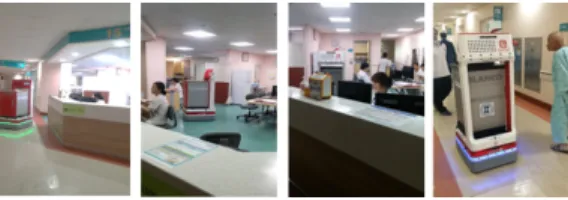
robot elevator boarding test. The application field is
shown in Figure 1.
그림 1. 로봇 동작 테스트 중인 간호병동
Fig. 1. Nursing ward under test of robot operation
III. Real-time context awareness generation technology
Robots have a lot of person on the movement path is absolutely unfavorable condition for the robot.
Particular attention should be paid to the fact that a number of physically fragile patients will be included because of the specialty of hospitals. In such a situation, the robot must be able to recognize the surrounding situation more delicately in order to carry the object and move to the designated place, and the traveling route and speed should be carefully designed so as not to give physical and psychological threat to the people. Therefore, the robot has distinguished the person and the object and studied the technology that detects the obstacle as much as possible and recognizes it so as not to interfere with the operation
[7[8].
1. Face-based human detection
Robots have a lot of person on the movement path is absolutely unfavorable condition for the robot.
Particular attention should be paid to the fact that a number of physically fragile patients will be included because of the specialty of hospitals. In such a situation, the robot must be able to recognize the surrounding situation more delicately in order to carry the object and move to the designated place, and the traveling route and speed should be carefully designed so as not to give physical and psychological threat to the people. Furthermore, it is natural that the robot should not collide with humans, but patients and elderly people may feel a great psychological threat, even if
they are not physically contacted, but pass by their own at a faster rate
[8]. Therefore, it is necessary to design a driving model design that takes people (patients, staffs, etc.) into consideration first in the hospital environment. The driving model was designed to design the protocol and sensitivity zone related to Safety and Smoothness and to design the Human-Centered Navigation (HCN) model. Also, the field of view (FOV) should be widened for user detection and tracking using face / omega /body detection. So I placed three Xtion cameras symmetrically. In addition, images and pseudo-LRF information are captured using RGB image and depth image to detect and track human
[9][10].
(a) 5 sensitive zone design considering safety and smoothness
(b) HCN model design
그림 2. 장애물 인식Fig. 2. Obstacle recognition
2. 3D Vision Information and Obstacle
Information Map Generation Study
In order to generate the map that informed the
obstacle situation by using 3D Vision information and
image segmentation, the depth information of the
Kinect sensor was integrated and the pseudo-LRF function was implemented and the user was detected and tracked using face/omega detection. Also, to measure the congestion level and to upgrade the map based on the cumulative driving information, we measured the congestion information of the route using the frequency of obstacles and user appearance. Also, to measure the congestion level and update the map attribute by region based on cumulative running information, we measured the congestion of path using obstacle and user appearance frequency.
IV. Review of results
In order to generate the obstacle context awareness map combining the obstacle attribute information, the obstacle attribute using the user detection and object movement information is recognized. In order to recognize the obstacle property, we used the geometric information of the obstacle detected through the Depth Image analysis, and the face / omega pattern was detected in the upper part of the detected obstacle area.
When the robot is moving, the response of the robot should be changed depending on whether or not the obstacle displayed at the front is human or not. In the case of objects, it is possible to avoid obstacles because they are fixed without moving. However, since people move, they must recognize the direction and speed of movement. Therefore, in this study, the recognition of obstacles is performed using geometric information and omnidirectional detection technology. The figure shows people and objects recognized.
(a) Recognized as a object (b) Recognized as a person
그림 3. 사람과 사물 인식Fig. 3 Recognized as a object and person
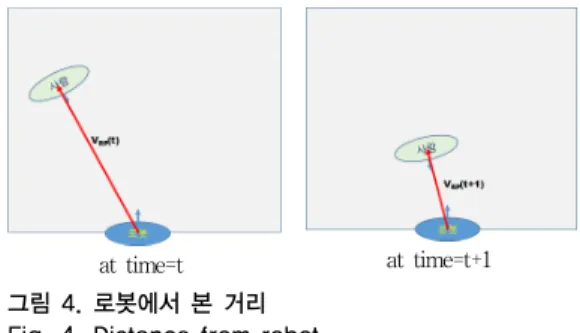
After recognizing a person, he or she should recognize the direction or speed of movement of the person. The robot should be aware of the situation in the operating section. The relative position of human and robot can be found in Robot View
,
, and we can know
of Ego-Motion of robot, that is, Bird Eye View, using Odometer information. Also, we used Equation 1 because we need to know human movement information.
(1)Orientation change of the robot itself was corrected separately and k was estimated by Equation (1). The relative distance between the robot and the obstacle is shown in Fig.
at time=t at time=t+1
그림 4. 로봇에서 본 거리Fig. 4. Distance from robot
The obstacle is classified as a person or an object,
and the direction and speed of the movement are
predicted so that the robot can move safely. The
obstacle must be recognized continuously when the
robot is driving. Therefore, we model continuous
congestion through driving learning. The space
occupied by the obstacle and the non - occupying space
that can be traveled were recognized in the space of 2
~ 3.5m ahead of the robot. The ratio of the total occupied pixels per line dividing the space is defined as the congestion of the corresponding position. In other words, it can be expressed as
(2)Thus, the probability of congestion of the line using the number of consecutive lines and the congestion level is defined as follows.
∑
(3)
As a result of the study, we will create an obstacle context awareness map that reflects the location/
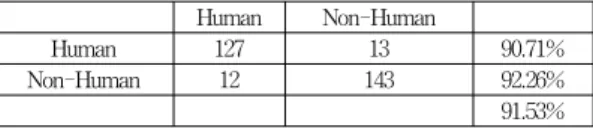
property of the obstacle and the area congestion. The context awareness map is composed of location information such as the distance to the obstacle, direction, etc., whether the obstacle is human or not, and movement information of the obstacle corrected by the robot's ego-motion. Therefore, in this study, the performance of the algorithm is verified by using 13 sensor data sets captured by using the robot sensor while directly moving the robot. As a result of the performance verification, it is expressed as Confusion Matrix, and the final recognition performance is evaluated as 91.53%.
표 1. 사람과 사물 구별 인식율
Table 1. Recognition rate of between people and object
Human Non-Human
Human 127 13 90.71%
Non-Human 12 143 92.26%
91.53%
V. Conclusion
The use of logistics robots for the automation of logistics in hospitals can improve the efficiency and productivity of manpower in the hospital, increase the job satisfaction, and reduce the hospital cost by reducing the labor cost. Therefore, we have studied the technology to avoid the collision between the robot and the object, which is a problem when using the logistics
robot in the hospital. A recognition technique to avoid collision between robot and obstacle was studied. It was also possible to predict the direction in which the obstacle can move in the case of a person. As a result, the recognition result of 91.53% was obtained. Based on the results obtained, we have field tested that the logistics robot operates smoothly in the hospital and that it operates safely and efficiently by passing the automatic door installed in the Laboratory Medicine field tests. Therefore, the technological spin-off effect is very effective by successfully applying the logistic robot system to the complex environment like the hospital, and naturally securing the essential technology that can be easily extended to similar environments and uses such as nursing homes, warehouses, and large libraries.
References
[1] S.H.Lee, et al., "Top 10 Science & Technology Issues in 2015", Featured Policy, Science &
Technology Policy, pp14-15, 2015 [2] https://www.amazonrobotics.com.
[3] Nessi, F., Beretta, E., Gatti, C., Ferrigno, G., De Momi, E., "Gesteme-free context-aware adaptation of robot behavior in human–robot cooperation:, ARTIFICIAL INTELLIGENCE IN MEDICINE, Vol.74, pp32-43, 2016.
[4] Hong, C..S., Cho, J. , Lee, K. W. , Suh, Y.-H., Kim, H., Lee, H.-C., "Developing a Context-Aware System for Providing Intelligent Robot Services", Lecture Notes in Computer Science, No.4727, pp.174-189, 2006.
[5] Bae, N.; Kwak, K.; Saraswathi, S.; Park, J.; Shin,
"A Study of Robot-Based Context-Aware Fire Escape Service Model:, "Lecture Notes in Computer Science, No.7973, pp.287-293, 2013.
[6] Shimamura, J.; Arakawa, K., "Location-Aware
Projection with Robust 3-D Viewing Point
Detection and Fast Image Deformation", ACM
Press, Vol.12, pp296-299, 2004.
최 은 혜(정회원)
∙2005 : Chungnam National Univ., Dept of Microbiology, B.S.
∙2008 : Chungnam National Univ., Dept. of Microbiology, M.S.
∙2011 ~ Eulji Univ., EMBRI(Eulji Med-Bio Research Institute)
<Research area : Immunology, biobank, molecular biology>
※ This work was supported by the Robot R&D program of MOTIE/KEIT.[10051155, The Development of Robot Based Logistics Systems Applicable to Hospital wide Environment]
[7] Nessi, F.; Beretta, E.; Gatti, C.; Ferrigno, G.; D
“Gesteme-free context-aware adaptation of robot behavior in human–robot cooperation”, Elsevier Science B.V., Amsterdam, Vol.74, 2016.
[8] Chan-Woo Moon, Young-Dae Lee, "Implementation of an Indoor Mobile Robot and Environment Recognition using Line Histogram Method", The Journal of The Institute of Internet, Broadcasting and Communication (JIIBC), Vol. 9 No. 2, pp.45-50, 2009.
[9] Tae-Woo Han, Yong-Ho Seo, "Emergency Situation Detection using Images from Surveillance Camera and Mobile Robot Tracking, System", The Journal of The Institute of Internet, Broadcasting and Communication (JIIBC), Vol. 9 No. 5, pp.101-107, 2009.
[10] Jeon, Young-Pil; Park, Jong-Ho; Lim, Shin-Teak;
Chong, Kil-To,"Research for robot kidnap problem in the indoor of utilizing external image information and the absolute spatial coordinates", Journal of the Korea Academia-Industrial cooperation Society, Vol. 16, No. 3, pp.2123-2130, 2015.
DOI : http://dx.doi.org/10.5762/KAIS.2015.16.3.2123
저자 소개
강 민 수(정회원)
∙1993 : Kwangwoon Univ., Dept. of Control & Instrumentation Eng., B.S.
∙1995 : Kwangwoon Univ., Dept. of Control & Instrumentation Eng., M.S.
∙2003 : Kwangwoon Univ., Dept. of Control & Instrumentation Eng., Ph.D.
∙2013 ~ : Eulji Univ., Dept. of Medical IT <Research area: AI, Medical IoT>
임 춘 화(정회원)
∙1993 : Chunhnam National University, Dept of Medicine, B.S.
∙2000 : Chunhnam National University, Dept of Medicine, M.S.
∙2004 : Chunhnam National University, Dept of Medicine, Ph.D.
∙2002 ~ Eulji Univ., School of Medicine
<Research area : Transfusion Medicine, biobank, molecular genetics>
이 재 연(정회원)
∙1984 : Seoul National University, Dept. of Control & Instrumentation Eng., B.S.
∙1986 : KAIST(Korea Advanced Institute of Science and Technology), Dept. of Eletrical Eng., M.S.
∙1996 : Tokai University, Dept. of Optical Eng., Ph.D.
∙1986 ~ Electronics and Telecommunications Research Institute (ETRI)
<Research area : Robotics, pattern recognition, computer vision and biometric security>
이 상 광(정회원)
∙1998 : Chung-Ang University, Dept of Biotechnology, B.S.
∙2000 : Chung-Ang University, Dept of Biotechnology, M.S.
∙2004 : Chung-Ang University, Dept of Pharmacy, Ph.D.
∙2011 ~ Eulji Univ., EMBRI(Eulji Med-Bio Research Institute) <Research area : Proteomics, Molecular Biology,
Protein-protein interaction>