• 검색 결과가 없습니다.

Development of the design methodology for large-scale database based on MongoDB

N/A
N/A
Protected

Academic year: 2021

Share "Development of the design methodology for large-scale database based on MongoDB"

Copied!
7
0
0

로드 중.... (전체 텍스트 보기)

전체 글

(1)

Development of the design methodology for large-scale database based on MongoDB

1)

Jun-Ho Lee*, Kyung-Soo Joo**

Abstract

The recent sudden increase of big data has characteristics such as continuous generation of data, large amount, and unstructured format. The existing relational database technologies are inadequate to handle such big data due to the limited processing speed and the significant storage expansion cost. Thus, big data processing technologies, which are normally based on distributed file systems, distributed database management, and parallel processing technologies, have arisen as a core technology to implement big data repositories. In this paper, we propose a design methodology for large-scale database based on MongoDB by extending the information engineering methodology based on E-R data model.

▸Keyword: Big Data, Data Modeling, NoSQL Database, MongoDB

I. Introduction

급격히 증가하는 정보량으로 기존의 관계형 데이터베이스에 모든 정보를 저장하기 어려운 상황이 되어 빅 데이터 데이터베 이스가 등장하게 되었다.

이러한 빅 데이터를 처리하기 위한 데이터베이스는 NoSQL(Not only SQL) 데이터베이스라고 부르며 그 종류는 MongoDB[1], Hadoop[2], Apache의 Casandra[3], HBASE[4] 등 여러 가지가 존재한다. 그 중 MongoDB의 경우 Document방식의 데이터모델을 채택하고 있는데, 이는 데이터 베이스를 일종의 문서 형태로 관리한다.

NoSQL 데이터베이스들은 기존의 관계형 데이터베이스와 다르 게 대규모의 데이터를 유연하게 처리할 수 있는 것이 강점이다.

한편, 이러한 NoSQL 데이터베이스를 위한, 정보 요구사항 분석부 터 데이터베이스 구축까지의 일관적인 설계방법들이 존재하지 않 아, 현재 설계방법을 위한 여러 연구가 진행 중에 있다[5, 6, 7].

본 논문에서는 관계형 데이터베이스 설계를 위한 E-R 데이터 모델 기반의 정보공학 방법론(Information Engineering Methodology)을 확장하여 NoSQL 중 하나인 MongoDB 기반

의 대규모 데이터베이스를 위한, 정보 요구사항 분석부터 데이터베 이스 구축까지의 일관된 설계 방법론을 개발하여 제안한다. 제안한 방법론을 적용하여 MongoDB를 구축하기 위한 데이터 셋으로는 통계청에서 제공하는 교사 및 학교 관리자를 대상으로 한 기초학력 진단-보정 시스템 설문조사 응답 내용을 사용하였다.

구체적인 확장 내용은, 관계형 데이터베이스를 위한 정보공 학 방법론 중 PDM 단계를 MongoDB를 위한 PDM 단계로 변 경하여 제안한 설계 방법론을 완성하였다.

본 논문의 구성은 다음과 같다. 2장에서는 정보공학 방법론 및 MongoDB에 대해 기술하고, 3장에서는 본 논문에서 제안하 는 E-R 데이터 모델을 기반으로 한 정보공학 방법론을 확장하 여 MongoDB 기반의 대규모 데이터베이스를 위한, 정보 요구 사항 분석부터 데이터베이스 구축까지의 일관적인 설계 방법론 을 설명한다. 그리고 제안한 모델로 실제 데이터를 이용해 MongoDB에 적용하고, MongoDB 스키마를 보여준다. 4장에서 는 결론 및 향후 연구에 대해 기술한다.

∙First Author: Jun-Ho Lee, Corresponding Author: Kyung-Soo Joo

*Jun-Ho Lee ([email protected]), Dept. of Computer Science, Soonchunhyang University

**Kyung-Soo Joo ([email protected]), Dept. of Computer Software Engineering, Soonchunhyang University

∙Received: 2017. 09. 27, Revised: 2017. 10. 23, Accepted: 2017. 11. 22.

∙This work was supported by the Soonchunhyang University.

(2)

II. Related works

2.1 Information Engineering Methodology

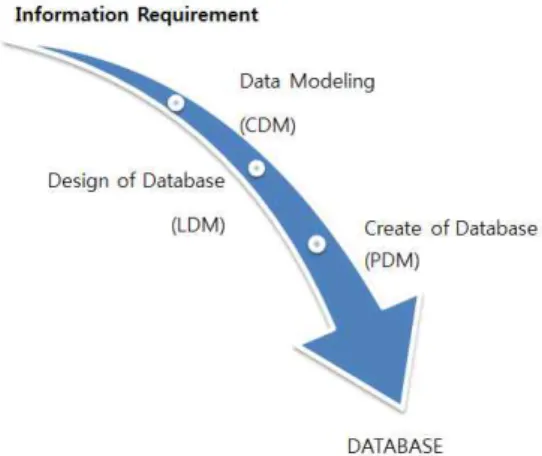
정보공학 방법론은 정보 요구사항과 어플리케이션 요구사항을 병행하여 분석하는데 데이터베이스 설계를 위한 정보 요구사항은 Fig. 1과 같이 데이터 모델링(Conceptual Data Modeling), 데이 터베이스 설계(Logical Data Modeling), 데이터베이스 구현 (Physical Data Modeling)의 세 단계로 수행 된다.[8]

데이터 모델링 단계는 E-R Data Model을 통해 엔티티를 정 의한다. 데이터베이스 설계 단계는 정의된 엔티티를 사용하여 데이터베이스의 테이블을 정의한다. 마지막, 데이터베이스 구 현 단계는 실제 사용 가능한 데이터베이스를 구현한다.

Fig. 1. Information Engineering Methodology

2.2 MongoDB

MongoDB는 10gen이라는 기업에서 2009년 개발한 NoSQL 방식의 빅 데이터 처리에 탁월한 성능을 가진 오픈소스 데이터베이스이다[9]. 필요한 쿼리 및 인덱싱을 통해 원하는 확장성과 유연성을 갖춘 Document 형태의 데이터 모델을 사 용한다[10].

MongoDB는 아래 Table 1과 같은 특징을 가진다.

1. JSON type data storage structure is provided.

2. Sharding / Replica function provid.

3. MapReduce function provid.

4. CRUD(Create, Read, Update, Delete) centered multiple transaction processing is possible.

5. Based on Memory Mapping technology, it provides excellent performance for Big Data processing.

Table 1. Special Feature of MongoDB

MongoDB는 JSON 타입의 데이터 표현방식을 사용하여 데 이터를 저장한다. 또한, 관계형 데이터베이스의 주요 기능인 CRUD 위주의 다중 트랜잭션 처리도 가능하다. 하지만 관계형 데이터베이스가 데이터를 보다 효율적으로 처리하기 위한 기술 이라면, NoSQL은 빅 데이터의 빠른 저장과 추출 및 분석을 위 한 기술로, 그 용도가 다르다. MongoDB는 기존의 관계형 데이

터베이스와 용어 면에서도 차이를 가지고 있는데, 아래 Table 2에서 그 차이를 확인할 수 있다[11].

MongoDB RDB

Collection Table

BSON Field Column

BSON Document Row

Embedded & Linking Relation Ship

Table 2. Term differences between MongoDB and Relational Database

III. Development Data Modeling Methodology for MongoDB and is

Application

데이터 모델은 데이터베이스에 필요한 데이터 구조의 개념 적 표현이다. 데이터 구조에는 데이터 객체, 데이터 객체 간의 연결 및 객체에 대한 작업을 제어하는 규칙이 포함된다. 데이터 모델의 목표는 데이터베이스에 필요한 모든 데이터 객체가 완 전하고 정확하게 표현되도록 하는 것이다. 데이터 모델은 쉽게 이해할 수 있는 표기법과 자연어를 사용하기 때문에 사용자가 정확하게 검토하고 확인할 수 있다[11].

본 논문에서는 MongoDB 데이터베이스를 설계함에 있어, 하향 식 접근 방식을 사용하는데 이는 개념적 데이터 모델로 시작하여 논리적 모델, 물리적 모델을 거쳐 MongoDB 데이터베이스를 만드 는 것으로 끝난다[12]. 적용할 실제 데이터는 통계청에서 제공하는 기초학력 진단-보정 시스템 설문조사 내용을 사용하였다.

3.1 CDM(Conceptual Data Modeling)

핵심 개념과 관계를 토대로 시스템의 범위를 파악하기 위해 개념 데이터모델(Cconceptural Data Model, CDM)을 작성한 다. CDM 모델링 과정은 아래 Fig. 2와 같다[13].

Fig. 2. Flowchart of CDM

개념적 데이터 모델링의 첫 번째 단계로 개념 템플릿을 만든

(3)

다. 개념 템플릿이란, 데이터 모델링에 필요한 각각의 개념들을 정리하는 것 이다. 개념적 데이터 모델링의 첫 번째 단계는 모 든 개념을 확인하고 정의하는 단계에서 Table 3과 같은 개념 템플릿을 완성 할 수 있다. Table 3에서 결정한 각각의 개념들 에 대한 정의는 다음 Table 4와 같은 형식으로 정리한다.

Who What When Where Why How

Organization Survey

Industry Survey

Category

Survey Comple tion Date

Compl eted Survey Survey

Respondent

Survey Section Survey Question Table 3. Concept Template

Completed Survey

One filled in survey that contains a collection of opinions from a survey respondent in reaction to service.

Industry The general sector in which

an organization operates.

Organization The company or government

agency that needs the survey.

Survey

A questions designed to be completed by an single for improvement.

Survey Category Category of Survey.

Survey Completion Date

The date that an individual filled in the survey.

Survey Question The inquiry an organization uses to seek feedback.

Survey Respondent The respondent who completes the survey.

Survey Section A logical grouping within the survey.

Table 4. Definitions for each of these concepts

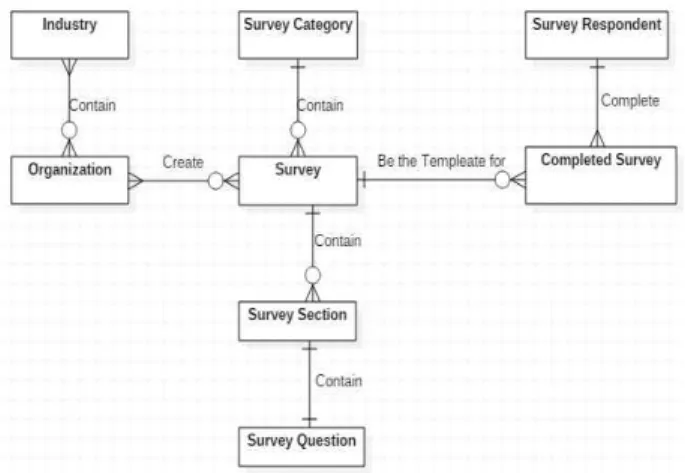
두 번째 단계에서는 각 개념들 간의 관계를 파악하는 단계로 써, 각 개념들의 관계를 식별 한 후 그림으로 정리하여 다음 Fig. 3과 같이 표현할 수 있다.

Fig. 3. Relationship of concepts

세 번째 단계는 파악한 개념들의 관계를 토대로 해당 데이터 모델을 표현하기 위한 표기법을 결정해야 한다. 정보공학 방법

론에 의해 표기할 수 있고, Axis기법 이라고 하는 비즈니스 친 화적 모델링 형식을 사용 할 수도 있다[13]. 본 논문에서는 정 보공학 방법론에 의해 표기하고, 다음 Fig. 4의 결과를 얻었다.

Fig. 4. Relationship Conceptual Data Model

네 번째 확인 및 검토 단계에서는 도출된 모델이 올바른지 확인하는 단계이다. 올바른 모델이라고 판단 될 때까지 위의 모 델링 방법을 반복 적용하여 수정할 수 있고, 올바르다고 판단된 다면 논리적 모델링 단계로 넘어간다.

3.2 LDM(Logical Data Modeling)

논리적 데이터 모델링(Logical Data Modeling, LDM)은 상 세 내용을 파악하는 단계로 CDM 과정에서 나온 데이터 모델을 토대로 만들어지게 된다. LDM 과정은 Fig. 5와 같다.

Fig. 5. Flowchart of LDM

논리적 데이터 모델의 첫 번째 단계는 개념의 속성을 식별하

고 정의하는 것이다. CDM에서 정의한 개념은 LDM의 엔티티

가 되며, 이 단계를 마치게 되면 속성 템플릿과 속성 특성 템플

릿을 얻을 수 있다. 각 엔티티의 속성 또는 데이터요소를 파악

하여 속성 템플릿을 작성한다. 작성된 템플릿은 각각 Table 5,

Table 6과 같다.

(4)

Industry Organizat

ion Survey Survey

Category

Survey

Section Survey Question Survey

Respondent Completed Survey

Name Id_name Org_nam

e Sc_name Ss_nam

e Sq_l_name Sr_name

Text Ss_desc

ription

Sq_description, Poss_An_valeue, Poss_An_discription

Comp_S_Free_Text, Comp_S_Fiexed_answ er

Date Org_First

_S_date Comp_S_date

Code SIC_cod

e

S_cod

e Sc_code

Number Ogr_DUN

S_num Sq_num

Identifier Sr_id

Indicator Sq_singular_Respon_indic

ator Table 5. Properties Template

Property Definition Sample

Value Format Length

Id_name

The common term used to describe the general sector an organization operations within. This is the standard description for the SIC code.

Computer programming services

Char 50

SIC_code

The Standard Industry Classification (SIC) is a system for classifying industries by a four-digit code. it is used by government agencies to classify industry areas.

62010 [Computer programming services]

Char 6

Org_name The common term used to describe the company or government agency that needs the survey.

Google

Naver Char 50

Org_First_S_date The date when the organization first started using survey. sep-08-2015 Date Ogr_DUNS_num Dun & Bradstreet(D&B) provides a DUNS Number, a unique

nine digit identification number, for each organization. 123456789 Char 9

S_code The unique and required short term referring to a survey. A001-A Char 6

Sc_name The common term used to describe the driver for the survey. Consumer

Feedback Char 50

Sc_code The unique and required short term to describe the driver for the survey such as employee satisfaction.

AA

BB Char 2

Ss_name The common term used to describe the logical grouping

within the survey. General Char 50

Ss_description The detailed text explaining the logical grouping within the survey. This is not displayed on the survey form.

Contains those questions pertaining to overall using experience.

Char 255

Sq_l_name What the survey respondent sees on the form. That is, the question that appears.

What about the overall user interface?

Char 255

Sq_description An explanation or background on the question, which is not displayed on the survey form.

This question lets the respondent rate user interface.

Char 255

Poss_An_valeue

Certain questions have a fixed response such as the Gender question for “Male” or “Female” or the “From 1 to 5. This field stores all of the possible fixed responses.

Male

Female Char 50

Poss_An_discription This field stores the meaning for each of the Possible Answer Values.

1 means poor

3 means Average Char 100 Sq_num A required number assigned to each question. This number is

unique within a survey.

1

2 Integer 3

Sq_singular_Respon_indic

ator Some questions allow for more than one response. Y

N Boolean

Sr_name The name the survey respondent writes on the completed survey.

JunHo Lee

KyungSoo Joo Char 100

Sr_id A unique and required value for each survey respondent. 000001 Integer 6

Comp_S_Free_Text Captures the responses to those questions that do not require a fixed response.

management of

students Char 255

Comp_S_Fiexed_answer Captures the responses to those questions that require a fixed response.

Male

Female Char 100

Comp_S_date The date the survey respondent completed the survey. Sep-09-2017 Date

Table 6. Properties Characteristics Template

(5)

두 번째 단계로는 정규화 및 추상화 작업을 실행한다. 추상 화는 모델내의 속성과 엔티티 그리고 관계를 재정의하고 결합 하는 과정으로써, 설계에 유연성을 줄 수 있다[13].

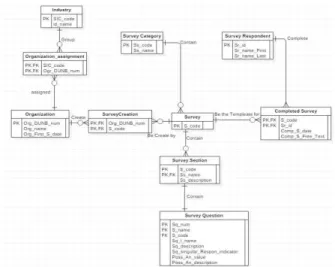
Table 5와 6의 템플릿을 작성한 후 정규화를 거친 결과 데 이터 모델은 아래 Fig. 6과 같다.

Fig. 6. Logical Data Model

세 번째, 네 번째 단계는 CDM 단계와 동일하게 유용한 표기 법을 결정하고 데이터 모델을 확인하는 단계이다.

3.3 PDM(Physical Data Modeling)

물리적 데이터 모델링(Physical Data Modeling, PDM)은 실제 MongoDB 컬렉션을 확정하는 단계로, LDM 과정에서 나온 데이터 모델을 토대로 만들어지게 된다. PDM 과정은 아래 Fig. 7과 같다.

Fig. 7. Flowchart of PDM

물리적 데이터 모델링의 첫 번째 단계로 LDM 단계에서 나온 논리적 데이터 모델을 기초로 임베드(Embed) 또는 참조 (Reference) 여부를 결정하여 초기 MongoDB 컬렉션을 준비한다.

Industry와 Organization은 비슷한 역할을 하기 때문에 하나의 컬렉션으로 롤업(Roll-Up)한다. 또한, Survey Respondent와 Completed Survey는 비슷한 변동성을 가지기 때문에 롤업한다.

그리고 Survey Category와 Survey, Survey Section은 서로 의존

엔티티이고, 변동성이 비슷하기 때문에 하나의 엔티티로 롤업한다.

최종적으로, Fig. 8과 같은 데이터 모델을 가지게 된다.

Fig. 8. Physical Data Model

두 번째 단계는 Accommodate History로 필드 값이 시간에 따라 어떻게 변하는지에 대한 옵션을 설정한다. 필드 값의 변화 를 다루기 위한 옵션은 SCD(Slowly Changing Dimension)로 불리며, 숫자(0, 1, 2, 3)로 구성된다.

① SCD 0 : 원 상태를 저장하고 변경사항은 저장하지 않는다.

② SCD 1 : 가장 최근의 상태를 저장한다.

③ SCD 2 : 데이터의 변경사항이 있을 때마다, 모든 변경사항을 컬렉션에 저장한다.

④ SCD 3 : 일부 기록에 대해 요구사항(최신보기, 이전보기 등...)이 있다.

각 컬렉션에 필요한 옵션을 결정해 Table 7의 컬렉션 기록 템플릿을 만든다[11].

Type 0 Type 1 Type 2 Type 3

Organization ✔

SurveyCreation ✔

Survey ✔

Completed Survey ✔

Survey Question ✔

Table 7. Collection History Template for the Case

세 번째 단계는 인덱싱(Indexing)과 샤딩(Sharding)이다. 인 덱싱은 논리적 데이터 모델의 기본키와 대체키를 고유 인덱스 (Unique Index)로 변환하는 것이고, 성능을 위한 인덱스를 추 가 할 수 있다. 샤딩은 컬렉션이 두 개 이상의 부분으로 분리되 는 경우를 말하며 수평, 수직 두 가지의 분할 방식이 있다[11].

네 번째 단계는 확인 및 검토 단계로 해당 모델이 올바르게 작성된 모델인지 검토한다.

다섯 번째 단계는 설계된 데이터 모델을 토대로 MongoDB 컬렉션을 정의한다[13].

3.4 MongoDB Collection

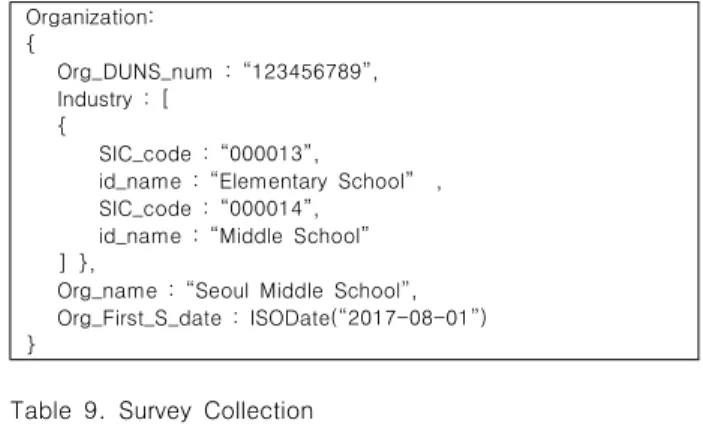
3.3절의 물리적 모델을 토대로 설계된 MongoDB 컬렉션을 정의

할 수 있다. 물리적 모델의 엔티티를 기반으로 설계되었으며, 다음

Table 8, 9, 10, 11, 12와 같이 MongoDB의 컬렉션을 정의한다.

(6)

Organization:

{

Org_DUNS_num : “123456789”, Industry : [

{

SIC_code : “000013”,

id_name : “Elementary School” , SIC_code : “000014”,

id_name : “Middle School”

] },

Org_name : “Seoul Middle School”, Org_First_S_date : ISODate(“2017-08-01”) }

Table 8. Organization Collection

Survey:

{

S_code: “A001-A”, S_typeCode : “AA”, S_categoryCode : “CF”,

S_categoryName : “Consumer Feedback”, S_sectionName : “Program Experience”,

S_sectionDescription : “Contains those questions pertaining to overall using experience.”

}

Table 9. Survey Collection

SurveyCreation:

{

Org_DUNS_num : “123456789”, S_Code : “A001-A”,

}

Table 10. SurveyCreation Collection

Survey Question:

{

Sq_num : “1”, S_code : “A001-A”,

Sq_l_name : “What about the overall user interface?”, Sq_Description : “This question lets the respondent rate user interface.”,

Sq_Singular_Respons_Indicator : “Y”

}

Table 11. Survey Question Collection

Completed Survey:

{

S_code : “A001-A”, Sr_id : “123456”,

Comp_S_date : ISODate(“2017-09-05”), sRespondentFirstName : “JunHo”, sRespondentLastName : “Lee”

}

Table 12. Completed Survey Collection

V. Conclusions

본 논문에서는 E-R 데이터 모델을 기반으로 한 정보공학 방 법론을 확장하여 MongoDB 기반의 대규모 데이터베이스를 위 한, 정보 요구사항 분석부터 데이터베이스 구축까지의 일관된 설계 방법론을 개발하여 제안하였다. CDM 단계에서 질문을 통 해 개념을 정의하고, 관계를 식별하여 개념적 데이터 모델링을

한 후, LDM 단계에서 각 엔티티에 대한 속성을 정의하고, 정규 화를 통하여 논리적 데이터 모델을 완성한다. 마지막으로, PDM 단계를 거쳐 인덱싱과 샤딩을 통해 MongoDB 기반의 대규모 데 이터베이스에 적합한 물리적 모델을 완성하고 MongoDB 스키 마를 정의하게 된다. 모든 과정은 질의응답 과정을 거쳐 만들어 지며 각 단계별 확인 및 검토를 통해 완료된다.

본 논문에서 제안한 설계 방법론을 적용하여 구축한 MongoDB 기반의 대규모 데이터베이스는 샤딩을 통한 분산시 스템의 구축이 가능하여 기존의 관계형 데이터베이스보다 확장 성면에서 이점을 가진다.

4.1 Future Work

향후 연구에서는 스타 스키마를 이용한 관계형 데이터베이 스 기반의 데이터웨어하우스 모델링 방법론을 확장하여 MongoDB 기반의 대규모 데이터웨어하우스 모델링을 위한 방 법론에 대하여 연구할 예정이다.

REFERENCES

[1] MongoDB, https://www.mongodb.org [2] Hadoop, http://hadoop.apache.org/

[3] Casandra, http://cassndra.apache.org/

[4] HBASE, http://hbase.apache.org/

[5] S. Wen, Y. Xue, J. Xu, H. Yang, X. Li, W. Song, and G.

Si, “Toward exploiting access control vulnerabilities within mongodb backend web applications,” in IEEE Annual Computer Software and Applications Conference, vol. 1, pp. 143–153, 2016.

[6] Zhao, Gansen, et al. "Modeling MongoDB with relational model," Emerging Intelligent Data and Web Technologies(EIDWT), Fourth International Conference on IEEE, 2013.

[7] Wei-Ping, Zhu, L. I. Ming-Xin, and Chen Huan. "Using MongoDB to implement textbook management system instead of MySQL," Communication Software and Networks(ICCSN), 2011 IEEE 3rd International Conference on. IEEE, 2011.

[8] TEOREY, Toby J. “Database modeling & design,” Morgan Kaufmann, 1999.

[9] Győrödi, Cornelia, et al. "A comparative study: MongoDB vs. MySQL," Engineering of Modern Electric Systems (EMES), 13th International Conference on IEEE, pp. 1-6, 2015.

[10] S. H. Aboutorabi, M. Rezapour, M. Moradi, and N. Ghadiri,

“Performance evaluation of sql and mongodb databases

for big e-commerce data,” in International Symposium

(7)

on Computer Science and Software Engineering, pp. 1–7, 2015.

[11] Mamenko, J. "Introduction to data modeling and msaccess," Lecture Notes on Information Resources, 2004.

[12] Baxter, Ira D., and Michael Mehlich., "Reverse engineering is reverse forward engineering,"

Proceedings of the Fourth Working Conference on.

IEEE, 1997.

[13] Hoberman, S., “DataModeling for MongoDB,” Technics Publications, 2014.

Authors

Jun Ho Lee received the B.S. degrees in Computer Software Engineering from Soonchunhyang University, Korea, in 2015 respectively. Lee received the BS degrees in Computer Software Engineering from Soonchunhyaung University in 2015.

Now he is undertaking a master degree of computer engineering courses as a member of the database lab at Soonchunhyang University. He is interested in database and bigdata database.

Kyung Soo Joo received the Ph.D. degrees in Computer Science from Korea University, Korea, in 1993 respectively. Dr.

Joo joined the faculty of the Department of

Computer Science at Korea University,

Seoul, Korea, in 1993. He is currently

a Professor in the Department of Computer Software

Engineering, Soonchunhyang University. He is interested

in data base and bigdata database.

수치

Table  1.  Special  Feature  of  MongoDB
Table  4.  Definitions  for  each  of  these  concepts
Fig.  6.  Logical  Data  Model
Table  8.  Organization  Collection

참조

관련 문서

For the structural design methodology to be practically used for the design of spaceborne electronics, it shall provide more reliable results on the mechanical safety

This thesis implements the intelligent image surveillance system based on embedded modules for detecting intruders on the basis of learnt information, detecting fires on the

In this paper, we propose tree-based greedy algorithm to solve the minimum power broadcasting problem for minimizing the total transmit power on broadcasting in wireless

 Once all syntax and functional errors have been eliminated, synthesize the design from the behavior description. 

Abstract This paper, based on two engineering industry SME case studies, traces the origin and process of technological innovations enabling the development

Research design, data, and methodology – The payment balance is a ratio of payment amounts made this country abroad and the receipts received by it from abroad for a

The initial rate of the hydrolysis reaction is much larger than the sum of the rates of the condensation reactions so that [SiOH] equals the consumption of H 2 O by hydrolysis.

Design is applied to create better convenience and beneficial values through a variety of design methodology in relevant industry, and new service