• 검색 결과가 없습니다.

A Study on the Knowledge and Use of Essential Oil by People of Different Age -Focused on women in Zhejiang, China-

N/A
N/A
Protected

Academic year: 2021

Share "A Study on the Knowledge and Use of Essential Oil by People of Different Age -Focused on women in Zhejiang, China-"

Copied!
9
0
0

로드 중.... (전체 텍스트 보기)

전체 글

(1)

JKSCI

A Study on the Knowledge and Use of Essential Oil by People of Different Age -Focused on women in Zhejiang, China-

1)

Qiaomeng Ying*, Kyeong-Ran Kim*

*Graduate student, Dept. of Beauty Science, Kwangju Women's University, Gwangju, Korea

*Professor, Dept. of Beauty Science, Kwangju Women's University, Gwangju, Korea

[Abstract]

With the advent of the age of"untact" modern people are pursuing a healthy body and mind. In order to achieve well-being, LOHAS and Wellness,people prefer to use natural affinity alternative therapies, Aromatherapy. This study focuses on women in their 20s~50s in Zhejiang Province, with the aim of investigating their knowledge and use of essential oils.The questionnaire was divided into four parts: 3 questions for general question, 11 questions for knowledge, 13 questions for use and 9 questions for satisfaction. In addition, the study was conducted using the WeChat and the Wenjuanxing Program from July 5 to August 30, 2019. Finally, a total of 617 questionnaires were analyzed. In this study, SPSS WIN 21.0 program is used for frequency analysis. The level of knowledge and satisfaction is verified by Cronbach‘s α. And the following analysis results were obtained by frequency analysis, descriptive statistics, Chi-squared test(  ), one-way ANOVA on the understanding level and usege of essential oils according to age. The results were as follows. The most common characteristics of subjects were the 20s, university students, essential oil recognition was high in having experience. There is no great difference in knowledge or satisfaction depending on age. knowledge and satisfaction was moderate. The results of experience in the use of essential oils were higher among all age groups, those who in their 30s did not think that the use of essential oils would be effective. However, people in their 20s and 40s and older have unclear answers, indicating that results showed a difference. The results of the survey on usage showed that there were significant differences in period of use, place of purchase, method of purchase, purpose of use, place of use, number of use, frequency of use, body parts of use. According to the study, awareness and knowledge of essential oils vary according to age, and those in their 20s use essential oils for facial skin, and those in their 30s and older use essential oils for stress relief and body management. This study provides basic information on marketing related to diversified essential oil products according to age.

▸Key words: Chinese Women, Age, Essential Oil, Knowledge and Usege

∙First Author: Qiaomeng Ying, Corresponding Author: Kyeong-Ran Kim

*Qiaomeng Ying ([email protected]), Dept. of Beauty Science, Kwangju Women's University *Kyeong-Ran Kim ([email protected]), Dept. of Beauty Science, Kwangju Women's University

∙Received: 2021. 02. 23, Revised: 2021. 03. 29, Accepted: 2021. 04. 06.

∙This study was prepared by completing some of the Qiaomeng-Ying master's thesis

Copyright ⓒ 2021 The Korea Society of Computer and Information

http://www.ksci.re.kr pISSN:1598-849X | eISSN:2383-9945

(2)

[요 약]

언텍트 시대가 돌입되면서 동서고금을 막론하고 현대인들은 건강한 신체와 정신을 추구하면서 웰빙 (well-being), 로하스(LOHAS), 웰니스(Wellness)를 위해 자연 친화적인 대체요법으로 아로마테라 피(Aromatherapy) 접근방식을 선호하고 있다. 이에 본 연구에서는 중국 절강성 지역 20대에서 50대 여성들을 중심으로 에센셜오일에 대한 지식정도와 사용실태를 알아보고자 일반적 특성 3문항, 지식 정도 11문항, 사용실태 13문항, 만족도 9문항을 2019년 7월 5일에서 8월 30일까지 위쳇(WeChat), 왠 쥬엔씽 프로그램(wenjuanxing program)을 이용하여 총 617부를 조사분석하였다. 분석방법은 SPSSWIN 21.0프로그램을 이용하여 빈도분석하였고, 지식정도, 만족도는 신뢰도 검증 Cronbach‘s α 을 실시하였고 , 연령에 따른 지식정도와 사용실태는 빈도분석, 기술통계분석, 카이스케어 검정(  ), 일원변량분석으로 분석한 결과를 요약하면 다음과 같다. 조사대상자들의 특성에서 연령은 20대, 학 력은 대학교 졸업, 에센셜오일을 들어본 경험 있음에서 각각 가장 높았다. 연령에 따른 에센셜오일 지식정도와 만족도는 모두 보통으로 나타났으며, 사용경험은 모든 연령층에서 높게 조사되었고, 그 외 사용하지 않은 이유는 30대는 효과가 없을 것 같아서가 높았으나, 20대와 40대 이상은 모두 잘 몰라서 응답이 가장 높은 것으로 모두 유의한 차이를 나타내었다. 사용실태는 사용기간, 구입장소, 구매방식, 사용목적, 사용장소, 사용횟수, 사용용도, 사용부위에서 차이가 유의미하게 나타났다. 이 의 결과 연령에 따른 에센셜오일의 인지도, 지식정도의 차이가 있고, 사용실태는 20대는 얼굴 피부, 30대 이상은 스트레스해소와 바디관리를 위해 사용하는 것으로 연령대의 차이가 있음을 확인하였 다. 연령에 따른 아로마 관련 제품 다양성과 마케팅을 위한 기초적 자료를 제시한다.

▸주제어: 중국여성, 연령, 에센셜오일, 지식정도, 사용실태

Ⅰ. Introduction

급변화된 4차산업혁명의 플랫폼노동은 현대인들에게 수 행업무난이도와 업무량의 증가로 인해 스트레스와 직결되 고 있다. 더욱이 2020년부터 확산된 COVID19는 경제적, 사회적, 환경적 변화가 매우커서 경제 불황과 실직 등은 물 론 전세계인들에게 극도의 불안감과 스트레스를 주고 있다.

스트레스는 몸과 마음에 질병을 일으키는 대표적인 주범으 로 심리적, 육체적, 정신적인 문제가 발생하게 되고[1],

이를 해결하기 심리적, 정신적으로 안정감이 있는 다양 한 테라피 기법이 주목을 받으면서 자연 친화적인 아로마 테라피(Aromatherapy)가 각광을 받고 있다[2].

아로마테라피에 사용되는 에센셜오일은 방향식물에서 추출한 휘발유(挥发油)· 향정유(香精油)· 방향유(芳香油)라 고도 하며, 세균억제, 살충, 항산화, 조직세포 재생 촉진작 용 등 식품·의약·일화(일용 화학 제품) 및 생물농약 등의 분야에서 응용되고 있다[3]. 에센셜오일은 비 침습적 방식 으로 호흡기(비강)나 피부를 통해 체내에 흡수되면 기분전 환, 면역기능, 통증이완, 피로회복, 질병예방 등 몸과 마음 의 건강을 유지하는 효능이 높고[4][5][6][7], 새로운 세포 의 성장촉진으로 세포를 재생시키고, 항 박테리아작용, 출

혈작용, 해독작용 등의 피부미용에 영향을 미친다[8]. 특히 사람의 신체, 이성과 지혜, 그리고 마음 속 깊은 곳의 생활 형태, 대인관계, 사회활동 등에 필요한 포괄적인 질병 치 료의 예술과학이다[9][10]. 이러한 아로마에 대한 인식과 관심이 높아짐에 따라 에센셜오일에 대한 수요와 에센셜 오일 첨가 제품이 급격히 확산되면서 많은 연구가 보고되 고 있다[11].

한국문헌에 보고된 에센셜오일과 관련된 연구결과는 에 센셜오일 인지도, 활용도, 사용실태[12][13][4]등이 있고, 향 선호도와 활용도 및 만족도[4][14] 등이 있다. 아로마테 라피와 관련된 연구로는 시행효과[12][1]와 만족도[15], 인 식과 이용실태[2][5] 등이 연구되고 있다. 그리고 에센셜오 일의 효능평가에서는 스윗오렌지, 클라리세이지, 일랑일랑 을 이용한 반신욕이 신체적, 정신적 스트레스 변화[16], 라 벤더, 일랑일랑, 네롤리오일 흡입이 스트레스와 수면의 질, 면역력 증강 효과[17] 등의 연구가 있다.

중국문헌에 보고된 아로마테라피 연구결과를 살펴보면

아로마 손마사지가 가슴통증 완화[18], 아로마와 뜸치료

병행이 우울증 개선[19], 노인들의 수면의 질과 불면증 개

(3)

선효과 등의 임상연구가 발표되었다[20][21]. 이러한 연구 가 지속적으로 발표되면서 아로마테라피에 대한 효과크기 를 분석하기 위한 메타분석연구가 보고되면서 수면장애와 불면증치료 효과분석[22][23], 아로마흡입법을 이용한 수 술 환자의 불안감 효과분석[24] 등이 있다. 중국인들의 피 부상태 및 질환 등의 에센셜오일 종류에 따른 효능평가 보 고에서는 티트리오일의 실금성 피부염 중증 환자 개선 [25], 안티에이징 효능[26], 라벤더오일이 광노화 피부개선 [27], 복숭아꽃 에센셜오일이 바이오 리바이탈라이징 효과 [28], 라벤더오일과 아시아 민트오일이 모발성장촉진 효과 [29] 등이 있는 것으로 보고되고 있다.

중국 경제가 급속히 발달하면서 향기산업 소비액은 연 간 신속하게 성장하면서 아로마 관련 산업도 거대한 시장 이 형성되고 있다[9], 중국 여성들이 에센셜오일에 대한 인 지도, 지식정도가 높아지고 아로마제품 욕구가 다양해지면 중국 아로마 시장 및 제품 개발에 큰 영향을 미칠 것으로 전망하고 있다. 지금까지 중국과 한국에서 에센셜오일을 이용하여 학문적으로 임상적용한 연구가 보고되고 있으나.

중국인들을 대상으로 에센셜오일에 대한 지식정도, 사용경 험, 사용실태와 관련된 분석 연구는 미흡한 실정이다. 그 러나 중국 에센셜오일 시장을 정확하게 파악하고 아로마 관련된 제품 개발과 마케팅(Marketing) 등에 활용하기 위 해서는 일반인들의 에센셜오일에 대한 지식정도와 사용실 태에 대해 조사 분석이 필요하다.

이에 본 연구는 중국 절강성에 거주하는 여성들의 에센 셜오일에 대한 지식정도와 사용실태가 연령과 관련성이 있는지를 파악하고자 한다. 따라서 중국여성들의 에센셜오 일과 관련된 지식과 사용실태 정보를 제공하고 아로마 제 품개발 및 마케팅 전략에 기초적 자료를 제공하고자 한다.

II. Study Methodology 1. Participants and the period of study

본 연구는 중국 절강성에 거주하는 20대에서 60대까지 여성들을 대상으로 2019년 7월 5일에서 8월 30일까지 위 쳇(WeChat), 왠쥬엔씽 프로그램(wenjuanxing program) 을 이용하여 무기명으로 설문조사를 실시하였으며, 18부 를 제외한 617명을 최종 대상자로 선택하였다. 연구 대상 자들은 연구목적을 읽고, 동의한 후 전자설문지에 설문하 여 엑셀프로그램(Excel 2013 program)으로 자동 코딩된 자료를 연구에 사용하였다. 이때 설문 참여자들은 설명문 과 동의서를 신중하게 검토한 후 동의하고, 언제든지 설문 을 중단하여도 불이익이 없음을 알렸다.

2. Survey Tools

본 연구는 선행연구[2][13][30][31][32]를 바탕으로 본 연구에 맞게 수정보완하여 총 36문항으로 재구성 하였다.

설문내용은 일반적인 특성 3문항, 에센셜오일 사용실태 13문항은 명목척도로 설문하였고, 에센셜오일에 대한 지 식정도 11문항과 만족도 9문항은 5점 리컷트 척도 ‘매우 그렇다 5점’, ‘전혀그렇지 않다 1점’으로 설문하였다. 척도 의 점수가 높을수록 측정변수의 성향이 높음을 의미한다.

설문방법은 설문지를 중국어로 번역하여 중국 위쳇에서 자기기입식 방법으로 조사하였다.

3. Data analysis

본 연구를 수행하는데 있어서 자료는 SPSSWIN 21.0프 로그램 이용하여 통계처리하였다. 조사대상자의 일반적 특 성과 에센셜오일 인지도과 사용실태를 알아보기 위하여 빈도분석을 이용하였다. 에센셜오일 지식정도과 만족도의 신뢰도는 Cronbach‘s α값로 판단하여 지식정도에 대한 평균과 표준편차를 알아보기 위해 기술통계분석을 처리하 였다. 조사대상자의 연령에 따른 에센셜오일 인지도, 사용 실태의 차이는 카이스케어 검정(  )을 이용되었고, 연령 에 따른 에센셜오일 지식정도, 만족도의 차이는 일원변량 분석을 이용하였으며, Scheffe의 다중범위 검정을 통하여 p<.05에서 유의한 차이를 검정하였다.

III. Results and Discussion

1. General Characteristics of Subjects

연구대상자의 일반적 특성을 살펴본 결과는 Table 2와 같다. 연령은 20대 52.8%, 30대 26.9%, 40대 이상 20.3%

순으로 나타났다. 학력은 대학교(학사)가 37.4%, 대학원 (석사 이상)이 23.3%, 전문/기술대학이 22.5%, 고등학교 졸업 이하가 16.7% 순이었다. 아로마오일에 대해 들어본 경험이 있는 응답자는 83.8%이었고, 아로마오일에 대해 들어본 경험이 없는 응답자는 16.2%이었다.

이영숙의 선행연구[32]에서 아로마 성분 함유 제품 소비

자들에게 에센셜오일에 대해 들어본 적 있다는 응답이

94.25%로 높게 나타나 본 연구 결과와 유사하였다. 중국

은 몇 년 사이 경제가 급성장 발전하면서 TV 및 인터넷

매체를 통해 대중들에게 미용건강 교육에 대한 광고 또는

홍보가 큰 역할을 한 것으로 사료된다.

(4)

2. Verification of the knowledge, satisfaction and reliability of the essential oil.

1) Verification of reliability

본 연구에 사용된 측정도구인 지식정도와 만족도 신뢰 성은 Cronbach‘s α계수를 사용하였으며 구체적인 결과 는 Table 3과 같다. 에센셜오일 지식정도 11문항의 전체 신뢰도 Cronbach's α는 .895, 아로마오일 만족도 9문항 은 .849으로 높은 값으로 나타냈다.

2) The degree of knowledge of essential oils 에센셜오일에 대한 지식정도를 살펴본 결과는 Table 1 와 같다. 분석결과 전체 평균은 2.99로 나타나 보통이상으 로 나타났다. 에센셜오일이 피부 건강 유지에 도움 (M=3.35), 시원하고 차광적인 유리병에 보관(M=3.24), 햇 빛, 습도, 온도, 산소에 대한 부안정성 때문에 반드시 조심 해서 보관(M=3.15), 항균 및 살균작용(M=3.05), 상처치료 촉진 작용(M=3.01), 식물의 꽃, 뿌리, 줄기, 잎, 열매에서 추출(M=3.00), 단일오일보다 블렌딩오일 사용이 더욱 효 과적(M=2.99), 마사지 방식은 순수 100% 고농축오일과 캐리어오일을 희석해서 사용(M=2.85), 한가지 에센셜오일 은 장시간 사용하면 효과가 떨어지기 때문에 3개월 정도에 오일을 바꿔서 사용(M=2.85), 흡입법이나 방향제로 사용 할 경우 소량의 100% 고농축 에센셜오일을 사용(M=2.72), 어린이나 노인은 에센셜오일 사용량을 정상인의 1/2만사 용(M=2.69) 순으로 나타났다.

에션셜오일에 대한 지식정도 조사연구에서 서울과 수도 권에 거주하는 20대~40대 여성에서 지식정도가 5점 만점 에서 전체 평균이 2.95점으로 나타났고[33], 20대~60대 여 성에서 지식정도는 12점 만점에서 전체 평균이 6.54로 보 통이상으로 나타나[13] 본 연구 결과와 유사하였다. 이러 한 결과는 대부분 여성들이 대중 매체를 통하여 에센셜오 일에 대한 자세한 지식보다는 인기 있는 아로마 제품에 대 한 일면적인 지식만을 습득하기 때문인 것으로 연구 보고 한 이론적 배경을 뒷받침하고 있다[32].

그러나 중국인들은 에센셜오일에 대한 이해 및 인식 부 족, 고정된 기구나 조직규범, 관련 전문 훈련 및 인증기관 부족, 인재분포 불균형, 종사자 자신의 자질이 부족한 것으 로 인식의 단순화, 표면화가 중요다고 보고하였다[9]. 그리 고 중국 아로마관련산업은 강력한 브랜드와 홍보가 부족하 고, 소비자들은 에센셜오일의 개념과 제품특성의 지식정도 가 부족하기 때문에 제품에 대한 인지도와 수용도에 영향 을 미친다[34]. 따라서 에센셜오일에 대한 정확한 지식과 사용방법, 정보 등 홍보교육의 필요성을 시사하고 있다.

Details M SD

Essential oils are extracted from flowers,

roots, stems, leaves and fruits of plants. 3.00 1.01 Use a small amount of 100% high

concentrated essence when using essential oil as an oil suction or an aromatic compound.

2.72 1.07

The100% pure high concentrated essential oil in aromatherapy is used after dilution of carrier oil.

2.85 1.07

A mixture of essential oils is more

effective than a single essential oil. 2.99 1.10 The elderly use 1/2 of the essential oil

used by the general population. 2.69 1.08 A prolonged use of an essential oil will

reduce the effectiveness of the essential oil, so it will take about three months to replace it.

2.85 1.08

Essential oils need to be kept carefully.

Essential oils are sensitive to sunlight,

humidity, temperature and oxygen. 3.15 1.11 Essential oils are to be kept in a shiny

glass bottle and kept in a freezer. 3.24 1.08 Essential oils have anti-bacterial and

anti-inflammatory properties. 3.05 1.08 Essential oils are used to heal wounds. 3.01 1.08 Essential oils help maintain healthy skin. 3.35 1.06 Understanding of essential oils 2.99 .75 Table 1. The degree of knowledge of essential oils

3. The difference in knowledge and satisfaction of essential oils according to age

본 연구의 연구대상자의 연령에 따른 에센셜오일 지식 정도의 차이를 살펴본 결과는 Table 2와 같다. 40대 이상 (M=2.88), 20대(M=2.91), 30대(M=3.21)순으로 30대 여성 들의 에센셜오일에 대한 지식정도가 가장 높게 나타나 유 의미한 차이를 나타내었으나(F=9.117, p<.001), 연령에 따 른 만족도의 차이는 유의수준 5%에서 유의미하지 않았다.

선행연구에서 조수진은[1] 30대 여성이 다른 여성보다 에센셜오일 지식정도가 가장 높게 나타난 결과와 본 연구 와 일치하였다. 이는 경제적으로 여유가 있고 생활이 안정 되는 30대 여성들이 자신 건강과 삶의 질을 높이기 위해서 아로마테라피를 많이 이용한다는 보고가 있다[2]. 에센셜 오일 관련 전문 인재가 부족하고 대부분의 중국 소비자들 은 에센셜오일의 선택은 중·저가 수준에 머물러 아로마테 라피 중 에센셜오일의 기능, 기술 등을 많이 알지 못한다 [36][34]. 일반 소비자들은 방향요법에 관련된 에센셜오일 의 순도 높고 종류도 다양하기 때문에 정유제품에 대한 시 장 인지도가 부족하고 시장에는 전문 인력이 턱없이 부족 하다는 보고가 있다[36]. 아로마테라피 서비스 품질에 대 한 소비자의 요구가 매우 높으나, 서비스 종사자의 기술·

기능·예술적 부분이 부족한 결과는 서비스 품질과 서비스

(5)

수준이 낮기 때문에 서비스 만족도까지 낮게 나타날 수 있 다[34].

Details N(%) SD F p Schef

fe Knowl

edge

20s (a) 278(2.91) .77

9.117*** .000 b>a,c 30s (b) 148(3.21) .68

Over the 40s (c) 91(2.88) .71 Satisf

action

20s 221(2.67) .66

2.951 .053 -

30s 135(2.53) .63

Over the 40s 77(2.72) .66

*** p<.001

Table 2. The difference in knowledge and satisfaction of essential oils according to age

4. The difference in usage of essential oils according to age

1) The difference in experience in the use of essential oils according to age

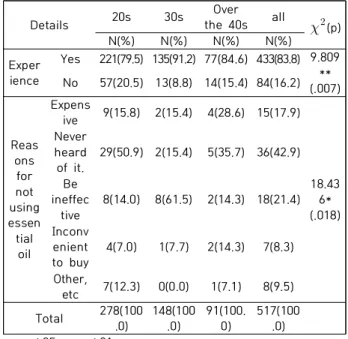
연령에 따른 에센셜오일 사용경험의 차이를 살펴본 결 과는 Table 3과 같다. 분석결과 에센셜오일 사용경험, 사 용하지 않은 이유 모두 유의미한 차이를 보였다. 에센셜오 일 사용경험에 대해 20대는 사용경험이 있다가 79.5%로 높았고, 사용경험이 없다가 20.5%로 나타났으나, 30대와 40대 이상은 사용경험이 있는 자가 각각 84.6%, 91.2%로 더 높게 나타났다( =9.809, p<.01). 에센셜오일을 사용 하지 않은 이유에서 20대 여성들은 에센셜오일을 잘 몰라 서가 50.9%이었고, 30대 여성들은 효과가 없을 것 같아서 가 61.5%로 가장 높게 나타났다( =18.436, p<.05).

선행연구에서 함희진은[13] 20대~50대 여성들을 대상으 로 에센셜오일 사용경험 여부에서 26∼30세 여성이 89.2%, 36세 이상이 75.6%으로 모두 높게 나타난 결과는 중년여성보다 젊은 여성들이 인터넷을 통해 미용 관련 정 보를 접하는 경우가 높은 결과로 해석하고 있다. 에센셜 오일을 사용하지 않은 이유는 모든 연령에서 잘 몰라서가 59.5%로 가장 높게 나타나 본 연구 결과와 유사하였다.

이희정은[2] 아로마테라피를 이용해본 경험에 대해서 20대 89.8%, 30대는 88.1%, 40대이상은 99.2%로 모두 높게 나 타났다. 이러한 결과는 연령이 높아질수록 경제적인 안정 감은 물론 자기를 가꾸려는 노력과 건강을 추구하기 위해 서 아로마테라피를 더 많이 이용하는 것으로 사료된다 [37]. 또한 기혼여성들은 결혼생활과 사회생활에서 오는 스트레스 해소를 아로마테라피를 통해 심신의 편안함을 추구한 결과로 해석할 수 있다. 이러한 결과는 20대 젊은 여성은 피부상태가 가장 좋은 시기이기 때문에 필요성이

낮고, 30대 여성은 비교적 안정된 수입과 자신의 이미지관 리가 높아지면서 피부 보호 제품 소비에 투자가 높아지면 서 에센셜오일에 대한 관심이 높아진것으로 보고하였다 [38]. 30~40대 여성들은 피부관리 경험과 미용 관련 정보 에 관심이 높아져서 아로마관련 제품에 대한 의욕이 강한 것으로 보고하였다[39].

Details 20s 30s Over

the 40s all

(p)

N(%) N(%) N(%) N(%)

Exper ience

Yes 221(79.5) 135(91.2) 77(84.6) 433(83.8) 9.809

**

(.007) No 57(20.5) 13(8.8) 14(15.4) 84(16.2)

Reas ons for not using essen tial

oil

Expens

ive 9(15.8) 2(15.4) 4(28.6) 15(17.9)

18.43 6*

(.018) Never

heard of it.

29(50.9) 2(15.4) 5(35.7) 36(42.9)

Be ineffec

tive

8(14.0) 8(61.5) 2(14.3) 18(21.4)

Inconv enient

to buy 4(7.0) 1(7.7) 2(14.3) 7(8.3) Other,

etc 7(12.3) 0(0.0) 1(7.1) 8(9.5) Total 278(100

.0)

148(100 .0)

91(100.

0)

517(100 .0)

* p<.05, ** p<.01

Table 3. The difference in experience in the use of essential oils according to age

2) The difference in usage of essential oils according to age

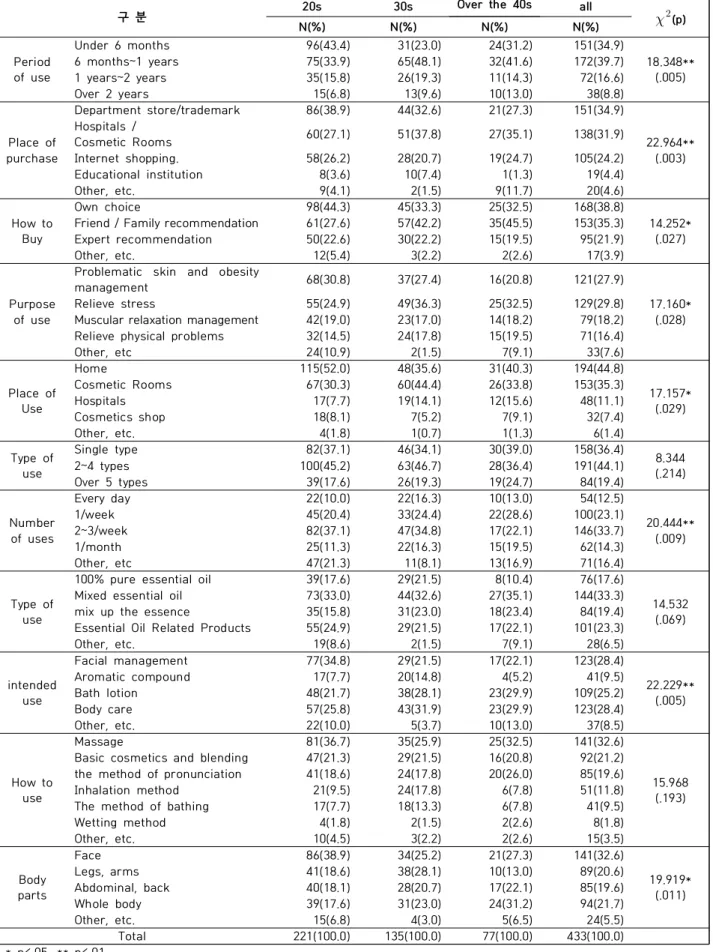
연령에 따른 에센셜오일 사용실태의 차이를 살펴본 결 과는 Table 4와 같다. 분석결과 에센셜오일 사용기간, 구 입장소, 구매방식, 사용목적, 사용장소, 사용횟수, 사용용 도, 사용부위의 차이는 유의미하게 나타났다. 에센셜오일 이용기간은 40대 이상과 30대 여성들은 ‘6개월∼1년 미 만’이 41.6%, 48.1%,로 높게 나타났고, 20대 여성들은 ‘6 개월 미만’이 43.4%로 가장 높게 나타났다( =18.348, p<.01). 구매장소로 40대 이상과 30대 여성들은 ‘병원/피 부관리실’이 35.1%, 37.8%로 가장 높았으며, 20대는 ‘문 샵점’이 38.9%로 가장 높게 나타났다( =22.964, p<.01).

구입방식으로 40대 이상과 30대 여성들은 ‘친구/가족 추 천’이 각각 45.5%, 42.2%로 가장 높았으며, 20대 여성들 은 ‘나에게 맞는 것’이 44.3%로 가장 높게 나타났다(

=14.252, p<.05), 사용목적으로 20대 여성들은 ‘문제성 피

부및 비만관리’이 30.8%, 40대 이상과 30대 여성들은 ‘스

트레스 완화’가 32.5%, 36.3%로 가장 높았다( =17.160,

(6)

구 분 20s 30s Over the 40s all

(p)

N(%) N(%) N(%) N(%)

Period of use

Under 6 months 96(43.4) 31(23.0) 24(31.2) 151(34.9)

18.348**

(.005)

6 months~1 years 75(33.9) 65(48.1) 32(41.6) 172(39.7)

1 years~2 years 35(15.8) 26(19.3) 11(14.3) 72(16.6)

Over 2 years 15(6.8) 13(9.6) 10(13.0) 38(8.8)

Place of purchase

Department store/trademark 86(38.9) 44(32.6) 21(27.3) 151(34.9)

22.964**

(.003) Hospitals /

Cosmetic Rooms 60(27.1) 51(37.8) 27(35.1) 138(31.9)

Internet shopping. 58(26.2) 28(20.7) 19(24.7) 105(24.2)

Educational institution 8(3.6) 10(7.4) 1(1.3) 19(4.4)

Other, etc. 9(4.1) 2(1.5) 9(11.7) 20(4.6)

How to Buy

Own choice 98(44.3) 45(33.3) 25(32.5) 168(38.8)

14.252*

(.027) Friend / Family recommendation 61(27.6) 57(42.2) 35(45.5) 153(35.3)

Expert recommendation 50(22.6) 30(22.2) 15(19.5) 95(21.9)

Other, etc. 12(5.4) 3(2.2) 2(2.6) 17(3.9)

Purpose of use

Problematic skin and obesity

management 68(30.8) 37(27.4) 16(20.8) 121(27.9)

17.160*

(.028)

Relieve stress 55(24.9) 49(36.3) 25(32.5) 129(29.8)

Muscular relaxation management 42(19.0) 23(17.0) 14(18.2) 79(18.2)

Relieve physical problems 32(14.5) 24(17.8) 15(19.5) 71(16.4)

Other, etc 24(10.9) 2(1.5) 7(9.1) 33(7.6)

Place of Use

Home 115(52.0) 48(35.6) 31(40.3) 194(44.8)

17.157*

(.029)

Cosmetic Rooms 67(30.3) 60(44.4) 26(33.8) 153(35.3)

Hospitals 17(7.7) 19(14.1) 12(15.6) 48(11.1)

Cosmetics shop 18(8.1) 7(5.2) 7(9.1) 32(7.4)

Other, etc. 4(1.8) 1(0.7) 1(1.3) 6(1.4)

Type of use

Single type 82(37.1) 46(34.1) 30(39.0) 158(36.4) 8.344

(.214)

2~4 types 100(45.2) 63(46.7) 28(36.4) 191(44.1)

Over 5 types 39(17.6) 26(19.3) 19(24.7) 84(19.4)

Number of uses

Every day 22(10.0) 22(16.3) 10(13.0) 54(12.5)

20.444**

(.009)

1/week 45(20.4) 33(24.4) 22(28.6) 100(23.1)

2~3/week 82(37.1) 47(34.8) 17(22.1) 146(33.7)

1/month 25(11.3) 22(16.3) 15(19.5) 62(14.3)

Other, etc 47(21.3) 11(8.1) 13(16.9) 71(16.4)

Type of use

100% pure essential oil 39(17.6) 29(21.5) 8(10.4) 76(17.6)

14.532 (.069)

Mixed essential oil 73(33.0) 44(32.6) 27(35.1) 144(33.3)

mix up the essence 35(15.8) 31(23.0) 18(23.4) 84(19.4)

Essential Oil Related Products 55(24.9) 29(21.5) 17(22.1) 101(23.3)

Other, etc. 19(8.6) 2(1.5) 7(9.1) 28(6.5)

intended use

Facial management 77(34.8) 29(21.5) 17(22.1) 123(28.4)

22.229**

(.005)

Aromatic compound 17(7.7) 20(14.8) 4(5.2) 41(9.5)

Bath lotion 48(21.7) 38(28.1) 23(29.9) 109(25.2)

Body care 57(25.8) 43(31.9) 23(29.9) 123(28.4)

Other, etc. 22(10.0) 5(3.7) 10(13.0) 37(8.5)

How to use

Massage 81(36.7) 35(25.9) 25(32.5) 141(32.6)

15.968 (.193) Basic cosmetics and blending 47(21.3) 29(21.5) 16(20.8) 92(21.2)

the method of pronunciation 41(18.6) 24(17.8) 20(26.0) 85(19.6)

Inhalation method 21(9.5) 24(17.8) 6(7.8) 51(11.8)

The method of bathing 17(7.7) 18(13.3) 6(7.8) 41(9.5)

Wetting method 4(1.8) 2(1.5) 2(2.6) 8(1.8)

Other, etc. 10(4.5) 3(2.2) 2(2.6) 15(3.5)

Body parts

Face 86(38.9) 34(25.2) 21(27.3) 141(32.6)

19.919*

(.011)

Legs, arms 41(18.6) 38(28.1) 10(13.0) 89(20.6)

Abdominal, back 40(18.1) 28(20.7) 17(22.1) 85(19.6)

Whole body 39(17.6) 31(23.0) 24(31.2) 94(21.7)

Other, etc. 15(6.8) 4(3.0) 5(6.5) 24(5.5)

Total 221(100.0) 135(100.0) 77(100.0) 433(100.0)

* p<.05, ** p<.01

Table 4. The difference in usage of essential oils according to age

(7)

p<.05). 사용장소는 30대 여성들은 ‘피부관리실’이 44.4%

로 가장 높았고, 40대 이상과 20대 여성들은 ‘집’이 각각 40.3%, 52.0%로 가장 높았다( =17.157, p<.05). 사용횟 수로 40대 이상 여성들은 ‘주 1회’가 28.6%로 가장 높았 으나, 30대와 20대 여성들은 ‘주 2∼3회’가 34.8%, 37.1%

로 가장 높았다( =20.444, p<.01).

사용용도로 40대 이상 여성들은 ‘바디관리’과 ‘목욕용 품’가 각각 29.9%로 가장 높았으면 30대 여성들은 ‘바디 관리’가 31.9%, 20대 여성들은 ‘얼굴관리’가 34.8%로 가 장 높게 나타났다( =22.229, p<.01). 사용부위는 30대여 성은 ‘다리,팔 ’은28.1%, 20대 여성은 ‘얼굴’이 38.9%, 40 대 이상 여성은 ‘전신’이 31.2%로 가장 높게 나타났다(

=19.919, p<.05).

에센셜오일의 사용실태 선행연구에서 사용목적은 30대 여성은 스트레스 완화, 20대여성은 문제성 피부 및 비만관 리를 위한 것으로 조사되었다[12]. 이는 젊은 여성들이 피 부문제 및 외모관심이 높고, 연령이 높은 여성들은 릴렉스 와 심신완화 때문인 것으로 보고한 이론적 배경을 지지하 고 있다[40]. 에센셜오일 사용횟수에서 20대 여성은 주 2

∼3회(38.8%) 사용하였고[11], 구입방식은 20대 여성은 69.5%가 본인이 직접 인터넷을 통한 구매가 높았고[11], 연령이 많은 여성일수록 전문가의 추천에 의해 구매가 높 게 나타나[33] 본 연구 결과와는 상이하였다. 이는 한국여 성이 중국여성보다 아로마에 대한 지식과 사용 경험이 더 많다는 연구결과를 뒷받침하고 있다.

그리고 20대의 경우 TV, 인터넷 등의 매스미디어에서 아로마 관련 특징과 정보를 습득하고, 30대 이상 여성들은 자기 능동적보다 전문가의 지식과 추천을 더 신뢰하기 때 문인 것으로 보고하였다[40]. 에센셜오일 전문점에서 구입 하는 것은 에센셜오일의 품질이나 용도를 고려하여 직접 구입하기 때문에 신뢰성이 높다고 보고한 결과를 뒷받침 하고 있다[15]. 그러나 선행연구에서 이희정은[2] 20대, 30 대, 40대 모든 연령에서 인터넷쇼핑몰에서 구입한다는 응 답이 높게 나타났다. 이와 같은 결과에서 2008년보다 2014년은 매스미디어의 발달이 중년층에까지 구매방식에 영향을 미치고 있음을 알 수 있다. 그리고 30~40대 이상 여성들이 피부관리실을 많이 이용하고, 아로마테라피 관련 정보를 많이 접하기 때문에 아로마의 효능을 잘 알고 있 다. 소비자들은 자신이 알고 관심 있는 일에 시간과 돈을 쓰는 경향이 높다[39]. 따라서 에센셜오일에 대한 관심도 와 이해도가 높을수록 구매를 시도하려는 의지가 높을 것 으로 해석할 수 있다.

IV. Conclusions

본 연구는 중국 절강성에 거주하는 20대에서 50대 여성 들을 대상으로 2019년 7월 5일부터 8월30일까지 연령에 따른 에센셜오일에 대한 지식정도, 만족도, 사용경험, 사 용실태를 조사분석한 결과 다음과 같은 결론을 얻었다.

조사대상자의 특성은 연령은 20대가 52.8%, 학력은 대학 교(학사)가 37.4%, 에센셜오일 인지정도는 들어본적있음 83.8%로 가장 많았다. 연령에 따른 에센셜오일 지식정도와 만족도는 모두 보통으로 나타났다. 연령에 따른 사용경험은 모든 연령층에서 83.8%로 높게 나타났으나, 40대 이상 (84.6%)이 20대(79.55%)보다 사용경험이 더 높은 것으로 유의미한 차이가 있었다. 그 외 사용하지 않은 이유는 30대 는 효과가 없을 것 같아서 61.5%로 응답하였고, 20대 ((50.9%)와 40대 이상(35.7%)은 모두 잘몰라서 응답이 가장 높은 것으로 유의미하게 나타났다. 연령에 따른 사용실태는 사용기간, 구입장소, 구매방식, 사용목적, 사용장소, 사용횟 수, 사용용도, 사용부위의 차이가 유의미하게 나타났다.

이상과 같이 중국여성들의 일상생활에서 에센셜오일을 다양하게 응용하고 있음을 알 수 있었고, 연령에 따라 에 센셜오일의 인지도, 지식정도, 사용실태에 관계가 있음을 확인하였다. 따라서 중국여성들이 에센셜오일 제품의 관심 이 점차 높아지고 있음으로 연령층의 선호도를 고려하여 제품 개발과 마케팅 전략을 위해 기초적 자료로 제공하고 자 한다.

REFERENCES

[1] S. J. Jo. A Study on the Recognition and the Use Realities of Aroma Essential oil. Sookmyung Women's University school of Distance Learning Master's thesis. Dec. 2014

[2] H. J. Lee. A Study on Awareness and Use of Aromatherapy.

Sookmyung Women's University school of Distance Learning Master's thesis. Jun. 2014

[3] F. Q. Li.. Bacteriostatic evaluation and application of plant essential oil. Nanjing Normal University School of Pharmaceutical Engineering Master's thesis. Apr. 2014. DOI:10.7666/d.Y26258 18

[4] E. S. kim. Research Study on the Preference, Use and Satisfaction of Aroma Perfume among Adolescents. KonKuk University School of Beauty Design Master's thesis. Feb. 2000

[5] Y. J. Jang. A Study on Aromatherapy Awareness and

Aromatherapy Types by Life Style. Changwon National

University school of Public Health Master's thesis. Jul. 2018

(8)

[6] Y. M. Wei., Y. Hong., Y. M. Fei,. M. G. Lin., G H Yang., and S. G. Wang. Discussion of Aromatherapy. ACTA CHINESE MEDICINE, No.1, pp.140-142. Jan. 2015. DOI: 10.16368/j.issn.

1674-8999.2015.01.047

[7] W. J. Kim., and M. H. Hur. Inhalation Effects of Aroma Essential Oil on Quality of Sleep for Shift Nurses after Night Work. Journal of Korean Academy of Nursing Vol.46, No.6, pp.769-779, Jun.

2016. DOI: http://dx.doi.org/10.4040/jkan. 2016.46.6.769 [8] Y. S. Yoo., and M. S. Na. Inhibitory Effect on Acne Using

Anti-Bacteria of Lavender Essential Oil in Adolescents. Korean Journal of Aesthetics and Cosmetology, Vol.8, No.4, pp.1-12.

Nov. 2010

[9] S. Y. Lin. Development status and prospect of aromatherapy industry. Management Observer, No.32, pp.188-189. No.32 2011.

DOI:10.3969/j.issn.1674-2877.2011.32.130

[10] J. Q. MEI. Establishment and Consideration for Aromatherapy Regulation in China. FLAVOUR FRAGRANCE COSMETICS, No.6, pp.52-55. Dec. 2008. DOI: 10.3969/j.issn.1000-4475.200 8.06.018

[11] Mi-Ok KiM. A study on the recognition of aroma oil among common consumers and the usability. Graduate Yong-in University School of Business Administration Master's [12] E. J. Jung. A Study on the Utilization and Effect of Essential

Oil. Sookmyung Women' s University School of Distance Learning Master's thesis. Jun. 2011

[13] H. J. Ham. The Study on Aroma Essential Use and Scent Preference. Han Sung University School of Education Master's thesis. Feb. 2015

[14] J. M. Park. A study on the Aroma Essential Oils Use and Preferences. Sungshin Women's University school of cultural Industry Master's thesis. Nov. 2011

[15] M. K. Kim., S. R. Lee., and Y. H. Lee. Satisfaction and Utilization of the Aromatherapy. J. Int Soc. Heal Beau, VOl.5, NO.1, May.

2011, pp.5-16. ISSN: 2005-369X(Print) 2765-1347(Online) [16] S. Y. Lee. The Effect of Half-Bath with Aroma Oil on Changes

of Physical and Mental Stress. Chung-Ang University school of Food and Drug Administration Master's thesis. Dec. 2008 [17] Lee, Yujin. The Inhalation Effects of Aroma Essential Oil on

Stress, Sleep Quality and Immunity of Shift work Nurses: A Parallel group Randomized Controlled Trial. Eulji University school of Nursing Master's thesis. Feb. 2018

[18] D. Y. Chen. Effect of massage and essential oil on breast tenderness. Chinese and Foreign Medical Research, Vol. 10, No.

32, pp.149, Nov. 2012. DOI: 10.14033/j.cnki.cfmr.2012.32.027 [19] Y. Liu., Y. Qiao., L. Li., and Y. L. Zhang. Clinical Study On

The Treatment Of Depression With Aromatherapy And Moxibustion. J Practical Chinese Medicine, Vol.25, No.4, pp.213-214, Apr. 2009, No: 1004-2814(2009), 04–213-02 [20] H. Li., L. Lin., Y. Z. Li., M. Xiong., and P. Tang. Effect of

Aromathrapy in Improving Elderly's Sleep Quality. Journal Of Chendu Medical College, Vol.11, No.1, pp.112-115, Mar. 2016.

DOI: 10.3969/j. issn.1674-2257. 2016.01.027

[21] R. W. Ji. Clinical application of Traditional Chinese medicine aromatherapy in insomnia patients. World Latest Medicne Information (Electronic Version), Vo1.18, No.02, pp.132-134, Feb. 2018. DOI: 10.19613/j.cnki.1671-3141. 2018. 02.106 [22] X. L. Zhang., G. R. Wang,. L. Yang., Y. Y. Zheng., and Y.

Y. Xu. Meta-analysis of the Efficacy of Aromatherapy in Improving Sleep Disorders. Medical Information, Vol.33, No.24, pp.63-66.

Nov. 2020. DOI: 10.3969/j.issn.1006-1959.2020.24.018 [23] C. Dong., L. Ma., S. N. Liu., X. Zhang., A. Sun., H. Y. Chen.,

W. Wang., and P. Gu. Effectiveness of aromatherapy for somatopathy comorbided insomnia:a meta-analysis of randomized controlled trials. Clinical Focus, Vol.31, No.12, pp.1357-1361.Dec. 2016 DOI: 10.3969/j.issn. 1004-583X.2016.

12.020

[24] Y. Y. Z. Wang., X. Q. Liu., Z. G. Zhang., C. Y. Zhang., X.

J. Pu., C. Y. Kou., W. J. Li., Y. P. Lei., L. P. Yang., and J.

H. Tian. The effect of inhaled aromatherapy for perspirative anxiety: a Meta analysis. Chinese Nursing Management, Vol.16, No.12, pp.1643-1648. Dec. 2016. DOI: 10.3969/ j.issn.1672-17 56.2016.12.013

[25] X. J. Peng., Z. Q. Jiang, Z. M. Chen., and H. H. Ou. Application of tea tree oil in nursing of patients with severe incontinent dermatitis. China Medicine and Pharmacy, Vol.10, No.9, pp.104-106. May. 2020

[26] J. J. Chen., and J. J. Wang. Research status of plant essential oil in anti-aging care of female skin. CHINESE GENERAL PRACTICE NURSING., Vol.11, No.35, pp.3350-3351. Dec.

2013. DOI: 10.3969/j.issn.1674-4748.2013.35.060

[27] M. H. Jing. Research progress on the mechanism of lavender essential oil on skin photoaging. Journal of Luzhou Medical College. Vol.40, No.1, pp.94-96. Jan. 2017. DOI: 10.3969/j.issn.

1000-2669.2017.01.027

[28] J. C. Sun., Y. Huang., N. Wang., Z. Ding., H. K. Gao., and H. Zhang. Heng. Biological Activity Analysis and Skin Care Effect of Peach Blossom Essential Oil. Journal of Capital Normal University (Natural Sciences Edition), Vol.41, No.6, pp.36-40.

Dec. 2020. DOI: 10.19789/j.1004-9398.2020.06.007

[29] R. Li, N. Zhang., L. Yao., and Y. H. Li. Study on the hair growth promotion effect of lavender essential oil and Asian mint essential oil. China Surfactant Detergent & Cosmetics. Vol.50, No.8, pp.536-541. Aug. 2020. DOI: 10.3969/j.issn.1001-1803.2020.08.

005

[30] J. S. kim. The research on perception and Aroma preference with the essential oils. Chung-Ang University School of With direction rose crane Master's thesis. Jun. 2007

[31] K. J. Cheong. A Study on the Effects of Aroma Essential Blending

(9)

Oils on Atopy Dermatitis. Sookmyung Women's University school of Distance Learning Master's thesis. Dec. 2009.

[32] Y. S. Lee. The effects of the Aroma added product for usage and awareness of satisfaction. Hansung University school of Arts Master's thesis. Dec. 2012.

[33] Y. M. Kim. A Study on Application and Satisfaction with the Use of Aroma Product. Sookmyung Women's University school of Distance Learning Master's thesis. Dec. 2008.

[34] L. P. Feng. Research on Marketing Strategy of Aromatic Physiotherapy in AR Living Store. NanjingNormalUniversity School of Master of Business Administration Master's thesis.

pp.15-33, Dec. 2014. DOI: 10.7666/d.Y2910494.

[35] H. Shen. Essential oils for aromatherapy. Detergent & Cosmetics, Vol.34, No.9, pp.42-46. Sep. 2011. DOI: 10.3969/j.issn.1006-7 264.2011.09.012

[36] H. T. Tian. D COMPANY ENSSENTIAL OIL PRODUCT MARKETING STRATEGY OPTIMIZATION RESEARCH.

Shanghai International Studies University School of Master of Business Administration Master's thesis. pp.2-33, jul. 2020.

[37] K. S. Park. A Study on the Recognition and Actual Conditions of Aromatherapy focusing on female college students in Beauty-Related Dept. Shinsung University school of Beauty Art.

Korean Journal of Aesthetics and Cosmetology, Vol.7, No.3, pp.225-238. Aug. 2009. DOI: http://www.riss.kr/ link?id=A1042 30516

[38] Q. Huang. STUDY ON THE CONSUMPTION BEHAVIOR OF FEMALE SKIN CARE PRODUCTS AND ITS INFLUENCING FACTORS——TAKE THE ESSENTIAL OIL AS AN EXAMPLE. Zhongyuan University of Technology School of MBA Master's thesis. May. 2016. DOI: 10.7666/d.D01035863 [39] S. Y. Lin., W. T. Xie., W. He., H. J. Liu., Z. Y. Zhang., and

S. Huang. The investigation of the cognition and willingness of the public on aromatherapy in city Changsha. Time Report, No.3, pp.178-181. Mar. 2012

[40] M. K. Park., and W. K. Yoo. A Study on the Utilization Pattern and Consciousness of Aroma Therapy. Journal of the Korean Society of Fashion& Beauty, Vol.2, No.2, pp.81-92. Oct. 2004.

ISSN : 1738-0480(Print)

Authors

Qiaomeng Ying Ph. D. course in the Department of Beauty Science, Kwangju Women's University.

Kyeong-Ran Kim Ph. D. in skin cosmetology, Wonkwang University in 2010.

Professor in the Department of Beauty Science, Kwangju Women's University.

Policy adviser of the Grwangju Future

Industry Promotion Committee and the TFT Committee of

Gwangju Metropolitan City in 2004. Interested in the

wellness beauty industry.

수치

Table  3.  The  difference  in  experience  in  the  use  of  essential  oils  according  to  age
Table  4.  The  difference  in  usage  of  essential  oils  according  to  age

참조

관련 문서

Changes in the composition and structure of Mediterranean rokey-shore communities following a gradient of nutrient enrichment: Descriptive study and test

this study analysed cast speed and solidification in thermal and flow perspectives and based on the results, conducted a confidence test on the high-speed general purpose

This study the changes in structure and mechanical characteristics by the analysis on mechanical characteristics of the welding part and the post weld

First, the general characteristics of the two groups were analyzed by frequency analysis and correlation analysis, which is technical statistics, and the

In the analysis of the dose constraint of nuclear medical radiation workers using chi-square test statistics, the dose constraint at (the time of) the highest

This study makes use of statistical method in estimating the spread of oil supply disruption, which will be the starting point of analysis on oil

The Effects of Inhaling Rosa Rugosa Aroma Essential Oil on Brain Function Quotient by EEG Analysis

The purpose of the achievement standard in the Chinese letters area was more focused on understanding and appreciation of the actual work than on the form