• 검색 결과가 없습니다.

Prediction of Planning Time in Busan Ports-Connected Expressways

N/A
N/A
Protected

Academic year: 2021

Share "Prediction of Planning Time in Busan Ports-Connected Expressways"

Copied!
6
0
0

로드 중.... (전체 텍스트 보기)

전체 글

(1)

DOI : http://dx.doi.org/10.5394/KINPR.2015.40.2.51

†Corresponding Author : [email protected] 051)410-4462

Prediction of Planning Time in Busan Ports-Connected Expressways

†Tae-Gon Kim

* Department of Civil Engineering, Korea Maritime and Ocean University, Busan 49112, Korea

Abstract : Expressways mean the primary arterial highways with a high level of efficiency and safety. However, Gyeongbu and Namhae expressways connected with Busan ports are showing travel time delay by increased traffic including the medium/large-sized vehicles of about 20% compared to those of about 13% regardless of the peak periods. This study, thus, intends to analyze lane traffic characteristics in the basic 8-lane segments of the above-mentioned expressways, compute the planning and buffer times based on travel time reliability, find the lane speed showing a higher correlation with planning time between the lane speeds in the basic 8-lane segments, and finally suggest a correlation model for predicting the planning time in expressways.

Key words : Expressways, Traffic characteristics, Space mean speed, Travel time reliability, Correlation analysis, Correlation model

1. Introduction

1.1 Background

Expressways mean the high-speed arterial highways with a high level of efficiency and safety. However, most of expressways don't play their roles by the high rate of the medium/large-sized vehicles of about 13% and increased traffic. In addition it is not easy to continue to build new expressways because of limited budget and time. So, it is absolutely needed to improve the mobility and efficiency of existing expressways instead of constructing new ones.

1.2 Objectives

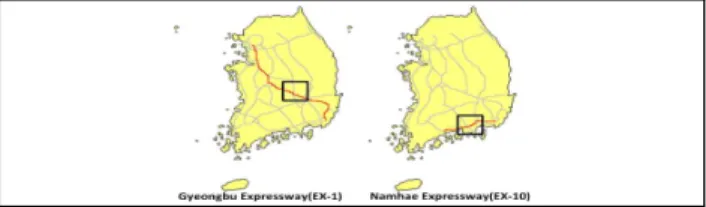
Study expressways as shown in Fig. 1 are showing travel delay by the higher rate of the medium/large-sized vehicles of about 20%. In the studies of travel time and speed, detector speed was reported to show the higher reliability in travel time estimation/prediction of expressways at a speed of over 70km/h(Oh et al., 2003), and average speed was reported to have the higher correlation with the speed on lane 2 than on lanes 3 and 4 in urban freeway(Kim and Jeong, 2012). So, this study is to investigate the lane traffic characteristics in the 8-lane expressways, identify the lane speed characteristics highly correlated with travel time reliability, and suggest the better correlation models for predicting planning time in the 8-lane expressways.

1.3 Data Collection

Study segments were selected from the basic 8-lane ones, as described in Table 1. So, data collection was repeatedly conducted from Jun. 16, 2014 to Jul. 6, 2014, and a master dataset for analysis was generated every 15 minutes in the basic 8-lane segments(i.e., lane 1 for passing vehicles, lane 2 for small-sized ones, lane 3 for medium-sized ones and lane 4 for large-sized ones for each direction).

Fig. 1 Expressways under the study

Item Gyeongbu(EX-1) Namhae(EX-10) Total Segment Total Segment Length(km) 416.0 4×15 273.1 4×15 No. of lanes 4 to 10 8 4 to 8 8 Rate of Medium/

Large Vehicles(%) 18.7 21.3

Table 1 Geometry of expressways under the study

2. Analysis of traffic characteristics

2.1 Flow

Flow was expressed by an hourly flow, as follows(TRB, 1975);

 

(1)

Where,

: Flow(veh/h)

(2)

: No. of vehicles observed at station(veh)

: Observed time(1hour)

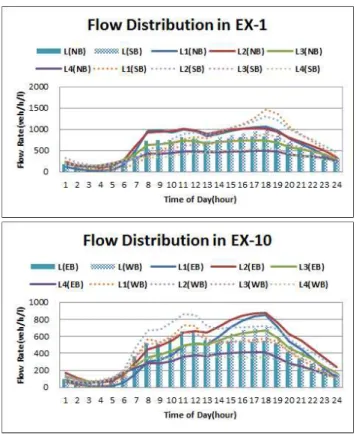
Fig. 2 Flow distribution in expressways under the study

Expressways Mean SD Mean SD Mean SD Mean SD L1 L2 L3 L4 L EX-1 NB 630 390 680 350 510 230 370 130 550

SB 650 430 710 380 530 240 400 150 570 EX-10 EB 380 280 480 280 370 200 260 130 370 WB 370 240 500 270 380 200 250 120 380 Note: L1 is lane 1, L2 is lane 2, L3 is lane 3, L4 is lane 4,

L is lane mean, NB is northbound, SB is southbound, EB is eastbound, WB is westbound, SD is standard deviation

Table 2 Flow statistics in expressways(veh/h/l)

There seemed to be a distinct difference in flow rate between the directions as well as the lanes for each expressway as shown in Fig. 2. Also, average flow rate appeared to increase by about 9% to 27% in lanes 1 and 2 showing a higher deviation, but to decrease by about 4%

to 31% in lanes 3 and 4 showing a lower deviation as summarized in Table 2.

2.2 Speed

Speed was converted into the space mean speed, as follows(May, 1990);

 

   

 

   

(2)

Where,

: Space mean speed in segment(km/h)

: No. of stations in segment

: No. of vehicles observed at station (veh)

: Spot mean speed at station (km/h)

Fig. 3 Speed distribution in expressways under the study

Expressways Mean SD Mean SD Mean SD Mean SD L1 L2 L3 L4 L EX-1 NB 119 4 104 3 92 3 81 3 100

SB 119 5 104 2 91 2 80 2 99

EX-10 EB 117 3 104 2 95 3 84 3 100

WB 114 2 104 1 94 3 83 2 99

Table 3 Speed statistics in expressways(km/h)

There did not seem to be a significant difference in speed

between the directions but there was a distinct difference

between the lane speeds for each expressway as shown in

Fig. 3. Also, average speed appeared to decrease by about

6% to 17% in lanes 3 and 4 showing about 2.5km/h

deviation, but to increase by about 5% to 18% in lanes 1

and 2 showing a higher deviation as summarized in Table

3.

(3)

2.3 Density

Density was estimated by the reciprocal of the distance headway, as follows(May, 1990);

 

   



 × 

(3)

Where,   : Distance headway of each vehicle (m)

: Density(veh/km)

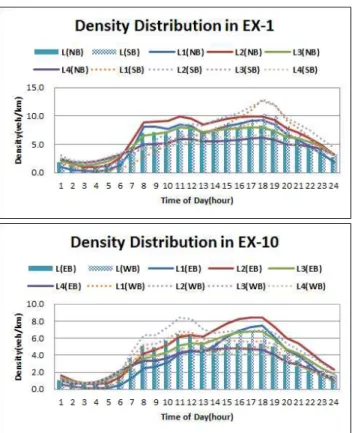
Fig. 4 Density distribution in expressways under the study

Expressways Mean SD Mean SD Mean SD Mean SD L1 L2 L3 L4 L

EX-1 NB 5 3 7 3 5 2 4 1 6

SB 6 4 7 4 6 3 5 2 6

EX-10 EB 3 2 5 3 4 2 3 1 4

WB 3 2 5 3 4 2 3 1 4

Table 4 Density statistics in expressways(veh/km)

There seemed to be a distinct difference in density between the directions as well as the lanes for each expressway as shown in Fig. 4. Also, average density appeared to decrease by about 8% to 18% in lanes 1 and 4 showing about 2.3veh/km deviation, but to increase by about 3% to 23% in lanes 2 and 3 showing about 2.7veh/km deviation as summarized in Table 4.

2.4 Travel Time Reliability

Travel time reliability was estimated by the planning time (  ) and buffer time(  ), as follows(SHRP2, 2013);

  ×

   ×  (4)

  ×

     ×  ×  i f 

  

(5)

Where,  : Planning time(sec)

: Regulatory speed(100km/h)

 : Length of segment(15km)

 : 95th percentile speed(km/h)

: Buffer time(sec)

Fig. 5 Travel time distribution in expressways

There did not seem to be a significant difference in travel

time reliability(  and ) between the directions but

there was a distinct difference between the actual travel

times(  ) as shown in Fig. 5. Also, average planning and

(4)

buffer times in EX-1 appeared to increase by about 10sec and about 7sec, respectively when compared to EX-10 as summarized in Table 5. As a result, there was a need to review the correlation analysis between lane speed characteristics and travel time reliability, an inverse proportion to speed in expressways described in the above.

Reliability EX-1(NB) EX-1(SB) EX-10(EB) EX-10(WB)

606 613 600 600

65 69 64 57

Table 5 Travel time reliability in expressways(sec)

3. Correlation Analysis of   and

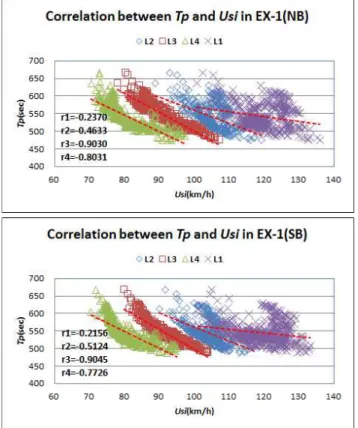
3.1 Correlation Analysis of     in EX-1 Lane speed(   ) and planning time(  ) in EX-1 appeared to have the negative linear relationship regardless of the direction as shown in Fig. 6.

Fig. 6 Correlation of     in EX-1

In particular there seemed to have the lowest correlation coefficients(r1) of -0.2370 and -0.2156 in lane 1, but the

highest ones(r3) of -0.9030 and -0.9045 in lane 3 for the NB and SB directions in EX-1, respectively as summarized in Table 6.

3.2 Correlation Analysis of   in EX-10 Lane speed(   ) and planning time(  ) in EX-10(EB) also appeared to have the negative linear relationship regardless of the direction as shown in Fig. 7.

Fig. 7 Correlation of     in EX-10

Expressways L1 L2 L3 L4

EX-1 NB -0.2370 -0.4633 -0.9030 -0.8031 SB -0.2156 -0.5124 -0.9045 -0.7726 EX-10 EB -0.3542 -0.5364 -0.9480 -0.7694 WB -0.5357 -0.5802 -0.9550 -0.8268 Table 6 Correlation analysis in expressways

In particular there seemed to have the lowest correlation

coefficients(r1) of -0.3542 and -0.5357 in lane 1, but the

highest ones(r3) of -0.9480 and -0.9550 in lane 3 for the

EB and WB directions in EX-10, respectively as

summarized in Table 6. As a result, there was a need to

consider the correlation model between the speed(   ) in

lane 3 and planning time(  ), because there showed the

(5)

highest correlation coefficient(r3) regardless of the direction in expressways.

4. Model Development and Verification

4.1 Model Development

Independent variable

 : space mean speed by lane (i=1, 2, 3, 4) Dependent variable

: planning time in the basic 8-lane segment Fig. 8 Sketch of segment and variables used

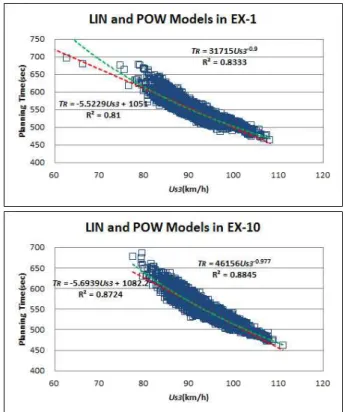
With the speed(   ) on lane 3 in the basic 8-lane segments selected as an independent variable and the planning time(  ) selected as the dependent one as shown in Fig. 8, the correlation models(      ) were suggested as follows;

LIN :      ×   (6) POW :    ×  

(7) Where,  : Planning time(sec)

 : Space mean speed on lane 3(km/h)

: Coefficients of function(

=0, 1)

Expressways Models

EX-1

LIN      ×  

0.8100 F-sig. 0.000 POW    ×    

0.8333 F-sig. 0.000

EX-10

LIN      ×  

0.8724 F-sig. 0.000 POW    ×    

0.8845 F-sig. 0.000 Note: LIN is linear model, POW is power model Table 7 Results of regression analysis

A regression analysis was used to build the correlation models for predicting the planning time with the high explained variation of  >0.81 as summarized in Table

7 and shown in Fig. 9. So, the most appropriate correlation models appeared to be the linear and power models in explanatory powers(  ) greater than 81% by the speed on lane 3 as summarized in Table 7.

Fig. 9 Development of correlation models

4.2 Model Verification

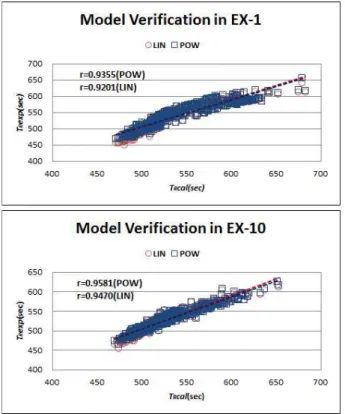
There were two approaches applied to ensure the validity of the models constructed. One approach was to conduct the paired t-tests between the observed and expected planning times, whether the p-values were greater than the significance level (/2=0.025) or not at the 95% confidence level.

Expressways/

Model Correlation

Coefficient(r) t-value p-value Result EX-1 LIN 0.9201 1.094 0.409 Accept

POW 0.9355 -1.569 0.117 Accept EX-10 LIN 0.9470 -1.405 0.160 Accept POW 0.9581 -2.015 0.274 Accept Table 8 Results of t-Test and correlation analysis

In the paired t-tests, the computed values of t statistic

appeared to fall inside the acceptance regions with the

probabilities of 0.409 in the LIN and 0.117 in the POW

(6)

of EX-1, and those of 0.160 in the LIN and 0.274 in the POW of EX-10, as summarized in Table 8.

Other approach was to test the utility of the correlation models with traffic data unused. The test results() were shown to be 0.9201(LIN) and 0.9355(POW) in EX-1, and 0.9470(LIN) and 0.9581 (POW) in EX-10, as shown in Fig. 10. So, the power model proved to be more effective in predicting planning time in the 8-lane expressways.

Fig. 10 Verification of correlation models

4.3 Model Evaluation

Root mean square error(RMSE) statistics were applied to evaluate the measures of effectiveness(MOE) between the linear and power models by comparing the planning times. Particularly, there was a little less difference in the RMSE values of the power model than in those of the linear one, as summarized in Table 9.

Model

Expressway LIN POW

EX-1 16 14

EX-10 10 9

Table 9 Results of RMSE analysis(sec)

So, the power model proved to have a little higher predictability than the linear one in the 8-lane expressways.

5. Conclusions

From the analyses and model development of the lane traffic characteristics in the Busan Ports-connected expressways, the following conclusions were drawn;

1) Planning time showed the highest correlation with the speed of lane 3, medium-sized vehicle lane in the 8-lane expressways.

2) Power model proved a higher explanatory power and validity in predicting the planning time in the 8-lane expressways.

It was concluded that this study needed to be continued concerning the various geometric characteristics of expressways for the purpose of proving the reliability of the correlation model.

References

[1] Kim, T. G. and Jeong, Y. W.(2012), “Prediction of Speed in Urban Freeway Having More Freight Vehicles", Journal of Navigation and Port Research, Vol. 36, No. 7, pp. 591-597.

[2] May, A. D.(1990), “Traffic Flow Theory”, Prentice Hall, Englewood Cliffs, New Jersey 07632.

[3] Oh, S. C., Kim, M. H. and Baek, Y. H.(2003),

“Development of a Freeway Travel Time Estimating and Forecasting Model using Traffic Volume”, Journal of Korean Society of Transportation, Vol. 21, No. 5, pp. 83-95.

[4] SHRP2(2013), Evaluating Alternative Operations Strategies to Improve Travel Time Reliability, Strategic Highway Research Program, Report S2-L11-RR-1, Transportation Research Board.

[5] Transportation Research Board(1975), Traffic Flow Theory, A Monograph, Special Report 165, Revised Edition, Transportation Research Board, National Research Council, Washington, D. C.

Received 25 January 2016

Revised 22 April 2016

Accepted 25 April 2016

수치

Fig. 1 Expressways under the study
Fig. 2 Flow distribution in expressways under the study
Fig. 5 Travel time distribution in expressways
Fig. 7 Correlation of      in EX-10
+3

참조

관련 문서

This study connected his Christian point of salvation and dark recognition of reality in the times of Japanese colony to his childhood, which shows in

This study the changes in structure and mechanical characteristics by the analysis on mechanical characteristics of the welding part and the post weld

Based on the above results, the characteristics of the wrestling Greco-Roman style of athletes were statistically significant in terms of basic physical

Recommendations on trajectory selection in flight planning based on weather uncertainty, Proceedings of the 2017 WMO Aeronautical Meteorology Scientific

Second, the perception of exercise immersion based on the general characteristics of the study subjects (gender, grade, guidance period, participation time,

The purpose in this study is to investigate roadway and traffic characteristic data in the multi-lane freeway segments congested during the rush hours (06:30~07:30),

To reduce erroneous detection rate of the other lanes in the lane are detected by the pre- processing to extract the lane boundary line, and recognizes the lane

In addition, it is the purpose of this study to analyze social and historical background and the characteristics on the establishment of the varied