http://dx.doi.org/10.7585/kjps.2014.18.3.210 Open Access
210
은행잎과 외종피 유래 바이오농약 연구동향
한상빈*·김종헌
한국과학기술정보연구원 Reseat 프로그램
Research Trend of Biopesticides from Ginkgo biloba(L.) Leaves and External Seed Coat
Sang-Bin Han*, Jong-Heon Kim
ReSeat Program, Korea Institute of Science and Technology Information, 335 Gwahangno, Yuseong-gu, Daejeon, 305-806, Korea
(Received on July 7, 2014. Revised on August 27, 2014. Accepted on September 2, 2014)
서 론
살아있는 화석이라 불리는 은행나무(Ginkgo biloba L.)는 2 억7천만 년 전부터 지구상에 존재했던 Ginkgophyta 중 현 재도 유일하게 생존하는 식물로 중국이 원산지이나 한국과 일본 등 세계적으로 분포하고 있다(Wikipedia). 암수가 다른 낙엽성의 교목으로 수명은 1,000년을 넘고 곤충, 박테리아, 바이러스, 진균과 같은 다양한 병해충과 오염물질에 고도의 저항성을 갖고 있다(Jacobs 등, 2000).
잎에는 flavone, flavonoid glycoside, diterpene lactone, sesquiterpene, p-hydroxybenzoic acid, ascorbic acid 및 catechin과 같은 바이오활성성분이 함유되어 있을 뿐만 아니 라(Van Beek 2002) ginkgolide A, B, C, J 및 bilobalide [C
15H
18O
8] 로 알려진 diterpene trilactone은 강력한 항산화작 용을 가져 광범위한 약리활성이 보고되었으며(Fig. 1), 이들 화합물은 벼멸구에 대한 강력한 살충작용이 확인되었다 (Ahn 등, 1997; Kwon 등, 1996). 더욱이 ginkgolic 또는 anacardic acid 로 알려진 alkyl phenolic acid는 항종양 (Itokawa 등, 1987)을 비롯하여 진균 과 박테리아의 활성을 억제하였다(Sati 등, 2011).
과거 연구는 외종피의 중요성을 무시한 채 잎의 유용성분 에만 집중되면서 외종피는 폐기물로 인식되어 토양과 물에 대규모로 매장되면서 토양오염은 물론 강과 호수 어류에도
독성을 미치었으나 최근에는 외종피에 함유된 ginkgolic acid 등 의 활성성분에 주목하기 시작하였다(Pan 등, 2006;
So 등, 2012).
중국과 한국 등 유기농가에서는 박피과정의 과즙을 물로 희석하거나 은행잎 분말을 주정으로 추출하여 천연살충제로 사용하고 있으며, 수많은 해충방제에 만족할 만한 결과를 보이는 것은 살충활성성분이 함유되어 있음을 의미하는 것 으로 기존의 합성농약을 대체할 수 있다.
2011 년 Pszczolkowski 등은 사과에 만연하는 코들링나방 (Cydia pomonella) 유충방제를 위하여 ginkgolic acid 등의 살충작용에 대한 화학구조별 비교시험을 실시하였고, bilo- balide를 가수분해하거나 산화하여 벼멸구 살충작용에 미치 는 영향을 조사함으로서 구조 활성관계를 검토하였다(Yang 등, 2001). Trilactone terpene 화합물의 유기합성(Crimmins 등, 1993)이나 효과적인 추출법(Lichtblau 등, 2002; van Beek 등, 2009) 및 bilobalide와 ginkgolide 전합성과정이 밝 혀졌으며(Corey 등, 1988; Desai 등, 1991), 계절이나 빛에 의한 성분의 조성변화와 같은 생리 및 화학적인 연구가 있
*Corresponding author
Tel: +82-42-869-0692, Fax: +82-42-869-0699 E-mail: [email protected]
ORIGINAL ARTICLES / REVIEW
Fig. 1. Ginkgo leaves and seed (left), and terpene trilactone
(right).
오농약으로 제조한 제품이 농약시장에 출시되지 못하고 있 다. 최근에는 은행잎에서 식내서성(endohytic, 植內棲性) 진 균을 분리한 후 에탄올로 추출하여 항균활성에 대한 조사에 서 gliotoxin은 양호한 항균활성이 확인되었다(Li 등, 2011).
본고에서는 은행잎과 외종피에 함유된 각종 바이오활성성 분의 추출과 정제, 분자합성과 구조 활성관계 및 살충과 살 균작용에 관한 최근의 국제적인 연구동향을 검토하였다.
추출 및 정제
1596 년 중국 본초강목(本草綱目)에 기침, 천식, 야뇨증, 알코올남용, 화농성피부감염 치료에 은행종자가 최초로 기 록되면서 주목받기 시작하였다(van Beek 등, 2009). 은행잎 과 외종피에는 다양한 성분이 함유되어 활성물질에 따라 추 출과 분리 및 정제방법을 달리하는데 추출용매는 물, 메탄 올, 에탄올, 클로로포름 등 다양하게 쓰이지만(Sati 등, 2011), ginkolide, bilobalide, ginkolic acid, flavonoid와 같은 살충 및 살균활성성분의 1차 추출용매로는 메탄올이 가장 널리 활용되고 있다(So 등, 2012).
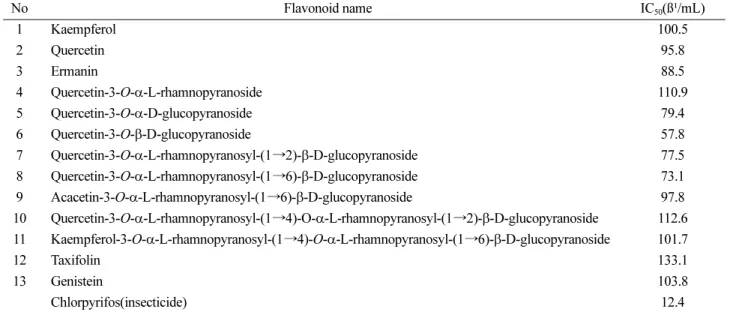
2013 년 Ding 등은 은행잎에 함유된 flavonoid 분리 및 정 제에서 1차 메탄올 추출물을 에틸아세테이트와 물로 재추출 한 후 칼럼크로마토그래프에서 분획별로 분리하고 HPLC로 13 개 flavonoids를 정제하여 AChE(acetylcholineesterase) 억 제활성을 조사하였다(Fig. 2).
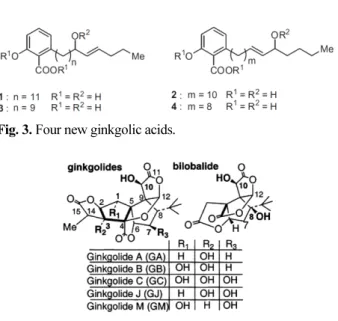
은행 외종피를 에탄올로 추출한 후 실리카겔 칼럼에서 step gradient로 용출 및 분획하여 얻어진 ginkgolic acid[6- [(Z)-10-Hepta decenyl]-2-hydroxy-benzoic acid] 의 살비활성 을 확인한 바 있으며(Pan 등, 2006), 은행잎을 메탄올로 추 출한 추출물을 클로로포름과 물로 분획한 후 클로로포름에 함유된 물질을 silica gel과 ODS 칼럼에서 분리 및 정제하 였으며, HPLC로 분석한 결과 기존에 확인된 ginkgolic acid 이외 새로운 ginkgolic acid 4종이 Fig. 3과 같이 확인되었다
(Deguchi 등, 2014).
은행잎에서 효과적으로 신속하게 ginkgolide와 bilobalide 를 추출하는 방법이 개발되었다. Ethyl acetate로 추출한 후 묽은 과산화수소와 수성의 잎 추출물을 가열하고 염기용액 으로 세척한 후 활성탄에서 여과하면 60~70%의 terpene trilactone이 함유된 황백색 분말을 얻을 수 있다. 과산화수 소 처리는 잎의 불필요한 성분을 분해시켜 추출하는 동안 고밀도 유화작용을 주도하였다. 더욱이 고분자수지를 이용 한 역상크로마토그래피 추출은 바람직하지 않은 ginkgolic acid 를 10 ppm 이하로 제거할 수 있었으며, 추출물에 분리 한 Fig. 4의 ginkgolides A, B, C, J와 bilobalide는 표준샘플 로도 이상적이었다(Lichtblau 등, 2002).
분자합성
1988 년 Corey 등은 은행나무 Ginkgo biloba에서 생산하 는 C
15다환 락톤 bilobalide[C
15H
18O
8](1)의 22단계 전합성 을 기술하였다. 합성 1단계는 bicyclic enone (4) 형성을 위 해 diester (3)의 딜리티오 유도체와 acetylenic ester (2)의 특이 전환반응이었으며, 천연 bilobalide 전합성에는 chiral (7) 활용과 enone (4) 형성이 주요 메커니즘이다(Fig. 5).
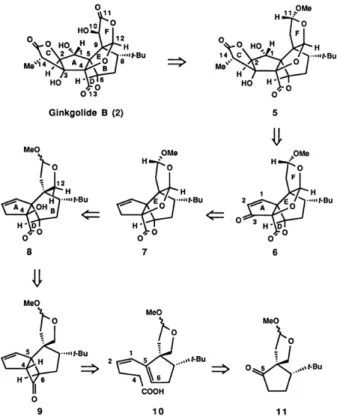
(±)-Ginkgolide B의 전합성 과정이 발표되었는데 Fig. 6과 같이 역합성 분석(retrosynthetic analysis)을 통하여 합성단 계를 확인하였다. 스피로화합물 중간물질과 카르복시산 합 성, [2 + 2]케톤-올레핀 고리부가반응, 광분해반응의 놀라운 결과와 입체화합물 확인, 링 E 완성, 링 C 구축과 Gink- golide B 완성을 합성 단계별로 반응조건과 촉매사용 등 상 세히 제시하였다(Desai 등, 1991).
구조 활성관계
2001 년 Yang 등은 bilobalide의 구조 활성관계를 규명하 기 위해 bilobalide를 가수분해 및 산화시켜 살충활성을 검 Fig. 2. Structure of flavonoids.
Fig. 4. Ginkgolides A, B, C, J, M and bilobalide.
정하였다. 분해물을 분석한 결과 염기 가수분해산물은 cyclopentenone계열의 화합물이었고, 산화물은 trilactone 형 태를 유지한 sesquiterpene 구조로써 dehydration된 형태로 추정되었다. 분해물의 살충활성을 검정한 결과, 살충력의 크 기는 bilobalide, monoacetyl 유도체, ginkgolide C, 산화분 해물, diacetyl 유도체, 가수분해산물 순으로 감소하여 살충 력은 trilactone 구조유지가 중요하였다(Fig. 7).
Table 1 은 벼멸구 Nilaparvata lugens 암컷 성충에게 국소 처리 24시간 후의 LC
50을 조사한 것으로 bilobalide는 0.64 ng 으로 가장 높은 살충활성을 보였으며, mono-acetyl 치환체 1.94 ng > ginkgolide C 2.39 ng > 산화물 36.67 ng >
diacetyl 치환체 46.15 ng 순이었으며, 구조가 변형된 가수분 해산물은 240.46 ng로 가장 낮은 살충활성을 보였다.
Ginkgolide B는 10 mg/mL의 농도로 코들링나방(Cydia pomonella L.) 신생유충의 먹이활동을 억제하였으나 gink- golide A 와 C는 별다른 효과를 보이지 않았다. 또한 Fig. 8 의 ginkgolic acid(GA)-C
15:0은 1 mg/mL의 농도로 C.
pomonella 유충거동을 억제하였으나 GA-C
13:0, GA-C
15:1,
GA-C
17:1은 그 효과를 보이지 않아 체인길이와 이중결합에 따라 큰 차이를 보였다(Pszczolkowski 등, 2011).
살충작용
은행잎에서 분리한 bilobalide 10은 벼멸구(Nilaparvata lugens Stal)의 경련과 마비를 야기하여 바이오살충제로서의 강력한 잠재력에 주목하게 되었다(Ahn 등, 1997). 최근에는 식물유도 신호케미컬(semiochemical)을 이용한 새로운 방제 Fig. 5. Main intermediate, starting and end product.
Fig. 6. Retrosynthetic analysis of ginkgolide B.
Fig. 7. Bilobalide structure.
Table 1. Insecticidal activities of bilobalide and its derivatives against Nilaparvate lugens adults determined by topical application
Product Time (hrs) LD
50(ng/ ♀)
Bilobalide 24 0.64
48 0.47
Mono-acetate 24 1.94
48 1.27
Ginkgolide C 24 2.39
48 2.07
Oxidation product 24 36.67
48 22.74
Diacetate 24 46.15
48 19.14
Hydrolysis product 24 240.46
48 167.30
Fig. 8. Structures of ginkgolic acids.
제에 저항성이 발달하여 방제가 곤란하지만 4령의 유충에 은행잎 에탄올과 메탄올 추출물은 양호한 방제효과를 보였 으며(Ahmad 등, 2011), 은행잎에서 분리한 13개 flavonoids (Table 2)는 벼멸구의 AChE(acetylcholinesterase) 활성을 억 제하였고 IC
50은 57.8~133.1 µg/mL이었다(Ding 등, 2013).
2011 년 Thompson 등은 5-HT
3(5-hydroxytryptamine type3) receptor 길항제로 알려진 bilobalide와 ginkgolide B 작용부 위인 통로(channel)에서의 결합위치를 조사하였다. 정확한 결합위치를 입증하기 위해 공극내벽 잔기와 치환한 5-HT
3receptor 를 구축하고 손톱개구리 Xenopus laevis 난모세포에
단백질과 글리코겐 및 지질은 번데기와 성체발생을 조절하 는데 외종피의 메탄올 추출물은 영양저장 변화와 함께 파밤 나방(Spodoptera exigua) 유충의 성장을 억제하였고 LD
50을 조사한 결과 1.92ng이었으며(Table 3), 치사율은 92.44%이 었다(So 등, 2012)
외종피에서 추출 및 동정한 살비기질의 6-[(Z)-10-hepta- decenyl]-2-hydroxy-benzoic acid (ginkgolic acid)는 귤응애 Panonychus citri (Mcg)에 대한 바이오검정에서 처리 24시 간 후 LC
50이 5.2 mg/L로 강력한 접촉 독성을 보였으며 (Table 4), 살충제 pyridaben (3.4 mg/L)과 유사한 수준이었 Table 2. AChE inhibitory activity of flavonoids 1~15
No Flavonoid name IC
50(ß¹/mL)
1 Kaempferol 100.5
2 Quercetin 95.8
3 Ermanin 88.5
4 Quercetin-3-O-α-L-rhamnopyranoside 110.9
5 Quercetin-3-O- α-D-glucopyranoside 79.4
6 Quercetin-3-O- β-D-glucopyranoside 57.8
7 Quercetin-3-O-α-L-rhamnopyranosyl-(1→2)-β-D-glucopyranoside 77.5 8 Quercetin-3-O- α-L-rhamnopyranosyl-(1→6)-β-D-glucopyranoside 73.1 9 Acacetin-3-O- α-L-rhamnopyranosyl-(1→6)-β-D-glucopyranoside 97.8 10 Quercetin-3-O-α-L-rhamnopyranosyl-(1→4)-O-α-L-rhamnopyranosyl-(1→2)-β-D-glucopyranoside 112.6 11 Kaempferol-3-O- α-L-rhamnopyranosyl-(1→4)-O-α-L-rhamnopyranosyl-(1→6)-β-D-glucopyranoside 101.7
12 Taxifolin 133.1
13 Genistein 103.8
Chlorpyrifos(insecticide) 12.4
Table 3. Median lethal dose of methanol extract of seed coat of Ginko biloba against third instar larvae of Spodoptera exigua
LD
95LD
80LD
50LD
40LD
20LD
10Slope ± SE (95% confidence limits, ng/larva) 0.53 ± 0.14 22.92
(16.25-37.19)
6.83 (5.61-8.72)
1.92 (1.55-2.30)
1.31 (0.99-1.62)
0.54 (0.34-0.74)
0.28 (0.15-0.42)
LD50, median lethal dose.Table 4. Contact (24h) toxicity of test compounds against Panonychus citri.
Corrected mortality (%)
Concentration (mg/l) 3.13 6.25 12.50 25.00 78.13 156.25 312.50 625.00 Ginkgolic acid 22.8 67.1 81.9 100.0 100.0 100.0 100.0 100.0
Pyridaben 50.3 55.0 65.8 85.2 100.0 100.0 100.0 100.0
Omethoate - - - - 25.5 63.1 75.2 98.7
*based on the average of three replication.
고 omethoate (122 mg/L) 보다는 월등하였다(Pan 등, 2006).
더욱이 본 화합물은 pyridaben이나 omethoate보다 신속한 살비활성으로 응애 각피의 강력한 침습작용을 하지만 식물 독성은 보이지 않았다.
2012년 Li 등은 은행 외종피와 잎에 함유된 GA는 새로운 종류의 연체동물 특히 민달팽이 살충작용이 보고되었으나 그 메커니즘은 거의 규명되지 못하고 있음에 주목하였다.
GA-C
13:0에 의한 민달팽이 미토콘드리아 손상을 TEM(투과 전자현미경)으로 조사하였고 RT-PCR(실시간 중합효소 연쇄 반응)로는 5개 미토콘드리아 효소의 유전자 발현 프로파일 을 조사한 결과 전반적인 미세구조 변화와 함께(Fig. 9), cytochrome c 산화효소, ATP 합성효소, cytochrome b 및 dihydronicotinamide adenine dinucleotide (NADH) 탈수소 효소 유전자 발현을 억제하였고 처리 12시간 후 LD
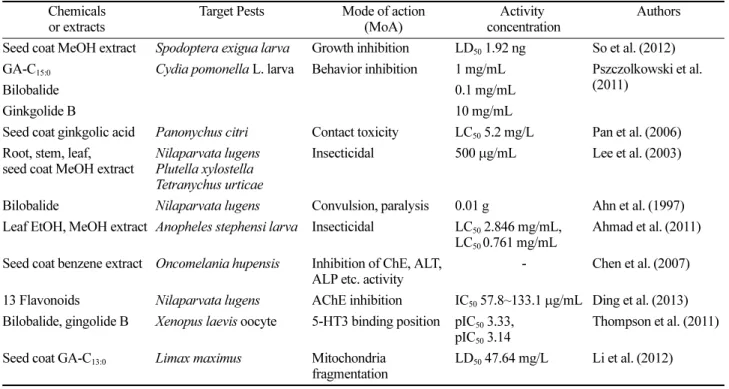
50은 47.64 mg/L 이었다. 이상에서 검토한 각종 해충(Fig. 10)에 대한 살충활성은 Table 5에 요약하였다.
살균작용
은행나무는 종자를 포함한 식물전체가 병해충에 강한 저 항성을 가져 1997년 Murata 등은 은행에서 분리한 anacardic acid (Ana) 의 박테리아와 이스트의 지질합성 억제 시험에서 Ana-a (Fig. 11)는 박테리아 B. subtilis의 성장과 이스트 Lipomyces starkeyi의 지질축적 억제를 확인하였다.
은행잎의 항균물질을 검색하기 위해 메탄올 추출물을 다 시 ethyl acetate로 추출한 후 HPLC로 정제한 화합물은 기
존의 ginkgolic acid나 bilobalide와 상이하였고, 0.12 µg/mL 으로 장구균(Enterococcus faecalis)에 강력한 억제활성을 보였다(Mazzanti 등, 2000).
2000 년 Wang 등은 분자량 13 kDa의 단일체인 항균 단백 질을 은행종자에서 분리하여 ginkbilobin으로 명명하였는데 이 단백질의 N 말단시퀀스는 하얀 가문비나무 배아에 풍부 한 단백질과 매우 유사하였다. 잿빛곰팡이병균(Botrytis cinerea)에 대한 IC
50은 0.25 µM이었으며(Fig. 12), 갈색반 점을 야기하는 Mycosphaerella arachidicola, 시들음병균 (Fusarium oxysporum), 잎집무늬마름병균(Rhizoctonia solani), 먹물버섯(Coprinus comatus)에 항균활성을 보였다. 또한 황 색포도상구균(Staphylococcus aureus), 녹농균(Pseudomonas aeruginosa) 및 대장균(Escherichia coli)과 같은 박테리아에 도 살균작용을 하였다.
은행잎에서 분리한 항균펩티드(GAFP)는 벼잎짚무늬마름 병균(Pellicularia sasakii), 사과과일썩음병균(Alternaria alter- nata), 붉은곰팡이병(Fusarium graminearum) 및 검은점무 늬병균(Fusarium moniliforme)에 활성을 보였으나 진균에 따라 차이가 있었다(Huang 등, 2000). 특히 100 µg/mL의 GAFP를 P. sasakii 균사에 처리하였을 시 균사 막 투과를 증가시키고 배지의 신속한 알칼리화를 야기하였고, GAFP 의 아미노산시퀀스는 수많은 키틴결합단백질 중 cysteine과 glycine 이 풍부한 키틴결합 도메인을 갖는 특성을 보였다.
추출용매를 달리하여 5개 동식물병원성 균주 Agro- bacterium tumefaciens, Bacillus subtilis, Escherichia coli, Fig. 9. Ultrastructure of snail’s mitochondrial image by TEM. Snails were exposed to GA-C13:0 and niclosamide. (A) Control snail mitochondria, (B) the mitochondrial of snails exposed to niclosamide with no obvious injury found in the mitochondria, and (C) mitochondria of snail exposed to GA-C13:0 showing fragmented cristae, membrane disruptions, edema and matrix vacuolation.
Fig. 10. Spodoptera exigua larva (1), Cydia pomonella L. (2), Panonychus citri (3), Anopheles stephensi (4), Nilaparvata lugens (5),
Oncomelania hupensis (6) Limax maximus (7), Xenopus laevis (8), Plutella xylostella (9) and Tetranychus urticae (10).
Erwinia chrysanthemi, Xanthomonas phaseoli에 미치는 은 행잎 추출물의 항균활성을 조사한 결과 메탄올 > 클로로포 름 >에탄올 >헥산 순이었으며, 최소억제농도는 메탄올추출 물이 7.8 µg/mL로 모든 균주에서 확인되었다(2011, Sati 등).
국내산 은행나무(Ginkgo biloba) 뿌리, 외종피, 가지 등 부위별 메탄올 추출물의 진균류, 일반세균 및 해충에 대한 생물활성을 조사한 결과 푸른곰팡이 병균(T. harzianum)과 대장균(E. coli) 등에 200 µg/disc 농도에서 저해활성을 보였
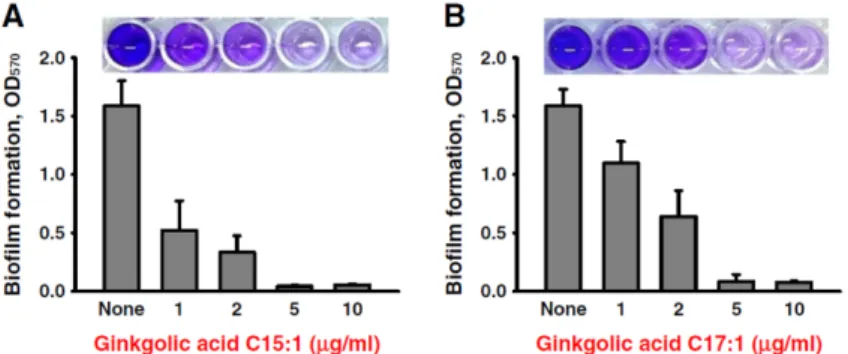
고 줄기부위가 더 높은 항균활성을 보였다. 특히 버섯 배양 상의 표면에 1 mg/mL 수준으로 처리할 경우 푸른곰팡이 병 발생을 상당히 억제시키는 효과를 보였다(Lee 등, 2003). 또 한 대장균(E. coli O157:H7)의 바이오필름 형성에 미치는 ginkgolic acid 의 억제시험에서는 Fig. 13에서와 같이 현저 한 억제효과를 보였다(Lee 등, 2014).
유해녹조류 방제에는 천연식물제제가 유용자원으로 인식 되어 은행 외종피의 ginkgolic acid에 주목하였다(Zhang 등, 2014). 은행 외종피를 석유에테르로 추출한 ginkgolic acid 는 독성 시아노박테리아 Microcystis aeruginosa를 효과적으 로 억제하였는데 EC
50,3d와 EC
50,7d는 3.26, 2.03 mg/L이었다.
노출 12~96시간 동안 유전자 발현과 생리적 변화 및 세 포형태를 조사한 결과 형태학적 손상과 세포용해를 보였 고, superoxide dismutase 활성과 항산화제를 감소시키고 malondialdehyde 함량은 증가시켜 산화손상을 야기하였다. 3 개 광합성유전자 psaB, psbD, rbcL 전사와 2개 영양섭취와 관련된 유전자 ntcA, phoU가 억제되었다. 또한 ginkgolic acid 는 microcystin 함량은 물론 microcystin과 관련된 유전자 전사에도 영향을 미치었다. 따라서 생리적 및 생화학적 반응 에 다면발현 영향으로 M. aeruginosa의 성장을 억제하였다.
2011 년 Hantano 등은 은행유래 지질전이 단백질과 항균 성분에 대한 연구에서 ginkgotoxin[C
9H
13O
3N]을 분리하여 분자수준의 활성메커니즘을 기술한 바 있으며, 최근에는 은 행나무에 기생하는 식내서성 진균이 병원성 미생물로부터 숙주식물을 방어하여 이들 진균의 분리 및 분비화합물에 주 목하기 시작하였다(Xiao 등, 2013). 80종의 식내서성 진균 Fig. 11. Structures of anacardic acid-a.
Fig. 12. Determination of IC
50of antifungal activity of ginkbilobin against B. cinerea. Lower right: Mes buffer control.
Lower left: 0.24 μM ginkbilobin. Upper right: 1.2 μM ginkbilobin. Upper left: 6 μM ginkbilobin. The IC
50was determined to be 0.25 μM.
Bilobalide 0.1 mg/mL
Ginkgolide B 10 mg/mL
Seed coat ginkgolic acid Panonychus citri Contact toxicity LC
505.2 mg/L Pan et al. (2006) Root, stem, leaf,
seed coat MeOH extract
Nilaparvata lugens Plutella xylostella Tetranychus urticae
Insecticidal 500 μg/mL Lee et al. (2003)
Bilobalide Nilaparvata lugens Convulsion, paralysis 0.01 g Ahn et al. (1997) Leaf EtOH, MeOH extract Anopheles stephensi larva Insecticidal LC
502.846 mg/mL,
LC
500.761 mg/mL
Ahmad et al. (2011) Seed coat benzene extract Oncomelania hupensis Inhibition of ChE, ALT,
ALP etc. activity
- Chen et al. (2007) 13 Flavonoids Nilaparvata lugens AChE inhibition IC
5057.8~133.1 μg/mL Ding et al. (2013) Bilobalide, gingolide B Xenopus laevis oocyte 5-HT3 binding position pIC
503.33,
pIC
503.14
Thompson et al. (2011) Seed coat GA-C
13:0Limax maximus Mitochondria
fragmentation
LD
5047.64 mg/L Li et al. (2012)
의 항균활성을 한천내확산법으로 조사한 결과 가장 활성을 보인 CDW7 균주는 현미경과 rRNA 유전자시퀀스 데이터 에서 Chaetomium globosum으로 동정되었고, 형태학적 특 성은 주사전자현미경(SEM)으로 관찰하였다(Fig. 14).
CDW7 배양배지를 3배 희석하여도 in vitro에서 Fusarium graminearum 분생자 발아와 균사성장을 완전히 억제하였다.
따라서 Fusarium spp.와 관련된 보리와 밀의 공통적인 푸사 륨위조병은 in vivo에서의 안티식물병원성 활성검정에 활용 하였으며, CDW7 배지발효에서는 54.9%의 보호효과와 48.8%
의 치유효과를 보였다.
생물학적 정량을 위한 접근에서 flavipin(1,2-benzenedi- carboxaldehyde-3,4,5-trihydroxy-6-methyl) 이 분리되었고(Fig.
15), 일부 식물병원성 진균 특히 F. graminearum의 성장을 현저히 억제하였는데 EC
50이 0.73 µg/mL로 살균제 carben-
dazim과 비교할 만한 수준이었다(Table 6). 따라서 본 화합 물은 살균제나 새로운 살균제 리드화합물로 사용할 수 있을 것으로 사료되었다.
앞서 검토한 바와 같이 식물기생 진균은 항암이나 항균 및 기타 바이오활성과 함께 다양한 구조의 2차대사산물로 인식되고 있다. 2011년 Li 등은 은행잎에서 식내서성 Chaetomium globosum (NM0066) 진균을 분리한 후 EtOAc 로 추출하여 항균활성에 대한 생물학적 및 화학적 조사에서 gliotoxin 등의 화합물을 분리하였으며(Fig. 16), gliotoxin은 Fusarium sulphureum, Alternaria alternata 및 Claviceps sorghi에 대하여 EC
50이 각각 68.5, 36.8 및 59.8 mg/mL로 양호한 항균활성이 확인되었다.
은행나무 유래 새로운 jasmonate 의존 방어유전자의 발현 과 특성 및 분자클로닝에 대한 연구가 수행되었다(Shena 등, 2005). Gbd 로 명명한 은행나무 defensin의 cDNA 전체길이 는 534 bp이었으며, Gbd 유전자는 손상이나 methyl jasmonate 처리로 상향조절이 확인되어 이 유전자는 식물이 손상된 동 Fig. 13. Biofilm reductions achieved using ginkgolic acids. EHEC (E. coli O157:H7) biofilm formation (OD
570) was quantified in the presence of ginkgolic acid-C
15:1(A), ginkgolic acid-C
17:1(B) at 37
oC after 24 h in 96-well plates.
Fig. 14. Morphological characteristics of strain CDW7. (e) Scanning electron micrographs of hyphae and ascospores.
Fig. 15. Chemical structure of favipin (1,2-benzenedicar- boxaldehyde-3,4,5-trihydroxy-6-methyl).
Table 6. EC
50of flavipin against plant-pathogenic fungi
Flavipin Carbendazim Chlorothalonil Procymidone
Pathogenic fungi ( μg/mL)
Sclerotinia sclerotiorum 3.68 ± 0.23 0.15 ± 0.03 - -
Fusarium graminearum 0.73 ± 0.09 0.50 ± 0.08 - -
Rhizoctonia solani 2.62 ± 0.15 1.42 ± 0.14 - -
Phytophthora capsici 2.76 ± 0.12 - 4.48 ± 0.40 -
Alternaria solani 12.35 ± 0.90 - - 2.19 ± 0.10
안에도 병원체에 내성을 갖는 것으로 예측되었다.
2012 년 Yuan 등은 은행나무 식내서성 박테리아를 분리하 고 Bacillus amyloliquefaciens CGMCC 5569로 명명하였다.
이 균주의 ethyl acetate 추출물과 여액 모두는 변재변색진 균 Lasiodiplodia rubropurpurea, L. crassispora, L. theo- bromae 의 성장을 억제하였다. 여액 ethyl acetate 추출물에 서는 fengycin, surfactin 및 bacillomycin이 함유된 일련의 안티진균 화합물 lipopeptide가 얻어졌으며, in vitro에서 L.
rubropurpurea, L. crassispora, L. theobromae의 성장을 각 각 70.22%, 69.53%, 78.76% 억제하여 CGMCC 5569 진균 의 강력한 변재변색 억제활성과 바이오활성성분은 바이오방 제 자원으로 제공될 수 있다.
연구동향
본 동향분석에는 Web of Science (Thomson Reuters) 데 이터베이스에서 검색어(pesticid* or biopesticid* or insecticid*
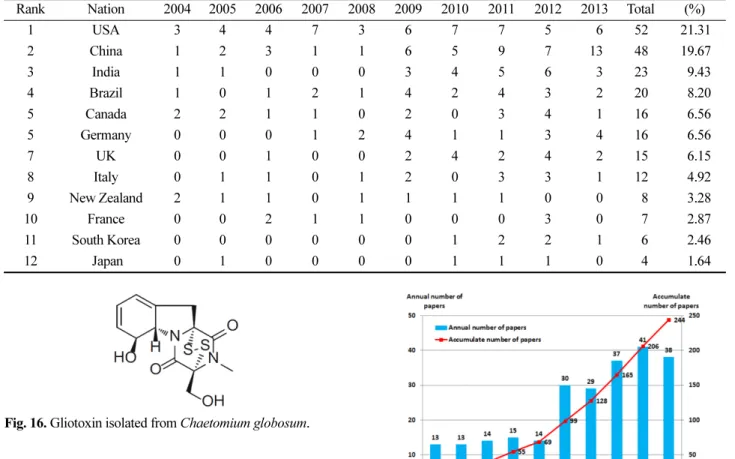
or fungicid*) 와 (ginkgo or endophyt* or “seed coat*” or sarcotesta)를 사용하여 최근 10년간의 동향을 검색한 결과 244 편이 수집되었다. 연도별 각국의 논문 수는 Table 7과 같 으며, 분석 대상기간의 연평균 증가율은 논문 수 기준 12.66%, 누적 논문 수 기준 38.51%로 지속적인 증가경향을 보였다(Fig. 17).
미국은 52편으로 가장 많은 논문을 발표하여 전체의 21.31% 를 차지하였고 우리나라는 6편으로 11위이었다. 전
체논문의 평균 피인용 수에 대한 국가별 논문의 평균 피인 용 수를 기반으로 질적 수준평가(1.0기준)를 하였을 때 일본 은 논문 당 (수준지수)/(피인용 수)가 2.636/22.75로 가장 우 수하였고 이탈리아(2.597/22.417)와 미국(1.609/13.885)은 2, 3 위이었다.
결 론
은행잎과 외종피 유래 다양한 활성물질의 분리·동정과 일부화합물의 전합성을 비롯하여 구조별 살충 및 살균활성 을 평가하는 다양한 기초연구가 수행되고 있었다. 은행유래 바이오농약 제품은 아직까지 출시되지 않고 있지만 합성농 약이 갖는 환경에서의 잔류독성이나 저항성발달과 같은 문 제점을 극복할 수 있어 유기농업에서는 소원재료 추출물을 병해충방제에 활용하고 있다.
바이오활성을 갖는 ginkgolide, bilobalide, ginkgolic acid, flavonoid 등의 살충 및 살균작용은 방제대상 병해충에 따라 합성농약과 대등하거나 그 이상의 효과를 보여 향후전망은 밝은 것으로 사료되었다. 식내서성 진균과 이들의 분비물을
4 Brazil 1 0 1 2 1 4 2 4 3 2 20 8.20
5 Canada 2 2 1 1 0 2 0 3 4 1 16 6.56
5 Germany 0 0 0 1 2 4 1 1 3 4 16 6.56
7 UK 0 0 1 0 0 2 4 2 4 2 15 6.15
8 Italy 0 1 1 0 1 2 0 3 3 1 12 4.92
9 New Zealand 2 1 1 0 1 1 1 1 0 0 8 3.28
10 France 0 0 2 1 1 0 0 0 3 0 7 2.87
11 South Korea 0 0 0 0 0 0 1 2 2 1 6 2.46
12 Japan 0 1 0 0 0 0 1 1 1 0 4 1.64
Fig. 16. Gliotoxin isolated from Chaetomium globosum.
Fig. 17. Accumulation and increasing of the papers according
to the years.
활용한 항균작용이나 E. coli에 의한 식중독예방 및 유해녹 조류 방제 등 다양한 분야에 활용될 수 있는 잠재력을 보였 으며, 살충범위도 벼멸구와 파밤나방, 응애류 등 이외에도 크게 확대될 것으로 기대되었다.
감사의 글
본 연구는 2014년도 한국과학기술정보연구원이 미래창조 과학부 과학기술진흥기금과 복권기금으로 수행하는「ReSeat 프로그램」에 의해 수행된 기술동향분석의 일부로 이에 감 사드립니다.
Literature cited