CNU Journal of Agricultural Science 39(4), 2012. 12
511
흑미 및 곡류 추출물의 항산화 효과
조은주
1ㆍ최미진
1ㆍ신선화
1ㆍ김현영
2*
1부산대학교 식품영양학과 및 노인생활환경연구소, 2경남과학기술대학교 식품과학부
Antioxidant activity of black rice and grains
Eun Ju Cho1, Mi Jin Choi1, Seon Hwa Shin1, Hyun Young Kim2*
1Department of Food Science and Nutrition, Pusan National University, Busan 609-735, Korea
2Department of Food Science, Gyeongnam National University of Science and Technology, Jinju 660-758, Korea
Received on 28 November 2012, revised on 11 December 2012, accepted on 12 December 2012
Abstract : In this study, the comparison of antioxidative effect of the methanol (MeOH) extracts from grains were investigated in vitro radical scavenging system. Ten grains (black rice, rice, barley, wheat, millet, sorghum, glutinous millet, buckwheat, phellines linteus rice and brown rice) were extracted with MeOH. Among the MeOH extracts of grains, sorghum and black rice showed effective scavenging activities of 1,1-diphenyl-2-picrylhydrazyl (DPPH) radical. The IC50 values of sorghum and black rice were 47.4 ㎍/mL and 50.6 ㎍/mL, respectively. In addition, black rice also exerted the strongest activities on hydroxyl radical (․OH) scavenging activity. Furthermore, the MeOH extracts of black rice showed effective and dose dependant scavenging activities of DPPH radical and ․OH. These results indicated that black rice showed strong free radical scavenging activity. It suggested that black rice could be a promising natural antioxidant against free radical-induced oxidative damage.
Key words : Grain crop, Black rice, DPPH, ․OH, Antioxidant
*Corresponding author: Tel: +82-55-751-3277 E-mail address: [email protected]
I. 서 론
유산소 호흡을 하는 거의 모든 생물체의 세포에서 발생 되는 reactive oxygen species(ROS)는 생체물질의 자가 산화, 방사선, 화학물질에 의한 외부자극에 의해 생성될 수 있는 것으로 알려져 있다(Fridovich, 1978; Kodama, 1988).
이러한 활성산소의 종류로는 superoxide anion(O
2-), hy- drogen peroxide(H
2O
2), singlet oxygen(
1O
2), hydroxyl radical(·OH), peroxyl radical(RO·) 등이 있다. 이들 활성 산소는 여러 가지 환경적 요인이나 병리적인 요인들에 의 하여 과잉으로 생성될 수 있으며 이들의 과다 생성과 활성 산소를 제거하고 방어하는 항산화 방어체계의 결핍은 항산 화 방어체계간의 불균형을 일으켜, 산화적 스트레스를 발 생시킨다(Cadenas and Davies, 2000; Bokov et al., 2004). 또한 산화적 스트레스의 증가는 암과 심혈관 질환
및 알츠하이머와 같은 만성 질환의 병리학적 진행과 노화 과정의 중요한 원인이 되는 것으로 알려져 있다(Cavalca et al. 2001; Gibson and Huang, 2005).
흑미( Oryza sativa L. cv. japonica)는 중국의 광동 운 남 지방에 야생되었던 것으로 본초강목에는 흑미가 인체조 절기능을 개선시키고 면역기능을 강화하며 질병예방에 효 과가 있다고 알려져 있다. 쌀겨층에 자홍색의 색소를 가지 고 있는 흑미는 주요 생산지는 중국이나 동남아시아 지역 이며, 우리나라의 경우 진도, 해남, 보성 등 일부 지역에서 생산되고 있다. 유색미의 일종인 흑미는 특유의 색과 향으 로 다양한 형태의 식품으로 가공되고 있으며 그 소비가 점 차 증가하고 있다. 흑미의 색소는 다양한 구조와 분자량의 폴리페놀화합물로 구성되어 있으며, 이러한 폴리페놀 성분 을 함유하고 있는 흑미를 이용하여 항산화성, 항암성, 항동 맥경화 등의 생리활성 연구가 보고되었다(Velioglu et al., 1998; Ling et al., 2002; Chung and Lee, 2003; Chen et al., 2006; Chiang et al., 2006). 또한 흑미는 단백질,
CNU Journal of Agricultural Science Vol. 39, No. 4, pp. 511-514, December 2012
DOI: http://dx.doi.org/10.7744/cnujas.2012.39.4.511
김현영 / 흑미 및 곡류 추출물의 항산화 효과
농업과학연구 제39권 제4호, 2012. 12
512
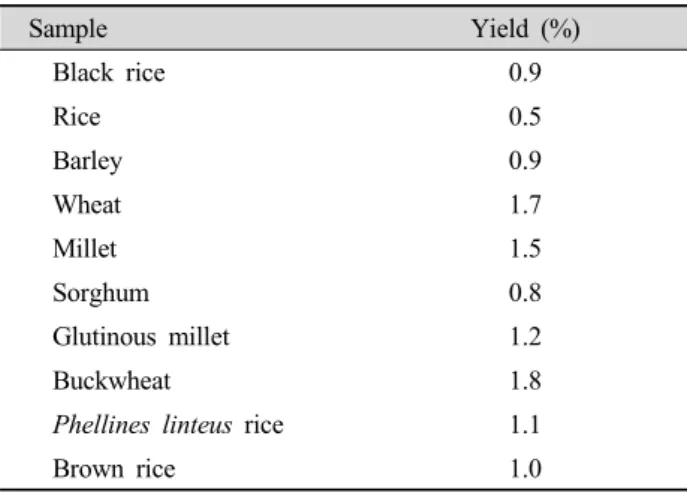
Table 1. Yield of the MeOH extracts from grains.
Sample Yield (%)
Black rice 0.9
Rice 0.5
Barley 0.9
Wheat 1.7
Millet 1.5
Sorghum 0.8
Glutinous millet 1.2
Buckwheat 1.8
Phellines linteus rice 1.1
Brown rice 1.0
식물성 지방, 섬유소, 무기질, 비타민 등 영양 성분이 풍부 하다(Defa and Xu, 1992).
본 연구에서는 곡류 추출물의 in vitro 에서의 라디칼 소 거능을 비교하였고, 이 결과를 바탕으로 곡류 중 항산화 활성이 뛰어난 흑미 추출물에 대해 in vitro 상에서 라디칼 소거능을 살펴보았다.
II. 재료 및 방법
1. 곡류의 메탄올 추출물 제조
흑미, 수수, 기장, 차조, 현미, 쌀, 보리, 밀, 메밀, 상황 버섯쌀을 구입하여 동결건조 한 다음, 분말화하여 시료 중 량의 20배 methanol(MeOH)로 12시간 동안 추출하였고 동 일한 과정을 3번 반복하여 얻어진 추출물을 모은 후 회전식 진공 농축기를 이용하여 농축하였다. 농축물은 -80℃의 냉동고에 보관하면서 실험에 사용하였다. 메탄올 추출물의 수율은 Table 1과 같다.
2. 1,1-Diphenyl-2-picrylhydrazyl(DPPH) 소거 측정
농도별로 ethanol에 녹인 시료 100 µL과 60 µM DPPH 용액 100 µL을 96-well plate에 혼합하여 30분간 실온에 방치시킨 후, 540 nm에서 흡광도를 측정하였다. 시료를 첨가하지 않은 대조군과 비교하여 free radical 소거효과를 백분율(%)로 나타내었다(Hatano et al., 1989; Koleva et al., 2002).
3. Hydroxy radical(․ OH) 소거 측정
Fenton반응에 따라 10 mM FeSO
4・H
2O-EDTA에 10 mM의 2-dexy-ribose solution과 농도별 시료용액을 혼 합한 다음, 10 mM의 H
2O
2를 첨가하여 37℃에서 4시간 동 안 배양한다. 이 혼합액에 2.8% trichloroacetic acid(TCA) 와 1.0% thiobarbituric acid(TBA) solution을 각각 첨가 하여 10분간 boiling한 후 cooling하여 520 nm에서 흡광도 를 측정하였다(Chung et al., 1997).
4. 통계분석
실험 결과는 평균 ± 표준편차로 나타내었고, 대조군과 실험군의 실험 결과는 one way ANOVA로 검증한 후 Duncan’s multiple range test로 유의수준 0.05에서 유의 성을 검증하였다.
III. 결과 및 고찰
1. 곡류 메탄올 추출물의 라디칼 소거능
DPPH는 안정한 free radical로 cysteine, glutathione 과 같은 함유황 아미노산과 ascorbic acid, tocopherol, polyhydroxy aromatic compounds(hydroquinone, pyro- galloyl etc.), aromatic amine(ρ-phenylenediamine, ami- nophenol etc.) 등에 의해서 환원되어 짙은 자색이 탈색되 므로 DPPH는 수소 공여체 또는 유리기 소거작용의 항산화 성을 측정하는데 사용되어지고 있을 뿐 만 아니라, 안정적 이고 간단하며, 재현성이 높아 식품을 비롯한 여러 분야에 서 널리 이용되고 있다(Hatano et al., 1989; Koleva et al., 2002). 곡류의 항산화 활성을 알아보기 위해 10가지 곡류의 DPPH radical 소거 효과를 살펴본 결과 Fig. 1과 같은 결과를 얻었다. 그 결과를 IC
50로 비교해보면, 수수 47.4 ㎍/mL, 흑미 50.6 ㎍/mL, 밀 111.6 ㎍/mL, 메밀 158.8 ㎍/mL로, 특히 수수와 흑미의 DPPH radical 소거 효과가 우수한 것으로 나타났다.
‧ OH은 활성 산소종 중에서 가장 반응성이 크고 인접한 생체 분자에 심각한 손상을 야기하는 것으로 알려져 있다.
Macrophages와 leukocytes의 phagocytosis 또한 ‧ OH 생 성 원인이 되며, 이러한 ‧ OH는 Fenton 반응에 의해 O
2-와
Hyun Young Kim / Antioxidant activity of black rice and grains
CNU Journal of Agricultural Science 39(4), 2012. 12
513
Fig. 1. DPPH radical scavenging activity of the MeOH extractsfrom grains Ascorbic acid; IC50 (㎍/mL)= 1.0 ± 0.1, Ascorbic acid is positive control. IC50 is concentration in ㎍/mL required to scavenge DPPH radical by 50%. GM = Glutinous millet, PLR = Phellines linteus rice, Values are mean ± SD.
Fig. 2. Hydroxyl radical scavenging activity of the MeOH extracts from grains. GM = Glutinous mille,t PLR = Phellines linteus rice, Values are mean ± SD.
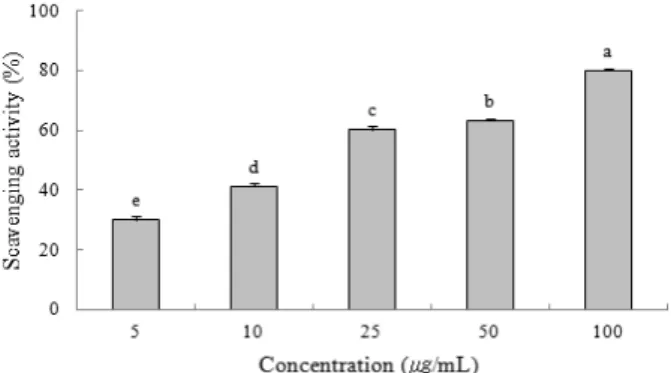
Fig. 3. DPPH scavenging activity of the MeOH extract from black rice. Values are mean ± SD. a-eMeans with the different letters are significantly different (p<0.05) by Duncan's multiple range test.
Fig. 4. Hydroxyl radical scavenging activity of the MeOH extract from black rice. Values are mean ± SD. a-dMeans with the different letters are significantly different (p<0.05) by Duncan's multiple range test.
H
2O
2로부터 생성되며, 활성질소종인 ONOO
-의 분해에 의 해 생성되기도 한다(Chung et al., 1997). ‧ OH은 DNA의 핵산과 결합함으로서 손상을 일으켜 발암성, 돌연변이 및 세포독성을 유발하게 되며, 지질과산화 과정에서 빠른 개 시제로서 작용하게 되는데 ‧ OH 소거활성은 지질과산화 과 정의 진행을 직접적으로 방해하거나 활성화된 산소종을 소 거함으로써 연쇄반응을 저해하기 때문이라고 보고되고 있 다(Manian et al., 2008). 곡류 메탄올 추출물의 ‧ OH 소거 효과를 살펴보면, 100 ㎍/mL에서 43.4%로 흑미가 ‧ OH에 대한 독성 제거 효과가 가장 높은 것으로 나타났다(Fig. 2).
앞서 살펴본 DPPH radical 소거능과 함께 고려해 볼 때, 10가지 곡류 중 흑미는 in vitro 에서 프리 라디칼 소거에 의한 항산화 효과가 가장 우수한 것으로 나타났다.
2. 흑미 메탄올 추출물의 라디칼 소거능
흑미의 항산화 활성을 확인하기 위해 DPPH radical 소
거 효과를 살펴본 결과 흑미 5 μg/mL 농도에서 30.25%, 25 μg/mL 농도에서 66.39%, 50 μg/mL 농도에서 75.63%
로 흑미 MeOH 추출물 처리농도에 따라 농도 의존적으로 DPPH의 소거능이 증가됨을 알 수 있었다. 특히 흑미의 최 종 농도인 100 μg/mL 농도에서는 84.03%의 뛰어난 소거 효과를 보였다(Fig. 3).
흑미 MeOH 추출물의 ‧ OH 소거 효과를 살펴보면, 낮은 농도인 5 µg/mL 에서도 70% 이상의 소거 효과를 나타내었 다. 특히 흑미추출물은 100 µg/mL 에서 92.64%로 아주 우수하게 ‧ OH 소거함을 알 수 있었다(Fig. 4).
흑미는 다른 곡류에 비해서 페놀화합물의 함량이 매우
높으며, 특히 우수한 생리활성이 보고되어진 cyanidin과
malvidin을 함유하고 있다(Hahn et al., 1995; Yoon et
al., 1997; Kaneda et al., 2006). 이러한 페놀화합물 및
색소성분이 흑미의 우수한 항산화활성을 나타내는데 기여
하는 것으로 사료된다. 따라서 흑미는 라디칼에 의해 유발
된 산화적 스트레스를 개선함으로써 이로 인한 질병을 예
김현영 / 흑미 및 곡류 추출물의 항산화 효과
농업과학연구 제39권 제4호, 2012. 12
514
방하는 항산화제로서 역할을 할 것으로 기대된다.
IV. 결 론
본 연구에서는 흑미, 수수, 기장, 차조, 현미, 쌀, 보리, 밀, 메밀, 상황버섯쌀의 MeOH 추출물을 제조하여 라디칼 소거능을 통해 항산화능을 검토하였다. 10가지 곡류 중 수 수와 흑미의 DPPH radical 소거 효과가 우수하였으며, 흑 미는 가장 우수한 ‧ OH 소거능을 보였다. 이를 토대로 흑미 의 농도별 라디칼 소거능을 확인한 결과, 농도 의존적으로 DPPH 라디칼 소거능이 증가하였으며, ‧ OH 소거 능은 낮 은 농도인 5 µg/mL 에서도 70% 이상의 소거 효과를 나타 냄을 확인하였다. 이러한 흑미의 라디칼 소거 활성은 항산 화 기능성 소재로써의 흑미의 활용 가능성을 보여주며, 흑 미 색소성분인 페놀화합물의 항산화활성 확인과 그 작용 기작등에 대한 연구가 필요하다고 사료된다.
감사의 글
이 논문은 2012년도 경남과학기술대학교 기성회 연구비 지원에 의하여 연구되었음.
참 고 문 헌
Bokov A, Chaudhuri A, Richardson A. 2004. The role of oxidative damage and stress in aging. Mechanisms of Ageing and Development 125:811-826.
Cadenas E, Davies KJ. 2000. Mitochodrial free radical gen- eration, oxidative stress, and aging. Free Radical Biology &
Medicine 29:222-230.
Cavalca V, Cighetti G, Bamonti F, Loaldi A, Bortone L, Novembrino N, De Franceschi M, Belardinelli R, Guazzi MD. 2001. Oxidative stress and homocysteine in coronary artery disease. Clinical Chemistry 47:887-892.
Chen PN, Kuo WH, Chian CL, Chiou HL, Hsieh YS, Chu SC.
2006. Black rice anthocyanins inhibit cancer cells invasion via repressions of MMPs and u-PA expression. Chemico- Biological Interactions 163:218-229.
Chiang AN, Wu HL, Yeh HI, Chu CS, Lin HC, Lee WC. 2006.
Antioxidant effects of black rice extract through the induction of superoxide dismutase and catalase activities.
Lipids 41:797-803.
Chung YA, Lee JK. 2003. Antioxidative properties of phenolic compounds extracted from black rice. Journal of the Korean Society of Food Science and Nutrition 32:948-951.
Chung SK, Osawa T, Kawakishi S. 1997. Hydroxyl radical- scavenging effects of spices and scavengers from brown mustard (Brassica nigra). Bioscience, Biotechnology, and Biochemistry 61:118-123.
Defa G, Xu M. 1992. A study on special nutrient of purple glutinous rice. Scientia Agricultura Sinica 25:36-41.
Fridovich I. 1978. The biology of oxygen radicals. Science 201:875-880.
Gibson GE, Huang HM. 2005. Oxidative stress in alzheimmer's disease. Neurobiology of Aging 26:575-578.
Hahn TR, Yoon HH, Paik YS, Kim JB. 1995. Identification of anthocyanidins from Korean pigmented rice. Agricultural Chemistry & Biotechnology 38:581-583.
Hatano T, Edamatsu R, Hiramatsu M, Mori A, Fujita Y, Yasugara T, Yoshida T, Okuda T. 1989. Effects of the interaction of tannins with co-existing substances, Ⅵ. Effects of tannins and related polyphenols on superoxide anion radical, and on 1,1-diphenyl-2-picrylhydrazyl radical. Chemical
& Pharmaceutical Bulletin 37:2016-2021.
Kaneda I, Kubo F, Sakurai H. 2006. Antioxidative compounds in the extracts of black rice brans. Journal of Health Science 52:495-511.
Kodama M. 1988. Role of oxygen species in carcinogenesis.
Tanpakushitsu Kakusan Koso 33:3136-3143.
Koleva Ⅱ, Van Beek TA, Linssen JPH, de Groot A, Evstatieva LN. 2002. Screening of plant extracts for antioxidant activity: a comparative study on three testing methods.
Phytochemical Analysis 13:8-17.
Ling WH, Wang LL, Ma T. 2002. Supplementation of the black rice outer layer fraction to rabbits decreases antioxidant status. Journal of Nutrition 132:20-26.
Manian R, Anusuya N, Siddhuraju P, Manian S. 2008. The antioxidant activity and free radical scavenging potential of two different solvent extracts of Camellia sinensis (O.) Kuntz, Ficus bengalensis L. and Ficus racemosa L. Food Chemistry 107:1000-1007.
Velioglu YS, Mazza G, Gao L, Oomah BD. 1998. Antioxidant activity and total phenolics in selected fruits, vegetables and grain products. Journal of Agricultural and Food Chemistry 46:4113-4117.
Yoon HY, Yoon JM, Cho MH, Hahn TR, Paik YS. 1997.
Physicochemical stability of anthocyanins Korean pigmented rice. Korean Journal of Food Science and Technology 29:211-217.