DOI : http://dx.doi.org/10.5394/KINPR.2012.36.7.571
A Study on Development of Laptop-Based Pilots’
Ship-Handling Simulation Software
†Tae-Gwoen Jeong, Chao Chen*, Shin-Geol Lee*, Jeong-Jin Lee*, Yong-Bum Huh**
†Professor, Division of Navigation Science, Korea Maritime University, Busan 606-791, Republic. of Korea
*Researcher, Korea Maritime University, Busan 606-791, Republic of Korea
**Technical Advisor, Korea Maritime Pilots’ Association, Seoul, Republic of Korea
Abstract : Berthing and unberthing maneuver is essential work for marine pilots and securing the safety against risks during the maneuver is more important than anything else. Moreover, the maneuvering environment in ports and harbors has changed rapidly and got worse due to development of a new port, the advent of a new type or large-sized ship, and the rapid increase in harbor traffic. As one of measures taken to cope with such changes in the maneuvering environment and for each pilot to improve his own maneuvering ability, this paper developed laptop-based ship-handling simulator which is readily available anytime and anywhere. This paper is to develop a conning display for ship’s maneuvering and electronic chart based display widely used nowadays to represent a model ship’s movement.
The displays were arranged appropriately considering pilot age, easy handling by mouse, using a maximum screen, proper arrangement of rudder, engine, thruster, tug etc and representation of information. Up to now thirteen (13) model ships were developed based on real-ship, whose mathematical model is Japanese MMG & pilots' low speed maneuver.
Key words : berthing/unberthing maneuver, laptop-based ship-handling simulation, low speed maneuver, Japanese MMG model
†Corresponding author, [email protected] 051)410-4246 * [email protected] 051)410-4856 * [email protected]
Note) This paper was presented on the subject of "Development of Laptop-based Pilots' Ship-handling Simulator" in MARSIM 2010 Conference which was held ar Singapore Maritime Academy, 23rd to 27th April, 2012
1. Introduction
Berthing and unberthing maneuver is essential for maritime pilots and securing the safety during the maneuver is more important than anything else. Due to the development of a new harbor, the advent of large-sized ships, the rapid increase in harbor traffic etc, the maneuvering environment in the port is changing continuously and quickly and is also getting worse. As one of measures taken to cope with this situation and to improve their own maneuvering ability, a customized ship-handling simulator should be developed to meet pilots' needs.
In view of these circumstances, Korea Maritime Pilots' Association (KMPA) determined the development project of pilots' ship-handling simulator as a maneuvering tool.
It demands 2D and 3D based simulators. 2D simulation is for each pilot and 3D one for the KMPA office.
Many studies on ship-handling simulation and simulator were already done by many research center and makers, which are Kongsberg Maritime, Atlas Elektronik,
TRANSAS, SimFlex and so on. Almost all of them are developed to train marine officers and masters or to carry out research or to do both. However, this study aims to meet pilots' requirements such as easy handling to practise self-training, proper arrangement of control menu and the embodiment of real ship's maneuverability.
Therefore, this paper is targeted at a customized pilots' ship-handling simulator.
First of all, this study is to focus on the development of the laptop-based 2D simulation software of two KMPA's demands. The studies regarding this paper were made by Huh(1996) and Jeong et al(2011).
In this paper the laptop-based simulation software includes a conning display for ship’s maneuvering and electronic chart based display widely used nowadays to represent a model ship’s movement. Using control panel a pilot can handle a model ship easily at anytime and anywhere he wants. In the electronic chart the movement of it can be displayed.
The displays are arranged appropriately to focus on the following.
- Considering pilot’s age - Easy handling by mouse - Using the maximum screen
- Appropriate arrangement of controlling rudder, engine, thruster, tug etc.
- Appropriate representation of information
The simulation program was made by using ‘Visual C++’(Horton, 2008; Vlissides, 2009). In addition, the ship models the pilots asked for are thirteen (13) ones such as container ships, oil tankers, VLCCs, LNG carrier etc, based on Japanese MMG. All the ship models were developed by trial and error method, dependant on pilots' opinion.
2. Ship motion equations & model ships
2.1 Ship motion equations
The ship fixed reference frame is a right hand frame, with the X-axis pointing forward, the Y-axis to the right and the Z-axis downward, as shown in Fig.1. And u, v, and r are the longitudinal or surge, lateral or sway, and rotational or yaw rate of the moving ship respectively.
Fig. 1 Ship fixed reference frame
Generally speaking, the ship motion equations are given by equations (1)(Lewis, 1989). Here, m is the mass of a ship. X and Y are the total forces in the longitudinal direction and in the lateral direction respectively. N is the turning moment around the Z-axis. Iz is the inertia moment of the ship about the Z-axis.
(1)
And the total forces and turning moment are represented by equations (2). Here subscript H indicates the fluid forces acting on the hull due to the surrounding water. Subscript P means the propulsion forces. Subscript R is the rudder forces. Subscript W and C is the wind &
current forces respectively. Subscript T shows the tug forces including thruster.
(2)
2.2 Ship models
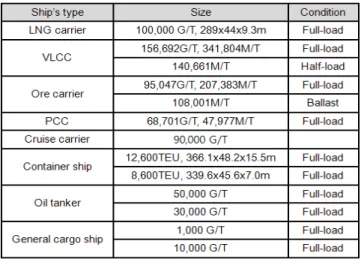
The ship models developed in this paper are represented by Table 1. There are thirteen (13) models. The following are LNG carrier, VLCCs of full load and half load, ore carriers of full load and ballast, PCC, cruise ship, 12,000 TEU container ships of more than 12,000TEU and 9,000 TEU, oil tankers of 30,000GT and 50,000 GT, general cargo ships of 1,000GT and 10,000 GT. The models are based on Japanese MMG.
Table 1 Ship models developed
Considering that the piloting maneuvers are done mainly at a low speed, not at a full speed or sea speed, these models are developed. The speed of each stage due to engine telegraph was determined and the time to reach the speed of each stage was also examined. The ship’s motion was based on sea trial test. Because the data of sea trial does not involve ship motions such as under the half loading or low speed condition, the ship models developed here were modified by pilots’ opinion.
3. Configuration of laptop-based pilots’
ship-handling simulator
The laptop-based pilots’ ship-handling simulator consists of two displays as shown as in Fig.2. One, which is on the left, is the conning display for maneuvering
model ships and the other, which on the right, is the electronic chart display to represent their tracks and movement data.
On the left of Fig.2, using the pop-up menu entitled
‘Scenario’, ‘Training’, and ‘Debriefing’ in small and white letters, we can choose one of them and start simulation. In the conning display there are three control buttons of
‘Information’ for describing the status of own ship’s motion,
’Tug’ for taking and controlling tugs, and ‘Ship’s particulars’ of own ship. There are also control buttons of using ‘Bow thruster’, ‘Engine telegraph’, ‘Stern thruster’ and
‘Rudder’. Meanwhile on the right there is the electronic chart describing own ship, targets, aids to navigation, land and so on. The simulation time, heading, speed, and distance to pivoting point from mid-ship are in the upper side. Fig. 2 shows that the own ship is approaching the Northern Port of Busan.
Fig. 2 Laptop based pilots’ simulation main display
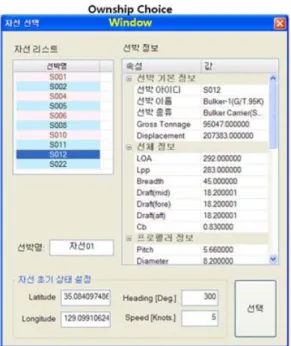
Fig. 3 Own ship choice window
Fig.3 shows ‘Own ship choice window’. Using this window we can select own ship, one of model ships developed in this study. The right describes detailed particulars of own ship chosen. On the bottom an arbitrary heading and/or speed are input as initial values.
Fig. 4 Ship’s Particular window during simulation
Fig.4 indicates the particulars of own ship during simulation. Using this window own ship’s particulars regarding type, tonnage, LOA, propeller etc can be confirmed when needed.
Tug choice window’ is given by Fig.5. This window is to determine the positions taken aboard own ship and bollard pull power of tugs. Eight (8) tugs can be taken to the maximum. Especially, the bollard pull of tugs used can be determined as much as that of the tugs available in the port, if a pilot wants. In addition tug’s positions taken onboard own ship can be chosen as appropriately as he wants.
Fig. 5 Tug choice window
Fig. 6 shows own ship with two tugs on the port bow and port stern and ‘Tug control window’. The window
describes the status of tugs used, i.e. ‘PULL’ or ‘Push’,
‘Half’ or Full’. In addition tugs can be ordered as a pilot wants by using this window.
Fig. 6 Tug control window
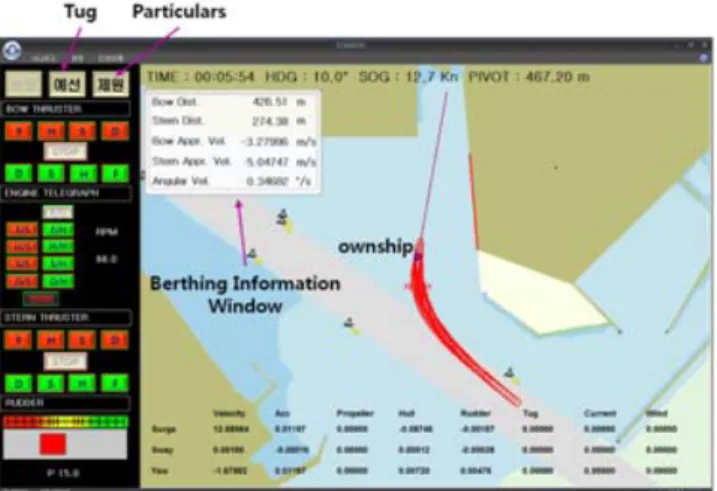
When approaching a berth, the distances to it and approaching ship’s speeds are needed. ‘Berthing information window’ is to provide a pilot with distance between bow and berth, distance from stern to berth, bow transverse speed, stern transverse speed etc. as shown in Fig. 7. On the bottom the detailed data of own ship’s motion are shown. These are the forces of longitudinal, lateral, and downward directions caused by propeller, rudder, tug, current, and wind. Because we can get the acceleration of each direction, we can predict the motion of own ship.
Fig. 7 Berthing information window
Fig. 8 shows how to get the bearing and range from own ship to a target and Fig. 9 indicates how to set a target’s route, which is determined by one of manual-input heading and speed, and adding or editing a
target’s route.
The features of main display are given by the following - Pilot-friendly arrangement
- Easy handling anytime or anywhere
- Appropriate arrangement of controlling rudder, engine, thruster, tug etc.
- Appropriate representation of information
Fig. 8 Range & bearing to target
Fig. 9 Setting target ship's route
4. Conclusions
This paper developed the laptop-based ship-handling simulator which a pilot can use anytime and anywhere.
Because the simulator display was made up in a pilot-friendly form, any pilot who is not familiar with a laptop computer can easily use it.
Considering that the screen of a laptop computer is small, the display was arranged to the maximum if possible. In addition an adequate color matching was given to be visible well.
Problems in use will be solved in further study. The prediction of own ship motion will be added.
References
1) Huh, Y. B. & Yoon, J. D.(1996), “A Study on the Development of PC-based Desk-top Ship Maneuvering Simulator for Training Purpose”, Journal of Korean Institute of Navigation, Vol. 20, No. 2, pp. 1-13.
2) Horton, I.(2008), Ivor Horton’s Beginning Visual C++, Wrox, pp. 646-650.
3) Jeong et al(2011), ”Development of Desk-top Tug-Barge Simulator and Evaluation Module”, Journal of Navigation and Port Research, Vol. 35, No. 2, pp. 113-119.
4) Jeong, T. G. et al(2011), "Development of Laptop-based Pilots' Ship-handling Simulator", 2012 Autumn Conference Proceedings of Korean Institute of Navigation and Port Research, pp. 136-138.
5) Lewis, E. O.(1989), Principles of Naval Architecture, 2nd edition, Volume III Motions in Waves and Controllability, The Society of Naval Architects and Marine Engineers, p. 194.
6) Vlissides, J.(2007), Design Patterns : Elements of Reusable Object-Oriented Software, Addison-Wesley Professional, pp. 214-216.
Received 29 May 2012 Revised 14 September 2012 Accepted 20 September 2012