• 검색 결과가 없습니다.

양극산화를 사용한 TiO2 마이크로/나노 구조체 제조 및 리튬 이온 전지 음극재로의 응용 연구

N/A
N/A
Protected

Academic year: 2021

Share "양극산화를 사용한 TiO2 마이크로/나노 구조체 제조 및 리튬 이온 전지 음극재로의 응용 연구"

Copied!
10
0
0

로드 중.... (전체 텍스트 보기)

전체 글

(1)

Review https://doi.org/10.14478/ace.2021.1020

1. Introduction 1)

With the transition from fossil fuel consumption to renewable en- ergy, extensive research is being conducted on the development of en- ergy storage and conversion systems that permit the effective use of intermittent renewable energy sources. Among the several types of en-

† Corresponding Author: Inha University,

Department of Chemistry and Chemical Engineering, Incheon 22212, Korea Tel: +82-32-860-8910 e-mail: [email protected]

pISSN: 1225-0112eISSN: 2288-4505 @ 2021 The Korean Society of Industrial and Engineering Chemistry. All rights reserved.

ergy storage and conversion systems in use, lithium-ion batteries (LIBs), which convert chemical energy to electrical energy and vice versa through electrochemical reactions between active materials, have be- come the primary option owing to their valuable properties, such as high energy density, high operating voltages, limited self-discharging, and low maintenance requirements[1-3]. In conventional LIBs, the cells are assembled with a carbonaceous anode and lithiated metal oxide cathode (LiCoO

2

and LiNiO

2

) with a porous membrane separator im- mersed in a lithium salt and mixed with liquid alkyl carbonates[4-6].

Currently, graphite is the most widely used anode material in LIBs be- cause of its abundance, low production cost, and charge-discharge cy-

양극산화를 사용한 TiO 2 마이크로/나노 구조체 제조 및 리튬 이온 전지 음극재로의 응용 연구

김용태⋅최진섭

인하대학교 화학공학과

(2021년 3월 12일 접수, 2021년 3월 31일 수정, 2021년 4월 6일 채택)

Anodically prepared TiO 2 Micro and Nanostructures as Anode Materials for Lithium-ion Batteries

Yong-Tae Kim

and Jinsub Choi

Department of Chemistry and Chemical Engineering, Inha University, Incheon 22212, Korea (Received March 12, 2021; Revised March 31, 2021; Accepted April 6, 2021)

초 록

전기자동차(EV) 및 중대형 에너지 저장 장치(ESS)의 활용을 위한 차세대 에너지 저장 장치에 대한 요구가 증가함에 따라, 높은 출력 및 안정성 등의 특성을 갖는 리튬 이온 전지 개발이 시급한 과제로 떠오르고 있다. 리튬 이온 이차

전지의 성능은 주로 전극 재료의 물리/화학적 특성에 의해 결정되는데, TiO

2

는 우수한 안정성 및 높은 안정성, 친환경

적 특성으로 인해 현재 상용화된 탄소계 음극재를 대체할 수 있는 물질로 높은 관심을 받고 있다. 특히, 양극산화를

통해 제조된 자기 정렬된 TiO

2

마이크로 및 나노 구조는 차세대 리튬 이온 이차 전지의 유망한 음극 소재 물질로 많은

연구가 이루어지고 있다. 본 총설 논문에서는 양극산화를 통한 TiO

2

나노 튜브 및 마이크로콘 구조 메커니즘 및 구조

발달에 영향을 미치는 인자에 대한 설명을 다루었다. 또한, TiO

2

의 낮은 전기전도도 및 용량 한계를 극복하기 위한

TiO

2

기반 복합체를 리튬 이온 이차 전지의 음극재로 활용한 연구를 소개하였다.

Abstract

With increasingly strict requirements for advanced energy storage devices in electric vehicles (EVs) and stationary energy storage systems (EES), the development of lithium-ion batteries (LIBs) with high power density and safety has become an urgent task. Because the performance of LIBs is determined primarily by the physicochemical characteristics of its electrode material, TiO

2

, owing to its excellent stability, high safety levels, and environmentally friendly properties, has received sig- nificant attention as an alternative material for the replacement of commercial carbon-based anode materials. In particular, self-organized TiO

2

micro and nanostructures prepared by anodization have been intensively investigated as promising anode materials. In this review, the mechanism for the formation of anodic TiO

2

nanotubes and microcones and the parameters that influence their morphology are described. Furthermore, recent developments in anodic TiO

2

-based composites as anode elec- trodes for LIBs to overcome the limitations of low conductivity and specific capacity are summarized.

Keywords: Lithium-ion batteries, Anode, TiO

2

, Nanotubes, Microcones

(2)

cle stability[7]. However, as the use of LIBs expands from portable electronic devices to large-scale energy storage systems (ESSs) and electric vehicles (EVs), the current commercial graphite anode cannot meet the increasing demand for such applications due to its moderate intrinsic specific capacity (372 mAh g

-1

), sluggish Li

+

diffusion co- efficient, and safety issues that arise from the formation of lithium dendrites, especially under the operating conditions of high current rates resulting from its high polarization and low operating voltage of

~0.1 V vs. Li/Li

+

[8,9]. Consequently, the development of new gen- eration anode materials that possess characteristics of high power and energy density, stable cyclability, and can operate with sufficient safety at high current density is urgently required[10,11].

Among the several candidate groups for use as next-generation anode materials such as lithium metal and Si and graphene-based materials, titanium-based compounds including Li

4

Ti

15

O

12

and TiO

2

are regarded as promising alternative anode materials for high power density LIBs owing to their advantages of high rate capability, safety, environmental friendliness, and low cost[11,12]. Compared with graphite, titanium-based anode electrodes possess a three-dimensional crystal lattice in which Li

+

ions are easily (de)intercalated. They also exhibit a high operating potential of ~1.5~1.7 V vs. Li/Li

+

within the electrochemical window of typical LIB electrolytes, which ensures the excellent safety of LIBs by suppressing the formation of lithium dendrites even under fast charge rates above 20 C[13,14]. Furthermore, owing to their outstanding structural stability, they exhibit negligible or little volume expansion (0.1% lattice strain) during cycling, significantly less than that exhibited by graphite (~10%), leading to excellent cycling properties. Notably, Li

4

Ti

15

O

12

-based electrodes have previously been used for fast charging applications in Toshiba batteries (SCiB) and Mitsubishi electric vehicles (i-MiEV) [15]. Among the eight known polymorphs of TiO

2

(rutile, anatase, brookite, TiO

2

-B, TiO

2

-R, TiO

2

-H, TiO

2

-II, TiO

2

-III), rutile, anatase, and TiO

2

-B have been most widely investigated as anode ma- terials for LIBs because of their thermodynamically (meta)stable na- ture[1,16,17]. The typical lithium intercalation-deintercalation reaction that occurs during the electrochemical process on the TiO

2

anode is de- scribed by [12,18].

TiO

2

+ xLi

+

+ xe

-

↔ LixTiO

2

(0 ≤ x ≤ 1) (1)

where the value x representing the molar fraction is largely influenced by the crystallinity, particle size, morphology, surface area, and the in- volved polymorph[19].

There are numerous approaches to the preparation of TiO

2

micro and nanostructures as anode materials for LIBs, such as anodization, sol-gel, templating, and hydrothermal methods, microwave irradiation, and al- kaline synthesis[20-25]. Among these, electrochemical anodization is the simplest, most straightforward, and cost-effective strategy to obtain diverse TiO

2

micro and nanostructures on Ti substrates. This method involves controlling experimental conditions such as applied voltage, temperature, and electrolyte composition to alter the dimensions of the obtained structural morphologies. In this review, we will briefly dis- cuss: the mechanism of formation of TiO

2

micro and nanostructures

through electrochemical anodization, with a focus on nanotubes and microcones, and the parameters that determine the type or morphology of the oxide structures. An overview of the electrochemical perform- ance of anodic TiO

2

micro and nanostructures as anode materials for LIBs is also provided.

2. Anodic TiO

2

Nanotubes

2.1. Mechanism for the preparation of TiO

2

nanotubes via ano- dization

Anodization is a conventional technique in use for more than a cen- tury to form an oxide layer on the surface of a metal substrate. It is generally performed in a two-electrode system where the valve metal functions as the working electrode (anode) and platinum or carbon is the counter electrode (cathode), by applying a specific voltage in aque- ous or organic electrolytes. After early reports on the anodization of pure Ti or Ti-6Al-4V in a chromic acid-based electrolyte by Zwilling et al. in 1999[26] and the synthesis of well-defined nanotube arrays on a Ti substrate in 0.5 to 3.5 wt% aqueous hydrofluoric acid (HF) by Gong et al. in 2001[27], intensive studies have been carried out to op- timize the parameters affecting the dimensions of the fabricated oxide structures and to elucidate the formation mechanism[28-32]. During anodization, barrier- or porous-type anodic TiO

2

is formed on the sur- face of the Ti substrate depending on the nature of the electrolyte[33].

Typically, barrier-type oxides are formed when electrolytes containing no fluoride, perchlorate, chloride, or bromide ions are used, and the thickness of the oxide layer is proportional to the applied voltage (2.5 nm V

-1

) owing to the movement of ions under an applied electric field, known as field-assisted oxidation[33,34]. However, in an electrolyte containing fluoride ions (F

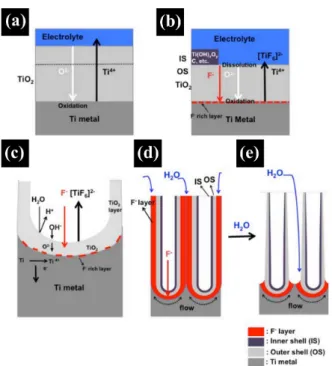
-

), as shown in Figure 1, field-assisted oxi- dation [Eq. (2)~(4)] and field-assisted dissolution [Eq. (5)~(7)] play important roles in forming a porous or tubular structured oxide layer.

Ti

4+

+ 4OH

-

→ Ti(OH)

4

(2)

Ti

4+

+ 2O

2-

→ TiO

2

(3)

Ti(OH)

4

→ TiO

2

+ 2H

2

O (4)

TiO

2

+ 6F

-

+ 4H

+

→ TIF

62-

+ H

2

O (5)

Ti(OH)

4

+ 6F

-

→ TiF

62-

+ 4OH

-

(6)

Ti

4+

+ 6F

-

→ TiF

62-

(7)

Oxygen anions (O

2-

) generated by the deprotonation of H

2

O by the induced electric field migrate from the electrolyte to the interface be- tween the metal and the oxide layer, where they combine with Ti

4+

ions dissolved from the Ti surface resulting in the growth of an addi-

tional oxide layer. Furthermore, because F

-

exists in the electrolyte, the

highly water-soluble [TiF

6

]

2-

complex is produced through the com-

plexation reaction of F

-

with Ti

4+

as well as the chemical dissolution

(3)

Figure 1. Schematic mechanism for the formation of TiO

2

nanotubes through anodization; (a) electric-field assisted oxidation, (b), (c) initial formation of porous structure, (d), (e) formation of tubular structure by dissolving F- rich layer by water. Reproduced with permission from [36]. Copyright 2018 MDPI.

of TiO

2

by F

-

ions[35,36]. The large number of pits formed by the dis- solution of the [TiF

6

]

2-

complex work as preferential sites where the electric field is concentrated, further improving the dissolution of the oxide layer to form porous or tubular TiO

2

structures[37]. In particular, the formation of nanotubes can be attributed to the generation of a flu- oride-rich layer at the oxide-metal interface induced by ion migration, followed by the displacement and dissolution of the layer toward the cell boundaries by a flow mechanism[38,39]. Therefore, 1D highly or- dered TiO

2

nanotubes are formed, indicating that each nanotube is sep- arated by chemical etching at the top and bottom ends, aligned in a close-packed arrangement. In an organic electrolyte containing a small amount of oxygen/water with a fluorine source such as NH

4

F at high pH, longer TiO

2

nanotubes with a better self-organized arrangement are obtained, whereas TiO

2

nanotube arrays with tube lengths below a few micrometers are formed in aqueous HF electrolytes[40,41].

Current-time transient, which is divided into three-stages, provides us important information about the formation of TiO

2

nanotube arrays during the anodization of Ti. In stage (I), the current density rapidly decreased to a minimum value as barrier oxide layer acting as high re- sistance is formed. Then, in stage (II), the current density subsequently rises to a maximum point as resistance of anodic layer decreases by nucleation of the pores. Finally, in stage (III), the current density is maintained or decreased slightly, indicating that a stead state where the formation and dissolution at the oxide/electrolyte interface are equal is reached[33].

2.2. Anode materials based on TiO

2

nanotubes 2.2.1. Pristine TiO

2

nanotubes

As shown in Equation (1), the lithium intercalation-deintercalation reaction occurring in the potential range of 1.4~1.8 V vs. Li/Li

+

results in a maximum theoretical capacity of 335 mAh g

-1

, where 1 M Li

+

is intercalated per 1 mol TiO

2

, and is comparable to that of graphite at 372 mAh g

-1

[42]. However, the typical amount of intercalated Li

+

for anatase is 0.5 mol per 1 mol TiO

2

[43]. The electrochemical properties of TiO

2

as an anode are significantly influenced by its morphology. In nanotubular structures, the porous structure permits the facile approach of Li

+

ions to the electrode by reducing the movement pathway.

Therefore, the polarization of the anode electrode decreases, allowing fast charging and discharging at a high current rate[1]. The perpendicu- lar orientation of TiO

2

nanotubes grown on a Ti substrate also has a positive effect on the electrochemical performance of LIBs. In 2012, Han et al. systematically explored the effect of the contact resistance between the active material and current collector by fabricating electro- des comprising vertically aligned and randomly oriented TiO

2

nano- tubes[44]. The aligned TiO

2

nanotubes show a six-fold increase in ca- pacity at a 10 C rate compared to randomly oriented TiO

2

nanotube electrodes with a 10 wt% conducting agent because of the good elec- trical contact between TiO

2

as the active material and Ti foil as the current collector. Additionally, crystallinity is an important factor that affects the electrochemical performance of TiO

2

anode electrodes for LIBs. The anatase and TiO

2

(B) phases offer more facile uptake of Li

+

ions than rutile structures[42,43]. The anatase phase transformation de- velops from a tetragonal to an orthorhombic phase via spontaneous phase separation[45]. Several studies have demonstrated that amor- phous TiO

2

nanotubes exhibit superior specific capacity and rate capa- bility compared to crystalline TiO

2

(anatase) nanotubes with similar di- mensions due to the high lithium-ion diffusivity owing to the larger number of disordered defects in the amorphous state[46-48].

2.2.2. TiO

2

nanotube composites

Despite the advantages of structural stability, low volume expansion

during lithium intercalation-deintercalation, and stable capacity retention

of TiO

2

nanotube composites which make it suitable for EV and sta-

tionary storage applications, the commercialization of LIBs based on

TiO

2

anode materials is still hindered by several drawbacks, such as

poor electric conductivity, low ionic diffusivity, the strong repulsive

force of Li

+

ions, and low theoretical capacity. Extensive investigations

on TiO

2

nanotube composites with high electronic conductivity (e.g.,

carbon-based materials such as graphene) or high capacity (e.g., Si- or

transition metal oxide-based materials) have been carried out to over-

come the limitations of pristine TiO

2

nanotubes as anode electrodes for

LIBs. In 2020, Gao et al. synthesized boron-doped graphene/TiO

2

nano-

tubes via anodization following an electron-assisted hot-filament plas-

ma chemical vapor deposition route, by controlling the morphology of

graphene and oxygen contamination, which improved the conductivity

of TiO

2

nanotubes[49]. Additionally, Menéndez et al. reported an elec-

trophoretic approach that allowed the preparation of self-organized TiO

2

/

graphene heterostructures with a capacity of over 200 mAh g

-1

after

(4)

Figure 2. SEM images of TiO

2

nanotubes (a), (b) before and (c), (d) after spray coating of Co

3

O

4

/CuO. (e) EPMA mapping images of TiO

2

nanotube composite; Ti, Co, Cu, and O. (f) Electrochemical per- formance of TiO

2

nanotube composite with Co

3

O

4

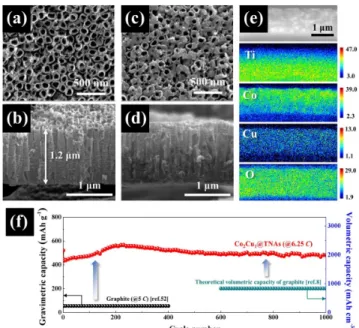
/CuO at high current density. Reproduced with permission from [51]. Copyright 2018 WILEY-VCH Verlag GmbH & Co. KGaA, WEINHEIM.

100 cycles, higher than that of pristine TiO

2

nanotubes[50]. The ob- tained electrode exhibited a capacity above 50 mAh g

-1

at extremely high rates close to 300 C owing to an apparent reduction in charge transfer resistance within the heterostructure.

In 2018, Kim et al. prepared and studied Co

3

O

4

/CuO@TiO

2

compo- sites by spray coating an anodic TiO

2

substrate using CuCl

2

and CoCl

2

solutions at various molar concentrations[51]. Co

3

O

4

has a high theo- retical specific capacity of 890 mAh g

-1

with a significant volume ex- pansion rate of ~300% during the charge/discharge process. In contrast, CuO has relatively good conductivity and an adequate theoretical spe- cific capacity of 670 mAh g

-1

with a relatively low volume expansion of ~174%. As shown in Figure 2, after five repeated spray and calcina- tion steps, crystalline Co

3

O

4

and CuO were uniformly decorated and anchored onto the TiO

2

nanotubes, imparting extraordinary rate capa- bility and volumetric capacity at optimized molar ratios of Co

3

O

4

and CuO by the synergetic effects of enhanced capacity and cycling stability. However, owing to the limitations of the spray coating techni- que, TiO

2

nanotubes shorter than 1 µm were required. To overcome this drawback, in 2021 Heo et al. succeeded in preparing 10-µm-thick TiO

2

nanotubes decorated with MoO

3

via cyclic voltammetry (CV), as shown in Figure 3(a)~(g)[52]. In this work, an ammonium molybdate tetrahydrate aqueous electrolyte with various concentrations was used for CV at a scan rate of 5 mV s

-1

. The as-prepared electrode, which was annealed at 450 ℃ for 2 h under an Ar atmosphere, exhibited a high specific capacity of 451 mAh g

-1

at a rate of 1 C after 150 cycles and capacity retention of 97% at a rate of 5 C over 500 cycles owing to the superior theoretical capacity of MoO

3

(~1117 mAh g

-1

) and the role of TiO

2

nanotubes in buffering the large volume expansion of

MoO

3

[Figure 3(h)~(i)].

3. Anodic TiO

2

Microcones

3.1. Parameters affecting the formation of TiO

2

microcones The physical properties and electrochemical performances of TiO

2

structures are significantly influenced by their morphology: 0-dimen- sional nanoparticles, 1-dimensional nanorods or nanowires, and 3-di- mensional porous structures. In anodization, diverse morphological TiO

2

structures can be obtained, including mesosponge and fishbone types, by adjusting experimental conditions such as the electrolyte, ap- plied voltage, and temperature[53,54]. In 2016, Park et al. reported a new anodization approach for the preparation of hollow crystalline TiO

2

microcones composed of multilayered nanofragments in H

2

SO

4

(or H

3

PO

4

) based aqueous electrolytes containing HF[55]. The formation mechanism of this method is slightly different from that of nanotubes because of the presence of H

2

SO

4

; although not critically affected by concentration, H

2

SO

4

is essential for the formation of microcone structures. The presence of SO

42-

ions accelerates the formation of TiO

2

, which makes the surface inhomogeneous and contributes to the formation of a thick oxide layer[56,57]. Furthermore, tiny cracks in the oxide surface occur because of the competitive dissolution reaction of F

-

and SO

42-

ions. Therefore, considerable compressive stress is gen- erated in the oxide layer resulting from volume expansion; this force pushes the oxide layer upwards and downwards for compensation, leading to the formation of TiO

2

microcone structures [Figure 4(a)].

The primary parameters that lead to the formation of TiO

2

micro- cones instead of barriers or nanotubes were investigated with respect to the applied voltage, concentration, and composition of the electrolyte.

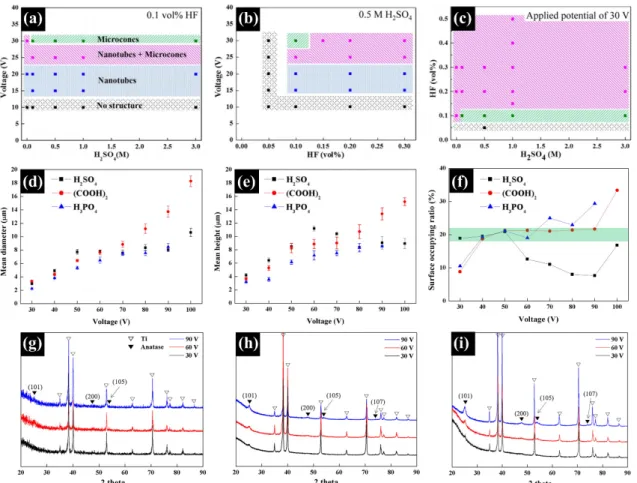
As shown in Figure 4(b)~(f), when the applied voltage increases, the morphology of the TiO

2

transforms from the barrier oxide layer to nanotubes and finally to microcones. Interestingly, the threshold volt- age at which microcones are obtained is lower in the H

2

SO

4

-based electrolyte (30 V) than in the H

3

PO

4

-based electrolyte (45 V) because of the lower pH of the H

2

SO

4

electrolyte. The critical factor for the formation of microcones is the concentration of HF. As the F

-

ions ren- der the oxide layer porous by forming a [TiF

62-

] complex and dissolv- ing the oxide layer, a specific suitable range of HF concentration is re- quired to obtain microcone structures[58]. Additionally, a minimum concentration of H

2

SO

4

is required to initiate the nucleation of micro- cones [Figure 5(a)~(c)].

As opposed to the electrolytes based on H

2

SO

4

or H

3

PO

4

, an electro- lyte based on (COOH)

2

results in the formation of TiO

2

microcones with a larger mean height and diameter of 15 and 18 µm, respectively.

In (COOH)

2

-based electrolytes the microcone formation is linearly pro-

portional to the applied voltages, whereas they converge to approxima-

tely 8 µm using the other electrolytes [Figure 5(d)~(e)][59]. Notably,

the ratio of the surface area occupied by well-dispersed and fully grown

TiO

2

microcones is approximately 20%, regardless of the applied volt-

age or type of electrolyte. In particular, the electrolyte based on

(COOH)

2

can be used in a wider range of applied voltages than other

electrolytes, resulting in well-dispersed TiO

2

microcones, and demon-

(5)

strating that (COOH)

2

is more suited to prepare TiO

2

microcones than H

2

SO

4

or H

3

PO

4

[Figure 5(f)]. The phase of the obtained anodic TiO

2

microcones is another unique physical characteristic. Typically, the phase of TiO

2

structures prepared by anodization is strongly dependent on the specific electrochemical conditions during fabrication, including applied voltage, time, and temperature; however, in many cases, they are amorphous[60,61]. Therefore, an additional annealing process is re- quired to transform the phases from amorphous to anatase at approx- imately 300~400 ℃, and from anatase to rutile at temperatures of 500

~700 ℃. However, as shown in Figure 5(g)~(i), anodic TiO

2

micro- cones prepared in H

2

SO

4

, H

3

PO

4

, or (COOH)

2

-based aqueous electro- lytes containing HF are already composed of anatase phases without a subsequent annealing step, which is likely attributable to the higher ap- plied voltages than that required for the formation of nanotubes.

3.2. Anode materials based on TiO

2

microcones

The first application of TiO

2

microcones as anode electrodes for LIBs was reported by Rhee et al. in 2016[55]. As demonstrated in

their pioneering report, anodic hollow crystalline microcone structures were prepared by anodization using a mixture of 1 M H

3

PO

4

and 0.5 wt% HF. The obtained microcones were perpendicularly oriented on Ti foil with an average diameter of 7.2 µm and 8.74 µm [Figure 6(a)].

Notably, the sidewall of the microcones was composed of several mul- tilayered nanofragments from the bottom upwards, leading to a large surface area where Li

+

ions could be stored [Figure 6(b)~(c)]. Electro- chemical measurements showed that the as-prepared TiO

2

microcones exhibited a much higher areal capacity with excellent rate capability up to 50 C and reliable capacity retention compared to anodic TiO

2

nano- tubes prepared by anodization at 20 V for 4 h in an aqueous solution containing 1 M H

3

PO

4

, 1 M NaOH, and 0.1% HF, as well as other types of TiO

2

electrodes [Figure 6(d)~(e)]. These results can be as- cribed to the large surface area and facile diffusion of Li

+

ions through the hollow multilayered nanofragment structures. In addition, in 2020, Kim et al. reported the inverse-direction growth of TIO

2

microcones via subsequent anodization in trace concentrations of HClO

4

without altering the overall microcone structure and crystallinity[62]. As shown Figure 3. SEM images of TiO

2

nanotubes (a), (c), (e) before and (b), (d), (f) after cyclic voltammetric coating of Mo

3

O

3

. (e) Cross-sectional SEM-EDS mapping image; Ti, Mo, and O. Electrochemical performance of MoO

3

-coated TiO

2

nanotubes; (h) cycling stability of electrode prepared with different concentration of ammonium molybdate tetrahydrate, (i) rate capability of the electrode at various current densities ranging from 0.1 to 25 C. Reproduced with permission from [52]. Copyright 2021 ELSEVIER SCIENCE INC.

Figure 4. (a) Schematic mechanism for the formation of TiO

2

microcones. SEM images of TiO

2

nanostructures formed at different voltages demonstrating transforming from nanotubes to microcones; (b) 10, (c) 15, (d) 20, (e) 25, and (f) 30 V. Reproduced with permission from [56].

Copyright 2017 The Electrochemical Society.

(6)

Figure 5. Parameters affect morphological transitions of self-organized TiO

2

nanostructures; (a) in 0.1 vol.% HF, (b) in 0.5 M H

2

SO

4

, (c) at 30 V. Variation of (d) mean diameters and (e) mean heights of TiO

2

microcones prepared in different electrolytes for 1 h as a function of applied voltage. (f) Surface occupancy ratio of TiO

2

microcones prepared in different electrolytes as a function of applied voltage. XRD patterns showing crystallinity of TiO

2

microcones anodized at different voltages in (a) H

2

SO

4

, (b) (COOH)

2

, and (c) H

3

PO

4

. Reproduced with permission from [56]

and [59]. Copyright 2017 The Electrochemical Society, and Copyright 2018 ELSEVIER SCIENCE INC.

Figure 6. TiO

2

microcones anodized at 60 V in 1 M H

3

PO

4

aqueous electrolyte with 0.5 wt% HF; (a) SEM and (b) TEM images, (c) schematic

diagram of Li

+

ions diffusing into microcones. Electrochemical performance of TiO

2

microcones as anode electrodes; (d) area capacity at current

density of 0.1 mA cm

-2

, (e) rate performance at rates from 0.5 to 50 C. (f) SEM images of TiO

2

microcones at the bottom side showing inverse-direction

growth of protruding nanoparticles. Electrochemical performance of TiO

2

microcones after second anodization; (g) charge-discharge curves of electrode

prepared with different concentration of HClO

4

, (h) Comparison of areal capacity of TiO

2

microcones compared to other type electrodes based

on TiO

2

material. Reproduced with permission from [55] and [62]. Copyright 2016 American Chemical Society, and Copyright 2018 WILEY-VCH

Verlag GmbH & Co. KGaA, WEINHEIM.

(7)

in Figure 6(f), after the second anodization step, the underlying hemi- spherical morphology of the bottom surface of the TiO

2

microcones transformed from a bumpy to a plump surface with a large number of protruding nanoparticles, permitting the storage of large amounts of Li

+

ions. They observed that these protruding nanoparticles were fabricated by the reaction of trace concentrations of perchlorate ions with Ti

4+

at the interface between the metal and oxide layer. Therefore, owing to the increased active surface area, the HClO

4

-treated TiO

2

electrode shows 1.6 times higher areal capacity than that of pristine TiO

2

micro- cones with excellent cycling stability and capacity retention [Figure 6(g)~(h)].

Other strategies to overcome the limitations of pristine TiO

2

as anode materials have also been developed by combining them with foreign materials with high conductivity or specific capacity. In 2018, Park et al. demonstrated the synthesis of rGO-coated TiO

2

microcones via electrophoretic deposition followed by CV for use in LIBs[63]. They attempted several approaches to reduce GO to rGO coated on TiO

2

mi- crocones by electrophoretic deposition, including hydrothermal, catho- dic reduction, and annealing treatment in a H

2

/Ar atmosphere. These approaches to reduce GO to rGO have several drawbacks, such as the need for hazardous hydrazine hydrate, the aggregation of GO, and de- tachment of TiO

2

microcones from the Ti substrate. Therefore, they ap- plied CV to successfully reduce GO to rGO without damaging the TiO

2

microcone aggregation of GO [Figure 7(a)]. In an optimized po- tential range of -1.0~0.8 V, where the reduced GO was reoxidized to GO during the backward scan, TiO

2

microcones evenly coated with rGO were obtained by one CV cycle. As anode materials for LIBs, the obtained rGO-coated TiO

2

microcones showed a higher discharge ca- pacity of 235 mAh g

-1

compared to that of pristine TiO

2

microcones

(181 mAh g

-1

). Additionally, the rGO-coated TiO

2

microcone electrode delivered a discharge capacity of 157 mAh g

-1

even at an ultrafast rate of 10 C (and of 88 mAh g

-1

at 50 C) with a capacity fading rate of only 0.02% per cycle for 1000 cycles owing to the decreased charge transfer resistance from 64.65% to 25.13 Ω [Figure 7(b)~(d)].

In 2019, Yoo et al. succeeded in preparing a SnO

2

-TiO

2

composite by decorating SnO

2

on a TiO

2

microcone substrate by the potential shock method using a 0.4 Na

2

SnO

3

H

2

O electrolyte in the potential range of 10~80 V for 10 s[64]. SnO

2

is known as a potential anode material for LIBs with a high theoretical capacity of 780 mAh g

-1

and a volume expansion ratio of ~150%. It was confirmed that amorphous SnO

2

was deposited in the valleys between the crystalline microcones and their hollow cores, demonstrating that SnO

2

is encapsulated by the TiO

2

shell. Therefore, the large volume expansion of SnO

2

during the charge/discharge process is effectively suppressed by counteracting the TiO

2

microcone shell, achieving a specific capacity of over 500 mAh g

-1

with excellent cycling stability over high current densities.

4. Others

Plasma electrolytic oxidation (PEO) is another type of anodization

that involves a complex process of plasma-assisted electrochemical

conversion of a metal surface to produce thick, hard, and well-adhered

solid products of electrolysis and adsorbed gel layers at the surface of

metals at high discharge temperatures and pressures[65,66]. In 2017,

Lee et al. reported partially crystalline anodic TiO

2

where SiO

2

was

uniformly composited over the entire oxide through the PEO of Ti foil

using an aqueous electrolyte containing H

2

SO

4

and Na

2

SiO

3

with ionic

conductivity below ~50 mS cm

-1

[67]. During the PEO process, during

Figure 7. (a) HR-TEM image of rGO-decorated TiO

2

microcones via cyclic voltammetric reduction. Electrochemical performance of rGO-decorated

TiO

2

microcone electrode; (b) galvanostatic charge-discharge curves, (c) long-term cycling stability at 10 C, (d) Nyquist plots. Reproduced with

permission from [63]. Copyright 2018 American Chemical Society.

(8)

the formation of the microporous TiO

2

layer, SiO

32-

ions migrated and were incorporated into the oxide layer owing to the strong electric field and subsequently oxidized to SiO

2

at high temperatures. These micro- porous structures caused by plasma bubbles during the PEO process fa- cilitated the movement of Li

+

and suppressed massive volume ex- pansion during cycling [Figure 8(a)~(c)]. As a promising anode elec- trode, as shown in Figure 8(d), the binder-free SiO

2

/TiO

2

composite film exhibits twice the capacity with stable cycling stability over more than 250 cycles owing to the high content of SiO

2

(≈ 25%) and du- rable structural properties with a low volume expansion rate of TiO

2

. More recently, in 2019, Jie et al. fabricated TiO

2

/SiO

2

composite by the one-step plasma discharge in an alkaline electrolyte for 2 min with- out post annealing process[68]. The core temperature ranging from 3000 to 5000 K facilitates the formation of composite film composed of crystalline TiO

2

with uniformly distributed amorphous SiO

2

within a short period of time. Due to the porous characteristic offering suffi- cient diffusion paths for Li

+

ions, intrinsic properties of TiO

2

with high stability and SiO

2

with high specific capacity, the obtained electrode exhibits an excellent cycling stability and rate capability with capacity above 400 mAh g

-1

at the current density of 100 µA cm

-2

.

5. Conclusions

TiO

2

micro and nanostructures prepared by anodization are promis- ing alternatives for carbon-based anode electrodes for developing next-generation LIBs with high power density and safety owing to their intrinsic characteristics of large surface area and short diffusion path of Li

+

ions. TiO

2

nanotubes grown in an electrolyte containing F

-

ions are obtained as highly ordered tubular structures via field-assisted oxidation and dissolution along with a plastic flow model. The dimen- sions of the nanotubes are determined by experimental conditions, in- cluding applied potential, temperature, and type of electrolyte. However, for the preparation of TiO

2

microcones, the existence of other anions such as (COOH)

-

, SO

42-

, or PO

43-

with higher applied potential is essen- tial to form a thick oxide layer that contributes to the formation of conical structures by pushing the oxide layer up and down to compen-

sate for the high compressive stress generated. Typically, unlike anodic TiO

2

nanotubes that exhibit an amorphous phase, anodic TiO

2

micro- cones exhibit an anatase phase owing to their higher applied potentials.

Anodic TiO

2

micro and nanostructural electrodes without binders show moderate electrochemical performance in LIBs using a Ti sub- strate as a current collector. Specifically, their capacity using micro- cones is three times higher than that using nanotubes because of their large surface area and structural stability. However, to overcome the intrinsic drawbacks of TiO

2

including low electrical conductivity and capacity, several intensive studies have been performed to develop TiO

2

composites with materials having high conductivity or specific capacity. In this review, we summarize recently reported anode electro- des comprising anodic TiO

2

structures in which foreign materials were introduced to improve the specific capacity of TiO

2

and suppress the volume expansion of these high-specific-capacity materials.

Acknowledgments

This research was supported by the Basic Science Research Program through the National Research Foundation of Korea (NRF) funded by the Ministry of Education (2020R1I1A1A01064020).

References

1. M. Madian, A. Eychmüller, and L. Giebeler, Current advances in TiO

2

-based nanostructure electrodes for high performance lithium ion batteries, Batteries, 4, 7 (2018).

2. B. Scrosati and J. Garche, Lithium batteries: Status, prospects and future, J. Power Sources, 195, 2419-2430 (2010).

3. X. Zuo, J. Zhu, P. Müller-Buschbaum and Y.-J. Cheng, Silicon based lithium-ion battery anodes: A chronicle perspective review, Nano Energy, 31, 113-143 (2017).

4. M. S. Whittingham, Lithium batteries and cathode materials, Chem.

Rev., 104, 4271-4302 (2004).

5. J. W. Fergus, Recent developments in cathode materials for lith- ium ion batteries, J. Power Sources, 195, 939-954 (2010).

6. J. Islam, F. I. Chowdhury, J. Uddin, R. Amin, and J. Uddin, Review

Figure 8. (a) Schematic illustration for the formation of porous SiO

2

/TiO

2

composite film by PEO. SEM images (b) without and (c) with sodium

metasilicate. (d) Electrochemical areal capacity and long-term stability of SiO

2

/TiO

2

composite electrode compared to other electrodes based on

TiO

2

materials. Reproduced with permission from [67]. Copyright 2017 WILEY-VCH Verlag GmbH & Co. KGaA, WEINHEIM.

(9)

on carbonaceous materials and metal composites in deformable electrodes for flexible lithium-ion batteries, RSC Adv., 11, 5958- 5992 (2021).

7. C. Wang, A. J. Appleby, and F. E. Little, Charge-discharge stabil- ity of graphite anodes for lithium-ion batteries, J. Electroanal.

Chem., 497, 33-46 (2001).

8. Y. Wu, C. Jiang, C. Wan, and E. Tsuchida, Effects of catalytic ox- idation on the electrochemical performance of common natural graphite as an anode material for lithium ion batteries, Electro- chem. Commun., 2, 272-275 (2000).

9. C. Uhlmann, J. Illig, M. Ender, R. Schuster, and E. Ivers-Tiffée, In situ detection of lithium metal plating on graphite in experi- mental cells, J. Power Sources, 279, 428-438 (2015).

10. C. Zhang, S. Liu, Y. Qi, F. Cui, and X. Yang, Conformal carbon coated TiO

2

aerogel as superior anode for lithium-ion batteries, Chem. Eng. J., 351, 825-831 (2018).

11. D. P. Opra, S. V. Gnedenkov, and S. L. Sinebryukhov, Recent ef- forts in design of TiO

2

(B) anodes for high-rate lithium-ion bat- teries: A review, J. Power Sources, 442, 227225 (2019).

12. Z. Weng, H. Guo, X. Liu, S. Wu, K. Yeung, and P.K. Chu, Nano- structured TiO

2

for energy conversion and storage, RSC Adv., 3, 24758-24775 (2013).

13. C. Huang, S.-X. Zhao, H. Peng, Y.-H. Lin, C.-W. Nan, and G.-Z.

Cao, Hierarchical porous Li

4

Ti

5

O

12

-TiO

2

composite anode materials with pseudocapacitive effect for high-rate and low-temperature ap- plications, J. Mater. Chem. A, 6, 14339-14351 (2018).

14. Y. Wang, Y.-x. Zhang, W.-J. Yang, S. Jiang, X.-w. Hou, R. Guo, W. Liu, P. Huang, J. Lu, and H.-t. Gu, Enhanced rate performance of Li

4

Ti

4

O

12

anode for advanced lithium batteries, J. Electrochem.

Soc., 166, A5014 (2018).

15. S. Wang, P.-K. Lee, X. Yang, A. L. Rogach, A. R. Armstrong, and Y. Denis, Polyimide-cellulose interaction in Sb anode enables fast charging lithium-ion battery application, Mater. Today Energy, 9, 295-302 (2018).

16. Z. F. Yin, L. Wu, H. G. Yang, and Y. H. Su, Recent progress in biomedical applications of titanium dioxide, PCCP, 15, 4844-4858 (2013).

17. F. Dachille, P. Simons, and R. Roy, Pressure-temperature studies of anatase, brookite, rutile and TiO

2

-II, Am. Min., 53, 1929-1939 (1968).

18. R. van de Krol, A. Goossens, and J. Schoonman, Spatial extent of lithium intercalation in anatase TiO

2

, J. Phys. Chem. B, 103, 7151- 7159 (1999).

19. H. Zhang and J. F. Banfield, Structural characteristics and mechan- ical and thermodynamic properties of nanocrystalline TiO

2

, Chem.

Rev., 114, 9613-9644 (2014).

20. J. Macak, F. Schmidt-Stein, and P. Schmuki, Efficient oxygen re- duction on layers of ordered TiO

2

nanotubes loaded with Au nano- particles, Electrochem. Commun., 9, 1783-1787 (2007).

21. C. Bae, H. Yoo, S. Kim, K. Lee, J. Kim, M. M. Sung and H.

Shin, Template-directed synthesis of oxide nanotubes: Fabrication, characterization, and applications, Chem. Mater., 20, 756-767 (2008).

22. M. G. Choi, Y.-G. Lee, S.-W. Song, and K. M. Kim, Lithium-ion battery anode properties of TiO

2

nanotubes prepared by the hydro- thermal synthesis of mixed (anatase and rutile) particles, Electro- chim. Acta, 55, 5975-5983 (2010).

23. S. Ribbens, V. Meynen, G. Van Tendeloo, X. Ke, M. Mertens, B.

Maes, P. Cool, and E. Vansant, Development of photocatalytic ef-

ficient Ti-based nanotubes and nanoribbons by conventional and microwave assisted synthesis strategies, Microporous Mesoporous Mater., 114, 401-409 (2008).

24. L. B. Arruda, C. M. Santos, M. O. Orlandi, W. H. Schreiner, and P. N. Lisboa-Filho, Formation and evolution of TiO

2

nanotubes in alkaline synthesis, Ceram. Int., 41, 2884-2891 (2015).

25. H. Tsuchiya, J. M. Macak, I. Sieber, and P. Schmuki, Self-orga- nized high-aspect-ratio nanoporous zirconium oxides prepared by electrochemical anodization, Small, 1, 722-725 (2005).

26. V. Zwilling, E. Darque-Ceretti, A. Boutry-Forveille, D. David, M.-Y.

Perrin, and M. Aucouturier, Structure and physicochemistry of anodic oxide films on titanium and TA6V alloy, Surf. Interface Anal., 27, 629-637 (1999).

27. D. Gong, C. A. Grimes, O. K. Varghese, W. Hu, R. Singh, Z. Chen, and E. C. Dickey, Titanium oxide nanotube arrays prepared by ano- dic oxidation, J. Mater. Res., 16, 3331-3334 (2001).

28. D.-J. Yang, H.-G. Kim, S.-J. Cho, and W.-Y. Choi, Thickness-con- version ratio from titanium to TiO

2

nanotube fabricated by anod- ization method, Mater. Lett., 62, 775-779 (2008).

29. H. Tsuchiya, J. M. Macak, L. Taveira, E. Balaur, A. Ghicov, K.

Sirotna, and P. Schmuki, Self-organized TiO

2

nanotubes prepared in ammonium fluoride containing acetic acid electrolytes, Electro- chem. Commun., 7, 576-580 (2005).

30. H. Tsuchiya, J. M. Macak, A. Ghicov, L. Taveira, and P. Schmuki, Self-organized porous TiO

2

and ZrO

2

produced by anodization, Corros. Sci., 47, 3324-3335 (2005).

31. Y. Li, Q. Ma, J. Han, L. Ji, J. Wang, J. Chen, and Y. Wang, Con- trollable preparation, growth mechanism and the properties research of TiO

2

nanotube arrays, Appl. Surf. Sci., 297, 103-108 (2014).

32. S. Sreekantan, K. A. Saharudin, and L. C. Wei, Formation of TiO

2

nanotubes via anodization and potential applications for photo- catalysts, biomedical materials, and photoelectrochemical cell, IOP Conf. Ser. Mater. Sci. Eng., IOP Publishing, pp. 012002 (2011).

33. D. Regonini, C. R. Bowen, A. Jaroenworaluck, and R. Stevens, A review of growth mechanism, structure and crystallinity of anodized TiO

2

nanotubes, Mater. Sci. Eng. R Rep., 74, 377-406 (2013).

34. M. Lohrengel, Thin anodic oxide layers on aluminium and other valve metals: High field regime, Mater. Sci. Eng. R Rep., 11, 243- 294 (1993).

35. A. Jaroenworaluck, D. Regonini, C. R. Bowen, R. Stevens, and D.

Allsopp, Macro, micro and nanostructure of TiO

2

anodised films prepared in a fluorine-containing electrolyte, J. Mater. Sci., 42, 6729-6734 (2007).

36. H. Yoo, M. Kim, Y.-T. Kim, K. Lee, and J. Choi, Catalyst-doped anodic TiO

2

nanotubes: Binder-free electrodes for (photo) electro- chemical reactions, Catalysts, 8, 555 (2018).

37. G. Thompson, Porous anodic alumina: Fabrication, characterization and applications, Thin Solid Films, 297, 192-201 (1997).

38. S. Berger, S. P. Albu, F. Schmidt-Stein, H. Hildebrand, P. Schmuki, J. S. Hammond, D. F. Paul, and S. Reichlmaier, The origin for tubular growth of TiO

2

nanotubes: A fluoride rich layer between tube-walls, Surf. Sci., 605, L57-L60 (2011).

39. S. Garcia-Vergara, P. Skeldon, G. Thompson, and H. Habazaki, A flow model of porous anodic film growth on aluminium, Electro- chim. Acta, 52, 681-687 (2006).

40. J. M. Macak, H. Tsuchiya, L. Taveira, S. Aldabergerova, and P.

Schmuki, Smooth anodic TiO

2

nanotubes, Angew. Chem. Int. Ed.,

44, 7463-7465 (2005).

(10)

41. H. Tsuchiya, J. M. Macak, A. Ghicov, A. S. Räder, L. Taveira, and P. Schmuki, Characterization of electronic properties of TiO

2

nanotube films, Corros. Sci., 49, 203-210 (2007).

42. T. Fröschl, U. Hörmann, P. Kubiak, G. Kučerová, M. Pfanzelt, C.

K. Weiss, R. Behm, N. Hüsing, U. Kaiser, and K. Landfester, High surface area crystalline titanium dioxide: Potential and limits in electrochemical energy storage and catalysis, Chem. Soc. Rev., 41, 5313-5360 (2012).

43. R. Kirchgeorg, M. Kallert, N. Liu, R. Hahn, M. S. Killian, and P.

Schmuki, Key factors for an improved lithium ion storage capacity of anodic TiO

2

nanotubes, Electrochim. Acta, 198, 56-65 (2016).

44. H. Han, T. Song, E.-K. Lee, A. Devadoss, Y. Jeon, J. Ha, Y.-C.

Chung, Y.-M. Choi, Y.-G. Jung, and U. Paik, Dominant factors governing the rate capability of a TiO

2

nanotube anode for high power lithium ion batteries, ACS Nano, 6, 8308-8315 (2012).

45. M. Wagemaker, W. J. Borghols, and F. M. Mulder, Large impact of particle size on insertion reactions. A case for anatase Li

x

TiO

2

, J. Am. Chem. Soc., 129, 4323-4327 (2007).

46. S. Ivanov, L. Cheng, H. Wulfmeier, D. Albrecht, H. Fritze, and A.

Bund, Electrochemical behavior of anodically obtained titania nanotubes in organic carbonate and ionic liquid based Li ion con- taining electrolytes, Electrochim. Acta, 104, 228-235 (2013).

47. W.-H. Ryu, D.-H. Nam, Y.-S. Ko, R.-H. Kim, and H.-S. Kwon, Electrochemical performance of a smooth and highly ordered TiO

2

nanotube electrode for Li-ion batteries, Electrochim. Acta, 61, 19-24 (2012).

48. H.-T. Fang, M. Liu, D.-W. Wang, T. Sun, D.-S. Guan, F. Li, J.

Zhou, T.-K. Sham, and H.-M. Cheng, Comparison of the rate capa- bility of nanostructured amorphous and anatase TiO

2

for lithium insertion using anodic TiO

2

nanotube arrays, Nanotechnology, 20, 225701 (2009).

49. J. Gao, G. Qiu, H. Li, M. Li, C. Li, L. Qian, and B. Yang, Bo- ron-doped graphene/TiO

2

nanotube-based aqueous lithium ion ca- pacitors with high energy density, Electrochim. Acta, 329, 135175 (2020).

50. R. Menéndez, P. Alvarez, C. Botas, F. Nacimiento, R. Alcántara, J. L. Tirado, and G. F. Ortiz, Self-organized amorphous titania na- notubes with deposited graphene film like a new heterostructured electrode for lithium ion batteries, J. Power Sources, 248, 886-893 (2014).

51. N. y. Kim, G. Lee, and J. Choi, Fast-charging and high volumetric capacity anode based on Co

3

O

4

/CuO@ TiO

2

composites for lith- ium-ion batteries, Chem. Eur. J., 24, 19045-19052 (2018).

52. B. Heo, J. Ha, Y.-T. Kim, and J. Choi, 10 µm-thick MoO

3

-coated TiO

2

nanotubes as a volume expansion regulated binder-free anode for lithium ion batteries, J. Ind. Eng. Chem., 96, 364-370 (2021).

53. D. Kim, K. Lee, P. Roy, B. I. Birajdar, E. Spiecker, and P. Schmuki, Formation of a non-thickness-limited titanium dioxide mesosponge and its use in dye-sensitized solar cells, Angew. Chem., 121, 9490- 9493 (2009).

54. D. Kowalski, D. Kim, and P. Schmuki, TiO

2

nanotubes, nano- channels and mesosponge: Self-organized formation and applica- tions, Nano Today, 8, 235-264 (2013).

55. O. Rhee, G. Lee, and J. Choi, Highly ordered TiO

2

microcones

with high rate performance for enhanced lithium-ion storage, ACS Appl. Mater. Interfaces, 8, 14558-14563 (2016).

56. J. Park, G. Lee, and J. Choi, Key anodization factors for determin- ing the formation of TiO

2

microcones vs nanotubes, J. Electrochem.

Soc., 164, D640 (2017).

57. D. Li, D. Chen, J. Wang, and P. Liang, Effect of acid solution, fluoride ions, anodic potential and time on the microstructure and electronic properties of self-ordered TiO

2

nanotube arrays, Electro- chim. Acta, 207, 152-163 (2016).

58. J. M. Macák, H. Tsuchiya, and P. Schmuki, High-aspect-ratio TiO

2

nanotubes by anodization of titanium, Angew. Chem. Int. Ed., 44, 2100-2102 (2005).

59. J. Park and J. Choi, Formation of well dispersed TiO

2

microcones;

the 20% surface occupation, Appl. Surf. Sci., 448, 212-218 (2018).

60. K. Lee, A. Mazare, and P. Schmuki, One-dimensional titanium di- oxide nanomaterials: nanotubes, Chem. Rev., 114, 9385-9454 (2014).

61. K. Indira, U.K. Mudali, T. Nishimura, and N. Rajendran, A review on TiO

2

nanotubes: Influence of anodization parameters, formation mechanism, properties, corrosion behavior, and biomedical applica- tions, J. Bio. Tribocorros., 1, 1-22 (2015).

62. Y. T. Kim, J. H. Youk, and J. Choi, Inverse-direction growth of TiO

2

microcones by subsequent anodization in HClO

4

for increased performance of lithium-ion batteries, ChemElectroChem, 7, 1248- 1255 (2020).

63. J. Park, S. Kim, G. Lee, and J. Choi, RGO-coated TiO

2

micro- cones for high-rate lithium-ion batteries, ACS Omega, 3, 10205- 10210 (2018).

64. H. Yoo, G. Lee, and J. Choi, Binder-free SnO

2

-TiO

2

composite anode with high durability for lithium-ion batteries, RSC Adv., 9, 6589-6595 (2019).

65. A. Yerokhin, L. Snizhko, N. Gurevina, A. Leyland, A. Pilkington, and A. Matthews, Discharge characterization in plasma electrolytic oxidation of aluminium, J. Phys. D: Appl. Phys., 36, 2110-2120 (2003).

66. L. Snizhko, A. Yerokhin, A. Pilkington, N. Gurevina, D. Misnyankin, A. Leyland, and A. Matthews, Anodic processes in plasma electro- lytic oxidation of aluminium in alkaline solutions, Electrochim.

Acta, 49, 2085-2095 (2004).

67. G. Lee, S. Kim, S. Kim, and J. Choi, SiO

2

/TiO

2

composite film for high capacity and excellent cycling stability in lithium-ion bat- tery anodes, Adv. Funct. Mater., 27, 1703538 (2017).

68. J. Wu, X. He, G. Li, J. Deng, L. Chen, W. Xue, and D. Li, Rapid construction of TiO

2

/SiO

2

composite film on Ti foil as lithium-ion battery anode by plasma discharge in solution, Appl. Phys. Lett., 114, 043903 (2019).

Authors

Yong-Tae Kim; Ph.D, Postdoctoral researcher, Department of Chemistry and Chemical Engineering, Inha University, Incheon 22212, Korea;

[email protected]

Jinsub Choi; Ph.D., Professor, Department of Chemistry and Chemical Engineering, Inha University, Incheon 22212, Korea; jinsub@inha.

ac.kr

수치

Figure  1.  Schematic  mechanism  for  the  formation  of  TiO 2   nanotubes  through  anodization;  (a)  electric-field  assisted  oxidation,  (b),  (c)  initial formation  of  porous  structure,  (d),  (e)  formation  of  tubular  structure  by  dissolvi
Figure  2.  SEM  images  of  TiO 2   nanotubes  (a),  (b)  before  and  (c),  (d)  after  spray  coating  of  Co 3 O 4 /CuO
Figure  5.  Parameters  affect  morphological  transitions  of  self-organized  TiO 2   nanostructures;  (a)  in  0.1  vol.%  HF,  (b)  in  0.5  M  H 2 SO 4 ,  (c)  at  30  V

참조

관련 문서

The paper examines the incentives of power generating companies (GENCOs) for efficient fuel procurement for power generation under the Cost-Based Generation

Applying Design Thinking as a Method for Developing Multi Competencies of Technical High School Student..

In general, commercial LIBs use ~10 m sized spherical anode (graphite) and cathode (e.g., lithium cobalt oxide, lithium iron phosphate, and lithium nickel cobalt

Photonic crystals containing rugate structure result in a mirror with high reflectivity in a specific narrow spectral region and are prepared by applying

Yanga, “Mesoporous activated carbon fiber as electrode material for high-performance electrochemical double layer capacitors with ionic liquid electrolyte”, J...

dKargo 플랫폼의 성공을 위해서는 기존의 물류 네트워크 참여자들이 손쉽게 플랫폼의 참여자가 될 수 있도록 하는 것이 중요하다.. 이를 위해 기존에 사업을

Seok Ho Song, Jung Hwan Park, Jin Young Heo, and Jeong Ik Lee(KAIST). Preliminary Thermal Sizing of PRHRS Heat Exchanger for Innovative Next

Surface characteristics and structure of anodic oxide films containing Ca and P on a titanium implant material.. Preperation of bioactive metal via anodic