pISSN 1598-2033 eISSN 2233-5706 Journal of the Korea Institute of Building Construction, Vol. 11, No. 4
http://dx.doi.org/10.5345/JKIBC.2011.11.4.396
www.jkibc.org
1)
An Enhanced TACT Technique for Finish Work of High-rise Residential Buildings
Kim, Sun-Kuk
1Son, Ki-Young
2Joo, Jin-Kyu
3Lee, Dong-Hoon
1Lee, Sung-Ho
1*Department of Architectural Engineering, KyungHee University, 1 Seocheon-dong, giheung-gu, Yongin-si, Gyeonggi-do 446-701, Republic of Korea1
Department of Construction Science, Texas A&M University, Texas 77843, USA2
Shindongah Engineering & Construction, 69-167 Yongsan-dong, Yongsan-gu, Seoul, 501-830, Republic of korea3
Abstract
Execution of the finish work for high-rise residential construction occurs when a mixture of work progresses simultaneously at each floor or sector and is carried on by highly-specialized subcontractor teams. Therefore, the finish work plan requires an effective scheduling method that interfaces between the work and the teams. In order to address these issues, the TACT technique is utilized in Korea. This technique is based on Line-of-Balance and Lean construction. However, according to recent case studies, finish work using TACT technique was frequently delayed with cost overruns because the work was performed without a detailed schedule control plan outlining the relationship between architecture and mechanical, electrical, and plumbing work. This paper describes the enhanced-TACT technique which provides a detailed work flow chart and TACT work template. With improved TACT technique, this paper will contribute to improved cash flow and reduced cycle time and provide quality improvement through work continuity.
Keywords : scheduling, lean construction, high-rise buildings
1. Introduction
1.1 Alternative Scheduling Strategies on High-rise Residential Projects
Currently, consumers are increasingly interested in the comfort and convenience of residential buildings which account for the biggest portion of the construction industry (Approximately 47% in the United States)[1]. In the case of high-rise residential buildings, the buildings are usually built with repetitive work on each floor with similar floor plans or in each zone of a housing complex[2]. Since
Received : April 7, 2011
Revision received : June 26, 2011 Accepted : July 1, 2011
* Corresponding author : Lee, Sung-Ho
[Tel: 82-31-201-3366, E-mail: [email protected]]
ⓒ2011 The Korea Institute of Building Construction, All rights reserved.)
the repetitive work is typically characterized the works that are interrelated with each other in terms of the space, resources and sequence of preceding and following work, if the preceding work consumes more time than scheduled, it can affect the following work, raise costs and delays the entire project. In addition, various work trades for the finish work of high-rise residential buildings are usually carried out simultaneously by subcontractors. Each floor or building zone is constructed in a repetitive manner. The finish work has also substantial impacts on the construction period and costs along with the earth work and structural work. Therefore, its process needs to be systematically and efficiently managed.
In Korea, builders are applying the TACT
technique which combines the Line of Balance (LOB)
and lean construction concepts that provide more
efficient construction management for high-rise buildings that demand repetitive work[3]. However, in many projects where the TACT technique was applied, builders did not fully consider the interrelations between the finish work and facility work[4]. Kim conducted a quantitative study for finish work effectiveness of the office building that used TACT technique. The results of the study indicated that since it was difficult to manage detailed processes in TACT technique, the interventions among work trades did not effectively control subcontractors in charge of finish work which frequently delayed the overall work process.
In addition, some researchers have attempted to investigate the impact of using TACT technique [3,4,5,6]. However, research into improving TACT technique is limited.
1.2 Research objectives and methods
This research aim is to upgrade the present TACT technique by proposing an Enhanced TACT (e-TACT) technique through analyzing problems of existing projects. The e-TACT technique will enable builders to inspect the overall work process including the interrelations between the critical factors and work processes and spatial limits by subdividing the task duration for each unit of TACT in detail. This will facilitate the finish work through reviewing and handling the requests of managers and subcontractors by sharing their opinions. The methodology of this research is as follows:
1) The Critical Path Method (CPM) and LOB method, major construction scheduling methods, were reviewed.
2) The TACT technique concept that is currently used in Korea and Japan was described.
3) Characteristics of finish work for Korean high-rise residential buildings and problems regarding the TACT technique were analyzed based on an existing project.
4) The e-TACT technique was suggested and examined through analysis of problems of the conventional TACT technique.
1.2.1 CPM versus LOB
The CPM makes it easy to establish scheduling by enabling builders to check the commencement, completion and float time of each work process.
However, it is hard to revise the logic of the already established schedule. This shortcoming hinders builders from flexibly coping with the changes in the project with a lot of repetitive work which is vulnerable to uncertainties[7]. The CPM also does not take into account the skill levels of work teams though their skill levels and productivity rise as they spend longer time in repetitive activities. Thus, builders are unable to make the best use of the resources due to the loophole in the technique[8].
Builders also cannot easily monitor the productivity and processes with the CPM, making it harder to manage a variety of repetitive work processes[7].
Therefore, the CPM is not suitable for projects which demand repetitive works such high-rise residential buildings.
In contrast, the LSM (Linear Scheduling Method)
and LOB techniques are widely used in managing
the work process of projects which demand many
repetitive works[9]. While the LOB technique
maintains the productivity of each work team, it
depicts the processes of each repetitive work by
sloping lines representing productivity levels and
displaying the overall status of projects to help
builders manage more efficiently. Builders are able
to collect information regarding productivity for the
entire construction period in a graphic format which
is easier to understand. This method also helps to
adjust and control productivity levels of repetitive
works by providing more effective work and resource
flow to builders[10]. However, the LOB technique is
complex, making it hard to efficiently manage the
tasks under various work processes[11]. Since the technique incorporates only the initial inputs for the entire process without the comparison and analysis of the changes in productivity[12], it is used only for high-rise commercial and residential buildings which demand repetitive work. In Korea, in order to cope with the shortcomings of the LOB technique, the TACT technique was developed by incorporating the concepts of the Lean Construction such as Just in Time, Flow Production, and Variation Management.
1.2.2 TACT Technique
In the past, the CPM based on bar charts and networking methods have been used in most Korean construction projects[4], but builders have had many difficulties in managing the work processes or repetitive works as well as shortening the waiting time and checking the interventions and problems among various activities. In addition, the finish work for the multi residential buildings in Korea is usually more demanding than that for U.S. housing because builders need to set up air-conditioning and heating facilities and add materials to prevent condensation and insulate walls due to seasonal factors such as the summer rainy season. The Ondol floor, a Korean traditional heating system under the floor, makes finish work more complicated compared to conventional finish work for U.S. homes which usually have HVAC systems. Wet construction such as lightweight concrete placing and floor plastering are also necessary for finish work in Korea, so builders need to set up a different schedule in winter. Thus, since a variety of additional work for Korean high-rise residential buildings, several work trades are usually carried out simultaneously.
However, interventions and conflicts among work trades often lead to 45% wasted time without any ongoing activity during the entire period for finish work[13].
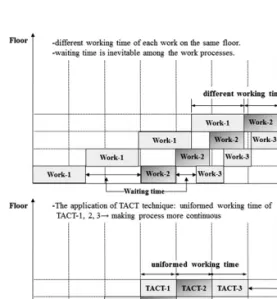
The TACT technique was introduced to reduce inefficiency, wasted time and interventions among work trades and to handle other issues more effectively. In high-rise residential buildings, repetitive work processes occur at each floor consecutively. However, since each work process has its own duration, waiting time is inevitable among the processes as shown in Figure 1. These intermissions extend the entire construction duration and decrease efficiency in the utilization of labor and resources. Therefore, the TACT defines each work process as a TACT unit and keeps their working time uniform with no wasted time. Thus, the TACT reduces the inefficiency of waiting time between work processes and shortens the entire construction duration by scheduling and managing those tasks in a well-connected way between the preceding and following activities[6]. In addition, the TACT can even out the number of laborers as well since the number of laborers is variable depending on the work processes. If the number of laborers cannot be managed uniformly due to unreasonable scheduling, this would cause cost overruns. In the e-TACT, quality would be improved through uniform management of all work processes and laborers.
Figure 1. Concept of TACT technique
2. Analysis of existing practice
2.1 TACT Project Overview
For the finish work in high-rise residential buildings, the workload and duration change in the preceding work substantially impacts the following work. In addition, since multiple tasks are simultaneously carried out, some work processes are delayed and interrupted by other tasks. This can delay the completion date and lower productivity[5]. Therefore, there is a need to manage the work processes effectively and the finish work should be controlled intensively. In this research, a Korean residential building project that applied the TACT technique was analyzed. The project was composed of six buildings as shown in Table 1. The buildings were divided into two separate zones and one building was analyzed.
Site area 29,533m2
Total floor area 59,976m2
Construction period Mar. 1, 2008-Feb. 28, 2010 No. of buildings 6 (13~15 floors of each buildings) No. of housing units 248(161m2:118units,194m2:130units) Management technique TACT
Table 1. Project outline
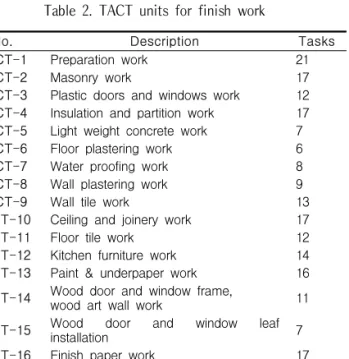
No. Description Tasks
TACT-1 Preparation work 21
TACT-2 Masonry work 17
TACT-3 Plastic doors and windows work 12
TACT-4 Insulation and partition work 17
TACT-5 Light weight concrete work 7
TACT-6 Floor plastering work 6
TACT-7 Water proofing work 8
TACT-8 Wall plastering work 9
TACT-9 Wall tile work 13
TACT-10 Ceiling and joinery work 17
TACT-11 Floor tile work 12
TACT-12 Kitchen furniture work 14
TACT-13 Paint & underpaper work 16
TACT-14 Wood door and window frame,
wood art wall work 11
TACT-15 Wood door and window leaf
installation 7
TACT-16 Finish paper work 17
TACT-17 Room furniture work 9
TACT-18 Floor work 4
TACT-19 Other works 5
Table 2. TACT units for finish work
The finish work of each floor was divided into 19 processes to apply the TACT technique. Table 2 describes the work list for 19 TACT units. Each TACT unit needed to be managed efficiently since there were more than 20 ongoing tasks.
Figure 2 shows the field master plan for the project. A TACT unit was built on each floor. In addition, to synchronize with the six-day structure work cycle, the basic TACT unit cycle was six days.
Furthermore, in order to start the finish work as early as possible, the finish work was commenced on completion of the fourth floor structure work. As shown in (1) of Figure 2, the 1-16 TACT units had a six-day duration which was carried out by the same slopes. In addition, as shown in (2) of Figure 2, since the lightweight concrete molding of TACT-5 and floor plastering of TACT-6 were carried out simultaneously, builders performed these processes on two to three floors at the same time to accomplish the daily workload.
Figure 2. TACT work process schedule
The TACT units 17-19, furniture, floor and other work processes, were performed in three day instead of the six-day cycle, a standard duration for the earlier 16 TACT units as shown on (3) of Figure 2.
In other words, since the 17-19 TACT units
consisted of simple work, they had a relatively
shorter duration than the earlier TACT units. These
units also did not affect the entire period. Thus, the
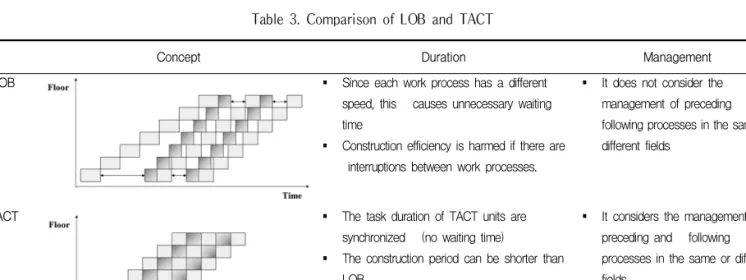
Concept Duration Management
LOB Since each work process has a different
speed, this causes unnecessary waiting time
Construction efficiency is harmed if there are interruptions between work processes.
It does not consider the management of preceding and following processes in the same or different fields
TACT The task duration of TACT units are
synchronized (no waiting time)
The construction period can be shorter than LOB
The waiting time occurs within the TACT unit.
It considers the management of preceding and following processes in the same or different fields
Table 3. Comparison of LOB and TACT
17-19 TACT units were scheduled in accordance with the completion date of the entire project. In addition, if the 17-19 TACT units were commenced immediately after the completion of the preceding work, the tight schedule could cause damage to furniture, door frames, glass and loss of hardware.
Thus, to prevent damage and secure the quality, the company carried out the 17-19 TACT units in accordance with the completion of the entire project, not the completion of the preceding work as shown in Figure 3. Furthermore, the float time from the units improve quality by creating time for doing delayed processes and preventing circulation conflicts among work trades.
Figure 3. 17-19 TACT units schedule
2.2 Challenges of TACT
The TACT technique applied to the project caused the following problems:
First, as shown in Table 2, subcontractors perform more than 20 tasks in each TACT unit for six days.
However, some work processes had to be postponed because the sequence between preceding and following work was not managed efficiently due to miscommunication with subcontractors. In addition, since finish work was carried out in a restricted area, it led to interruptions and conflicts among various tasks. Furthermore, unexpected waiting time occurred because work teams did not fully coordinate elevators use and spaces for storing materials. These problems resulted from the fact that work teams simultaneously deployed labor and resources.
Second, with the frequent replacement of workers by subcontractors, work processes were delayed.
Newly employed workers need warm-up time to understand the project and adapt to tasks. However, the project was delayed because of frequent replacements and scheduling that did not take into account the unexpected replacements.
Third, subcontractors carried out their tasks in
due sequence which took from half a day to three days to complete. Thus, in the case of the six-day cycle, some subcontractors wasted the remaining period after completing their tasks. It means that subcontractors were not able to continuously perform their work.
Therefore, more efficient management was needed not only for the entire TACT schedule but also for the subcontractors in charge of subdivided work.
3. e-TACT Technique
3.1 e-TACT Overview
The LOB that is widely used in the projects with repetitive work depicts the process of each activity by sloping lines. In the scheduling method, since each task has its own duration, intermissions inevitably take place. Thus to eliminate wasted time on the LOB, each TACT unit duration should be synchronized and the work process represented by TACT unit in sequence not by sloping lines.
However, since each unit has a variety of work, an efficient scheduling method for each unit is required to complete various tasks at the same time. In addition, in the TACT, since there is no waiting time, if a certain unit is delayed, the following unit is also postponed. The entire period cannot be reduced under such circumstances. Therefore, an efficient scheduling method is required in the overall TACT as well as for each unit. Table 3 briefly shows the comparison of LOB and TACT.
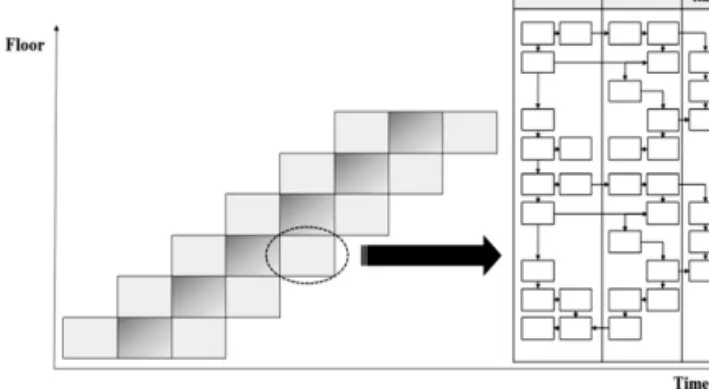
The e-TACT technique is an updated version of the conventional TACT technique. In order to apply TACT technique more efficiently, this new scheduling method focuses on analyzing the types of work, the relation between preceding and following and critical work in TACT units. As shown in Figure 4, the e-TACT technique enables builders to monitor the relationship between the preceding and following
work within each TACT unit to reduce the interventions among them and prevent delay of the project by managing critical work in each TACT unit. In this research, an e-TACT working template for each TACT unit was suggested based on conventional TACT technique.
Figure 4. Concept of e-TACT technique
3.2 Work Process Analysis of TACT unit
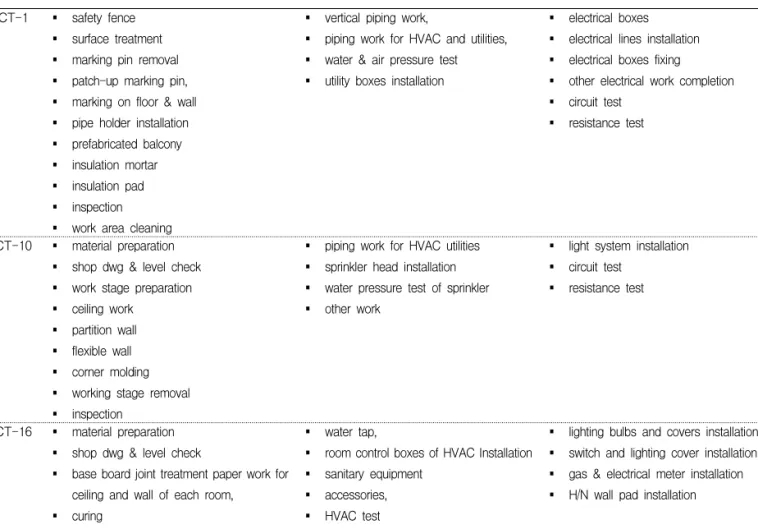
For establishing an e-TACT Working Template, types and duration of each task and the relationship among tasks in each TACT unit has to be analyzed in detail. Table 4 represents the analysis of subdivided tasks within major TACT units for the finish work in a high-rise residential building.
In TACT-1, 11 architecture, 4 mechanical, and 6 electrical/communication tasks are carried out. In addition, over 15 tasks occur in TACT-2, 3, 10, 13 and 16. To establish the working template, all these tasks need to be analyzed including duration, correlation among tasks, and deployed workers and materials.
3.3 e-TACT Working Template
Based on consultation with experts, an e-TACT working template is suggested after analyzing the interruptions between preceding and following work.
In the conventional TACT technique, the scheduling
is based on a daily-based time scale. However, the
e-TACT technique is established based on a
Architecture Mechanical Electrical/Communication TACT-1 safety fence
surface treatment
marking pin removal
patch-up marking pin,
marking on floor & wall
pipe holder installation
prefabricated balcony
insulation mortar
insulation pad
inspection
work area cleaning
vertical piping work,
piping work for HVAC and utilities,
water & air pressure test
utility boxes installation
electrical boxes
electrical lines installation
electrical boxes fixing
other electrical work completion
circuit test
resistance test
TACT-10 material preparation
shop dwg & level check
work stage preparation
ceiling work
partition wall
flexible wall
corner molding
working stage removal
inspection
piping work for HVAC utilities
sprinkler head installation
water pressure test of sprinkler
other work
light system installation
circuit test
resistance test
TACT-16 material preparation
shop dwg & level check
base board joint treatment paper work for ceiling and wall of each room,
curing
water tap,
room control boxes of HVAC Installation
sanitary equipment
accessories,
HVAC test
lighting bulbs and covers installation
switch and lighting cover installation
gas & electrical meter installation
H/N wall pad installation Table 4. Analysis of work in TACT units
semi-daily basis by dividing each day into two time slots for a.m. and p.m. to specify tasks in more detail. In addition, each TACT unit is classified into mechanical, architecture, and electrical/communication fields. The critical factors in each field and the relationship between the preceding and following work in each field, as well as among fields, is analyzed through communication with field experts.
In addition, after analyzing the possible interruptions such as spatial limits that can affect construction, the working template is finalized.
Figure 5 represents the working template that is completed by the procedure described above.
Figure 5. Concept of e-TACT working template
In the template, the tasks of each TACT unit are
classified into three fields, mechanical, architecture
and electrical/communication, in order to understand
the work flow of each field more effectively. The
work flow of the fields is symbolized as follows:
i = Sequence number between preceding and following works in the same field
j = Sequence number among tasks that are carried out simultaneously
A
i,j,M
i,jand E
i,jdenote architecture, mechanical, and electrical/communication work, respectively. The symbolic of A
i,jdenotes the sequence in the same field. For example, as shown in Figure 5, architecture work in the TACT unit is carried out in sequence of A
1,jto A
7,j. In other words, the tasks in same field are numbered according to this sequence.
j of A
i,jdenotes the sequence of tasks that are carried out during the same period. For example, A
3,j, A
4,j,E
1,jand E
2,jare carried out in the morning of Day 2 and the sequence among the four tasks is decided by communication with experts such as A
4,1,E
1,2,A
3,1and E
2,4.In other words, the tasks are numbered according to work flow. In addition, after analyzing critical work among tasks that are performed during the same period, the critical path is represented beside the time table. For example, among the tasks, M
1,1of the morning of Day1, M
2,1of the afternoon of Day1 and A
3,5of the morning of Day2 are chosen as critical tasks in Figure 5.
Therefore, with the working template, builders can prevent delays by intensively check ing and managing the tasks which can affect the following work among tasks that are carried out simultaneously. In addition, because the tasks that are not in the same sequence but are carried out during the same period can be easily checked, interruptions such as spatial limit can be monitored.
Figure 6 describes the application of e-TACT working template to TACT-1. The TACT-1 process is composed of 4 mechanical, 11 architecture and 6 electrical/communication tasks. The sequence of tasks in each field and the relationship among tasks in all fields are represented after consultation with experts in each field. The critical factors that are
carried out simultaneously are separately noted on critical path. For instance, two tasks, safety fence installation (1.1) and surface treatment (2.2), are carried out in sequence along with electrical boxes installation (1.3) in the morning of Day 1. In addition, among these tasks, the most critical task, surface treatment (2.2), is noted on the critical path on the left side of the timetable. In such a manner, the critical tasks of each time slot such as marking pin removal (3.2) in the afternoon of Day 1, marking on floor and wall (5.1) in the morning of Day 2 and pipe holder installation (6.1) in the afternoon of Day 2 are enumerated to create the critical path. The vertical piping work (1.1) is carried out along with other electrical work completion (4.2) during the entire Day 3. The horizontal work for HVAC and utilities (2.1), prefabricated balcony installation (7.2), circuit test (5.3) and resistance test (6.4) are carried out in this order on Day 4. Among these tasks, the horizontal work for HVAC and utilities (2.1) is classified into the critical path. Therefore, with the working template, builders can forecast spatial limits because there are three ongoing tasks on Day 1. In addition, after analyzing the critical path, three mechanical tasks, vertical piping work (1.1) on Day 3, horizontal work for HVAC and utilities (2.1) on Day 4 and water and air pressure test (3.1) in the morning of Day 5 are represented as a critical path during the three days.
In conventional TACT, the mechanical work has largely played an undervalued critical role. If this work is not properly considered, it can negatively affect the sequence of preceding and following work and even delay the entire period. Thus the scheduling should be carefully established in consultation with experts in the mechanical, architecture, and electrical/ communication fields.
Based on the hour-based time scale, the e-TACT
working template can analyze the sequence of
preceding and following work in the TACT unit and
the interruptions among fields. As a result, the template helps builders understand the critical factors and duration of detailed tasks in each TACT unit.
Figure 6. Application of e-TACT working template to TACT-1
4. Practical Application
The case project applied the e-TACT technique after completing five floors. As a result, the project period was reduced and improved human resources and quality control. The e-TACT technique provided benefits as follows:
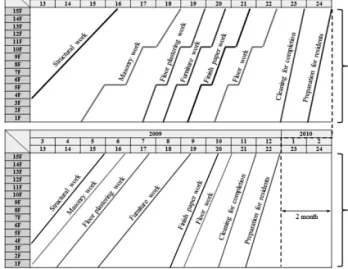
First, the entire period was reduced by more than two months by replacing the conventional scheduling method with the e-TACT technique. There was some waiting time on the LOB schedule as shown in Figure 7 which was eliminated by the application of the e-TACT technique. This reduced the entire period. For the early start of finish work and the adjustment of six days in the structure work period, the company spent approximately $120,000 in terms of direct cost. However, it reduced the indirect cost by about $160,000 due to the lower overhead cost because of the shortened construction period. The
company also saved $530,000 of financing costs in terms of non-operating revenue. This resulted in a total cost reduction of approximately $570,000.
Figure 7. Effect of e-TACT technique
Second, under the conventional method, to carry out the finish work in a short period, a large number of workers needed to be employed after the completion of the structure work. However, the new method helped the company to manage human resources more efficiently since fewer experienced workers were needed for the repetitive processes after the application of the e-TACT technique. This helped builders to reduce confusion, improve quality and minimize defects by securing adequate time for tasks and inspections.
Third, the company improved the quality of interior finish work as each work process was carried out in sequence by floor. This new technique also prevented damage to finish materials which had frequently been caused by confusion among work trades.
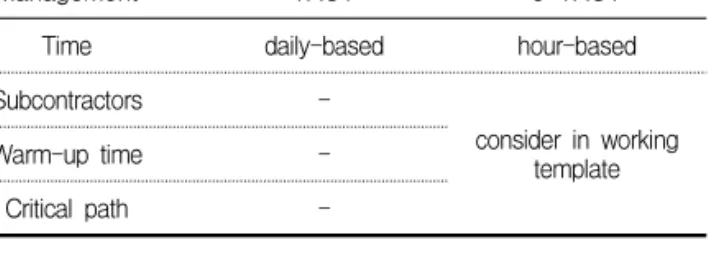
Table 5 indicates the differences between TACT
and e-TACT techniques. As hour-based time scale,
the e-TACT technique can be managed the sequence
among tasks and effectively employed workers. In
addition, unlike TACT technique, since working
templates are utilized to control subcontractors, new employers and critical path of works, e-TACT technique can be minimize schedule delays and construction costs.
Table 5. Comparison between TACT and e-TACT
Management TACT e-TACT
Time daily-based hour-based
Subcontractors -
consider in working template
Warm-up time -
Critical path -
5. Conclusion
This research has reviewed the problems of the conventional TACT technique that has been widely used in finish work for high-rise residential buildings in Korea and has suggested an updated TACT, e-TACT technique. The conventional TACT technique, on a daily-based time scale, created difficulties in checking interruptions in each unit as well as the sequence of work and problems such as spatial limits and interventions. In addition, unexpected delays occurred because wasted time as the companies did not fully communicate with subcontractors to coordinate the use of elevators and spaces for storing materials. Therefore, to minimize wasted time, a working template classifies the tasks into mechanical, architecture and electrical/communication and analyzes the sequence of preceding and following tasks in fields that are carried out simultaneously. The template also enables builders to review the project more easily and conveniently.
Furthermore, the critical path in the template helps to identify interruptions such as spatial limits which can take place during construction by analyzing critical work among the tasks that are performed simultaneously.
The application of the e-TACT technique with the newly proposed working template minimizes wasted time in each TACT unit. In addition, the project that applied the e-TACT technique reduced the entire period by approximately two months through efficient management of the tasks and critical factors in all fields. It also eliminated a total of
$530,000 of direct and indirect costs due to the shorter construction period.
The e-TACT technique examines work processes such as critical factors, sequence between the preceding and following work in all fields, and spatial limits by analyzing the types and duration of tasks and sequence among tasks. This will help builders facilitate finish work of high-rise residential buildings through reviewing and handling the requests of managers and subcontractors by sharing their opinions. In addition, the new technique provides scheduling that takes into account warm-up time for new employees to improve quality. The e-TACT technique is also an eco-friendly approach to reduce waste since it enables builders to make an efficient use of construction materials in an optimal amount through detailed scheduling. However, it was hard to guarantee work continuity in winter because many wet construction tasks are performed in finish work.
Therefore, to handle this issue, approaches such as dry construction of lightweight walls and precast structures will be necessary.
In this research, an e-TACT technique for finish
work in high-rise residential buildings is suggested
to reduce construction period and costs. As further
research, the research that applied the e-TACT
technique in not only buildings but also other
projects that demand repetitive work such as
highways, bridges, railways and pipe line networks
will be necessary.
Acknowledgement
This work was supported by the National Research Foundation of Korea(NRF) grant funded by the Korea government(MEST) (No. 2011-0001031)
I would like to express my gratitude to Daelim Industrial co., LTD. for its Knowledgable advice and support.
References
1. United States Census. 2004 economic census industry series reports construction. [On-line]. [Retrieved Aug 11, 2011]
Available at www.census.gov/econ/census02/ guide/INDRPT23.
HTM.
2. Sacks R, Goldin M. Lean management model for construction of high-rise apartment buildings. ASCE Journal of Construction Engineering and Management. 2007 May;133 (5):374-84.
3. Kim JH, Yoon YS, Jang MH, Suh SW. Work flow-based TACT Planning & Scheduling Process: Focused on the Finish Work of Apartment Building. Journal of the Architectural Institute of Korea. 2007 Dec; 23(6):153-63.
4. Kim YS, Hwang MH, Park CS. A Study on the Present Status and Problem Analysis of Construction Process Management in Domestic Building Construction Sites. Journal of the Architectural Institute of Korea. 1996 Dec;12(12):253-65.
5. Hwang HS, Kim KR, Suh SW, Kim CD, Shin DW. Analysis of Actual Duration by Effecting Elements to Duration Estimate:
Focused on Standard Duration of the Office Building Construction. Korean Journal of Construction Engineering and Management. 2002 June; 3(3):84-93.
6. Yoon YS, Suh SW. The application of tact time at finish work for building construction: Focused on Office Building. Korean Journal of Construction Engineering and Management. 2005 Dec;6(6):90-7.
7. Rahbar FF, Rowing JE, Repetitive Activity Scheduling process. Proceedings of the 36st Annual Meeting of the Transactions of the American Association of Cost Engineers;
Orlando; [date unknown]. Orlando (PL): Transactions of the American Association of Cost Engineers; 1992. p. 51-58.
8. Selinger S. Construction planning for linear projects. ASCE Journal of Construction Engineering and Management. 1980 Feb;106(2):195-205.
9. Carr RI, Meyer W.L. Planning construction of repetitive building units. Journal of the Construction Division 1974 Sep;100(3):403-12.
10. Arditi D, Albulak MZ. Line-of-balance scheduling in pavement construction. ASCE Journal of Construction Engineering and Management. 1986 Dec;112(3): 411-24.
11. Arditi D, Tokdemir OB, Suh K. Challenges in Line-of-Balance Scheduling. ASCE Journal of Construction Engineering and Management. 2002 Dec;128(6): 545-56.
12. Neale RH, Neale DE. Construction Planning. London (UK):
Thomas Telford Ltd.; 1989. 165 p.
13. Kim YJ, Han JY, Shin DW, Kim KR, Kim CD, Seo SW. A Tact Planning and Scheduling Process Model for Reduction of Finishing Work Duration in Building Construction Projects. Journal of the Architectural Institute of Korea.
2003 Sep;19(1):161-168.