https://doi.org/10.9721/KJFST.2021.53.5.613
613
©The Korean Society of Food Science and Technology
식초음료를 첨가한 파우치형 곤약젤리의 제조 및 품질 특성
김청혜1 · 김연정2 · 김지연1,*
1서울과학기술대학교 식품공학과, 2(주)뉴트리아이 교육센터
Pouch-type Konjac jelly manufacture and quality characteristics of jelly-containing vinegar drinks
Chung-Hye Kim
1, Yun-jung Kim
2, and Ji Yeon Kim
1,*
1
Department of Food Science and Technology, Seoul National University of Science and Technology
2
Education Center, NUTRI-I Co., Ltd.
Abstract
The quality characteristics of jelly-containing vinegar drinks were divided into three stages in this study. The jelly, which differs from the contents of the vinegar drink, sharply decreased the pH. After sterilization, hardness was significantly decreased, and the formulation was not maintained, which was considered the effect of low pH and high total acidity of vinegar drinks. Different experiments confirmed that pH and sterilization heating conditions were the major quality variables for gelation as both sodium citrate content and jelly hardness were correlated before and after sterilization.The hardness of the jelly, which differs in gel content, correlated with the increase in gelation content both before and after sterilization. Therefore, considering the spout jelly of a vinegar drink, pH of 3.5-3.7 and a content of glucomannan and caragenane mixed gel were considered appropriate to match the product's sensory properties.
Keywords:
vinegar konjac jelly, texture, konjac, pH서 론
삶의 질 향상 및 인구 고령화에 따른 노인성 질환 증가로 건 강에 관한 관심이 높아짐에 따라 건강기능식품 시장이 지속적으 로 확대되어 가고 있다(Kim과 Han, 2020). 또한 최근 사회문화 적인 변화로 다양한 식재료를 이용한 고부가가치 디저트를 중시 하는 문화가 트렌드로 자리 잡아 감에 따라 건강기능성을 갖춘 기호식품에 대한 관심도 같이 높아지고 있다(Jeong과 Cha, 2020).
식초는 오래전부터 중풍, 고혈압, 내장지방 및 체지방 감소에 효 과가 있어 약용으로도 사용되었으며, 음식을 조리할 때 산미를 갖게 하는 조미료로서 비린내를 제거하거나 육류를 연하게 하는 등 각종 요리에도 널리 사용되고 있다(Lim과 Cha, 2010). 이 외 에도 여러 연구에서 식초의 대사조절 기능 등이 보고되면서(Kim 등, 2013; Kondo 등, 2009; Sakakbarea 등, 2006) 단순 조미료로 서의 기능뿐 아니라 건강식품으로도 주목받는 등 식초에 대한 관 심이 증가되고 있는 실정이다. 젤리는 과즙, 당, 겔화제 등을 넣 고 응고시킨 식품으로 겔화제의 종류에 따라 한천젤리, 펙틴젤리 등으로 구분되며 젤라틴 젤리는 씹힘성과 검성은 있으나 부드러 움이 떨어지는 것으로 알려져 있다(Kim, 1999). 특히 카라기난은
다량의 황산다당류를 함유하고 있어 장내세균에 의해 분해되지 만 탈황산반응이 거의 일어나지 않는 것으로 알려져 있고, 글루 코만난은 인체 내에서 소화되지 않는 특징이 있지만, 특유의 겔 형성력으로 식품의 조직감 형성에 영향을 주어 널리 응용되고 있 는 기능성 소재로 알려져 있기도 하다(Lee 등, 1993). 일반적인 과 일 젤리로는 산수유(Jeong 등, 2017), 오디착즙액(Moon 등, 2012), 다래 농축액(Park 등, 2013), 양파추출물(Jeong과 Cha, 2020) 등을 이용한 연구는 많이 보고되고 있으나 식초를 응용한 연구로는 높 은 유기산과 낮은 pH로 인하여 겔화가 쉽지 않거나 씹힘성과 조 화가 맞지 않을 수 있는 등 다양한 제품 가공에 장애가 되고 있 어 생리활성 등의 기능성에 대한 기초 연구에 머무는 실정이다.
식초의 제형다양화 등의 응용 연구로는 겔화제 함량을 달리한 발 사믹 식초 젤리 품질의 특성(Choi 등, 2013), 농축 사과식초 젤리 의 제조 및 품질특성등 정도에 그치고 있어 식초의 기능성에 대 한 과학적 근거가 충분함에도 불구하고 산업적으로 다양한 제형 으로의 연구가 부족한 실정이다. 따라서 본 연구는 식초음료가 첨가된 곤약젤리의 제조공정에 따른 살균전후의 이화학적 특성 을 식초음료의 함량에 따른 변화 연구, pH의 조절에 따른 연구, 겔화제 함량에 따른 변화 연구 순서로 품질특성을 조사하였다.
또한 우리나라는 질식사 우려로 인해 컵타입 형태에 대한 용기 및 중량 규격만 있을 뿐 물성에 대한 세부적인 기준이 없어 물 성측정의 기준을 일본의 스마일케어식 중 삼킴 장애가 있는 고령 자용 젤리식품에 대한 조직감, 경도(hardness), 응집성(cohesiveness), 부착성(adhesiveness)을 적용하므로써 일반적 젤리의 삼킴 안전성 과 나아가 초고령사회로 진입에 대비하여 고령친화 제품 및 식 초음료 스파우트 파우치 젤리의 상품화를 위한 기초자료를 제공 하고자 한다.
*Corresponding author: Ji Yeon Kim, Department of Food Science and Technology, Seoul National University of Science and Technol- ogy; Seoul 01811, Korea
Tel: +82-2-970-6740 Fax: +82-02-976-6460
E-mail: [email protected]
Received July 15, 2021; revised August 9, 2021;
accepted August 10, 2021
재료 및 방법
실험재료
본 연구에 사용된 식초음료는 청정원 홍초 석류(Daesang Co., Seoul, Korea), 식이섬유 원료인 화이버졸 2 L (Daesang Co.), 액 상 알룰로오스(Samyang Co., Seoul, Korea), 글루코만난(Hubei Yizhi Konjac Biotechnology Co., Ltd, Yichang, China), 카라기난 (CP Kelco ApS, Lille Skensved, Denmark), 에리스리톨(Cargill Inc., MN, USA), 구연산삼나트륨(Weifang Ensign Industry Co., Ltd, Shandong, China) 을 시중에서 구입하여 사용하였다.
젤리 제조
식초 음료의 함량이 품질에 미치는 영향을 파악하기 위해서 식 초 음료의 함량에 따른 품질특성 배합비는 Table 1 에 구연산삼나 트륨의 함량을 달리한 품질특성 배합비는 Table 2, 겔화제 함량 을 달리한 품질특성 배합비는 Table 3 에 나타내었다. Huang과 Lin(2004) 의 연구에 따르면 글루코만난은 알칼리 조건에서 κ-카 라기난, 잔탄검, 젤란검과 같이 사용될 때 겔화를 더 쉽게 하기 때문에 식초음료의 낮은 pH와 높은 유기산 함량 등의 특성은 겔 화의 허들로 작용할 것으로 예상되어 식초 음료의 함량에 따른
품질 특성 연구와 구연산삼나트륨의 함량을 달리한 품질특성의 연구는 글루코만난과 카라기난의 1:1 (w/w)의 비율로 4.0%로 고 정하고 젤리의 제조는 Fig. 1 의 공정으로 진행하였으며 90
oC 이 상의 정제수에 액상원료(액상 알룰로오스, 난소화성 말토덱스트 린, 식초음료)를 혼합한 후 pre-mixing한 분말원료(글루코만난, 카 라기난, 에리스리톨)를 첨가하여 용해한 후 교반 하여 스파우트 파우치 형태에 충진하여 100
oC 끓는 물에 15분 중탕 살균하여 냉각하였다.
이화학적 특성
젤리의 당도(
oBrix) 는 굴절당도계(Refractometer RX5000α, Atago, Tokyo, Japan) 로 측정하였고, pH 측정은 pH meter (Model ST5000, OHAUS Co., NJ, USA) 를 이용해 측정하였다. 총산은 검 체 10 mL를 취하고, 이에 끓여서 식힌 물을 가하여 100 mL로 하고 그 20 mL를 1% 페놀프탈레인용액(Samchun Chemicals, Pyeongtaek, Korea) 을 지시약으로 하여 0.1 mol/L-수산화나트륨용액(N/10) (Samchun Chemicals) 으로 적정하여 3회 측정하는 시험법으로 그 평균값으로 나타내었다. 측정에 사용한 시료는 겔화제를 빼고 배 합조건 및 제조방법에 따라 제조한 배합액을 사용하여 측정하였다.
Table 1. Formulation of jelly products with different rations of vinegar beverage
Ingredients (%)
Group
1)Control VB5 VB10 VB15 VB20 Vinegar beverage 0 5 10 15 20
Allulose 15 15 15 15 15
Fibersol 2-L 5 5 5 5 5
Carrageenan 0.2 0.2 0.2 0.2 0.2 Glucomannan 0.2 0.2 0.2 0.2 0.2
Erythritol 2 2 2 2 2
Water 77.6 72.6 67.6 62.6 57.6
Total 100 100 100 100 100
1)
Control, vinegar beverage 0%; VB5, vinegar beverage 5%; VB10, vinegar beverage 10%; VB15, vinegar beverage 15%; VB20, vinegar beverage 20%
Table 2. Formulation of jelly products with different trisodium citrate
Ingredients (%) Group
1)Control VT0.1 VT0.2 VT0.3 Vinegar beverage 20 20 20 20
Allulose 15 15 15 15
Fibersol 2-L 5 5 5 5
Carrageenan 0.2 0.2 0.2 0.2
Glucomannan 0.2 0.2 0.2 0.2
Erythritol 2 2 2 2
Trisodium citrate 0 0.1 0.2 0.3
Water 57.6 57.5 57.4 57.3
Total 100 100 100 100
1)
Control, trisodium citrate 0%; VT0.1, trisodium citrate 0.1%; VT0.2, trisodium citrate 0.2%; VT0.3, trisodium citrate 0.3%
Table 3. Formulation of jelly products with different gellant Ingredients (%)
Group
1)VBJ0.2 VBJ0.3 VBJ0.4 VBJ0.5 Vinegar beverage 20 20 20 20
Allulose 15 15 15 15
Fibersol 2-L 5 5 5 5
Carrageenan 0.1 0.15 0.2 0.25
Glucomannan 0.1 0.15 0.2 0.25
Erythritol 2 2 2 2
Trisodium citrate 0.2 0.2 0.2 0.2
Water 57.6 57.5 57.4 57.3
Total 100 100 100 100
1)
VBJ0.2, carrageenan 0.1%+glucomannan 0.1%; VBJ0.3, carrageenan 0.15%+glucomannan 0.15%; VBJ0.4, carrageenan 0.2%+glucomannan 0.2%; VBJ0.5, carrageenan 0.25%+glucomannan 0.25%
Fig. 1. Procedures for added vinegar beverage jelly products.
텍스쳐 측정
텍스쳐 측정에는 Texture analyzer (ETC-3305B-2, Yamaden, Tokyo, Japan) 를 이용하여 측정하였다. 텍스쳐 특성에는 플런저 면적이 영향을 미치는 것으로 알려져 있다. 본 연구는 일본 후생 노동성의 연하 곤란자용 식품의 규격기준(Ministry of Health, Labour and Welfare, 2009) 으로 플런저 높이 8 mm, 직경이 20 mm 의 디스크형을 사용하였다. 시료는 직경 40 mm, 높이 20 mm, 용기 15 mm에 충진 하여 20
oC 온도에서 측정하였다. 측정방법은 Kawano 등(2005)의 기준으로 Texture 기록 곡선에 의해 경도 (hardness), 부착성(adhesiveness), 응집성(cohesiveness)을 측정하였다.
통계분석
본 실험의 결과는 SPSS 22.0 software (Statistical package for social science, IBM, Aarmonk, NY, USA) 로 평균값과 표준편차를 나타내고 일원 분산 분석(one-way ANOVA)을 수행하여 유의성 을 확인하였으며 p<0.05 수준에서 Duncan’s multiple range test를 통해 사후검정을 하였다.
결과 및 고찰
식초음료 함량에 따른 곤약젤리의 이화학적 품질 특성 0, 5, 10, 15, 20% 의 식초음료의 양을 달리하여 제조한 젤리 배 합액의 당도, 총산도, pH의 결과를 Table 4 에 나타내었다. 식초음 료의 함량이 높아질수록 당도와 총 산도는 높아졌다(p<0.001). 이 는 식초음료에 함유되어 있는 당 함량과 산도의 영향으로 높아 진 것으로 보여 진다. 반면 pH는 식초음료의 함량이 높아 질 수 록 낮아졌는데 Control인 식초음료 0% 시료가 중성 수치에 가까 운 약산성으로 pH 6.19로 나타났으나 식초음료 5%를 첨가 후 배 합액의 pH는 급격히 낮아졌다. 이는 Table 4 에 표시한 것처럼 식 초음료의 pH 2.57의 산성인 식초음료 10, 15, 20%를 첨가한 배 합액의 pH에서도 감소하는 결과를 나타내었다(p<0.001). 이는 산
수유 퓨레 첨가량에 따라 당도는 소폭 증가하고 pH 소폭 감소 하는 Jeong 등(2017)의 연구 결과와 석류첨가량 및 천연초 첨가 량이 증가할수록 pH가 낮아지고 당도와 산도가 높아지는 경향을 보인 Cho와 Choi (2009)의 연구 결과와 유사한 결과를 나타내었다.
식초음료 함량에 따른 곤약젤리의 텍스쳐 측정
0, 5% 10, 15, 20% 의 식초음료의 양을 달리하여 Fig. 1 과 같 이 제조한 젤리의 살균공정 전, 살균공정 후의 결과를 Table 5 와 Table 6 에 나타내었다. 식초음료의 함량이 5, 10, 15, 20% 높아짐 에 따라 살균 전과 살균 후 공정 모두 경도(hardness)는 낮아졌다 (p<0.001). 이는 Jeong 등(2017)의 산수유 퓨레 첨가량이 증가함 에 따라 전체적인 단단함의 정도가 감소하는 경향과 동일한 경 향을 보였다. 반면, 식초음료의 함량이 동일한 조건에서의 살균 공정을 거친 젤리는 살균공정 전의 젤리 경도(hardness)에 비해 식초음료의 함량이 높아질수록 그 결과가 현저히 낮았는데 오히 려 식초음료를 함유하지 않은 젤리는 경도(hardness)가 높아 졌고 특히 15, 20%의 식초음료를 함유한 젤리의 유의적 차이가 크게 나타났다(p<0.001). He 등(2012)의 연구 결과에 의하면 글루코만 난과 κ-카라기난의 혼합 겔의 pH 3-9의 조건에서의 경도(hardness) 는 pH 5 이상에서 안정적인 경도(hardness)를 나타내고 pH 5에 서 pH 3으로 내려갈수록 경도(hardness)는 낮아졌다고 보고하였 는데 이는 Meng 등(2003)의 연구 결과와 같이 κ-카라기난은 알 칼리성과 중성 환경에서 안정적이며 pH 4 이하에서 가수분해 되 기 시작하여 겔의 경도(hardness)가 낮아진다는 결과를 근거로 보 고하였다. 이는 본 연구 결과와 유사한 결과로 식초음료를 넣지 않은 VB0는 pH는 5 이상으로 pH 6.19 경도(hardness)가 가장 높 게 측정되었고 식초음료 첨가 후 pH는 모두 3이하였고 pH가 낮 아질수록 그 경도(hardness)는 낮아졌다. 이 결과는 pH가 혼합겔 의 안정성에 중요한 요소임을 보고한 He 등(2012)과 Li 등(2004) 의 연구 결과를 뒷받침 한다.
Table 4. Sugar content, pH, total acidity of jelly with different rations vinegar beverage
Variables
Group
1)F-value
Control VB5 VB10 VB15 VB20
Sugar contents (
oBrix) 13.4
2)±0.05
a3)16.4±0.05
b17.2±0.08
c19.0±0.08
d20.7±0.05
e3808.167
***pH 6.19±0.01
a2.84±0.01
b2.73±0.01
c2.70±0.01
d2.67±0.01
e3808.167
***Total acidity (from acetic acid) 0.05±0.01
a0.16±0.01
b0.34±0.01
c0.47±0.01
d0.61±0.01
e906.640
***1)
Control, vinegar beverage 0%; VB5, vinegar beverage 5%; VB10, vinegar beverage 10%; VB15, vinegar beverage 15%; VB20, vinegar beverage 20%
2)Values are mean± SD. *** p<0.001
3)
a-e means in a column by different superscripts are significantly different at 5% significance level by Duncan’s multiple range test. "continued"
Table 5. Variation of texture profile of jelly according to the content of vinegar beverage before sterilization TPA
1)attractions
Group
2)F-Value
Control VB5 VB10 VB15 VB20
Hardness (N/m
2) 3.6
3)±0.5
a4)×10
33.3±0.6×10
3a2.3±0.3×10
3b1.8±0.2×10
3c1.5±0.2×10
3c37.786***
Cohesiveness 0.50±0.05
a0.48±0.03
a0.48±0.04
a0.52±0.06
a0.50±0.05
a1.078 Adhesiveness (J/m
3) 5.9±1.4×10
a7.2±1.6×10
ab8.4±1.5×10
b5.9±1.1×10
a5.8±1.1×10
a5.000**
1)
Texture profile analysis
2)
Control, vinegar beverage 0%; VB5, vinegar beverage 5%; VB10, vinegar beverage 10%; VB15, vinegar beverage 15%; VB20, vinegar beverage 20%
3)Values are mean±SD. **p<0.01 and ***p<0.001
4)
a-c means in a column by different superscripts are significantly different at 5% significance level by Duncan’s multiple range test.
구연산삼나트륨 함량에 따른 곤약젤리의 이화학적 및 텍스쳐 품질특성
pH 가 혼합겔의 안정성에 중요한 요소임을 확인한 결과에 따라 서 곤약과 카라기난의 혼합젤리는 알칼리 조건에서 겔화를 더 쉽 게 한다는 Huang과 Lin(2004)의 연구 결과를 참고하여 일반적 산 미가 있는 음료에서 주로 사용되는 산도조절제인 구연산삼나트 륨을 사용하여 배합액의 pH를 조절하여 젤리 물성의 안정화를 높일 수 있는 최적 조건을 찾고자 한다. 본 연구는 식초가 함유 된 산미가 있는 관능적 특성을 지닌 제품으로 0, 0.10, 0.20,
0.30% 의 구연산삼나트륨의 양을 달리하여 pH를 조절하여 제조 한 젤리 배합액의 당도, 총산도, pH의 결과 값을 Table 7 에 나타 내었고 구연산삼나트륨의 함량이 높아질수록 pH는 높아졌다. 0.1, 0.2, 0.3% 의 구연산삼나트륨의 양을 달리하여 제조한 젤리의 살 균공정 전, 살균공정 후의 텍스쳐 결과를 Table 8 과 Table 9 에 나 타내었다. 구연산삼나트륨의 함량이 0.1, 0.2, 0.3% 높아짐에 따 라 살균 전과 살균 후 공정 모두 경도(hardness)는 높아져 pH와 의 상관관계를 확인하였다(p<0.001). 이는 He 등(2012)의 글루코 만난과 κ-카라기난의 혼합겔의 pH 3-5의 조건에서 pH가 높아짐 Table 6. Variation of texture profile of jelly according to the content of vinegar beverage after sterilization
TPA
1)attractions
Group
2)F-value
Control VB5 VB10 VB15 VB20
Hardness (N/m
2) 4.5±0.4
3)×10
3a4)3.3±0.5×10
3b1.8±0.2×10
3c1.2±0.2×10
3d1.0±0.1×10
3d138.359***
Cohesiveness 0.47±0.03
a0.55±0.07
b0.54±0.05
b0.58±0.05
b0.57±0.04
b4.552**
Adhesiveness (J/m
3) 6.2±1.7×10
a5.9±0.3×10
a5.4±1.6×10
a4.9±1.6×10
a4.7±1.4×10
a0.731
1)
Texture profile analysis
2)
Control, vinegar beverage 0%; VB5, vinegar beverage 5%; VB10, vinegar beverage 10%; VB15, vinegar beverage 15%; VB20, vinegar beverage 20%
3)Values are mean±SD. ** p<0.01 and ***p<0.001
4)
a-d means in a column by different superscripts are significantly different at 5% significance level by Duncan’s multiple range test.
Table 7. Sugar content, pH, total acidity of jelly with different rations trisodium citrate
Variables
Group
1)F-value
Control VT0.1 VT0.2 VT0.3
Sugar contents (
oBrix) 20.7±0.05
2)a3)20.7±0.05
a20.7±0.05
a20.7±0.05
a0.000
pH 2.67±0.01
a3.19±0.01
b3.57±0.02
c3.84±0.01
d4353.714***
Total acidity (from acetic acid) 0.61±0.01
a0.61±0.01
a0.61±0.01
a0.61±0.01
a0.000
1)
Control, trisodium citrate 0%; VT0.1, trisodium citrate 0.1%; VT0.2, trisodium citrate 0.2%; VT0.3, trisodium citrate 0.3%
2)
Values are mean±SD. *** p<0.001
3)
a-d means in a column by different superscripts are significantly different at 5% significance level by Duncan’s multiple range test.
Table 8. Variation of texture profile of jelly according to the content of trisodium citrate before sterilization TPA
1)attractions
Group
2)F-value
Control
2)VT0.1 VT0.2 VT0.3
Hardness (N/m
2) 1.5±0.2
3)×10
3a4)2.2±0.59×10
3b2.7±0.3×10
3c3.3±0.2×10
3d35.976***
Cohesiveness 0.50±0.05
a0.47±0.06
ab0.42±0.03
c0.40±0.06
c7.957**
Adhesiveness (J/m
3) 5.8±1.1×10
a9.2±2.0×10
b6.1±1.9×10
a5.9±1.1×10
a8.529***
1)
Texture profile analysis
2)
Control, trisodium citrate 0%; VT0.1, trisodium citrate 0.1%; VT0.2, trisodium citrate 0.2%; VT0.3, trisodium citrate 0.3%
3)
Values are mean± SD. ** p<0.01 and ***p<0.001
4)
a-d means in a column by different superscripts are significantly different at 5% significance level by Duncan's multiple range test.
Table 9. Variation of texture profile of jelly according to the content of trisodium citrate after sterilization TPA
1)attractions
Group
2)F-value
Control VT0.1 VT0.2 VT0.3
Hardness (N/m
2) 1.0±0.2
3)×10
3a4)1.5±0.8×10
3b2.3±0.3×10
3c2.7±0.2×10
3d129.802***
Cohesiveness 0.57±0.05
a0.51±0.02
b0.45±0.03
b0.48±0.05
b7.299**
Adhesiveness (J/m
3) 4.7±1.4×10
a7.2±1.3×10
b4.5±0.7×10
a4.9±0.8×10
a9.729***
1)
Texture profile analysis
2)
Control, trisodium citrate 0%; VT0.1, trisodium citrate 0.1%; VT0.2, trisodium citrate 0.2%; VT0.3, trisodium citrate 0.3%
3)
Values are mean±SD. **p<0.01, ***p<0.001
4)
a-d means in a column by different superscripts are significantly different at 5% significance level by Duncan’s multiple range test.
에 따라 경도(hardness)가 증가하는 결과와 동일하였다. 반면, 구 연산삼나트륨의 함량을 달리한 조건의 살균공정을 거친 젤리는 살균공정 전의 젤리 경도(hardness)에 비해 그 결과가 낮아지고 (p<0.05) 동일 함량의 살균 전과 살균 후의 젤리 경도(hardness)에 서도 그 결과가 낮아지는 동일한 경향을 보였다. 이는 산성 조건 의 젤리에서 열처리 전 젤리는 열처리 후 보다 높은 영률을 유 도하였다는 Brenner 등(2013a)의 연구결과와 본 실험과 동일한 구 연산삼나트륨을 0.22%를 사용하여 pH 3.5-3.7의 조건에서 글루코 만난, 카라기난 등을 함유한 젤리의 제조 가열시간 조건에 따라 젤리의 물성이 감소되는 Brenner 등(2013b)의 연구 결과와 동일 하였는데 이는 식초음료가 함유되어진 젤리를 양산화하기 위해 서는 pH 뿐만 아니라 가열 조건이 겔화의 주요 변수임을 확인 하였다. 본 연구는 식초음료를 응용한 제품으로 pH의 함량이 높 아질수록 산미의 관능적 특성이 낮아짐과 pH에 따른 젤리 형태
의 보형성을 고려하였을 때 본 연구 목적에 가장 부합하는 구연 산삼나트륨의 최적 비율은 0.2% 내외로 보여진다.
겔화제 함량에 따른 곤약젤리의 이화학적 및 텍스쳐 품질 특성 식초음료 20%, 구연산삼나트륨 0.2%를 고정한 후 글루코만난 과 카라기난을 1:1 (w/w)로 혼합하여 0.2, 0.3, 0.4, 0.5%의 겔화 제 함량을 달리하여 제조한 젤리 배합액의 당도는 20.7
oBrix, pH 3.57, 총산은 0.61%의 결과를 나타내었다. 0.2, 0.3, 0.4, 0.5%의 겔화제(글루코만난, 카라기난의 1:1 비율)의 양을 달리하여 Fig.
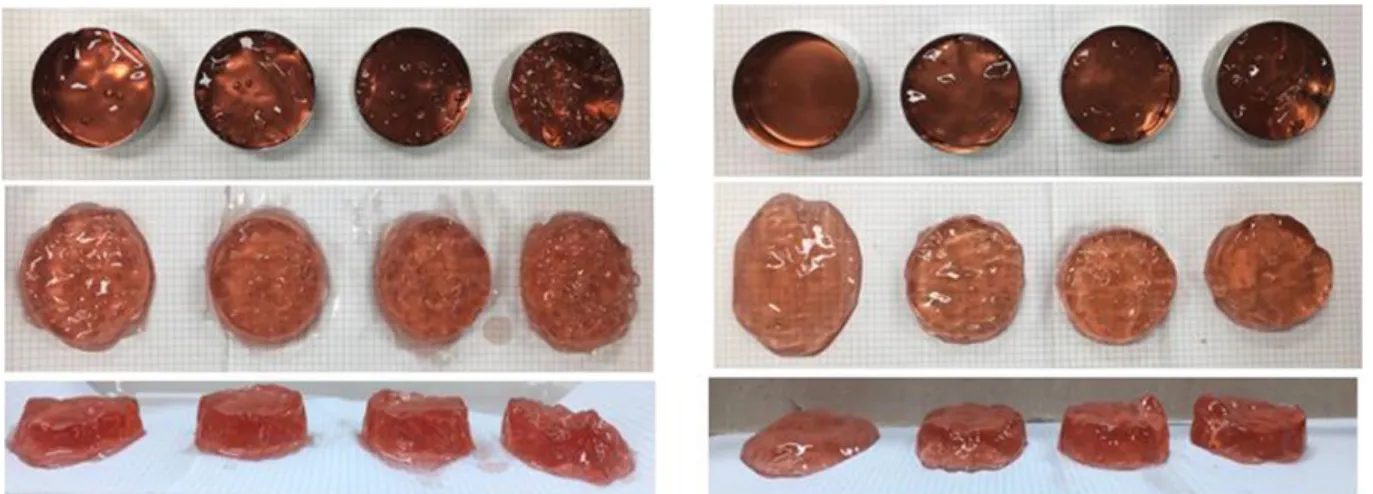
2 과 같이 제조한 젤리의 살균공정 전, 살균공정 후의 텍스쳐 결 과를 Table 10 과 Table 11 에 나타내었다. 겔화제의 함량이 0.2, 0.3, 0.4% 높아짐에 따라 살균 전과 살균 후 공정 모두 전체적으 로 경도(hardness)는 높아지는 경향을 보였다. 특히 겔화제 함량 이 0.4% 이상일 때 유의적 차이는 더 높게 나타났고 Fig. 2와 같 Fig. 2. Photo of jelly before and after sterilization according to the content of gellant. left: Before sterilization VBJ0.2, VBJ0.3, VBJ0.4, VBJ0.5; right: after sterilization VBJ0.2, VBJ0.3, VBJ0.4, VBJ0.5
Table 10. Variation of texture profile of jelly according to the content of gellant before sterilization TPA
1)attractions
Group
2)F-value
VBJ0.2 VBJ0.3 VBJ0.4 VBJ0.5
Hardness (N/m
2) 2.4±0.2
3)×10
3a4)2.4±0.3×10
3a2.7±0.3×10
3b3.3±0.2×10
3c19.472***
Cohesiveness 0.41±0.02
ab0.44±0.05
b0.42±0.03
ab0.39±0.03
b2.877 Adhesiveness (J/m
3) 4.2±1.4×10
a1.1±0.2×10
2d6.1±1.9×10
b8.5±0.8×10
c33.980***
1)
Texture profile analysis
2)
VBJ0.2, carrageenan 0.1%+glucomannan 0.1%; VBJ0.3, carrageenan 0.15%+glucomannan 0.15%; VBJ0.4, carrageenan 0.2%+ glucomannan 0.2%; VBJ0.5, carrageenan 0.25%+glucomannan 0.25%
3)
Values are mean±SD. *** p<0.001
4)
a-c means in a column by different superscripts are significantly different at 5% significance level by Duncan's multiple range test. “continued”
Table 11. Variation of texture profile of jelly according to the content of gellant after sterilization TPA
1)attractions
Group
2)F-value
VBJ0.2 VBJ0.3 VBJ0.4 VBJ0.5
Hardness (N/m
2) 1.1±0.2
3)×10
3a4)1.3±0.2×10
3a2.3±0.3×10
3b2.9±0.3×10
3c87.974***
Cohesiveness 0.52±0.05
a0.51±0.02
a0.45±0.04
a0.50±0.07
a0.861 Adhesiveness (J/m
3) 5.5±1.3×10
a9.1±1.9×10
b4.5±0.7×10
a7.7±1.8×10
b15.163***
1)
Texture profile analysis
2)
VBJ0.2, carrageenan 0.1%+glucomannan 0.1%; VBJ0.3, carrageenan 0.15%+glucomannan 0.15%; VBJ0.4, carrageenan 0.2%+glucomannan 0.2%;
VBJ0.5, carrageenan 0.25%+glucomannan 0.25%
3)
Values are mean± SD. ***p<0.001
4)
a-c means in a column by different superscripts are significantly different at 5% significance level by Duncan's multiple range test.
이 살균공정 후 겔화제의 함량이 0.4, 0.5%에서 경도(hardness)와 보형성은 유지가 되는 것으로 보였는데, 통계적 유의 수준에서도 겔화제의 함량이 0.3% 이하일 경우 경도(hardness)의 유의차는 p<0.001 이었고 겔화제의 함량이 0.4% 이상일 경우 유의차는 p<0.05 로 나타났다. 본 결과는 Jeong과 Kim(2008)의 카라기난의 함량을 고정한 후 곤약의 함량을 0.1-0.6%까지 증가시켜 물성을 관능검사로 측정한 결과 곤약 0.2% 이상 첨가군에서 형태가 온 전하게 유지되는 특성을 보였다는 결과와 유사하게, 본 연구에서 의 겔화제 함량 내 글루코만난의 함량이 0.2% 이상인 0.4, 0.5%
의 겔화제 함량에서 젤리의 경도(hardness)가 현저히 올라간 것으 로 예상된다. 또한, 살균공정 전, 후의 물성은 Fig. 2 에 나타난 바 와 같이 동일한 결과를 보였고 살균후의 젤리는 겔화제의 함량 의 영향을 받아 젤리의 경도(hardness)에 대한 상호 보완이 되는 것으로 보여진다. 이는 관능적 기호도의 씹힘성에 변수가 있을 수 있으나 Jeong과 Kim(2008)의 카라기난 1.2% 고정, 곤약의 함 량을 증가시킬 때 0.4% 이상은 젤리의 강도가 매우 높아 부적합 하다는 결과와 같이 본 연구에서도 겔화제 함량이 0.5%일 때 젤 리의 강도가 높아 겔화제의 함량이 높아질수록 누르는 힘이 강 해지므로 스파우트 파우치 젤리에서의 부적합한 성상을 나타낸 다는 결과와 유사한 결과로 보여진다.
요 약
본 연구에서는 식초음료가 함유된 젤리의 품질특성에 관하여 식초음료 함량, 구연산삼나트륨 함량, 겔화제 함량에 따라 3단계 에 나눠 제조공정에 따른 살균전후의 이화학적 특성을 연구하였 다. 식초 음료의 함량을 달리한 젤리는 식초음료의 함량이 높을 수록 pH는 급격히 낮아졌고 살균 후는 살균 전 보다 경도 (hardness) 가 현저히 낮아져 제형이 유지되지 않았다. 이는 pH와 높은 산도의 영향으로 보여 진다. 산도조절제인 구연산삼나트륨 의 함량을 달리한 실험 결과 pH는 구연산삼나트륨의 첨가 함량 의 증가는 살균전후 모두 구연산삼나트륨의 함량과 젤리의 경도 (hardness) 는 상관관계를 보였으며 살균 공정 후 젤리는 살균보다 경도(hardness)는 낮아져 pH와 살균 가열 조건이 겔화의 품질 주 요 변수임을 확인하였다. 겔화제의 함량을 달리한 젤리의 경도 (hardness) 는 살균전후 모두 겔화제 첨가 함량의 증가와 상관관계 를 보였다. 따라서 식초음료의 스파우트 젤리임을 고려할 때 제 품 관능 속성에 부합될 수 있도록 pH 3.5-3.7, 글루코만난과 카 라기난의 혼합겔의 함량은 0.4-0.5%가 적절하다고 판단되었다.
References