• 검색 결과가 없습니다.

Evidence-Based Treatments of Disruptive Behavior in Children and Adolescents

N/A
N/A
Protected

Academic year: 2021

Share "Evidence-Based Treatments of Disruptive Behavior in Children and Adolescents"

Copied!
19
0
0

로드 중.... (전체 텍스트 보기)

전체 글

(1)

637 www.kcp.or.kr

Evidence-Based Treatments of Disruptive Behavior in Children and Adolescents

Joo-Young Lee

Department of Child Development and Education, Dongduk Women’s University, Seoul, Korea

This study aimed to suggest treatment guidelines for evidence-based treatments of disruptive behavior in children and ado- lescents by reviewing related research articles. Disruptive behavior refers to a wide range of significant behavior problems, and it persists by complex interactions of multiple risk-factors across the individual, family, peer, school, and community do- mains. This study examined empirically-supported treatment programs for disruptive behaviors from other countries and reviewed 28 Korean research articles, from 1998 to 2019, dealing with treatments of disruptive behaviors. Finally, this study summarized guidelines for evidence-based treatments of disruptive behaviors in children and adolescents, and discussed fu- ture directions for research and clinical implications.

Keywords: child, adolescent, disruptive behavior, evidence-based treatment

심리학에서의 근거기반치료(evidence-based treatment)는 연구에 의해 치료의 효과가 경험적으로 지지된 치료(Empirically support- ed treatment, EST)를 의미한다. 근거기반치료 또는 경험적으로 지 지된 치료를 판단하는 기준은 통제연구에서의 효능(efficacy), 실제 임상 현장에서의 효과성(effectiveness) 및 임상적 유용성(clinical utility)이다(Chambless & Hollon, 1998; Yim, Lee, Lee, Kim, & Choi, 2013). 미국심리학회 임상심리학 분과(American Psychiatric Asso- ciation [APA] 12분과)는 경험적으로 지지된 치료의 효능을 검증하 기 위한 가이드라인을 제시하였고, 그 기준에 따라 ‘잘 확립된(well- established) 치료’와 ‘효과가 있음직한(probably efficacious) 치료’

를 구분하였다(Chambless et al., 1998). 아동 및 청소년의 경우에는 미국심리학회 아동청소년 임상심리학 분과(APA 53분과)에서 5단 계의 근거기반치료 기준을 제시하고 있다(Southam-Gerow & Prin- stein, 2014). 일반적으로 ‘잘 확립된 치료’는 서로 다른 연구진에 의 한 최소 두 개 이상의 집단 간 연구설계에서 약물이나 심리적 위약

조건 또는 다른 치료조건보다 우월한 효과를 보여야 하며, ‘효과가 있음직한 치료’는 최소 두 개 이상의 연구에서 대기 통제집단보다 우월한 효과를 보여야 한다. ‘잘 확립된 치료’와 ‘효과가 있음직한 치료’ 모두 치료 매뉴얼이 있거나 치료의 내용이 분명하게 기술되어 있어야 하며, 표본의 특성이 명확해야 한다.

한국임상심리학회에서는 2017년 특별호 발간을 통해 불안 및 관 련 장애들의 근거기반치료에 관한 리뷰 논문들을 발표하였고(Cho, 2017), 2018년에는 아동 및 청소년 장애의 근거기반치료를 다루는 논문들을 발간하기로 하였다. 본 논문은 아동 및 청소년기에 흔히 진단되는 장애 중의 하나인 품행장애(conduct disorder, CD)의 근 거기반치료를 소개하고 국내에서의 권고안을 제언하는 것을 목적 으로 하고 있다. 품행장애는 외현적으로 드러나는 다양한 형태의 문제행동들을 포괄하고 있어 품행장애로만 대상자를 한정 짓기에 는 무리가 있다. 따라서 본 논문에서는 대상자의 문제를 품행장애 에만 국한하지 않고, 보다 포괄적인 용어인 ‘파괴적 행동(disruptive behavior)’을 사용하고자 한다.

파괴적 행동의 개념과 특성

파괴적 행동(disruptive behavior)이란 아동 및 청소년기에 외현적 으로 나타나는 광범위한 문제행동(예: 공격성, 재산 파괴, 가출, 거

© 2018 Korean Clinical Psychology Association

Korean Journal of Clinical Psychology 2018. Vol. 37, No. 4, 637-655

eISSN 2733-4538

Correspondence to Joo-Young Lee, Dongduk Women’s University, 60 Hwarang-ro 13-gil, Seongbuk-gu, Seoul, Korea; E-mail: jylee7694@dongduk.

ac.kr

Received Sep 16, 2018; Revised Nov 2, 2018; Accepted Nov 15, 2018

I would like to express my sincere appreciation to Seon Min Lee for organizing data related to this paper.

Review Article

https://doi.org/10.15842/kjcp.2018.37.4.014

(2)

짓말, 절도 등)을 지칭하는 용어로 그 문제의 수준이 심각하면 정신 건강 전문가에 의뢰되거나 사법적 처분의 대상이 된다(McCart &

Sheidow, 2016). 파괴적 행동을 묘사하는 용어는 다양한데, 정신건 강 영역에서는 그러한 행동을 적대적 반항장애(oppositional defi- ant disorder, ODD)나 품행장애(CD)와 같은 진단적 범주로 기술하 며(APA, 2013), 파괴적 행동을 보이는 청소년이 사법체계(juvenile justice system)에 연루되면 비행(delinquency)이나 소년범죄(juve- nile crime)와 같은 용어가 사용되기도 한다.

파괴적 행동을 지칭하는 다양한 용어들은 서로 유사하기도 하지 만 개념적으로 구분될 필요가 있다. 먼저, 품행장애는 정신질환의 진단 및 통계 편람 제5판(DSM-5; APA, 2013)에서 파괴적, 충동조 절 및 품행장애(Disruptive, Impulse-Control, and Conduct Disor- ders) 범주에 속해있는 정신과적 장애로, 다른 사람의 기본 권리를 침해하고 연령에 적절한 사회적 규범 및 규칙을 위반하는 지속적이 고 반복적인 행동 양상을 핵심 특징으로 한다. 이러한 행동은 크게 사람과 동물에 대한 공격성, 재산 파괴, 사기 또는 절도, 심각한 규 칙 위반이라는 4가지 영역으로 구분되고 10세를 기준으로 아동기 발병형과 청소년기 발병형으로 구분된다. DSM 진단기준을 사용 한 연구들에 따르면 품행장애의 유병률은 2–10%로 알려져 있고, 약 3:1 또는 4:1의 비율로 여아보다는 남아에게 더 자주 진단되는 것 으로 보고되고 있다(APA, 2013). 품행장애가 파괴적 행동을 범주 적으로 접근한 진단명이라면 외현화(externalizing) 문제는 차원적 접근에서 파괴적 행동을 경험적으로 기술한 개념이다(Achenbach

& Rescorla, 2001). 아동 및 청소년의 문제행동을 평가하기 위해 개 발된 Achenbach System of Empirically Based Assessment(ASEBA) 에서 외현화 문제는 규칙위반(rule-breaking behavior)과 공격행동 (aggressive behavior)의 2개의 소척도로 측정된다(Oh & Kim, 2010).

품행장애와 외현화 문제 이외에도 파괴적 행동과 관련되는 용어 로는 공격성, 반사회적 행동, 비행, 소년범죄 등이 있다. 공격성은 일 반적으로 다른 사람을 해치거나 해하려는 의도를 가진 외현적인 신 체적, 언어적 행동으로 정의되고(Crick & Grotpeter, 1995; Crick &

Zahn-Waxler, 2003), 반사회적 행동은 연령과 상관없이 공격행동, 기물파손과 같이 타인에게 피해를 입히거나 약물남용, 위험 성행 동과 같이 개인의 안녕감을 해치고 사회적 비용을 발생시키는 행 동을 지칭하는 보다 포괄적인 용어라고 할 수 있다(Coie & Dodge, 1998). 한편, 비행은 재산범죄(property offense), 인신범죄(person offense), 지위범죄(status offense)와 같이 주로 18세 이하의 청소년 이 법을 위반하는 행동을 지칭하고(Seo & Kim, 2015), 소년범죄는 법적으로 미성년에 해당하는 자의 범죄 행위로(Siegel & Welsh,

2009), 한국에서는 소년법(법률 제8722호)에 의거하여 14세(형사책 임 연령) 이상 19세 미만의 소년에 의한 범죄 행위와 10세 이상 14세 미만의 소년에 의한 촉법행위를 의미한다. 이와 같이 아동 및 청소 년기에 나타나는 파괴적 행동은 그러한 행동을 평가하는 방법이나 개입 장면 및 사법체계 연루 여부 등에 따라 다양한 용어로 기술되 고 있음을 알 수 있다. 본 논문에서도 파괴적 행동을 품행장애, 외 현화 문제, 공격성, 비행, 범죄 등의 다양한 용어로 기술되는 문제행 동으로 정의하고 국내 연구들을 리뷰할 때 파괴적 행동, 품행장애, 외현화 문제, 공격성, 비행, 범죄 등의 키워드를 모두 활용하였다.

파괴적 행동의 원인(causes) 및 관련 변인(correlates)

파괴적 행동에 대한 근거기반치료를 개관하기 전에 파괴적 행동의 원인과 관련 변인을 간단하게 정리하고자 한다. 왜냐하면 파괴적 행동의 근거기반치료는 대부분 여러 개의 치료 요소(multicompo- nent)로 구성되어 있는데 치료의 각 구성요소를 제대로 이해하기 위해서는 파괴적 행동을 설명하는 변인들에 대한 이해가 선행되어 야 하기 때문이다. 선행연구들은 파괴적 행동을 단일한 원인으로 설명하기보다는 개인, 가정, 또래, 학교, 지역사회 등의 다양한 체계 에서 비롯되는 위험요인들의 복잡한 상호작용으로 설명하고 있다 (Loeber, Burke, & Pardini, 2009; Patterson, DeBaryshe, & Ramsey, 1989). 먼저, 개인 수준의 위험요인에는 유전적 영향(Beaver & Con- nolly, 2013), 위협에 대한 반응에 관여하는 해마 및 전두엽 영역의 이상과 같은 신경학적 손상(Crowe & Blair, 2008), 기질 특성, 인지 과정 등이 포함되는데, 낮은 행동 통제와 높은 부정적 정서성(DeLi- si & Vaughn, 2014), 냉담-무정서 특질(Frick, Ray, Thorton, & Kahn, 2014) 등이 유전적 기반을 가진 기질적 특성으로서 파괴적 행동에 영향을 미치는 위험요인으로 알려져 있다. 사회정보처리 결함으로 대표되는 인지적 요인 역시 파괴적 행동을 설명하는 변인으로 오랫 동안 연구되어 왔다(Fontaine, Yang, Dodge, Pettit, & Bates, 2009).

다음으로, 가정 수준의 위험요인에는 부적응적인 양육과 부모-

자녀 간의 강압적인 상호작용이 대표적이다(Hoge, Guerra, & Box-

er, 2008). 어린 아동들은 자신이 하기 싫은 행동을 회피하는 데 효

과적인 적대적이고 공격적인 행동을 학습하게 되는데, 파괴적 행동

으로 발전하는 아동들의 부모들은 자녀의 이러한 행동들을 제대로

통제하는 데 실패한다. 이러한 아동들이 청소년이 되면, 부모들은

자녀에게 온정적인 태도를 보이지 못하고 부모-자녀 간 갈등을 심

화시키며 청소년 자녀의 일상생활을 제대로 지도감독하지 못함으

로써 파괴적 행동을 악화시키게 된다(Dishion, Bullock, & Granic,

2002). 초기 아동기에는 아동의 기본적인 인지 기술과 부적응적인

(3)

EBT of Disruptive Behavior

639

https://doi.org/10.15842/kjcp.2018.37.4.014

양육이 파괴적 행동과 좀 더 밀접하게 관련되어 있기 때문에 아동 을 대상으로 하는 근거기반치료에서는 이러한 요소들에 보다 초점 을 맞추는 경향이 있다.

비행 또래(deviant peers)와의 어울림은 청소년기의 파괴적 행동 을 가장 강력하게 예측하는 또래 수준의 위험요인이다(Dodge, Dishion, & Lansford, 2007; Fleming, Catalano, Haggerty, & Ab- bott, 2010; Patterson, Dishion, & Yoerger, 2000). 더불어 학업 성취 의 실패, 잦은 무단결석과 같은 학교생활의 어려움 역시 파괴적 행 동에 부정적 영향을 미치는 위험요인으로 보고되고 있다(Janosz, LeBlanc, Boulerice, & Tremblay, 1997; Loeber et al., 2005). 청소년 의 파괴적 행동을 다루는 근거기반치료에서는 가정 수준의 위험요 인뿐만 아니라 비행 또래와의 관계 및 학업 실패 등도 중요한 치료 요소로 다루어진다. 즉, 아동 및 청소년의 파괴적 행동의 근거기반 치료는 연령에 따라 관련되는 위험요인이 다르기 때문에 그에 대한 치료도 다르게 구성되어야 한다. 더욱 중요한 것은 이상에서 언급 한 다양한 위험요인들이 각각 독립적으로 파괴적 행동에 영향을 미치는 것이 아니라 서로 복잡한 방식으로 상호작용하기 때문에 치료 대상의 연령과 발달적 특성에 맞춘 근거기반치료의 구성이 매 우 중요하다고 하겠다.

파괴적 행동의 근거기반치료: 해외 

아동과 청소년의 파괴적 행동에 대한 근거기반치료를 다룬 대표적 인 해외 메타연구로는 Eyberg, Nelson과 Boggs(2008)의 연구 및 이 연구의 업데이트 버전인 Kaminski와 Claussen(2017)의 연구와 McCart와 Sheidow(2016)의 연구가 있다. Eyberg 등(2008)의 연구 에서는 1996년부터 2007년 사이에 발표된 아동 및 청소년의 적대 적 반항장애와 품행장애에 대한 심리사회적 근거기반치료 논문을 리뷰하였다. Chambless 등(1998)이 제안한 근거기반치료의 기준

1)

에 따라 관련 논문들을 리뷰한 결과, 16개의 근거기반치료가 ‘잘 확 립된(well-established)’ 또는 ‘효과가 있음직한(probably effica- cious)’ 치료로 확인되었다(Table 1). 이 연구에서 제안된 16개의 근 거기반치료 중 현재까지도 활발하게 연구가 진행되고 있는 9개의 핵심 치료 프로토콜을 소개하면 다음과 같다. 아래에 소개된 치료 프로그램들의 개발 배경, 치료 효과, 실행 연구 등에 대해서는 Weisz와 Kazdin(2017)의 “아동·청소년을 위한 근거기반 심리치 료”에 보다 자세히 소개되어 있으며, 캘리포니아 근거기반 정보센터 (California Evidence-Based Clearinghouse for Child Welfare,

CEBC) 홈페이지에서도 관련 내용을 찾아볼 수 있다(http://www.

cebc4cw.org/topic/disruptive-behavior-treatment-child-adoles- cent).

잘 확립된(well-established) 치료

오레곤 부모 관리 훈련(Parent Management Training Oregon Model, PMTO; Patterson, Reid, Jones, & Conger, 1975) 오레곤 부모 관리 훈련(PMTO)은 부모에게 자녀의 행동을 수정하 기 위한 기본적인 행동 원리를 가르치고, 부모로 하여금 아동의 행 동을 모니터링하고 자녀의 행동 문제를 개선하기 위해 행동 수정 프로그램을 실행할 수 있도록 돕는 프로그램이다(https://www.

generationpmto.org). 과거 PMTO로 불리던 이 프로그램은 현재

‘세대 부모 관리 훈련-오레곤(Generation Parent Management Training-Oregon, GenerationPMTO)’으로 발전하였다. Genera- tionPMTO는 부모를 변화의 중개인으로 간주하며, 변화의 메커니 즘으로 알려진 부모양육기술을 강화함으로써 아동의 행동 문제를 다룬다. 이 프로그램에서 가르치는 핵심적인 부모양육 요소는 격려 를 통한 교육, 아동과의 긍정적인 관여, 효과적인 가족문제해결, 모 니터링과 슈퍼비전, 효과적인 제한 설정 등이 있으며, 이러한 핵심 요소를 지원하는 부수적인 기술에는 명확한 지시, 정서 조절, 효과 적인 의사소통이 있다(Forehand, Lakfo, Parent, & Burt, 2014;

1) Chambless 등 (1998) 이 제안한 근거기반치료 기준은 Cho(2017) 의 논문 Table 1 에 제시되어 있음 .

Table 1. Criteria Met by the Evidence-Based Treatments of Disruptive Behavior (Eyberg, Nelson, & Boggs, 2008)

Well-Established Probably Efficacious Parent Management

Training Oregon Model

Anger Control Training

Group Assertiveness Training (Counselor Led) Group Assertiveness Training (Peer Led) Helping the Noncompliant Child Incredible Years Parent Training Incredible Years Child Training Multidimensional Treatment Foster Care Multisystemic Therapy

Parent-Child Interaction Therapy Problem-Solving Skills Training Problem-Solving Skills Training+Practice Problem-Solving Skills Training+Parent

Management Training

Rational-Emotive Mental Health Program

Rational-Emotive Mental Health Program

Triple P (Positive Parenting Program) Enhanced

Triple P Standard Individual Treatment

(4)

Weisz & Kazdin, 2017). Patterson, Chamberlain과 Reid(1982)는 치료 프로그램이 평균 17시간 정도가 요구된다고 하였고, Bernal, Klinnert와 Schultz(1980)는 각 가정 당 10번의 1시간짜리 회기 및 주 2회의 전화가 필요하다고 보고하였다. 이상의 두 연구들은 PMTO가 아동의 파괴적 행동을 감소시키는 데 대안적인 치료보다 더 효과적임을 보고하였다.

효과가 있음직한(probably efficacious) 치료

분노 통제 훈련(Anger Control Training; Lochman, Barry, &

Pardini, 2003)

분노 통제 훈련은 초등학생들을 위한 인지행동적 개입으로 아동 들은 약 6명으로 구성된 소집단으로 보통 주 1회, 40–50분씩의 회 기를 갖게 된다. 아동들은 분노 통제에 대한 사회정보처리 모델 (Crick & Dodge, 1994)에 따라 분노가 유발되는 사회적 상황을 어 떻게 다룰지에 대한 문제해결기술을 학습하고 적절한 사회적 반응 을 연습하며 새로운 분노 통제 전략을 획득하게 된다. 분노 통제 훈 련의 효과를 검증한 선행연구들(Lochman, Coie, Underwood, &

Terry, 1993; Robinson, Smith, & Miller, 2002)에서는 치료 길이가 각각 26–30회기, 15회기였다. Lochman의 분노 통제 훈련은 이후 Anger Coping Program(Larson & Lochman, 2010)과 아동의 공격 적 행동을 다루는 Coping Power Program(Lochman, Wells, &

Lenhart, 2008)으로 발전하였다(Weisz & Kazdin, 2017; www.cop- ingpower.com 참고).

비순응 아동 돕기(Helping the Noncompliant Child, HNC;

Forehand & McMahon, 1981)

비순응 아동 돕기 프로그램(HNC)은 비순응적 행동을 보이는 유 아와 어린 아동(3–8세)을 위한 이차 예방 프로그램(secondary pre- vention program)으로 각 가정에 개별적으로 실시된다. 이차 예방 프로그램의 목적은 조기 진단과 치료를 통해 이미 존재하는 문제 의 지속 기간과 영향력을 줄이려는 것으로 HNC에서는 잘못된 부 모-자녀 상호작용에서 비롯되는 유아와 아동의 비순응 문제가 더 심각한 품행문제로 발전하는 것을 막고자 한다. 치료자는 주 1회, 10주간 부모와 아동을 만나는데, 부모들에게 부모-자녀 상호작용 의 강압적 악순환을 끊을 수 있는 기술(예: 아동의 바람직한 행동 에 대한 긍정적 피드백 늘리기, 사소한 부정적 행동 무시하기, 아동 에게 명확한 지시 내리기, 아동의 순응적/비순응적 행동에 대한 칭 찬 및 타임아웃 실시하기 등)을 교육한다. 이 프로그램은 체계적 가 족치료보다 아동의 비순응적 행동을 감소시키는 데 더 효과적인 것으로 확인되었다(Wells & Egan, 1988).

멋진 시절(Incredible Years, IY; Webster-Stratton & Reid, 2003) 멋진 시절(IY)은 아동의 공격성과 행동문제를 감소시키고 사회적 유능성을 증진시키기 위한 목적으로 개발된 프로그램 시리즈의 명 칭이다(www.incredibleyears.com 참고). IY는 부모용, 아동용, 교 사용이 있으며 3개의 프로그램 모두 그 효능(efficacy)이 검증되었 다(Webster-Stratton & Hammond, 1997; Webster-Stratton, Reid,

& Hammond, 2004). 부모용 프로그램은 1회기 당 2시간으로 총 13 회기로 구성되어 있으며, 파괴적 행동문제를 보이는 2–10세 자녀를 둔 부모 8–12명이 집단을 이루게 된다. 치료기간 동안 부모들은 1–2 분 길이의 비디오 250개를 보고 사회적 학습과 아동 발달의 원리를 학습한다. 부모들은 긍정적인 부모-자녀 상호작용 방법을 배우고 자녀에게 문제해결기술을 가르치는 방법을 교육받게 된다. 아동용 프로그램은 6명의 아동으로 구성된 집단을 대상으로 매주 2시간 씩 총 22주에 걸쳐 진행된다. 이 프로그램에는 가정과 학교에서의 실제 갈등 상황이 담긴 100여 개의 비디오를 통해 아동에게 문제해 결기술과 사회적 기술을 학습하도록 한다. 아동용 프로그램은 부 모용 프로그램과 함께 실시되는 경우가 많다.

다차원 치료 위탁 보호(Multidimensional Treatment Foster Care, MTFC; Chamberlain & Smith, 2003)

다차원 치료 위탁 보호(MTFC)는 지역사회 기반의 프로그램으로,

현재는 ‘오레곤 치료 위탁 보호(Treatment Foster Care Oregon,

TFCO; www.tfcoregon.com 참고)’로 명칭이 바뀌었다. MTFC는

원래 심각하고 만성적인 비행을 보이는 청소년들을 소년원과 같은

시설에 수용하는 것의 대안으로 개발된 프로그램으로, 이 프로그

램에 속한 청소년들은 6–9개월간 지정된 위탁 가정에서 지내면서

훈련된 위탁 부모의 보호 아래 가족 치료자, 개인 치료자, 기술 코

치, 필요 시 정신과 자문의와 정기적으로 만나며 개별적인 행동 관

리 프로그램과 일관된 사례 관리를 통해 지역사회에서 성공적으로

살아가기 위해 필요한 새로운 기술을 학습하고, 친부모와 긍정적인

재통합을 이룰 수 있는 도움을 제공받게 된다(Weisz & Kazdin,

2017). TFCO의 특징 중 하나는 청소년이 위탁 가정에서 지내는 동

안 친부모 혹은 주양육자가 개별적으로 심층적인 부모 훈련을 받

는다는 것인데, 이러한 과정을 통해 가정의 재통합이 이루어지도록

한다. 현재 TFCO는 3–6세 유아를 위한 TFCO-Preschoolers

(TFCO-P), 7–11세 아동을 위한 TFCO-Childhood(TFCO-C), 청

소년을 위한 TFCO-Adolescents(TFCO-A)로 세분화되어 실행되

고 있다.

(5)

EBT of Disruptive Behavior

641

https://doi.org/10.15842/kjcp.2018.37.4.014

다중체계치료(Multisystemic Therapy, MST; Henggeler & Lee, 2003)

다중체계치료(MST)는 심각한 반사회적 행동 및 비행을 보이는 청 소년들을 대상으로 심층적인 가족 및 지역사회 기반의 개입을 제 공함으로써 청소년의 책임감 있는 행동을 증진시키고 시설 수용을 예방하는 데 목적이 있다(http://www.mstservices.com 참고). 다중 체계치료는 근거기반의 인지행동적 접근, 행동치료, 부모 훈련, 가 족치료, 약물 개입으로 구성되어 있으며 모든 서비스는 자연스러운 환경(예: 집 또는 학교)에서 제공되며 보통 3–5개월간 계속된다. 다 중체계치료에서 치료자들은 대상 청소년 및 가족에게 언제든지 필 요한 도움을 줄 수 있으며, 2–4명의 치료자들이 팀을 이루어 각자 4–6가정의 사례를 담당한다. 다중체계치료는 필요에 따라 청소년 을 둘러싼 여러 체계에 동시에 개입하기 때문에 서비스 형태가 고정 화되어 있지 않고 매우 탄력적으로 운영된다.

부모-아동 상호작용 치료(Parent-Child Interaction Therapy, PCIT; Brinkmeyer & Eyberg, 2003)

부모-아동 상호작용 치료(PCIT)는 파괴적 행동문제를 보이는 아 동(2–7세)을 위한 부모양육기술 훈련 프로그램이다(www.pcit.org 참고). 치료는 주 1회, 평균 12–16회기로 구성되며 각 회기 동안 부 모들은 2가지 기본적인 상호작용 패턴을 학습한다. 아동-주도 (child-directed) 상호작용 단계에서는 자녀에게 긍정적인 주의를 기울이는 방법과 적극적으로 무시하는 기술을 배우게 되는데, 이 단계의 주요 목표는 긍정적인 양육과 온정적인 태도를 증진하는 것 이다. 다음으로 부모-주도(parent-directed) 상호작용 단계에서는 이전 단계에서 확립된 긍정적이고 온정적인 부모-자녀 관계를 바탕 으로 자녀에게 명확한 지시를 내리는 방법을 연습하고 훈육이 필요 한 상황에서는 칭찬이나 타임아웃을 제공하는 방법을 훈련한다.

치료자는 치료 회기 내에서 부모들이 자녀들과 상호작용하는 모습 을 보고 차분하고 일관되게 양육기술을 적용하도록 코칭하고 가정 내에서도 유능감을 가지고 그러한 기술들을 실천할 수 있도록 돕 는다. PCIT는 대기통제집단에 비해 아동의 파괴적 행동을 감소시 키는데 효과적이었음이 검증되었다(Nixson, Sweeney, Erickson, &

Touyz, 2003; Schuhmann, Foote, Eyberg, Boggs, & Algina, 1998).

문제해결기술훈련(Problem-Solving Skills Training, PSST;

Kazdin, 2003)

문제해결기술훈련(PSST)은 파괴적 행동을 보이는 7–13세 아동들 을 위해 고안된 행동적 치료 프로그램이며 주로 40–50분 동안 진행 되는 20–25회기로 구성된다. 이 프로그램에서 아동들은 문제해결

전략들을 배우고 이러한 전략들을 실제 생활에 적용하게 된다. 문 제해결기술에는 문제 확인하기, 해결책 생성하기, 각 해결책의 장점 과 단점을 파악하기, 의사결정하기, 결과 평가하기 등이 포함된다.

치료자는 회기 내 연습, 모델링, 역할연기, 교정적 피드백, 사회적 강 화, 토큰 대가 등의 기법을 활용하여 문제해결기술을 가르치게 된 다. PSST는 관계치료(relationship therapy)나 통제집단에 비해 치 료 효과가 우수한 것으로 검증되었다(Kazdin, Bass, Seigel, &

Thomas, 1989; Kazdin, Esveldt-Dawson, French, & Unis, 1987).

PSST 관련 자료는 https://yaleparentingcenter.yale.edu/store에서 찾아볼 수 있다.

긍정적 양육 프로그램(Positive Parenting Program, Triple P;

Sanders, 1999)

긍정적 양육 프로그램(Triple P)은 아동의 문제의 심각성에 따라 다섯 수준으로 이루어진 다층 치료 시스템이다(www.tprn.net 참 고). 수준 1(보편적 Triple P: Universal Triple P)은 텔레비전과 뉴스 등을 통해서 일반 대중들에게 양육에 대한 정보를 제공하는 보편 적 예방 프로그램이다. 수준 2(선별된 Triple P: Selected Triple P)는 1–2개의 경미한 행동문제에 대한 염려를 가지고 있는 부모들을 대 상으로 일차 건강 기관에서 간략한 1–2회기의 개입이 이루어지는 것이다. 수준 3(일차 관리 Triple P: Primary Care Triple P)은 일차 건강 기관에서 4회기 정도의 개입으로 이루어지며 여기에서 부모 들은 중등도의 까다로운 행동문제를 다루는 양육기술을 배우게 된다. 수준 4(표준 Triple P: Standard Triple P)는 정신건강 전문가 가 개인 또는 집단 형태로 12회기에 걸쳐 진행하는 방식으로 긍정 적인 양육기술에 대한 집중적인 훈련을 원하는 부모들을 대상으로 시행된다. 수준 5(강화된 Triple P: Enhanced Triple P)는 아동의 파 괴적 행동뿐만 아니라 부모의 우울증이나 결혼생활문제 등과 같 은 가정 내의 스트레스에 초점을 맞춘 행동적 가족 개입이다. 이 중 에서 수준 4의 표준 Triple P와 수준 5의 강화된 Triple P가 효과가 있음직한 치료의 기준을 만족시켰다(Bor, Sanders, & Markie- Dadds, 2002; Sanders, Markie-Dadds, Tully, & Bor, 2000).

이상에서 소개한 주요 치료 프로그램들을 요약해 보면, 어린 연

령대의 유아나 아동을 대상으로 한 프로그램들에서는 부모-자녀

상호작용과 아동의 기본적인 인지 기술(예: 문제해결 및 사회적 갈

등 해결)에 개입하고 있는데, 이는 아동기의 파괴적 행동이 주로 부

적응적인 양육과 인지 과정의 결함에 기인한다는 연구 결과를 바

탕으로 하고 있다. 한편, 청소년을 대상으로 한 프로그램들에서는

아동기에서부터 발전되어 온 보다 심각한 파괴적 행동(예: 품행장

애, 범죄)이 가족관계는 물론 비행 또래 및 학업적 부적응과도 밀접

(6)

하게 관련되어 있다는 연구 결과에 따라 친부모와의 성공적인 재결 합을 위한 가족치료와 비행 또래와의 어울림을 차단하고 친사회적 인 또래 관계를 형성하도록 돕는 개인 코칭을 실시하는 TFCO, 청 소년들이 속한 다양한 체계(예: 가정, 학교, 지역사회)에 개입하고 자 하는 MST와 같은 지역사회 기반의 프로그램들이 경험적인 지 지를 얻고 있다. 이와 같이 아동 및 청소년의 파괴적 행동을 다루는 근거기반치료는 파괴적 행동의 발생과 유지에 기여하는 다양한 체 계의 위험요인들을 연령에 따라 세심하게 다루어야 한다.

최근 Kaminski와 Claussen(2017)은 Eyberg 등(2008)의 연구를 업데이트하고자 파괴적 행동을 보이는 12세 미만의 아동들을 위한 근거기반치료들을 검토하였다. 2007년부터 2016년까지 발표된 논 문들을 검색하여 총 64개의 논문을 분석하였고, 이 논문들에서 소

개된 치료들을 6개의 치료 그룹(treatment family)으로 구분한 결 과 (1) 부모 행동 치료, (2) 아동 행동 치료, (3) 교사 훈련, (4) 부모-중 심 치료, (5) 아동-중심 놀이치료, (6) 가족 문제해결훈련으로 분류 되었다. Chambless 등(1998)의 근거기반치료 기준 및 Southam- Gerow와 Prinstein(2014)의 Journal of Clinical Child and Adoles- cent Psychology(JCCAP) Evidence Base Update 기준(Table 2)에 따라 프로그램 명칭이 아닌 치료 그룹을 평가한 결과, 부모 행동 치 료와 아동이 참여하는 개인 부모 행동 치료가 ‘잘 확립된(well-es- tablished)’ 치료로 확인되었고, 13개의 치료 그룹이 ‘효과가 있음직 한(probably efficacious)’ 치료로 확인되었다(Table 3). Table 3을 살 펴보면, 집단 부모 행동 치료에 속하는 프로그램으로는 멋진 시절, PMTO, Communication Method Program(COMET), Triple P(수

Table 2. Journal of Clinical Child and Adolescent Psychology Evidence Base Update Criteria Methods Criteria

M.1. Group design: Study involved a randomized controlled design

M.2. Independent variable defined: Treatment manuals or logical equivalent were used for the treatment

M.3. Population clarified: Conducted with a population, treated for specified problems, for whom inclusion criteria have been clearly delineated M.4. Outcomes assessed: Reliable and valid outcome assessment measures gauging the problems targeted (at a minimum) were used

M.5. Analysis adequacy: Appropriate data analyses were used & sample size was sufficient to detect expected effects Level 1: Well-Established Treatments

1.1 Efficacy demonstrated for the treatment in at least two (2) independent research settings and by two (2) independent investigatory teams dem- onstrating efficacy by showing the treatment to be either:

1.1.a. Statistically significantly superior to pill or psychological placebo or to another active treatment OR

1.1.b. Equivalent (or not significantly different) to an already well-established treatment in experiments AND 1.2. All five (5) of the Methods Criteria

Level 2: Probably Efficacious Treatments

2.1. There must be at least two good experiments showing the treatment is superior (statistically significantly so) to a waitlist control group OR

2.2. One or more good experiments meeting the well-established treatment level with the one exception of having been conducted in at least two independent research settings and by independent investigatory teams AND

2.3. All five (5) of the Methods Criteria Level 3: Possibly Efficacious Treatments

3.1. At least one good randomized controlled trial showing the treatment to be superior to a waitlist or no-treatment control group AND

3.2. All five (5) of the Methods Criteria OR

3.3. Two or more clinical studies showing the treatment to be efficacious, with two or more meeting the last four (of five) Methods Criteria, but vnone being randomized controlled trials

Level 4: Experimental Treatments

4.1. Not yet tested in a randomized controlled trial OR

4.2. Tested in 1 or more clinical studies but not sufficient to meet Level 3 criteria.

Level 5: Treatments of Questionable Efficacy

5.1. Tested in good group-design experiments and found to be inferior to other treatment group and/or waitlist control group, that is, only evidence

available from experimental studies suggests the treatment produces no beneficial effect.

(7)

EBT of Disruptive Behavior

643

https://doi.org/10.15842/kjcp.2018.37.4.014

준 4)가 있었고, 아동이 참여하는 개인 부모 행동 치료에는 PMTO, Oregon Social Learning Center program(OSLC 프로그램), 단축형 PCIT, PMT(Kazdin, Siegel, & Bass, 1992), Triple P(수준 4)가 있었 다. 즉, 강력한 근거를 가진 대부분의 치료들은 파괴적 행동을 보이 는 자녀를 둔 부모들을 대상으로 행동적 부모양육기술을 훈련하는 프로그램들임을 알 수 있다.

한편, 청소년 대상의 근거기반치료를 리뷰한 McCart와 Shei- dow(2016)는 2007년부터 2014년까지 출판된 논문들과 1998년과 2008년 연구(Brestan & Eyberg, 1998; Eyberg et al., 2008)에 포함되 었던 청소년 대상 논문들을 다시 평가하여 총 86개의 논문들을

JCCAP의 기준에 따라 5가지 단계로 분류하였다. 분석 결과, 2개의 중다요소 치료(multicomponent treatment)가 ‘잘 확립된(well-es- tablished)’ 치료로 분류되었는데 여기에는 다중체계치료(MST)와 TFCO(전 MTFC)가 포함되었다(Table 4). 즉, 아동기와 달리 청소 년기에는 파괴적 행동으로 인해 사법체계에 연루되는 청소년들이 많아지면서 중다요인의 가족-기반 치료들에 대한 연구가 확대되었 고, 그에 따라 MST와 TFCO와 같이 청소년을 둘러싼 다양한 수준 의 생태학적 환경(예: 개인, 가정, 또래, 학교, 지역사회)의 위험요인 들을 타깃으로 하여 가족적, 행동적, 인지행동적 치료 전략을 통합 적으로 결합한 중다요인 치료들이 강력한 근거기반을 가지게 되었 Table 3. Treatment Family and Program by Level 1 and 2 of Evidence (Kaminski & Claussen, 2017)

Level of Evidence Treatment Family Program

Level 1: Well-Established Group parent behavior therapy Incredible Years Basic PMTO COMET

Triple P (Level 4) Individual parent behavior therapy with child

participation Behavioral parent training

PMTO OSLC

Social learning parent training (Hanf model) Abbreviated PCIT

Parent Management Training Triple P Precursor

Level 2: Probably Efficacious Group parent behavior therapy+group child behavior

therapy SNAP Under 12 Outreach Program

Incredible Years Basic+Dinosaur School (Norway) Group parent behavior therapy with child

participation+Family problem-solving training Multiple Family Group

Group parent behavior therapy with child participation Group Parent-Child Interaction Therapy Individual parent behavior therapy Brief PMTO (Norway)

Individual parent behavior therapy with child participation+individual child behavior therapy with parent participation+teacher training

First Step to Success

Self-directed parent behavior therapy Every Parent COMET THOP 1-2-3 Magic

Incredible Years Precursor

Self-Directed Behavioral Family Intervention Group child behavior therapy Incredible Years Dinosaur School

Group child behavior therapy+teacher training Incredible Years Dinosaur School plus Teacher Training Individual child behavior therapy Problem Solving Skills Training

Individual child behavior therapy with parent

participation Problem Solving Skills Training with in vivo practice

Group parent-focused therapy Turning Into Kids

Group child-centered play therapy Group Activity Play Therapy Individual child-centered play therapy Adlerian Play Therapy

Note. COMET=Communication Method Program; OSLC=Oregon Social Learning Center Program; PCIT=Parent-Child Interaction Therapy;

PMTO=Parent Management Training Oregon; SNAP=Stop Now and Plan; THOP=Therapy program for children with hyperkinetic and opposi-

tional problem behavior.

(8)

음을 알 수 있다. 많은 정신과적 장애들이 인지행동치료를 가장 강 력한 근거기반치료로 제언하고 있는 것과 달리 청소년의 파괴적 행 동에 대해서는 인지행동치료뿐만 아니라 청소년을 둘러싼 맥락적 요소를 반드시 고려해야 한다는 입장이 경험적인 지지를 받고 있 다(Farrell et al., 2010; Lansford, Malone, Dodge, Pettit, & Bates, 2010; McMahon, Felix, Halpert, & Petropoulos, 2009; Nelson &

Coyne, 2009; Werner & Hill, 2010).

파괴적 행동의 근거기반치료: 국내

아동 및 청소년의 파괴적 행동에 대한 국내 심리치료 연구는 한국 교육학술정보원(KERIS)에서 제공하는 학술연구정보서비스 (RISS) 사이트에서 검색하였다. 검색어는 ‘파괴적 행동’, ‘품행장애’,

‘외현화’, ‘공격성’, ‘비행’, ‘범죄’ AND ‘치료’, ‘상담’, ‘프로그램’, ‘개 입’으로 설정하여 1998년부터 2018년까지 KCI 등재지 혹은 등재후 보지에 출판된 연구들을 검색하였고, 성인을 대상으로 한 연구들 을 제외한 결과 1차적으로 98편의 논문이 검색되었다. 파괴적 행동 에 대한 국내 근거기반치료를 규명하기 위한 목적에 따라 본 연구 에서는 Chambless 등(1998), Kaminski와 Claussen(2017), McCart 와 Sheidow(2016)의 연구를 참고하여 검색된 98편의 논문들 중에 서 다음의 기준을 충족하는 논문들을 선별하였다.

① 파괴적 행동을 치료 타깃으로 한 연구: 파괴적 행동 경향이 있 는 집단을 대상으로 자존감, 사회성, 도덕성, 공감 능력 향상 을 목표로 한 연구는 제외

② 집단 간 설계를 활용한 연구로 대조집단(무처치나 대기 통제 집단)이나 비교집단(다른 치료)을 설정한 연구: 집단 내 설계 연구(한 집단 사전-사후 설계)와 단일사례연구는 제외

③ 무선할당이 이루어졌거나 무선할당이 이루어지지 않은 경우 집단 간 사전 동질성 검증이 이루어진 연구

④ 효과 검증을 위한 양적 평가를 포함한 연구: 질적연구는 제외

⑤ 표본 선정의 기준이 명확한 연구로 타당한 도구를 활용하여 파괴적 행동을 보이는 연구대상을 선별한 연구: 단, 보호관찰 소나 소년원과 같이 사법적 처분을 받은 청소년을 대상으로 한 연구는 별도의 표본 선정 도구를 활용하지 않아도 포함시 켰으며, 일반 지역사회 표본은 제외

⑥ 치료 매뉴얼이 있거나 치료 과정과 내용이 상세하게 기술된 연구

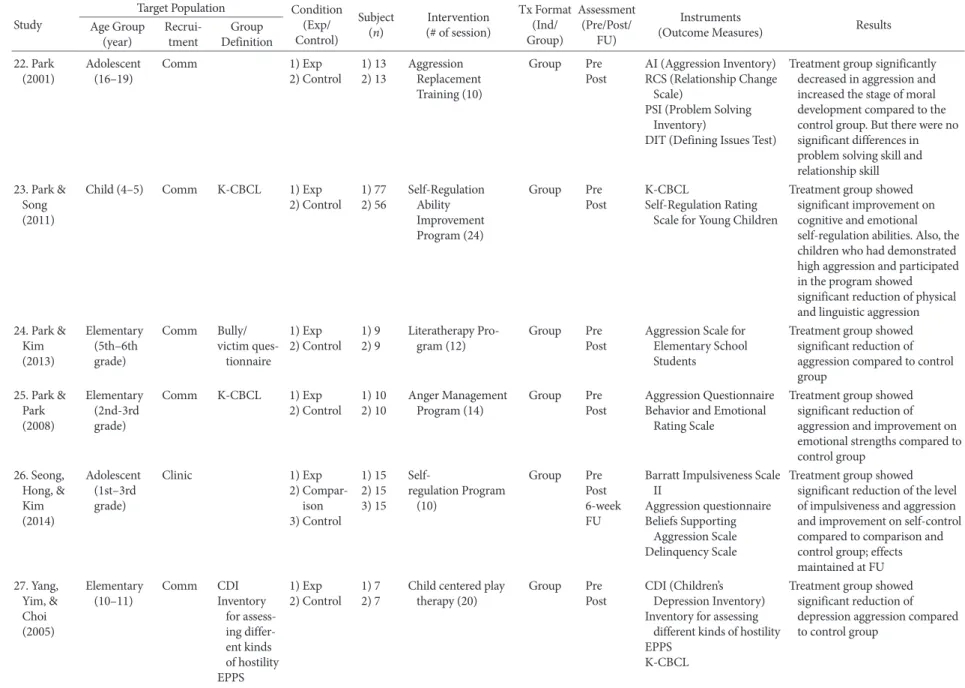
이상의 6가지 기준을 만족한 연구는 총 28편으로 유아를 대상으 로 한 연구가 3편, 초등학생을 대상으로 한 연구가 10편, 중고등학 생을 대상으로 한 연구가 9편, 보호관찰대상이나 소년원생과 같이 사법적 처분을 받은 청소년을 대상으로 한 연구가 6편이었다(Table 5). 총 28편의 논문 중 무선할당이 이루어진 연구는 19편이었으며, 집단 간 사전 동질성이 확보된 연구는 9편이었다. 치료 형태를 살펴 보면 28편이 모두 집단 치료 형태였으며, 이 중에서 이야기, 문학, 놀 이, 미술, 영화 등의 매체를 활용한 치료가 7편이었고 긍정심리학에 기반한 표현적 글쓰기(expressive writing)를 활용한 치료가 1편 있 었다. 해결중심상담 이론과 Winnicott 이론에 기반한 집단상담 프 로그램이 각각 1편, 게슈탈트 집단상담이 2편이었다. 나머지 16편은 행동치료, 인지행동치료, 마음챙김 등 크게 인지행동적 전략들을 활용한 치료 프로그램들로 각 프로그램의 구체적인 내용과 명칭은 부모-자녀 상호작용 치료(PCIT), 공격성 대체 프로그램(Aggres- sion Replacement Training, ART), 분노조절 프로그램, 자기조절 (자기통제) 프로그램, 변증법적 행동치료 프로그램, 마음챙김 인지 치료, 공감훈련 프로그램 등으로 다양하였다.

국내 근거기반치료의 특징을 요약하면 다음과 같다. 첫째, 아동 및 청소년의 인지발달 수준과 언어적 능력을 고려하여 다양한 매 체를 활용한 연구가 많았다. 이야기와 문학(Ku & Jo, 2011; Park &

Kim, 2013; Yoo & Choi, 2017), 놀이(An & Lee, 2008; Yang, Yim, &

Choi, 2005), 미술(Kim & Kwon, 2012), 영화(Jo, Kim, Cha, & Cheon, 2013) 등의 매체를 주로 활용한 치료들은 대부분 통제집단에 비해 Table 4. Treatment Type and Name by Level 1 and 2 of Evidence (McCart & Sheidow, 2016)

Level of Evidence Treatment Type Treatment Name

Level 1: Well-Established Combined Behavioral Therapy,

Cognitive-Behavioral Therapy (CBT), and Family Therapy

Multisystemic Therapy (JJ-Involved) Treatment Foster Care Oregon (JJ-Involved)

Level 2: Probably Efficacious CBT Aggression Replacement Training +Positive Peer Culture

(Equipping Youth to Help One Another) (JJ-Involved) Solution-Focused Group Program (JJ-Involved) Combined Behavioral Therapy,

CBT, and Family Therapy Functional Family Therapy (JJ-Involved) Multisystemic Therapy (Disruptive Behavior, not

JJ-Involved)

Note. JJ=Juvenile Justice.

(9)

EB T o f Di sr up tiv e B eh avio r

645 htt ps://do i.o rg/10.15842/k jcp .2018.37.4.014

Table 5. Characteristics of Studies Examining the Effects of Psychological Treatments for Disruptive Behavior in Children and Adolescents (N=28)

Study Target Population Condition

(Exp/

Control)

Subject

(n) Intervention (# of session)

Tx Format (Ind/

Group)

Assessment (Pre/Post/

FU)

Instruments

(Outcome Measures) Results

Age Group

(year) Recrui-

tment Group Definition 1. An & Lee

(2008) Adolescent

(15–19) Comm 1) Exp

2) Control 1) 10

2) 10 Play Therapy based on Reality Therapy (10)

Group Pre

Post EPPS (Edwards Personal Preference Schedule) SES (Self-Efficacy Scale)

Treatment group showed significant decrease in aggression and increase in self-efficacy compared to control groups

2. Baek

(2012) Adult (20s–

40s) &

Child (3–7)

Clinic ECBI 1) Exp

2) Control 1) 16

2) 14 Group Parent Child Interaction Thera- py (PCIT) (6)

Group Pre

Post ECBI (Eyberg Child Behavior Inventory) K-MBRS (K-Maternal

Behavior Rating Scale) K-CBRS (K-Child

Behavior Rating Scale)

The children from the treatment group showed significant reduced levels of disruptive behavior.

Also, the mothers of the children from the treatment group had significantly increased levels of responsive, effective interactions and deceased levels of directive interactions with their children Compared to the control group 3. Cheon,

Lee, & Lee (2000)

Adolescent

(14–19) Clinic Neuroti- cism Scale Novaco

Anger Scale

1) Exp 1 2) Exp 2 3) Exp 3 4) waiting list control

1) 14 2) 14 3) 14 4) 14

Cognitive- Behavioral Group Therapy (10) Cognitive-relaxation

therapeutic group/

Social Skill therapeutic group/

Integrative group

Group Pre

Post 2-month FU

State-Trait Anger Scale Impulsiveness

Questionnaire BDHI (Buss-Durkee

Hostility Inventory)

Treatment group showed more significant decrease in state anger, trait anger, impulse and aggressiveness than those of control group in post-test. But effects only in state anger and the impulse maintained at FU, not in trait anger and aggressiveness The therapeutic difference didn’t

appear between the therapeutic conditions

4. Doo &

Lee (2012) Adult (30s–

40s) &

Child (3–6)

Comm ECBI

DSM-IV 1) Exp

2) Waiting list control

1) 24

2) 24 Group Parent- Child Interaction Therapy (12)

Group Pre

Post 3-month FU

ECBI

DPICS-III (Dyadic Parent-Child Interaction Coding System-Third Edition)

PSI (Parenting Stress Index) BDI (Beck’s Depression

Inventory)

For all the outcomes: Effects shown only in Treatment group, not in Control

(Continued to the next page)

(10)

htt ps://do i.o rg/10.15842/k jcp .2018.37.4.014

Study Target Population Condition

(Exp/

Control)

Subject

(n) Intervention (# of session)

Tx Format (Ind/

Group)

Assessment (Pre/Post/

FU)

Instruments

(Outcome Measures) Results

Age Group

(year) Recrui-

tment Group Definition 5. Ha &

Kwon (2016)

Adolescent

(M=16) Clinic &

Comm JTCI 1) Exp 1

2) Exp 2 3) Contro

1) 14 2) 15 3) 14

Strengths-based Writing Interven- tion (10) - Corresponding

strengths group/

balancing strengths group

Group Pre

Post 2-week FU

JTCI (Junior Temperament and Character Inventory) CST-A (Character Strength

Test for Adolescents) K-YSR (Korean Youth Self

Report)

SWL (Satisfaction with Life Scale)

Triangular scale of Happiness

PANAS (Positive Affect and Negative Affect Schedule) RSES (Rosenberg

Self-Esteem Scale)

Corresponding strengths group showed significant improvement only in subjective happiness;

effects maintained at FU Balancing group showed significant

decrease only in the externalizing problem scores; effects maintained at FU

6. Han &

Lee (2000) Adolescent (2nd grade middle school)

Comm Standard- ized Anxi- ety Test BDHI

1) Exp 1 2) Exp 2 3) Control

1) 13 2) 13 3) 13

Gestalt Group Counseling (8) - Constructed or

Unconstructed

Group Pre

Post Standardized Anxiety Test

BDHI Treatment groups showed

significant reduction of anxiety and aggressive behaviors. But there was no significant difference between the constructed group and unconstructed group 7. Hong &

Kim (2010)

Elementary

(2nd grade) Comm K-CBCL 1) Exp

2) Control 1) 6

2) 6 Solution- Focused Group Counseling (10)

Group Pre

Post 4-week FU

K-CBCL (Korean-Child Behavior Checklist) SEI (Self-Esteem Inventory)

Treatment group showed significant reduction of externalizing behavior and improvement on self esteem;

effects maintained at FU 8. Hong &

Seo (2007) Elementary

(4th grade) Comm BDHI EPPS The

State-Trait Anger Scale

1) Exp

2) Control 1) 10

2) 10 Empathy Training

Program (14) Group Pre

Post BDHI

EPPS

The State-Trait Anger Scale Empathy Questionnaire

Treatment group showed significantly weakened tendency to abruptly express anger, anger level and aggression and increased empathy level as compared to those of the control group

9. Hyun &

Han (2015)

Adolescent Clinic 1) Exp

2) Compari- son- similar program 3) Control

1) 19 2) 19 3) 22

Self-Regulation group counseling program (8)

Group Pre

Post Self-control scale

Aggression questionnaire Treatment group showed significant improvement on self-control and reduction of aggression compared to comparison group and control group

(Continued to the next page)

(11)

EB T o f Di sr up tiv e B eh avio r

647 htt ps://do i.o rg/10.15842/k jcp .2018.37.4.014

Study Target Population Condition

(Exp/

Control)

Subject

(n) Intervention (# of session)

Tx Format (Ind/

Group)

Assessment (Pre/Post/

FU)

Instruments

(Outcome Measures) Results

Age Group

(year) Recrui-

tment Group Definition 10. Jang &

Kim (2016)

Adolescent

(15–19) Clinic 1) Exp

2) Control 1) 21

2) 22 Group Counseling Program based on Winnicott's Theory (8)

Group Pre

Post BDHI

VCI (Volitional Components Inventory) SES

Treatment group showed significant reduction of aggressiveness and improved self-regulatory ability and self-esteem score 11. Jeon &

Kim (2011)

Adolescent Clinic 1) Exp

2) waiting list control

1) 13

2) 13 Mindfulness Based Cognitive Therapy;

MBCT (10)

Group Pre

Post KIMS (Kentucky Mindfulness Skill Scale) AQ-K (Aggression

Questionnaire-Korean version)

Impulsivity Inventory BDI (Beck's

Depression Inventory)

Treatment group showed significant reduced level of aggression and depression, but not impulsiveness

12. Jin &

Son Adolescent

(2nd grade middle school)

Comm BDHI 1) Exp

2) Control 1) 9

2) 9 Dialectical Behavioral Therapy (DBT) (9)

Group Pre

Post 4-week FU

BDHI

STAXI (State-Trait Anger Expression Inventory)- Korean Version RSES

Treatment group showed significantly lower aggression and higher self-esteem than the control group

Anger expression was not significantly different between the two groups

13. Jo, Kim, Cha, &

Cheon (2013)

Elementary (5th–6th

grade)

Comm VAS (Verbal Aggres- siveness Scale)

1) Exp

2) Control 1) 13

2) 13 Cinema Therapy

Program (12) Group Pre

Post Self-Esteem Inventory for Children

BDHI IPPA-R (The Inventory of Parent and Peer Attachment)

Treatment group showed significant reduction of aggression and improvement on peer relationship compared to control group

Self-Esteem was not significantly different between the two groups 14. Kim &

Shin (2017)

Elementary (3rd–6th grade)

Comm K-CBCL 1) Exp 1

2) Exp 2 add-on practice sessions

1) 9 2) 8 Cognitive- Behavioral Anger management program (10 or 16)

Group Pre

Post 3-week FU

K-CBCL

Anger Control Scale Both treatment group showed significant reduction of aggression, but the instructors reported significantly more decrease of aggression in the participants of 16-session group than those of 10-session group during the period between the completion of the 16 session and the FU. And there was no significant difference in self-reported anger management between the two groups Table 5. Continued

(Continued to the next page)

(12)

htt ps://do i.o rg/10.15842/k jcp .2018.37.4.014

Study Target Population Condition

(Exp/

Control)

Subject

(n) Intervention (# of session)

Tx Format (Ind/

Group)

Assessment (Pre/Post/

FU)

Instruments

(Outcome Measures) Results

Age Group

(year) Recrui-

tment Group Definition 15. Kim

(2011) Adolescent (2nd grade middle school)

Comm BDHI 1) Exp

2) Control 1) 14

2) 14 Elaboration- Centered Gestalt Group Counseling (10)

Group Pre

Post 3-week FU

BDHI Treatment group showed

significant decrease in all part of adolescent's aggression (esp, violence aggression and anger);

effects maintained at FU 16. Kim,

Park, &

Han (2007)

Adolescent (3rd grade middle school)

Comm BDI

Juvenile Delin- quency Scale K-YSR BDHI

1) Exp

2) Control 1) 20

2) 18 Cognitive- Behavioral Group Counseling Program (12)

Group Pre

Post Juvenile Delinquency Scale K-YSR

BDHI K-CBCL

Treatment group showed significant reduction in the level of depression and aggressiveness compared to control group

17. Kim &

Kwon (2012)

Adolescent

(13–18) Clinic 1) Exp

2) Control 1) 7

2) 8 Collage in Temporary Art Therapy (6)

Group Pre

Post BDHI

ERQ (Emotion Regulation Questionnaires)

Treatment group showed significant decrease in aggression and increase in emotional regulation compared to control group.

18. Ku & Jo

(2011) Adolescent (1st–3rd grade mid- dle school)

Comm STAI

BDHI 1) Exp

2) Control 1) 10

2) 10 Awareness-Based Literatherapy Program (12)

Group Pre

Post 5-week FU

STAI (State Anxiety Inventory) BDHI

Treatment group showed significant

decrease in anxiety and aggression;

effects maintained at FU 19. Lee &

Song (2018)

Elementary

(3rd grade) Comm K-CBCL 1) Exp 1 2) Exp 2 3) Exp 3 4) Control

(Physical activity)

1) 5 2) 5 3) 6 4)16

Structured Cognitive Behavioral Intervention Program (9) - Internalization

group/

Externalization group/

Mixed group

Group Pre

Post K-CBCL After the treatment, the

Internalization group showed significant decrease in internalization, anxiety/

depression and the

Externalization group showed reduction level of externalization, aggressive behavior. But there were no significant differences in the Mixed group

20. Nam &

Baek (2013)

Elementary

(6th grade) Comm BDHI 1) Exp

2) Control 1) 8

2) 8 Cognitive-Behavior Group Counseling Program (10)

Group Pre

Post BDHI

K-CBCL SEI

Treatment group showed significant reduction in aggression (esp, conscious of the guilty) and improvement on self-esteem (esp, social self-esteem)

21. Oh &

Song (2009)

Elementary

(6th grade) Comm BDHI

EPPS 1) Exp

2) Control 1) 3

2) 3 Anger Control

Program (10) Group Pre

Post 10-day FU

BDHI

EPPS Treatment group showed

significant reduction in

aggression and all aggressive

behaviors

(13)

EB T o f Di sr up tiv e B eh avio r

649 htt ps://do i.o rg/10.15842/k jcp .2018.37.4.014

Table 5. Continued

(Continued to the next page)

Study Target Population Condition

(Exp/

Control)

Subject

(n) Intervention (# of session)

Tx Format (Ind/

Group)

Assessment (Pre/Post/

FU)

Instruments

(Outcome Measures) Results

Age Group

(year) Recrui-

tment Group Definition 22. Park

(2001) Adolescent

(16–19) Comm 1) Exp

2) Control 1) 13

2) 13 Aggression Replacement Training (10)

Group Pre

Post AI (Aggression Inventory) RCS (Relationship Change

Scale)

PSI (Problem Solving Inventory)

DIT (Defining Issues Test)

Treatment group significantly decreased in aggression and increased the stage of moral development compared to the control group. But there were no significant differences in problem solving skill and relationship skill 23. Park &

Song (2011)

Child (4–5) Comm K-CBCL 1) Exp

2) Control 1) 77

2) 56 Self-Regulation Ability Improvement Program (24)

Group Pre

Post K-CBCL

Self-Regulation Rating Scale for Young Children

Treatment group showed significant improvement on cognitive and emotional self-regulation abilities. Also, the children who had demonstrated high aggression and participated in the program showed significant reduction of physical and linguistic aggression 24. Park &

Kim (2013)

Elementary (5th–6th grade)

Comm Bully/

victim ques- tionnaire

1) Exp

2) Control 1) 9

2) 9 Literatherapy Pro-

gram (12) Group Pre

Post Aggression Scale for Elementary School Students

Treatment group showed significant reduction of aggression compared to control group

25. Park &

Park (2008)

Elementary (2nd-3rd grade)

Comm K-CBCL 1) Exp

2) Control 1) 10

2) 10 Anger Management

Program (14) Group Pre

Post Aggression Questionnaire Behavior and Emotional

Rating Scale

Treatment group showed significant reduction of aggression and improvement on emotional strengths compared to control group

26. Seong, Hong, &

Kim (2014)

Adolescent (1st–3rd grade)

Clinic 1) Exp

2) Compar- 3) Control ison

1) 15 2) 15 3) 15

Self-

regulation Program (10)

Group Pre

Post 6-week FU

Barratt Impulsiveness Scale Aggression questionnaire II Beliefs Supporting

Aggression Scale Delinquency Scale

Treatment group showed significant reduction of the level of impulsiveness and aggression and improvement on self-control compared to comparison and control group; effects maintained at FU 27. Yang,

Yim, &

Choi (2005)

Elementary

(10–11) Comm CDI

Inventory for assess- ing differ- ent kinds of hostility EPPS

1) Exp

2) Control 1) 7

2) 7 Child centered play

therapy (20) Group Pre

Post CDI (Children’s Depression Inventory) Inventory for assessing

different kinds of hostility EPPS

K-CBCL

Treatment group showed

significant reduction of

depression aggression compared

to control group

(14)

참여자들의 공격성을 유의미하게 감소시키는 결과를 보였다. 둘째, 해결중심 집단상담(Hong & Kim, 2010)에서는 성공경험에 대한 공 유와 긍정적인 피드백이 외현화 문제행동의 감소로 이어졌다고 분 석하고 있으며, Winnicott 이론 기반 집단상담(Jang & Kim, 2016) 에서는 Winnicott의 충분히 좋은 엄마의 촉진적 환경을 적용하여 참여자들이 성장 과정에서 경험한 결핍 환경을 재경험하게 함으로 써 자기조절능력을 향상시키고 공격성을 감소시키고자 하였다. 게 슈탈트 집단상담(Han & Lee, 2000; Kim, 2011)에서는 신체활동을 포함한 다양한 활동을 통해 자기 인식과 자기 성찰을 증진시켜 참 여자들의 공격성을 감소시키고자 하였다. 이상의 다양한 접근의 치료들은 개별 연구 수준에서는 그 효과가 검증되었으나 다양한 연구팀에 의해 반복 검증되지 못하고 기존의 다른 치료보다 우수 하다는 사실이 검증되지 못하는 등 근거기반치료로서의 조건을 제 대로 갖추고 있지 못하였다.

셋째, 해외에서 근거기반치료로 입증된 부모-아동 상호작용 치 료(PCIT)를 활용한 2개의 연구(Baek, 2012; Doo & Lee, 2012)만이 연구대상에 부모를 포함시키고 있었으며 이 연구들은 모두 유아를 대상으로 하여 행동문제와 파괴적 행동을 유의미하게 감소시키는 것으로 나타났다. 넷째, PCIT를 제외하고 인지행동적 전략을 주로 활용한 14개의 연구들은 프로그램 구성과 회기별 세부 내용에서 는 다소 차이가 있었으나 분노조절, 인지 재구성, 인지/정서/행동조 절, 문제해결, 사회적 기술, 의사소통 등을 핵심적인 치료 요소로 활용하고 있었다(Cheon, Lee, & Lee, 2000; Hong & Seo, 2007;

Hyun & Han, 2015; Jeon & Kim, 2011; Jin & Son, 2013; Kim, Park,

& Han, 2007; Kim & Shin, 2017; Lee & Song, 2018; Nam & Baek, 2013; Oh & Song, 2009; Park, 2001; Park & Park, 2008; Park &

Song, 2011; Seong, Hong, & Kim, 2014). 이상의 연구들을 종합하 여 볼 때, 아동 및 청소년의 파괴적 행동을 다루는 국내 연구들에서 는 인지행동치료가 가장 효과적인 것으로 나타났다. 그러나 엄격한 대조집단을 포함시킨 연구의 부족과 연구방법론상의 문제 등으로

‘잘 확립된’ 치료가 아닌 ‘효과가 있음직한’ 치료로 분류되는 것이 타당해 보인다.

본 연구에서 검토한 국내 근거기반치료들은 파괴적 행동의 원인 및 관련 변인에 대한 선행연구들에 근거하여 개발된 것들도 일부 있었으나 상당수의 치료들이 특정한 심리치료 이론에 근거하여 개 발된 것들이었다. 파괴적 행동에 대한 심리치료가 효과를 거두기 위해서는 파괴적 행동의 발생, 유지, 악화에 기여하는 다양한 위험 요인들에 대한 선행연구들에 기반하여 구체적인 개입 요소를 결정 하고 해당 요소를 가장 효과적으로 전달할 수 있는 치료적 전략을 연령에 따라 구성하는 것이 바람직할 것으로 판단된다.

St ud y Ta rg et P op ul at io n Con dit ion (E xp/ Co nt ro l) Su bjec t (n ) In ter ven tio n (# o f s es sio n) Tx F or m at (In d/ G ro up )

As ses sm en t (P re/P os t/ FU) In str um en ts (O ut co m e M ea sur es) Res ul ts Ag e G ro up (y ea r) Re cr ui- tm ent G ro up D ef ini tio n 28.Y oo & Ch oi (2017)

Ado les cen t (15–16) Clinic CD CL (C on duc t Di so rder Ch ec kli st) 1) E xp 2) C on tro l 1) 35→32 2) 35→34 G ro up N ar ra tiv e Th era py (8) G ro up Pre Po BD HI st BDI Resi lien ce s ca le o f K or ea n ado les cen ts

Tr ea tm en t g ro up s ho we d sig nif ica nt de cr ea se in ag gr es sio n/a gg res sio n a nd in cr ea se in r esi lien ce s co res co m pa re d t o co nt ro l g ro up No te. Co mm = sa m ple re cr ui te d fro m co mm uni ty ; C linic = ju veni le-j us tice in vo lv ed or sa m ple re cr ui te d f ro m co un se lin g cen ter s o r h os pi ta ls; E xp = exp er im en t g ro up; Co nt ro l= co nt ro l g ro up; Tx = Tr ea tm en t; I nd = In di vid ua l; FU = fo llo w-u p

Ta bl e 5. C ont in ue d

(15)

EBT of Disruptive Behavior

651

https://doi.org/10.15842/kjcp.2018.37.4.014

파괴적 행동의 근거기반치료 권고안 및 제언

본 연구에서는 아동 및 청소년의 파괴적 행동에 대한 국내외 근거 기반치료를 개관하는 것을 목적으로 하였다. 현재 미국의 Society of Clinical Child & Adolescent Psychology에서는 파괴적 행동 문 제에 대한 근거기반치료를 아동과 청소년으로 나누어 제시하고 있 는데, 먼저 아동의 파괴적 행동에 대해서는 수준 1(Level 1, Works Well)의 치료로 부모를 대상으로 한 행동치료를 제안하고 있으며, 수준 2(Level 2, Works)의 치료로 부모-중심 행동치료, 아동-중심 행동치료, 놀이치료를, 수준 4(Level 4, Experimental)의 치료로 가 족 문제해결훈련을 제안하고 있다. 수준 3(Level 3, Might Work)과 수준 5(Level 5, Tested and Does Not Work/Questionable)에는 제 안된 치료가 없다. 다음으로 청소년의 파괴적 행동에 대해서는 수 준 1(Level 1, Works Well)의 치료로 부모-중심 행동치료를 제안하 고 있으며, 수준 2(Level 2, Works)의 치료로 자기주도적 부모-중심 행동치료, 교사 훈련, 아동-중심 행동치료, 아동-중심 집단놀이치 료를, 수준 4(Level 4, Experimental)의 치료로는 아동과 마찬가지 로 가족 문제해결훈련을 제안하고 있다. 청소년에 대해서도 수준 3(Level 3, Might Work)과 수준 5(Level 5, Tested and Does Not Work/Questionable)에는 제안된 치료가 없다. 아동 및 청소년의 파 괴적 행동에 대한 국내외 근거기반치료 권고안은 Table 6에 요약하 였다.

Table 6을 보면, 해외에서는 ‘행동 치료’가 가장 강력한 치료로 잘 확립되어 있으며, 파괴적 행동을 보이는 아동이나 청소년 본인을 대상으로 하는 치료보다는 이들의 부모를 대상으로 실시되는 행동 치료가 보다 더 강력한 경험적 지지를 받고 있다. 그러나 국내에서

는 부모를 대상으로 실시된 연구가 매우 부족하고(Koo, Choi, &

Kwon, 2012), 행동치료 원리에 입각한 프로그램보다는 분노조절, 인지 재구성, 자기조절, 문제해결 등의 요소를 포괄하는 인지행동 치료가 주를 이루고 있어 해외 연구들과는 다소 거리가 있었으며, 치료의 충실성(fidelity)을 평가할 수 있는 구체적인 치료 내용 및 절 차가 매뉴얼화되어 있지 않은 경우가 많았다. 특히, 청소년의 파괴 적 행동 문제에 대해서 해외에서는 다중체계치료(MST)나 오레곤 치료 위탁 보호(TFCO)와 같이 중다요인(multicomponent)의 가 족-기반 치료가 경험적인 지지를 얻고 있는 것과 달리 국내에서는 여전히 청소년 개인의 분노조절 기술이나 비합리적 사고에 대한 재 구조화 등에만 초점을 맞추고 있어 파괴적 행동과 관련되는 다양 한 수준(가정, 또래, 학교, 지역사회 등)의 위험요인에 대해서는 전 혀 다루고 있지 못한 실정이다. McCart와 Sheidow(2016)는 부적응 적인 사회적 의사결정을 강화하는 다양한 맥락적 요인 및 행동 문 제를 지속시키는 또래와 학교 요인(예: 비행또래와 어울리는 시간, 학교에서의 퇴학 등)을 전체적으로 변화시키지 않고는 파괴적 행동 이 지속될 수밖에 없음을 지적하고 있다. 따라서 국내에서도 아동 과 청소년의 연령에 따른 프로그램의 차별화, 부모를 대상으로 하 는 프로그램의 개발, 아동과 청소년을 둘러싼 다양한 수준의 위험 요인에 개입할 수 있는 프로그램들이 개발되어 그 효과가 실제 현 장에서 검증되어야 할 필요가 있겠다. 특히, 사법체계에 연루된 범 죄 청소년들에 대해서는 이들에 대한 법적 처분에 보호관찰소나 소 년원 등에서 반드시 부모가 교육을 받도록 명시하는 제도적 장치 가 마련되어야 할 것이다. 마지막으로, Koo 등(2012)의 연구에서 제 안된 바와 같이 국내의 아동 청소년 심리치료 효과 검증 연구들은 방법론적으로 매우 취약하여 치료의 효과가 과대 평가되었을 가

Table 6. Summary of Treatment Guidelines for Evidence-Based Treatments of Disruptive Behavior in Children and Adolescents

Level of evidence Treatment (Korea) Treatment (Other Countries)

Children Adolescents

Strong/well-established None Behavior therapy Parent-focused behavior therapy

Modest/probably efficacious Group CBT, PCIT Parent-focused behavior therapy, Self-directed parent-focused behavior therapy, Child-focused behavior therapy, Teacher training,

Play therapy Child-focused behavior therapy,

Group child-centered play therapy Controversial/experimental Literatherapy, Family problem-solving training Family problem-solving training

Play therapy, Art therapy, Cinema therapy, Solution-focused therapy, Psychodynamic therapy, Gestalt therapy

Note. CBT=Cognitive behavioral therapy; PCIT=Parent-Child Interaction Therapy.

수치

Table 1. Criteria Met by the Evidence-Based Treatments of Disruptive  Behavior (Eyberg, Nelson, & Boggs, 2008)
Table 5. Characteristics of Studies Examining the Effects of Psychological Treatments for Disruptive Behavior in Children and Adolescents (N=28)
Table 5. Continued
Table 5. Continued
+2

참조

관련 문서

And in Danggwibohyeol-tang group A, B, C there was significant inhibitory effect on reduction in comparison with control group but there was no significant

Results: Compared to the control group, both the high and low dose group showed statistically significant differences after treatment in TBUT, Schirmer test, the number of

‘Frequency of food reward’, eating amount, and intakes of carbohydrate, potassium, and vitamin C showed significant improvement compared to the placebo group after the second month

The education group showed a significant positive correlation with attitude toward behavior, perceived behavior control and subjective norm, and the non-education group showed

Results: The experimental group showed significant improvement for self-esteem (z=-3.130, p=.002), powerlessness(z=-3.267, p=.001), and anxiety (z=-2.932, p=.003) when

B group showed significant decrease of VAS, NDI and improvement of pain threshold after 3rd time treatment than before treatment (p<0.01, p<0.001). 2) No significant

Results: The immediate effects showed statistically significant improvements in pain intensity, muscle tension, PPT, and CROM in the treatment group in comparison to the

* : P<0.05 comparison before and after in control group, †: P<0.01 comparison before and after in control group, ‡: P<0.05 compared test group and control