*This research was supported by the Ministry of Education of the Republic of Korea and the National Research Foundation of Korea(NRF-2015S1A5B8A02052991).
*Corresponding Author : Dae-Yeon Cho([email protected]) Received December 30, 2020
Accepted March 20, 2021 Revised February 9, 2021
Published March 28, 2021
A Study on the Policy Directions for the Development of Skill Convergence in the Post-COVID19 Era
Eun-Bee Kim
1, Dae-Yeon Cho
2*, Kyung-Ran Roh
3, Seok-Young Oh
4, Kee-Burm Park
5, Joshua Ryoo
6, Jhong-Yun Kim
71
Research Professor, Korea University Research Institute for HRD Policy
2
Professor, Dept. of Education, Korea University
3
Professor, Dept. of Education, Sung-Shin Women's University
4
Professor, Dept. of Education, Yon-Sei University
5
Professor, Dept. of Social Studies Education, Seoul National University of Education
6Independent Researcher, Korea University Research Institute for HRD Policy
7
Research Professor, BK21 FOUR R&E Center for Education KOREA UNIVERSITY
포스트코로나시대 융합인재양성을 위한 정책방향연구
김은비
1, 조대연
2*, 노경란
3, 오석영
4, 박기범
5, 류성창
6, 김종윤
71
고려대학교HRD정책연구소 연구교수,
2고려대학교 교육학과 교수,
3성신여자대학교 교육학과 교수,
4
연세대학교 교육학부 교수,
5서울교육대학교 사회교육과 교수,
6고려대학교HRD정책연구소 공동연구원,
7
고려대학교 4단계 BK21 교육학 교육연구단 연구교수
Abstract This study aimed to look for educational ways to prepare for the future society for education and people of talent who will lead the post-COVID-19 era. To this end, the factors necessary for the type of future talent in the post-COVID-19 era were identified by analyzing Big data. Based on the deducted factors composing the type of talent in the post-COVID-19 era, policy direction according to the emergence of the post-COVID-19 era were deducted through the interviews with the group of experts and delphi survey, and on the basis of this, this study sought for“a plan for the educational change in line with cultivation of people of talent in the post-COVID-19 era. The results of this study are as follows. First, through the big data analytics and analysis of the interviews, convergence, ICT utilization ability, creativity, self-regulated competency and leadership were found to be the factors necessary for the type of talent in the post-COVID-19 era. Second, it considered the innovation of digital education system and the support for vulnerable classes as the issue for cultivation of people of talent in the post-COVID-19 era. Third, the most important policy with regard to the educational direction for cultivation of people of talent in the post-COVID-19 era was cultivation of convergence talents. Convergence is a very important variable in the post-COVID-19 era since it creates new values by connecting things that are separated from each other. Hopefully, this study will build a basis for competency development, education and training in preparation for the post-COVID-19 era.
Key Words : Type of talent, Develpment of skill, Education Policy, Post-COVID-19, Capabilities 요 약 본 연구에서는 포스트코로나 시대를 주도할 교육과 인재양성을 위해 미래 사회를 대비할 수 있는 교육 방향을 모색하고자 한다. 이를 위해 빅데이터 분석을 통해 포스트코로나 인재상을 알아본 후 도출된 포스트코로나 인재상을 바탕으로 전문가 집단의 인터뷰와 델파이 조사를 통해 포스트코로나 시대 도래에 따른 이슈를 도출하고 이를 토대로
‘포스트코로나시대 융합인재양성을 위한 정책방향’을 모색하고자 하였다. 연구결과는 다음과 같다. 첫째, 빅 데이터 분석 과 온라인 인터뷰 분석을 통해 융합, ICT 활용 능력, 창의성, 자기주도학습 능력, 리더십을 COVID 19 이후 시대에 인재역량으로 보았다. 둘째, 디지털 교육 시스템의 혁신, 취약계층에 대한 지원, 학급당 학생 수 감소가 새로운 인재육성 을 위한 교육 이슈로 보았으며 셋째, COVID 19 이후 시대의 인재 육성에 대한 교육 방향 중 가장 중요한 정책은 융합 인재 양성이었다. 융합은 서로 분리된 것들을 연결함으로써 새로운 가치를 창조하기 때문에 매우 중요한 이슈라고 볼 수 있다. 본 연구는 포스트코로나 시대를 대비한 인재양성 및 이를 위한 교육, 훈련에 필요한 기반을 마련하고 기초자료 를 제시하는데 의의가 있다.
주제어 : 인재상, 인재양성, 교육정책, 포스트코로나, 역량
1. Introduction
Due to the continued spread of COVID-19 since WHO’s pandemic declaration in March, 2020, the whole world is in unprecedented crisis.
COVID-19 has rapidly changed not only economy, industries, medical care, finance, scientific technology, culture and art, and even education. Fears of being infected with the COVID-19 virus have raised anxiety about face-to-face contact among people, which increased the demand for distance learning and non-face-to-face industries and caused a new normal in our society. It is predicted that this non-face-to-face era with high volatility, complexity and ambiguity will take an unprecedented turn that human beings have never experienced before.
The rapid changes caused by COVID-19 have had a huge influence on education, causing a change in the educational management system.
In South Korea, the Ministry of Education announced the postponement of opening days of kindergartens and all the other schools including universities, prohibiting every face-to-face class.
After then, online school opening was implemented, and non-face-to-face distance learning courses began to be carried out.
All the fields promptly changed themselves in order to adapt themselves to the era of digital transition, but education in the reality did not.
Until now, the educational environment has been one of the areas vulnerable to digital transition.
However, due to the infection with COVID-19 in 2020, the pace of digital transformation in education is expected to accelerate as the educational field quickly focuses on (non-face -to-face) online education environments.
With the spread of non-face-to-face trends throughout everyday life around the world, the educational field is trying to adopt “online (distance) learning” in line with the suspension, closure or online opening of schools. Recently,
the Ministry of Education emphasized that the era of “digital jobs” will begin after COVID-19, announcing that digital infrastructure and big data-related industries should be prepared.
In terms of the educational field, schools began online for the first time in about 70 years due to COVID-19, and digital distance education is being carried out, but the educational infrastructure, contents and quality of teaching are evaluated to be very poor. With the outbreak of COVID-19, discussions are underway to prepare for related matters such as the establishment of laws and systems, infrastructure and systems to activate distance learning.
As the post-COVID-19 era has come, there is a need to establish a mid- and long-term national counterplan with regard to the future type of talent. The post-COVID-19 era features a completely different direction of paradigm and technology, industry, needs in the market, and competitive edge in different directions.
Therefore, it is expected that people will encounter a new era that mankind has never experienced. From this point of view, it is required to figure out what kind of the type of future talent is going to lead the post-COVID-19 era[1] and to implement education to prepare for future society based on the type of future talent.
The innovations and advances in the future technology that the future society will bring are expected to further expand the scope of the role of artificial intelligence that can replace human labor. This reduces people's simple labor and directly leads to job problems[2]. Such an increase in the number of jobs replaced by machinery is expected to cause a sharp drop in jobs, but at the same time, new job creation is expected to proceed as well. In this situation, it is very important not only to train and collaborate with machines, but also to establish the type of talent that can perform even what the machines cannot[2,3].
There have been discussions on the type of
future talent in various studies[2,4,5], but they were vague and uncertain. There is a lack of practical consistency, and in the post-COVID-19 era, it is necessary to seek new type of talent and educational directions[3]. Thus, Establishing a new type of talent is expected to contribute to the development of national competitiveness in the post-COVID-19 era.
Accordingly, the questions of this research are as follows:
1. What is the new type of talent in the new normal era after the post-COVID-19 era like?
First of all, this research aims to establish a new type of talent discussed on the threshold of the post-COVID-19 era by comprehensively analyzing the recent prior researches.
2. What is the educational plan in accordance with the new type of talent like?
In expert advisory meetings, the type of talent is analyzed and opinions from experts are collected. The validity of the analysis results by sector will be verified based on the advice from future education experts as well.
3. What is the new direction for
comprehensive future talent development and future education?
Finally, proposing a policy direction to foster human resources required in the post-COVID-19 era is the final goal of this research.
Therefore, the researchers are presenting education policies through the Delphi method, setting the direction for future education in the post-COVID-19 era.
2. Theoretical background 2.1 the COVID-19 era
COVID-19 is a highly contagious disease characterized by fever, coughing, fatigue, and difficulty breathing[6]. Face-to-face contact with people has become a very dangerous act,
especially due to other diseases and other powerful infectious diseases. This has a very negative effect on the economy of not only Korea but also the world. The global economy has shrunk significantly[7], and the outbreak of the coronavirus, represented by social distancing, constrains daily life in many areas, resulting in many negative changes in the world's population in terms of health[8], riots, politics, living materials, social psychology, and various industries. Changes in social psychology and social behavior caused by COVID-19 have led to changes in behavior in many parts of society, including economics, culture, religion and so on.
For this reason, experts call the so-called new normal, which differs from the standard of the times we have lived [9]. At this point, education is considered one of the most urgent issues to deal with in these corona situations. This is because education is a matter of a person's future.
2.2 Issues of the post-COVID-19 era The COVID-19 virus, which has been shaking the world since early 2020, has made a big difference in society as a whole and our life, With "Untact" becoming "New Normal," changes are expected in all areas of society, including politics, economy, society, and culture, and tasks are being proposed to cope with them. In particular, it has caused great confusion in education and has become a turning point for introducing a new type of education system. In February, the Ministry of Education announced an urgent postponement of the start of school due to the rapid influx and spread of Covid-19, and since then, face-to-face classes at elementary, middle and high schools nationwide have been banned. In March, the opening of
"online" schools was announced sequentially
according to school level and grade [3], and
Korea is facing a phase of non-face-to-face
remote education for about 5.4 million
elementary, middle and high school students and
3 million college students.
New phenomena and discussions related to education are occurring, and various voices from school teachers, students, and parents, who are the subjects of education, are attracting social attention at the practice site. Therefore, major issues such as non-face-to-face classes, remote education, e-learning, and online classes, which have been highlighted as key agendas in the transition of the education system due to the Corona 19, have recently become a social phenomenon that all members of society pay attention to and experience. Therefore, it is time to think about ways to nurture talented and talented people in the post-corona era.
2.3 Type of Talent the post-COVID-19 era Since COVID-19, when advanced information and communication technologies are integrated in the society at large and innovation takes place, the trend of non-face-to-face education is making changes in the future environment and education, and reflection on all the educational contents and methods is required. Since this situation can be an important basis in our educational field, we are trying to focus on the characteristics of the post-COVID-19 era and the type of future talent that this era requires.
The talent that society wants has changed according to the times and places[10]. In order to cope with the complex and rapid changes in the non-face-to-face society and economy since the outbreak of COVID-19, major advanced countries are presenting the right type of talents for the future society and the core competencies required for them. According to the Korean Language Dictionary (National Institute of Korean Language, 2008), "talented person" means
“an educated and competent man with outstanding character”, and “a person who has a distinguished talent”[11]. Talent can be also defined as a next-generation leader who has the leadership to lead the future society in a healthy
and desirable way[8], and it means valuable ability or capacity embodied in an individual as a sum of knowledge, skills and attitudes.
2.4 Type of Future Talent in Precedent Researches
Baek Seo-in et al., 2020 suggests the type of future talent that has creative and intellectual competency, competency in cultivating the right perspective on the world, competency in developing the general character, competency regarding integrated awareness and competency regarding global awareness. First, creative and intellectual competency is the competency to create creative and innovative ideas based on the ability to manage knowledge that tells truth from untruth[8]. Second, competency in cultivating in the right perspective on the world is the one that can develop the perspective on the world and the universe, which is the background for human beings’ value system, since every individual has their own perception and perspective on the world due to the difference in experience. Third, competency in developing the general character is to develop the mature and balanced character with intelligence, emotion and will. Fourth, competency regarding integrated awareness is the competency to solve and apply problems with an open attitude to other areas and academic fields, as social phenomena occur in the network of causes and issues due to the increase in complexity today. Fifth, competency regarding global awareness is the competency to develop smooth relationships with foreigners with an open international sense and perspective as a global citizen living in the era of globalization[12].
In 2017, Lee Jae-ho presented the “gifted person for intelligence and information society”
as the core talented person that the future
society requires. As “soft skills” become the core
competency in the post-COVID-19 era,
competencies related to character, expertise,
production and integration were presented as what the type of future talent needs to possess[1].
In the case of overseas researches, Mckinsey (2018) presented the skills that workers should further strengthen in preparation for 2030 in a report titled “Skill Shift Automation and the Future of the Workforce.” This report divided the skills that workers need to have in the era of automation and artificial intelligence into five categories―physical and manual skills, basic cognitive skills, higher cognitive skills, social and emotional skills and technology skills[13].
In addition, the following four factors were presented as the core attributes that the future talents need to have[10]. The first one is general cognitive ability, which is the ability to learn something quickly and adapt to it. The second one is leadership, which is about knowing when to take lead and stay quiet. The third one is Googleyness, which is the ability to accept ambiguous and uncertain situations and cooperate with others. The fourth one is role-related knowledge, which means to possess the experience and professional knowledge about one’s role[11,12].
To sum up what was mentioned in domestic and overseas research reports on the type of future talent, perceptions of talent at home and abroad were not much different from each other.
This can be interpreted that in the world which is already globalized, talent is not limited to countries and regions. In addition, not much different from the aforementioned keynote materials, creation or creativity, intelligence related to one’s own field of specialization, fusion-related ability, global ability and character were mentioned.
3. Research Method
The data analysis procedures with regard to the post-COVID-19 education were conducted in
three stages. First, news articles where the post-COVID-19 education was mentioned were selected and collected. Based on them, data processing was conducted in the second stage.
During the basic preprocessing process and analysis of morphemes on the words in the articles, data to be used for the analysis was completed. Lastly, analysis and visualization were carried out based on the level of interest and frequency analysis. On the basis of the COVID-19-corona type of talent obtained from the analysis, focus group interview was conducted.
3.1 Big Data analytics
This study aimed to find out the key words regarding online learning articles reported in national major media on human resource cultivation issues related to COVID-19 and analyze what key words the issues changed into over time, and text mining and network analysis method were used for this. Text mining is an analytical method that analyzes mass text data using statistical quantitative techniques.
This research was conducted on the top 10 daily newspapers with the highest circulation among the domestic newspapers published by October 2020 to find out the direction of education in the era of post-COVID-19. In order to collect data, 1,150 articles were searched by collecting media articles based on “post-COVID-19”,
“non-face-to-face” and “COVID-19 education” as
search words. On the basis of this, 413 articles
meeting the purpose of the research were
selected as the final analysis targets after
checking the titles and texts, except for the
articles with overlapping titles and those whose
research subjects were not students. In other
words, the data analysis process related to the
type of future talent was conducted in three
stages. First, news articles that mentioned the
type of future talent were selected and collected
during the collection of data. Based on this, data
processing was conducted in the second stage.
During the basic preprocessing process and analysis of morphemes on the words written in the news articles, data to be used for the analysis was completed. The data analysis program used MS Excel and SPSS23.0 Process (Ver.3.4 by Andrew F. Hayes).
3.2 online interview
This interview was carried out in order to understand the direction of the post-COVID-19 education in depth and deduce the relevant issues. Experts in this group were selected first among those who were willing to attend the interview on the list of recommended experts.
Lastly, this group consisted of four experts, and the interview was conducted twice, on August 15 and September 19, 2020. Details about the interviews by group and the profiles of attendees are as in the following Table 1. They were doctoral-level experts with type of talent &
cultivation of people of talent research experience such as writing research reports or academic theses were selected primarily.
division Number of
participants State-run research institutes and education
officials 2
faculty members 2
Table 1. Group-specific expert information
The detailed questionnaire Configuration interviews as shown in Table 2 below.
division Highlights
type of talent in post COVID-19
▪ type of talent in post COVID-19
▪ post COVID-19’s cultivation of people of talent
Table 2. Online Interview Questionnaire Configuration Details
3.3 The Delphi Method
The Delphi method is the method that collects opinions on specific topics from experts, and
based on them, solve problems or predict the future[13]. Since it is a decision-making process on the basis of not statistical methods but decisions by experts, selection of expert panels is very important. This research used the five-step expert selection by Okoli & Pawlowski (2004) in order to select the experts to be surveyed for the Delphi method. The procedure to select the expert panels in this research is as follows[14].
First, using search engines such as KIC (Korea Citation Index) and RISS (Research Information Sharing Service), key words such as future talent, type of talent, training talented individuals were searched for, and doctoral-level experts with lots of research experience such as writing research reports or academic theses were selected primarily. In addition, a list of relevant experts was written based on the recommendation for them. The experts discovered through a variety of routes were classified by group such as university, government-contributed research institute (researcher) and school (teacher). Next, the degree of relevance with this study was ranked among the experts included in the list through internal research team meetings, and based on this, 33 experts were finally selected as expert panels by group.
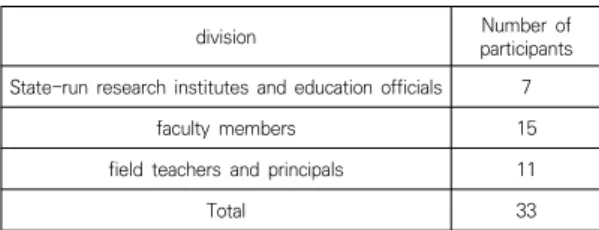
The expert information for each step derived from the process above is as follows. Fifteen professors in the academic circles, seven government-run research institutes and public educational officials and eleven on-site school experts (teachers and principals) were discovered. Information about the experts by group is shown in Table 3 below.
division Number of
participants State-run research institutes and education officials 7
faculty members 15
field teachers and principals 11
Total 33
Table 3. Group-specific expert information
3.4 Organization of Delphi Questionnaire The Delphi survey constructed a questionnaire to evaluate the importance (not at all) (not at all important) to the previously derived elements of the talent on a Likert 5-point scale (not at all urgent) and urgency (not at all urgent (1 point) to very urgent (5 points). In addition to Likert's evaluation of the talent, an open questionnaire was also included in the questionnaire to present opinions from the expert panel. The Delphi questionnaire is shown below Fig. 1.
*** is of little importance in post-COVID talent. ✔ on ②
*** I think it's a very urgent factor in post-COVID talent. ✔ on ⑤
importance
never doesn't matter so so some great
** ① ②✔ ③ ④ ⑤
urgency
never doesn't matter so so some great
** ① ② ③ ④ ⑤✔
Fig. 1. Organization of Delphi Questionnaire
3.5 Analysis on the Result of Educational Direction in the Post-COVID-19 Era T-test, Borich's Needs Analysis, Hershkowitz Threshold Function were used to analyze the priority needs of policy tasks in each area for the results responded by the experts.
First, T-test is the first verification method conducted when deriving priorities for needs analysis and analyzes whether the average difference between the two groups is statistically significant based on the assumption that there is an average difference between the importance at
present and the feasibility in the future of each question. However, since T-test simply presents the difference in average values between the two levels and is unable to contribute to making a judgement in desirable directions for the future, Borich's Needs Analysis is used to compensate for it.
Second, Borich's Needs Analysis is the most frequently used analysis method in determining priorities[3]. It multiplies the mean value of the future level (feasibility) by the sum of difference between the future level (feasibility) and the present level (importance) for an item, and then determines the priority based on the result value divided by the total number of cases[8,9]. Thus, the higher the future level and the lower the current level, the higher the value of needs.
4. Research Result 4.1 Big Data Analysis
4.1.1 Frequency Analysis
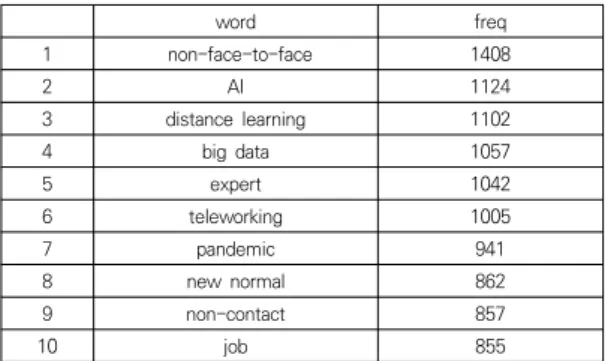
The results of frequency analysis regarding the news articles where the type of future talent are as follows. A total of 413 key words were listed in Korean consonant order, with the average frequency being about 185 times. The key word with the highest frequency was capacity (1,408 times) and the one with the lowest frequency was awareness, tendency, and execution (51 times).
word freq
1 non-face-to-face 1408
2 AI 1124
3 distance learning 1102
4 big data 1057
5 expert 1042
6 teleworking 1005
7 pandemic 941
8 new normal 862
9 non-contact 857
10 job 855
Table 4. Top Results for Big Data Frequency Analysis
4.1.2 Word Cloud Analysis
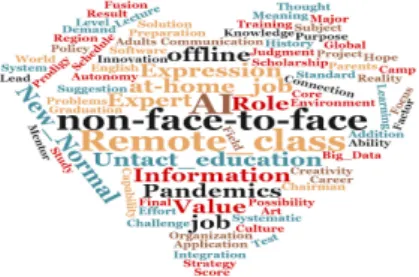
Fig. 2 shows the results presented in the form of Word Cloud by conducting a frequency analysis of key word emergence to look into the overall trend of the post COVID-19 education. As a result, non-face-to-face, AI, distance learning, big data, expert, teleworking, pandemic, new normal, non-contact and job were deduced as the major words. This can be understood that the concept of the type of future talent has been mentioned along with key words such as competence and artificial intelligence required in the post-COVID 19 world.
Fig. 2. The results of Word Cloud Analysis
4.2 Analysis of Interview Results
The direction of education after COVID-19 can be categorized as follows.
4.2.1 Direction Following the Type of Talent 4.2.1.1 Cultivation of Convergence Talent I think that talents with knowledge, morals and body need to be cultivated. Of course, such talents are required just like before COVID-19 in the aspect of cultivating talents, but in the post-COVID-19 society, it will be important for talents to have convergence competence in combining knowledge in various fields and restructuring them.
4.2.1.2 Cultivation of Talent with ICT Utilization Ability
Talents with ICT utilization ability need to be cultivated. I think that they have ICT-utilizing
literacy ability to overcome the issues occurring in this non-face-to-face era due to COVID-19. In addition, as the social atmosphere where physical contact is avoided continues, interaction in the cyber world has been further emphasized, and I believe that people with digital learning capabilities are needed. Considering the fact that the future is an intelligent information society, the importance of ability to utilize intelligence information will increase, and in this process, it is necessary to foster human and non-human educational interactions and network capabilities.
4.2.1.3 Cultivation of Creative Talent Shouldn’t we need talented people with creativity? In the future after COVID-19, we will need creative people who can enjoy culture, create new cultures, and respond flexibly to various situations.
4.2.1.4 Cultivation of Leading Talent
I think we need to develop people into the talents with self-initiated attitude.. I consider that talented people in the future after COVID-19 are required to have self-initiated learning ability (self-management ability). For this, should we try to help students form self-initiated lifestyle habits so that they become a talented person with self-initiated learning ability?
4.2.1.5 Cultivation of Talent Who Can Lead the Community
I think we need to cultivate talents with the
ability to lead a democratic community. Wouldn't
the importance of improving communication
skills be highlighted in future societies? So we
need to move the values that we think are
important to the digital world and foster good
citizens in it. Furthermore, shouldn't we cultivate
talented people who can think about human
issues and find solutions based on global
community awareness?
4.2.1.6 Others
I have a different opinion. Judging that the type of talent presented in Korean education is the one with competency in dealing with a variety of situations, changes in the type of talent is unnecessary.
4.2.2 Direction That Follows Educational Policies 4.2.2.1 Innovation of Educational System Based
on Digital.
It is the innovation of educational system based on digital. I think that training to improve digital literacy ability and distance teaching skills using digital devices needs to be expanded from now on. In addition, there will be changes in the education system due to the diversification of teaching methods, and from the instrumental perspective of education, blended learning based on distance learning will be activated, and the utilization of distance education within school education will be further increased. In other words, I believe that future education needs to be carried out in a way that enhances learners' convergence competency and skills to utilize intelligent information.
4.2.2.2 Solution of Educational Divide
It’s solution of educational divide. Strong expansion of support measures for vulnerable social groups is needed to bridge the educational gap with regard to human resources development after COVID-19. Specifically, I believe that more than three teachers per class should be assigned to the class to link and manage education and welfare so that support for the vulnerable can be treated as the most important thing in education.
4.2.2.3 Solution of Overcrowding in Class It is solution of overcrowding in class. In the post-COVID-19 education field, I believe that more fundamental discussions on the appropriate size of classes and schools are needed to address the difficulties of prevention
due to overcrowding of students in classrooms and expansion of schools. Specifically, at the human resources level, shouldn't a class support group consisting of doctors, educators, local welfare administrators, and teachers be operated to provide learning and welfare support that takes into account children’s individual situations? I think that the importance of diagnosis of different learners’ characteristics and ability to evaluate their understanding will be emphasized.
Based on interviews, there can be five major types of talent after the post COVID-19. First, it is a man-made disaster with combination of knowledge, morality, and physical health. Second, they are talented people with ICT skills. Third, he is a talented person with creativity. Fourth, he is a talented person with self-directed ability. The last is the talent who has the ability to lead a democratic community. In the post COVID-era, the importance of enhancing communication skills will be highlighted. Therefore, we will need talented people to move our important values to the digital world and further to take the initiative and find creative solutions.
4.3 The Results of Delphi Analysis 4.3.1 T-test and the Borich needs analysis
The priority was deduced targeting ten educational directions for fostering future talents after COVID-19 by utilizing t-test and the Borich needs analysis, and the result showed that fostering of convergence-typed talents was ranked first, fostering of talents who can handle ICT (VR, IoT, 3D printing) was ranked second, and settlement of educational divide was ranked third.
The ranking of Borich needs analysis and
Hershkowitz threshold function were used to
make final decisions to consider the scope of
priorities. Creativity enhancement, ICT
competency, and self-directed learning ability
located in the first quadrant were finally derived
as priorities
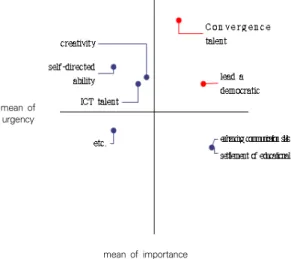
4.3.2 Hershkowitz threshold function analysis Hershkowitz threshold function was used to analyze the top priority in order to be more clear in presenting the direction of priority decision.
The value of importance in the direction of education was displayed on the horizontal axis and the value of practicability was displayed on the vertical axis, and the result showed that the importance and two practicabilities were higher than the average in the first quadrant, which was used to derive the competence with the highest priority.
The detailed ranking of other policy tasks is as shown in Fig. 3 below.
mean of urgency
mean of importance
Fig. 3. The results of Hershkowitz threshold function Analysis
4.3.3 Derivation of priority groups
Considering the Borich needs analysis and Hershkowitz threshold function, fostering convergence- typed talents and settlement of educational divide, which were placed in the first quadrant in the Hershkowitz threshold function graph with a high level of Borich needs were derived as the top priority.
5. Discussion and Conclusion
This study aims to establish a new type of
talent in the post-COVID 19 era and suggest the educational plan for new type of talent development. The following are the conclusions of this study.
First, thru big data analysis and Focus Group Interview analysis, convergence, ICT utilization ability, creativity, self directed learning ability, and leadership are listed as types of talent in the post-COVID 19 era. In competency level, creativity, self directed learning ability and leadership were founded and in skill level, Convergence and ICT utilization ability were selected as types of talent. In other words, the creative, self motivated leader with convergence and ICT utilization ability is a representative talent in the post-COVID 19.
Second, innovation of digital educational system, support for vulnerables, reducing the number of students per class are suggested as the educational plan for new talent development. In order for all students to receive the same level of education as before Corona 19, the policies and systems should be supported. Therefore, the provision of open education environment based on ICT technology will enable educational plans to be successfully implemented[13].
Also a reduction in the digital learning environment surrounding students while reducing the number of students per class. In other words, the need to innovate the digital learning system in consideration of the circumstances in which the school education in the space of a school is conducted in the home through online media without corona (e.g., students with their own study rooms, students with personal PCs, and students sharing PCs with siblings).
Third, the most important policy among
educational directions for talent developments in
the post-COVID 19 era was Cultivation of
Convergence Talent. Convergence is very
important variables since it creates new values
by connecting things that were separated from
each other. Therefore, convergence is necessary
as a key talent in the new era to connect various subjects and students can have new perspectives and create new values through them.
Based on the prior research presented through the theoretical background, a holistic educational support should be taken for people who are preparing for the non-face-to-face education during the outbreak of COVID-19.
Park et al.(2018) also raised the issues from the gap of educational opportunities that may arise in this COVID 19 situation. Furthermore, in order to prepare future talents development in the post-COVID 19 era and provide systematical supports for the education field, cooperation among the central government, local communities, industries, and individuals are strongly suggested[15,16].
It is expected that our study will establish a foundation to support the talent development and training for the post COVID-19 era. Based on this, Korea will have the comparative condition in talent development compared to other countries if we successfully build infrastructure of talent development [17,18].
With regard to the expansion of online learning and adoption of non-face-to-face education due to COVID-19, overseas studies dealing with the inequality of educational opportunities for the vulnerable social group [19]
and the quality of education [20] have been conducted a lot. Thus, attention of the government and academic world to political suggestions on cultivation of future talented individuals and systematic analysis of the problems and demands occurring in the field will be necessary. Not only politics and economy but also universal education are entering an era of huge revolution because of COVID-19. At this point, this study analyzed whether the direction of discussion was being presented from the perspective of cultivation of talented individuals in this new era. Based on these findings, this study analyzed the topics that the society pays
attention to by approaching the agenda related to cultivation of talented individuals in the future
―post-COVID-19 era―which has been discussed only from the perspective of insiders in the academic field of pedagogy from a broader view, while presenting the agendas which are important but overlooked by the society. This study has a limitation that its data collection period with regard to big data analysis is relatively short. Therefore, analyses of more data in the long term through follow-up studies will lead to deduction of results different from of this study, and analysis studies on trends in international discussion as well as domestic and relevant researches and government policy data will also be needed. Lastly, as a subject of follow-up study, it suggests field research or case research as a qualitative research on educational fields and subjects in order to present the semantics with regard to the phenomenon more densely.
Our findings presented basic ideas about the
future talent development for a new society. It
can be used as a basic information of the future
talent which can be used not only in education,
but also in other fields of society. This will help
reinforce the areas required to nurture the future
talent. And the curriculum in school education,
the application of the Andragojic model
proposed in lifelong education, and the
integration of life and education to foster
convergence talent. Also, it is believed to be
useful for operating and planning educational
programs required for all the age groups, which
are not only children but also adults. Finally, this
study examines and compares various
perspectives the Development of Skill
Convergence in the Post-COVID19 Era, and
discusses ways to foster Post-COVID19 Era
talents, which is considered to serve as
meaningful data not only for education but also
for all sectors of society
REFERENCES
[1] J. H. Lee, S. U. Baek, Y. J. Lee & K. H. Lee. (2018). A Study on the future talent competencies. Journal of Creative Information Culture, 4(3), 311-320.
[2] D. Y. Cho et al. (2019). Prediction of future education direction in the fourth industrial revolution era using scenario technique. Journal of Humanware, 2(1), 81-105.
[3] D. Y. Cho & S. K. Kim. (2019). Problems of the framework act on human resources development and the amendments plan. The Journal of Law of Education, 31(1), 81-100.
[4] J. S. C. Ryoo & T. H. Kang. (2018). Exploring the curriculum and educational methods for the era of industry 4.0. Educational Research, 72, 101-117.
DOI: 10.17253/swueri.2018.72.005
[5] H. I. Jeong, D. Y. Cho, J. Choi, J. M. Lee, E. H. Jang &
H. J. Kang. (2018). Study on the required and priority competencies for future talent at life stages in the 4th industrial revolution. Journal of Lifelong Education, 24(4), 61-92.
[6] R. Pellegrino, K. W. Cooper, A. Di Pizio, P. V. Joseph, S. Bhutani & V. Parma. (2020). Corona viruses and the chemical senses: past, present, and future.
Chemical Senses, 45(6),
415-422.[7] D. Zhang, M. Hu & Q. Ji. (2020). Financial markets under the global pandemic of COVID-19. Finance Research Letters, 101528.
[8] I. M. Veer, A. Riepenhausen, M. Zerban, C.
Wackerhagen, H. Engen, L. Puhlmann & A. Uściƚko.
(2020). Mental resilience in the Corona lockdown:
First empirical insights from Europe.
[9] B. Kundu & D. Bhowmik. (2020). Societal impact of novel corona virus (COVID ̶19 pandemic) in India.
[10] A. Bowdle & L. S. Munoz-Price. (2020). Preventing infection of patients and healthcare workers should be the new normal in the era of novel coronavirus epidemics. Anesthesiology: The Journal of the American Society of Anesthesiologists, 132(6), 1292-1295.
[11] National Institute of Korean Language. (2018).
standard Korean language dictionary.
[12] B. J. Lee, S. H. Myeong & S. H. Kim. (2012). An exploratory study on the relationship among talent characteristics, information capability, and social network. Journal of Korean Association for Regional Information Society, 15(1), 121-146.
DOI: 10.22896/karis.2012.15.1.006
[13] E. B. Kim, J. S. C. Ryoo, K. B. Park, Y. S. Paek, S. M.
Park & D. Y. Cho. (2019). Tasks for the future education of elementary schools in the face of a decrease in the population. Journal of Competency Development & Learning, 14(3), 193-221.
[14] Ministry of Education (2015). 2015 Revised Elementary and Secondary Curriculum General Discussion.
[15] S. I. Baek, H. J. Lee & H. T. Kim. (2020). Analysis of artificial intelligence’s technology innovation and diffusion pattern: Focusing on USPTO patent data.
The Journal of the Korea Contents Associatio, 20(4), 86-98. DOI: 10.5392/JKCA.2020.20.04.086
[16] S. D. Choi, Y. I. Seo, E. H. Hwang, Y. S. Choi, S. H.
Jang & Y. C. Kim. (2013). Promoting Core Competency Education and Building Innovative Learning Ecosystems for Fostering Talent for the Future (Ⅰ). Seoul: Korean Educational Development Institute.
[17] A. Shah et al. (2019). Infectious diseases specialty intervention is associated with better outcomes among privately insured individuals receiving outpatient parenteral antimicrobial therapy. Clinical Infectious Diseases, 68(7), 1160-1165.
[18] K. A. Kim, B. R. Ryu, J. H. Kim, J. H. Kim, S. H. Park
& M. J. Lee. (2015). A Study of Establishing Future Oriented Educational System in an Era of Declining Number of Students. Seoul: Korean Educational Development Institute.
[19] L. W. Van & Z. Parolin. (2020). COVID-19, school closures, and child poverty: a social crisis in the making,
The Lancet Public Health
,5(5),
243-244, [20] C. Hodges, S. Moore, B. Lockee, T. Trust & A. Bond.(2020) The difference between emergency remote teaching and online learning.