ISSN 2288-1069 (Online)
http://dx.doi.org/10.12925/jkocs.2020.37.6.1475
The Effect of Dementia Club Activity on College Life Satisfaction, Dementia Knowledge,
and Dementia Attitude in Nursing Students
Young-Sun Park1*․Young-Ju Jee2✝
1Associate Professor, College of Nursing, Kyungbok University, Namyangju-si, Korea
2Assistant Professor, Department of Nursing, Kyungnam University, Changwon-si, Korea (Received October 3, 2020; Revised December 21, 2020; Accepted December 22, 2020)
Abstract : This is a quasi-experimental study with one-group pretest-posttest design to investigate the effect of dementia club activities on college life satisfaction, dementia knowledge, and dementia attitude in nursing students. The subjects were 26 nursing students who participated in club activities for more than three hours per a week. The college life satisfaction was measured using School Life Satisfaction Scale and dementia knowledge was measuring using Questionnaire for Awareness of Dementia used in dementia prevalence survey. Dementia Attitude Scale (DAS) was used to measure dementia attitude. The tests were performed before and after club activity, and collected data were analyzed using descriptive statistics and paired sample t-test. The results showed that the scores of college life satisfaction (t=-2.38, p= .025), dementia knowledge (t=-5.56, p< .001), dementia attitude social comfort that evaluate emotion, behavior, and awareness about dementia (t=-4.50, p< .001), dementia attitude dementia knowledge (t=-2.59, p= .016), and dementia attitude total score (t=-4.20, p< .001) increased statistically significantly after club activity. It is concluded, based on the results, that the club activities in college improve college life satisfaction, dementia knowledge, and dementia attitude thus provide contribute to caring for patients with dementia. The replication studies with larger random samples, however, are necessary to confirm the findings obtained from this study.
Keywords : Dementia, Club Activity, College Life Satisfaction, Dementia Knowledge, Dementia Attitude
✝Corresponding author
(E-mail: [email protected])
1. Introduction
1.1. Background
The college period, as an early stage of adulthood, is important in terms of personal growth and development and expected to explore important values in life, establish one's own identity, and appropriately cope with physical, social and psychological changes [1].
The college students lived a uniform and passive life, mainly for college entrance exams, until high school, however they are now expected to live autonomous and proactive life different from that of past, such as determining the courses by themselves, taking part in club activities while managing time, and preparing for careers and employment [2].
Some college students fail in adjusting to college and give up their studies due to the stresses resulting from the fact that it is a transitional period in which they have to focus on several tasks for transition to adulthood [3]. In addition, they experience negative and counterproductive emotions in various aspects such as anxiety, disappointment, regret, dissatisfaction, and hostility, instead of the joy, satisfaction, hope, and confidence of college life [2].
It is assumed that the college students who had healthier college life are more likely to have a positive adaptation life in adulthood [4]. The college life satisfaction, a predictor of high adaptability in social life after graduation, represents a positive experience, high achievement, and intrinsic motivation in the transition to adulthood, which leads to a feeling of satisfaction in everyday life [5].
The Club activity supports balanced development of mind and body and allows students to be free from environmental and situational stress [6], and is an important basis for university culture formation. The college students, by actively participating in various activities other than the curriculum in their leisure time, develop hobbies and talents, and have various experiences and wide range of
encounters with students from other majors [7]. Since the club activity is done not only within the university but also outside the university, the spatial scope of the activities is also expanded. In addition, the club activity may enhance the social ability to fulfill responsibilities and obligations in an autonomous relationship [8] and complement the formal curriculum by expanding the aspects of affection and social experience that are not covered in the regular curriculum, which are helpful in achieving the purpose of university education, cultivating humans with holistic grounding [9]. Many researchers agreed on the necessity of activities to increase college life satisfaction, accordingly, investigated the effects of leisure activities [10], sports club activities [11], and music club activities [9].
Therefore, it is necessary to develop and apply various activities that can continuously provide opportunities for more activities to satisfy university life.
It is estimated that the number of patients with dementia among the elderly population aged 65 and over increase from about 540,000 in 2012 to about 1.27 million in 2030 and about 2.71 million in 2050, showing almost twice every 20 years [12]. Since the college students are not only the main actors in the support of the elderly in the future, but also have a direct relationship with the aging society [13] and the values and attitudes formed during college become a cornerstone for later life [14], the perception of college students about dementia is very important. It is important for the nursing students to have knowledge of dementia so that they provide more excellent care to the elderly with dementia.
Recently, the employment rate or grades are considered more frequently than one's aptitude and interest, in deciding major [15] [16].
However, students who choose their major based on these criteria are I risk of experiencing low major satisfaction, which may have a negative impact on future careers [17].
Motivated by high employment rate, many students admitted to nursing department without much concern about the major.
However, unlike other departments, nursing students, even when they are lower grade, take basic major courses such as anatomy, physiology, basic nursing, and practice, which require understanding and memorization of unfamiliar terms, which making them to complain of difficulties in university life adaptation and dissatisfaction with their major [15]. Shin et al. showed that volunteer activity related to major affects satisfaction with major and the students should be encouraged to involve these kinds of volunteer activities because such activities may lead to valuable leisure activities in life [18]. These activities were also reported to be effective in improving emotional intelligence and satisfaction with major [19]. Also, previous studies on dementia major learning in the field of nursing education showed that dementia partner education has a positive effect on dementia knowledge and attitude [20] and that volunteer activities for the elderly have an effect on knowledge and attitudes toward the elderly [21]. However, such studies especially those evaluating the effects of dementia club activities have been limited.
Dementia, which occurs with high prevalence in the elderly, affects more than 10% of the total elderly population in Korea as of 2020, and the number of elderly patients with dementia is predicted to exceed one million by 2025 [22]. Dementia has become a disease requiring national-level management because the rapid increase in elderly with dementia affects the relationship between elderly and family members and is recognized as a social and policy problem [23]. Nursing students are likely to nurse the elderly with dementia in clinical setting and, in such case, the lack of knowledge about dementia keeps them from proper coping to care for elderly with dementia. The acquisition of knowledge about dementia is important for is, therefore,
important to provide best nursing care to elderly with dementia [24]. A previous study provided activity therapy to family members of elderly with dementia for their acquisition of information about dementia diagnosis and symptoms and mitigation of care burden and reported that it improved attitude to manage dementia, and mood, quality of life, and dementia coping skill of the family members [25, 26]. There results suggested that the nursing students should be provided with information about dementia in their club activities.
The attitude toward dementia refers to emotional attitude meaning the positive or negative emotion to the situations accompanied by the disease of dementia itself, and behavioral attitude meaning the overall behavioral tendency toward the situation formed by dementia [27] . It was found that those who have more positive attitude toward elderly with dementia are likely to show higher level of caregiving thus improve the quality of life of patients with dementia [28]. The positive attitude toward dementia has also effect on the outcome of treatment, delay the entrance to the institution, and relieve the burden of carer for the caring [29]. The elderly and dementia nursing, in addition, is not considered an important subject because it is not included in the national nurse examination, it is important to provide club activities as an extra-curricular education method for the management of the dementia elderly. Therefore, it is very insightful to examine the effects of the dementia major club activities
1.2. Purpose
The purpose of this study was, therefore, to investigate the effect of dementia club activities on college life satisfaction, dementia knowledge, and dementia attitude and the specific ones are as follows:
- To measure the college life satisfaction after participating in dementia club activity.
- To measure the dementia knowledge and attitude after participating in dementia club activity.
1.3. Hypothesis
The dementia club activity will increase the participants’
∙ Hypothesis 1: score of college life satisfaction.
∙ Hypothesis 2: score of dementia knowledge.
∙ Hypothesis 3: score of dementia attitude -stabilization scale.
∙ Hypothesis 4: score of dementia attitude – knowledge scale.
∙ Hypothesis 5: total score of dementia attitude.
2. Method 2.1. Design
The purpose of this one group pretest- posttest study was to investigate the effect of volunteer activities for elderlies with dementia.
The specific steps of the study are as follows:
2.2. Subjects
The subjects were nursing students at K University located in Gyeonggi-do
∙ who join and act in ‘Match’, a dementia club in Nursing Department,
∙ who participate in club activity for at least three hours per a week, and
∙ who have interested in dementia.
The eligible nursing students were 27 and, after excluding one student who do not want participation, 26 students were population of this study.
The required number of subjects was calculated using G*Power 3.1 program following the principle of sample calculation based on Cohen formula [30], and determined as 26 with group number of 1, statistical power of 0.8, significance level of α=0.05,
and effect size of 0.5 for the paired sample t-test. After excluding participants who complete questionnaire unsatisfactory or stopped club activity, a total of 26 students were included as subjects.
2.3. Measures
2.3.1. College life satisfaction
School life satisfaction is the extent to which behaviors of student are well harmonized and successful in interactions with school environments and to which they maintain a smooth relationship with significant others such as teachers and other students. It is also represented by their participation in classes actively, compliance of school rules, and playing the role as an independent individual [31]. The college life satisfaction was measured using the School Life Satisfaction Scale developed by Kim [31] that is self- administered one composed of six factors and 25 items. Specifically, it had three items for overall satisfaction with school life, four items for interpersonal satisfaction, four items for lecture and learning satisfaction, four items for educational environment satisfaction, four items for school rule and special activity satisfaction, and six items for social support satisfaction.
The higher score is associated with higher satisfaction with college life. The score range was 25-125 and the Chronbach's α reported by developer was .74 [31]. The Chronbach's α of this scale in this study was .76.
2.3.2 Dementia knowledge
The dementia knowledge was measured using Questionnaire for Awareness of Dementia used in dementia prevalence survey in 2008 and 2012 [12], that is composed of 15 items of five items for etiology of dementia, three items for epidemiology and institution, four items for symptom and diagnosis, and three items for prevalence and treatment. Each item was answered on two-point Likert scale of 1 (yes) and 2 (no).
Type Contents
Learning Activity
“Dementia Partner Course” hosted by Central Dementia Center
‘Mini-Mental State Examination-Dementia scale (MMSE-DS)’, an instrument to measure cognitive function
‘Activation of Brain for All’, a dementia intervention program Experience Activity with Elderly
Experience Activity with Overcoming Dementia
Volunteer Service Activity
Nursing Home
Drawing hand, Making goose figure Matching card
Matching card
Day Care Center ‘Activation of Brain’, a dementia intervention program MMSE-DS evaluation
Village
Education for dementia prevention Education for falls prevention Arrangement of village bulletin board Table 1. Club Activities
Items no. 2, 3, 4, 9, 10, 13, and 14 were reversely-coded and the higher score is associated with higher level of dementia knowledge. The Chronbach's α reported by developer was .74 [12], and in this study, that was .76.
2.3.3. Dementia attitude
The dementia attitude refers to attitude toward dementia and is classified into the emotional attitude that reflects positive or negative feelings about the disease, dementia itself, or accompanied situations and behavioral attitude which refers to the overall behavioral tendency as a response to dementia or the accompanied situations. The dementia attitude was measured using Dementia Attitudes Scale (DAS) developed by O’connor & McFadden [32] and translated by Kim et al. [12] after modifying to satisfy the purpose of this study.
This instrument was composed of 20 items addressing dementia knowledge (10 items) that measures aspects of knowledge and social comfort (10 items) that measures emotion and behavior. Each question was answered using seven-point Likert scale where 1point means 'definitely false’ and 7 point ‘definitely true’, so
the total score ranged 20-140. Six items were reversely-coded and the higher score is associated with higher level of dementia attitude. The Chronbach's α reported by developer was .83-.85[12], and in this study, that was .61.
2.3.4. Club activity Program Operation The dementia club is a group organized voluntarily by the members to help patients with dementia and volunteers through face-to-face contact and mutual relationships with those with dementia. The dementia club in this study was 'MATCH', a dementia club of K University located in Gyeonggi-do and their activity was composed of completion of Dementia Partner course in Central Dementia Center listening to two special lecture on dementia, two experience activities, and volunteer activities including three times at nursing home and two times at day care center, two hygiene education activities, and one environmental activity (Table 1). For volunteer activity at institutions, the agreements were signed with an elderly nursing home and a village located at N city and elderly day care center located at U city.
Characteristics Category Frequency (%)
Gender Male 5(19.2)
Female 21(80.8)
Grade
1st grade 14(53.9)
2nd grade 6(23.1)
3rd grade 5(19.2)
4th grade 1(3.8)
Dementia Club Activity Paricipation Period
Less than one year 17(65.4)
More than one year 5(19.2)
More than two years 2(7.7)
More than three years 2(7.7)
Table 2. General characteristics of subjects (N=26) 2.4. Ethical Consideration
The agreements were signed with an elderly nursing home and a village located at N city and elderly day care center located at U city and obtained permission from them. This study selected a club in K University and requested for research cooperation. After obtaining consent for research cooperation, the purpose of the study was explained to all subjects and written consents were obtained for each subject.
It was explained that the data is used only for research purpose and its confidentiality is protected and that they are allowed to withdraw the consent for participation at any time.
2.5. Data Collection
The data were collected from the students of a club in K University located in Gyeonggi-do who participated in club activities including meeting for over three hours per a week from Mar. 1 to Dec. 30, 2019. Data from 26 students were used in analysis after excluding 18 ones who have not completed questionnaire or stop club activity from qualified 44 ones.
The questionnaire surveys were performed before and after club activity, respectively.
2.6. Data Analysis
The methods for analyzing data are as
follows:
▪The general characteristics and motivation for joining club were analyzed using descriptive statistics (real number, percentage, and standard deviation)
▪The effect of club activities on college life satisfaction, dementia knowledge, and dementia attitude were tested using t-test for pre-post comparison.
3. Results
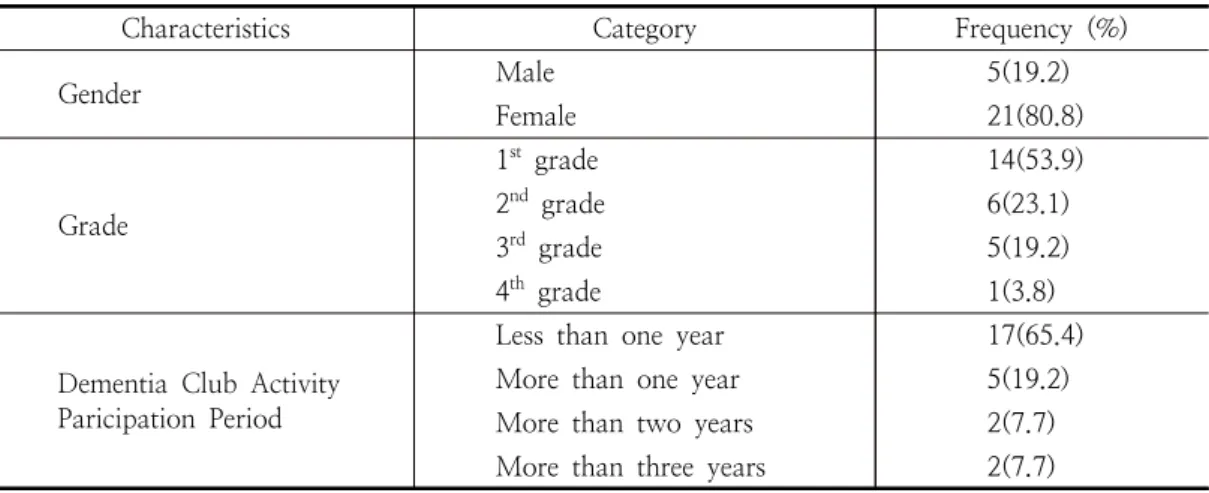
3.1. General Characteristics of Subjects Female subjects (n=21; 80.8%) were more than male ones (n=5; 19%). For the age, 19-23 and 24-27 years old accounted for 80.8%(n=21) and 19.2%(n=5), respectively.
The most frequent length of club activity was less than one year (n=17; 65.4%), and followed by 1-2 year (n=5; 19.2%), 2-3 years (n=2; 7.7%), and three years or more (n=2;
7.7%) (Table 2).
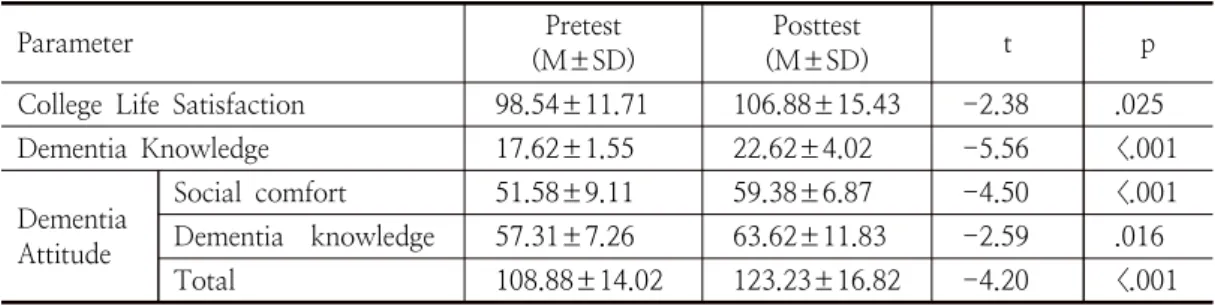
3.2. Testing Effect of Club activity The club activities were found to (Table 3) ∙ (Hypothesis 1) increase their score of college life satisfaction from 98.54±11.71 to 106.88±15.43 and the difference was statistically significant (t=-2.38, p= .025).
Parameter Pretest (M±SD)
Posttest
(M±SD) t p
College Life Satisfaction 98.54±11.71 106.88±15.43 -2.38 .025
Dementia Knowledge 17.62±1.55 22.62±4.02 -5.56 <.001
Dementia Attitude
Social comfort 51.58±9.11 59.38±6.87 -4.50 <.001
Dementia knowledge 57.31±7.26 63.62±11.83 -2.59 .016
Total 108.88±14.02 123.23±16.82 -4.20 <.001
Table 3. The effects of club activity (N=26) ∙ (Hypothesis 2) increase their score of dementia knowledge from 17.62±1.55 to 22.62±4.02 and the difference was statistically significant (t=-5.56, p< .001).
∙ (Hypothesis 3) increase their score of dementia attitude social comfort from 51.58±9.11 to 59.38±6.87 and the difference was statistically significant (t=-4.50, p< .001).
∙ (Hypothesis 4) increase their score of dementia attitude knowledge from 57.31±7.26 to 63.62±11.83 and the difference was statistically significant (t=-2.59, p= .016).
∙ (Hypothesis 5) increase their score of dementia attitude knowledge from 108.88±
14.02 to 123.23±16.82 and the difference was statistically significant (t=-4.20, p< .001).
∙ The results of testing the effect of club activity by comparing the score before and after activities showed that dementia knowledge (t=-5.56, p<.001) and dementia attitude (t=-4.20, p<.001) improved significantly after club activities. The score for college life satisfaction also improved though it did not reach statistical significance (pre-test:
91.38±9.63, post=test: 94.08±15.60) (Table 3)
4. Discussion
This study investigated the effect of club activities for the elderly with dementia on college life satisfaction, dementia knowledge, and dementia attitude in college students.
These activities have great significance in that they improve college life satisfaction, which is
helpful for college life, and that they are extra-curricular medium that provides an opportunity to learn knowledge and attitude about dementia, which is a national and social issue. The main results of this study are compared with those of previous studies on the effect of club activities on college students as follows. These results, in combination with Kim & Han's study that confirmed the effect of college student's leisure activities through clubs on peer relationship, organizational identification, and life satisfaction, suggest that, sense of belonging within the organization and the dynamic relationship between seniors and juniors is helpful in college life [10].
Although direct comparison is difficult because it is not on the effect of club activities related to dementia, a study on the effect of participation in sports club activities to investigate relationship between psychosocial health and college life satisfaction reported that the club activity is an important factor in improving college life satisfaction [33].
Considering that the club activity is a voluntary one, this is consistent with the results of this study that the club activities led to significant difference in college life satisfaction. However, since the club activities of the subject in this study were different, the generalization of the results was limited. It is justified, therefore, to perform replicate studies to confirm this result.
In addition, the studies reported statistically significant association between college life adjustment and college life satisfaction [34]
and the direct effect of club activity on college life adjustment [35] are supportive of this study. The dementia club activity, in this study, is considered to have effect on college life satisfaction by making the students to adjust actively to learning, interpersonal relationship, and environment and thus by meeting their desire for self-development and internal growth. A previous study on sports club participation and college life satisfaction, on the other hand, reported a positive correlation between club participation and college life satisfaction, and assumed the reason that sports club activities help them to improve athletic performance and physical strength and provide opportunities to be acquainted with peers [36], suggesting that dementia club activity is helpful in acquiring the knowledge necessary for study and in developing smooth relationship with peers.
It was reported that he dementia knowledge is an influencing factor of dementia attitude [37] and that nursing students have negative awareness and attitudes toward the elderly with dementia than the general one, and have a low level of knowledge about dementia [38].
The incorrect knowledge about dementia may cause a negative attitude toward elderly with dementia, and a negative attitude toward the elderly with dementia may increases the burden of nursing thus lowers the quality of care [39]. Nursing college students in the future would be a key professional that provide direct and indirect nursing services to the elderly with dementia in various fields. The current increase of elderly population, in addition, means more elderly with dementia and more opportunities to care for elderly with dementia. They are, therefore, important professionals for health management of elderly with dementia because they provide nursing care to such elderly based on knowledge and experience about dementia [40]. This study showed, after dementia club activity, statistically significant increase in knowledge about caring for elderly with dementia, which
is significant in that it demonstrates that the dementia club activity is an effective educational medium for acquiring knowledge about dementia. Since the studies on relationship between dementia knowledge and club activity have been limited, making the direct comparison with previous studies to be impossible, the other studies reporting improvement of dementia knowledge are discussed below.
It was reported that the dementia education program, which provided three training sessions (12 hours in total) to students of Departments of Nursing, Early Childhood Education, and Social Welfare, improved their knowledge about dementia in the test immediately after education and four weeks after education [41], which is similar result with that of this study where participation in dementia club activities led to significant improvement of dementia knowledge and positive learning effects through dementia understanding, evaluation methods, and cognitive rehabilitation programs. A study, in addition, that developed and implemented a program for dementia education addressing theory and practice composed of 48 hours for two weeks and three days a week, reported that dementia knowledge increased significantly [42], supporting this study. Given that the subjects of the study were similar with them of this study in age and grade, these results suggest the dementia club activities may be an effective educational method as an educational program for dementia knowledge. The nursing students who took a 100-minute class once a week for 4 weeks to supplement the limits and gaps in theoretical education by facing the elderly with dementia through movies, experienced a statistically significantly higher learning effect than the control group with the existing teaching method. The students presented their impression after watching a movie addressing each theme. The themes of movies were definition of dementia in 1st session, symptom of dementia in 2nd session,
nursing care for patient with dementia in 3rd session, and dementia family and prevention in 4th session [43]. The subjects of this study identified naturally the stats of elderly with dementia while visiting them and providing cognitive rehabilitation program in health education as a dementia intervention and examined the severity of disease through cognitive function test, which were similar to the previous study and positive factor in acquiring dementia knowledge. Considering, however, that the subjects of this study were positive in club activity and interested in dementia, there is limitation in generalizing the results of the results to students who are not interested in club and dementia.
Attitude is the state of mind toward the other person and dementia attitude is a negative or positive emotion toward dementia [44]. The total score of dementia attitude in this study increased from 108.88±14.02 in pre-test to 123.23±16.82 in post-test and the difference was statistically significant. This was due to significant difference in social comfort and dementia knowledge, which were sub- factors of dementia attitude. These differences may be related to the fact that the subjects were interested in dementia. A study on the influencing factors of dementia attitude reported demands for dementia prevention education, interest in dementia, whether disclosure or not when there is a person with dementia in family members, diagnosis of dementia among family members as the influencing factors of dementia attitude [41].
This is maybe because the subjects of this study were interested in dementia enough to join dementia club and have active attitude toward dementia. A study on the awareness of and attitude toward dementia among workers in long-term nursing home for the elderly reported positive correlation between awareness of dementia and dementia attitude [45]. The significant increase of dementia attitude in this study may be due to improvement of dementia knowledge, suggesting that the education of
dementia knowledge is necessary for improving dementia attitude. The dementia attitude, in addition, may vary depending on social culture or personal experiences and values, and affects relationships with and behavior toward patients with dementia [44], and interactions and effective communication with them [46]. The attitude tended to be positive in those who had experience of volunteer service or education related to dementia [47], supporting that the dementia attitude in this study improved by dementia education and volunteer services for elderly with dementia.
The previous studies on improvement of dementia attitude reported Improved dementia knowledge and dementia attitude in nursing students completed Dementia Partners course at Central Dementia Center [48], development and provision of dementia education programs for nursing students to practice for the elderly patients [42], and provision of dementia education programs through watching video and lectures lecture on dementia in general college students [41]. The educational program for national certificate on professional caregivers also had positive effect on improving dementia attitude of the trainees [49]. In these studies, dementia education improved dementia knowledge and thus dementia attitude. In these studies, education was composed of direct knowledge delivery, service, and practical activities. It is also estimated, in this study, that the knowledge acquired through lecture-style education and direct volunteer activities for the dementia elderly had a positive effect on the improvement of dementia attitude, confirming that dementia attitude may be improved through club activities. The study using movie reported significant improvement in dementia knowledge but not in dementia attitude of the subjects [43]. This may be due to limitation in direct education in watching movie and discussion, necessitating a further study to include the extended scope of subjects, in-depth design about educational method and
club activity, and evaluation.
DAS includes social comfort sub-scale that evaluates the caregiver's emotions and behaviors for dementia care and a dementia knowledge sub-scale for dementia care perception. In this study, dementia attitude total score (t=-4.20, p< .001), social comfort score related to dementia care (t=-4.50, p<
.001), and dementia knowledge score (t=-2.59, p=. 016) showed a significant difference between before and after club activity (Table 3). On the contrary, there was report that educational programs including general knowledge of dementia for families of elderly with dementia, coping methods for dementia mental behavior symptoms, stress management and introduction of support organizations increased their total score and social comfort score but decreased their dementia knowledge score [50], and that educational programs for volunteers including dementia prevention, general knowledge of dementia, long-term care insurance for the elderly, dementia cognitive function evaluation, and dementia prevention intervention program increased the total score, social comfort score, and dementia knowledge score, but it was not significant [ 51]. This may be because the subject in this study, unlike above two studies, shared and discussed the knowledge gained through applying actual care to the elderly with dementia, preparation for care, and the difficulties of planning in the club meeting. Choi et al. [29] reported that the caregivers for elderly with dementia in Korean community had more negative emotional attitude compared to cognitive attitude, and these factors may lead to negative behavior toward elderly with dementia by lowering the emotional and behavioral level in providing care for elderly with dementia. In this respect, education and volunteer activities in this study are expected to be applied successfully to education for community caregivers.
This study evaluated the effect of club activity on college life satisfaction and
dementia knowledge and dementia attitude in nursing students who were active in the dementia club (MATCH) of a university located in Gyeonggi-do. This study included only those who participated in club activity for more than three hours per week and excluded those and there was no comparison with those without club activity or who joined other club, which are limiting the generalization of the results. The results of further studies that included more diverse subjects and club activities are expected to provide valuable date for development of education program related to nursing care of elderly with dementia in various fields. In particular, the subjects who are 3rd and 4th grade nursing students and completed geriatric nursing course and geriatric nursing practice may share information with 1rd and 2nd grade students who did not yet completed the courses. It should be cautioned, however, when the results of this study is compared with those of other studies that evaluated dementia knowledge and attitude of general population or other students who completed the dementia education. It is necessary, therefore, to consider subjects or the time period of club activity in planning study design of future studies. The dementia club activity, in addition, is expected to contribute to improving the quality of life of the elderly with dementia and their families by helping to manage them in the local community according to the national policy.
Finally, the reliability of tool for dementia attitude used in this study was Cronbach’s α=
.61 lower than .83~.85 reported by tool developer, which should be considered in interpreting the results of this study.
5. Conclusion
This study investigated the effect of dementia club activities in nursing college students, and the dementia education and volunteer activities performed in this study were shown to have
effect in acquiring dementia knowledge and improving dementia attitude to care for elderly with dementia. The absence of control group, however, limited the interpretation of the results. It is recommended, therefore, to perform a repetitive study that includes non-participants and participants in other clubs to confirm the effect of club activities, and includes general public or students with other majors to confirm the effect of dementia education. The results of such confirmation are expected to be used as an important fundamental data in developing education program in various fields related to nursing for elderly with dementia and to measures for effective college life. The dementia club activity is, in addition, expected to contribute to improve the quality of life of elderly with dementia and their family by helping to manage the elderly with dementia in the community according to the national policy.
References
1. S. R. Noh, S. A. Bae, “The Effects of emotional Intelligence and Learning Flow on College Adaptation in Undergraduate Students”, Journal of Learner-Centered Curriculum and Instruction, Vol.14, No.2 pp. 343-362, (2014).
2. E. M. Park, “Effects of Personality Education Program for University Students”, The Journal of the Korea Contents Association, Vol.12, No.7 pp.
497-509, (2012).
3. M. M. Chemers, L. T. Hu, B. F. Garcia,
“Academic self-efficacy and first year college student performance and adjustment”, Journal of Educational Psychology, Vol.93, No.1 pp. 55-64, (2001).
4. E. J. Park, H. K. Lee, “A Study of Factors affecting College Dropout Intention for Freshmen in College: Focused on K-College”, Forum for youth culture,
Vol.41, 91-111, (2016).
5. C. Levesque, A. N. Zuehlke, L. R. Stanek, R. M. Ryan, “Autonomy and competence in German and American university students: A comparative study based on self-determination theory”, Journal of Educational Psychology, Vol. 96, No.1 pp.
68-84, (2004).
6. S. U. Park, G. Ha. Hong, H. H. Kang, “A Study on the Leisure Satisfaction and Collegiate-Life Satisfaction according to the Types of Circle Activities”, The Korean Journal of Physical Education, Vol. 41, No.5 pp. 349-356. (2002).
7. D. J. Kim, M. H. Yang, “Relationships among Activity Types, Activity Satisfactions, Activity Constraints and University Life Satisfactions of University Students’ Circles”, Korean Society for Study of Physical Education, Vol. 7, No.4 pp. 135-150, (2003).
8. G. K. Kim, M. S. Kim, B. J. Kim, “The Effect of Participation Level in University Club Leisure Activities on Fun, Commitment and Psychological Well-being” Official Journal of the Korean Society of Dance Science, Vol. 32, No.2 pp. 33-46, (2015).
9. O. J. Lee, J. Y. Yoon, “The Effects of Music Club Experience on Pre-teachers’
Pedagogical Content Knowledge in Early Childhood Music”, Korean Journal of Early Childhood Education and Care, Vol.
10 pp. 45-63, (2017).
10. Y. M. Kim, H. W. Han, “Influence of Club Leisure Activity on Peer Relationship, Organizational Identification and Life Satisfaction of University Students”, Journal of Leisure, Recreation Studies, Vol. 34, No.2 pp. 35-46, (2010).
11. I. H. Kim, C. H. Kim, “Influence of Participation Level in Sport Club Activities on Character Competency and College Adjustment in College Students”, The Korean Journal of Growth and Development, Vol. 26, No.4 pp. 519~528,
(2018).
12. Ministry of Health and Welfare, “2012 National Epidemiology survey of Dementia,” (2012).
13. H. J. Lee, “Caregiving experience and adaptation process of the husbands who are caring for wives with Alzheimer- focusing on elderly couple household”, Journal of the Korean Gerontological Society, Vol. 26, No.1 pp. 45-62, (2006).
14. M. S. Lee, S. N. Yang, “Effect of social work student’s attitude, knowledge and experience with senior citizens”, Journal of Digital Convergence, Vol.10, No.8 pp.
265-273, (2012).
15. M. H. Nam, H. O. Kim, “Relations between Clinical practice emotional labor, Self- esteem and Major Satisfaction of among Nursing Students”, Journal of Digital Convergence, Vol.14, No.1 pp.
263-273, (2016).
16. J. H. Oh, “The Influencing factors of Self- esteem and Major Satisfaction on College Adjustment among Nursing Students”, The Journal of the Korea Contents Association, Vol.14, No.10 pp. 873-884, (2014).
17. Tae JJ. The Effect of Nursing Professionalism, Satisfaction in Major, and Self-leadership on Career Preparation Behavior in Nursing Students. M. S. thesis, Nursing Department, Keimyung University, Daegu, Korea, (2014).
18. M. A. Shin, K. S. Ahn, “A study on Satisfaction in Major and Job Esteem based on volunteering Experience of college Students in the Department of Dental Hygiene and Nursing”, Journal of Korean Society of Dental Hygiene, Vol.12, No.6 pp. 1090-1100, (2012).
19. P. N. Park, “Relationships among Volunteer Activities, Emotional Intelligence and Major Satisfaction of Nursing Students”, The Journal of the Korea Contents Association, Vol.17, No.11 pp. 264-273, (2017).
20. S. H. Jo, E. H. Kim, “A Convergence
Study on the Knowledge and Attitudes of Dementia Partner Nursing Students on Dementia”, Journal of the Korea Convergence Society, Vol.9, No.7 pp.
317-323, (2018).
21. E. S. Cho, J. G. Moon, H. Y. Lee, D. W.
Han, “The Effects of the Participation in the voluntary Service for the Elderly on the Cognition about the Elderly of Physical Therapy Students”, Journal of the Korean Data Analysis Society, Vol.14, No.3B pp.1467-1477, (2012).
22. Ministry of Health and Welfare, “National dementia management comprehensive plan-dementia management,” (2012) 23. Y. S. Park, K. B. Joo, Y. J. Jee, “A Study
on Effect of a Dementia Education Program”, Convergence Research Letter, Vol.5, No.1 pp.209-214, (2019).
24. M. S. Lee, M. C. Kim, S. K. Kim, “Study on attitude of College students and physical therapists towards seniors with dementia”, Journal of The Korean Society of Integrative Medicine, Vol.2, No.2 pp.21-29, (2014).
25. Y. S. Park, Y. J. Jee, “A Study on the Dementia Family Intervention Program”, International Journal of Elderly Welfare Promotion and Management, Vol.2, No.2 pp.49-54, (2018).
26. Y. S. Park, Y. J. Jee “A Study on Effects of a Program for Families with Dementia Patients”, International Journal on Consulting Psychology for Patients, Vol.2, No.1 pp.13-18, (2018).
27. H. J. Kim, H. S. Yang, “Study on Relations among Care Givers’ Job-Relation Feature, the Attitude Toward Dementia and Confidence of Dementia Care”, Journal of the Korean Gerontological Society, Vol.36, No.1 pp.137-149, (2016).
28. M. R. Kang, K. S. Jeong, “Attitudes toward Caring for the Elderly and Geriatric Nursing Practice of Nurses in a General Hospital”, The Journal of the Korea Contents Association, Vol.18, No.7
pp.127-137, (2018).
29. J. Y. Choi, H. Jeong, J. Y. Park, T. H.
Kim, D. Y. Lee, D. W. Lee, S. H. Ryu, S.
K. Kim, J. C. Youn, J. H. Jhoo, J. L.
Kim, S. B. Lee, J. J. Lee, K. P. Kwak, B.
J. Kim, S. W. Moon, J. N. Bae, J. H.
Park, K. W. Kim, J. W. Han. “Factors Associated with the Attitudes toward Dementia in Community Caregivers:
Results from the Nationwide Survey on Dementia Care in Korea”, Journal of Korean Geriatric Psychiatry, Vol 19, No.1 pp.24-31, (2015).
30. F. Franz, E. Edgar, B. Axel, L. A. Georg,
“Statistical power analyses using G*Power 3.1: Tests for correlation and regression analyses”, Behavior Research Methods, Vol.41, 1149-1160, (2009).
31. Kim JY. A Study on the Development and Validation of the School Life Satisfaction Scale for High School Students, M. S.
thesis, Department of Education, Wonkwang University, Icsan, Korea, (2009).
32. M. L. O'Connor, S. H. McFadden,
“Development and Psychometric Validation of the Dementia Attitudes Scale”, International Journal of Alzheimer’s Disease, Vol. 22, pp.1-10, (2010).
33. H. S. An, “Effect of Sports Club Activity on School Satisfaction and Stress in College Students”, Journal of Sport Science, Vol.26, pp.143-160, (2014).
34. M. J. Park, Y. L. Ham, D. N. Oh,
“Levels and their Correlations of Decision- Making-Competency, Adjustment to College Life, Satisfaction to College Life in Freshmen”, Journal of The Korea Contents Association, Vol. 12, No.4 pp.327-337, (2012).
35. S. M. Ham, J. H. Lee, “The Effects of Club Activities to College Life Adaptation:
Based on the Mediator of Social Support and Grit”, Journal of Learner-Centered Curriculum and Instruction, Vol.20, No.12 pp.327-348, (2020).
36. H. J. Yoo, “Sports Club Participation, College Life Satisfaction and Sports Club Enjoyment”, Asia-pacific Journal of Multimedia Services Convergent with Art, Humanities, and Sociology, Vol.8, No.1 pp.245-252, (2018).
37. J. E. Lee, Y. J. Jang, " Comparative Study of Factors Affecting Adolescents’ Attitudes towards Dementia”, Korea Institute for Health and Social Affairs, Vol.36, No.1 pp.233-260, (2016).
38. M. S. Kwon, J. H. Lee, “Analysis of Knowledge, Attitude and Service Requirements about Dementia among Nursing Students”, Journal of the Korea Academia-Industrial Cooperation Society, Vol.18, No.9 pp. 177-185, (2017).
39. E, J. Lee, C. W. Han, “The Impact of the Volunteer Program for the Aged on University Students’ Perception toward the Aged and the Aged Welfare”, Korean Gerontological Society, Vol.29, No.4 pp.
1233-1245, (2009).
40. G. R. S. Hong, K. O. Park, E. M. Oh,
“Assessment and Suggestion on Strategies to Overcome Dementia and Its Tasks:
Nursing Perspectives”, Health and Social Welfare Review, Vol.38, No.1 pp. 37-63, (2018).
41. N. J. Je, M. R. Park, H. J. Yang, S. Y.
Kim, “Effects of Dementia Education Program on College Students Knowledge, Attitude, Awareness of Aged Support, and Cognitive-Affective Empathy”, Journal of the Korea Academia-Industrial Cooperation Society, Vol.20, No.4 pp. 100-111, (2019).
42. H. Y. Kang, M. J. Chae, H. S. Seo, K.
M. Yang, “The Effect of Dementia Education Program on Nursing Students”, The Journal of Korean Academic Society of Nursing Education, Vol.19, No.1 69-77, (2013).
43. I. S. Ko, E. K. Han, D. R. Kim,
“Relationship among Dementia Knowledge, Attitude, and Care Burden of Nurses in