INTRODUCTION
Archery was instated as and has remained an Olympics game since 1900. In archery, wherein archers shoot the center of the target with arrows, an archer's performance is determined within a short amount of time of 10~15 s between stance and shooting. Additionally, since archers are required to repeatedly make the same motions until the end of a game, the consistency of the motions determines the success in a game.
Archery, an individualistic sport, requires archers to perceive minute movements, which cannot be seen with eyes, through small muscular movements in a static posture (Kim, 1999). Archery consists of the following movements seamlessly connected together: stance, set, set- up, drawing, anchoring, aiming, release, and follow-through (Yi, Hah, Ryu & Kim, 2007). If these movements are made in an unstable state, errors can arise at the moment of shooting. Even small errors can be significant as arrows travel over longer distances and negatively impact
the records (Yoon, Ryu & Kim, 1993).
Therefore, good records in archery require high stability in the fol- lowing domains: physical stability to maintain a stable posture without disturbance, mental stability to overcome extreme tension and psycho- logical pressure, and physiological stability to maintain repetitive move- ments and consistent pace (Kim, 2000; Choi, 2013).
In order to develop archery techniques to improve performance, the Korean Archery Association is conducting continued research. Further- more, in order to improve archers' performance in games, research is being conducted to investigate psychological, physiological, mechanical, and physical factors that can influence archery performance (Kim, 2016;
Lee, 2011; Yun & Kim, 2004). Most research on archery has focused on improving physical strength for improved endurance and streng- thening exercises for muscles involved in gross motor movement (Heo, 2003). Moreover, research focusing on the psychological states of archers (Kim, 2010; Lee, 2011) and research on shooting techniques for accurate shooting have also been conducted (Kim, 2007; Kim & Kim, 2005). Since
http://e-kjsb.org eISSN 2093-9752
ORIGINAL
The Effects of the Upright Body Type Exercise Program on Body Balance and Record of Archers
Dong-Kuk Kim
Department of Physical Education, Graduate School of Silla University, Busan, South Korea
Received : 30 January 2018 Revised : 05 March 2018 Accepted : 05 March 2018
Corresponding Author Dong-Kuk Kim
Department of Physical Education, Silla University, 140, Baekyang-daero 700beon-gil, Sasang-gu, Busan, 46958, South Korea
Tel : +82-51-941-3552 Fax : +82-51-941-3551 Email : [email protected]
Objective: This study aimed to analyze how the upright body type exercise program affected body balance and record of archers. This study aimed to prove the effectiveness of upright body type exercise, on this basis, in enhancing the performance of archery players.
Method: A total of 14 archers (7 men and 7 women) in B Metropolitan City who had ≥ 4 years of career in archery and were given explanation of its contents and purpose before giving spontaneous consent to the experiment were enrolled in the study. The upright body type exercise program was implemented thrice a week for 12 weeks, with higher exercise intensity with time. A resistive pressure sensor, Gaitview AFA-50, was used to measure the foot plantar pressure distribution and analyze quantitative information concerning variation in posture stability and weight shift in dynamic balance of foot plantar pressure in shooting and static balance of plantar pressure with the eyes open and closed and the change in archery record accompanying the change in body balance.
Results: As for the differences in foot plantar pressure between before and after participation in the upright body type exercise program, there was no significant difference in static balance of foot plantar pressure with the eyes open, and there was statistically significant difference at the α=.05 significance level in static balance of foot plantar pressure with the eyes closed or in dynamic balance of foot plantar pressure in shooting. There was statistically significant difference at the α=.05 significance level in archery record.
Conclusion: The upright body type exercise program had positive effects on static and dynamic balance of foot plantar pressure by allowing archers to experience less body sway and physical imbalance in shooting with closed eyes and positive effects on archery record. Thus, the program is expected to help archers correct their posture and perform better.
Keywords: Shooting, Upright body type exercise program, Foot plantar pressure, Static balance, Dynamic Balance, Record of archers
the upper limbs play more important roles in archery than do lower limbs, many studies have also investigated muscular strength or kine- siology of the upper limbs. A previous study found that consistent posture, sense of rhythm, distribution of power, respiratory control, concentration, equipment, and psychological anxiety influence archery records (Kim & Kim, 2005). Further, proper balance of the body and dis- tribution of upper limb muscular strength, as well as consistent heart rate and respiration, are also reported to directly influence the performance (Kim & Kim, 2005).
A stable posture is an important determinant of performance in archery. In order to maintain a stable, consistent posture, muscular strength of the upper limbs, accurate use of required muscles, and stable base of support in the surface supporting the lower limbs are required. In particular, in finding a stable base of support for the lower limbs, balance of the feet is closely associated with ways to maintain body balance (Eric, 2005), and the balance of foot plantar pressure can be used to perceive postural balance of the body and know the pres- sure distribution across the feet and balance of the feet (Jahss, 1982;
Dowling, 2001).
Moreover, in archery trainings, in addition to traditional trainings focused on the upper body, various methods to improve the body balance have been sought, with a particular focus on supporting struc- ture of the lower limbs and the balance of the feet. The body of athletes is a 6-part sports biomechanical chain structure consisting of the neck, back, waist, pelvis, knees, and ankles. Since the feet are sus- taining the weight at the bottom, they can influence the chain structure through the ankles, knees, pelvis, waist, back, and neck if they cannot move properly at the right positions. Further, this can progressively lead to body imbalance. As such, feet structure is closely related to body balance; in other words, body balance can be disturbed if problems arise in feet structure (Son, 2014; Jo, 2010).
Various studies have been conducted in motion analysis in archery to elucidate the correlation between physical stability and foot plantar pressure. In their study investigating the relationship between physical stability and records, Kim (2000) analyzed body pressure distribution and shaking and reported that left and right centers of balance, among stability factors, and pressure distribution in each foot influence the records during shooting and non-shooting. Moreover, since physical instability results in an improper distribution of power between the draw and bow arms during extension, it can lead to inaccurate shooting (Korea, 2011). In body balance, imbalance of the lower limbs can cause difficulties in maintaining a proper posture and lead to dislocation of body parts (Kwon, Lee & Park, 2006). Moreover, in cases of lowered balance caused by spinal imbalance, loss of sense of direction, emotional anxiety, impulsivity, and distractibility can also arise (Shin & Song, 2007).
The upright body type exercise program, which was developed based on clinical trials conducted for 6 years between 2009 and 2014 on 12,000 subjects, was developed to promote effective movements of bones, joints, and muscles and enable people to maintain appropriate body types through spinal and skeletal alignment (Kim, 2015). The program is known to improve spinal balance, prevent injuries, improve exercise performance, and improve body balance in athletes (Park, Song
& Lee, 2015).
The present study aims to confirm that the upright body type exercise program, which is a spinal stabilization exercise, improves body balance of archers and analyze how this improved stability influences archery performance. Through this, the study seeks to prove the effects of the upright body type exercise program and provide supporting evidence to help archers to improve their performance.
METHODS
The present study aims to analyze how the upright body type exercise program, which is a spinal stabilization exercise, influences body balance and archery records in middle- and high-school archers that performed program. Through this, this study seeks to prove the effects of the exercise program and use the results to aid improvements of archers' performance. The following section summarizes subjects, methods, equipment, and data analysis.
1. Subjects
For this study, a total of 14 archers in B Metropolitan City with more than 4 years of experience, including 2 male high-school archers, 6 female high-school archers, 5 male middle-school archers, and 1 female middle-school archer, were selected as the subjects. The purpose and details of the study were explained to all subjects, and only those who gave voluntary consent to participate were selected. While conducting the upright body type exercise program, the selected subjects only conducted archery trainings and running and did not conduct any
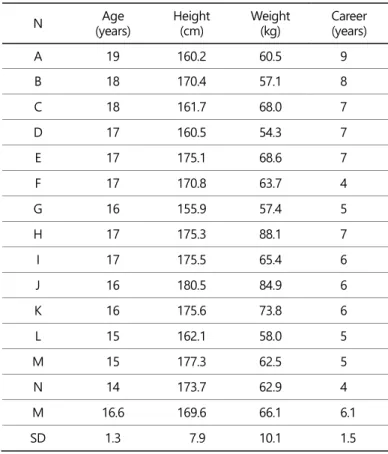
Table 1. General characteristics of the subjects
N Age
(years) Height
(cm) Weight
(kg) Career (years)
A 19 160.2 60.5 9
B 18 170.4 57.1 8
C 18 161.7 68.0 7
D 17 160.5 54.3 7
E 17 175.1 68.6 7
F 17 170.8 63.7 4
G 16 155.9 57.4 5
H 17 175.3 88.1 7
I 17 175.5 65.4 6
J 16 180.5 84.9 6
K 16 175.6 73.8 6
L 15 162.1 58.0 5
M 15 177.3 62.5 5
N 14 173.7 62.9 4
M 16.6 169.6 66.1 6.1
SD 1.3 7.9 10.1 1.5
weight training since it can influence body balance.
The experiments were conducted at the archery center of B High School located in Busan; the pretest was conducted on Monday, September 4, 2017, and the posttest was conducted on Tuesday, November 28, 2017. Each morning before the experiments, the sub- jects' height (cm) and body weight (kg) were measured on an empty stomach using InBody 4.0 (Biospace Co., Korea), which is a body com- position testing device. Table 1 summarizes the subjects' age, height, body weight, and experiences. No difference in age, height, or body weight was taken into account when selecting the subjects.
2. Experimental methods and tools
1) Foot plantar pressure analyzer (Gaitview AFA-50)
The distribution of foot plantar pressure was measured using a resis- tive pressure sensor analyzer Gaitview AFA-50 (Figure 1, alFOOTs Co., Korea). There are 2,304 pressure sensors in Gaitview AFA-50 in an area measuring 410×410×3 mm. By measuring the relative ratios between standing posture and load, Gaitview AFA-50 measures alignment during walking. The Gaitview Pro 1.0 software is used to analyze the collected data, and the maximum pressure is 100 N/cm2. The load imposed onto the measurement area by the body weight is used to calculate center and movement of body pressure, which are shown as relative color variations and numbers. Through body weight distribution, feedback training by pressing of the feet can be conducted. Moreover, quan- titative information on changes in weight movement and stability of posture can be acquired as follows:
(1) Envelope area (ENV)
The envelope area (ENV) is the external area of the trajectory of the center of pressure (COP) measured in mm2. Smaller ENV indicates better balance.
(2) Rectangular area (REC)
The rectangular area (REC), measured in mm2, is an area calculated with the maximum top, bottom, left, and right points of each frame. A smaller REC indicates better balance.
(3) Root mean square area (RMS)
The root mean square area (RMS) is obtained for each frame through the location and average of the COP. Through an algorithm used in the area frequently used for balancing, the area is calculated in mm2. A smaller RMS implies better balance.
(4) Total length from the COP (TLC)
The total length from the COP (TLC) is the sum of distances from an average point to the COP in each frame and measured in mm2. For the TLC, shorter lengths indicate better balance in the center of weight.
(5) Total length
The total length refers to the total distance travelled from the COP throughout the test and is measured in mm. For the total length, smaller
values imply relatively better balance.
(6) Sway Velocity
The sway velocity is obtained from the total length and test time and is measured in mm/s. For the sway velocity, lower velocities indicate relatively better balance.
(7) Unit envelope area length (length/ENV)
The unit envelope area length (length/ENV) is obtained as total trajectory/ENV. Higher length/ENV is indicative of better balance. The length/ENV is measured in 1/mm.
2) Analysis of dynamic balance of foot plantar pressure in shooting
In the experiment conducted to analyze dynamic balance of the foot plantar pressure, all subjects were asked to take off their shoes and socks and use the measurement device with bare feet for an accurate measurement. The subjects were also asked to warm up sufficiently before the experiment so that they can participate in a stable, com- fortable state. In order to measure dynamic balancing abilities while drawing and shooting arrows, postures were measured for 2 s from anchoring to follow-through after shooting, as shown in Figure 2. For an accurate measurement, each subject was asked to shoot 10 arrows from a distance of 60 m for middle-school archers and 70 m for high- school archers.
3) Analysis of static balance of foot plantar pressure with the eyes open and closed
Static balance of foot plantar pressure is an ability to maintain a standing posture on a fixed base of support against gravity (Ducan, Studenski, Chandler, Bloomfeld & Lapointe, 1990). The posture stability of the subjects was measured through foot pressure in a static state.
For the body static balance experiment, the subjects were asked to take off their shoes and socks and use the measuring device for foot plantar pressure balance with bare feet. As shown in Figure 3, the subjects stood Figure 1. Gaitview AFA-50
on the measurement surface with their feet shoulder-width apart while looking at the wall straight in the front, and measurements were made
for 20 s each with the eyes open and closed.
4) Analyzed phases and events
In this study, analyzed phases were divided into a total of 3 phases and 4 events, starting from E1, in which the drawing begins during set-up, until E4, in which follow-through ends. Figure 4 presents the phases and events of analyzed motions.
(1) Phases
① Phase 1: drawing (E1) → end of anchoring (E2)
② Phase 2: end of anchoring (E1) → shooting (E3)
③ Phase 3: shooting (E3) → end of follow-through (E4)
(2) Events
① Event 1: Set-up
② Event 2: Anchoring
③ Event 3: Shooting
④ Event 4: Follow-through
5) Measurement of archery records
For measurement of the records, 10 performances were measured at a distance of 60 m for middle-school archers and 70 m for high-school archers. For 1 performance measurement, 36 arrows (for a total score of 360) were shot.
(1) Middle-school archers
10 performances were measured at a distance of 60 m before and after the exercise program.
(2) High-school archers
10 performances were measured at a distance of 70 m before and after the exercise program.
6) Upright body type exercise program
The upright body type exercise program, which helps one to maintain a proper posture through skeletal and spinal alignment, can effectively relax tense muscles. This promotes smooth body movement and flexi- Figure 2. Analysis of dynamic balance of foot plantar pressure in
shooting
Figure 4. Event and phase
Figure 3. Analysis of static balance of foot plantar pressure with the eyes open and closed
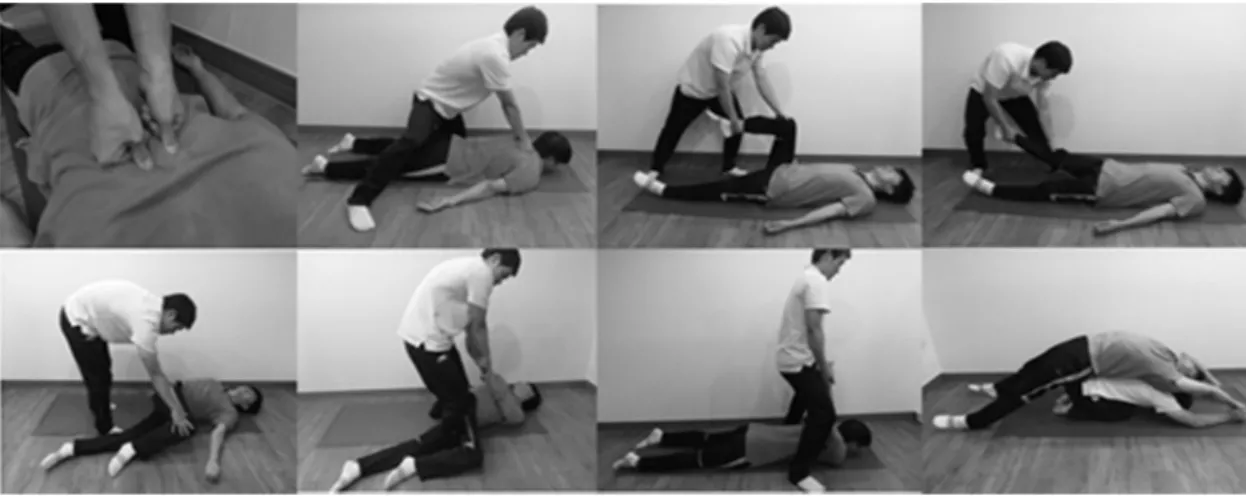
bility, which ultimately stabilize body balance and improve the circu- lation and cardiopulmonary function (Kim, 2013). The upright body type exercise program, which is a spinal stabilization exercise, was conducted for 12 weeks, 3 times a week, and for 60 min per session. The program was conducted at a rating of perceived exertion (RPE) of 11~12 for the
first 6 weeks (weeks 1~6) and at a higher RPE of 13~14 for the last 6 weeks (weeks 7~12). It is a paired exercise program in which the partici- pants exchange roles as shown in Figure 5. Table 2 summarizes the details of the upright body type exercise program.
Table 2. Experimental design for the study
Division Intensity Frequency Time Type
Warming up 3 times/week 10 min Flexibility exercises, stretching, massage
1-6-week program
Main exercises
RPE 11~12
Hip joint exercise (20 times)
40 min Both exercises (gym mate) After each exercise Stretch three times Pelvis exercise 1 (10 s)
Pelvis exercise 2 (3 min) Shoulder exercise (3 min)
Back exercise 1 (3 times) Neck exercise (3 times) Back exercise 2 (3 times)
Knee exercise (5 times) 7-12-week program
RPE 13~14
Hip joint exercise (20 times)
40 min Both exercises (gym mate) After each exercise Stretch three times Pelvis exercise 1 (10 s)
Pelvis exercise 2 (3 min) Shoulder exercise (3 min)
Back exercise 1 (3 times) Neck exercise (3 times) Back exercise 2 (3 times)
Knee exercise (5 times)
Cooling down Flexibility exercises, stretching, massage 10 min Flexibility exercises, stretching, massage Figure 5. Upright body type exercise
7) Data analysis
In order to verify the differences in experimental scores of middle- and high-school archers before and after participation in the upright body type exercise program, the following foot plantar pressure meas- urement data were analyzed: ENV, REC, RMS, total length, TLC, sway velocity, and length/ENV. For measurement of archery records, the same conditions as those used in real matches were used. The training arena was set to match the dimensions of an actual archery field. Moreover, a timer was set to allow 240 s for 6 arrows, flags were placed to measure the wind, and judges were asked to measure the performances.
For statistical analysis, paired t-tests were conducted using SPSS version 23.0. Statistical significance was set at α=.05.
RESULTS
The following section summarizes the results of paired t-tests con- ducted to investigate differences in each measured variable before and after the upright body type exercise program.
1. Test of pre- and posttest differences in analysis of dynamic balance of foot plantar pressure in shooting
When pre- and posttest differences in dynamic balance of foot plantar pressure in shooting were analyzed, all variables except length/ENV were found to be statistically different. Pretest ENV (44.25 ± 29.47) was greater than posttest ENV (37.84 ± 21.98), with the difference being statistically significant (t = .503, p =. 013). Pretest REC (145.40 ± 100.49) was greater than posttest REC (121.79 ± 80.68), and the difference was statistically significant (t = 2.287, p = .024). Pretest RMS (108.16 ± 66.52) was greater than posttest RMS (88.26 ± 62.25), with a statistically significant difference (t = 2.746, p = .007). Pretest TLC (222.31 ± 82.33) was greater than posttest TLC (166.66 ± 52.96), with a significant dif- ference (t = 7.077, p = .000). Pretest total length (52.96 ± 17.96) was greater than posttest total length (47.40 ± 19.31), with the difference being significant (t = 3.101 p = .002). Pretest sway velocity (26.51 ± 8.98) was greater than posttest sway velocity (23.72 ± 9.65), and the
difference was statistically significant (t = 3.102, p = .002). There was no statistically significant difference in length/ENV. Table 3 shows the detailed results.
2. Test of pre- and posttest differences in static balance of foot plantar pressure with the eyes open
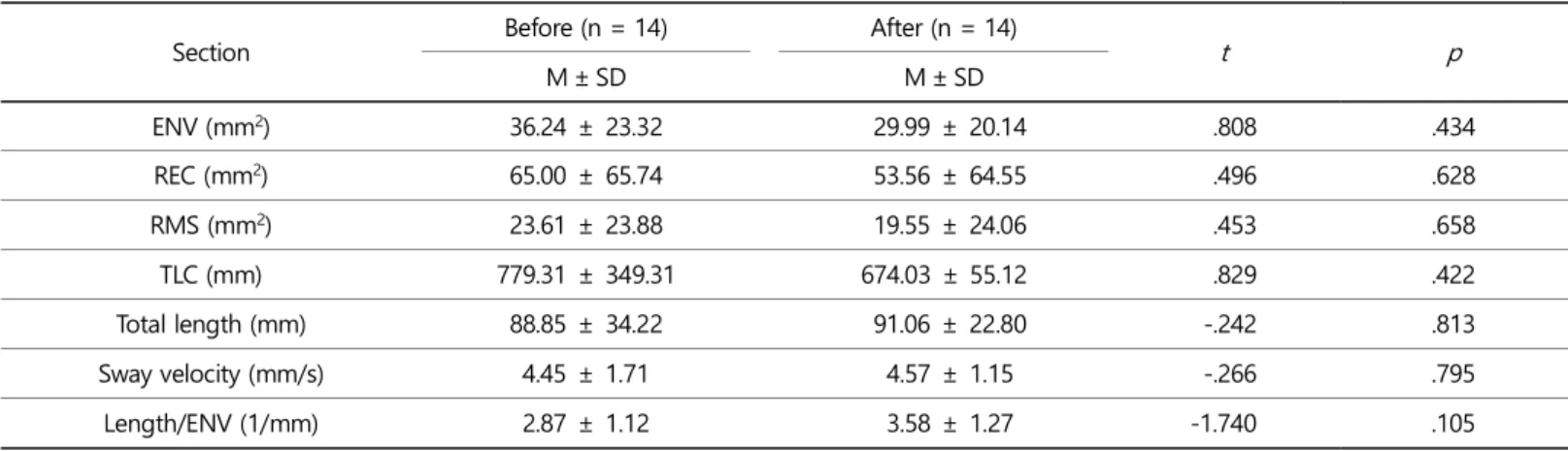
When pre- and posttest differences in static balance of foot plantar pressure measured with the eyes open were analyzed, no variable showed statistically significant differences. Table 4 shows the detailed results.
3. Test of pre- and posttest difference in static balance of foot plantar pressure with the eyes closed
When pre- and posttest differences in static balance of foot plantar pressure measured with the eyes closed were analyzed, all variables except length/ENV were found to be significantly different. Pretest ENV (46.69 ± 20.73) was greater than posttest ENV (29.73 ± 11.21), with a statistically significant difference (t = 3.417, p = .005). Pretest REC (79.31 ± 41.78) was greater than posttest REC (45.10 ± 23.26), and the difference was statistically significant (t = 3.957, p = .002). Pretest RMS (30.03 ± 27.92) was also greater than posttest RMS (14.41 ± 8.48), with the difference being statistically significant (t = 2.656, p = .020).
Pretest TLC (870.49 ± 308.75) was greater than posttest TLC (613.05 ± 177.26), and the difference was significant (t = 4.104, p = .001). Pretest total length (118.63 ± 45.40) was also greater than posttest total length (94.23 ± 30.82), with a significant difference (t = 2.970, p = .011). Pretest sway velocity (5.94 ± 2.27) was greater than posttest sway velocity (4.72 ± 1.52), and the difference was found to be statistically significant (t = 2.973, p = .011). There was no statistically significant difference in length/ENV. Table 5 shows the detailed results.
4. Test of pre- and posttest differences in archery records after the upright body type exercise program
When differences in archery records were analyzed, the records Table 3. Test of differences between pretest and posttest of dynamic balance of plantar pressure in archery shooting
Section Before (n = 14) After (n = 14)
t p
M ± SD M ± SD
ENV (mm2) 44.25 ± 29.47 37.84 ± 21.98 2.503* .013
REC (mm2) 145.40 ± 100.49 121.79 ± 80.68 2.287* .024
RMS (mm2) 108.16 ± 66.52 88.26 ± 62.25 2.746** .007
TLC (mm) 222.31 ± 82.33 166.66 ± 52.96 7.077*** .000
Total length (mm) 52.96 ± 17.96 47.40 ± 19.31 3.101** .002
Sway velocity (mm/s) 26.51 ± 8.98 23.72 ± 9.65 3.102** .002
Length/ENV (1/mm) 1.37 ± 0.32 1.33 ± 0.21 1.482 .141
*p < .05, **p < .01, ***p < .001.
were higher after the exercise program 323.39 ± 8.78) than before (322.53 ± 8.66), with the difference being statistically significant (t = -2.172, p = .032). Table 6 shows the detailed results.
DISCUSSION
1. Analysis of dynamic balance of foot plantar pressure at shooting
According to our findings regarding foot plantar pressure at shooting, ENV, REC, and RMS were lower after the exercise program than before, indicating that the pressure moved over a smaller area during measure- ment. Moreover, TLC, total length, and sway velocity were lower, meaning
that the COP moved over a shorter distance. Such results demonstrate that the upright body type exercise program lowered the foot plantar pressure, which also indicates that the body moved less during shooting.
However, there was no significant difference in length/ENV, which is calculated as the external area formed by the trajectory of the COP during measurement. Since the overlaps made by trajectories are not calculated during measurement, this would have led to greater measu- rements, thus resulting in nonsignificant differences.
In previous research conducted on archery and body balance, Gong, Jung, and Bae (2005) reported that the body balancing ability increased significantly in the group that performed trunk stabilization training than in the group that did not. Kim (2000) conducted 12 weeks of balancing training according to sprinter/skater pattern in 8 high-school archers.
Table 4. Test of differences between pretest and posttest of static balance of foot plantar pressure with the eyes open
Section Before (n = 14) After (n = 14)
t p
M ± SD M ± SD
ENV (mm2) 36.24 ± 23.32 29.99 ± 20.14 .808 .434
REC (mm2) 65.00 ± 65.74 53.56 ± 64.55 .496 .628
RMS (mm2) 23.61 ± 23.88 19.55 ± 24.06 .453 .658
TLC (mm) 779.31 ± 349.31 674.03 ± 55.12 .829 .422
Total length (mm) 88.85 ± 34.22 91.06 ± 22.80 -.242 .813
Sway velocity (mm/s) 4.45 ± 1.71 4.57 ± 1.15 -.266 .795
Length/ENV (1/mm) 2.87 ± 1.12 3.58 ± 1.27 -1.740 .105
*p < .05, **p < .01, ***p < .001.
Table 5. Test of differences between pretest and posttest of static balance of plantar pressure with the eyes closed
Section Before (n = 14) After (n = 14)
t p
M ± SD M ± SD
ENV (mm2) 46.69 ± 20.73 29.73 ± 11.21 3.417** .005
REC (mm2) 79.31 ± 41.78 45.10 ± 23.26 3.957** .002
RMS (mm2) 30.03 ± 27.92 14.41 ± 8.48 2.656* .020
TLC (mm) 870.49 ± 308.75 613.06 ± 177.26 4.104** .001
Total length (mm) 118.63 ± 45.40 94.23 ± 30.82 2.970* .011
Sway velocity (mm/s) 5.94 ± 2.27 4.72 ± 1.52 2.973* .011
Length/ENV (1/mm) 2.73 ± 0.72 3.39 ± 1.13 -1.684 .116
*p < .05, **p < .01, ***p < .001.
Table 6. Test of differences between pretest and posttest of archery record
Section Before (n = 14) After (n = 14)
t p
M ± SD M ± SD
Archery record 322.53 ± 8.66 323.39 ± 8.78 -2.172* .032
*p < .05, **p < .01, ***p < .001.
Upon analysis of shaking and pressure distribution across the body, the authors reported that the training influenced body balance and stability between anchoring and shooting.
Taking the previous findings and our findings together, archery is an exercise in which the aiming of the upper body and supporting of the lower body coordinate to improve static stability. Moreover, the info- mation on the movement and shaking of the body weight is used during archery to achieve stability of dynamic balance (Chung & Shin, 2005). The stability of dynamic balance of the body at shooting is known to be important in archery, along with the stability of the archery pos- ture of the upper limbs and the coordination between the stability of the base of support and supporting surface of the lower limbs. More- over, in the present study, the upright body type exercise program was found to be beneficial for dynamic balance of foot plantar pressure at shooting, confirming that the program is effective in improving body balance.
2. Analysis of static balance of foot plantar pressure with the eyes closed and open
Although no significant difference was found between foot plantar pressure measured with the eyes open before and after the exercise program, the pressure measured with the eyes closed was significantly lower after the program than before. As in the analysis of dynamic balance, the area formed by the trajectory of pressure decreased, and the distance travelled by the COP also decreased. This indicates that the body movement and disturbance with eyes closed decreased. No significant difference in length/ENV was noted, and this can also be interpreted similarly as in dynamic balance.
According to previous studies conducted on static balance, body balance is controlled by the central nervous system, which integrates centripetal information collected by the visual, vestibular, and somato- sensory systems and causes limb movements and reflexive regulation of the eyes (Bae & Kim, 2015; Lim, Na, Lee & Joon, 2003). Moreover, Horvat, Ramsey, Miszko, Keeney and Blasch (2003) reported that body balance is maintained primarily by visual feedback. Goldie, Evans and Bach (1992) reported that limiting or blocking the visual system de- creases the ability to regulate body balance and that postural distur- bance increases when vision is blocked. Moreover, Robert (1989) showed that vision is important in the regulation of body balance, reporting that postural disturbance increases and decreases when the vision is blocked and allowed, respectively.
Summarizing previous findings and our findings, disturbances in body balance decrease when the eyes are open, and vision plays a crucial role in regulating body balance. The results imply that the upright body type exercise program does not influence static balance when the eyes are open. In contrast, when body movements increase with the eyes closed, the upright body type exercise program can decrease distur- bances in body movement caused by closed eyes, thus promoting static balance of the foot plantar pressure.
3. Differences in archery records before and after the upright body type exercise program
The findings of this study confirm that the archery records are better after the exercise program than before. In a related study, Kim (1993) reported that body balance should be improved in archery since the body's center of gravity (COG) moves with vertical movements of the bow. Moreover, Kim (2008) investigated how 12 weeks of balancing training conducted according to sprinter/skater pattern in 12 female archers affected their postural regulation and shooting records. In their study, the authors reported that movements in the x- and y-axes of the body's COG decreased, leading to improved body balance. When changes in shooting records (6 shoots from 70 m) resulting from improved body balance were investigated, the posttest records (M ± SD = 8.64 ± 0.59) were found to be slightly better than the pretest records (M ± SD = 8.03 ± 1.06). Although the difference was not statistically significant, the authors reported that long-term training programs can improve archers' performance if their body balancing abilities and archery postures can be stabilized.
Linking the previous findings and our findings together, body balance can act as an important factor in improving archery performance.
Moreover, since the upright body type exercise program can improve dynamic and static balance of the body, it can improve the body balance, ultimately leading to improved archery records.
CONCLUSION
In the present study, a total of 14 archers in B Metropolitan City, including 2 male high-school archers, 6 female high-school archers, 5 male middle-school archers, and 1 female middle-school archer, were selected as the subjects. After 12 weeks of the upright body type exercise program, the archers' body balance and archery records were com- pared to those measured before the program, and the following con- clusion was obtained.
The upright body type exercise program was effective in decreasing body movement and improving the body balance. In particular, it improved the dynamic balance of foot plantar pressure at shooting and static balance of foot plantar pressure with the eyes closed. Such stabilization of static and dynamic balance was found to improve archery records.
The present study confirmed that the upright body type exercise program influences archers' actual performance by improving body balance. Thus, we expect that the upright body type exercise program can be incorporated into training programs to improve archery records.
REFERENCES
Akuthota, V. & Nadler, S. F. (2004). Core strengthening. Arch Phys Med Rehabil, 85(3 Suppl 1), S86-92.
Bae, S. W. & Kim, J. I. (2015). Change the balance function with aging using computerized dynamic posturography. The Exercise Science, 12(4), 747-758.
Cha, S. C., Kim, C. G., Jo, S. W. & Lee, I. S. (2003). A Study on the Sports
Injuries of Athletes Who Had Visited Oriental Medical Clinic in Athletes' Village at the 14th Busan Asian Games and Oriental Medical Treatment. Journal of Oriental Rehabilitation Medicine, 13(4), 131-145.
Cho, D. S. J. (2010). Analysis of Basic Fitness, Body Composition and Foot Balance of Women in their Twenties according to Pilates Mate Exercise. Unpublished doctoral dissertation, Graduate School of WonKwang Univercity.
Choi, Y, S. (2013). The Effect of Sports Massage and Taping Treatments on Archery Records. Unpublished master thesis, Graduate School of Keimyung University.
Choi, Y. T. (2000). The Analysis of Power And Endurance of Leg in Score Player. Journal of Educational Theory and Practice, 10(1), 385-399.
Chung, C. S. & Shin, I. S. (2005). Introduction to sports biomechanics.
[Seoul]: Daehan Media, 2011.
Dowling, A. M. (2001). Does obesity affect foot structure and function, foot sensation and plantar pressure distribution in children. Un- published Master of Science (Honours) Thesis. NSW Australia:
Department of Biomedical Science, University of Wollongong.
Duncan, P. W., Studenski, S., Chandler, J., Bloomfeld, R. & Lapointe, L. K.
(1990). Electromyographic analysis of postural adjustments in two methods of balance testing. Journal of Physical Therapy, 70(2), 88 -96.
Eric franklin, B. (2005).Clinical measurement of postural control in adults.
Physical Therapy, 67(12), 1881-1885.
Goldie, P. A., Evans, O. M. & Bach, T. M. (1992). Steadiness in one-lehhed stance: Development of a reliable force platform testing procedure.
Arch Phys Med Rehabil, 73,348-354.
Gong, W. T., Jung, Y. W. & Bae, S. S. (2005). The Effects of Sacroiliac Joint Mobilization and Lumbopelvic Stabilizing Exercises on the Equilib- rium Ability. The Journal of Korean Society of Physical Therapy, 17(3), 285-295.
Heo, J. S. (2003). The Effects of Physical Fitness of Archers on the Scores in Archery Game. Korea Sport Research, 14(5), 1631-1645.
Horvat, M. C., Ramsey, V. K., Miszko, T., Keeney, R. & Blasch, B. B. (2003).
Compensatory analysis and strategies for balance in individuals with visual impairments. Journal of Visual Impairment & Blindness, 97(11), 695-703.
Jahss, M. H. (1982). Disorders of the foot. USA, philadelphia: W. B Saunders Company.
Jang, Y. S. (2006). (A) Study on Development of Archery Training Mana- gement System & Field Application. Unpublished doctoral disser- tation, Graduate School of Myongji University.
Jo, D. S. J. (2010). Analysis of Basic Fitness, Body Composition and Foot Balance of Women in their Twenties according to Pilates Mate Ex- ercise. Unpublished master' thesis, Graduate School of Wonkwang University.
Jung, S. Y., Nam, H. J., Hong, D. S., Lee, J. H., Kim, J. K. & Nho, H. S.
(2013). A Comparison of balance activity and body alignment by sports type in unilateral exercise athletes. The Korean Journal of Physical Education, 52(1), 431-442.
Kim, B. H. (2010). The Effects of Self-monitor Training on the Psycho- logical States during the Archery Field Training and Event. Korean
Society of Sport Psychology, 21(2), 47-61.
Kim, K. C., Ryu, J. S. & Yun, H. J. (1993). A study of relationship between body stability and a bow stability. The Research Institute of Physical Education & Sports Science, 12(1), 13-19.
Kim, K. C. (1999). The Role of Mental State in Archery Games. Korean National University of Physical Education, 22(1), 116-124.
Kim, K. C. (2007). Exploration of Tension in Archery. The Korea Sport Research, 18(1), 337-348.
Kim, D. K. (2016). Effects of upright body type exercise on archers' shooting motion analysis, foot plantar pressure, body alignment and ANS. Unpublished doctoral dissertation, Graduate School of Silla University.
Kim, J. H. & Kim, H. Y. (2005). Kinematic analysis on the release move- ment for expert archers. The Korean Journal of Physical Education, 25(4), 415-424.
Kim, J. P. (2000). The Correlation of the Physical Stability and the Per- formance of Archers in Non-shooting and Shooting. Korean Journal of Sport Biomechanics, 18(2), 65-74.
Kim, J. P. (2008). The Effect of Balance Exercise on Postural Control and Shooting Record in Archers. Korean Journal of Sport Biomechanics, 18(2), 65-74.
Kim, E. S. (2013). Utilization of Sport Biomechanics for the Correct Pos- ture Exercise Program: Centering in Female Middle School Students.
Unpublished doctoral dissertation, Korean Journal of Sport Bio- mechanics, 23(3), 261-269.
Kim, E. S. (2015). Effects of the probody massage on the physiological variables, gross motor function and ROM in youth with cerebral palsy: case study. Unpublished doctoral dissertation, Graduate School of Silla University.
Kisner, C. & Colby, L. A. (2012). Therapeutic Exercise. Foundations and Techniques.
Korea, A. A. (2011). Archery = Theory and the actual fighting. [Seoul]:
Korea Archery Assoclation, 2011.
Kwon, W. R., Lee, J. H. & Park, E. Y. (2006). The effects of Iumbar exercise program on pain relief and muscle function for patients with the chronic low back pain. Korea Sports Science, 45(2), 527-536.
Lee, B. K., Choi, Y. H. & Kim, C. K. (2010). The Effects of Asymmetric Exercise of Athletes on the structure of the Spine. Journal of Sport and Leisure Studies, 41(2), 753-761.
Lee, E. K. (2011). (The) development of a psychological skills scale for elite archery. Unpublished doctoral dissertation, Graduate School of Korea University.
Lim, K. B., Na, Y. M., Lee, H. J. & Joo, S. J. (2003). Comparison of Postural Control Measures between Older and Younger Adults Using Balance Master System. Annals of Rehabilitation Medicine, 27(3), 21-423.
Okuda, K., Abe, N., Katayama, Y., Senda, M. & Kuroda, T. (2005). Effect of vision on postural sway in anterior cruciate ligament injured knees.
Journal of Orthopedic Science, 10(3), 277-283.
Park, J. S., Song, S. H. & Lee, H. S. (2015). Effects of Passive Body Alignment Exercise on Regional Malalignment and Foot Pressure in Male Adolescents. The Official Journal of Korean Society of Dance Science, 32(3), 143-154.
Robert, B L. (1989). Effects of walking on balance among elders. Research,
38, 180-183.
Shin, S. S. & Song, C. H. (2007). Clinical Article : The Effect of Lumbar Stabilization Exercise on the Static Balance of Adolescent Idiopathic Scoliosis. The Korean Journal of Sports Medicine, 25(2), 165-173.
Son, N. Y. (2014). Effects of the upright body type exercise program on pastures and foot balance in female high school students. Un- published doctoral dissertation, Graduate School of Silla University.
Son, N. Y. (2016). Effects of the probody massage on physical char- acteristics, body alignment and foot plantar pressure balance in middle-aged women with musculoskeletal diseases. Unpublished doctoral dissertation, Graduate School of Silla University.
Woo, K. H. (2016). Effects of the upright body type excercise program on posture, Muscle Strength of leg, lung capacity and depression in people with mental illness. Unpublished doctoral dissertation, Graduate School of Silla University.
Yi, J. H., Hah, C. K., Ryu, J. S. & Kim, K. C. (2007). Evaluation on Motion
Features of the World's Second Archer during Back-Tension in Archery.
Yoo, H. N., Lee, M. G. & Sung, S. C. (2009). Comparison of figures of the vertebra and pelvis by sports type in collegiate athletes. Korean Journal of Physical Eduaction, 48(1), 411-421
Yoon, H, J., Ryu, J. S. & Kim, K, C. (1993). A study of relationship between body stability and a bow stability. The Research Institute of Physical Education & Sports Science, 12(1), 13-19.
Yoon, M. J. & Kim, K. J. (2012). Effects of 8 Weeks Pilates for the Body Balance, Posture and Pain in Players of Tennis, Archery, and Athletics.
The Official Journal of the Korean Association of Certified Exercise Pofessionals, 14(3), 103-113.
Yun, Y. K. & Kim, W. B. (2004). Analytic Hierarchy Process to examine psychological factors influencing football performance. Korean Journal of Sport Biomechanics, 17(3), 197-207.