INTRODUCTION
World-class Korean archers exhibit no unnecessary motion that can interfere with athletic performance, and maintain posture through con- sistency of motion and body stability (Heo, 2003). To improve archery technique, optimal body balance and force distribution, and control of breathing and heart rate are required, and these factors directly affect athletic performance (Kim, 2000; Kim & Kim, 2005). Imbalance of the body causes improper distribution of forces between bow arm and draw arm during bow extending in archery, resulting in inaccurate shooting (Korea Archery Association, 2011). It has been reported that archers can improve shooting efficiency through development of trunk muscles with improvement in body stability and motion (Yoon & Jung, 2002), and higher scores in archery can be achieved when all physical, mental, and physiological parameters are in simultaneous balance (Choi, 2013).
Many countries in Europe and Asia have recruited Korean archery coaches to provide systematic and scientific training, with the result that
performance levels of archers throughout the world have gradually become equal. As a result, Korean archery has to recognize the training limitations of focus on physical fitness and technique, and must intro- duce new training methods based on the existing framework (Lee, 2011;
Jang, 2006; Heo, 2003). Factors in archery such as repetitive movements and overload on the arms cause pains in the shoulder, neck, and low back. In addition, prolonged exercise in a unilateral posture can cause imbalance between the left and right muscles of the body (Yoon & Kim, 2012). Spinal imbalance often occurs in events such as archery, which impose unilateral forces on the spine. Incorrect coaching and excessive training of archers results in undesirable asymmetrical posture, so that most archers have postural imbalance (Kim, 2008).
A comparison of bilateral and unilateral sports found that athletes in unilateral events had structural deformations of the spine and pelvis, with differences in spine curvature, pelvic slope, slope of bilateral trunk curvature, and trunk rotation (Lee, Choi, & Kim, 2010). Pelvic shapes of collegiate athletes were compared by event using a 3-dimensional
KJSB
http://dx.doi.org/10.5103/KJSB.2016.26.3.285http://e-kjsb.org eISSN 2093-9752
ORIGINAL
The Effects of the Upright Body Type Exercise Program on Foot Plantar Pressure of Archers
Dong-Kuk Kim1, Joong-Sook Lee2
1Department of Physical Education, Graduate School of Silla University, Busan, South Korea
2Department of Kinesiology, College of Health and Welfare, Silla University, Busan, South Korea
Received : 10 August 2016 Revised : 19 September 2016 Accepted : 23 September 2016
Corresponding Author Joong-Sook Lee
Department of Kinesiology, College of Health and Welfare, Silla University, 140, Baekyang-daero 700beon-gil, Sasang-gu, Busan, 46958, South Korea
Tel : +82-51-999-5064 Fax : +82-51-999-5576 Email : [email protected]
Objective: This study collected data on muscle fatigue and ground reaction force during walking to provide a basis for development of custom-fitted outdoor walking shoes. The study analyzed an upright body exercise program using spine stabilization technique to determine the effect on foot plantar pressure in archers, demonstrate the effectiveness of upright body exercise, and develop a new, effective, and efficient training program.
Method: A 12-week upright body exercise program was evaluated for the effect on plantar pressure in archers.
Ten prize-winning archers (3 men, 7 women) in B metropolitan city, each with ≥10 years of experience, were given an explanation of the content and purpose of the program, and provided informed consent.
Upright body exercise was performed 3 times a week for 12 weeks. A resistive pressure sensor was used to measure foot plantar pressure distribution and analyze quantitative information on variation in postural stability and weight shifting in dynamic balance during shooting, as well as plantar pressure in static balance with the eyes open and closed.
Results: There were no significant differences in foot plantar pressure before and after participation in the exercise program. There was no statistically significant difference in foot plantar pressure in static balance with the eyes open or closed, or in foot plantar pressure in dynamic balance during shooting.
Conclusion: An upright body exercise program had positive effects on foot plantar pressure in static and dynamic balance in archers by reducing body sway and physical imbalance during shooting and with eyes closed. This program is expected to help archers improve their posture and psychological state, and thereby improve performance.
Keywords: Shooting, Upright body exercise program, Foot plantar pressure, Static balance, Dynamic balance
image analyzer, which found that archers showed the greatest changes in the anterior and posterior trunk, slope angle, and length of pelvic slope (Yoo, Lee, & Sung, 2009). The bodies of athletes comprised 6 hook-type kinematic chain structures including the neck, back, low back, pelvis, knees, and ankles. If the feet are weight-loaded at the bottom and fail to move appropriately, the chain structure is affected, gradually resulting in body imbalance. Thus, body balance and foot structure are closely related, and abnormality in foot structure inevitably results in body imbalance (Son, 2014; Jo, 2010). Since muscles on the less-used side of the body become weak, repeated loading of body weight on one leg results in weakness of muscles in the other leg and hyper- trophy of muscles in the leg with body weight-loading, leading to liga- ment damage and muscle spasticity. These cause imbalance in the lower extremities, making it difficult to maintain upright posture (Kwon, Lee,
& Park, 2006).
Archers repeatedly train a unilateral side for prolonged duration, and this excessive training can cause issues in body alignment. In fact, many archers fail to maintain correct posture in the field, which indicates that repeated training in unilateral events can have negative effects on main- tenance of correct posture (Kim, 2008; Jung et al., 2013). Poor balance caused by spinal imbalance can be accompanied by a deficit in sense of direction, emotional instability, impulsivity, and distractibility (Kim, 2004; Shin & Song, 2007).
An upright body exercise program was developed to comprehensively enhance effectiveness of joints, bones, and muscles, and to maintain upright body position through alignment of the skeletal system and spine based on clinical investigation of 12,000 subjects over 6 years, from 2009 to March 2014 (Kim, 2015). The program is effective for align- ment of the skeletal system and movement and flexibility of the body through maximization of range of motion in joints and relaxation of stiffened muscles. The program also includes cervical spine alignment and stabilizes body balance through relaxation of joints and muscles in the spine; thus, it is a highly effective spine stabilization exercise pro- gram that can enhance blood circulation and improve cardiopulmonary function (Kim, 2015).
The present study aimed to demonstrate the effects of the upright body exercise program and to use the program as a basis for a new, effective, and efficient training technique. This study demonstrated improved motor control ability in the arms of archers through appli- cation of the upright body spine stabilization exercise program, and analyzed the effects of improved stability in body balance on foot plantar pressure.
METHOD
In the present study, archers performed the upright body spine stabili- zation exercise program for 12 weeks, and then the effects on plantar pressure were analyzed. The exercise program was applied 3 times a week for 12 weeks, in which exercise intensities were set at Rated Per- ceived Exertion (RPE) 11~12 during weeks 1~6 and at RPE 13~14 during weeks 7~12. The following participants, experimental equipment, experi- mental process, and data processing were components of the study for the analysis of plantar pressure in archers during shooting, before and
after the program.
1. Participants
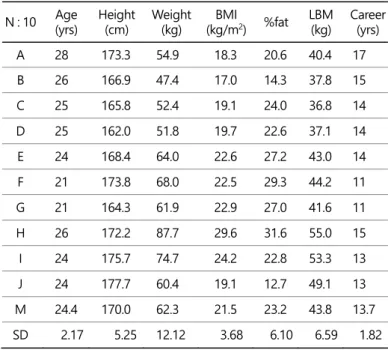
Participants included 10 archers (3 adult males, 4 adult females, and 3 collegiate females) from B metropolitan city, each with at least 10 years of archery experience. Before the study, all participants were given full explanations about the contents and objective, and provided signed informed consent. Body weight (kg), body mass index (BMI), body fat percentage (%), and lean body mass (LBM) (kg) were measured by using IN-Body 3.0 (Bio-Space Co., Korea). General characteristics of the participants are shown in (Table 1).
2. Experimental methods and equipment 1) Plantar pressure and balance analyzer
Gaitview AFA-50 (alFOOTs, Korea), an analyzer with a resistive pres- sure sensor, was used to measure distribution of foot plantar pressure.
Gaitview AFA-50 (Figure 1) has 2,304 pressure sensors distributed within 410 × 410 × 3 mm and was used to measure alignment state during gait, standing posture, and level of load as relative ratios, and the col- lected data were analyzed with the Gaitview pro 1.0 software, with maxi- mum pressure measurement up to 100 N/cm2. While body weight was loaded on the measuring stage, shift and center of body pressure were presented in relative values and colors depending on loading, and body weight distribution by foot pressure enabled feedback training. Thus, quantitative information about shifts in body weight and changes in stability of posture could be obtained as follows:
Table 1. General characteristics of the subjects N : 10 Age(yrs) Height
(cm) Weight (kg) BMI
(kg/m2) %fat LBM
(kg) Career (yrs)
A 28 173.3 54.9 18.3 20.6 40.4 17
B 26 166.9 47.4 17.0 14.3 37.8 15
C 25 165.8 52.4 19.1 24.0 36.8 14
D 25 162.0 51.8 19.7 22.6 37.1 14
E 24 168.4 64.0 22.6 27.2 43.0 14
F 21 173.8 68.0 22.5 29.3 44.2 11
G 21 164.3 61.9 22.9 27.0 41.6 11
H 26 172.2 87.7 29.6 31.6 55.0 15
I 24 175.7 74.7 24.2 22.8 53.3 13
J 24 177.7 60.4 19.1 12.7 49.1 13
M 24.4 170.0 62.3 21.5 23.2 43.8 13.7
SD 2.17 5.25 12.12 3.68 6.10 6.59 1.82
(1) Envelope area (ENV)
Envelope area indicates area of the envelope along the length of the center of pressure, measured in mm2. A smaller ENV area indicates better balance.
(2) Rectangle area (REC)
Rectangle area indicates rectangular area measured through the maximum lengths to the left and right, and from top to bottom at the center of pressure (COP) in each frame, measured in mm2. A smaller REC indicates better balance.
(3) Root Mean Square area (RMS)
RMS area means area calculated from the position values of the COP in each frame and its mean value, and was calculated with an algorithm for relatively more frequent positions, measured as mm2. A smaller RMS also indicates better balance.
(4) Total Length from COP (TLC)
TLC is the sum of lengths from an average position to COP in each frame, measured as mm2. In TLC, a shorter distance moved from the center of gravity indicates better balance.
(5) Total length
Total length is the sum of distances moved from COP during the test period, measured in mm. A shorter Total Length indicates relatively better balance.
(6) COP speed (Sway Velocity)
Sway velocity indicates total length and test period, measured as mm/s. A lower sway velocity indicates relatively better balance.
(7) Length of unit envelope area (Length/ENV)
This is calculated as total length/envelope area, with the value in- creasing as sway becomes more stable. The unit of measure is 1/mm.
2) Analysis of plantar pressure in static balance with eyes open or closed (Figure 2)
Balance of plantar pressure requires the ability to maintain a standing
posture against gravity in a space on a fixed basal plane. Posture stability was measured through foot pressure in a static state. In order to ex- amine plantar pressure in static balance, participants stood barefoot on the stage of the plantar pressure and balance analyzer, with the feet shoulder-length apart and facing straight ahead, followed by measure- ments 2 times each with the eyes closed or open. When the eyes were opened, participants were instructed to look only at the wall to the front, and measurements were made after they fixed their gaze on the wall.
Each experiment required 20s.
3) Analysis of plantar pressure in dynamic balance during archery shooting (Figure 3)
For accurate measurements of plantar pressure in dynamic balance, all participants stood barefoot on the analyzer. After a full warm-up, they were measured in a comfortable and stable state. For measurement of dynamic balance ability during shooting, postures from anchoring to follow through after shooting, corresponding to phases 2 and 3, were measured for 2s, and each participant shot 12 arrows for accurate measurements.
Figure 1. Gait View AFA-50.
Figure 2. Analysis of foot plantar pressure in static balance of with the eyes open and closed.
Figure 3. Analysis of foot plantar pressure in dynamic balance during shooting.
4) Events and phases
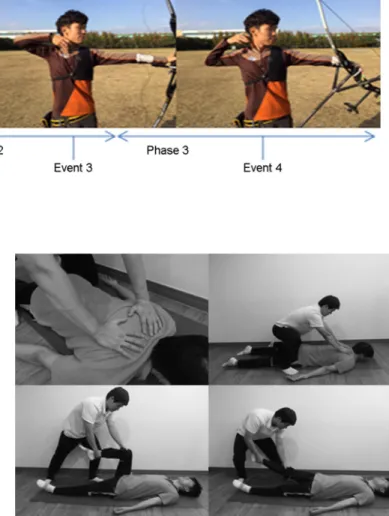
Analysis in the present study was performed for a total of 4 events and 3 phases, ranging from E1, between set-up and beginning of drawing, to E4, corresponding to end of follow-through. (Figure 4) shows events and phases of analyzed movements.
(1) Events
① Event 1: set-up
② Event 2: anchoring
③ Event 3: shooting
④ Event 4: follow-through
(2) Phases
① Phase 1: beginning of drawing (E1) - end of anchoring (E2)
② Phase 2: end of anchoring (E1) - beginning of shooting (E3)
③ Phase 3: beginning of shooting (E3) - end of follow-through (E4)
5) The upright body exercise program
This exercise program helps maintain upright posture through align- ment of the spine and skeletal system, and effectively relaxes stiffened muscles; this maximizes range of motion in joints and improves align- ment of the skeletal system, making it highly-effective for improvement of cardiopulmonary function and blood circulation, with stabilization of body balance for flexibility and smooth movement (Kim, 2013).
This upright body spine stabilization exercise program was applied 3 times a week for 12 weeks, 60 min per session; exercise intensity was set at RPE 11~12 during weeks 1~6 and at RPE 13~14 during weeks 7~12. It was performed as a partner exercise with 2 people, and with each switching roles, as shown in (Figure 5); the contents of the exercise program are shown in (Table 2).
3. Data processing
To determine differences in scores of archers before and after the ex- ercise program, the balance data including ENV, REC, RMS, Total Length, Sway velocity (COP speed) and Length/ENV were analyzed statistically.
A paired t-test was applied in statistical analysis using IBM SPSS Statistic Ver. 23.0 (IBM Co., Armonk, NY, USA), with statistical significance level
set as α=.05.
RESULTS
Group variables were set for before and after the upright body exercise program, and improvement was measured by the change in scores after compared to before the program; a paired t-test showed the following:
1. Test of differences in plantar pressure in static balance with the eyes open, before and after the program
When static balance was analyzed before and after the program, all measured factors showed no statistically significant differences, with the significance level set at α=.05 in (Table 3).
2. Test of differences in plantar pressure in static balance with the eyes closed, before and after the program
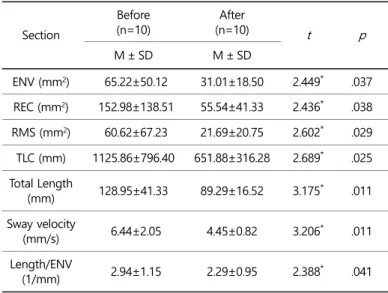
When plantar pressure in static balance with the eyes closed was analyzed before and after the program, all factors showed statistically significant differences, with the significance level set at α=.05. ENV was Figure 4. Events and phases.
Figure 5. Upright body exercise.
lower after (31.01 ± 18.5) the program than before (65.22 ± 50.13), with a statistically significant difference (t=2.449, p=.037). REC was lower
after (55.54 ± 41.33) the program than before (152.98 ± 138.52), with a statistically significant difference (t=2.436, p=.038). RMS was lower after (21.69 ± 20.756) the program than before (60.62 ± 67.234), with a statistically significant difference (t=2.602, p=.029). TLC was lower after (651.88 ± 316.28) the program than before (1125.86 ± 796.41), with a statistically significant difference (t=2.689, p=.025). Total Length was lower after (89.29 ± 16.53) the program than before (128.95 ± 41.34), with a statistically significant difference (t=3.175, p=.011). Sway velocity was lower after (4.45 ± 0.83) the program than before (6.44
± 2.06), with statistically significant difference (t=3.206, p=.011). Length/
ENV was lower after (2.297 ± 0.957) the program than before (2.94 ± 1.15), with a statistically significant difference (t=2.388, p=.041) in (Table 4).
3. Test of differences in plantar pressure in dynamic balance during archery shooting, before and after the program
When differences in dynamic balance during archery shooting were tested before and after the program, all factors showed statistically significant differences, with significance level set at α=.05. ENV was lower after (24.81 ± 7.012) the program than before (34.942 ± 13.727), Table 3. Test of differences in plantar pressure in static balance with
the eyes open, before and after the program
Section
Before
(n=10) After
(n=10) t p
M ± SD M ± SD
ENV (mm2) 33.67±19.58 32.01±11.59 .318 .758 REC (mm2) 61.02±42.09 57.27±36.05 .359 .728 RMS (mm2) 27.25±21.83 25.61±17.96 .307 .766 TLC (mm) 828.47±321.3 819.74±317.71 .089 .931 Total Length
(mm) 77.61±23.64 81.97±23.95 -.482 .641 Sway velocity
(mm/s) 3.88±1.17 4.11±1.19 -.505 .625 Length/ENV
(1/mm) 2.65±0.76 2.74±0.75 -.297 .774 Table 2. Experimental design for the study
Division Intensity Frequency Time Type
Warming up 3 times/week 10 min Flexibility exercises, stretching, massage
Weeks 1~6
RPE 11~12
Hip joint exercise (20 times)
40 min Both exercise (Gym mate) After each exercise
Stretch 3 times Pelvis exercise 1 (10 s)
Pelvis exercise 2 (3 min) Shoulder exercise (3 min)
Back exercise 1 (3 times) Neck exercise (3 times) Back exercise 2 (3 times)
Main exercises Knee exercise (5 times)
Weeks 7~12
RPE 13~14
Hip joint exercise (20 times)
40 min Both exercise (Gym mate) After each exercise Stretch three times Pelvis exercise 1 (10 s)
Pelvis exercise 2 (3 min) Shoulder exercise (3 min)
Back exercise 1 (3 times) Neck exercise (3 times) Back exercise 2 (3 times)
Knee exercise (5 times)
Cooling down Flexibility exercises, stretching, massage 10 min Flexibility exercises, stretching, massage
with a statistically significant difference (t=2.302, p=.047). REC was lower after (88.291 ± 36.526) the program than before (155.898 ± 114.765), with a statistically significant difference (t=2.430, p=.038). RMS was lower after (57.394 ± 29.744) the program than before (113.346 ± 60.798), with a statistically significant difference (t=3.087, p=.013). TLC was lower after (123.194 ± 35.632) the program than before (173.472
± 47.73), with a statistically significant difference (t=3.772, p=.004). Total Length was lower after (32.088 ± 7.185) the program than before (44.39
± 16.207), with a statistically significant difference (t=2.450, p=.037).
Sway velocity was lower after (16.146 ± 4.006) the program than be- fore (22.699 ± 9.284), with a statistically significant difference (t=2.276, p=.049). Length/ENV was lower after (1.332 ± 0.102) the program than before (1.421 ± 0.115), with a statistically significant difference (t=3.765,
p=.004) in (Table 5).
DISCUSSION
1. Analysis of plantar pressure in static balance with the eyes open or closed
In a preceding study, Robert (1989) reported that exercise improved balance, and postural sway decreased with the eyes open, suggesting that vision should be more critical in balance control, based on restric- tion and interference with eyesight.
Paulus, Straube, & Brandt (1984) reported that there was less differ- ence between body balance and postural sway with the eyes open, and Horvat, Ramsey, Miszko, Keeney, & Blasch (2003) reported that main- tenance of body balance primarily depends on visual feedback. Gong, Jung, & Bae (2005) applied a lumbopelvic stabilizing exercise to normal participants in their 20s, and the exercise group had greatly improved body balance ability compared to the group without exercise. Okuda, Katayama, & Senda (2005) applied visual interference in patients, and found that blocking of visual information resulted in a higher rate of postural sway, regardless of gender.
Lee, Kim, & Lee (2010) also applied a lumbar stabilization exercise in 10 patients with lumbar and foot malalignment, and observed significant improvement in the misaligned lumbar spine and feet. These corrective results were due to cooperation between the lumbar spine and the feet.
Choi & Noh (2011) applied 6 weeks of proprioceptive neuromuscular facilitation (PNF) exercise in participants in their 20s with malalignment syndrome; the result was not only enhanced force and a higher impulse during gait, but also reduction of differences in plantar pressure between the left and right sides, with greater stability.
In both preceding studies and the present study, sway in body bal- ance decreased with the eyes open, and vision was more important in body balance control. Evaluation of archers before and after the upright exercise program consistently found that there was no effect on plantar pressure in static balance according to body sway with the eyes open.
On the contrary, sway of body balance increased with the eyes closed, and blocking of visual information affected the ability to maintain static balance. Therefore, upright body exercise was effective for plantar pres- sure in static balance in archers with the eyes closed. This suggested that archers should be able to improve body movement and stability in static balance through the upright body exercise program; this would be help- ful for improvement of efficiency and athletic performance in shooting, because archers have postural imbalance due to movement patterns that use major lower extremity joints and muscles on only one side.
2. Analysis of plantar pressure in dynamic balance during shooting in archery
In a preceding study by Son (2012), taekwondo poomsae athletes had a lower degree of sway in dynamic balance (one leg standing after obstacle jump) after training compared to non-athletes.
Kim (2000) applied balance training in a sprinter/skater pattern for 12 weeks in 8 high school archers, and measured body balance; training Table 4. Test of differences in plantar pressure in static balance with
the eyes closed, before and after the program
Section
Before
(n=10) After
(n=10) t p
M ± SD M ± SD
ENV (mm2) 65.22±50.12 31.01±18.50 2.449* .037 REC (mm2) 152.98±138.51 55.54±41.33 2.436* .038 RMS (mm2) 60.62±67.23 21.69±20.75 2.602* .029 TLC (mm) 1125.86±796.40 651.88±316.28 2.689* .025 Total Length
(mm) 128.95±41.33 89.29±16.52 3.175* .011 Sway velocity
(mm/s) 6.44±2.05 4.45±0.82 3.206* .011 Length/ENV
(1/mm) 2.94±1.15 2.29±0.95 2.388* .041
*p<.05
Table 5. Test of differences in plantar pressure in dynamic balance during archery shooting, before and after the program
Section
Before
(n=10) After
(n=10) t p
M ± SD M ± SD
ENV (mm2) 34.94±13.72 24.81±7.01 2.302* .047 REC (mm2) 155.89±114.76 88.29±36.52 2.430* .038 RMS (mm2) 113.34±60.79 57.39±29.74 3.087* .013 TLC (mm) 173.47±47.73 123.19±35.63 3.772** .004 Total Length
(mm) 44.39±16.20 32.08±7.18 2.450* .037 Sway velocity
(mm/s) 22.69±9.28 16.14±4.00 2.276* .049 Length/ENV
(1/mm) 1.42±0.11 1.33±0.10 3.765** .004
*p<.05, **p<.01
was found to affect stability of body balance from anchoring to release, based on results of pressure distribution and sway factors. In a study by Jo (2010), woman participants in their 20s performed a Pilates mat exercise composed of 16 moves for the upper and lower body, and had improved postural stability in static foot balance. Gong, Jung, & Bae (2005) reported that a group with a lumbopelvic stabilization exercise had greater balancing ability than a group without the exercise.
Based on all the study results, archery is an event that not only uses supporting ability of the lower extremities and a sequence of coord- ination from aiming to shooting, but also requires stability for fine dynamic movement for improvement of athletic performance. Kim (1993) reported that since the center of the body moves along with the up and down movement of the bow during shooting in archery, stability in body balance should be enhanced. Kim (2008) reported that body sway in shooting was reduced by balance training of archers, thus helping to improve scoring; the present study also found that the upright body exercise was effective for plantar pressure in dynamic balance during shooting. Thus, stability in dynamic balance during shooting on a sup- porting surface and a stable basal plane is an important factor, along with coordination between the upper and lower extremities. Therefore, the upright body exercise program reduced sway of plantar pressure in dynamic balance during shooting in archery.
CONCLUSION
The present study assessed 10 participants archers, who performed an upright body exercise program for 12 weeks, and the effects on plantar pressure before and after the program were evaluated, with conclusions as follows:
The type exercise program decreased body sway and increased stability of body balance, with positive effects on plantar pressure in static balance with the eyes closed, and in dynamic balance during shooting in archery. Use of the upright body exercise program should be helpful in improving performance of archers through postural cor- rection, psychological stabilization, and improved body alignment and balance stability. Further study on the effects of the exercise program with regard to archery scores should be performed in the future.
ACKNOWLEDGEMENTS
This study was excerpted from the doctoral thesis of Dong-Kuk Kim in 2016.
REFERENCES
Choi, J, W. & Noh, H. J. (2011). The Influence of Trunk Rotation Exercise and PNF Exercise on Gait in the Individuals with Malalignment Syn- drome. Korea Proprioceptive Neuromuscular Facilitation Association, 9(4), 49-55.
Choi, Y, S. (2013). The Effect of Sports Massage and Taping Treatments on Archery Records. Unpublished master' thesis, Graduate School of Keimyung University.
Gong, W. T., Jung, Y. W. & Bae, S. S. (2005). The Effects of Sacroiliac Joint
Mobilization and Lumbopelvic Stabilizing Exercises on the Equilib- rium Ability. The Journal of Korean Society of Physical Therapy, 17(3), 285-295.
Heo, J. S. (2003). The Effects of Physical Fitness of Archers on the Scores in Archery Game. Korea Sport Research, 14(5), 1631-1645.
Horvat, M., C., Ramsey, V. K., Miszko, T., Keeney, R. & Blasch, B. B. (2003).
Compensatory analysis and strategies for balance in individuals with visual impairments. Journal of Visual Impairment & Blindness, 97(11), 695-703.
Jang, Y. S. (2006). A Study on Development of Archery Training Man- agement System & Field Application. Unpublished doctoral dis- sertation, Graduate School of Myongji University.
Jo, D. S. J. (2010). Analysis of Basic Fitness, Body Composition and Foot Balance of Women in their Twenties according to Pilates Mate Exercise. Unpudlished master' thesis, Graduate School of Wonkwan University.
Jung, S, Y., Nan, H. J., Hong, D. S., Lee, J. H., Kim, J. K. & Nho, H. S.
(2013). A Comparison of balance activity and body alignment by sports type in unilateral exercise athletes. Korea Sports Science, 52(1), 431-442.
Kim, K. C., Ryu, J. S. & Yun, H. J. (1993). A study of relationship between body stability and a bow stability. The Research Institute of Physical Education & Sports Science, 12(1), 13-19.
Kim, E. S. (2013). Effects of the Body Type Exercise Program on Scoliosis, Muscle Function and VAS in Female Middle School Students. Un- pudlished master' thesis, Graduate School of Silla University.
Kim, E. S. (2015). Effects of the probody massage on the physiological variables, gross motor function and ROM in youth with cerebral palsy: case study. Unpublished doctoral dissertation, Graduate School of Silla University.
Kim, E. Y. (2004). Relations Between Thoracic Scoliosis and Gastroenteric Disorder. Unpublished master' thesis, Graduate School of Daejeon University.
Kim, J. H. & Kim, H. Y. (2005). Kinematic analysis on the release move- ment for expert archers. The Korean Journal of Physical Education, 25(4), 415-424.
Kim, J. P. (2000). The Correlation of the Physical Stability and the Performance of Archers in Non-shooting and Shooting. Korean Journal of Sport Biomechanics, 10(1), 133-147.
Kim, J. P. (2008). The Effect of Balance Exercise on Postural Control and Shooting Record in Archers. Korean Journal of Sport Biomechanics, 18(2), 65-74.
Korea, A., A (2011). Archery = Theory and the actual fighting. [Seoul]:
Korea Archery Association, 2011.
Kwon, W, R., Lee, J. H. & Park, E. Y. (2006). The effects of lumbar exercise program on pain relief and muscle function for patients with the chronic low back pain. Korea Sports Science, 45(2), 527-536.
Lee, B, K., Choi, Y. H. & Kim, C. K. (2010). The Effects of Asymmetric Exercise of Athletes on the structure of the Spine. Journal of Sport and Leisure Studies, 41(2), 753-761.
Lee, C, W., Kim, K. T. & Lee, M. C. (2010). The Effects of Using Foot Orthoses and Lumbar Stabilization Exercise hat Influence Articular (Lumbosacral & Pelvic Girdle) Angles in Spinal Malalignment
Patients with Flatfoot. Journal of Sport and Leisure Studies, 41(2), 473-484.
Lee, E. K. (2011). The development of a psychological skills scale for elite archery. Unpublished doctoral dissertation, Graduate School of Korea University.
Okuda, K, Abe, N., Katayama, Y., Senda, M. & Kuroda, T. (2005). Effect of vision on postural sway in anterior cruciate ligament injured knees. Journal of Orthopedic Science, 10(3), 277-283.
Paulus, W. M., Straube, A. & Brandt, T. (1984). Visual stabilization of posture: Physiological stimulus characteristics and clinical aspects.
Brain, 107(4), 1143-1163.
Robert, B. L. (1989) Effects of walking on balance among elders. Nursing Research, 38 No, 180-182.
Son, K. H. (2012). Comparison of Static Balance, Dynamic Balance, and Gait Balance Between Taekwondo Poomsae Players and College Students. Unpublished master' thesis, Graduate School of Kyunghee
University.
Son, N. Y. (2014). Effects of the upright body type exercise program on pastures and foot balance in female high school students. Un- published master' thesis, Graduate School of Silla University.
Shin, S. S. & Song, C. H. (2007). Clinical Article: The Effect of Lumbar Stabilization Exercise on the Static Balance of Adolescent Idiopathic Scoliosis. The Korean Journal of Sports Medicine, 25(2), 165-173.
Yoo, H N., Lee, M. G. & Sung, S. C. (2006). Comparison of figures of the vertebra and pelvis by sports type in collegiate athletes. Korea Sports Science, 48(1), 411-421.
Yoon, M. J. & Kim, K. J. (2012). Effects of 8 Weeks Pilates for the Body Balance, Posture and Pain in Players of Tennis, Archery, and Athletics.
The Official Journal of the Korean Association of Certified Exercise Professionals, 14(3), 103-113.
Yoon, Y. J. & Jung, M. R. (2002). The upper Body EMG Analysis of male archers. The Korean Journal of Physical Education, 41(3), 535-544.