논문 2011-4-6
무선 인지 애드 혹 네트워크를 위한 휴지 노드를 활용하는 효율적인 다중 채널 MAC 프로토콜
An Efficient Multi-Channel MAC Protocol for Cognitive Ad-hoc Networks with Idle Nodes Assistance
디니쉬 고텀*, 구인수**
Dinesh Gautam, Insoo Koo
요 약 본 논문에서는 무선 인지 애드 혹 네트워크에서 다중 채널 숨겨진 지국 문제
(hidden terminal problem)
를 해 결하고 네트워크 성능을 향상시키기 위하여,
이웃 휴지 노드(idle node)
들을 활용하는 효율적인 다중 채널MAC
프로 토콜을 제안한다.
제안된 알고리즘은 각 노드가 단일 송수신기를 갖고,
제어 메시지 교환을 위한 공동 제어 채널을 활용하는 무선 인지 애드 혹 네트워크에 활용될 수 있다.
특히,
제안된 알고리즘에서는 데이터를 교환하고자 하는 통 신 노드들이 한 홉(hop)
밖에서 사용되고 있는 데이터 채널에 대한 정보를 가지고 있는 이웃 휴지 노드들을 활용하여 데이터 채널을 선택함으로써 다중 채널 숨겨진 지국 문제를 효율적으로 해결할 수 있다.
시뮬레이션을 통해,
제안된 알고리즘이 중 채널 숨겨진 지국 문제를 최소화하고2
차 사용자간의 데이터 채널 선택시 발생하는 출돌(collision)
을 줄임으로써 네트워크의 처리율을 증가시킬 수 있음을 보였다.
Abstract In this paper, we propose an efficient multichannel MAC protocol with idle nodes assistance to avoid the multi-channel hidden terminal problem in cognitive radio ad hoc network and further to improve the performance of the network. The proposed MAC protocol can be applied to the cognitive radio adhoc network where every node is equipped with the single transceiver and one common control channel exists for control message negotiation. In the proposed protocol, the idle nodes available in the neighbour of communication nodes are utilized because the idle nodes have the information about the channels being utilized in their transmission range. Whenever the nodes are negotiating for the channel, idle nodes can help the transmitting and receiving nodes to select the free data channel for data transfer. With the proposed scheme, we can minimize the hidden terminal problem and decrease the collision between the secondary users when selecting the channel for data transfer. As a result, the performance of the network is increased.
Key Words : Cognitive radio, Medium access control, Multichannel, Ad-hoc network, Idle nodes
*준회원, 울산대학교, 전기공학부
**정회원, 울산대학교, 전기공학부 (교신저자) 접수일자 2011.5.12, 수정일자 2011.7.12 게재확정일자 2011.8.12
Ⅰ. Introduction
Now-a-days exponential growth of wireless application and services continue to strain the limited
radio spectrum. In the reference
[1], it was observed that
the traditional static spectrum allocation techniques left
a significant amount of unused space (or white space)
in licensed radio spectrum due to non-uniform spectral
demand in time, frequency and space. The limited
available spectrum and the inefficiency in the spectrum
usage necessitate a new communication paradigm to
exploits the existing wireless spectrum opportunistically.
Cognitive radio, a paradigm originated by Mitola, has emerged as a promising technology for maximizing the utilization of the limited spectrum while accommodating the increasing amount of services and applications in wireless networks and further driven the shift of spectrum allocation paradigm from static to dynamic
[2]. This promising technology allows a group of unlicensed users (i.e., secondary users) to opportunistically access frequency bands which is not currently used by licensed users (i.e., Primary Users).
Cognitive radios (CRs) have the potential to utilize the large amount of unused spectrum in an intelligent way while not interfering with the licensed users (Primary Users). Since the control and coordination of communication over wireless channels takes at the medium access control (MAC) layer, designing a smart and efficient MAC protocol remains a key requirement for successful deployment of any CR networks.
Compared to its infrastructure-based counterpart, a distributed CR networks can be more practical choice because of its easier and faster deployment, lower system complexity, and lower cost of implementation.
A MAC protocol for a distributed CR networks should be able to smartly adapt to the unique features of network and maintain a robust performance in presence of a highly dynamic system environment. Although several MAC protocols have been reported, there remain a number of major issues such as collision avoidance and the multi-channel hidden terminal problem while keeping the node complexity lower.
Since cognitive users utilize the licensed band, they must detect the presence of licensed users and share the free spectrum band without collision. In a single channel MAC protocol node can listen its neighbour node transmission. A single channel MAC protocol does not work well in multi-channel MAC due to the multi-channel hidden terminal problem. This motivates us to design the efficient multi-channel MAC protocol for CR networks and solve the hidden terminal problem, which is more challenging than the single
channel MAC. In the multi-channel scenario, each node can listen to different channel and can miss the control message from the neighbouring nodes. Therefore, there is greater chance of choosing the same channel by different nodes for data exchange. As a result, the collision increases and decreases the performance of the networks. In this paper, we propose a multi-channel MAC protocol that utilizes idle nodes who have the information about the channel state (busy or free) and help the sender and receiver nodes to choose the collision free channel for data exchange.
The paper is organized as follows: In Section II, we describe the related work. In Section III we look at some preliminaries works on IEEE 802.11’s DCF and power saving mechanism, and then we view the hidden terminal issue from the multi-channel point of view. In Section IV we present our proposed scheme. Simulation results are presented in Section V and Section VI concludes the paper.
Ⅱ. Related Work
Medium access control (MAC) design for CR networks is an exciting new research area and a number of MAC protocols have been proposed in the literature
[4,5]. The dynamic open spectrum sharing MAC protocol
[4]and Synchronized MAC protocol
[5]was based on the use of multiple transceivers at secondary user's nodes for their operation. The presence of multiple transceivers helps to combating hidden terminal problem and improved the efficiency of channel negotiating process, which is very necessary in distributed cognitive radio environment. However, the multiple transceivers at the secondary users will increase the node complexity and the designing cost. In addition, they are not compatible with the IEEE 802.11.
To avoid the node complexity and the designing
cost, most of the protocols assume single transceiver
per node and solve the hidden terminal problem using
a global common control channel. These protocols
usually have periodic frame structure, where individual frame have time allocated for channel negotiation before data transmission can occur. In the reference
[3], the MAC protocol with a single transceiver per node is proposed, to solve the hidden terminal problem in multi-channel environment and improve the network throughput significantly. Among other protocols, CSMA based MAC
[6]was proposed to discuss a most favourable channel between a transmitter-receiver pair and utilized CSMA type contention scheme to perform the negotiation over the common control channel.
However, in these protocols the channel sensing information is not used. Without channel sensing information, in cognitive radio ad-hoc network, CSMA based MAC can cause serve interference to Primary User (PUs).
Ⅲ. Preliminaries
In this section, we present some of the background information about the IEEE 802.11’s distributed coordination function (DCF) and Power Saving Mechanism (PSM) and multi-channel hidden terminal problem.
1. IEEE 802.11 DCF
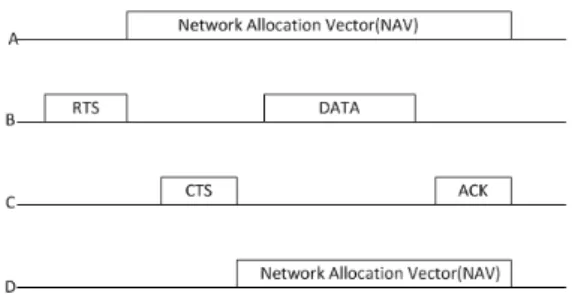
One of the two protocol defined by IEEE at the MAC sub layer is DCF. In IEEE 802.11 DCF, a node reserves the channel for data transmission by exchanging RTS/CTS messages with the target nodes.
The nodes that are affected by the RTS and CTS packets will defer its transmission
[3]. Every node maintains the Network Allocation Vector (NAV) that records the duration of time it must defer its transmission. This process helps to avoid the hidden node problem in single channel environment as shown in Fig. 1.
그림 1. IEEE 802.11 DCF 동작 예시도.
Fig. 1. Operation of IEEE 802.11 DCF.
2. IEEE 802.11 Power Saving Mechanism (PSM)
In subsection, we describe the IEEE 802.11 PSM to explain how Ad-hoc Traffic Indication Message (ATIM) windows are used. The time is divided into beacon intervals and every node in the networks is synchronized by periodic beacon transmission. Therefore, every node will start and finish each beacon interval at about the same time. A node will enter the doze mode when there is no need for exchanging data. Fig. 2 illustrates the process of IEEE 802.11 PSM. At the start of each beacon interval, there exists an interval called the ATIM window, where every node should be in the wake up state. If node A has packets for node B, it sends an ATIM packet to node B during this interval.
If node B receives this message, it replies by sending an ATIM-ACK to node A. Both A and B nodes will then stay awake for that entire beacon interval. The nodes that do not send or received any ATIM packets during the ATIM window (e.g., node C in Fig. 2) it will enter into the doze mode until the next beacon interval.
그림 2. IEEE 802.11 PSM 동작 예시도.
Fig. 2. Operation of the IEEE 802.11 PSM.
3. Multi-channel hidden terminal problem In this section, we will discuss the hidden terminal problem in multichannel environment. Here we consider the scenario as shown in Fig. 3. Suppose that the node A has a packet for node B, it will send RTS packet on channel l and then node B select the channel 2 and sends CTS for data transmission back to node A. After receiving the CTS, the sender node A and receiver node B have to reserve channel 2 in the transmission range. After completion of the data transfer, node B will send, acknowledge message to the sender and finish the data transfer. Suppose that node C was busy on receiving in another channel , node C did not hear the CTS from node B, and after some time node C want to transmit its own data, initiate the communication with node D, and end up with selecting the channel 2, so there is collision in node B. This situation considered as a hidden node in multichannel environment.
그림 3. 다중 채널 숨겨진 지국 문제 예시도.
Fig. 3. Multichannel hidden terminal problem.
Ⅳ. Proposed Multi-Channel MAC Protocol
In this section, we describe our proposed protocol and working principle in details. We consider the
cluster based cognitive radio ad-hoc networks. We assume that there are licensed spectrum band consisting of N multiple data channels and a separate Common Control Channel (CCC). Common control channel is free of any primary user activity and available for all the secondary users.
In our proposed protocol, we utilizes the idle nodes;
if a node does not have any data to transmit it is considered as idle nodes which always listen to the common control channel. Therefore idle nodes can have the information about the channel state (busy or free) in its surrounding and can help the sender and receiver nodes during the channel negotiation process.
The frame structure of the proposed protocol is divided into three different phases, as shown in Fig. 4.
그림 4. 제안된 다중 채널 MAC 프로토콜의 프레임 구조.
Fig. 4. Frame structure of the proposed scheme.
1. Sensing Phase
In the sensing phase the secondary users sense the data channel and maintain the channel state (busy or free) in the channel status table. Due to the time limitation, SUs cannot sense the entire channel.
Therefore, SUs cannot have information about the channel being used.
2. Negotiation Phase
Negotiation phase is used for negotiating the data
channel between the sender and the receiver nodes. If
nodes have data to send, sender and receiver nodes
negotiate for common data channel by exchanging the
control message. If both sender and receiver nodes
agree on common data channel, they both switch to the
selected data channel and exchange data. During the
negotiation between the sender and receiver nodes, the
idle node may help the sender and receiver nodes to
select the collision free common data channel. By using
this strategy, we can minimize the multi-channel hidden terminal problem. As an example, let’s consider the scenario as shown in Fig. 5. In Fig. 5, the node A has data for the node B. Due to the multi-channel hidden terminal problem, the node A may have failed to perceive the control message from its neighbours and also the node B may miss the control message from the neighbours. Therefore, the node A and the node B do not have the information about the channel being used by their neighbouring nodes. In the negotiation phase, if the node A and the node B decide to select the common channel that is now being used by the neighbouring nodes (i.e., D, E, F and G), collision will occur. In the Fig. 5, the node C and the node H are the idle nodes, which have the information about the channel being used by neighbouring nodes. The idle nodes may help the sender and the receiver nodes to select the free data channel in the negotiation phase for data exchange.
그림 5. 제안된 프로토콜의 동작설명을 위한 네트워크 예시.
Fig. 5. A network scenario for explaining the operation of the proposed scheme.
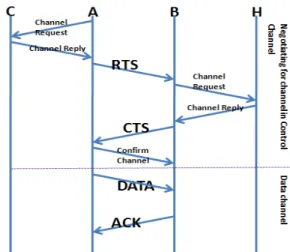
Fig. 6 illustrates the overall negotiation phase of the proposed protocol. The following steps can be executed in the negotiation process:
•Nodes will use the carrier sense multiple access with collision avoidance (CSMA/CA) technique to exchange the control message.
•At the negotiation phase, if the node A wants to transmit data to node B, node A will send the channel request message to its idle nodes. After that, the idle nodes will send to the node A the channel reply message which includes the free channel list.
•After receiving the channel list from the neighbouring idle nodes, the node A will update its own channel list table and send RTS message to the destination node B.
•After receiving the RTS message, the destination node B will also send the channel request message to its idle neighbour nodes. Then idle neighbour nodes will reply with the free channel list to the node B by using the channel reply message. After receiving the channel list from the idle neighbour nodes, the node B will update its channel list table, select one free channel and send the CTS message to the source node A.
•If the node A receives the CTS message from node B, the node A will send the confirm message and change its transceiver to the selected data channel.
•After receiving the confirm message, the node B will also switch its transceiver to the selected data channel.
그림 6. 제안된 프로토콜의 메시지 교환 절차.
Fig. 6. Message exchange procedure of the proposed scheme.
3. Data Phase
In this phase, the node A will send its data to the
node B. After finishing the data exchange, the
destination node B will send the ACK message to
confirm the success of data exchange.
Ⅴ. Simulation
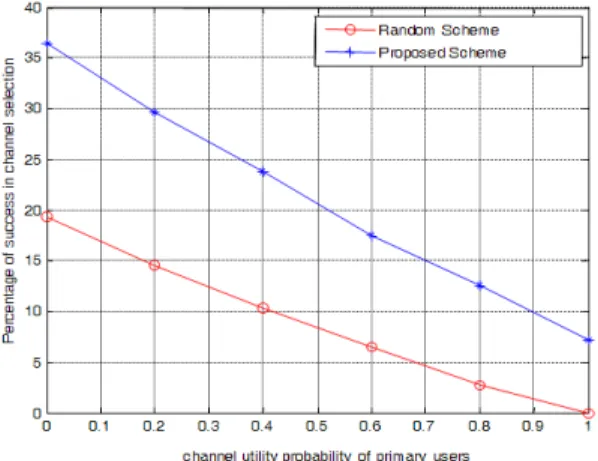
For the simulation, the 2 primary users and 16 secondary users are randomly distributed over area of 100m × 100m. We assume that there are 5 transmitters, 5 receivers and 11 idle users among 16 secondary users, and that each transmitting node can reach its destination in a single hop. For the comparison, we take the random scheme into account. In the random scheme, each node will select the data channel without helping from the idle neighbour nodes.
그림 7. 기사용자의 채널 사용율에 따른 채널 선택 성공 확률.
Fig. 7. Success probability of channel selection according to the channel utility probability of primary users.
Fig. 7 shows the success probability of channel selection according to the channel utility probability of primary users. As shown in Fig.7, the success probability of channel selection will be decreased as the channel utility probability of primary users increases, which is mainly due to the channel scarcity by the higher channel utilization of primary users. However, it is noteworthy that the proposed scheme significantly increases the success probability of channel selection, compared with the random selection scheme.
그림 8. 다중채널 수에 따른 채널 선택 성공 확률.
Fig. 8. Success probability of channel selection according to number of channels.