조 현 구(Hyen Goo Cho)1*
1경상대학교 지구환경과학과 및 기초과학연구소
(Department of Earth & Environmental Sciences and Research Institute of Natural Science, Gyeongsang National University, Jinju 660-701, Korea)
2경상대학교 박물관
(University Museum, Gyeongsang National University, Jinju 660-701, Korea)
*Corresponding author: +82-55-772-1474, E-mail: [email protected]
서 론
우리나라를 비롯해 중국, 일본, 러시아 등 동북 아시아에서는 선사시대의 장식용 옥기류가 출토되 고 있다. 옥기의 출현은 원시 씨족사회에서 문명국 가로 변천해 나가는 과정의 중요한 현상 중의 하나 로 인식되고 있다. 따라서 옥기에 대한 연구는 한 반도를 비롯한 동북아시아지역 선사시대 문화를 조명하는데 매우 중요하지만(Lim, 2003, 2012), 옥 기에 대한 연구 진척은 다른 나라에 비해 열악한 실정이다.
청동기시대에는 다양한 옥기류가 사용되었고, 특 히 남해안 중심의 청동기 유적지에서 출토된 장식 용 옥기류, 즉 식옥(飾玉)에 대한 연구 결과를 보면 그 재질을 대부분 천하석(天河石)으로 규정하고 약 간의 벽옥도 포함시키고 있다(Choi, 2000; Lee, 2002; Shoda, 2005). Lee (2002)가 지적하고 있듯 이 청동기 옥기류에 대한 연구에서 경옥, 연옥, 천 하석, 벽옥 등의 재질이 혼용되어 사용되어 재질에 대한 혼란이 가중된 상태다. 천하석은 선사시대 중 신석기시대의 옥기류에서는 등장하지 않는 재질이 다. 청동기시대 옥기류의 재질로 천하석이 등장한 이유에 대해서는 알 수 없으나 일본 학자 Otsubo
(2001)의 연구가 영향을 미쳤을 것으로 판단된다.
Otsubo (2001)는 한반도 출토의 곡옥(曲玉) 분포를 조사하면서 천하석 재질을 언급하였고, 또한 일본 규슈에서의 출토 사례와 비교하였다. Choi (2000) 는 천하석이란 재질에 대해 과학적으로 분석된 사 례가 없다고 언급하고 있으며, 외국의 경우에도 고 고학분야의 연구에서 옥기류의 재질로 천하석에 대한 언급이 드물게 발견되지만(예: Bar-Yosef Mayer and Porat, 2008), 그 재질이 무엇인지에 대해서는 구체적으로 검토되고 있지 않다. 다만 천하석에 대 한 광물학적 연구는 많지는 않으나 19세기 후반 이후 꾸준히 진행되고 있는 실정이다. 이 논문에서 는 우리나라 청동기시대 출토 유물 중 천하석이라 여겨지는 시료를 대상으로 그 기재적 및 지구화학 적 검토를 시도해 보고자 한다.
천하석
천하석(amazonite)의 어원은 아마존 강 근처에서 발견된 연옥과 녹색 장석에서 유래된 아마존스톤 (amazonstone)으로 알려져 있다(Hintze, 1897). Brei- thaupt (1847)는 K이 풍부한 조성의 삼사정계 K- 장석에 제한적으로 천하석이라고 명명하였다. 그러
Fig. 1. Amazonite occurrence in the granitic rocks found in the Oksanri site, Sancheong, Korea.
Fig. 2. Amazonite artefact (A) and its cut section (B).
나 Rudenko and Vokhmentsev (1969)는 청색∼녹 색 올리고클레이스 역시 천하석의 성질을 가지고 있음을 보였고, Cech et al. (1971) 또한 녹색의 정 장석에 대한 화학적 및 구조적 연구로부터 청색∼
녹색의 미사장석, 녹색 정장석 및 유사색의 모든 장석을 천하석에 포함되어야 함을 주장했다. 그럼 에도 불구하고 천하석의 정의는 삼사정계 K-장석 에 제한적으로 사용되고 있다(Hofmeister and Ross- man, 1983).
1960년대 이후 천하석에 대한 연구는 꾸준히 진 행되어 왔는데, 특히 장석이 푸른색을 띠는 발색 원인에 대한 연구가 주를 이루고 있다. Taylor et al. (1960)은 방사분광기를 사용한 정량분석을 통 해 유색 또는 무색의 장석에서 화학적 차이가 없다 고 밝혔지만, 이후 천하석에서 Pb, Rb, Cs, Tl 등 의 함량이 높게 나타난다는 보고들이 이어졌고
(Zhirov and Stishov, 1965; Shmakin, 1968; Foord and Martin, 1979; Nunes, 1979), 특히 Pb 원소와 발색의 관계가 주장되어왔다. 그러나 Pb2+ 이온은 전자전이로 말미암아 발색과 관계없음이 알려져 있고, 대신 Pb1+이온의 존재(Marfunin and Bershov, 1970)와 물의 함량(Plyusnin, 1969)이 관계한다고 지적되어왔다. Hofmeister and Rossman (1981, 1985a, b)은 그들의 일련의 연구에서 물의 방사유도 분해 (radiation-induced dissociation)로 인해 Pb2+에서 Pb1+로 환원된다고 제안했고 또한 천하석의 발광 유도(irradiation-induced)에 의한 발색과 색의 차별 이 K-장석 내의 구조수와 Pb 함량에 좌우된다고 하였다. 한편, Julg (1998)는 천하석의 발색이 미사 장석의 K+ 자리에 들어가는 Pb1+와 Pb3+ 이온에 기 인하며, 각각은 녹색과 푸른색을 띠게 한다는 흡광 분석의 결과를 제시하였다.
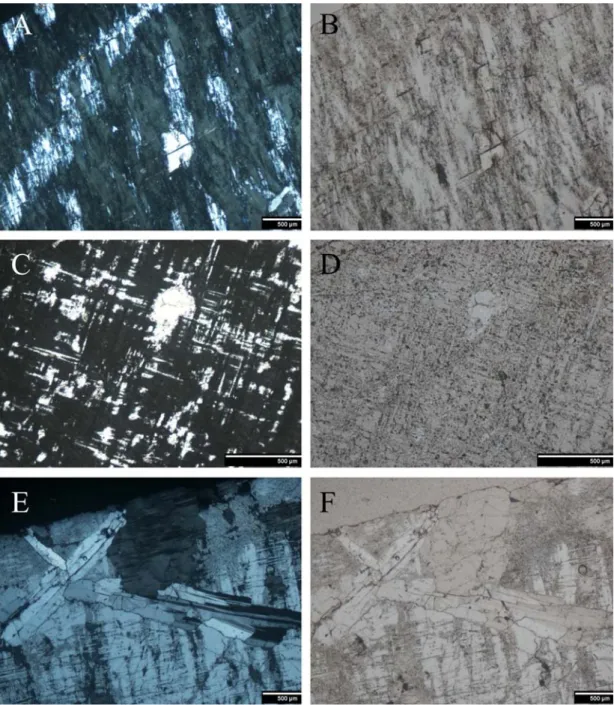
Fig. 3. Photomicrographs of the amazonite specimen. (A & B) albite exsolution texture, (C & D) complex twinning, (E & F) plagioclase laths in amazonite crystal. A, C, E: crossed polar, B, D, F: open polar.
Pb의 화학종의 차이가 발색 원인이라는 가정 하 에서 Pb가 어떻게 K-장석 내에 포함될 수 있는지 에 대한 연구가 이어졌다. Murakami et al. (2000) 은 호주 뉴사우스웨일스의 Broken Hill에서 산출 되는 녹색의 정장석을 천하석이라 취급하고 Pb는
K+ + Si4+ ↔ Pb2+ + Al3+의 쌍치환으로 인해 PbAl2
Si2O8 단성분으로 최대 3.8 mol%까지 포함될 수 있다고 주장했다. 한편, Sokolov and Martin (2009) 는 페그마타이트 중의 천하석 K-장석에 Pb2+ + □
→ 2K+의 치환으로 PbO가 0.7% 가까이 포함되며
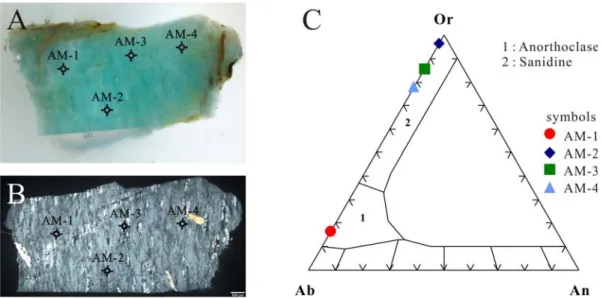
Fig. 4. (A&B) Analytical points of micro-XRF analysis (A&B). (C) Or-Ab-An discrimination diagram for K-feldspar.
발색은 구조수의 이온화 방사효과로 인함을 언급 하고 있으며, Nakano and Makino (2010)는 천하 색에 최대 103 ppm 정도의 PbO가 함유된다고 보 고하고 있다.
K-장석 내의 납의 기원은 광물 내에 포유된 방 연석 또는 납-함유 미세결정으로부터 유래되었다 고 설명되거나(Murakami et al., 2000), 또는 방연 석 및 섬아연석을 포함하는 기반암이 화강암질 마 그마의 관입으로 인한 탈유황작용과 혼염작용의 결과로 납이 유입되었을 것이라고 추정되기도 하 는데 이는 천하석과 방연석의 Pb 동위원소비의 유 사성으로부터도 인지된다(Stevenson and Martin, 1986, 1988).
천하석에는 보통의 K-장석에 비해 여러 미량성 분이 농집되어 있다. 천하석에 대한 micro PIXE (Proton-Induced X-ray Emission) 분석과 음극발광 분광기 분석 등으로부터 천하석에 Fe, Rb, Pb, Ga 등의 원소가 검출한계 이상으로 포함되며, 유색 및 무색 K-장석에 Pb 함량의 차이가 뚜렷한 것으로부 터 Pb가 발색의 원인이라는 가설을 지지하고 있다 (Borghi et al., 2004; Vaggelli et al,. 2004, 2005).
또한 Sokolov and Martin (2007)은 미국 버지니아 Morefield 페그마타이트에서 산출되는 천하석이 미사장석으로 거의 순수한 알바이트가 용리된 퍼 싸이트조직이 뚜렷하며, Pb, Rb, Cs 및 Tl 함량에 강한 농집을 보인다고 했다. 최근에는 Correcher
and Garcia-Guinea (2011)의 자연산 천하석에 대 한 발광 특성(luminescence properties)에 대한 연 구에서 발색의 원인으로 Mn과 Fe 불순물의 효과 를 추가적으로 지적하고 있다.
옥산리 유적의 천하석
경상대학교 박물관이 1997년 산청 옥산리 청동 기 유적지에서 수습한 출토유물 중에는 천하석으 로 알려진 옥기류가 포함되어 있다. 이 옥기류의 하나를 대상으로 기재적 연구 및 지구화학 분석을 실시하였다.
천하석 시료는 녹색을 띠고, 원석으로 추정되는 거정질 화강암의 구성광물의 하나로 나타난다(그림 1, 2). 원석의 원산지는 아직 확인되지 않아 향후 밝혀야 할 과제이다. 천하석 시료에 대한 박편관찰 의 결과를 보면, 기재적으로 두 가지 특징을 나타 내는데, 하나는 알바이트 쌍정과 페리클린 쌍정이 직교하는 패치조직이고, 다른 하나는 용리조직이다 (그림 3). 하나의 시료에 두 가지 조직이 동시에 나 타나는데, 이로부터 천하석의 광물이 미사장석이며 또한 퍼싸이트임을 알 수 있다. 미사장석의 복합 쌍정이 저온에서의 알바이트 용리에 의해 페리클 린 쌍정이 파괴되고 부분적으로 퍼싸이트 조직을 형성시킨 것으로 생각된다(Tibballs and Olsen, 1977).
천하석에서의 미사장석의 결정작용과 알바이트의
ZrO2 0.02 0.03 0.02 0.03
Ga2O3 0.01 0.01 0.00 0.01
WO3 0.01 0.03 0.02 0.03
용리는 200℃ 정도의 저온에서 일어나는 것으로 추정되기도 한다(Nakano and Makino, 2010). 한 편, 천하석 내에는 사장석의 래스 형태의 결정이 나타나는데(그림. 3E, 3F), 이 사장석은 초기 정출 광물로 나중에 정출한 미사장석에 의해 포획된 것 으로 해석되며, 일부 페그마타이트에서 산출되는 천하석에서의 산상과 유사하다(예: Nakano and Makino, 2010).
천하석 시료에 대한 지구화학분석을 연세대학교 에 설치된 micro XRF (Bruker M4 Tornado)를 이 용하여 점분석으로 수행하였는데(그림 4), 분석 조 건은 Rh 튜브를 이용하여 50 kV, 800 µA의 전압 과 30 µm의 스폿 크기로 분석하였으며, 그 결과는 표 1과 같다.
천하석의 화학분석 결과를 K-장석 조성으로 환 산하면, 용리된 알바이트에 해당하는 AM-1의 조 성은 Ab83Or17로 아노소클레이스 영역에 도시되었 으며, AM-2, AM-3, AM-4의 조성은 Ab3~22Or78~97
로 새니딘 영역에 도시되었다(그림 4). 장석을 이 루는 주성분원소 이외의 미량원소로는 Rb, Pb, Fe, Ti, Zr, Ga, W과 같은 원소들이 검출되었는데, 알 바이트에 해당하는 AM-1을 제외한 나머지 K-장석 의 조성에서 Rb이 가장 많고, 다음으로 Pb의 함량 이 높게 나타난다. 이 결과는 기존에 알려진 천하 석에 포함된 미량성분들의 함량과도 조화적이다.
결 론
천하석은 우리나라 청동기시대 옥기 유물의 중 요 재질로 알려져 있으나 그에 관한 구체적인 검토
이 연구는 국립문화재연구소의 2013년 문화유산융복 합연구(R&D) 사업 “흑요석 및 옥기의 산지추정을 위한 기초연구”의 지원으로 이루어졌음을 밝힌다.
REFERENCES
Bar-Yosef Mayer, D.E. and Porat, N. (2008) Green stone beads at the dawn of agriculture. PNAS (Proceedings of the National Academy of Sciences of the United States of America), 105, 8548-8551.
Borghi, A., Fiora, L., Cossio, R., Fedi, M., Giuntini, L., Massi, M., Lo Giudice, A., Olmi, F., and Vaggelli, G. (2004) Combined micro-PIXE facility and monochromatic cathodoluminescence spectro- scopy on coloured minerals of “Natural Stones”: an example from Amazonite. 10th International Confe- rence on Particle Induced X-ray Emission and its Analitical Applications, 851.1-851.3.
Breithaupt, A. (1847) Vollstandiges Buch der Mine- ralogie III. Dresden und Leipzig.
Cech, F., Misar, Z., and Povondra, P. (1971) A green lead-containing orthoclase. Tchermaks Mineralo- gische und Petrographische Mitteilungen, 15, 213-231.
Choi, J.K. (2000) On amazonite beads excavated in Duhori. 「Goseong Duhori Site」 Gyeongnam Archa- eological Institute, 28-32 (in Korean).
Correcher, V. and Garcia-Guinea, J. (2011) Study of the luminescence properties of a natural amazonite.
Radiation Measurements, 46, 971-974.
Foord, E.E. and Martin, R.F. (1979) Amazonite from the Pikes Peak batholith. Mineralogical Record, 8, 373-384.
Hintze, C. (1897) Handbuch der Mineralogie II. Verlag von Weit, Leipzig, 1354-1357.
Hofmeister, A.M. and Rossman, G.R. (1981) The effect of radiation on water and lead in potassium feldspar.
Geological Society of America Abstracts with Programs, 13, 505.
Hofmeister, A.M. and Rossman, G.R. (1983) Color in Feldspar. Feldspar Mineralogy (Ribbe, P.H., ed.) Reviews in Mineralogy, v. 2, 271-280.
Hofmeister, A.M. and Rossman, G.R. (1985a) A spec- troscopic study of irradiation coloring of amazonite:
structurally hydrous, Pb-bearing feldspar. American Mineralogist, 70, 794-804.
Hofmeister, A.M. and Rossman, G.R. (1985b) A model for the irradiative coloration of smoky feldspar and the inhibiting influence of water. Physics and Chemistry of Minerals, 12, 324-332.
Julg, A. (1998) A theoretical study of the absorption spectra of Pb+ and Pb3+ in site K+ of microcline:
application to the color of amazonite. Physics and Chemistry of Minerals, 25, 229-233.
Lee, S.G. (2002) Characteristics of Se-hyeong-dong- geom cultural period in terms of ornaments. Kyushu Archaeological Society and Yeongnam Archaeolo- gical Society, 175-212 (in Korean).
Lim, S.K. (2003) A research regarding the quality and the production method of the Chinese jade in the Neolithic age. Sarim, 20, 127-171 (in Korean with English abstract).
Lim S.K. (2012) A study on the slit jade earring exca- vated in the Korean Peninsula. Munhwajae Korean Journal of Cultural Heritage Studies, 45, 4-21 (in Korean with English abstract).
Marfunin, A.S. and Bershov, L.V. (1970) Paramagnetic center in feldspar and their possible crystallo- chemical and petrological significance. Doklady Akademie Nauk SSSR, 193, 129-130.
Murakami, H., Takashima, I., Nishida, N., Shimoda, S.
and Matsubara, S. (2000) Solubility and behavior of lead in green orthoclase (amazonite) from Broken Hill, New South Wales, Australia. Journal of Mine- ralogy, Petrology and Economic Geology, 95, 71-84.
Nakano, S. and Makino, K. (2010) Amazonitic alkali feldspar from the Tanakami Granitic pegmatite, south- west Japan. Journal of Mineralogical and Petrolo- gical Sciences, 105, 45-56.
Nunes, J.E.L. (1979) Amazonites de Mocambique. Ser- vicos Geologicos de Portugal LXIV, 71-79.
Otsubo, Y. (2001) Stone ornaments in Korean Peni- nsula. Journal of the Faculty of Literature, 73, Kumanoto University.
Plyusnin, G.S. (1969) On the coloration of amazonite.
Zapiski Vsesoyuznogo Mineralogicheskogo Obshchestva, 98, 3-17.
Rudenko, S.A. and Vokhmentsev, A.Ya. (1969) Plagio- clase-amazonite. Doklady Akademie Nauk SSSR, 184, 113-115.
Shmakin, B.M. (1968) Enigma of the amazonstone.
Priroda, 8, 52-57.
Shoda, S. (2005) An approach to division of labour in Daepyeong-site by the study of beads making. Yeong- nam Gogohak, 36, 5-25 (in Korean with English abstract).
Sokolov, M. and Martin, R.F. (2007) The geochemical attributes of the amazonitic microcline at the More- field NYF-type pegmatite, Amelia district, Virginia.
Granitic Pegmatites: The State of the Art - Interna- tional Symposium, Porto, Portugal.
Sokolov, M. and Martin, R.F. (2009) A Pb-dominant member of the tourmaline group, Minh Tien granitic pegmatite, Luc Yen district, Vietnam. Estudos Geo- logicos, 19, 352-353.
Stevenson, R.K. and Martin, R.F. (1986) Implications of the presence of amazonite in the Broken Hill and Geco metamorphosed sulfide deposits. Canadian Mineralogist, 24, 729-745.
Stevenson, R.K. and Martin, R.F. (1988) Amazonitic K-feldspar in granodiorite at Portman Lake, North- west Territories: Indications of low f(O2), low f(S2), and rapid uplift. Canadian Mineralogist, 26, 1037-1048.
Taylor, S.R., Heier, K.S., and Svedrup, T.L. (1960) Trace element variations in three generations of feld- spar from the Landsverk I pegmatite, Evje, Southern Norway. Norsk Geologisk Tidsskrift, 40, 133-156.
Tibballs, J.E. and Olsen, A. (1977) An electron micro- scopic study of some twinning and exsolution tex- tures in microcline amazonites. Physics and Chemi- stry of Minerals, 1, 313-324.
Vaggelli, G., Olmi, F., Massi, M., Giuntini, L., Fedi, M., Fiora, L., Cossio, R., and Borghi, A. (2004) Chemical investigation of coloured minerals in natural stones of commercial interest. Microchimica Acta, 145, 249-254.
Vaggelli, G., Borghi, A., Cossio, R., Fedi, M., Fiora, L., Giuntini, L., Massi, M., and Olmi, F. (2005) Combined micro-PIXE facility and monochromatic cathodoluminescence spectroscopy applied to colored minerals of natural stones: an example from ama- zonite. X-ray Spectrometry, 34, 345-349.
Zhirov, K.K. and Stishov, S.M. (1965) Geochemistry of amazonitisation. Geokhimiya, 1, 32-42.
접수일(2013년 12월 3일), 수정일(1차 : 2013년 12월 26일), 게재확정일(2013년 12월 26일), 책임편집위원 : 이영재