․투고일: 2018.09.03, 심사일: 2018.09.27, 게재확정일: 2018.10.01
․Corresponding author: Woo-seok Jang Dept. of Cardiovascular and Neurologic Diseases of Korean Internal Medicine, Daegu Oriental Hospital of Daegu Haany University, 136 Sinchendong-ro, Suseong-gu, Daegu, Republic of Korea TEL: 053-770-2125 FAX: 053-770-2055 E-mail: [email protected]
․이 논문은 2017년도 대구한의대학교 대학원 한의학 석사학위
Scrophulariae Radix Aqueous Extracts Ameliorate the Pressure Overloaded Heart Failure by Transverse Aortic Constriction in Mice
Seong-jin Woo, Kyung-min Baek, Woo-seok Jang
Dept. of Cardiovascular and Neurologic Diseases of Korean Internal Medicine, Daegu Oriental Hospital of Daegu Haany University
Scrophulariae Radix Aqueous Extracts Ameliorate the Pressure Overloaded Heart Failure by Transverse Aortic Constriction in Mice
Seong-jin Woo, Kyung-min Baek, Woo-seok Jang
Dept. of Cardiovascular and Neurologic Diseases of Korean Internal Medicine, Daegu Oriental Hospital of Daegu Haany University
ABSTRACT
Objectives:
The purpose of this study was to investigate the cardioprotective effect of the potent antioxidant properties of Scrophulariae Radix (SR) aqueous extracts by examining pressure overload (PO) heart failure (HF) induced by transverse aortic constriction (TAC) of C57BL/6 mice.Methods:
SR (500, 250, 125 mg/kg) and resveratrol (10 mg/kg) were administered orally once a day for 14 days, after the TAC operation. Changes in mortality, the body and heart weights, histopathology of the heart, and antioxidant defense system of the heart were analyzed.Results:
After the TAC operation, increases were observed in mortality, heart weights, left ventricular hypertrophy, and lytic and focal fibrotic histological change, and destruction of the heart antioxidant defense system. However, the HF signs showed dose-dependent inhibition following 14 days of continuous oral treatment with SR. A SR dose of 125 mg/kg gave a similar inhibition to that obtained with resveratrol at 10 mg/kg.Conclusions:
Oral administration of SR beneficially improves PO-induced HF following TAC surgery by increasing the activity of the heart antioxidant defense system. The overall effect of SR at 125 mg/kg is similar to the effect of resveratrol at 10 mg/kg.However, more detailed mechanistic studies should be performed by screening of the biologically active compounds in SR.
Key words:
Scrophulariae Radix, heart failure, cardioprotective, transverse aortic constriction, in vivoⅠ. Introduction
Heart failure (HF) is a pathological condition
in which the heart fails to function efficiently and
does not supply blood and oxygen to maintain
life
1. HF is induced by left ventricular hypertrophy
caused by pressure overload (PO)
2.
Endogenous antioxidant defense system controls the amount of reactive oxygen species (ROS) to persist physiological homeostasis. However, when various cardiovascular diseases including HF are present ROS production predominates over antioxidant defense system, causing chronic oxidative stress and damaging cells
2,3. Therefore, it is necessary to find alternate strategies to provide safe and effective HF therapy through natural antioxidative agents
2,4. Resveratrol (trans-3,4,5-trihydroxystilbene), a polyphenol found mainly in grapes and berries, have been studied in a variety of experimental environments, including hypertension, myocardial infarction, and HF
5,6. In particular, recent study have examined the effect of resveratrol on the prevention of chronic pathological changes in cardiac function and structure of PO-induced HF in mice
2. Scrophulariae Radix (SR), a dried root of Scrophularia buergeriana Miquel has been used for a long time with excellent traditional therapeutic effects on yin nourishing, blood cooling, fire purging and toxin removal
7. Recent pharmacological research and clinical practice explained that it possesses anti-inflammatory
8, antimicrobial
9activities, and anti-angiogenesis
10. So it can be used for the treatment of pharyngalgia, constipation, rheumatism, arthritis and conjunctival congestion
11. Especially SR has potent antioxidant-based cardioprotective effects against coronary artery ligation-induced ventricular remodeling rat models
12,13.
However, no study has examined the effects of SR in preventing chronic pathological changes on the cardiac structure and function on PO-induced HF in mice. Therefore, the aim of this study is to observe the cardioprotective effect of SR on
PO-induced HF in mice through possible antioxidant effects.
Ⅱ. Materials and methods
1. Animals and husbandry
A total of Sixty-six healthy male SPF/VAF inbred C57BL/6 mice (Seungnam, Korea; OrientBio;
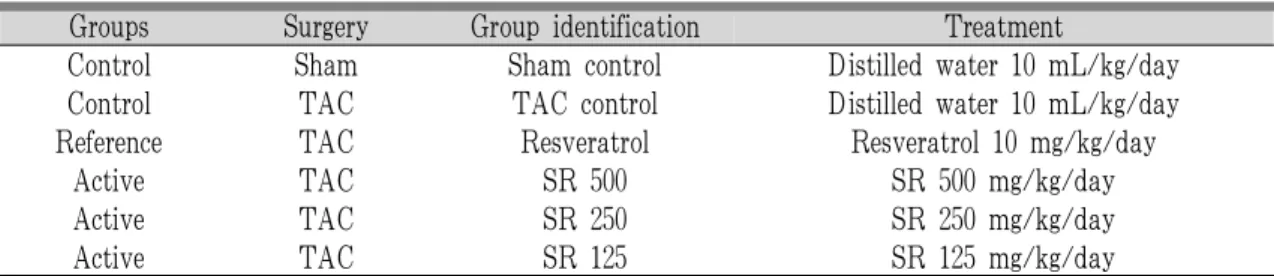
6-week old; body weight 18-21 g), were used for 7 days after acclimatization. Six groups, total 40 TAC operated or eight sham mice were selected on the basis of body weight at 14 days after TAC surgery (Table 1, Fig. 1).
2. Preparations and administration of test materials SR produced in Andong (Korea), were purchased from local herb store (Omniherb, Yeoungcheon, Korea) under the inspection of herbologist (Prof.
Park JH, KMD, PhD). Both resveratrol and SR are dissolved (up to 1 mg/mL solution in resveratrol and up to 50 mg/mL solution in SR) in distilled water. SR for a dose of 50, 25 and 12.5 mg/kg concentration by which directly dissolved in 1 mL of distilled water and then orally administered in a dose of 10 mL/kg at 500, 250 and 125 mg/kg equivalent using gastric gavages, once per day for 14 day from 14 day after TAC surgery. Resveratrol also has been dissolved in distilled water at concentration of 1 mg/mL and orally administered at a dose of 10 mL/kg as equivalence to 10 mg/kg.
In TAC control and sham mice, the equal amount
of distilled water was orally administered, once per
day for 14 day from 14 day after TAC surgery,
respectively (Table 1, Fig. 1).
Groups Surgery Group identification Treatment
Control Sham Sham control Distilled water 10 mL/kg/day
Control TAC TAC control Distilled water 10 mL/kg/day
Reference TAC Resveratrol Resveratrol 10 mg/kg/day
Active TAC SR 500 SR 500 mg/kg/day
Active TAC SR 250 SR 250 mg/kg/day
Active TAC SR 125 SR 125 mg/kg/day
SR : Scrophulariae Radix aqueous extracts, TAC : transverse aortic constriction Table 1. Experimental Design
Fig. 1. Experimental design.
SR : Scrophulariae Radix aqueous extracts, TAC : transverse aortic constriction
3. TAC operation
The central thoracotomy was made with a length of 3 mM. The transverse aortic arch was connected (7-0 Prolene) with an overlying 28-gauge needle between left common carotid and the innominate arteries, and then the needle was removed to leave a discrete region of stenosis. A chest was closed, and then pneumothorax was evacuated.
4. Mortalities
Any unusual mortalities were recorded before and after the administration at least twice a day from day of first administration to last drug treatment day.
5. Body weight measurements
The body weight change was measured on 1 day before the initial test article administration, the day of the first test material administration, 1, 7, 13, 14 days after initial resveratrol or SR administration using an automatic electronic scales (Precisa Instrument, Dietikon, Switzland).
6. Heart weight measurements
At sacrifice, the heart weights of all survived
animals were assessed at g levels, and to reduce
the difference between individual weight, the relative
body weight (% of body weight) was calculated
using sacrifice body weight and absolute heart
weight.
7. Analysis of heart antioxidant defence system Some of the heart from survived animals at sacrifice (5 mice in each group) were homogenized and weighed with a buffer consisting of 10 mM Tris-HCl, and 0.1 M MEDTA (pH 7.4), 10 mM sucrose and then centrifugated, for 15 min at 12,000 g.
1) Analysis of lipid peroxidation
In order to quantify the amount of lipid peroxidation, thiobarbituric acid reactive substances (TBARS) produced during the acid-heating reaction was measured. Therefore samples of tissue homogenate were mixed with trichloroacetic acid (10%; 1mL, Merck, San Francisco, CA, USA) and thiobarbituric acid (0.67%; 1mL, Merck, San Francisco, CA, USA) before heating in a boiling water bath (15 min).
The TBARS absorbance was measured at an optical density (OD) of 535 nM, using a UV/VIS spectrophotometer (Mecasys, Daejeon, Korea, OPTIZEN POP) and the results were expressed as MDA equivalents (nM/g).
2) Analysis of CAT and SOD activity
The level of CAT activity was measured by the decrease in the hydrogen peroxide OD at 240 nM, using UV/VIS spectrophotometer (Mecasys, Daejeon, Korea, OPTIZEN POP). CAT activity is determined by the amount of enzyme required to degrade 1 nM of H
2O
2per minute, at 25 ℃ and pH 7.8.
SOD activity levels were measured from adrenaline autoxidation inhibition. The SOD activity was measured by the inhibition degree of the reaction at OD 560 nM. One unit of SOD enzyme activity is determined by enzyme that decrease the initial absorbance of adrenaline by 50% using a UV/VIS spectrophotometer (Mecasys, Daejeon, Korea, OPTIZEN POP) for 1 min.
3) Analysis of GSH levels
The total GSH levels of the reduced and disulphide type tissue homogenate samples were evaluated. GSH reduction is recirculated to glutathione reductase and NADPH, associated with an absorption change at 412 nM (associated with a decrease in DTNB).
This analysis has been modified for use with microplate readers (Tecan, Männedorf, Switzerland).
8. Histological process
At the sacrifice, each of the myocardial regions collected from the surviving animals (5 mice per group). To better observe changes, mean numbers of lytic necrotic myocardial fibers (myofibers/1000 myofibers), total left ventricle thickness from endocardium to pericardium (μM/heart) and myocardical diameters (μM/fiber) were measured by histomorphometrical analysis using computer assisted image analysis program (Quebec, Canada, i Solution FL ver 9.1, IMT i -solution Inc.) under H&E stain with mean percentages of interstitial and perivascular collagen fiber occupied areas in left ventricle (%/mm
2) under Sirius red stain
2.
9. Statistical analysis
All data are described as mean±standard deviation (SD). Multiple comparison tests were performed for different dose groups. Variance homogeneity was investigated using the Levene test. If the Levene test does not show significant deviations from variance homogeneity, data were analyzed by one-way analysis (ANOVA) test and least significant difference (LSD) test to determine which group pair was significantly different.
Kruskal-Wallis H test, Non-parametric comparison
test were performed when the dispersion homogeneity
was significantly out of the Levene test. When
significant difference were observed in a Mann-Whitney
U (MW) test, the Kruskal-Wallis H test was performed to determine a particular pair of group comparisons, which is very different. Statistical analysis was performed using SPSS for Windows (Armonk, NY, USA, Release 14.0K, IBM SPSS Inc.).
Ⅲ. Results
1. Survivability
Survivability after 14 days of experiment in sham control was 100.0%, and they were detected
as 62.5, 75.0, 100.0, 87.5 and 75.0% in TAC control, resveratrol 10 mg/kg, SR 500, 250, 125 mg/kg treated mice, respectively (Table 2).
2. Changes on the body weight
Significant changes of body weight during 14 days were not detected in all TAC operated mice as compared to sham control. In addition no significant change of body weight was detected in all three different doses of SR or resveratrol 10 mg/kg treated mice as compared to TAC control (Table 3).
Times
Groups 0 1 2 3 4 Days of administration 5 6 7 8 9 10 11 12 13 Total* Survival (%)
Sham control 0 0 0 0 0 0 0 0 0 0 0 0 0 0 0/8 100.00
TAC control 0 0 0 0 1 0 0 2 0 0 0 0 0 0 3/8 62.50
Resveratrol 0 0 0 0 1 0 0 0 0 1 0 0 0 0 2/8 75.00
SR 500 0 0 0 0 0 0 0 0 0 0 0 0 0 0 0/8 100.00
SR 250 0 0 0 0 0 0 0 1 0 0 0 0 0 0 1/8 87.50
SR 125 0 0 0 0 0 0 0 0 1 1 0 0 0 0 2/8 75.00
The values are expressed as the number of died animals.
* Total mortality for 14 days of observation - died animals/whole animal observed (eight mice in each group).
SR : Scrophulariae Radix aqueous extracts, TAC : transverse aortic constriction Table 2. Mortalities Observed in Sham or TAC Operated Mice
Times
Groups First administration [A] Body weights at Sacrifice [B] Weight gains [B-A]
Sham control 18.40±1.52 21.23±1.53 2.83±0.43
TAC control 18.24±1.29 20.20±1.05 2.50±0.37
Resveratrol 18.31±1.51 21.17±1.70 2.68±0.52
SR 500 18.28±1.56 20.74±1.62 2.46±0.51
SR 250 18.23±1.43 20.59±1.44 2.49±0.49
SR 125 18.26±1.28 20.82±1.66 2.72±0.44
Values are expressed as Mean±S.D. of a variable number of mice according to mortality (see Table 2), g.
SR : Scrophulariae Radix aqueous extracts, TAC : transverse aortic constriction
Table 3. Body Weight Gains Observed in Sham or TAC Operated Mice
3. Changes on the heart weight
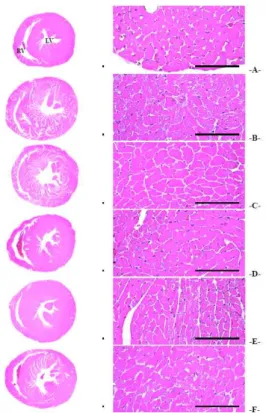
After the administration of 14 days, a significant increases ( p<0.01 ) in the absolute and relative heart weights in TAC control as compared to sham control has been demonstrated. However, heart hypertrophic changes induced by TAC were dramatically inhibited by treatment of SR 500, 250, 125 mg/kg, dose-dependently, and also by resveratrol 10 mg/kg as compared to TAC control; significant ( p<0.01 ) and dose-dependent reduction of absolute and relative weight of the heart were noticed in all three different dose of SR administered mice, and also in resveratrol 10 mg/kg treated mice as compared to TAC control (Fig. 2, 3).
Fig. 2. The representative gross images of heart, taken from sham or TAC operated mice.
A : sham control, B : TAC control, C : resveratrol, D : SR 500, E : SR 250, F : SR 125, Scale bars : 5 mM
SR : Scrophulariae Radix aqueous extracts, TAC : transverse aortic constriction
Fig. 3. Changes on the heart weights in sham or
TAC operated mice.
Values are expressed as Mean±S.D. of a variable number of mice according to mortality (see Table 2), g.
SR : Scrophulariae Radix aqueous extracts, TAC : transverse aortic constriction
a
p<0.01 as compared to sham control by LSD test
b
p<0.01 as compared to TAC control by LSD test
4. Effects on the heart antioxidant defense system 1) Changes on the heart MDA levels
In the TAC control, a significant ( p<0.01 ) increase in heart lipid peroxidation and a rise in MDA level were observed compared to sham control. However, the elevation of MDA levels was significantly reduced in a dose-dependent manner in all three different dose of SR. In addition, the heart lipid peroxidation in resveratrol 10 mg/kg treated mice was significantly ( p<0.01 ) reduced compared to TAC control (Table 4).
2) Changes on the heart GSH contents Significant reduction ( p<0.01 ) of heart endogenous antioxidant, GSH content in TAC control was observed compared to sham control. However, the reduction of heart GSH content by TAC operation was significantly ( p<0.01 ) and dose-dependently inhibited during the 14 days of oral administration of SR 500, 250, 125 mg/kg, respectively. In addition, heart GSH content of resverastrol 10 mg/kg treated mice were also significantly ( p<0.01 ) increased as compared to TAC control (Table 4).
3) Changes on the heart CAT activity
Significant reduction ( p<0.01 ) of the CAT activity, heart endogenous antioxidative enzyme was detected in TAC control as compared to sham control.
However, the reduction of heart CAT activitiy
was significantly ( p<0.01 ) and dose-dependently
inhibited during the 14 days of oral administration
of SR 500, 250, 125 mg/kg, respectively. In addition,
the heart CAT activities in resveratrol 10 mg/kg treated mice were also significantly ( p<0.01 ) increased as compared to TAC control (Table 4).
4) Changes on the heart SOD activity
Significant ( p<0.01 ) reduction of the SOD activities, heart endogenous antioxidative enzyme in TAC
control was observed compared to sham control.
But dramatic significant ( p<0.01 ) increases of SOD activities were observed in resveratrol 10 mg/kg, SR 500, 250, 125 mg/kg administrated mice as compared to TAC control, respectively (Table 4).
Items (Unit)
Groups MDA
(nM/g protein) GSH
(nM/g protein) CAT
(U/g protein) SOD
(U/g protein)
Sham control 0.87±0.32 4.54±0.56 0.79±0.13 8.51±1.48
TAC control 5.04±0.74
a0.91±0.26
c0.18±0.09
a2.29±0.61
aResveratrol 2.87±0.27
ab2.56±0.46
ce0.36±0.05
ab4.06±0.57
abSR 500 1.93±0.16
ab3.56±0.57
de0.55±0.10
ab5.82±0.33
abSR 250 2.04±0.15
ab2.86±0.23
ce0.45±0.10
ab5.03±0.75
abSR 125 2.91±0.22
ab2.47±0.47
ce0.35±0.05
ab3.99±0.69
abThe values are expressed as Mean±S.D. of 5 mice, g.
SR : Scrophulariae Radix aqueous extracts, TAC : transverse aortic constriction, MDA : Malondialdehyde, GSH : Glutathione, CAT : Catalase, SOD : Superoxide dismutase
a
p<0.01 as compared to sham control by LSD test
b
p<0.01 as compared to TAC control by LSD test
c
p<0.01 anddp<0.05 as compared to sham control by MW test
e
p<0.01 as compared to TAC control by MW test
Table 4. Heart Antioxidant Defense Systems Detected in Sham or TAC Operated Mice
5. Effects on the heart histopathology
1) Changes on the total thicknesses of left ventricle
In the TAC control, the total thickness of the left ventricle from endocardium to pericardium was significantly increased ( p<0.01 ) compared to sham control. However, resveratrol 10 mg/kg, SR 500, 250, 125 mg/kg treatments significantly ( p<0.01 ) inhibited TAC-related ventricular hypertrophy compared to TAC control. In addition, SR showed clear dose-dependent effects (Table 5, Fig. 4).
2) Changes on the mean numbers of lytic necrotic cardiac muscle fibers in left ventricle
In the TAC control, the mean number of lytic
fibers was significantly ( p<0.01 ) increased as compared to sham control. However, 14 day oral treatment with resveratrol at 10 mg/kg, SR 500, 250, 125 mg/kg in TAC treated mice showed a significant ( p<0.01 ) increase in TAC-related degenerative muscle fibers as compared to TAC control, respectively.
In addition, SR showed clear dose-dependent effects (Table 5, Fig. 4).
3) Changes on the diameters of cardiac muscle fibers in left ventricle
In the TAC control, the average diameter of
cardiac muscle fibers was increased significantly
( p<0.01 ) compared to the sham control. However,
in TAC-operated mice, a continuous oral treatment
mg/kg inhibited increases of the diameters of cardiac muscle fibers significantly ( p<0.01 ) as compared with TAC control. In addition, SR showed clear dose-dependent effects (Table 5, Fig. 5).
4) Changes on the mean percentages of perivascular collagen fiber occupied regions in left ventricle
A significant ( p<0.01 ) increase in the mean percentage of area of collagen fiber occupying area around the left ventricle was observed in TAC control. SR normalized TAC-related perivascular fibrosis in a dose-dependent and significant ( p<0.01 or p<0.05 ) manner. Furthermore, 10 mg/kg resveratrol is significantly reduced ( p<0.01 ) the average percentage of area occupied by perivascular collagen fibers in
the left ventricle as compared to TAC control (Table 5, Fig. 5).
5) Changes on the mean percentages of interstitial collagen fiber occupied regions in left ventricle
A significant ( p<0.01 ) increase of the mean percentage of interstitial collagen fiber in left ventricle was observed in TAC control. SR was significantly ( p<0.01 or p<0.05 ) related to the TAC interstitial fibrosis in a dose-dependent manner were standardized. In addition, resveratrol 10 mg/kg significantly ( p<0.01 ) reduced the mean percentage of interstitial collagen fiber occupied regions in left ventricle as compared to TAC control (Table 5, Fig. 5).
Items (Unit) Groups
Total left ventricle thickness (μM/heart)
Lytic and necrotic myofiber numbers (fibers/1000 fibers)
Myofiber mean diameters (μM/fiber)
Collagen occupied regions (%/mm
2) Perivascular
regions Interstitial regions Sham control 1197.32±102.36 53.20±14.77 13.63±1.79 2.48±0.58 0.96±0.32
TAC contorl 2011.33±199.81
a679.60±127.01
a30.89±3.46
a32.08±6.90
c26.71±3.57
aResveratrol 1598.35±106.07
ab336.60±60.76
ab22.03±3.54
ab7.78±1.08
cd18.18±2.47
abSR 500 1356.30±64.57
b169.20±34.56
ab16.61±2.24
b5.39±1.18
cd9.24±1.57
abSR 250 1508.80±85.17
ab209.80±49.44
ab20.33±2.31
ab6.76±1.32
cd15.57±3.32
abSR 125 1615.04±136.32
ab338.60±32.54
ab22.98±2.03
ab7.95±1.65
cd19.13±5.00
abThe values are expressed as Mean±S.D. of 5 mice, g.
SR : Scrophulariae Radix aqueous extracts, TAC : transverse aortic constriction
a
p<0.01 as compared to sham control by LSD test
b
p<0.01 as compared to TAC control by LSD test
c
p<0.01 anddp<0.05 as compared to sham control by MW test
e